Building Up and Tearing Down

Fitzwilliam Street 1

Ten days ago the state’s Electricity Supply Board announced plans to pull down its existing premises on Dublin’s Lower Fitzwilliam Street and build anew on the site. Since then there has been much discussion about what the replacement should look like. In order to assist in that dialogue, here follows a synopsis of how the present office block came into being.
In 1952 the late Maurice Craig wrote with rapture of this street and those on either end, describing how down its length, ‘the light ripples in gay vertical streaks, varied within modest limits, and disappearing, as cheerful as ever, into the anonymous distance.’ So it might have remained to the present but for the ESB which in 1927 had arrived in the area to occupy just the drawing room of a single building (No. 28 Lr Fitzwilliam Street). However, as the company grew and its duties and staff swelled, additional buildings were acquired along the same block until almost its entirety had come into the organisation’s possession. It was in December 1961 that the ESB first announced the intention to demolish sixteen houses on the street, Nos.13-28, and to replace the terrace with a purpose-built office block designed by the winner of a proposed architectural competition. Although this would mean the destruction of Europe’s longest unbroken line of Georgian houses (the ‘Georgian Mile’ actually somewhat less but running unbroken from the northern end of Merrion Square to the top of Fitzwilliam Place) various arguments were presented as justification for the demolition. These ranged from declaring the buildings ‘structurally unsound’ to claims that dry rot had been discovered in their roof timbers. Yet, as the Irish Georgian Society’s Bulletin noted at the time, if structural problems did exist then ‘the ESB, having used these buildings for 20 years cannot entirely disclaim responsibility for this.’ More significantly, in an interview carried by the IGS’s Bulletin in 1962 the ESB’s chairman Thomas Murray admitted his organisation had in fact envisaged rebuilding the terrace more than twenty years earlier: ‘Rules for an architectural competition to provide a replacement were drawn up in 1938, but the competition was abandoned because of the war.’

IMG_7576

IMG_7572

The ESB’s plans attracted widespread opposition, both at home and abroad, with The Manchester Guardian‘s correspondent asking ‘Is there a public opinion in Ireland sufficiently concerned to put a stop to this vandalism; and if not, why not?’ In an editorial on the same subject The Irish Times invited readers to ‘stand outside Holles Street hospital and look towards the Dublin Mountains. What would Canaletto have made of the view?’ A public meeting called at Dublin’s Mansion House attracted some 900 people, with 300 more having to be turned away at the door and therefore being denied the opportunity to hear the ESB denounced by the likes of actor Mícheál MacLiammóir and artist Sean Keating, then President of the Royal Hibernian Academy who warned that if Fitzwilliam Street’s destruction went ahead, ‘the next move will be to feed the books in the Library of Trinity College to the boilers of the Pigeon House.’ (Similarly in a report written by Dublin City Architect Daithi Hanly the question was posed ‘How important is the Book of Kells? At what price and for what convenience would we divide it and allow 16 pages of it to be destroyed?’). The audience at the Mansion House meeting also heard read the contents of a telegram of objection to the ESB’s scheme sent by the ground landlord of Fitzwilliam Street, the Earl of Pembroke whose forbears were responsible for the original development of the area. In an attempt to preserve the Fitzwilliam Street buildings, he now offered the ESB an alternative site nearby on James Street East. This proposal was not only declined but a compulsory purchase order was served on the Fitzwilliam Street houses, for which Lord Pembroke was paid a derisory £1,000; he immediately donated half the sum to the Irish Georgian Society to help its campaign.

IMG_7695

IMG_7674

On the other hand there were voices heard in favour of the terrace’s destruction. For example, two groups of architectural students attended the Mansion House meeting to demonstrate their support of the ESB’s intentions and in February 1962 the council of the Royal Institute of Architects in Ireland declared itself ‘satisfied that a new building need not destroy the beauty of the existing environment’ – despite the fact that the design of the new building had yet to be seen. (One wonders if the RIAI would still stand over that declaration). It was only in November 1962 that the winner of the ESB’s architectural competition was announced: Stephenson Gibney and Associates in which Sam Stephenson – who would write to The Irish Times the following summer denouncing Georgian buildings’ general shoddiness of construction – was a partner. The distinguished architectural historian Sir John Summerson was now hired by the ESB to champion the company’s cause. Having already pronounced that the only reasonable course was ‘to build to an entirely new design,’ in an interview carried by the Irish Georgian Society’s spring 1962 Bulletin (which was entirely devoted to the subject of the Fitzwilliam Street houses) in his report for the ESB he went further, calling the existing houses ‘a sloppy, uneven series’ and declaring ‘It is nearly always wrong to preserve rubbish, and by Georgian standards these houses are rubbish.’ In doing so, of course, he was viewing the houses individually and not as part of a greater – and more architecturally important – whole. The IGS retaliated by inviting an expert of its own, another architectural knight, Sir Albert Richardson. His retort to Summerson’s dismissal of Fitzwilliam Street was to argue that ‘no eighteenth century houses were substantially built – does that lessen their merit?’

IMG_7666

IMG_7669

The battle went on for more than two years. Both the IGS and the Old Dublin Society organised meetings and petitions against the ESB’s plans but no matter how much support they mustered or how vocal their objections it made no difference, not least because the Government of the day had no objections to the buildings’ demolition but instead gave support to the proposal. In late September 1964 on the very day before a new Planning Act – which could have provided salvation for the old houses – came into effect, then-Minister for Local Government Neil Blaney signed an order granting full planning permission for the new office development on Lower Fitzwilliam Street. The timing was surely no accident, and sealed the buildings’ fate. The following summer the sixteen houses were knocked down and work began on their replacement which ever since has continued to disrupt the unity of the area’s layout.
Thus we come to the present situation where the block commissioned by the ESB half a century ago has now been deemed unfit for purpose and only good for demolition. There was no need for the ESB to remain in this location in the 1960s and there is no need for it to do so today. On the contrary this is an ideal opportunity for the company to move out, allowing proper redevelopment of the terrace as a series of residential units. Instead, it has continued to acquire property in the area and commissioned a replacement of the Lr Fitzwilliam Street block from Grafton Architects and O’Mahony Pike. In no circumstances can the current building be declared an object of beauty but nor is its proposed proposed successor. The design is, quite frankly, a piece of poor pastiche: it acknowledges the authority of the original streetscape but then insists on fiddling with details of the buildings in a facile manner by playing around with window and door heights. The result suggests the architects, while accepting the power of the past, are nevertheless desperate that their interpretation, no matter how weak, receive some notice.
At the time of the old buildings’ demolition, Build magazine predicted, ‘If the ESB’s victory fires the starting gun for a wholesale onslaught on the remaining splendours of the eighteenth century, then it will be a victory most Pyrrhic indeed for the city of Dublin.’ And so it came to pass: where the ESB led, dozens of other state and private organisations followed and terrible destruction was wrought across the capital. It is surely telling that today Dublin City Council wants the lost facades to be reinstated, a huge change in attitudes over the past half-century. But one thing remains the same: the inability of corporations and individuals in Ireland ever to admit a mistake has been made. The ESB wouldn’t accept it was wrong then, and it won’t accept it is wrong now. Instead the company has declared its hand and shown the course intended to take: no matter how fierce the opposition, be prepared for the ESB to resist any change to announced plans.

Fitzwilliam Street 3

Today’s photographs show Lr Fitzwilliam Street as it was in the early 1960s and as it looks today. Immediately above is a picture of the proposed Grafton Architects and O’Mahony Pike replacement. A facebook page has been established to campaign for the restoration of the original streetscape, see: https://www.facebook.com/pages/Restore-Fitzwilliam-Street-Dublins-Georgian-Mile/303073159831331

A Plucky Survivor

IMG_5610

The entrance to the last remaining 18th century house on O’Connell Street, Dublin. Set in the red brick façade, No. 42’s limestone door case has a handsome carved tablet centred on a lion mask not unlike those one finds on Irish mahogany tables of the period; the lintel above has been damaged for as long as I can remember. On a site leased in 1752 to Robert Robinson, State Physician and Professor of Anatomy at Trinity College, the building appeared four years later on Roque’s map of the city. The first floor contains a fine room to the front with very pretty rococo decoration on its ceiling.
At the time of the house’s construction, O’Connell Street (then called Sackville Street) was the city’s finest residential thoroughfare and not the grubby strip of fast-food outlets and slot-machine arcades the local authority has of late encouraged it to become. Yet one wonders whether this building can survive when it has suffered such sore neglect for years. The site to the immediate north, for example, formerly occupied by the decidedly mediocre Royal Dublin Hotel is now an vacant plot with obvious consequences for this structure. Somehow it still stands but for how much longer…

A Spouse’s Souvenir

Turner

Dating from c.1816 this watercolour is deemed to be J.M.W Turner’s only Irish view and shows Clontarf Castle, County Dublin. The picture was painted for one of the artist’s closest friends, Walter Fawkes of Farnley Hall, Yorkshire who owned a large collection of Turner’s work. The watercolour is of particular interest because Turner never visited Ireland and therefore must have been working from an image of Clontarf Castle produced by someone else; the connection is that Fawkes’ second wife Maria Sophia Vernon – who he married precisely around the time this watercolour was produced – had grown up at Clontarf Castle, so presumably it was intended to act as a souvenir of her childhood home. Twenty years later the building, originally constructed in the 12th century by the Knights Templar and acquired by the Vernons in the second half of the 17th century, was very extensively remodelled by William Vitruvius Morrison at the request of Maria Sophia’s nephew, John Edward Venables Vernon. Thus the picture also serves as a guide to what the house looked like in its earlier incarnation. Today Clontarf is a suburb of Dublin and the castle, greatly enlarged, an hotel. It is possible to gain a sense of what the building and surrounding lands were like a century ago by reading ‘A Georgian Boyhood’ the third part of Cyril Connolly’s wonderful Enemies of Promise published in 1938. His mother was a Vernon and he therefore spent holidays as a child in the house. Estimated to fetch €20,000-€40,000, the watercolour is due to be auctioned next Monday by Adam’s as part of its country house sale at Slane Castle, County Meath (see: http://www.adams.ie).
Update: the Turner watercolour of Clontarf Castle sold for €65,000.

Castles in the Air

image

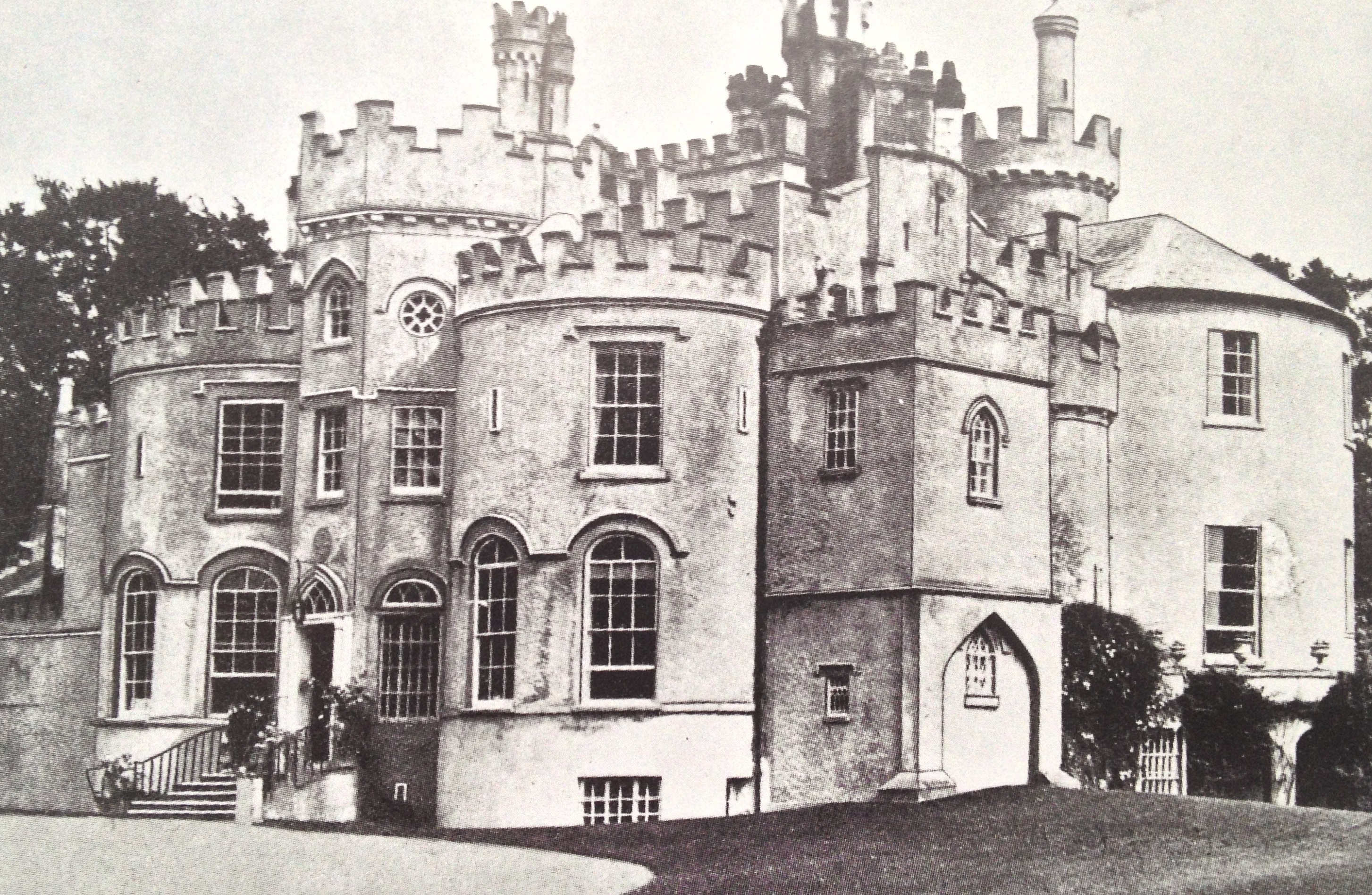
An old photograph of Shanganagh Castle, County Dublin showing the house when all its external decoration was still intact (some has since been removed/lost). Although there have been buildings of that name on the site since the early 15th century, the core of the present structure dates from c.1760 when a plain classical residence was constructed. At the start of the 19th century the property was bought by Major-General Sir George Cockburn who in 1805 commissioned Sir Richard Morrison to remodel the house: the addition of what has been accurately described as ‘a profusion of battlements and turrets’ transformed the place into a fantastical toy fort. The interiors were more restrained not least because Cockburn, who was something of an aesthetically-minded career soldier and had acquired a collection of antiquities, sculptures and paintings during his military career, required a top-lit gallery in which these could be displayed.
As with so many Irish houses, the history of Shanganagh in the last century was not a happy one: after serving for some time as a Church of Ireland college of education it was converted into an open prison and remained such until closed ten years ago. Since then the building has suffered from being left vacant, but earlier this month Dún Laoghaire-Rathdown County Council announced it had acquired Shanganagh and immediately surrounding acreage as part of a complex land-exchange programme. Inevitably the property is now in poor condition and so remedial work must be undertaken to make it secure. One awaits further developments, not least whether Shanganagh will be returned to the appearance it presents in this photograph.

From Townhouse to Tenement – and Back

IMG_6641

In recent weeks a succession of events in Dublin have commemorated the centenary of the Lock-Out, an occasion when many of the city’s larger employers, determined their workforce should not become trade-unionised, denied access to factories, yards and docks to anyone suspected of involvement in the movement for labourers’ rights. One of the consequences of this remembrance has been to recall how many Dubliners of the period lived in extreme poverty, occupying houses which had been built for the wealthiest members of 18th century Irish society but were subsequently divided into tenement dwellings in which entire families would rent a single room. It is worth pointing out, incidentally, that the owners of these properties were not absentee landlords but, as is made plain in James Plunkett’s 1969 novel Strumpet City (which deals with the 1913 Lock-Out), members of the indigenous Catholic haute bourgeoisie.
The area north of the river Liffey was especially given over to tenement housing, a far cry from the circumstances in which these buildings had first been erected. Such was the case, for example, on Henrietta Street, originally laid out in 1729-30 by the period’s most visionary developer, Luke Gardiner whose descendants would subsequently become Earls of Blessington. Gardiner’s ambitions are reflected in the size of the Henrietta Street houses, some of which are four- or five-bay wide, making them considerably larger than other terraced properties of the time. As befitted such splendid residences initially Henrietta Street was occupied by some of the wealthiest aristocratic families in the country; early occupants included the Earl of Bessborough, Viscount Mountjoy and Lord Farnham; a 1792 city directory lists one Archbishop, two Bishops, four peers and four MPs as living there.

IMG_6636

IMG_6594

IMG_6599

Together with its immediate neighbour to the north, No. 12 Henrietta Stree is among the earliest extant terraced houses in Dublin and dates from 1730-1733 when both were erected by Luke Gardiner with the intention of being either rented or sold. A surviving drawing for a stone-cut doorway by Sir Edward Lovett Pearce suggests that this pre-eminent architect had a hand in the design of the houses, although both have been so much altered since their original construction that only fragmentary evidence survives of their appearance when newly-built. In the case of No. 12, some of the greatest structural modifications occurred from 1780 onwards when Richard Boyle, second Earl of Shannon, decided to join the pair of buildings in order to create one vast town residence for himself.
A descendant of the original Richard Boyle, the early 17th century Great Earl of Cork, Lord Shannon inherited considerable wealth and political influence from his father Henry Boyle who for a long time served as both Chancellor of the Irish Exchequer and Speaker of the Irish House of Commons. Seemingly described by Sir Robert Walpole as ‘king of the Irish House of Commons’ he eventually relinquished his seat there in 1756 when he accepted a peerage and became Earl of Shannon. Although his son never played as significant a role in the affairs of the country, even so he became known as ‘the Colossus of Castlemartyr’ (the name of his country seat in County Cork) due to the power he wielded by controlling so many electoral boroughs. If only for this reason, he needed to have a residence close to the centre of power in Dublin and thus settled on linking the two houses on Henrietta Street.

IMG_6583

IMG_6589

IMG_6592

Among the most significant changes made to No. 12 Henrietta Street after its acquisition by Lord Shannon was the removal of its main staircase and, on the first floor, the instatement of windows very much longer than their predecessors which, as was the fashion earlier in the century, had only dropped to dado level. Some of the wooden window and door frames appear to have been recycyled on the floor above, where they remain to this day. The piano nobile rooms were also re-decorated during this time with simple neo-classical plasterwork cornices designed by Dublin stuccodore Charles Thorp. What most impresses a visitor today are the height and volume of these spaces, and the purity of light with which they are suffused.
The Earl of Shannon remained in residence until his death in 1807 after which the two buildings were once more divided. From 1821 No.12 was occupied by Captain George Bryan of Jenkinstown Park, County Kilkenny, known as the richest commoner in Ireland – although he suffered a dent in his wealth through the long and ultimately unsuccessful legal claim he made to a dormant Irish peerage. Presumably it was during his time that the present staircase was installed in the rear hall; its antecedent had been located immediately inside the front door as remains the case next door. Until the close of the 20th century, Captain Bryan was the house’s last owner-occupier since it next became offices for a solicitor and a Proctor before passing into the possession of the British War Office which from 1861 onwards used the premises as headquarters of the City of Dublin Artillery Militia. After which it went into precipitous decline and sunk into an open-door tenement building, remaining such until rescued in 1985.

IMG_6602

IMG_6560

IMG_6563

When No. 12 Henrietta Street came into the hands of its latest owner – who has since invested it in a legal entity called The Irish Land Trust – he had to undertake an enormous amount of work to secure the house. At the time of his acquisition there was extensive dry rot, deteriorating timbers, roof valley decay and many other daunting structural problems. All of these have since been resolved and the property can now look forward to a secure future. Some internal decoration has also been undertaken, not least the removal of internal partitions which had been fitted in order to accommodate more tenants. The original chimneypieces had long since been taken out and sold, as had all intercommunicating doors but the latter have since been replaced. Fortunately, buried beneath successive layers of linoleum, the original wood floors had survived, as had the window shutters.
Despite its great size, the house does not hold very many rooms: just two on the ground floor and three on each of those above. Limited financial resources means the interior has been lightly decorated, and in some places, such as the smallest of the first-floor rooms, evidence of the house’s use as a tenement has been retained: look at the way successive layers of paint were applied to walls only as high as could be reached by the inhabitants. One advantage of this light touch is that the building’s remarkable architectural qualities can be appreciated without the distraction of furniture and pictures. In particular the main reception rooms come into their own when lit at night by candles alone. On such an occasion it is possible to imagine the house as it must have looked more than 200 years ago when the Lord Shannon was in residence and entertaining his political cronies.

IMG_6566

During the forthcoming Open House Weekend (October 4th-6th) No. 12 Henrietta Street will be the location for an exhibition of contemporary artworks, which will launch a new venture called @TheDrawingRoom designed to develop public awareness of architecture, culture and heritage through a series of events in some of Dublin’s finest Georgian houses. For more information, see: http://www.thedrawingroom.info

September 2013

IMG_6547

September 1913
William Butler Yeats

What need you, being come to sense,
But fumble in a greasy till
And add the ha’pence to the pence
And prayer to shivering prayer, until
You have dried the marrow from the bone;
For men were born to pray and save?,
Romantic Ireland’s dead and gone,

It’s with O’Leary in the grave.
Yet they were of a different kind,
The names that stilled your childish play,
They have gone about the world like wind,
But little time had they to pray
For whom the hangman’s rope was spun,
And what, God help us, could they save?
Romantic Ireland’s dead and gone,
It’s with O’Leary in the grave.

Was it for this the wild geese spread
The grey wing upon every tide;
For this that all that blood was shed,
For this Edward Fitzgerald died,
And Robert Emmet and Wolfe Tone,
All that delirium of the brave?
Romantic Ireland’s dead and gone,
It’s with O’Leary in the grave.

Yet could we turn the years again,
And call those exiles as they were
In all their loneliness and pain,
You’d cry ‘Some woman’s yellow hair
Has maddened every mother’s son’:
They weighed so lightly what they gave.
But let them be, they’re dead and gone,
They’re with O’Leary in the grave.

Inspired by Dublin Corporation’s refusal to provide financial assistance to Sir Hugh Lane for the building of a modern art gallery in the city, Yeats’ poem was published in The Irish Times 100 years ago today. The picture above shows one of the designs prepared by Edwin Lutyens for the projected gallery, not that of a bridge spanning the river Liffey but more conventionally sitting within the western railings of St Stephen’s Green.
You can discover more about the events behind the writing of September 1913 by watching: http://www.youtube.com/watch?v=62C1sbgKVk4

A Whiter Shade of Pale

IMG_6315

It cannot be claimed that in the 17th and 18th centuries, Ireland’s senior Anglican clergy devoted themselves exclusively to matters religious. Indeed, they were often more preoccupied with politics and the acquisition of material goods than with spirituality, but in at least some instances we are today all the beneficiaries of their activities in these fields. The man who might be said to have set the tone for what followed in the Church of Ireland was Adam Loftus. Born in Yorkshire in 1533, apparently while still an undergraduate at Trinity College, Cambridge he met and impressed Queen Elizabeth and thereafter enjoyed her patronage. Embracing Protestantism, he began to climb through the ranks of the Anglican Church but only really achieved power after serving as chaplain to Thomas Radclyffe, Earl of Sussex following the latter’s appointment as Lord-Lieutenant of Ireland in 1559. By 1561 Loftus was chaplain to the Bishop of Kildare and the same year was appointed to his first living. Thereafter his rise was rapid: in 1563 he was consecrated Archbishop of Armagh at the age of only 28, swapping this four years later for the Archbishopric of Dublin. In 1581 he was appointed Lord Chancellor of Ireland and then strove to ensure that the country’s first university would be located on a site of his choosing: in 1593 he became the first Provost of Trinity College, Dublin, named after his old alma mater. Meanwhile in addition to building up his political as well as ecclesiastical authority, he was acquiring land so as to leave something for his heirs: he and his wife had twenty children, of whom eight died in infancy.

IMG_6219

IMG_6279

IMG_6218

One of the parcels of land which came into Loftus’s possession was located at Rathfarnham at the foothills of the Dublin mountains, confiscated from James Eustace, 3rd Viscount Baltinglass after he had rebelled against the crown. A castle of some kind existed on the site but soon after Loftus was granted Rathfarnham in 1583 at a nominal rent of thirty shillings he began work on a new residence, which remains to the present day. Although the interiors were said to have been luxurious, the castle’s external appearance was very much defensive being rectangular in shape with four massive corner flanking towers to allow guards watch for any approach to the building. Four storeys high,its walls are on average some five feet thick and running east-west through the centre of the entire castle is another wall almost ten feet thick: this seems solid but it is now proposed that in fact the wall actually held a series of chambers or corridors from which access was gained to rooms on either side. Nevertheless, Loftus was right to construct such a solid building since its location left Rathfarnham vulnerable to attack from the Wicklow clans. Five years before his death in 1605 it withstood assault from this source, and did so again during the 1641 rebellion before passing back and forth between different sides in the Irish Confederate Wars. It was only towards the late 1650s that the Loftus family was able to regain control of the place.

IMG_6184

IMG_6216

IMG_6172

In the early 18th century Rathfarnham passed to Philip Wharton, who at the age of 19 was created first (and last) Duke of Wharton by George I; Wharton’s mother had been Lucy Loftus, only child of Adam Loftus, Viscount Lisburne. Wharton seems to have been a hopelessly character. His father Thomas Wharton although notoriously dissipated was at least politically astute and one of the leaders of the opposition to James II. Philip Wharton on the other hand, despite having every advantage, set out on a course of ruination that saw him end his days a hopeless drunk in a Spanish monastery, dead at the age of 32. In 1723 indebtedness caused by over-investment in the South Sea Bubble obliged him to sell his Irish estates including Rathfarnham which was bought by William Conolly, Speaker of the Irish House of Commons. He paid £62,000 for house and lands but never lived there, presumably because he had already begun work on his own house at Castletown, County Kildare (see Up Pompeii, June 17th). Instead the castle was let to various tenants who began to refurbish it before the whole place was sold in 1742 to another Anglican cleric, John Hoadly who had just been made Archbishop of Armagh. On his death Rathfarnham passed to Hoadly’s son-in-law Bellingham Boyle but like Philip Wharton he also suffered from chronic indebtedness and so in 1767 Rathfarnham was sold to Nicholas Hume-Loftus, second Earl of Ely, a descendant of the castle’s original builder. On his death without children it was inherited by his uncle Henry Loftus who also had no issue (compared to their forebear with his twenty offspring, these later Loftuses proved to be an unfecund set) and so Rathfarnham was inherited by a nephew Charles Tottenham who in 1800 would become first Marquess of Ely.

IMG_6179

IMG_6178

IMG_6248

The Elys, who owned several estates, spent little time at Rathfarnham which at some date before 1852 was sold to Francis Blackburne, then Lord Chancellor of Ireland; he and his descendants lived there until 1913 when the place was bought by the Jesuit Order who used it as a seminary and added two long wings on the north- and south-east sides of the main building (they also seem to have taken out the main staircase which is a great shame). The Jesuits in turn put the place up for sale in the mid-1980s when it was bought by a firm of property developers. As the area by this date had become a suburb of Dublin and much of the immediately surrounding land was given over to housing estates, there were concerns that the castle itself would be left to fall into ruin or pulled down. In 1987 the Irish State acquired the building and immediate acreage and under the auspices of the Office of Public Works has been engaged in a process of restoration and refurbishment ever since (see http://www.heritageireland.ie/en/Dublin/RathfarnhamCastle).
There is a great deal more one could write about Rathfarnham Castle, and perhaps might on another occasion. For the present, the accompanying photographs will give an idea of a notable feature of the building which attracts relatively little notice: its fine plasterwork. Throughout the 18th century a succession of different owners and occupiers did much to improve and update the building, and its interiors reflect changes in taste over that period. Different rooms are decorated in different styles, so that the whole castle becomes a history of fashion in stuccowork, ranging from the lightest rococo to severe neo-classicism (both Sir William Chambers and James ‘Athenian’ Stuart had a hand in the design of some of the interiors). All of it is of high quality and serves as an example of the level of Irish craftsmanship – and the ability to adapt to an evolving clientele – throughout the period. It is a pity more is not made of this aspect of the building since Rathfarnham Castle’s diverse decoration gives it a unique character and deserves to be celebrated. Hence the decision to feature only details of the house’s plasterwork today.

IMG_6198

Next Saturday morning, I shall be speaking about Adam Loftus, as well as many of his successors, in the course of a talk entitled ‘Building Bishops: Architectural Ambitions among 18th Century Irish Clergy’ at the Roe Valley Arts and Cultural Centre in Limavady, County Derry as part of a three-day conference devoted to Frederick Hervey, the great Earl-Bishop of Derry. For more information about this event, see: http://www.herveysummerschool.com/

Written in the Stars

IMG_1973

A detail of the frieze that runs around the hemispherical ceiling of what was originally Lord Charlemont’s study in the Casino at Marino in Dublin (see Casino Royale, March 25th). Located in the eastern arm of the Greek Cross building, this is known as the Zodiac Room since, as can be seen, the frieze is decorated with astrological signs. It has been proposed that originally the ceiling was painted to represent the northern firmament but today only the plasterwork remains.

A Woman of Substance

sybil-connolly11

Venturing outside the Irish Aesthete’s customary sphere, today we consider the career of Irish couturier Sybil Connolly who sixty years ago this month came to international prominence following a fashion show in County Meath. ‘Ireland,’ wrote former American Vogue editor Bettina Ballard in her 1960 memoir In My Fashion, ‘was a completely unexpected centre for fashion for everyone but Carmel Snow. We were drawn en-masse to Dublin by the personable, milk-skinned Irish charmer called Sybil Connolly who showed a small collection made of Irish tweeds and linens in Dunsany Castle and bewitched us all into buying models or filling our editorial pages with them.’
It comes as no surprise that the incomparable Carmel Snow, outstanding editor of Harper’s Bazaar for over a quarter century, should have championed Sybil since she too was Irish, having been born in Dalkey, County Dublin in 1887 (for more about Snow’s life and work I recommend Penelope Rowlands’ 2005 biography A Dash of Daring). Presumably she and the designer had met when the latter first visited New York in 1952 and thereafter they remained friends. Certainly Snow was responsible for ensuring a large group of American buyers and journalists, en route to Paris for the couture shows, stopped off in Ireland to see the work of a rising Irish star.

000008

000015a

After Sybil Connolly’s July 1953 fashion show, Carmel Snow wrote enthusiastically in her syndicated column of what she and the others present had been shown: ‘Miss Connolly is lovely, with jet black, curling hair and amazingly grey eyes. She came to America last spring and went back to Dublin with many orders. Today she has her foot firmly planted on the ladder of international success – a success that gives one a glow.’ As for the clothes, Snow attributed their appeal to a number of factors: ‘Her integrity in using exclusively Irish materials and using them with strict relevance to native needs; her imaginative adaptation of traditional Connemara garments for contemporary use; her colossal capacity for hard work; her respect for native craftsmanship and the age-old independence of weaver and dyer, and a parallel determination to guide and suggest where she is far too intelligent to demand.’
Throughout her career Sybil was fortunate to have women of influence and authority offering their support in this way. For example, the most powerful woman in American public relations Eleanor Lambert was a close friend for decades (indeed, it was through Sybil that I came to know Eleanor and to sit on the adjudicating panel for her International Best Dressed List – but all that is perhaps for another occasion). Then there were the well-connected women who helped by buying the clothes and promoting her name, not least Sheila, Lady Dunsany who offered the use of beautiful Dunsany Castle for that show in July 1953. (I remember Sheila Dunsany’s wry amusement as she told me some months before her death in July 1999 that Sybil, whose Welsh mother’s maiden name was Phillips, liked to claim an affinity since this was also Sheila’s family name). Then look at the pictures above and note that in the first of these the models photographed by Norman Parkinson for Vogue in July 1954 are Ladies Melissa and Caroline Wyndham-Quin, daughters of the sixth Earl of Dunraven, while that below, taken by Henry Clarke, shows one-time model Anne Gunning who by this date was married to English politician Sir Anthony Nutting.

000018

000016

000001

Sybil Connolly’s signature design was a dress made from pleated handkerchief linen. She used to say that she first discovered this featherweight fabric in a Northern Irish factory where it had been manufactured many years earlier for the crowned heads of Europe, but after the First World War ‘there weren’t enough of them left around.’ Sybil had the linen tightly pleated to produce lengths which were thed used to make clothes. Nine yards of linen were required to produce one yard of finished pleated material. The first garment made in this way to be shown in the United States, a white evening dress called First Love, required three hundred handkerchiefs and contained more than five thousand pleats (see bottom picture which shows Sybil wearing the item).
The great merit of her pleated linen was that it was uncrushable – and virtually indestructible. I recently came across one of her dresses in a box in Birr Castle; it had been made for the late Anne Rosse. Although not worn for decades after a quick shake the dress fell into place and looked much as it must have done when first produced. Harper’s Bazaar noted in June 1958 that a Connolly pleated linen skirt ‘will pack into a small duffle bag and emerge unscathed.’ Sybil’s pleated linen is as remarkable a contribution to fashion history as was Mariano Fortuny’s Delphos pleated silk dress half a century earlier and will similarly be forever associated with the name of one designer.

000006

000014

As can be seen by the two pictures immediately above, Sybil did not only use pleated linen, but also worked with other fabrics, the majority of them associated with Ireland. So, for example, she bought bales of red flannel traditionally used for petticoats in Connemara and had the material made into quilted skirts which were then teamed with white cambric blouses and black shawls to create an early version of peasant chic. She was not above using seemingly mundane material: a dress called Kitchen Fugue from her summer 1954 collection, for example, had a full skirt made from lengths of striped tea towels. But her clothes more often featured the likes of hand-dyed tweed and hand-made Carrickmacross lace and crochet.
In her heyday – the second half of the 1950s and early 1960s, Sybil Connolly was internationally renowned and enjoyed huge success, especially in the United States where her clientele included members of the du Pont, Mellon and Rockefeller families as well as the likes of Elizabeth Taylor, Rosalind Russell and Merle Oberon. Jacqueline Kennedy’s official portrait for the White House (painted by Aaron Shikler) shows the former First Lady wearing one of Sybil’s outfits. Although she lived until May 1998 and always kept herself busy through such projects as designing fabrics for Brunschwig & Fils and china for Tiffany, already by 1970 her moment as a fashion leader had come to an end. Still, it is worth remembering just what a pioneer she was for Irish design and how, thanks to a show staged sixty years ago, she turned the global fashion spotlight on this country.

000013

To commemorate the sixtieth anniversary of her July 1953 fashion show, I shall be giving a talk on Sybil Connolly at the Little Museum of Dublin next Wednesday 24th July at 7pm. For further information, see http://www.littlemuseum.ie

Lane’s Lore

Hugh Lane pencil portrait 1905

Art dealer and collector Sir Hugh Lane drawn by the artist John Butler Yeats in August 1905. At the time, Yeats was engaged in producing a series of portraits of notable Irish men and women, a commission he received from Lane who intended these works to form the core of a National Portrait Gallery for Ireland. Within three years he had instead established a modern art gallery in Dublin which continues to this day. To learn more about Lane, and about the controversy over a collection of Impressionist paintings after his unexpected death in 1915, you can now watch two short films featuring the Irish Aesthete: