A Unique Legacy

IMG_1744
Few houses better exemplify the maxim of initial appearances being deceptive than Headfort, County Meath. An immense, austere block – the limestone facade including wings runs to more than five hundred feet – in 1789 it was described by then-Lord Lieutenant the Duke of Rutland as ‘a long range of tasteless building’ and three years later George Hardinge said it was ‘more like a college or an infirmary’ than a private residence. Headfort was built for the descendants of Thomas Taylor who came to Ireland in the middle of the 17th century in the company of his school contemporary Sir William Petty. By 1660 Taylor had secured 21,000 acres of land in Cavan and Meath, and settled outside Kells. No trace remains of the original house constructed by the family, but from the middle of the 18th century onwards plans were under way to build a new country seat suitable for their advancement in the Irish peerage: already a baronet, the third Sir Thomas Taylor, who inherited the estate in 1757, would be created Baron Headfort in 1760, Viscount Headfort two years later and Earl of Bective in 1766. His son, in turn, would become first Marquess of Headfort in 1800.

IMG_1775
IMG_1908
IMG_1897
The first architect consulted about designs for a new house was Richard Castle, a favourite for such commissions among Irish landowners during the period. However in this instance his proposals of 1750 failed to win the approval of the second Taylor baronet; an extant portfolio is marked: ‘Mr Castle’s plan and a damn bad one.’ John Ensor and another anonymous architect also drew up proposals for a similarly Palladian-style building but these too were spurned. The Taylors were not as wealthy as some of their contemporaries and funds to spend on the building were limited. Presumably this is why although still more designs were commissioned in 1765 from fashionable neo-classical architect William Chambers those were similarly rejected. In any case, by that date work had already started on a sober, and accordingly economical scheme which, on the basis of a 1760 plan inscribed GS, is attributed to George Semple, a Dublin-based builder and self-taught architect. Whoever was responsible, the house’s exterior would not have required much architectural skill in its composition. Of three storeys and 11 bays, the near-identical front and rear elevations of grey Ardbraccan limestone are largely unrelieved other than by pedimented doorcases.

FullSizeRender
IMG_1778
IMG_1837
But if the house’s exterior lacks ornament, its interior was intended to present a different image. Between 1771 and 1775, Lord Bective requested Scottish-born architect Robert Adam to produce decorative schemes for a suite of rooms in the newly completed Headfort. Adam, who never visited this country, duly came up with designs for the entrance and staircase halls, as well for as a series of three adjacent spaces on the garden front culminating in a double-height saloon that was known as the ‘Eating Parlor.’ Even if not all his proposals were fully implemented, the interiors are of immense importance as the only extant examples of Adam’s work in Ireland. Once more due to shortage of funds, a simplified version of the suggested decoration was executed in the entrance and staircase halls. But the architect’s original drawings survive and indicate that other elements of the scheme were carried through, not least in the Eating Parlor, where the only major modification saw the architect’s recommended barrel-vaulted ceiling instead being coved. Created by reconfiguring the house’s layout to merge two rooms on both ground and first floors, the Eating Parlor is lit by a line of tall windows between which stand the original marble-topped console tables and pier glasses. Facing these are a pair of carved white marble chimneypieces with circular overmantles holding classical compositions by the Italian artist Antonio Zucchi, who worked with Adam on a number of other occasions; further Zucchi work is found elsewhere in the room, including a ceiling centrepiece. The rest of the walls are covered with panels intended to contain Taylour family portraits, and a number of matching doorcases. The adjacent, somewhat smaller, saloon is similarly decorated but the third room in the suite, the Chinese Drawing Room, has since lost the landscape wallpaper from which derived its name.

IMG_1710
IMG_1754
IMG_1726
Inevitably with the passage of time, the fabric of Headfort began to deteriorate; problems of damp coming into the building were a particular problem. It didn’t help that since 1949 the house has served as a preparatory school, with inevitable wear and tear on its fabric. Due to the significance of the Adam interiors, in 2004 the World Monuments Fund placed the house on its list of 100 Most Endangered Sites. Thereafter the Headfort Trust, thanks to funding from the WMF, Ireland’s Heritage Council and relevant state departments, initiated a programme of essential work including repairs to the roof, chimney stacks and gutter piping. Internally the trust embarked on a conservation and research project that revealed the original Adam decorative scheme. Nowhere was this more the case than in the Eating Parlor which underwent complete refurbishment thanks to aid from the Irish Georgian Society which in 2008 made the room the beneficiary of its 50th anniversary fundraising efforts. For a long time the Eating Parlor had been painted a shade of blue more usually found in hospital wards. However analysis of the walls revealed they had first been decorated using a variety of mid- to dark shades of verdigris, a scheme which tallied with the Adam drawings. The same colours were also used in the staircase hall, while those of the Saloon are softer, with an abundance there of pink and pale blue. When initially finished, and furnished, the effect must have been quite startling and highly novel, and even today, depleted of their contents and put to alternative use, these rooms can still confound the popular notion of how a chaste neo-classical interior should look. Today, when no other examples of Adam’s work can be seen on this island, it is a unique legacy.

IMG_1763

From the Same Hand

IMG_2866
Two County Kildare mid-18th century houses, located less than four miles apart and linked by marriage not long after both were constructed. It is therefore no wonder that they share certain characteristics, not least in the matter of decoration. The elaborate cornice above is found in the drawing room of one house, that below in the dining room of the other. But they clearly come from the same hand and show the inspiration, if not necessarily the involvement, of Robert West who was producing work of this kind during the 1750s/60s.

IMG_2878

Hilton Hospitality

FullSizeRender 2
A thesis waits to be written on the links between country house construction in Ireland and the history of the national economy.* There have been waves of building here and these were often aligned with agricultural prices: the better the annual return, the more likely houses would be erected, reconstructed or enlarged. Contrarily in lean times the amount of such work tailed off. In its present incarnation Hilton Park, County Monaghan exemplifies this phenomenon, since the house was last overhauled in the early 1870s, sufficiently after the Great Famine for the country’s agriculture to have recovered and not long before the onset of the following decade’s Land Wars which, coupled with the arrival of cheap grain and meat from the other side of the Atlantic, saw land values, and therefore estate owners’ incomes, precipitously decline towards the end of the 19th century. The land on which the house stands was purchased in 1734 by the Rev. Samuel Madden, the origins of whose family appear to lie in descent from a branch of the ancient O Madaidhin or O’Madden clan. A forebear is believed to have fled the tribal lands and become based in Oxfordshire in the 15th century where the phonetics of his name suggested O’Mudgeoin, which to English ears sounded like Mudwyn. The first proven ancestor is John Mudwyn, one of whose sons Thomas Mudwyn settled in this country and changed his name to Madden (as did his brother Robert in England)  Thomas served as Comptroller of the Household to Sir Thomas Wentworth, later first Earl of Strafford during his time as Lord Lieutenant of Ireland, and the Rev Samuel Madden was his great-grandson. This gentleman was commonly known as ‘Premium’ Madden, derived both from a provision in his will providing for premiums for Irish-made goods to the Dublin Society and from having been the founder of the ‘Madden Premium’ in Trinity College, Dublin (first given in 1718). Author of a play Themistocles, the Lover of his Country: a Tragedy (1729), he also wrote a work of speculative, and satiric, fiction called Memoirs of the Twentieth Century (1733). Dedicated to Frederick, Prince of Wales, to whom Madden had been tutor, the book was suppressed Prime Minister Sir Robert Walpole a fortnight after its publication. More influential was Madden’s Reflections and Resolutions Proper for the Gentlemen of Ireland which appeared in 1731 and embodied many of the aspirations behind the formation of the Dublin (later the Royal Dublin) Society which his brother, the Rev John Madden, co-founded the same year. No wonder Dr Johnson declared ‘His was a name which Ireland ought to honour.’

IMG_2165
IMG_1962
IMG_4109
FullSizeRender 3
As mentioned above, in 1734 Samuel Madden bought some 4,000 acres of what subsequently became the Hilton estate. This had been land originally owned by the MacMahons but acquired through purchase in the 17th century first by Sir William Temple, Provost of Trinity College Dublin and then after his death by the Forth family. It was sold by them to Samuel Madden who bought it for his third son, John Madden. He married Anne Cope of Loughgall in 1752 and planted the oak wood on the estate which is called Cope’s Wood, which indicates they were then living a house dating from early 17th century, almost certainly built by either Sir William Temple or the Forths. The townland on which the property stands was called Killshanless but the estate was now named Maddenton and here a house was erected in the 1770s or 1780s, perhaps incorporating elements of the earlier building, of seven bays and two storeys with tall brick chimney stacks. It survived until 1803 when the greater part of it was accidentally destroyed by fire; tradition has it that the conflagration began after a servant set down a bucket of hot coals on the floor but it may be that during those troubled times the house was attacked and ransacked before being set alight. Whatever the cause, the disaster was compounded by the fact that then-owner Colonel Samuel Madden of the Monaghan Militia was a ne’er-do-well gambler who ran through the family money and had to face his creditors two years before he died in 1814. The estate itself was only preserved thanks to the prudence of the Colonel’s father-in-law, the Rev Charles Dudley Ryder who kept the greater part of his own fortune to pass on to his grandson. But in the immediate aftermath of the fire, the family moved into what had been the servants’ quarters in the upper stableyard. Rebuilding may have begun around 1815 when Ryder died, or not until the early 1830s, with the focus being on the rooms at the south side of the house which looked down to the lake: the dining room and a bedroom immediately above retain their decoration from this period. The finished house, the design of which is assigned to James Jones of Dundalk and the appearance of which can still be seen in old family photographs, had a long eastern facade of two storeys over basement and eleven bays. The centre five of these projected slightly, a flight of stone steps leading to the rather meanly proportioned entrance door. All this work and more (a new nursery wing to the north) was undertaken by Colonel John Madden of the Monaghan Militia who was able to benefit from his wise maternal grandfather’s inheritance and was as industrious as some of his forebears: he became a noted breeder of Shorthorn cattle and hackney horses, and built the Ride, a colonnade for exercising horses on wet days under his study window. A keen sailor and member of the Royal Yacht Squadron, he won a race around Ireland and sailed to the Mediterranean, bringing back from Naples a chimney piece now found in the drawing room. He also built a villa at Sandycove, Dublin and it was there he died in 1844. (He is also shown in third place in his yacht Ganymede in the inaugural races held in 1828 at Kingstown, now Dun Laoghaire, in a well-known print of the event held in honour of then-Lord Lieutenant Henry Paget, first Marquess of Anglesey.)


IMG_2043
IMG_2046
IMG_2055
IMG_2051
Colonel Madden’s heir, another John, was not yet eight when his father died and was duly made a Ward of Court. Throughout his life John Madden held strong views not always shared by others of his class and background. As a young man he joined Isaac Butt’s Home Rule Party but failed to get elected in any of the elections he fought. In addition, in 1869 he was dismissed as a Deputy Lieutenant and Justice of the Peace for County Monaghan owing to letters he had written to the Secretary of State and for using ‘language of studied insult to the government of the Queen’. (The Countess of Dartrey who lived elsewhere in the county described him at the time as ‘a semi-madman, who stood as a Tory Home Ruler for Monaghan in 1868, and wrote such outrageous letters that he was struck off the list of JPs.’)
More interestingly from our perspective, this John Madden carried out a sequence of improvements and allterations on his estate, beginning at age 19 with the sinking of a 135-foot well ‘under my own engineering superintendence as I had studied mining’ from which Hilton still draws its water: two years later he erected a bell tower of some 70 feet. In the aftermath of his abortive political ambitions, he engaged the gardener and landscape architect Ninian Niven, former curator of the National Botanic Gardens, to remodel Hilton’s parkland and lay out the Parterre formed by excavating the ground around the house’s basement. Soon afterwards Madden embarked on a transformation of the house, initially consulting Sir Charles Lanyon but eventually settling for William Hague who today is primarily known for his work on public buildings, in particular Roman Catholic churches (he designed or altered between forty and fifty across the country). Cost may have been a factor in his selection, but also the fact that Hague was more likely to take direction from his client than would the established Lanyon. Hague’s intervention is immediately apparent on the exterior of the building, around which the ground was excavated some eight feet to create a new ground floor in what had hitherto been the basement. Access to the house was no longer gained at the top of a flight of steps, so to ensure protection against the era’s growing agrarian unrest a steel front door and shutters were installed. Meanwhile the facade, now fronted in sandstone and with a rusticated ground floor, was given a vast porte cochêre with a line of Italianate Ionic columns and pilasters beneath a pediment carrying the Madden coat of arms carved in Portland stone. The first floor pedimented windows have the long proportions of the late Georgian period but plate glass of the Victorian, while those above retain their sashes. Around the corner on the south side plans were drawn up for a central pavilion with an octagonal drawing room and matching wings but these were not carried out, a blessing according to the late Jeremy Williams since the outcome ‘would have given the house the semblance of a vast hotel to overwhelm the lake below.’

FullSizeRender 4
IMG_2124 IMG_2108
IMG_2126
Internally, Hilton Park looks much as it did when Madden and Hague had finished their work on the building around 1878. The front door gives access to a hall with encaustic tiles and barrel vaulted ceiling: on either side a former coachman’s and housekeeper’s room became a study and smoking room respectively. Double doors open to the stair hall in carved oak which climbs to the first floor reception rooms (the oak was worked by John Armstrong, estate carpenter at Parkanaur, County Tyrone, seat of John Madden’s kin the Burges family, who was loaned for the purpose). On the upper section of the west wall are a pair of heraldic stained glass windows made by Mayer & Co of London: between them is a niche holding a bust of ‘Premium’ Madden. At the top of the stairs a door to the immediate left opens into what had been a vast double drawing room: for reasons of practicality (and heat conservation) this was divided in two in the last century when the central timber archway was filled in. The northern section has a heavily carved Victorian chimney piece, the southern contains that brought back from Naples by the earlier John Madden. A boudoir to the north completes this run of reception rooms, ample enough to host a ball. Meanwhile at the centre of the south side of the house is the dining room which did not undergo refurbishment in the 1870s and therefore remains as designed by Jones forty years earlier; vaguely gothic in intent, it has sprung vaulting featuring oaks and ropes initiated from foliate corbels in each corner, but a classical black marble chimney piece (the rope motif was said to be in honour of Horatio Nelson with whom Colonel John Madden’s father-in-law Admiral William Wolseley was friendly and had sailed). Also still retaining their original décor are the bedrooms above, the walls of one still covered in a pretty blue floral paper hung in the 1830s. Although much has changed in the intervening period, Hilton Park still remains in the hands of the Madden, the ninth generation now responsible for its future. Open to the public for weddings, weekend guests and houseparties (see hiltonpark.ie) it wonderfully exudes much of its original atmosphere, although one suspects that were earlier occupants to return they would be amazed by how much warmer and more comfortable is the house than used to be the case (and how much better the cooking today than it traditionally was in such places). All being well, the Maddens will continue to reside there offering Hilton hospitality for at least another nine generations.

IMG_4123
*Of course if anyone knows of such a thesis, please let me know.

Seen in the Round

IMG_1499

On January 1st 1778 John Dawson, Viscount Carlow married Lady Caroline Stuart, daughter of the third Earl of Bute. Shortly before this occasion, Mrs Delany wrote of her as follows: ‘Lady Caroline is a genius in painting and musick, and has made a great progress in both; she has a clear, sweet voice, under good management, and less of the fashionable yell than most of her contemporarys. She is extremely good-humoured and sensible, but is one in whom many pleasing accomplishments are a little hurt by an awkward habit: she has no affectation, but a trick of a laugh at whatever is said or that she says herself.’ Fortunately we know a great deal more about Lady Caroline than this somewhat ambivalent description, as she was an ardent letter writer, especially to her youngest and favourite sibling, Lady Louisa Stuart. Their correspondence survives and was published in 1895 as Gleanings from an Old Portfolio. From her letters we learn that Lady Caroline was not altogether happy living in Ireland, separated from her family and old friends. It did not help that the house inherited by her husband failed to meet with her approval. Dawson Court stood on an estate in County Laois which had been acquired by Viscount Carlow’s grandfather, a clever banker called Ephraim Dawson who had married a Preston heiress and built the house for his bride. What might have sufficed at the start of the 18th century was no longer deemed good enough towards its close, and more than once Lady Caroline grumbles about the old building and its disadvantages. In August 1781 she writes, ‘we have had a storm of wind and rain to-day, that I really have been expecting this infirm house to give way, and dreamt of it all night, my fears were so strong… I have no pleasure in the place this summer, for, as nothing has been done in our absence, it is all in the greatest disorder, not a walk in the garden free from weeds, no water in the river, and the weather so bad that, in short, I comfort myself, as Miss Herbert says, with a good fire.’ That December, she complains again about problems caused by high winds: ‘I can hardly find a place to sit in to-day, being turned out of the drawing-room by smoke, and here’s a whirlwind in the library.’ One suspects that it was at least in part to put an end to her protests that around 1790 Lady Caroline’s husband, by now created first Earl of Portarlington, embarked on building a new residence.

IMG_1483
FullSizeRender
IMG_1510
Painted in Rome by Batoni in 1769 while on a Grand Tour, the future first Earl of Portarlington was a man of considerable artistic ability. According to George Hardinge, who visited Ireland in 1792 and 1793, Lord Portarlington ‘draws prettily & is a very ingenious architect… [he]draws in Sandby’s manner and almost as well – many of the views in Sandby’s work – (“The Virtuoso’s Museum”) are taken by the former, who has made a voyage pittoresque of Ireland worthy of immediate publication…’ Almost as great a patron of the arts as Lord Charlemont, Portarlington displayed his discernment by being one of the key supporters of James Gandon who he had met in the home of the aforementioned Paul Sandby and to whom he wrote from Ireland in 1779, ‘I do not see any architect of the least merit here.’ By 1790 Lord Portarlington had already commissioned from Gandon the design of a new church close by his estate at Coolbanagher (see A Very Conspicuous Object, December 28th 2015). Understandably he therefore turned to Gandon again when looking for a design for the proposed new house and so work commenced on what would prove to be the architect’s most important private commission. Evidently Lady Portarlington’s dislike of the old house was so great that the family demolished this building and moved into the new – named Emo Court – even though it was far from finished. And then disaster struck. In the autumn of 1798 her husband joined the army summoned to repel a French invasion in Mayo. In late November he wrote to his wife that ‘in consequence of a cold, I have had the most violent attack on my lungs; which was a dangerous situation for six days past, but I had last night a favourable change; which gives me great hopes of getting thro it…’ He died shortly afterwards and work on Emo Court came to a halt. The second earl initially seemed to promise well but proved a disappointment to the family, an army career stalling in 1815 when he somehow failed to join his company at the Battle of Waterloo until after much of the fighting had taken place: it would appear he had been enjoying himself too much and too late the night before. Thereafter he is generally described as giving himself up to dissipation, and the squandering of family funds, supposedly remarking on one occasion that he could not see what difference another nought would make to his financial obligations. He died in Londin in 1845 unmarried and unmourned, leaving title and estate – complete with unfinished house – to a nephew who also inherited debts running to some £600,000.

IMG_1512
IMG_1480

IMG_1493An account of Emo Court in the middle of the 19th century noted that ‘The principal apartments in the house are a grand reception saloon at the entrance, and a state drawing room, but these rooms, although built nearly sixty years rough bricks and stone still visible.’ Elsewhere could be found scaffolding and tools used on work begun but not concluded by the second earl who in the 1820s had employed the fashionable London architect Lewis Vulliamy and an otherwise little known trio of brothers called Williamson who ran a practice in Dublin. Between them, they had built a portico on the rear facade, decorated the dining room ceiling and designed the interior of the rotunda. It is the last of these that is shown here today, finally completed in around by yet another architect, William Caldbeck who also added that standard of the Victorian country house, a ‘bachelor’ wing. So what of this key space, aside from its basic form, can be attributed to James Gandon? The rotunda, otherwise known as the saloon, lies at a crucial juncture in the house, directly behind the entrance hall and between dining and drawing rooms. Here a series of marble pilasters capped with gilded Corinthian capitals rise to a coffered dome with glazed top. Niches between the pilasters would once have held statues and the floor is inlaid with elaborate parquet. The rotunda was intended to be the central point in an enfilade overlooking the gardens but could it ever have served any purpose, other than as a rather lovely meeting place while passing from one functional area to another? And again, what of its decoration can be considered based on Gandon’s intentions, and what those of the Victorian Caldbeck? It helps to compare the room with other near-contemporaneous examples, most obviously the saloon of Castle Coole, County Fermanagh designed by James Wyatt and dating from the same period. Again the walls are lines with Corinthian pilasters (scagliola) and there are round-topped niches (these holding Wyatt-designed stoves) the upper section of which has plasterwork which might have been Gandon’s aim for the Rotunda. Another, and closer, comparison can be made with Ballyfin, just a few miles away and designed in the early 1820s by the Morrisons, father and son. One suspects that in this instance, the incomplete work at Emo provided inspiration for Ballyfin’s top-lit rotunda (as the former’s library did for that at the latter) although here the walls are lined by Siena scagliola columns with Ionic capitals. So it seems reasonable to conclude that even if not executed by Gandon Emo’s rotunda displays his spirit.

IMG_1495

More on Emo Court in due course. With thanks to the Office of Public Works for permission to photograph the house’s interior.


Getting Ahead

Powerscourt 2
We are fortunate that so much of the interior decoration has survived in Powerscourt House, Dublin designed in the first half of the 1770s by Robert Mack for Richard Wingfield, third Viscount Powerscourt. The interior of the house has rightly been called ‘schizophrenic’ by Christine Casey owing to a rich and eclectic style derived from a number of hands. The stair hall was decorated by James McCullagh assisted by Michael Reynolds and for work here and in a number of other rooms in the building his bill ran to over £730. An exuberant mélange of arabesque scrolls, urns, acanthus leaves, palms and portrait medallions, the stair hall is one of the city’s most madcap pieces of ornamentation. Unfortunately it is also one of the most difficult to examine, being excessively cluttered with signage and retail bric-a-brac…

Powerscourt 3

Attention to Detail

IMG_8390
Viewing an old building, one is often so engaged absorbing the totality that details of design can be overlooked. How many visitors to Ballyvolane, County Cork, for example, pay much attention to the stairs? This house, originally built in 1728 by Sir Richard Pyne, was extensively modified in the second half of the 1840s by a descendant, Jasper Pyne. Evidently a new staircase was one of his additions but note how on the side of every tread is affixed a cast-iron putto in each of whose fists can be found a nail holding one of the balusters in place.

IMG_8405

Occupational Therapy

FullSizeRender
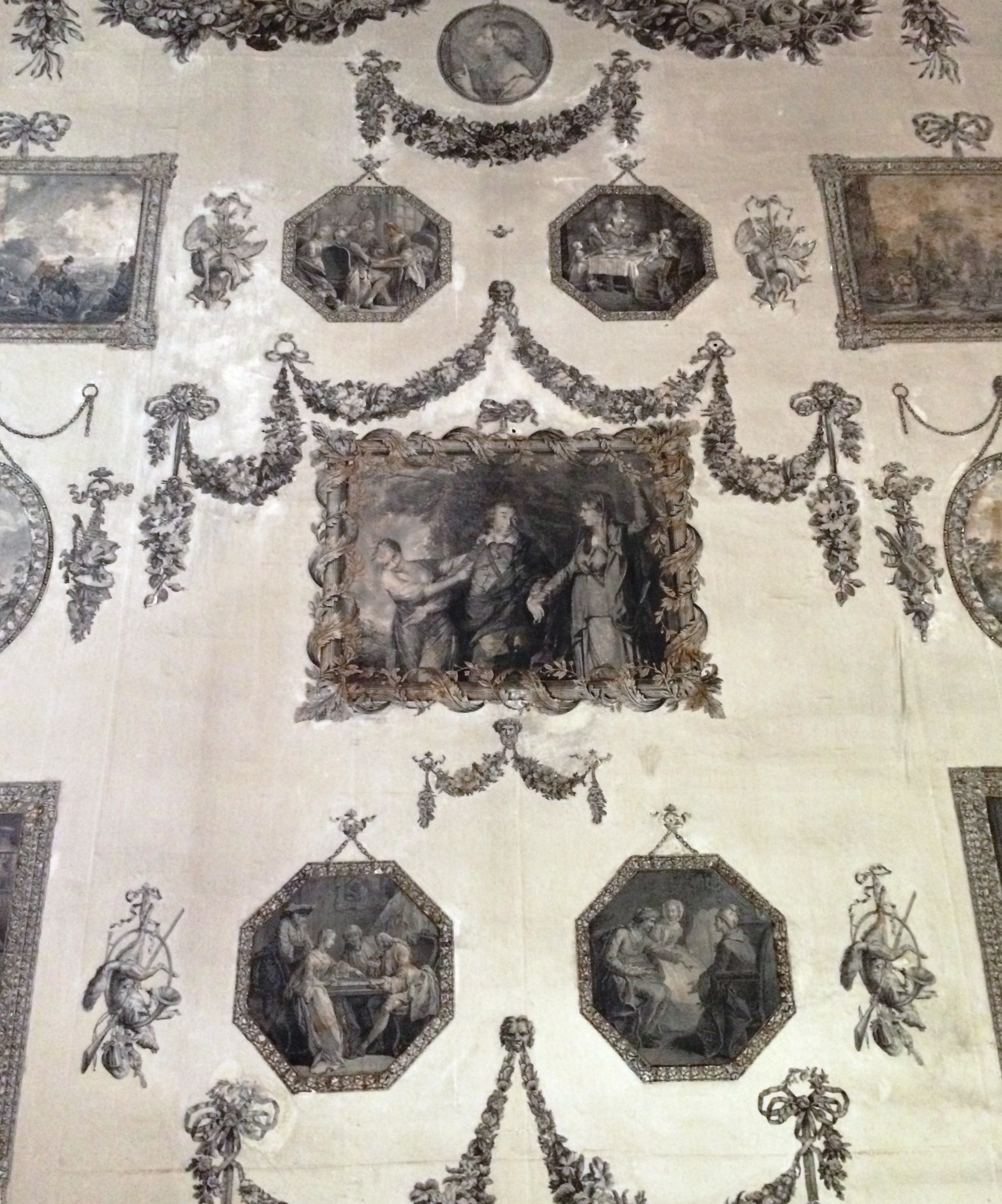
During this post-festive season, when evenings can seem especially long and monotonous, readers might like to consider occupying their time with the creation of a print room. This once-fashionable pursuit, which had its heyday in the second half of the 18th century, subsequently fell out of favour and only one intact example survives in Ireland: that at Castletown, County Kildare. The design and execution of print rooms was customarily left to women, although it evolved from the mostly-male habit of collecting valuable prints and storing these either in a cabinet or within albums. Later on prints might be hung in a chamber designated for the purpose, often kept shrouded in order the work avoided suffering light damage: while cheaper than paintings prints, especially those of larger dimensions could be expensive to produce. However, larger runs of prints in the 18th century, often reproductions of popular works of art, helped to bring down costs and make these pictures accessible to a broader market than had hitherto been the case. Cheaper prices led to greater disposability and the emergence of the print room, a phenomenon effectively unique to Britain and Ireland (although there were some instances of the vogue found in America).

IMG_3175
IMG_3173
IMG_3176
IMG_3179
Located behind the house’s main staircase and part of an enfilade on the ground floor overlooking the garden, Castletown’s Print Room was created in 1768 by Lady Louisa Conolly. She had been collecting pictures for at least the previous six years, and in addition had gained experience through assisting in similar ventures with her sister Emily, Countess of Kildare at nearby Carton and with Lady Clanbrassil at Cypress Grove House, Templeogue, County Dublin. Both these rooms have since been lost. The project was a long time in gestation: in 1762 she wrote to her sister Lady Sarah Bunbury, ‘I always forget to thank you my Dear for the Prints you sent me, I hope you got them of Mrs Regnier, for I have a bill there, the two little ones that you admired so, are the very things I wanted, that of Helen is charming. I have not had time to do my Print room yet.’ It is likely the reason the Print Room took so many years coming into existence is both because the Conollys were preoccupied with other work at Castletown and because Lady Louisa did not want to rush preparing the layout of what is a larger space than that customarily used for such a purpose: the ceiling here, for example, is twenty-five feet high. As a result, an awful lot of prints were needed. As late as February 1768 she was still writing to her sister Lady Sarah, ‘…any time that you choose to go into a print Shop, I should be obliged to you, if you would buy me five or Six large Prints, there are some of Teniers engraved by LeBas, which I am told are larger than the common size, if you meet with any, pray send me a few.’ Working out the design for this room was a complex business, particularly since border frames for each of the frames also had to be prepared, as well as garlands, trophies and other elements of the overall decoration.

IMG_3180
IMG_3178
IMG_3181
IMG_3196
When Lady Louisa finally came to embark on the scheme, the prints were duly cut out and then glued onto lengths of warm off-white painted paper. These in turn were attached to the room’s walls on battens overlaid with cloth. As Ruth Johnstone has noted, in many cases Lady Louisa ‘made editorial decisions based on the outside shapes of images.’ Accordingly she altered the original rectangular format of forty-six images to either an octagonal, oval or circular shape, or to a rectangle with a convex top. Most likely because of the need to create a visual balance based on size and shape there is no overriding theme to the pictures but rather they reflect mid-18th century taste. A handful of images were included for a specific reason. In central position between the two windows, for example, is a print of Van Dyck’s portrait of the children of Charles I, a group including Lady Louisa’s great-grandfather Charles II. In the same position on the opposite wall is a print taken from Sir Joshua Reynolds’ portrait of Lady Louisa’s sister, the aforementioned Lady Sarah Bunbury (the original painting, incidentally, is now in the collection of Chicago’s Art Institute). Providing a centrepiece on the east and west walls are prints of the era’s most famous actor, David Garrick, and the room also includes a portrait of William Pitt, Earl of Chatham, rather surprising since he was a political opponent of Lady Louisa’s brother-in-law Henry Fox, first Baron Holland. Otherwise the sources were diverse, with a fondness for both pastoral and classical subjects taken from the works of diverse artists including Teniers, Greuze, Jan Steen and Claude Lorrain. Despite such dissimilitude, Castletown’s Print Room conveys an impression of homogeneity thanks to its designer’s careful preparation. Anyone intending to embark on a similar enterprise will find these long winter evenings perfect for similarly thorough planning.

Last Pic
Much more information on Castletown’s Print Room can be found in Ruth Johnstone’s essay on the subject including in the Office of Public Work’s 2011 publication Castletown: Decorative Arts.


Getting Thoroughly Plastered

IMG_9646
One of the past year’s most fascinating personal discoveries was the dining room at Altidore Castle, County Wicklow. Often described as a Georgian ‘toy fort’ the house was built c.1730 for General Thomas Pearce, uncle of the architect Sir Edward Lovett Pearce, who may well have been responsible for its design. Much of the interior decoration dates from that period, including the dining room’s panelling. In the last quarter of the 18th century, however, additional ornamentation was added with the introduction of oval and circular plaster medallions featuring female classical deities and graces: this would have been around the period that Altidore was owned by Rev William Blachford, Librarian of Marsh’s Library and father of early Romantic poet Mary Tighe (author of the once-much read Psyche, or the Legend of Love),  and subsequently by her brother. During the same period the interiors of nearby Mount Kennedy – designed by James Wyatt in 1772 but only built under the supervision of Thomas Cooley the following decade – was being decorated by the celebrated stuccadore Michael Stapleton. The medallions are not unlike those seen in Lucan House, County Dublin where Stapleton also worked: might he have had a hand in the plasterwork at Altidore?

IMG_9659

Being in the Service of the Lord

IMG_0715
As was mentioned last week Kilcooley, County Tipperary stands on land formerly settled by Cistercian monks. The order established a house here c.1182 at the request of Donal Mór O’Brien, King of Thomond and a thrice-great grandson of Brian Boru. It was one of no less than four Cistercian monasteries initiated by O’Brien and soon became a daughter house of Jerpoint Abbey, County Kilkenny, established a couple of years earlier. Like so many other such properties, Kilcooley was subject to attack, especially during the fifteenth century when many religious establishments became caught up in feuds between rival families. Having already suffered from an assault in 1418, in 1445 it was reported the abbey had been burnt and almost completely destroyed by ‘armed men.’ This led to the construction of the present church, albeit largely on the footprint of its predecessor. The work was carried out under the direction of then-abbot Philip O’Mulwanayn whose burial slab was formerly sited in front of the main altar but is now suspended on the north wall of the chancel.

IMG_0571
IMG_0531
IMG_0598
IMG_0564
Access to Kilcooley Abbey is via a well-preserved entrance chamber, in effect the church’s north transept, composed of two bays the outer having a handsome traceried window on the east wall. The inner bay has retained its stone vaulting and to the south stands a carved stone baptismal font. One then enters the church, notable for flamboyant tracery windows at the east and west ends. The main body of the building has lost its roof but this remains over the oblong crossing which supports a hefty tower, and over the chancel. To the south a narrower two-bay, rib-vaulted transept – serving as a pair of small chapels – in turn leads to a succession of other rooms, as well as offering access to the night stairs, and to the cloister garth beyond: almost nothing of the last of these now remains other than outer walls. Several other buildings in the vicinity, such as chapter house and refectory, survive in various states of ruin.

IMG_0540
IMG_0584
IMG_0599
IMG_0559
The interior of Kilcooley is memorable for two features: the chancel tombs and the doorway leading from south transept to sacristy. With regard to the former, the finest tomb here is that against the chancel’s north wall erected in memory of Piers Fitzjames Oge Butler who died in 1526. This work is attributed to Rory O’Tunney, member of a County Kilkenny family responsible for carving a number of such tombs during the first half of the 16th century. Butler’s monument features the deceased lying on top of the tomb clad in a mixture of chain and plate armour and with a loyal dog at his feet. Below him runs an elaborate panel featuring ten apostles, each in his own niche. Passing through the south transept, one is confronted by a remarkable carved screen carrying a number of images seemingly scattered at random and on sundry dates. Yet as Roger Stalley has noted (in The Cistercian Monasteries of Ireland, 1987) ‘this cannot be so as the stones have all been carefully cut to suit their present positions.’ However the impression of an ad hoc design remains: two tracery panels beneath the arch, for example, are smaller than their neighbours. Further down, panels are placed with no evident concern for their location. One shows a mermaid with comb and mirror being observed by two fish, another has an abbot inside an ogee arch, but not to the centre of it. A crucifixion scene above the door is likewise off-centre, sharing the space with St Christopher carrying the Christ child. The whole design appears simultaneously wilful and whimsical. 

IMG_0552
IMG_0558
IMG_0604
IMG_0589
Likely because of its links with the Butler family, following the Dissolution of the Monasteries Kilcooley became the property of the Earls of Ormonde. In 1636 the twelfth earl (and future first Duke of Ormonde) sold the estate to Norfolk-born judge Sir Jerome Alexander for £4,200. On his death in 1670, Kilcooley was inherited by his daughter Elizabeth who married another English-born lawyer, William Barker. In 1676 he became the first of four successive baronets bearing the same name, the last of whom built a new house on the estate around 1770. Prior to that date the Barkers may not have spent much time at Kilcooley and when they were present they lived in the old abbey which had been modified to serve as a private residence: this helps to explain why it is better preserved than many other mediaeval monasteries in Ireland. Following the death without direct heir of the last Sir William Barker in 1818 the estate was inherited by his nephew, Chambre Brabazon Ponsonby on condition he adopted the surname Barker. When he in turn died in 1834 Kilcooley passed to his eldest son, William Ponsonby-Barker some of whose idiosyncrasies were discussed last week. Again he died without leaving a son, so the next owner was his brother, Captain Thomas Ponsonby, known as ‘Damnation Tom’ owing to his habit of using the expletive in every sentence. But he only lived a further three years before dying in 1880. His son Chambre Brabazon Ponsonby, married to Mary Plunkett, sister of Sir Horace Plunkett, went to the United States with the intention of buying land there and selling Kilcooley, but died during his return journey across the Atlantic in 1884. The estate passed to six-year old Thomas Brabazon Ponsonby, whose guardian was the aforementioned Horace Plunkett, pioneer of agricultural cooperatives in Ireland. Imbued with his uncle’s idealism, Thomas Ponsonby was a progressive farmer, establishing many new enterprises on the estate including a cheese factory, a large pig enterprise and saw mills. Narrow gauge railway lines served the pigs, and this line extended to a hill where timber was felled and loaded onto bogies which would roll downhill to the saw mill. Likewise he and his wife Frances Paynter modernized the main house, with central heating installed throughout the building including the basement, the whole fired by a large coal boiler below ground in the north yard, and the water circulated by thermo-syphon. The boiler house had a glass roof, so that if there was an explosion, the force of the blast would go straight up.
Kilcooley remained in the ownership of the Ponsonbys until some ten years ago, since when it has experienced what could best be described as mixed fortunes in various  hand. It recently came on the market at the centre of an estate running to more than 1,200 acres. Given its fascinating history and exceptional collection of buildings – of which not all have been described here – one can only hope that it soon finds a new custodian, one who proves as sympathetic to the place as were the Ponsonbys.

IMG_0698

A Generous Welcome to the World

IMG_0184
The generous proportions of the front door in the entrance hall at Ballymacmoy, County Cork. Since the early 18th century the house has been home to successive generations of Hennessys, one of whom Richard emigrated to France where he became an officer in the famous Dillon’s Regiment before settling in the Cognac region and founding the eponymous family firm. The present building dates from the second decade of the 19th century, replacing an older property when its excessively heavy slates caused the roof to collapse, killing a pig and a goose, and injuring a beggar who unfortunately happened just then to call to the door.