Of Changes in Taste

IMG_7746
Those of us blessed – or perhaps afflicted – with an aesthetic cast of mind are inclined to believe that in matters of taste absolutes exist, and that our own judgement is invariably sound. Yet even a cursory scan of cultural history reveals that taste and its manifestations change from one era to another and are dependent on many factors, not all of them aesthetic. Our own judgement is thereby revealed to be, if not fallible, certainly more subjective than we might imagine to be the case: we are the products of our age, and so is the environment we create around us. The evolution of the interiors at Emo Court, County Laois offer evidence of the ever-changing subjectivity of taste. The history of the house’s gradual construction was summarised a few weeks ago (see In the Round, February 1st 2016) but this can be seen by an exploration of its rooms. The building was commissioned in 1790 by John Dawson, first Earl of Portarlington, his architect being James Gandon who had already designed the neo-classical church at nearby Coolbanagher for the same discerning patron. Emo Court’s entrance front is perhaps the truest expression of Gandon’s intentions, a severe seven-bay facade, the three central bays stepped forward to feature a giant pedimented Ionic portico featuring the family coat of arms. The end pavilions, likewise brought forward, appear to be single-storey, their upper sections featuring Coade stone panels featuring on one side the Arts and on the other a pastoral scene. Relatively little of the rest of the house was finished before Lord Portarlington died in 1798 leaving a widow and young children, after which the project went into abeyance for several decades.

IMG_1455
IMG_1433
FullSizeRender 3
IMG_1425
The next burst of activity occurred during the period 1824-36 when the wastrel second Earl of Portarlingon commissioned English architect Lewis Vulliamy to draw up designs for Emo Court. Born in 1791 and apprenticed to Robert Smirke before establishing his own practice, Vulliamy is summarised in one biographical notice as being an ‘eclectic designer’ who was ‘competent in any style required of him.’ Buildings designed by him range from the since-demolished Italian Renaissance Dorchester House, London to Jacobethan Westonbirt House in Gloucestershire. Vulliamy oversaw the completion of the garden front with its own giant Ionic portico and, indoors he initiated work on the rotunda and completed the dining room. The latter’s most notable feature is the ceiling plasterwork, richly ornate in the style preferred during the late Georgian period and almost certainly not what Gandon would have had in mind for this space (or any other within the building). This is even more the case with the next stage of work at Emo which only occurred following the second earl’s death in 1845. He left the estate, and considerable debts, to a nephew, the third earl who was only in a position to embark on a fresh programme of decoration in 1860. The architect now employed was Dubliner William Caldbeck who designed what is now the library (but was originally a drawing room) with its neo-rococo ceiling and extraordinary Carrara marble chimneypiece that features putti frolicking amongst grapevines, and the salon (formerly a library/ballroom) which has screens of green marble Ionic columns at either end. During this period the walls of the drawing room were hung with damask silk, and those of the entrance hall with embossed leather. We move further and further from the neo-classical concept of James Gandon and his patron.

FullSizeRender 7
FullSizeRender 4
FullSizeRender 6
FullSizeRender 5
In 1920 Emo Court and its surrounding demesne were sold to the Land Commission, not an organisation ever renowned for its taste. The land was broken up and the house sat empty and stripped of all contents until 1930 when, with the immediate parkland and lake, it was sold to the Jesuit Order for use as a novitiate. One of the residents during the following decades was Fr Francis Browne, the well-known photographer who would record the interior of so many remaining Irish country houses. During their time there, the Jesuits made a number of changes to the interior of Emo Court. The rotunda and adjacent drawing room, for example, were adapted for use as a chapel. This necessitated the removal of the mahogany double doors between the two spaces, together with two of the Corinthian Siena marble pilasters immediately inside the former and the chimneypiece in the latter. Part of the rotunda’s inlaid floor was also taken out to accommodate an altar in what was now a chapel sanctuary (the drawing room holding the congregation). Likewise the salon was altered to act as a refectory, the end screens including the green marble columns being taken out, along with its chimneypiece. Meanwhile the drawing room became a conference room.

IMG_1573
IMG_1579
IMG_1587
IMG_1603
Owing to a decrease in their numbers, the Jesuits left Emo Court in 1969 and the house was soon afterwards bought by Major Cholmeley Dering Cholmeley-Harrison who had already restored one property in this country, Woodstown, County Waterford (which famously he rented to Jacqueline Kennedy and her family in the summer of 1967). Major Cholmeley-Harrison employed the London firm of Sir Albert Richardson & Partners to oversee Emo’s restoration, and it was discovered most of the elements removed by the previous occupants had not been destroyed but stored and could therefore be reinstated. Thus The warped mahogany doors were flattened with weights and braces to return to their original form before being once more hung, while the demolished wall of the rotunda was rebuilt and the floor re-inlaid. The drawing-room got back its neo-rococo chimney piece and became a library and the Jesuit’s refectory was similarly given back its chimneypiece, screens and marble columns. In the entrance hall, coves to either side were were painted by Geoffrey Ghin in trompe l’oeil to Gandon’s unexecuted design for stuccowork here. In 1994 Major Cholmeley-Harrison presented Emo Court and its land to the Irish state, remaining in residence there until his death eight years ago. Today Emo is an accumulation of different eras’ taste, not least that of only four decades ago. The present decoration of the main reception rooms – the hessian-covered walls in the dining and drawing rooms, the acid green paint covering both walls and ceiling in the salon – are reflections of another period’s taste. Were Emo Court to be restored today, it is inconceivable such materials or colours would be employed. No doubt some visitors, and perhaps some employees of the Office of Public Works which is now responsible for the property, must yearn to instigate a programme of redecoration which would include an assiduous investigation of original paint shades and finishes so that these could be reinstated. The craze for historically ‘accurate’ decoration is a reflection of our own age and as likely to be superseded as have many others before. What makes Emo Court so interesting is precisely the building’s ability to incorporate so many shifts in taste without giving first place to any one of them. Instead they must perforce co-exist. There’s a lesson here for all of us blessed or cursed with an aesthetic cast of mind.

FullSizeRender 2With thanks to the Office of Public Works for permission to photograph the interiors of Emo Court. The house reopens to the public on March 24th.

Head In the Clouds

IMG_2587
In his Preface to Dublin Decorative Plasterwork of the Seventeenth and Eighteenth Centuries (1967) C.P. Curran argues that any study of the subject must concern itself primarily with the latter period: ‘This is so for two reasons. The Dublin stuccodores’ craft reached a singular perfection in that century and notwithstanding the loss their work has suffered and still undergoes in the vicissitudes of the city’s growth, examples of its various excellence are still abundant and are accessible for study.’ Today’s examples, all now in Dublin Castle, admirably illustrate this point.

IMG_8509
IMG_8505
IMG_2583
Demolished in the early 1950s owing to the value of the land on which it stood, Mespil House now tends to be remembered as the home of artist Sarah Purser. But the man responsible for its construction is just as worthy of notice, having enjoyed a distinguished career across diverse fields.
Born in Cork in 1698, after studying first at Trinity College Dublin and then at the University of Leiden, Edward Barry became a doctor like his father before him. Initially he practised in his native city, there writing his first book, A Treatise on a Consumption of the Lungs, published in 1726. In addition to his medical work, he found time to become a member of the Irish Parliament, representing Charleville from 1745 to 1761. By the time his political career began, he had already moved to Dublin, and here produced his principal medical work, On Digestion in 1759. A decade earlier he had been elected President of the College of Physicians and in 1754 he was appointed Regius Professor of Physic at Trinity College Dublin. But he was as interested in the arts as the sciences, and on good terms with many of the notable writers of his day. In 1736 he reported to John Boyle, Earl of Orrery (and future Earl of Cork) about their mutual friend Dean Swift, ‘I’m concerned to hear that Swift is confin’d by some Disorder; I hope nothing but a bilous cholic, which a few Satyrical evacuations will remove.‘ At the age of 63 Barry decided to move his practice to London but there is some question over whether he did as well there as had been the case in Ireland. According to Boswell, Samuel Johnson once remarked of Barry, ‘He was a man who had acquired a high reputation in Dublin, came over to England and brought his reputation with him, but had not great success.’ Created a baronet in 1775, he died the following year but not before producing a final book running to almost 500 pages: Observations, Historical, Critical and Medical on the Wines of the Ancients, and the Analogy between them and Modern Wines. This was the remarkable man responsible for building Mespil House in 1751.

IMG_2545
IMG_2535
FullSizeRender
Returning to Curran’s Preface, the author comments that ‘The diversity and excellence achieved by the middle of the eighteenth century is unquestionably due to outside stimulus. In the arts, no more than in nature, there can be no Declaration of Independence, since to be isolated is to be sterile and an organism is strong only in so far as it can assimilate.’ One of the outside stimuli from which indigenous stuccodores assimilated ideas during this period was Barthelemy Cramillion, whose origins and training remain unknown, although it has been suggested he was French Huguenot or Walloon by birth. He first appears in Ireland in August 1775 when employed by Dr Mosse to decorate the chapel of the new Lying-In Hospital, now known as the Rotunda: the contract bound him to complete the work within thirteen months. In December 1757 he was again engaged to execute the chapel altarpiece within six months. His total bill, finally settled in 1760, came to £585, nine shillings and ninepence. He left Ireland a year or two later but then returned in 1772 and in the Dublin Journal advertised his services to ‘Any Nobleman or Gentleman inclined to employ him.’ Two ceilings removed from Mespil House before its demolition and now installed in Dublin Castle (top and bottom series of pictures) have been credited to Cramillion by Joseph McDonnell in Irish Eighteenth-Century Stuccowork and its European Sources (1991). On the other hand, Timothy Mowl and Brian Earnshaw in their 1999 book An Insular Rococo question that attribution, noting that Mespil House dates from 1751, four years before Cramillion appears working on the Rotunda chapel. They also believe the ceilings ‘appear to be the work of two different plasterers,’ noting technical differences in the moulding of figures and in compositional layout. Unless additional documents turn up, most likely we will never know for certain who was responsible. The top group is centred around a medallion depicting Minerva Introducing the Arts to Hibernia, while that below shows Apollo as Sun God emerging to scatter the clouds. Incidentally, a third ceiling from Mespil House is now in Áras an Uachtaráin.

IMG_2600
IMG_2593
IMG_2607
Similar uncertainty hangs over the authorship of another ceiling now in Dublin Castle (shown in the middle group of photographs above) but taken from another, long-since demolished building. Tracton House once occupied a site at 40 St Stephen’s Green, on the corner with Merrion Row. A bank stands there today and Tracton House was pulled down in 1912 to facilitate the commercial premises’ development. The lost building dated from the mid-1740s when the MP, surveyor and director-general of fortifications Arthur Jones-Nevill acquired the site to build himself a fine town residence. In 1765 it passed into the hands of James Dennis who fourteen years later was raised to the peerage as Baron Tracton and from him the property acquired the name by which it was thereafter known. The building subsequently underwent modifications according to changes of ownership and use but one portion remained unaltered: a first-floor back drawing room. This kept intact its decoration as installed at the time of Jones-Nevill. When the whole place was pulled down coincidentally the National Museum was keen to acquire a good example of the Georgian domestic interior and so the room was carefully removed and reinstated in Kildare Street where it stayed for another three decades until once more taken down: it moved to its present location in the 1960s. The main focus of the Tracton House room is its ceiling on which (as J.B. Maguire has discussed in a fascinating article published in the 2012-13 volume of the Journal of the Royal Society of Antiquaries of Ireland) are inscribed two dates: 1746 and 1752. Might it be that the ceiling, the central lozenge of which shows Apollo Musagates opulently lounging in the clouds, a lyre resting on one knee, was decorated in two stages? Could the outer compartments featuring diverse trophies of the arts associated with this god have been created before or after the Apollo, hence the two dates? As with the Mespil House ceilings, it seems unlikely we will ever be able to come up with absolute answers. But in the meantime, a visit to these rooms in Dublin Castle is encouraged, especially as it provides an opportunity to put your head in the clouds and there join the company of classical deities.

FullSizeRender 2

A Unique Legacy

IMG_1744
Few houses better exemplify the maxim of initial appearances being deceptive than Headfort, County Meath. An immense, austere block – the limestone facade including wings runs to more than five hundred feet – in 1789 it was described by then-Lord Lieutenant the Duke of Rutland as ‘a long range of tasteless building’ and three years later George Hardinge said it was ‘more like a college or an infirmary’ than a private residence. Headfort was built for the descendants of Thomas Taylor who came to Ireland in the middle of the 17th century in the company of his school contemporary Sir William Petty. By 1660 Taylor had secured 21,000 acres of land in Cavan and Meath, and settled outside Kells. No trace remains of the original house constructed by the family, but from the middle of the 18th century onwards plans were under way to build a new country seat suitable for their advancement in the Irish peerage: already a baronet, the third Sir Thomas Taylor, who inherited the estate in 1757, would be created Baron Headfort in 1760, Viscount Headfort two years later and Earl of Bective in 1766. His son, in turn, would become first Marquess of Headfort in 1800.

IMG_1775
IMG_1908
IMG_1897
The first architect consulted about designs for a new house was Richard Castle, a favourite for such commissions among Irish landowners during the period. However in this instance his proposals of 1750 failed to win the approval of the second Taylor baronet; an extant portfolio is marked: ‘Mr Castle’s plan and a damn bad one.’ John Ensor and another anonymous architect also drew up proposals for a similarly Palladian-style building but these too were spurned. The Taylors were not as wealthy as some of their contemporaries and funds to spend on the building were limited. Presumably this is why although still more designs were commissioned in 1765 from fashionable neo-classical architect William Chambers those were similarly rejected. In any case, by that date work had already started on a sober, and accordingly economical scheme which, on the basis of a 1760 plan inscribed GS, is attributed to George Semple, a Dublin-based builder and self-taught architect. Whoever was responsible, the house’s exterior would not have required much architectural skill in its composition. Of three storeys and 11 bays, the near-identical front and rear elevations of grey Ardbraccan limestone are largely unrelieved other than by pedimented doorcases.

FullSizeRender
IMG_1778
IMG_1837
But if the house’s exterior lacks ornament, its interior was intended to present a different image. Between 1771 and 1775, Lord Bective requested Scottish-born architect Robert Adam to produce decorative schemes for a suite of rooms in the newly completed Headfort. Adam, who never visited this country, duly came up with designs for the entrance and staircase halls, as well for as a series of three adjacent spaces on the garden front culminating in a double-height saloon that was known as the ‘Eating Parlor.’ Even if not all his proposals were fully implemented, the interiors are of immense importance as the only extant examples of Adam’s work in Ireland. Once more due to shortage of funds, a simplified version of the suggested decoration was executed in the entrance and staircase halls. But the architect’s original drawings survive and indicate that other elements of the scheme were carried through, not least in the Eating Parlor, where the only major modification saw the architect’s recommended barrel-vaulted ceiling instead being coved. Created by reconfiguring the house’s layout to merge two rooms on both ground and first floors, the Eating Parlor is lit by a line of tall windows between which stand the original marble-topped console tables and pier glasses. Facing these are a pair of carved white marble chimneypieces with circular overmantles holding classical compositions by the Italian artist Antonio Zucchi, who worked with Adam on a number of other occasions; further Zucchi work is found elsewhere in the room, including a ceiling centrepiece. The rest of the walls are covered with panels intended to contain Taylour family portraits, and a number of matching doorcases. The adjacent, somewhat smaller, saloon is similarly decorated but the third room in the suite, the Chinese Drawing Room, has since lost the landscape wallpaper from which derived its name.

IMG_1710
IMG_1754
IMG_1726
Inevitably with the passage of time, the fabric of Headfort began to deteriorate; problems of damp coming into the building were a particular problem. It didn’t help that since 1949 the house has served as a preparatory school, with inevitable wear and tear on its fabric. Due to the significance of the Adam interiors, in 2004 the World Monuments Fund placed the house on its list of 100 Most Endangered Sites. Thereafter the Headfort Trust, thanks to funding from the WMF, Ireland’s Heritage Council and relevant state departments, initiated a programme of essential work including repairs to the roof, chimney stacks and gutter piping. Internally the trust embarked on a conservation and research project that revealed the original Adam decorative scheme. Nowhere was this more the case than in the Eating Parlor which underwent complete refurbishment thanks to aid from the Irish Georgian Society which in 2008 made the room the beneficiary of its 50th anniversary fundraising efforts. For a long time the Eating Parlor had been painted a shade of blue more usually found in hospital wards. However analysis of the walls revealed they had first been decorated using a variety of mid- to dark shades of verdigris, a scheme which tallied with the Adam drawings. The same colours were also used in the staircase hall, while those of the Saloon are softer, with an abundance there of pink and pale blue. When initially finished, and furnished, the effect must have been quite startling and highly novel, and even today, depleted of their contents and put to alternative use, these rooms can still confound the popular notion of how a chaste neo-classical interior should look. Today, when no other examples of Adam’s work can be seen on this island, it is a unique legacy.

IMG_1763

Hilton Hospitality

FullSizeRender 2
A thesis waits to be written on the links between country house construction in Ireland and the history of the national economy.* There have been waves of building here and these were often aligned with agricultural prices: the better the annual return, the more likely houses would be erected, reconstructed or enlarged. Contrarily in lean times the amount of such work tailed off. In its present incarnation Hilton Park, County Monaghan exemplifies this phenomenon, since the house was last overhauled in the early 1870s, sufficiently after the Great Famine for the country’s agriculture to have recovered and not long before the onset of the following decade’s Land Wars which, coupled with the arrival of cheap grain and meat from the other side of the Atlantic, saw land values, and therefore estate owners’ incomes, precipitously decline towards the end of the 19th century. The land on which the house stands was purchased in 1734 by the Rev. Samuel Madden, the origins of whose family appear to lie in descent from a branch of the ancient O Madaidhin or O’Madden clan. A forebear is believed to have fled the tribal lands and become based in Oxfordshire in the 15th century where the phonetics of his name suggested O’Mudgeoin, which to English ears sounded like Mudwyn. The first proven ancestor is John Mudwyn, one of whose sons Thomas Mudwyn settled in this country and changed his name to Madden (as did his brother Robert in England)  Thomas served as Comptroller of the Household to Sir Thomas Wentworth, later first Earl of Strafford during his time as Lord Lieutenant of Ireland, and the Rev Samuel Madden was his great-grandson. This gentleman was commonly known as ‘Premium’ Madden, derived both from a provision in his will providing for premiums for Irish-made goods to the Dublin Society and from having been the founder of the ‘Madden Premium’ in Trinity College, Dublin (first given in 1718). Author of a play Themistocles, the Lover of his Country: a Tragedy (1729), he also wrote a work of speculative, and satiric, fiction called Memoirs of the Twentieth Century (1733). Dedicated to Frederick, Prince of Wales, to whom Madden had been tutor, the book was suppressed Prime Minister Sir Robert Walpole a fortnight after its publication. More influential was Madden’s Reflections and Resolutions Proper for the Gentlemen of Ireland which appeared in 1731 and embodied many of the aspirations behind the formation of the Dublin (later the Royal Dublin) Society which his brother, the Rev John Madden, co-founded the same year. No wonder Dr Johnson declared ‘His was a name which Ireland ought to honour.’

IMG_2165
IMG_1962
IMG_4109
FullSizeRender 3
As mentioned above, in 1734 Samuel Madden bought some 4,000 acres of what subsequently became the Hilton estate. This had been land originally owned by the MacMahons but acquired through purchase in the 17th century first by Sir William Temple, Provost of Trinity College Dublin and then after his death by the Forth family. It was sold by them to Samuel Madden who bought it for his third son, John Madden. He married Anne Cope of Loughgall in 1752 and planted the oak wood on the estate which is called Cope’s Wood, which indicates they were then living a house dating from early 17th century, almost certainly built by either Sir William Temple or the Forths. The townland on which the property stands was called Killshanless but the estate was now named Maddenton and here a house was erected in the 1770s or 1780s, perhaps incorporating elements of the earlier building, of seven bays and two storeys with tall brick chimney stacks. It survived until 1803 when the greater part of it was accidentally destroyed by fire; tradition has it that the conflagration began after a servant set down a bucket of hot coals on the floor but it may be that during those troubled times the house was attacked and ransacked before being set alight. Whatever the cause, the disaster was compounded by the fact that then-owner Colonel Samuel Madden of the Monaghan Militia was a ne’er-do-well gambler who ran through the family money and had to face his creditors two years before he died in 1814. The estate itself was only preserved thanks to the prudence of the Colonel’s father-in-law, the Rev Charles Dudley Ryder who kept the greater part of his own fortune to pass on to his grandson. But in the immediate aftermath of the fire, the family moved into what had been the servants’ quarters in the upper stableyard. Rebuilding may have begun around 1815 when Ryder died, or not until the early 1830s, with the focus being on the rooms at the south side of the house which looked down to the lake: the dining room and a bedroom immediately above retain their decoration from this period. The finished house, the design of which is assigned to James Jones of Dundalk and the appearance of which can still be seen in old family photographs, had a long eastern facade of two storeys over basement and eleven bays. The centre five of these projected slightly, a flight of stone steps leading to the rather meanly proportioned entrance door. All this work and more (a new nursery wing to the north) was undertaken by Colonel John Madden of the Monaghan Militia who was able to benefit from his wise maternal grandfather’s inheritance and was as industrious as some of his forebears: he became a noted breeder of Shorthorn cattle and hackney horses, and built the Ride, a colonnade for exercising horses on wet days under his study window. A keen sailor and member of the Royal Yacht Squadron, he won a race around Ireland and sailed to the Mediterranean, bringing back from Naples a chimney piece now found in the drawing room. He also built a villa at Sandycove, Dublin and it was there he died in 1844. (He is also shown in third place in his yacht Ganymede in the inaugural races held in 1828 at Kingstown, now Dun Laoghaire, in a well-known print of the event held in honour of then-Lord Lieutenant Henry Paget, first Marquess of Anglesey.)


IMG_2043
IMG_2046
IMG_2055
IMG_2051
Colonel Madden’s heir, another John, was not yet eight when his father died and was duly made a Ward of Court. Throughout his life John Madden held strong views not always shared by others of his class and background. As a young man he joined Isaac Butt’s Home Rule Party but failed to get elected in any of the elections he fought. In addition, in 1869 he was dismissed as a Deputy Lieutenant and Justice of the Peace for County Monaghan owing to letters he had written to the Secretary of State and for using ‘language of studied insult to the government of the Queen’. (The Countess of Dartrey who lived elsewhere in the county described him at the time as ‘a semi-madman, who stood as a Tory Home Ruler for Monaghan in 1868, and wrote such outrageous letters that he was struck off the list of JPs.’)
More interestingly from our perspective, this John Madden carried out a sequence of improvements and allterations on his estate, beginning at age 19 with the sinking of a 135-foot well ‘under my own engineering superintendence as I had studied mining’ from which Hilton still draws its water: two years later he erected a bell tower of some 70 feet. In the aftermath of his abortive political ambitions, he engaged the gardener and landscape architect Ninian Niven, former curator of the National Botanic Gardens, to remodel Hilton’s parkland and lay out the Parterre formed by excavating the ground around the house’s basement. Soon afterwards Madden embarked on a transformation of the house, initially consulting Sir Charles Lanyon but eventually settling for William Hague who today is primarily known for his work on public buildings, in particular Roman Catholic churches (he designed or altered between forty and fifty across the country). Cost may have been a factor in his selection, but also the fact that Hague was more likely to take direction from his client than would the established Lanyon. Hague’s intervention is immediately apparent on the exterior of the building, around which the ground was excavated some eight feet to create a new ground floor in what had hitherto been the basement. Access to the house was no longer gained at the top of a flight of steps, so to ensure protection against the era’s growing agrarian unrest a steel front door and shutters were installed. Meanwhile the facade, now fronted in sandstone and with a rusticated ground floor, was given a vast porte cochêre with a line of Italianate Ionic columns and pilasters beneath a pediment carrying the Madden coat of arms carved in Portland stone. The first floor pedimented windows have the long proportions of the late Georgian period but plate glass of the Victorian, while those above retain their sashes. Around the corner on the south side plans were drawn up for a central pavilion with an octagonal drawing room and matching wings but these were not carried out, a blessing according to the late Jeremy Williams since the outcome ‘would have given the house the semblance of a vast hotel to overwhelm the lake below.’

FullSizeRender 4
IMG_2124 IMG_2108
IMG_2126
Internally, Hilton Park looks much as it did when Madden and Hague had finished their work on the building around 1878. The front door gives access to a hall with encaustic tiles and barrel vaulted ceiling: on either side a former coachman’s and housekeeper’s room became a study and smoking room respectively. Double doors open to the stair hall in carved oak which climbs to the first floor reception rooms (the oak was worked by John Armstrong, estate carpenter at Parkanaur, County Tyrone, seat of John Madden’s kin the Burges family, who was loaned for the purpose). On the upper section of the west wall are a pair of heraldic stained glass windows made by Mayer & Co of London: between them is a niche holding a bust of ‘Premium’ Madden. At the top of the stairs a door to the immediate left opens into what had been a vast double drawing room: for reasons of practicality (and heat conservation) this was divided in two in the last century when the central timber archway was filled in. The northern section has a heavily carved Victorian chimney piece, the southern contains that brought back from Naples by the earlier John Madden. A boudoir to the north completes this run of reception rooms, ample enough to host a ball. Meanwhile at the centre of the south side of the house is the dining room which did not undergo refurbishment in the 1870s and therefore remains as designed by Jones forty years earlier; vaguely gothic in intent, it has sprung vaulting featuring oaks and ropes initiated from foliate corbels in each corner, but a classical black marble chimney piece (the rope motif was said to be in honour of Horatio Nelson with whom Colonel John Madden’s father-in-law Admiral William Wolseley was friendly and had sailed). Also still retaining their original décor are the bedrooms above, the walls of one still covered in a pretty blue floral paper hung in the 1830s. Although much has changed in the intervening period, Hilton Park still remains in the hands of the Madden, the ninth generation now responsible for its future. Open to the public for weddings, weekend guests and houseparties (see hiltonpark.ie) it wonderfully exudes much of its original atmosphere, although one suspects that were earlier occupants to return they would be amazed by how much warmer and more comfortable is the house than used to be the case (and how much better the cooking today than it traditionally was in such places). All being well, the Maddens will continue to reside there offering Hilton hospitality for at least another nine generations.

IMG_4123
*Of course if anyone knows of such a thesis, please let me know.

Getting Ahead

Powerscourt 2
We are fortunate that so much of the interior decoration has survived in Powerscourt House, Dublin designed in the first half of the 1770s by Robert Mack for Richard Wingfield, third Viscount Powerscourt. The interior of the house has rightly been called ‘schizophrenic’ by Christine Casey owing to a rich and eclectic style derived from a number of hands. The stair hall was decorated by James McCullagh assisted by Michael Reynolds and for work here and in a number of other rooms in the building his bill ran to over £730. An exuberant mélange of arabesque scrolls, urns, acanthus leaves, palms and portrait medallions, the stair hall is one of the city’s most madcap pieces of ornamentation. Unfortunately it is also one of the most difficult to examine, being excessively cluttered with signage and retail bric-a-brac…

Powerscourt 3

Attention to Detail

IMG_8390
Viewing an old building, one is often so engaged absorbing the totality that details of design can be overlooked. How many visitors to Ballyvolane, County Cork, for example, pay much attention to the stairs? This house, originally built in 1728 by Sir Richard Pyne, was extensively modified in the second half of the 1840s by a descendant, Jasper Pyne. Evidently a new staircase was one of his additions but note how on the side of every tread is affixed a cast-iron putto in each of whose fists can be found a nail holding one of the balusters in place.

IMG_8405

Occupational Therapy

FullSizeRender
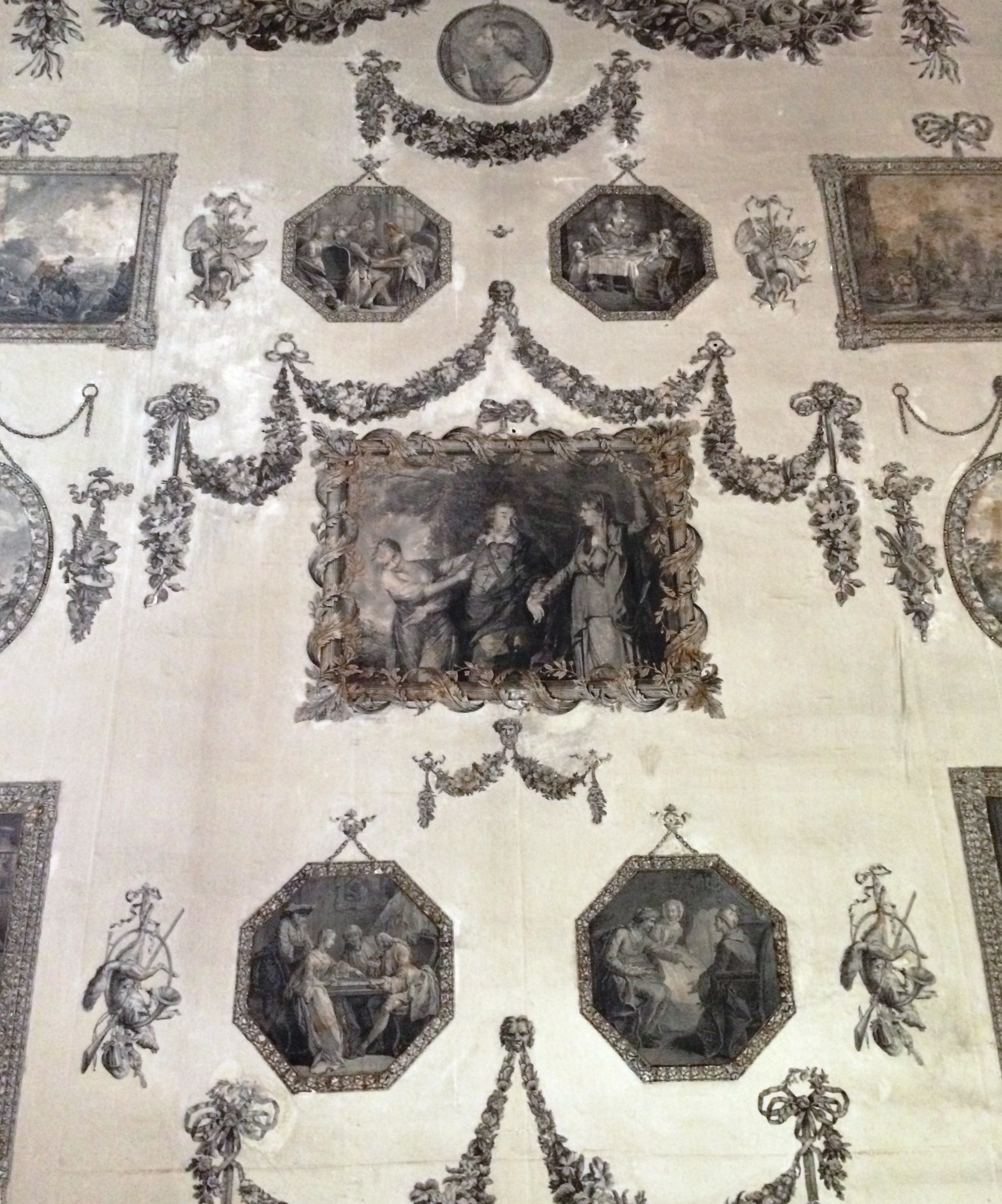
During this post-festive season, when evenings can seem especially long and monotonous, readers might like to consider occupying their time with the creation of a print room. This once-fashionable pursuit, which had its heyday in the second half of the 18th century, subsequently fell out of favour and only one intact example survives in Ireland: that at Castletown, County Kildare. The design and execution of print rooms was customarily left to women, although it evolved from the mostly-male habit of collecting valuable prints and storing these either in a cabinet or within albums. Later on prints might be hung in a chamber designated for the purpose, often kept shrouded in order the work avoided suffering light damage: while cheaper than paintings prints, especially those of larger dimensions could be expensive to produce. However, larger runs of prints in the 18th century, often reproductions of popular works of art, helped to bring down costs and make these pictures accessible to a broader market than had hitherto been the case. Cheaper prices led to greater disposability and the emergence of the print room, a phenomenon effectively unique to Britain and Ireland (although there were some instances of the vogue found in America).

IMG_3175
IMG_3173
IMG_3176
IMG_3179
Located behind the house’s main staircase and part of an enfilade on the ground floor overlooking the garden, Castletown’s Print Room was created in 1768 by Lady Louisa Conolly. She had been collecting pictures for at least the previous six years, and in addition had gained experience through assisting in similar ventures with her sister Emily, Countess of Kildare at nearby Carton and with Lady Clanbrassil at Cypress Grove House, Templeogue, County Dublin. Both these rooms have since been lost. The project was a long time in gestation: in 1762 she wrote to her sister Lady Sarah Bunbury, ‘I always forget to thank you my Dear for the Prints you sent me, I hope you got them of Mrs Regnier, for I have a bill there, the two little ones that you admired so, are the very things I wanted, that of Helen is charming. I have not had time to do my Print room yet.’ It is likely the reason the Print Room took so many years coming into existence is both because the Conollys were preoccupied with other work at Castletown and because Lady Louisa did not want to rush preparing the layout of what is a larger space than that customarily used for such a purpose: the ceiling here, for example, is twenty-five feet high. As a result, an awful lot of prints were needed. As late as February 1768 she was still writing to her sister Lady Sarah, ‘…any time that you choose to go into a print Shop, I should be obliged to you, if you would buy me five or Six large Prints, there are some of Teniers engraved by LeBas, which I am told are larger than the common size, if you meet with any, pray send me a few.’ Working out the design for this room was a complex business, particularly since border frames for each of the frames also had to be prepared, as well as garlands, trophies and other elements of the overall decoration.

IMG_3180
IMG_3178
IMG_3181
IMG_3196
When Lady Louisa finally came to embark on the scheme, the prints were duly cut out and then glued onto lengths of warm off-white painted paper. These in turn were attached to the room’s walls on battens overlaid with cloth. As Ruth Johnstone has noted, in many cases Lady Louisa ‘made editorial decisions based on the outside shapes of images.’ Accordingly she altered the original rectangular format of forty-six images to either an octagonal, oval or circular shape, or to a rectangle with a convex top. Most likely because of the need to create a visual balance based on size and shape there is no overriding theme to the pictures but rather they reflect mid-18th century taste. A handful of images were included for a specific reason. In central position between the two windows, for example, is a print of Van Dyck’s portrait of the children of Charles I, a group including Lady Louisa’s great-grandfather Charles II. In the same position on the opposite wall is a print taken from Sir Joshua Reynolds’ portrait of Lady Louisa’s sister, the aforementioned Lady Sarah Bunbury (the original painting, incidentally, is now in the collection of Chicago’s Art Institute). Providing a centrepiece on the east and west walls are prints of the era’s most famous actor, David Garrick, and the room also includes a portrait of William Pitt, Earl of Chatham, rather surprising since he was a political opponent of Lady Louisa’s brother-in-law Henry Fox, first Baron Holland. Otherwise the sources were diverse, with a fondness for both pastoral and classical subjects taken from the works of diverse artists including Teniers, Greuze, Jan Steen and Claude Lorrain. Despite such dissimilitude, Castletown’s Print Room conveys an impression of homogeneity thanks to its designer’s careful preparation. Anyone intending to embark on a similar enterprise will find these long winter evenings perfect for similarly thorough planning.

Last Pic
Much more information on Castletown’s Print Room can be found in Ruth Johnstone’s essay on the subject including in the Office of Public Work’s 2011 publication Castletown: Decorative Arts.


Spectacle as Drama

IMG_7951
It was through reading more than thirty years ago Sacheverell Sitwell’s perpetually engaging book Southern Baroque Art (first published in 1924) that I first discovered the work of the Bibienas. From the mid-17th century onwards, four generations of this Tuscan family worked throughout Europe as artists and architects, but above all as theatre designers. In some instances they were responsible for the design of buildings in which theatrical and musical performances were held. (The best-known being in Mantua, and now called the Teatro Bibiena: by Antonio Bibiena it dates from the 1760s.) But they are now better remembered for their work on the stage side of the proscenium arch.
The family’s origins in this field lay with Giovanni Maria Galli da Bibiena, born outside Florence in 1625. A painter who studied with, and then worked as assistant to, Francesco Albani, he was based in Bologna at the time of his early death aged forty. His daughter Maria Oriana who remained in that city also became a painter, specializing in portraits and history pictures. Meanwhile her two brothers led more peripatetic lives, with Francesco designing theatres as far afield as Verona and Vienna. The latter city proved particularly important for the Bibienas since it was here that Maria and Francesco’s sibling Ferdinando and then his son Giuseppe became the most celebrated stage designers of the age.

IMG_8001
IMG_7982
IMG_7989
IMG_8137
Born in Bologna in 1656, Ferdinando Galli Bibiena spent some thirty years based in Piacenza working for the Duke of Parma. But in 1708 he travelled to Barcelona to organise the wedding festivities of the Habsburg Archduke Charles. When the latter became Charles VI, Holy Roman Emperor in 1711 Fredinando Galli Bibiena moved to Vienna where he designed elaborate theatre scenery and also oversaw court festivities. He returned to Bologna in 1716 but his second son Giuseppe remained in Vienna and in effect inherited his father’s position as the Emperor’s chief designer, remaining such until Charles VI’s death in 1740. Of the Emperor, Sitwell wrote ‘Music, like everything else, required a setting which would reflect honour on this Caesar, and so he retained in his service a whole race of Italians, to whom he entrusted the decorations of a theatre, a procession or a masque with the subsequent banquet. In this way a building which seemed to have the permanence of a Versailles could be put up in a few days, and by the next morning it had disappeared from the ground, as if by enchantment. The Bibiena family of Bologna were in command of the nocturnal army…It is as though the Italians, having matured their plans so far in earlier times, now that their imagination was unfettered and had the skill to play how it liked, found themselves without the money to realize their schemes, and so were forced to take opportunities abroad and produce in plaster and canvas that which they had planned in brick and marble.’

IMG_7956
IMG_8043
IMG_8049
IMG_7961
The Bibienas were renowned for the ingenious use of perspective in their stage designs, the ability to suggest infinite horizons within a severely limited space. In his work Ferdinando was the first to replace a central, vertical, axis with a diagonal, thereby increasing the impression of distance. He and his son created fantastically grand architecture intended to be dismantled within days of its construction. An examination of Giuseppe’s extant designs indicates that he developed his father’s initiatives in this field to produce complex interiors in which colonnaded passages seem to run in every direction and seemingly without ever coming to a close. Vaulted ceilings tower over the figures beneath, while the walls are smothered with ornament including niches, brackets and curvilinear frames. Against this painted backdrop figures would act out complex emotional dramas, often to texts written by another Italian, Metastasio who in 1729 was appointed Court Poet in Vienna: in the mid-18th century there was scarcely an opera composer in Europe not dependent on a Metastasio libretto (as late as 1791 Mozart used one for La Clemenza di Tito). Surely his lofty language and noble sentiments influenced Bibiena’s designs, and vice versa? The most celebrated castrato of the age Carlo Broschi, known as Farinelli, made his debut at the age of fifteen singing music composed by his teacher Nicola Porpora set to a text by Metastasio. When Farinelli (of whom it was said, ‘One God, one Farinelli’) sang in Vienna in 1731 – once more to music by Porpora and words by Metastasio – the Emperor advised he should cease trying to astonish listeners with his vocal prowess and instead engage their emotions through the purity of his tone; ‘you are too lavish of the gifts with which nature has endowed you; if you wish to reach the heart, you must take a more plain and simple road.’ Perhaps Charles VI felt there was already enough virtuosity on stage thanks to the designs of Giuseppe Galli Bibiena.

IMG_8026
IMG_8028
IMG_8029
IMG_8058
These notes on the Bibiena family are inspired by the room seen here today, the double height entrance hall at Gloster, County Offaly. The most perfect baroque interior in Ireland, it was almost certainly designed by Sir Edward Lovett Pearce in the early 1720s; he was a first cousin of the property’s then-owner Trevor Lloyd. Whether Pearce actually oversaw the execution of his work is more open to question as some of the detailing is not quite as refined as might otherwise have been the case. Even so, Gloster’s entrance hall is something of a coup de theatre, clearly intended to make an impact on anyone stepping into the space. The view from the front door is of walls heavily covered in plasterwork panelling, with a focus on the pedimented doorcase directly ahead; on either side of this are niches with fanlights above that match those of the facing doors. Obviously the hall’s height adds additional drama, and the feature is emphasised by a band of elaborate scrolling plasterwork positioned at what would be cornice level; the effect is to divide the vertical into two sections. Continuing up, the eye is next caught by a series of round-headed niches on either side wall which contain busts on plinths. These are matched on the entrance wall by three windows which ensure the hall is exceptionally bright: they are arched on the inside although rectangular on the exterior in order to match those on the rest of the thirteen-bay facade. Facing the windows are three arched balconies, part of a first floor gallery accessed via an inner hall that has flanking staircases to its rear. The gallery is a superlative piece of work. Entered through a screen of Doric columns and rising to a coffered, barrel-vaulted ceiling, it features a pair of monumental pedimented chimneypieces with glass in the upper sections so that one reflects the other. To one side of these run long corridors, barrel-vaulted like the landing, which lead to the main bedrooms and provide the ensemble with an additional sense of drama. Indeed it the combination of these passages and the balconies overlooking the entrance hall that particularly bring to mind the designs of Ferdinando and Giuseppe Bibiena. As a piece of design it evokes the grandeur and solemnity of Metastasio’s texts, combined with the virtuosity of Farinell’s singing in a fashion rarely seen in Ireland. It is easy to imagine baroque opera being played out in such a setting (what might the late Jean-Pierre Ponnelle have filmed in the house). These spaces have recently been redecorated by Gloster’s dedicated owners, who deserve accolades for all that they have already achieved here. The results are breathtakingly exciting and highlight the outstandingly theatrical quality of the architecture.

IMG_7967

More about the glories of Gloster on another occasion…

Carve the Year with Pride

IMG_6133
A detail of the carved oak chimneypiece in the entrance hall of Salterbridge, County Waterford. Although the core of the present house was built around the middle of the 18th century, it was subject to several alterations and aggrandisements thereafter. Some of these are sufficiently documented but the date of other interventions remains unclear. In the case of the entrance hall carving, even though the craftsman responsible for the work is nameless we can be sure when he undertook this task since the panelling to the left of the chimneypiece carries the year 1884.

IMG_6145

An Assiduous Collector

IMG_4917

Although now a dormitory town, for centuries Carrigaline, County Cork was a small, single street village where the main employment came from local corn and flax mills. These were operated by successive generations of the Roberts family, of which the original member, the Rev. Thomas Roberts, moved from England to Ireland in the 1630s. Until 1927 his successors lived at Kilmony Abbey near Carrigaline but in 1784 William Roberts acquired a house called Mount Rivers which had been built some twenty years before by a wealthy Cork merchant James Morrison. The building is of unusual design since its facade originally had a recessed centre between two projections with curved corners. A scale model in the main bedroom shows what the building now looks like because in the 1830s the central space was filled in, a portico created and a third storey added to the house. However as a souveenir of its original and unique appearance the outer corners of Mount Rivers still retain their rounded windows and the ground floor porch is a convex-sided recess.

IMG_4818
IMG_4840
IMG_4922
IMG_4935
Mount Rivers never had much land attached and its owners were always businessmen, some more successful than others. Following the closure of the Carrigaline mills in 1928 the house’s then-owner Hodder Roberts converted some of his old industrial buildings into a pottery, having noted that bricks were already being produced not far away. He took a sample of Carrigaline clay to the English potteries at Stoke-on-Trent to see whether it would be possible to interest any of the established companies there in his project. Receiving no offers of support Roberts was about to leave when, through a local landlady, he met the young pottery designer Louis Keeling. The latter took the Irish clay and used it to make a teapot; today this item stands in the drawingroom at Mount Rivers. Initially employing just Louis Keeling and six workers, the Carrigaline Potteries proved to be an outstanding success and grew to have a 250-strong workforce. Demand for its wares meant that by the end of the 1930s it became necessary to import clay from the south of England, with boats travelling up the river Owenabue and docking at Carrigaline. While much of the output was strictly functional, it was also distinguished by the beautiful colour of the glazes, in particular a lustrous turquoise that remains highly distinctive.

IMG_4831
IMG_4855
IMG_4835
IMG_4857
Although the Carrigaline pottery business continued through various travails into the new millennium, after Hodder Roberts’ death in 1952 his family had little further involvement in the pottery. As for Mount Rivers, it passed to the present owner – the sixth generation of Roberts to live there – when his elder brother showed no interest in taking on the responsibility. By then the house had plenty of problems, since it had not been occupied by the family since the early 1950s but instead let to a succession of tenants: at one stage there were 15 of them were living on the groundfloor alone. When these all moved out in 1974 the local authority condemned Mount Rivers as being unfit for human habitation. Fortunately this did not deter the present owner, and nor did the amount of restoration work that lay ahead of him. One of the tenants, for example, drilled holes in the hall ceiling to release rainwater that had come into the house through gaps in the roof; as a result of the constant damp, the ceiling on the floor above had partially collapsed.

IMG_4827
IMG_4913
IMG_4864
IMG_4858
After taking on the role of Mount Rivers’ saviour, the present owner also started to salvage what he could of other buildings once belonging to members of his extended family. The weather slating on the exterior of Mount Rivers, for example, was rescued from a now-demolished house called Hoddersfield. Similarly the limestone step outside the backdoor came from the front door of another now-lost property, Britfieldstown which stood at a place directly associated with the family, Roberts Cove. Inside Mount Rivers spilling out of drawers and cabinets, and covering the top of every possible surface are innumerable items with some Roberts connection, the majority carefully tagged to advise on their origins. In truth, the present owner is an inveterate and assiduous collector, and objects linked to his family’s history provide only one of several outlets for his passion. A room on the top floor of Mount Rivers is filled with boxes containing tens of thousands of postmarks, mostly Irish. Then there is a collection of old signatures and anything to do with th Irish country house: letters, bookplates, sheets of note paper. Books fill every shelf and continue to be heaped on whatever surface might still have space; failing that, they are stacked on the stairs. Not everyone could live in this fashion but it clearly suits Mount Rivers’ current occupants. It also makes their house that rare and absorbing phenomenon: a living museum.

IMG_4945