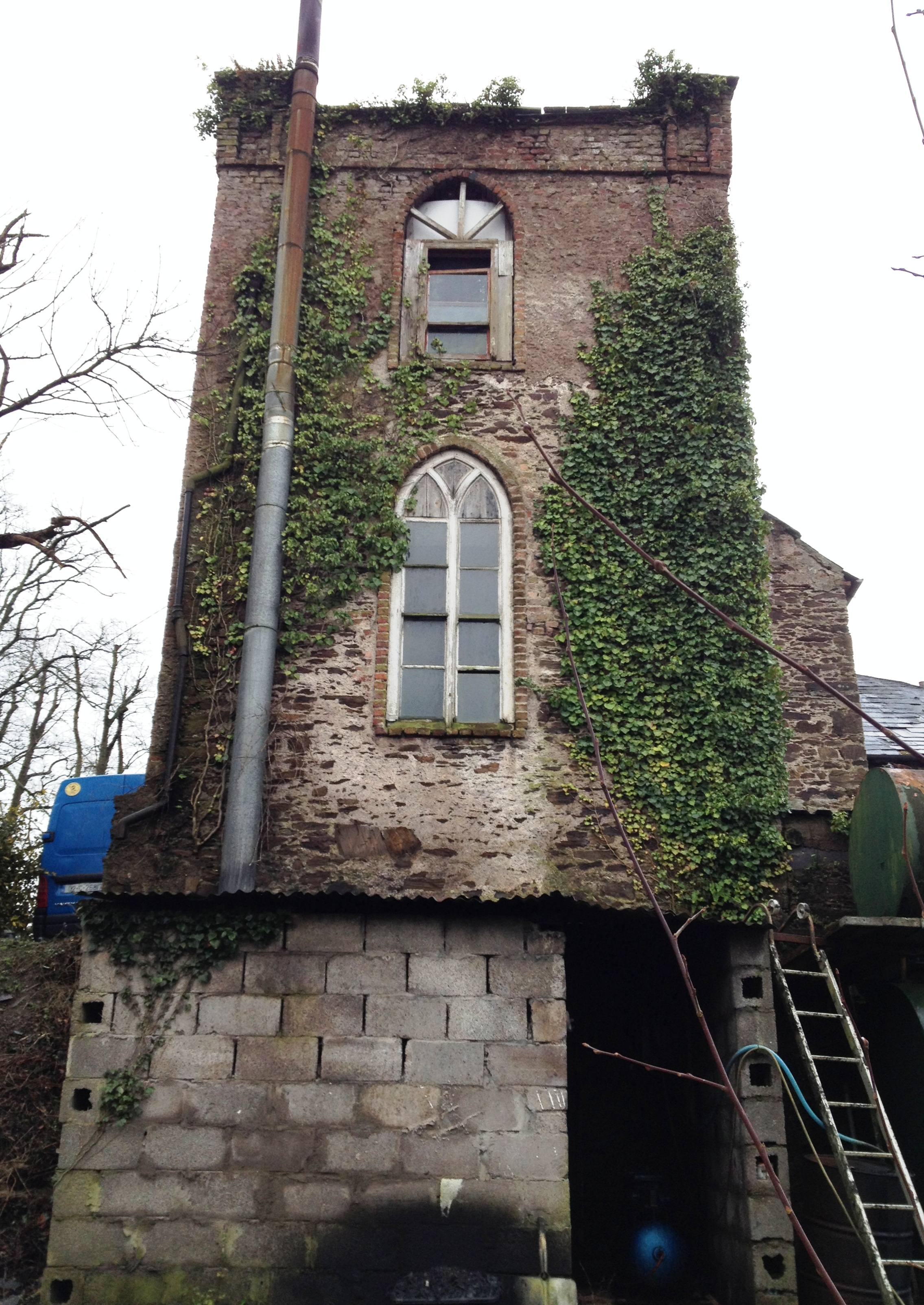
The former Franciscan friary at Kilcrea, County Cork has been discussed here before (see Lo Arthur Leary, November 2nd 2015). Not far away is a five storey tower house completed around 1465 by Cormac Láidir Mór, Lord of Muskerry then-head of the McCarthy clan. As Coyne and Wills wrote in The Scenery and Antiquities of Ireland (1841), ‘The ruins evince it to have been a place of considerable extent and rude magnificence.’ It was also intentionally built within sight of the friary which Cormac Láidir Mór had established around the same time: As the photograph below shows, a perfect view of one from the other can be seen through a window on the uppermost level of the old castle, reached via a stone spiral staircase.
Tag Archives: County Cork
Take a Bow

While much excitement – and publicity – was generated by a house contents sale conducted by Mealy’s Auctioneers at Lotabeg, Cork for some of us the building proved as interesting as what it held. Dating from c.1800 Lotabeg is a relatively late work by Abraham Hargrave, an English-born architect who appears to have come to Ireland in 1791 to supervise the construction of St Patrick’s Bridge over the river Lee in Cork. He then stayed on and was responsible for work on a number of other country houses in the vicinity, including Fota and Castle Hyde, in both cases making alterations/additions to the original structure. Lotabeg on the other hand is entirely by Hargrave, its most notable feature being the large bow on the north-facing seven-bay entrance front. Behind this lies the house’s finest internal space: an immense circular domed entrance hall, around the walls of which snakes a cantilevered timber staircase up to the first floor gallery with access to a series of bedrooms.
Studying the Classics

Often overlooked by visitors to Cork’s Crawford Art Gallery is the institution’s remarkable collection of classical sculpture casts. Derived from those in the Vatican, the casts were made on the instructions of Pope Pius VII and under the supervision of Antonio Canova. They were originally presented to Britain’s Prince Regent (the future George IV) but he having no desire for them, the casts languished until William Hare, Lord Ennismore (later first Earl of Listowel), then President of the Cork Society of Arts persuaded the Prince to have the collection shipped to Ireland where they duly arrived in 1818. Initially displayed inside a converted theatre on Patrick Street, the casts subsequently passed into the care of the Cork School of Art and thus came to reside in what is now the Crawford Gallery. Above, the Belvedere Torso can be seen through the form of the Lancellotti Discobolus. The latter also figures below, sighted beyond the Borghese Gladiator and the Apollo Belvedere.
An Architectural Conundrum

In Three Homes, a memoir published in 1938, playwright and author Lennox Robinson, together with his siblings Tom and Nora, recalled their childhood in late 19th century County Cork. Robinson was born in Douglas, now a dormitory suburb of Cork city but then still a separate village lying a few miles to the south-east. The youngest child of a stockbroker-turned-clergyman, he was born in a since-demolished property called Westgrove but often visited his aunt Eleanor, who had married a wealthy brewer, John Frazer Crichton, in Donnybrook House which still stands. This the Robinsons in their recollections describe as being ‘lowbuilt, old and charmingly planned, rooms open one into the other on the ground floor a bedroom opened off the dining room, the drawing room on the opposite side of the hall had its back drawing room and the same plan was repeated in the bedrooms upstairs.’ More than a century later, although the condition of the building has somewhat deteriorated, the layout remains unchanged.


The origins of Donnybrook House are unclear. We know that by the mid-18th century the land on which it stands had come into the ownership of the Davies family as the Rev Boyle Davies, Dean of Cloyne died there in 1763. He was the son of another of those ambitious Anglican clerics so common to the era, in this case the Rev Rowland Davies whose father of the same name had come to Ireland from Herefordshire probably in the 1640s: Rowland Davies was born in Cork in 1649. He entered Trinity College Dublin in 1665 and initially seemed destined for a career in medicine before switching to the church. After taking orders in 1671 he held several minor offices and then became Dean of Cloyne in 1679. An ardent supporter of the Anglican faith (in 1716 he published a treatise called A truly Catholick and Old Religion, shewing that the Established Church in Ireland is more truly a member of the Catholick Church than the Church of Rome), he participated in the Battle of the Boyne, and the Sieges of both Limerick and Cork before returning to his pastoral duties. In 1707 he became Precentor of Cork and three years later Dean of the same diocese. He died in 1721. Rowland Davies may have been responsible for the purchase of Donnybrook’s land. On the other hand, he is known to have been a tenant of the Blarney estate, where two of his sons were born, until it was sold in 1702 to Lord Chief Justice Sir Richard Pyne for £3,000. It is said that the winged cherub heads seen above the arched ground floor windows of Donnybrook’s wings came from Blarney. Furthermore Rowland Davies built himself a house called Dawstown on part of what had formerly been McCarthy land north of Blarney. Here he died and here one branch of his descendants continued in occupation until the early 19th century. One wonders therefore whether the Donnybrook estate might have been bought by the Dean for his son, or whether Boyle Davies himself bought it. Curiously a year after the latter’s death his widow Mary, whose maiden name was Travers, leased the place to one Boyle Travers, who was a cousin of both her and her late husband (the reason for their shared first name is that they were both descendants of Elizabeth Boyle whose father Richard Boyle had become Archbishop of Tuam in 1638).


The Davies/Travers/Boyle family synopsis above helps to explain why it is not easy to work out the origins of Donnybrook House. Douglas emerged as an urban settlement from the early 18th century onwards thanks to the development here of mills associated with the textile and weaving industries which produced linen sailcloth. Tellingly the first such to open was Donnybrook Mills in 1726 (it was also one of the very last to close in the 20th century). A large pond which stood in front of the house (it can be seen in the watercolour above which dates from the first half of the 19th century) is now dried out. However formerly it served as catchment for a millrace that twenty feet below drove the millwheel. The site on which Donnybrook House stands is therefore at the top of a slope, the ground dropping sharply to the immediate north of the building. A substantial basement beneath the main rooms could be the earliest part of the fabric, dating back to before the arrival of the Davieses; in other words, as was so often the case, a newer residence was created incorporating parts of an older one. It has been proposed that a McCarthy castle stood here, thereby establishing another link with Blarney.
As one sees it today, the central block of the house, facing east, is of five bays and features a fine carved limestone doorcase with pretty fanlight above. The building initially looks single storey but this is not the case: a mid-18th century staircase directly beyond the front door leads to a first floor, the only evidence of which on the outside of the building is a solitary dormer window likely dating from the late 19th century and lighting the upper landing. The two slightly projecting tower ‘wings’ are believed to have been added in the early 1800s. They served both to increase accommodation and to give the house a more ancient, picturesque appearance (hence the gothic arched windows). As can be seen in that early watercolour, like the rest of the exterior the towers were originally rendered but subsequently covered in weather slates. Various additions were also made to the rear of the building over the course of two centuries, including a rather fine Edwardian bathroom that opens off the staircase return.


Donnybrook House’s original setting has long since gone: the surrounding gardens no longer exist, nor do any mills that once operated in the vicinity. Likewise most of the other historic houses and villas once dotting the landscape in this part of the country are gone: today almost the entire area is given over to housing estates. As is apparent, the building at present needs some attention. The roof of the south tower (that to the left of the entrance) has collapsed, bringing down the floors inside and making this part of the building unsafe. Meanwhile the north tower is suffering from water ingress and risks becoming similarly hazardous. This damage is not visible from the exterior because blind gothic windows on the upper level were designed to conceal the pitched roofs. On the other hand, the central section of the property appears to be in relatively good condition although rather damp, and has continued to be used and occupied. Internally some of the original 18th and early 19th century wooden joinery, including wainscot panelling, has survived, as have a number of the old sash windows. The spirit of the house invoked by Lennox Robinson and his siblings can still be felt.
Here is a building waiting to be rescued from what too often has been the fate of such properties in Ireland: ruin and disappearance. Wonderfully the present owner is keen to restore Donnybrook House and bring it back to residential use. Rescue and refurbishment is still feasible and must be encouraged. Donnybrook House is an important and rare testament to Cork’s architectural and industrial history. Its preservation merits everyone’s support.
With special thanks to Ciara O’Flynn, Built Heritage Conservation Consultant/Buildings Archaeologist, for generously sharing her research into Donnybrook House.
Respected and Lamented by All Who Knew Him

In the rarely opened south transept of Cloyne Cathedral, County Cork the end wall is dominated by this splendid early 18th century monument to members of the Longfield family, the first listed John Longfield having acquired a nearby estate and named it Castle Mary, perhaps in honour of his heiress wife, Mary Hawnby of Mallow. Successive generations are listed, the first (and last) Viscount Longueville being the grandson of John and Mary Longfield: note how the word ‘respected’ had to be tucked into the available space. On Lord Longueville’s his death without an heir, Castle Mary was inherited by a cousin, Colonel Mountifort Longfield. The house was burnt by the IRA in 1920, so this is now the best-preserved memorial to the family.
Living in Eternity’s Sunrise
A Vision Realised

The second half of the 19th century witnessed a frenzy of church building in Ireland. In Cobh, County Cork for example, the construction of a vast new cathedral designed by Edward Pugin and George Ashlin began in 1867. That building, like the majority of others, was commissioned by the Roman Catholic church intent in the aftermath of penal reform to make its mark across the country. By contrast the Anglican Church of Ireland, which until around 1830 had engaged in a similar ferment of church building, primarily (although not exclusively) funded by the Board of First Fruits, was now in retreat. The Irish Church Act of 1869 (it came into force two years later) broke a long-standing link between the Anglican church and the state, and repealed legislation requiring all citizens to pay tithes to the Church of Ireland. As a result, the Church of Ireland’s ability to engage in construction or even restoration of property severely contracted. All the more interesting therefore to see that not far from Cobh and during the same decade as work on its cathedral began a similarly ambitious project was initiated by the Irish Anglican community: the rebuilding of St Fin Barre’s Cathedral in the centre of Cork city. The site on which it stands is believed to have been a place of worship since a monastery was founded here in the seventh century and named after the local patron saint Fionnbarr (meaning ‘fair headed’). The city of Cork grew up around this religious settlement and in turn the monastic church became the city’s cathedral. This mediaeval structure was damaged during the Siege of Cork in 1690 and largely replaced in the following century: the most important extant feature of that much earlier building is the Dean’s Gate: now inserted into the southern boundary of the Cathedral grounds’ wall it was originally an archway in the west portico of the bell tower.


Only a couple of photographs taken shortly before its demolition give an idea of the appearance of Cork’s 18th century cathedral. Other than retaining the ancient tower at the west end, it looks to have been not unlike places of worship erected elsewhere in Ireland during the same era, such as the Anglican cathedrals then built in Cashel, County Tipperary and Waterford city. Commentators today, perhaps dazzled by its successor, tend to be unfairly disparaging about the old St Fin Barre’s since it probably had ample architectural merit, given some of the cultural pedigree of the bishops involved. Richard Caulfield’s Annals of St Fin Barre’s published in 1871 gathered together all source material on the building’s history and reported that in November 1733 ‘Whereas it appears to the Dean and Chapter that the Cathedral is in very bad repair, and in great danger of falling, & that an application be made to the Bishop by the Dean, Archdeacon, and Oeconomus [the bursar], that his Lordship would be pleased to give his advice about pulling down and re-building same Cathedral…and that the Dean, &c., should indemnify the Bishop.’ In September of the following year ‘The Cathedral was ordered to be taken down, the Oeconomus to employ workmen, and the Bishop to be requested to direct such a plan as he may think proper.’ Soon afterwards Robert Clayton was appointed bishop of the diocese and it was during his term, and that of his successor, that the new cathedral was built. Clayton, who would later have troubles over his religious beliefs (at the time of his death in 1758 he was facing charges of heresy having publicly espoused the doctrines of Arianism), was a man of considerable taste: his splendid Dublin townhouse on the south side of St Stephen’s Green was designed for him in the mid-1730s by Richard Castle (it is now part of Iveagh House). One therefore imagines that the cathedral works over which he presided in Cork would have displayed equal taste, even if in this instance we do not know who was the architect responsible. Yet work on the new St Fin Barre’s proceeded slowly, in part due to shortage of funds. In March 1737, for example, it was noted ‘The Dean and Archdeacon to wait on the Bishop to represent the state of the Cathedral, that all their money has been expended, and to seek his Lordship’s advice’ and later that same year, ‘The Dean and Chapter, not having sufficient means to finish the Cathedral, make a lease to John Supple of the great and small tytles of the Oeconomy of the Cathedral, for four years, at a yearly rent of £108 15s.; and as it would greatly retard the finishing of the Church if the Dean and Chapter were to wait till the rents became payable, &c., John Supple has advanced the four years’ rent in the whole sum of £435.’ Ultimately it appears the job had still not been finished by the time Clayton moved on to the diocese of Clogher in 1745, his place being taken by a local cleric, Jemmett Browne. He was likewise interested in architecture, reconfiguring his family house outside the city at Riverstown where the Ticinese sibling stuccodores Paolo and Filippo Lafranchini are credited with decorating the interior. A photograph of the chancel arch of 18th century St Fin Barre’s shows its walls to have been covered in elaborate rococo plasterwork on either side of a large Venetian window and this has been attributed by Joseph McDonnell to the same Lafranchini brothers. All of which suggests that the cathedral must have had a rather fine interior.


Time passes and tastes change, and the following century it was again resolved to demolish St Fin Barre’s. One suspects that this decision, officially taken in 1862, was due to the arrival that same year of a new bishop, John Gregg, appointed to the position on the recommendation of his admirer and then Lord Lieutenant, the seventh Earl of Carlisle. Evidently keen to leave a mark on his diocese, the strong-minded Gregg declared that the building he had inherited ought to be taken down and replaced with ‘a structure more worthy of the name, Cork Cathedral.’ One suspects the existing St Fin Barre’s was rather too secular in style to suit the Gregg’s brand of evangelical Christianity. Accordingly an international competition was held for an architect to design a new cathedral. This attracted sixty-eight entrants, William Burges being declared the winner, even though – as some of the losers pointed out – his proposal excluded from the prescribed budget of £15,000 the monies needed to build towers, spire and sculpture. The eventual cost would climb to more than £100,000 (on the other hand, reverting back to the Roman Catholic cathedral in Cobh, its original construction budget of £25,000 overran to a final total of £235,000). Moreover Burges declared himself ‘unconcerned’ over any difference between intended and ultimate cost of building his vision. In the future, he informed Bishop Gregg, ‘the elements of time and cost being forgotten, the result only will be looked at. The great questions will then be, first, is this work beautiful and, secondly, have those to whom it was entrusted, done it with all their heart and all their ability.’ These sentiments were not perhaps altogether appreciated by the people of Cork who, in the aftermath of the Church of Ireland’s disestablishment, had to find the funds for St Fin Barre’s. But Burges’ background explains his own indifference to budgetary matters: born in London in 1827, he inherited a fortune from his engineer father and therefore never had to worry about earning a living. After years of travel and working in the offices of both Edward Blore and Matthew Digby Wyatt, he set up his own practice in 1856. Thereafter despite providing designs for various competitions he was aged thirty-five before he finally won his first major commission: St Fin Barre’s. His proposal involved the total demolition of the building then on the site, including the mediaeval west tower, because Burges was an architectural ideologue whose preferred style – Early French Gothic – trumped all others: ‘I was brought up in the thirteenth century belief,’ he once wrote, ‘and in that belief I intend to die.’ No qualms here about clearing away anything that might impede the execution of his vision.


Both Burges and Bishop Gregg died before work on St Fin Barre’s had been completed, the former in 1881, the latter three years earlier but since he was succeeded in the diocese by his son Robert Gregg, the work continued seamlessly. Thus the cathedral as we see it today is essentially the expression of these two men’s aesthetic and religious beliefs: Burges’ intentions are understood but the importance of Gregg in the development of St Fin Barre’s has been less discussed. It is not difficult to understand why this should be the case, as Burges – who in today’s parlance might be reckoned a control freak – was responsible for the design of every part of the building: nothing was permitted to escape his attention and approval. He drew the designs for all of St Fin Barre’s sculptures inside and out, for the majority of its seventy-four stained glass windows, the mosaic pavement in the chancel, the pulpit, altar and bishop’s throne. An indication of his personal commitment was Burges’ gift of the Resurrection Angel made of copper covered in gold leaf that crowns the sanctuary roof at the east end. Given how elaborate the decorative scheme is, and the increasing demands of his work schedule elsewhere notably with the third Marquess of Bute in Cardiff, no wonder Burges died at the age of 53. Although the cathedral is relatively small (it was intended to hold a congregation of 700 souls, no more than the average for a London parish), it is smothered in embellishment. The exterior is built of Cork limestone, the interior of Bath stone and the walls are lined with red Cork marble. As was the case with mediaeval cathedrals, internally and externally St Fin Barre’s is intended to be ‘read’ by the faithful as the building narrates the story of Christianity. For example, the west rose window illustrates the story of creation according to the book of Genesis, while the windows on either side of the nave feature tales from the Old Testament. Those in the ambulatory deal with the life of Christ. While the cathedral was consecrated in 1870, its decorative work in accordance with Burges’ intentions was only finished in the mid-1930s. In this respect, it bears similarities with the slow construction of such buildings in the Middle Ages, and indeed with that of its 18th century predecessor. Today St Fin Barre’s is rightly admired as one of the finest and most complete expressions of Gothic Revival architecture in these islands. It also represents a final flourish on the part of the Anglican church in Ireland before the onset of a long decline.

The photograph above is a detail of a half-scale plaster model of a sculpture above the rose window on the inside of St Fin Barre’s. Depicting an architect at work, it is believed to represent William Burges.
The Regency Buck

Born in 1786 at Elm Hall, County Tipperary, John Burke moved to London where he became engaged in genealogical studies. In 1826 he issued his Genealogical and Heraldic Dictionary of the Peerage and Baronetage of the United Kingdom the first such work in which entries were arranged alphabetically, and both peers and baronets were included. Initially continued by his descendants before passing into other hands, the abiding popularity of ‘Burke’s Peerage’ has led to its regular appearance ever since. In 1819 Burke met another displaced Irishman, the artist Adam Buck who that year exhibited a watercolour portrait of his new friend’s wife at the Royal Academy. Further images of the family followed (some seen below) not least the picture above: dating from 1833 it depicts John Burke and his son, the future Sir John Bernard Burke. These works are included in an exhibition devoted to Buck currently running at the Crawford Gallery, Cork (the artist’s native city). As one of the most prolific and successful miniaturists and portraitists of the early 19th century, Buck saw his work widely reproduced as prints or on porcelain. However even before his death in 1833 (the same year as the Burke double-portrait) he had begun to fall out of fashion and for a long time thereafter was little regarded. This exhibition helps to re-establish him as one of Ireland’s finest artists of the period and merits a visit to Cork.
Adam Buck (1759-1833): A Regency Artist from Cork runs at the Crawford Gallery until April 9th next.
Attention to Detail

Viewing an old building, one is often so engaged absorbing the totality that details of design can be overlooked. How many visitors to Ballyvolane, County Cork, for example, pay much attention to the stairs? This house, originally built in 1728 by Sir Richard Pyne, was extensively modified in the second half of the 1840s by a descendant, Jasper Pyne. Evidently a new staircase was one of his additions but note how on the side of every tread is affixed a cast-iron putto in each of whose fists can be found a nail holding one of the balusters in place.
A Path Through the Fields

In the depths of grey winter, a memory of six months ago, and a distant view of Kilcrea Castle, County Cork. This five storey tower house was completed by 1465 by Cormac Láidir Mór, then-head of the McCarthy clan. As Coyne and Wills wrote in The Scenery and Antiquities of Ireland (1841), ‘The ruins evince it to have been a place of considerable extent and rude magnificence.’ Although today on private land, the castle is regularly explored by visitors to the area, as testified by a well-worn path through the field.