Head In the Clouds

IMG_2587
In his Preface to Dublin Decorative Plasterwork of the Seventeenth and Eighteenth Centuries (1967) C.P. Curran argues that any study of the subject must concern itself primarily with the latter period: ‘This is so for two reasons. The Dublin stuccodores’ craft reached a singular perfection in that century and notwithstanding the loss their work has suffered and still undergoes in the vicissitudes of the city’s growth, examples of its various excellence are still abundant and are accessible for study.’ Today’s examples, all now in Dublin Castle, admirably illustrate this point.

IMG_8509
IMG_8505
IMG_2583
Demolished in the early 1950s owing to the value of the land on which it stood, Mespil House now tends to be remembered as the home of artist Sarah Purser. But the man responsible for its construction is just as worthy of notice, having enjoyed a distinguished career across diverse fields.
Born in Cork in 1698, after studying first at Trinity College Dublin and then at the University of Leiden, Edward Barry became a doctor like his father before him. Initially he practised in his native city, there writing his first book, A Treatise on a Consumption of the Lungs, published in 1726. In addition to his medical work, he found time to become a member of the Irish Parliament, representing Charleville from 1745 to 1761. By the time his political career began, he had already moved to Dublin, and here produced his principal medical work, On Digestion in 1759. A decade earlier he had been elected President of the College of Physicians and in 1754 he was appointed Regius Professor of Physic at Trinity College Dublin. But he was as interested in the arts as the sciences, and on good terms with many of the notable writers of his day. In 1736 he reported to John Boyle, Earl of Orrery (and future Earl of Cork) about their mutual friend Dean Swift, ‘I’m concerned to hear that Swift is confin’d by some Disorder; I hope nothing but a bilous cholic, which a few Satyrical evacuations will remove.‘ At the age of 63 Barry decided to move his practice to London but there is some question over whether he did as well there as had been the case in Ireland. According to Boswell, Samuel Johnson once remarked of Barry, ‘He was a man who had acquired a high reputation in Dublin, came over to England and brought his reputation with him, but had not great success.’ Created a baronet in 1775, he died the following year but not before producing a final book running to almost 500 pages: Observations, Historical, Critical and Medical on the Wines of the Ancients, and the Analogy between them and Modern Wines. This was the remarkable man responsible for building Mespil House in 1751.

IMG_2545
IMG_2535
FullSizeRender
Returning to Curran’s Preface, the author comments that ‘The diversity and excellence achieved by the middle of the eighteenth century is unquestionably due to outside stimulus. In the arts, no more than in nature, there can be no Declaration of Independence, since to be isolated is to be sterile and an organism is strong only in so far as it can assimilate.’ One of the outside stimuli from which indigenous stuccodores assimilated ideas during this period was Barthelemy Cramillion, whose origins and training remain unknown, although it has been suggested he was French Huguenot or Walloon by birth. He first appears in Ireland in August 1775 when employed by Dr Mosse to decorate the chapel of the new Lying-In Hospital, now known as the Rotunda: the contract bound him to complete the work within thirteen months. In December 1757 he was again engaged to execute the chapel altarpiece within six months. His total bill, finally settled in 1760, came to £585, nine shillings and ninepence. He left Ireland a year or two later but then returned in 1772 and in the Dublin Journal advertised his services to ‘Any Nobleman or Gentleman inclined to employ him.’ Two ceilings removed from Mespil House before its demolition and now installed in Dublin Castle (top and bottom series of pictures) have been credited to Cramillion by Joseph McDonnell in Irish Eighteenth-Century Stuccowork and its European Sources (1991). On the other hand, Timothy Mowl and Brian Earnshaw in their 1999 book An Insular Rococo question that attribution, noting that Mespil House dates from 1751, four years before Cramillion appears working on the Rotunda chapel. They also believe the ceilings ‘appear to be the work of two different plasterers,’ noting technical differences in the moulding of figures and in compositional layout. Unless additional documents turn up, most likely we will never know for certain who was responsible. The top group is centred around a medallion depicting Minerva Introducing the Arts to Hibernia, while that below shows Apollo as Sun God emerging to scatter the clouds. Incidentally, a third ceiling from Mespil House is now in Áras an Uachtaráin.

IMG_2600
IMG_2593
IMG_2607
Similar uncertainty hangs over the authorship of another ceiling now in Dublin Castle (shown in the middle group of photographs above) but taken from another, long-since demolished building. Tracton House once occupied a site at 40 St Stephen’s Green, on the corner with Merrion Row. A bank stands there today and Tracton House was pulled down in 1912 to facilitate the commercial premises’ development. The lost building dated from the mid-1740s when the MP, surveyor and director-general of fortifications Arthur Jones-Nevill acquired the site to build himself a fine town residence. In 1765 it passed into the hands of James Dennis who fourteen years later was raised to the peerage as Baron Tracton and from him the property acquired the name by which it was thereafter known. The building subsequently underwent modifications according to changes of ownership and use but one portion remained unaltered: a first-floor back drawing room. This kept intact its decoration as installed at the time of Jones-Nevill. When the whole place was pulled down coincidentally the National Museum was keen to acquire a good example of the Georgian domestic interior and so the room was carefully removed and reinstated in Kildare Street where it stayed for another three decades until once more taken down: it moved to its present location in the 1960s. The main focus of the Tracton House room is its ceiling on which (as J.B. Maguire has discussed in a fascinating article published in the 2012-13 volume of the Journal of the Royal Society of Antiquaries of Ireland) are inscribed two dates: 1746 and 1752. Might it be that the ceiling, the central lozenge of which shows Apollo Musagates opulently lounging in the clouds, a lyre resting on one knee, was decorated in two stages? Could the outer compartments featuring diverse trophies of the arts associated with this god have been created before or after the Apollo, hence the two dates? As with the Mespil House ceilings, it seems unlikely we will ever be able to come up with absolute answers. But in the meantime, a visit to these rooms in Dublin Castle is encouraged, especially as it provides an opportunity to put your head in the clouds and there join the company of classical deities.

FullSizeRender 2

Luggala Redux

70

Just over sixty years ago in late January 1956, the occupants of Luggala, County Wicklow woke to find the building on fire, apparently started by faulty electrical wiring. Although three local fire brigades were summoned, deep snow hindered the arrival of their engines which in the course of a descent to the house slithered into a ditch and had to be dug out with shovels. Branches were then laid down to form a carpet over which the wheels could travel but once finally at the house, the firemen discovered no water coming from their hoses: they had forgotten to attach the nozzle to the engine. Even once they got underway, the intense cold hampered proceedings, with ladders becoming treacherous to use as ice formed on the steps. By the time the flames were doused at 10am, the greater part of the building had been gutted.  Fortunately Luggala’s then owner, Oonagh, Lady Oranmore and Browne immediately embarked on a restoration programme and by March of the following year she was back in the house which today remains in the care of her son, the Hon Garech Browne.
I shall be discussing this and other incidents in the wonderful history of Luggala next Wednesday, March 9th during a talk hosted by the Irish Georgian Society at the Somerset Club, 42 Beacon Street, Boston, Massachusetts. For more information, please see: https://www.igs.ie/events/detail/us-event-the-magical-world-of-luggala-the-story-of-a-guinness-house

71

A Blackwater Beauty

IMG_6123

Wonderfully sited above the Blackwater river, Salterbridge, County Waterford has a complex building history. The core of the house, the three bays articulated by the giant limestone Tuscan pilasters and heavy parapet entablature, likely date from c.1751 when a residence was constructed here by Richard Musgrave who had acquired this portion of lands previously owned by the Earls of Cork. In the early 19th century his grandson Anthony Chearnley, who had married an heiress, embarked on a programme of enlargement and embellishment, extending the house’s by a further bay on either side and giving it the Wyatt windows seen on the first floor. Further work took place in the 1840s when the ground floor canted bays were added and the glazing here altered.
Salterbridge is among the houses lining the Blackwater that I shall be discussing in a talk hosted by the Irish Georgian Society at the Chesterfield Hotel, Palm Beach, Florida on Monday, March 7th. For further information, please see: https://www.igs.ie/events/detail/us-event-the-beauties-of-the-blackwater

IMG_6111

A Unique Legacy

IMG_1744
Few houses better exemplify the maxim of initial appearances being deceptive than Headfort, County Meath. An immense, austere block – the limestone facade including wings runs to more than five hundred feet – in 1789 it was described by then-Lord Lieutenant the Duke of Rutland as ‘a long range of tasteless building’ and three years later George Hardinge said it was ‘more like a college or an infirmary’ than a private residence. Headfort was built for the descendants of Thomas Taylor who came to Ireland in the middle of the 17th century in the company of his school contemporary Sir William Petty. By 1660 Taylor had secured 21,000 acres of land in Cavan and Meath, and settled outside Kells. No trace remains of the original house constructed by the family, but from the middle of the 18th century onwards plans were under way to build a new country seat suitable for their advancement in the Irish peerage: already a baronet, the third Sir Thomas Taylor, who inherited the estate in 1757, would be created Baron Headfort in 1760, Viscount Headfort two years later and Earl of Bective in 1766. His son, in turn, would become first Marquess of Headfort in 1800.

IMG_1775
IMG_1908
IMG_1897
The first architect consulted about designs for a new house was Richard Castle, a favourite for such commissions among Irish landowners during the period. However in this instance his proposals of 1750 failed to win the approval of the second Taylor baronet; an extant portfolio is marked: ‘Mr Castle’s plan and a damn bad one.’ John Ensor and another anonymous architect also drew up proposals for a similarly Palladian-style building but these too were spurned. The Taylors were not as wealthy as some of their contemporaries and funds to spend on the building were limited. Presumably this is why although still more designs were commissioned in 1765 from fashionable neo-classical architect William Chambers those were similarly rejected. In any case, by that date work had already started on a sober, and accordingly economical scheme which, on the basis of a 1760 plan inscribed GS, is attributed to George Semple, a Dublin-based builder and self-taught architect. Whoever was responsible, the house’s exterior would not have required much architectural skill in its composition. Of three storeys and 11 bays, the near-identical front and rear elevations of grey Ardbraccan limestone are largely unrelieved other than by pedimented doorcases.

FullSizeRender
IMG_1778
IMG_1837
But if the house’s exterior lacks ornament, its interior was intended to present a different image. Between 1771 and 1775, Lord Bective requested Scottish-born architect Robert Adam to produce decorative schemes for a suite of rooms in the newly completed Headfort. Adam, who never visited this country, duly came up with designs for the entrance and staircase halls, as well for as a series of three adjacent spaces on the garden front culminating in a double-height saloon that was known as the ‘Eating Parlor.’ Even if not all his proposals were fully implemented, the interiors are of immense importance as the only extant examples of Adam’s work in Ireland. Once more due to shortage of funds, a simplified version of the suggested decoration was executed in the entrance and staircase halls. But the architect’s original drawings survive and indicate that other elements of the scheme were carried through, not least in the Eating Parlor, where the only major modification saw the architect’s recommended barrel-vaulted ceiling instead being coved. Created by reconfiguring the house’s layout to merge two rooms on both ground and first floors, the Eating Parlor is lit by a line of tall windows between which stand the original marble-topped console tables and pier glasses. Facing these are a pair of carved white marble chimneypieces with circular overmantles holding classical compositions by the Italian artist Antonio Zucchi, who worked with Adam on a number of other occasions; further Zucchi work is found elsewhere in the room, including a ceiling centrepiece. The rest of the walls are covered with panels intended to contain Taylour family portraits, and a number of matching doorcases. The adjacent, somewhat smaller, saloon is similarly decorated but the third room in the suite, the Chinese Drawing Room, has since lost the landscape wallpaper from which derived its name.

IMG_1710
IMG_1754
IMG_1726
Inevitably with the passage of time, the fabric of Headfort began to deteriorate; problems of damp coming into the building were a particular problem. It didn’t help that since 1949 the house has served as a preparatory school, with inevitable wear and tear on its fabric. Due to the significance of the Adam interiors, in 2004 the World Monuments Fund placed the house on its list of 100 Most Endangered Sites. Thereafter the Headfort Trust, thanks to funding from the WMF, Ireland’s Heritage Council and relevant state departments, initiated a programme of essential work including repairs to the roof, chimney stacks and gutter piping. Internally the trust embarked on a conservation and research project that revealed the original Adam decorative scheme. Nowhere was this more the case than in the Eating Parlor which underwent complete refurbishment thanks to aid from the Irish Georgian Society which in 2008 made the room the beneficiary of its 50th anniversary fundraising efforts. For a long time the Eating Parlor had been painted a shade of blue more usually found in hospital wards. However analysis of the walls revealed they had first been decorated using a variety of mid- to dark shades of verdigris, a scheme which tallied with the Adam drawings. The same colours were also used in the staircase hall, while those of the Saloon are softer, with an abundance there of pink and pale blue. When initially finished, and furnished, the effect must have been quite startling and highly novel, and even today, depleted of their contents and put to alternative use, these rooms can still confound the popular notion of how a chaste neo-classical interior should look. Today, when no other examples of Adam’s work can be seen on this island, it is a unique legacy.

IMG_1763

From the Same Hand

IMG_2866
Two County Kildare mid-18th century houses, located less than four miles apart and linked by marriage not long after both were constructed. It is therefore no wonder that they share certain characteristics, not least in the matter of decoration. The elaborate cornice above is found in the drawing room of one house, that below in the dining room of the other. But they clearly come from the same hand and show the inspiration, if not necessarily the involvement, of Robert West who was producing work of this kind during the 1750s/60s.

IMG_2878

On Guard

IMG_4405
The ferociously-protected entrance of Freame Mount, County Monaghan. This charming red-brick house dates from 1772 when built by Charles Mayne, agent for the nearby Dawson estate at Dartrey: its name derives from Philadelphia Freame, granddaughter of William Penn and second wife of Thomas Dawson, first Lord Dartrey. A flight of steps leads to the cut limestone tripartite door, the latter’s proportions somewhat too short so that more space than is customary has been given to the gothick fanlight.

A Call to Action

FullSizeRender 1

Last November the Department of Arts, Heritage and the Gaeltacht launched a document called An Action Plan for the Sustainable Future of the Irish Historic House in Private Ownership. In her Introduction Minister Heather Humphreys observed that these properties ‘are an important part of our social, cultural and architectural heritage,’ as well as being ‘an essential thread of our national story and a great source of local community pride.’ Furthermore historic houses are ‘a vital attraction for both local and foreign visitors and they play an important role in stimulating economic development, particularly at community level.’
Last Thursday members of the Browne family announced that Westport House, County Mayo where they and their forebears have lived for almost 350 years, is to be placed on the open market. The financial difficulties faced by the Brownes, arising from a bank loan (and its attendant guarantees) taken out in 2006 by the late Jeremy Sligo, have been well known for some time. (Incidentally, they demonstrate yet again how in this country while a borrower can be penalised for making an ill-advised decision, the relevant lender suffers no such retribution). Westport’s predicament demonstrates how fragile is Ireland’s remaining stock of historic properties, how vulnerable to the vagaries of shifting circumstance, precisely because so few safeguards or supports exist to ensure they can weather past and future storms.
Westport House perfectly conforms to Minister Humphreys’ designation of the Irish historic property being a source of local pride, an attraction for domestic and overseas visitors and a key player in stimulating regional economic development. A report commissioned last year by Mayo County Council found the house and grounds attracted 162,000 visitors annually and contributed €1.7 million to the fiscal purse and local economy, with 60 per cent of respondents citing the Browne family home as their main reason for visiting Mayo. It is vital to the well being of the area, and the Brownes deserve applause for making this so.
Over the past year there have been plenty of reports, meetings, analyses and consultations over Westport’s plight. The time for talk has now come to a close. Decisive action needs to take place, the estate and house ought to be preserved, and the values espoused in its recent document by the Department of Arts, Heritage and the Gaeltacht made manifest. Otherwise, yet again, we will witness the diminution of Ireland’s heritage, and the loss of another ‘essential thread of our national story.’

FullSizeRender

Public Palladianism

IMG_2678
The spirit of Palladianism lingered far longer in Ireland than elsewhere, and was present in the design not just of private houses but also public buildings. In the latter category among the very last such work was the Blue Coat School (now the Law Society of Ireland) designed in the early 1770s by Thomas Ivory. Among the pleasures of this property are the details of the façade. The granite rusticated quadrants, for example, have niches, the round tops of which together with the string coursing are of Portland stone (see above). Similarly the monolithic solidity of the two large end pavilions (one intended for use as a schoolroom, the other a chapel) is relieved at the bases by blind oculi once more of Portland stone inserted into granite (below).

IMG_2671

Seen in the Round

IMG_1499

On January 1st 1778 John Dawson, Viscount Carlow married Lady Caroline Stuart, daughter of the third Earl of Bute. Shortly before this occasion, Mrs Delany wrote of her as follows: ‘Lady Caroline is a genius in painting and musick, and has made a great progress in both; she has a clear, sweet voice, under good management, and less of the fashionable yell than most of her contemporarys. She is extremely good-humoured and sensible, but is one in whom many pleasing accomplishments are a little hurt by an awkward habit: she has no affectation, but a trick of a laugh at whatever is said or that she says herself.’ Fortunately we know a great deal more about Lady Caroline than this somewhat ambivalent description, as she was an ardent letter writer, especially to her youngest and favourite sibling, Lady Louisa Stuart. Their correspondence survives and was published in 1895 as Gleanings from an Old Portfolio. From her letters we learn that Lady Caroline was not altogether happy living in Ireland, separated from her family and old friends. It did not help that the house inherited by her husband failed to meet with her approval. Dawson Court stood on an estate in County Laois which had been acquired by Viscount Carlow’s grandfather, a clever banker called Ephraim Dawson who had married a Preston heiress and built the house for his bride. What might have sufficed at the start of the 18th century was no longer deemed good enough towards its close, and more than once Lady Caroline grumbles about the old building and its disadvantages. In August 1781 she writes, ‘we have had a storm of wind and rain to-day, that I really have been expecting this infirm house to give way, and dreamt of it all night, my fears were so strong… I have no pleasure in the place this summer, for, as nothing has been done in our absence, it is all in the greatest disorder, not a walk in the garden free from weeds, no water in the river, and the weather so bad that, in short, I comfort myself, as Miss Herbert says, with a good fire.’ That December, she complains again about problems caused by high winds: ‘I can hardly find a place to sit in to-day, being turned out of the drawing-room by smoke, and here’s a whirlwind in the library.’ One suspects that it was at least in part to put an end to her protests that around 1790 Lady Caroline’s husband, by now created first Earl of Portarlington, embarked on building a new residence.
IMG_1483
FullSizeRender
IMG_1510
Painted in Rome by Batoni in 1769 while on a Grand Tour, the future first Earl of Portarlington was a man of considerable artistic ability. According to George Hardinge, who visited Ireland in 1792 and 1793, Lord Portarlington ‘draws prettily & is a very ingenious architect… [he]draws in Sandby’s manner and almost as well – many of the views in Sandby’s work – (“The Virtuoso’s Museum”) are taken by the former, who has made a voyage pittoresque of Ireland worthy of immediate publication…’ Almost as great a patron of the arts as Lord Charlemont, Portarlington displayed his discernment by being one of the key supporters of James Gandon who he had met in the home of the aforementioned Paul Sandby and to whom he wrote from Ireland in 1779, ‘I do not see any architect of the least merit here.’ By 1790 Lord Portarlington had already commissioned from Gandon the design of a new church close by his estate at Coolbanagher (see A Very Conspicuous Object, December 28th 2015). Understandably he therefore turned to Gandon again when looking for a design for the proposed new house and so work commenced on what would prove to be the architect’s most important private commission. Evidently Lady Portarlington’s dislike of the old house was so great that the family demolished this building and moved into the new – named Emo Court – even though it was far from finished. And then disaster struck. In the autumn of 1798 her husband joined the army summoned to repel a French invasion in Mayo. In late November he wrote to his wife that ‘in consequence of a cold, I have had the most violent attack on my lungs; which was a dangerous situation for six days past, but I had last night a favourable change; which gives me great hopes of getting thro it…’ He died shortly afterwards and work on Emo Court came to a halt. The second earl initially seemed to promise well but proved a disappointment to the family, an army career stalling in 1815 when he somehow failed to join his company at the Battle of Waterloo until after much of the fighting had taken place: it would appear he had been enjoying himself too much and too late the night before. Thereafter he is generally described as giving himself up to dissipation, and the squandering of family funds, supposedly remarking on one occasion that he could not see what difference another nought would make to his financial obligations. He died in Londin in 1845 unmarried and unmourned, leaving title and estate – complete with unfinished house – to a nephew who also inherited debts running to some £600,000.

IMG_1512
IMG_1480

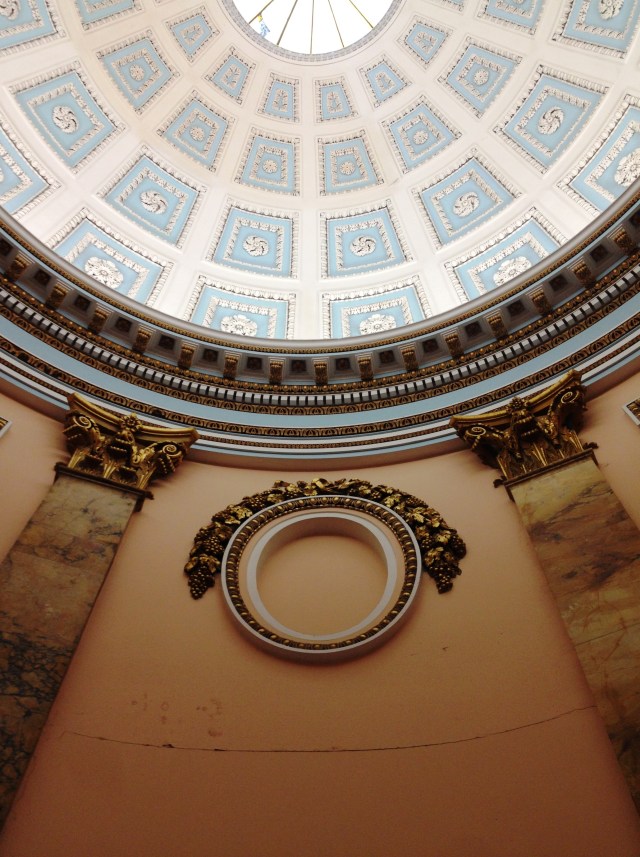
IMG_1493An account of Emo Court in the middle of the 19th century noted that ‘The principal apartments in the house are a grand reception saloon at the entrance, and a state drawing room, but these rooms, although built nearly sixty years rough bricks and stone still visible.’ Elsewhere could be found scaffolding and tools used on work begun but not concluded by the second earl who in the 1820s had employed the fashionable London architect Lewis Vulliamy and an otherwise little known trio of brothers called Williamson who ran a practice in Dublin. Between them, they had built a portico on the rear facade, decorated the dining room ceiling and designed the interior of the rotunda. It is the last of these that is shown here today, finally completed in around by yet another architect, William Caldbeck who also added that standard of the Victorian country house, a ‘bachelor’ wing. So what of this key space, aside from its basic form, can be attributed to James Gandon? The rotunda, otherwise known as the saloon, lies at a crucial juncture in the house, directly behind the entrance hall and between dining and drawing rooms. Here a series of marble pilasters capped with gilded Corinthian capitals rise to a coffered dome with glazed top. Niches between the pilasters would once have held statues and the floor is inlaid with elaborate parquet. The rotunda was intended to be the central point in an enfilade overlooking the gardens but could it ever have served any purpose, other than as a rather lovely meeting place while passing from one functional area to another? And again, what of its decoration can be considered based on Gandon’s intentions, and what those of the Victorian Caldbeck? It helps to compare the room with other near-contemporaneous examples, most obviously the saloon of Castle Coole, County Fermanagh designed by James Wyatt and dating from the same period. Again the walls are lines with Corinthian pilasters (scagliola) and there are round-topped niches (these holding Wyatt-designed stoves) the upper section of which has plasterwork which might have been Gandon’s aim for the Rotunda. Another, and closer, comparison can be made with Ballyfin, just a few miles away and designed in the early 1820s by the Morrisons, father and son. One suspects that in this instance, the incomplete work at Emo provided inspiration for Ballyfin’s top-lit rotunda (as the former’s library did for that at the latter) although here the walls are lined by Siena scagliola columns with Ionic capitals. So it seems reasonable to conclude that even if not executed by Gandon Emo’s rotunda displays his spirit.

IMG_1495

More on Emo Court in due course. With thanks to the Office of Public Works for permission to photograph the house’s interior.


A Triumphal Entrance

IMG_9327
Cloverhill House, County Cavan was shown here some months ago (see A Mere Shell, 9th September 2015), a ruin well on the way to vanishing altogether. Happily its entrance is in better condition, a slim, unadorned ashlar triumphal arch flanked by pedestrian gates. The residnce to which it originally gave access was extended by Francis Johnston in 1799, so one imagines the arch dates from the same period. The side gates need to be cleared of overgrowth if they are not to go the way of the old house.

FullSizeRender