Two years ago the Irish public voted Sir Frederic William Burton’s 1864 watercolour The Meeting on the Turret Stairs the nation’s favourite painting. Burton, who eventually became director of the National Gallery in London, was born in this house, Clifden, County Clare in 1816. The Burtons were landowners in this part of the country: Sir Frederic’s grandfather was High Sheriff of Clare in 1780. The family seem originally to have lived in a house called Riverstown which Samuel Lewis in his Topographical Dictionary of Ireland (1837) reported as being ‘now converted into a chief constabulary police station.’ It was presumably succeeded by Clifden, believed to date from c.1800 and a house of seven bays and two storeys over basement. The rendered façade is distinguished by the charming blind niche directly over the main entrance with its handsome cut limestone doorcase. The property has been recently and very sensitively restored.
Tag Archives: Georgian Architecture
Let the Door be Instantly Open, For There is Much Wealth Within…
Some attention has already been paid here to the eccentricities of Frederick Augustus Hervey, Bishop of Derry and Earl of Bristol, specifically the house he constructed at Downhill, County Derry (see It’s Downhill All the Way, October 28th 2013). Today the focus is on his other great building project in Ireland, one which attracted more attention at the time but is now largely forgotten, at Ballyscullion in the same county where work began around 1787/88 (that is, more than a decade after Downhill). As with the first house the architect credited for being responsible was Cork-born Michael Shanahan. He appears to have come to Hervey’s attention when, prior to his transference to Derry, he was serving as Bishop of Cloyne. Although Shanahan seemingly had trained as a stonecutter, he possessed a facility for drawing (he would teach this to the bishop’s son) and an interest in architecture. Hence he was taken up by Hervey and indeed taken to Italy in 1770-72 where time was spent in the Veneto, and specifically in Vicenza in May 1771. This is important because a key influence on Ballyscullion’s distinctive design is Palladio’s Villa La Rotonda (in turn derived from the Pantheon in Rome): one must assume it was seen by Hervey and Shanahan while they were in the area. A second influence, and one closer to home, is Belle Isle on Lake Windermere, Cumbria which was designed in 1774 by another self-taught architect, John Plaw. This is a circular building capped by a segmental dome and fronted by a full-height pedimented portico, all features shared with Ballyscullion. Since Plaw was based in London (and designed Belle Isle for a wealthy city merchant Thomas English) it is probable that Hervey and Shanahan would have seen his plans for the house even if they did not visit it.
Ballyscullion was never fully completed, and in its unfinished state was only intermittently occupied before being demolished a decade after the bishop’s death in 1803. Therefore imagination is required to grasp how it must have looked (aided by familiarity with Ickworth, Suffolk, the last of the bishop’s building schemes begun in 1795 and following a similar ground plan to that of Ballyscullion). However, the house was so curious in form and scale that many visitors were drawn there during its brief period of existence, and some of them left a record of what they found. A few of these now follow.
In August 1799 the Rev William Bisset, then Rector of Loughgall, Co Armagh (and later Bishop of Raphoe, County Donegal) travelled along the Ulster coast with his brother George. He kept a journal of the trip from which the following is taken:
‘Aug. 13_ at 7 O’Clock in the morning We left a very indifferent Inn, and sending our Baggage by the direct road to Coleraine, turned out of our way to gratify a curiosity which the name and character of Lord Bristol excited, to see his House at Ballyscullion. I was not disappointed for I expected something singular, and assuredly I found it_ the Singularity however did not please me_ his Lordship has put himself to great expence to produce a
very bad Effect_ at a distance One cannot imagine what extraordinary thing it is that stands so staringly in the Landscape_ a large black Dome raised high in the Air, without anything that seems proportioned or connected with it; no Trees, or dressed ground of any sort_ A gigantic Mass presents itself upon the naked Plain, and though I was so far prepared as to be actually going to see a large house, and one too that I expected would be in some respect or other singular, yet it did not occur to me that the Object I had in view long before I reached the Village of Ballaghy about a mile distant from it, could be the Mansion we were looking for_ such however it was; and upon a nearer approach we perceived it to be a large round house with a small Corinthian Portico, and surrounded by fluted Pilasters of the same Order_ Above these is a Frieze and Cornice, and upon the whole a high Attic Story with another Cornice bearing a ponderous Roof; every part of which is not only visible, contrary to the general Taste in Architecture, but is so strikingly conspicuous that I found it difficult to turn my Attention to anything else…
…I must observe however that the Plan of this House is not completed_ it is intended to connect it by a Colonnade with other buildings, and probably it will be less disagreeable to the Sight, when relieved in that manner_ The Hall appeared to me to be small, but I did not measure it, and as it is at present filled with Casts of the Laocoon, Centaurs, &c the dimensions may be more considerable than they now appear_ I could not mistake in observing that the Staircase is dark, and from the Figure of the house which is nearly circular, the fantastic Shape of the Rooms, at least of many of them may be supposed, and could not well be avoided_ The Eating room is a handsome one, and the Drawing room corresponding throughout, and the Pictures though not of the first Masters are such as one should like to have_ I am told there are no Originals, but the Person who shewed the house not having a Catalogue I could not make a memorandum of particulars_ Many of them were very pleasing to me_there is a beautiful Portrait of the present unfortunate Pope, a Death of Wolfe, the Departure of Regulus, and indeed a great number if not of the best and highest Character, certainly of sufficient merit to captivate an unskilful Person_ The Whole Taste of the Furniture is vicious; one should imagine it had been chosen by the Neapolitan Lady whose Portrait you are shewn, and who is said to have been a Favourite of his Lordship. Nothing can be more gawdy and effeminate, nothing less suitable to a Bishop, or agreeable to a manly taste_ the Library is almost without Books, a fault which cannot be remedied, as there are no places made to receive them_upon the whole I must confess, I am led to form as low an Opinion of the noble Owners proficiency in matters He seems to have devoted himself to, as his public conduct obliges me to form of his Character in those higher points to which his Rank and Profession have in vain demanded his Attention…’
Not long afterwards a more sympathetically-inclined Anglican clergyman visited Ballyscullion. This is taken from the Rev. George Vaughan Sampson’s Statistical Survey of The County of Londonderry published in 1802:
‘The house of Ballyscullion is so uncommon as to plan, that even the following imperfect sketch may be desirable to lovers of architecture.
The ground plan is an oval, whose greatest diameter is 94 feet, the shorter is 84 feet; around the building are disposed 20 fluted Corinthian pilasters of two feet nine inches in diameter; the intermediate spaces are faced with stone, quarried in the neighbouring mountains, in colour resembling the Portland stone. On the frieze are the following lines in gold letters, which encircle the house.
”Hic viridi in campo, templum de marmore ponam,
Propter aquam, tardis ingens ubi flexibus errat
Bannius, et tenui praetexit arundine ripas.”
Of these lines, the literal translation is: “Here is a verdant plain; I will place a temple of marble beside the waters, where the vast Bann strays in sluggish windings, and clothes his banks with tender reed.”
…The northern face presents a stately portico, supported by six pillars, similar to the pilasters as to order and dimension. On the frieze of the portico the following Greek verses are inscribed in large gold letters…”Immediately open ye doors, for much wealth is within, and, with that wealth, fresh-springing benevolence.”
Over a neat entablature is raised an attic storey, 12 feet in height; the building is crowned by a dome, in which is an elegant sky-light. The hall is in measurement 24 by 22½ feet, ornamented by admirable statues of the Apollo Belvedere, and the Vatican Mercury; the busts of Cicero, Demosthenes, Seneca and Pericles, of fine statuary marble, are placed in niches. The great stair-case is constructed geometrically, in the centre of the house; it is of cut stone, carrying with it a back stair-case, occasionally communicating; these form a kind of double spiral and both are lighted from above. A number of busts and statues are placed in niches, along the stairs and lobbies.
The drawing and dining-rooms are on the first floor; each of these is a segment of an ellipse, 36 feet long, 24 feet wide and 18 feet high: both rooms are ornamented with fine paintings. The library is 70 by 22½ feet. The upper rooms are sleeping chambers, each being the section of an ellipse.
From a small room on either side of the hall, a coridore (sic) is extended, which coridores are intended to conduct towards two large galleries, one for the paintings of the Italian, the other for those of the Flemish school: these galleries are to be 82 feet by 25.
Two large squares of offices, each 110 feet, are to be ranged in front of the galleries. All these are to be faced with cut stone, from the quarries near Dungiven. When completed, the line of building in front will extend nearly 350 feet.’
In October 1807, four years after Hervey’s death, the restless Rector of Navan, County Meath, the Rev. Daniel Beaufort made a tour of the north of the country (one wonders, did none of the period’s Anglican clergymen ever think to stay put in their parishes?). He was accompanied by his wife Mary and their youngest daughter Louisa. The latter was the first woman to be made an honorary member of the Royal Irish Academy and here is her account of the family’s visit to Ballyscullion:
‘2 miles brought us to Balaghy a tolerable village, church repairing, it has good spire, some very nice houses with flower gardens & shrubs before them. In the middle of the town was a very high pole, on the top of which was a board painted blue & orange, one person said it was a weather cock, another a free masons sign.
Here we turned off to Ballyscullen, whose ruin’d magnificence shew at once the taste & Madness of Ld. Bristol – it is circular in the Corinthian stile, built of well color’d free stone – brought from Ballinascreen, the pediment of the Portico white Marble veined with pale grey on which Ld Bs & the See Arms were carved in Italy, the Collumnes seem too slender for their height – the staircase is very light & handsome, all the work seems to have been uncomly well executed, as much of the handsome stucco, still remains tho’ all the windows have been taken out & sold, as were the floors, doors & every thing that could be got at, it is expected that Ld O’Neal will buy the staircase – the rooms were numerous shapes very pretty & well contrived – the lead from the roof has been sold, so that in a few years the weather will compleat what Avarice has so well begun.
The house was built on a gentle eminence which forms a small peninsula in Lough Beg, the view from it extensive & rendered pleasing by Church Island & It might have been made a very fine place, by plantings, the small groves that are there seem to grow extremely well.’
As has been mentioned before, the Earl-Bishop spent his last years in Italy where he died in July 1803; taken ill on the way to Albano he could only find sanctuary in the outhouse of a peasant who refused to admit a heretic into his cottage. An equally degrading fate awaited his great house at Ballyscullion. Along with the rest of his Irish property, this was left to yet another Anglican clergyman, the Rev. Henry Hervey Bruce whose great-grandfather had been the first Earl of Bristol. In 1786 his rich kinsman settled on him a yearly income of £400 and the incumbency of Tamlaghtfinlagan, County Derry. In addition Hervey Bruce became the Bishop’s steward at Downhill, assuming responsibility for both managed the estate and the diocese during the older man’s increasingly long absences from Ireland.
On coming into his inheritance, Hervey Bruce (who was created a baronet in 1804) removed the greater part of Ballyscullion’s contents to Downhill where he preferred to live. Ballyscullion was left to moulder: Louisa Beaufort’s observations reveal that even by 1807 it had begun to fall into decay. What could be sold out of the building was offered to buyers: the great staircase caught the attention of Lord O’Neill and went to Shane’s Castle where regrettably it too was lost in the great conflagration there in 1816 (see Fascination Frantic in a Ruin that’s Romantic, February 17th last).
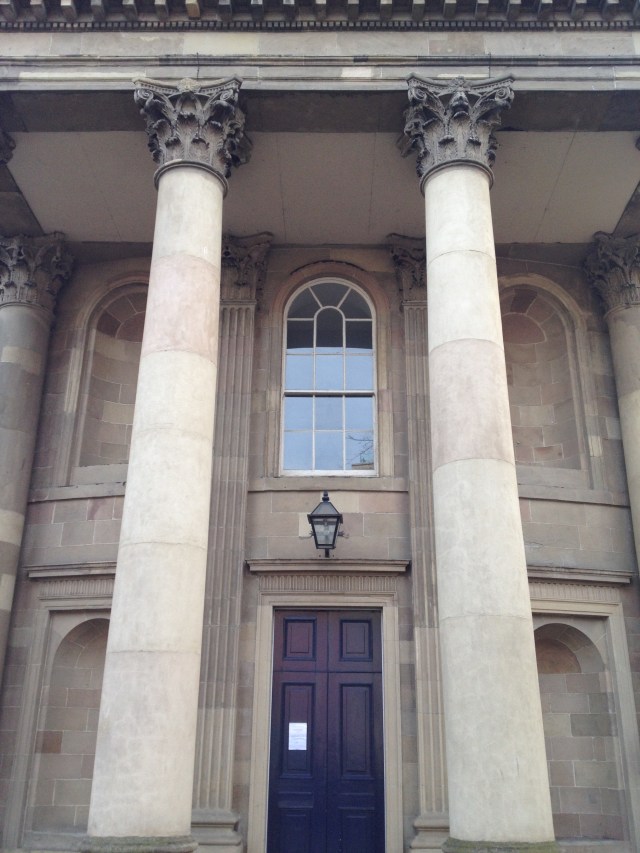
But not everything perished. For example, Ballyscullion’s portico with its four towering Corinthian columns was bought by Dr. Nathaniel Alexander, then-Church of Ireland Bishop of Down and Connor and presented by him to the rebuilt St. George’s Church in High Street, Belfast; supposedly the stones were first brought by horse and cart to Lough Neagh and from there travelled by the first cargo barge to make the journey to Belfast on the new Lagan Canal. Photographs of the facade of St George’s, incorporating the Ballyscullion portico, can be seen above.
For his own residence in Portglenone, Dr Alexander bought other items from Ballyscullion including chimneypieces and a pair of scagliola columns with corresponding pilasters (curiously this house has since become a Roman Catholic Cistercian monastery). Other pieces of Ballyscullion were acquired by diverse house owners and remain in some of these properties to the present time (see various pictures above). But within ten years Hervey’s great building was largely gone and today almost nothing remains other than the outline of the main block’s foundations and the partial walls of one of the galleries, all of it surrounded by thick woodland.
There is still a house on the Ballyscullion estate: in 1840 Sir Charles Lanyon designed a handsome new residence – see below – for Admiral Sir Henry Bruce (a younger son of the Rev. Sir Henry Hervey Bruce) who at the age of 13 had fought at the Battle of Trafalgar and went on to command the British fleet in the Pacific. Ballyscullion Park remained in the possession of the Bruce family into the last century before being sold in 1938 to the Hon. Sir Harry Mulholland, first Speaker of the Northern Ireland Parliament at Stormont. Sir Harry’s grandson Richard and his wife Rosalind live in the house today and maintain the property with every respect and appreciation for its distinguished and colourful history. The Bishop’s Ballyscullion may have gone but its memory is duly cherished.
For more information on Ballyscullion Park, see: http://www.ballyscullionpark.com
Court Out
The main entrance to the former Court House in the county town of Antrim. A popular venue for markets and fairs since the first patent to do so was granted in 1605, inevitably there was a certain amount of disruption whenever these took place. Hence the citizens of Antrim felt the need to have a court house where miscreants could be tried and punished. In the early 18th century, the County Antrim Grand Jury granted £150 ‘towards building and carrying on a Session House in the town of Antrim in and for said county.’ Dating from 1726, the court house is of two storeys, that on the lower level originally having an open arcade where mercantile activity could take place even while justice was being administered upstair. By 1836, the ground floor had been converted into an enclosed yard
for prisoners attending trial and for confining drunkards
and rioters. The building continued to serve as a courthouse until 1994 since when it has been extensively restored by the local authority. Commendable work, although one must regret the installation of such commonplace light fittings and metal grills.
When New Becomes Old
In early June 1765 Faulkner’s Dublin Journal reported that the former M.P. Francis Bindon had ‘died suddenly in his chariot on his way to the country’ before going on to describe him as having been ‘one of the best Painters and Architects this Nation has ever produced,’ as well as ‘a most Polite, wellbred gentleman and an excellent scholar which he improved by his Travels abroad.’
We know a certain amount about Bindon but some facts elude us, such as the date of his birth although this must have been around the end of the 17th century. He was the fourth of five sons and three daughters born to David Bindon, M.P. for Ennis and Dorothy Burton, whose family controlled the Ennis Parliamentary borough. Based at Clooney, County Clare, an estate they acquired in the 1660s, the Bindons were substantial landowners in that county and in neighbouring Limerick. Among Francis’ siblings, two brothers Henry and Thomas studied at Trinity College Dublin, the former becoming a barrister-at-law, the latter Dean of Limerick. The other two brothers David, who wrote on trade and commerce, and Samuel both served as M.P. for Ennis as indeed did Francis after 1761: even in the 18th century Irish politics was a family affair. However, of especial interest to us here is the fact that in 1716 Samuel married Anne, daughter of Thomas Coote of Coote Hill aunt of the distinguished architect Sir Edward Lovett Pearce.
Bindon was a successful gentleman amateur sans pareil: family wealth and connections meant he did not have to earn a living, yet he appears to have been highly productive throughout his life. It would seem he spent some time studying abroad: he is recorded as having been in Padua with his cousin Samuel Burton of Burton Hall, Co. Dublin, in October 1716. He is also believed to have attended the Academy of Painting run by Sir Godfrey Kneller in London between 1711-16. Returning to Ireland and settling in Dublin where he spent the greater part of his time thereafter, Bindon built up a substantial practice as a portraitist, no doubt aided by his family’s political links. Sitters included the Viceroy, Lionel Sackville, Duke of Dorset painted in 1734 and Jonathan Swift, Dean of St Patrick’s Cathedral painted four times by Bindon between 1735 and 1740. Many other well-connected clerics sat for him like Dean Patrick Delaney, Archbishop Hugh Boulter and Archbishop Charles Cobbe. Bindon was a member of the Dublin Society in 1733 (two years after its foundation) and that same year was given the freedom of the Guild of St Luke in Dublin (the city’s Corporation of Painter-Stayners). By 1758 failing eyesight had forced him to give up painting and the following year he drew up a will, leaving most of his possessions in Dublin and an annuity of £75 for life to Francis Ryan, a house painter of Dublin, who had lived and worked with him for many years.
In addition to working as a portraitist, Bindon was also an architect, his ties by marriage with Sir Edward Lovett Pearce being of use in gaining commissions. It appears that he collaborated on at least two projects with Richard Castle, who following Pearce’s death in 1733 had become as the country’s premier designer of country houses. The first of these was the now-ruined Belan, County Kildare (see Splendours and Follies, September 30th 2013), and the second Russborough, County Kildare where Bindon is considered to have been responsible for the interiors following Castle’s own death in 1751. A number of houses in his native County Clare are attributed to him including Carnelly, Newhall and Castlepark as well as two once fine residences in County Kilkenny: Woodstock (see Of Wonderous Beauty did the Vision Seem, May 13th 2013) and Bessborough (see In the Borough of Bess and Back to Bessborough, November 25th and December 2nd 2013). As an architect, Bindon was certainly not of the first rank, his work being derivative and dependent on a handful of leitmotifs. As the Knight of Glin wrote in an assessment of Bindon’s output, examined collectively ‘one cannot help noticing the solid, four square somewhat gloomy quality of many of them. They are often unsophisticated, naive and clumsily detailed but they nevertheless amount to a not unrespectable corpus, worthy to be recorded and brought in from the misty damps that surround so much of the history of Irish Palladianism.
’
And there is one piece of work that is rather special, namely that shown here today: Bindon’s design for John’s Square, Limerick. Work on this began in 1751, meaning it predates by a couple of years the earliest of similar developments in Dublin, Rutland (now Parnell) Square. John’s Square was a speculative scheme undertaken by two local men, John Purdon and Edmond Sexton Pery (future speaker of the Irish House of Commons) on a site in Limerick’s Irishtown which had never recovered from an assault by Williamite troops during the siege of the city in August 1690. Members of the local aristocracy and gentry when visiting Limerick had nowhere fashionable to stay, and New Square as it was originally called, was created to address this need. Eight houses (with a further two subsequently added) were built on three sides of the square, the fourth easterly side being occupied by the church of St John which still remains, although rebuilt in the mid-19th century and no longer in use for services.
Built at a cost of £630, John’s Square as designed by Francis Bindon consists of two L-shaped blocks of limestone-fronted houses each one identical to its neighbour and sharing certain features such as brick-lined oculi. Eight of the houses are three-bay, three-storey over basement, those at the extreme end of the north and south sides being larger and running to five bays. When the square was completed, Pery and Purdon both took a property, the other houses being let at £32 per annum. Original tenants included Vere Hunt from Curraghchase, William Monsell of Tervoe and Pery’s brother, the Rev. William Cecil Pery, later Bishop of Limerick.
In her 1991 book The Building of Limerick Judith Hill, having noted that the development of John’s Square ‘was Limerick’s first taste of fashionable urban architecture’ goes on to report that a surviving building account made by Pery for the scheme and dating from 1751 to 1757 ‘gives an insight into the materials used and the construction process at this date. Pery appears to have paid each worker separately, a role taken today by the building contractor. He not only paid those on the city site but also quarrymen, stone-cutters and turf carriers presumably operating locally but at a distance. Brick also seems to have been burnt locally for Pery paid for turf “in nine boats” and “the emptying of the boats and casting of turfs into the green brick yard”. He paid men for attending the fire, he paid for reeds for their shelter and for the loading, carriage and landing of kiln-loads of brick at Mardyke. … Brick was used in John’s Square for floors to the kitchen and the passage, the vaulting to the cellars, the internal partitions, as a dry lining to the exterior walls and as an infil for the stone oculi on the facades. There was sufficient faith in the strength and integrity of locally produced bricks to give them a significant structural role.’
Following the demolition of the old city walls, in 1765 Edmond Sexton Pery commissioned the Italian engineer Davis Ducart to design an urban plan for land he owned to the immediate south of Limerick: this became known as Newtown Pery. Its emergence spelled trouble for John’s Square as wealthy residents preferred to move to the newer quarter: typically both Pery and his brother the bishop acquired alternative residences on Henry Street.
Meanwhile John’s Square began going into decline. For example, one Sam Dixon opened a dye works to the immediate rear of his residence at the extreme end of the south side. On the opposite side there appears to have been a brewery established (behind what is today a butcher’s shop). In the 19th and early 20th centuries many of the houses became tenements, although No. 3 on the north side remained the residence of the rector of St John’s Church until 1922 (it is distinguished from all the other houses by a wider doorway with fanlight which one assumes was inserted in the late 1700s). By the 1960s many of the properties were vacant and there was talk of demolishing the entire square. Fortunately this did not come to pass and instead extensive restoration work was carried out in 1975 to coincide with European Architectural Heritage Year. Further improvements were undertaken more recently with the local authority laying down granite paving, upgrading lighting and introducing traffic calming measures.
Even if it never returns to fashionability, the future of John’s Square is now secure, although after all the money spent improving the area’s appearance it is a disappointment so many of the houses have inappropriate uPVC windows and other ill-considered alterations. Nevertheless, considering what might have happened here, one should rejoice this very important example of 18th century urban improvement still stands. To end, a photograph of John’s Square taken probably in the 1950s when its survival looked much less certain than it does today.
Villas for Villiers
A plasterwork panel forming part of the stairwell decoration at Kilpeacon, County Limerick. The building’s external appearance makes it look like a modest-sized villa but this is an case of looks being deceptive since Kilpeacon proves a substantial country house. Dating from c.1810-20 its design is attributed to Sir Richard Morrison whose client would have been local land owner Edward Cripps; he assumed the additional surname of Villiers on inheriting property from an uncle who had died childless. This gentleman’s widow, Mrs Hannah Villiers, on her own death in 1821 left funds to build alms houses in Limerick city; designed by James Pain and still in use, these were originally intended ‘as an asylum for Protestant, or Presbyterian widows, who will each receive £24 per annum besides most comfortable accommodation.’
More about Kilpeacon in the coming weeks.
Completely Floored, Part Two
The entrance hall of Ballyfin, County Laois is paved with an elaborate marble floor the centre of which features a large antique Roman mosaic. Along with many other decorative elements, this was sent to Ireland from Italy in 1822 and incorporated into the Morrisons’ design for the house, a triumph of early 19th century neo-classicism.
La nature est un temple*
This small domed stone temple was originally erected around 1740 by Sir Compton Domville on his estate at Templeogue, Dublin. Later moved to Santry Court, it was lying in pieces on the ground when discovered in the late 1940s by architectural historian Maurice Craig. He encouraged Oonagh Guinness to rescue the monument and re-erect it at Luggala, County Wicklow on the shores of Lough Tay. In recent years her son Garech has further restored the temple and replaced its lost ball finial.
*from Baudelaire’s Correspondences.
Charity Begins at Home
From George Benn’s The History of the Town of Belfast, with an Accurate Account of its Former and Present State (published 1823):
‘The Belfast Incorporated Charitable Society, or as it is more generally denominated the Poor House, for the reception of aged and infirm persons, as well as for the support and instruction of children destitute of protectors, has long remained a noble proof of the general philanthropy which prevails among the inhabitants of this town. It stands at the extremity of Donegall Street, in an elevated and healthful situation. The ground was granted by the late Marquis of Donegall, the building completed by subscriptions and the produce of a lottery, and first opened for the purposes above stated in the year 1774. Since its commencement, it has preserved annually about three hundred individuals, old and young; the former from want and misery, the latter from idleness and vice. The children are here instructed in the elementary branches of education, till they are capable of being apprenticed out to trades. The old are carefully attended to, being permitted to increase their comforts by their own industry; and it is a proof not less of the instability of fortune than of the great benefits of the establishment, that an individual was lately received into the Poor House who had, in more prosperous times, contributed to its support. All its inmates, varying in number but commonly about three hundred and fifty, are fed and clothed at the expense of the society. The dress of the children is uniform; they walk on the Sabbath Day, hand in hand, to the respective houses of worship; and due care is taken, in every respect, of their moral and religious habits. The whole government of the Institution is conducted in the most methodical manner, and it receives contributions from every denomination of Christians, all being anxious for the continuance of an establishment which is as invaluable to the poor as it is creditable to the opulent.’
In the 18th century Belfast was a small but growing market town and port: as late as 1801 its population stood at just 19,000. Nevertheless, the town’s spirit of enquiry and liberalism can be seen through several developments during this period, such as the publication of what is now the world’s oldest surviving English language daily newspaper, the Belfast News Letter, (started 1737), the creation of the Belfast Academy (now Belfast Royal Academy) in 1785 and the setting up of a library (later to become the Linenhall Library and still extant) three years later. Of interest here today are the origins of another organisation which continues to the present day, the Belfast Charitable Society.
In 1631 Edward Holmes, a former Sovereign of Belfast (as the city’s mayors were called until 1842) left in his will ‘to the poore decayed inhabitants of Belfast 40 pounds.’ This created a fund to which further sums were added over the next hundred years. However by the middle of the 18th century, it was apparent that more was required to assist the poor and needy. Hence in late August 1752 a group of concerned citizens met at an establishment called the George Inn and there resolved ‘to consider a proper way to raise a sum for the building of a poor House & Hospital & a new Church in or near the town of Belfast.’
A site of eight acres for the project was granted by Arthur Chichester, fifth Earl (and later first Marquess) of Donegall, whose family had long owned most of the land on which Belfast developed. The funds required to build the Poor House, at an estimated cost of ₤7,000, were raised through private donations and also by running a lottery based on the model of that already existing in Dublin. Work started promptly and in December 1774 the new premises were officially opened by Lord Donegall with the following accommodation: seven beds for the sick, four double beds for the beggars, twenty-two double beds for the poor and four single beds for vagrants.
The building’s design has an interesting history. Both the Scottish-born architect Robert Mylne and his former draughtsman and clerk Thomas Cooley submitted proposals, but eventually the person responsible was a local amateur, Robert Joy (1722-1785). He and his brother Henry were co-proprietors of the aforementioned Belfast News Letter, which had been founded by their father Francis Joy; they were also uncles of the United Irishman, Henry Joy McCracken. The siblings were among the key figures behind the Poor House’s foundation and hence it is understandable that Robert Joy should have been permitted to have the final say in its design. However, extant drawings by Mylne indicate that his work provided a basis for the eventual structure. Corridors off a passage behind the entrance hall, for example, retain walled-up Tuscan columns, part of what was once an open-air colonnade, a feature of Mylne’s scheme. On the other hand, Joy replaced the dome and lantern proposed by Mylne with an octagonal stone tower and spire rising behind the brick facade the appearance of which mimics that of a Palladian country house. Despite the spire, the church which was originally intended to be part of the scheme was never built.
It is instructive, if a little disturbing, to read the role played by the Poor House’s more youthful occupants in the establishment of the cotton industry in Ulster. This account is taken from Philip Dixon Hardy’s 1820 publication The Northern Tourist:
‘In 1771, at which time there was not a single cotton loom in the whole North of Ireland, the late Robert Joy conceived the scheme of introducing into this then desponding kingdom the cotton manufacture which had proved an unfailing source of industry and consequent opulence to the sister country. Having, in conjunction with Thomas M’Cabe, suggested that the spinning of cotton yarn might, as an introductory step to the establishment of the manufacture, be at once a fit and profitable employment for the children in the Belfast Poor-house, several of them were set to work…And shortly after an experienced spinner was brought over by Mr Joy from Scotland, to instruct the children in the Poor-house. Also, under the same direction, and at the expense of the gentlemen mentioned, a carding machine was erected at Mr Grimshaw’s, to go by water, which was afterwards removed to the Poor-house, and wrought by hand. A firm was now formed of the original projectors, and others, under the name of Joys, M’Cabe and M’Cracken, who contracted with the same charitable institution for the employment of a number of its children, as well as for the use of its vacant rooms…In less than ten years from their first introduction in the country, several thousand looms were employed in the manufacture of cotton in the towns of Belfast, Lisburn and Hillsborough.’
During its first decades of operation, the Poor House looked after inmates well, not least by providing them with all necessary clothing and food. With regard to the latter, daily meals included bread, cheese, milk, broth, rice and porridge. Beef and veal were added to the diet on Sundays. On Sundays, the meal included beef and veal, this at a time when around a third of the country’s population lived on potatoes and buttermilk.
Local physicians attended the sick in the Poor House, their services provided without charge, and there was also a dispensary where the same doctors would see the unwell from outside the house on Tuesdays and Saturdays. In 1794 the Belfast Charitable Society opened Ireland’s first Fever Hospital in a rented building on Factory Row (now Berry Street) and soon afterwards, as a means of raising funds, it started a cemetery in the city. Other methods of generating income included taking responsibility for Belfast’s water supply, which it did from 1795 to 1840, and then charging households for access to fresh water.
By the time the society gave up this role (in return for financial compensation), much else had changed, not least new Poor Laws and a more active role by the state in the provision of assistance to those citizens unable to support themselves. However, the Poor House remained true to its original purpose and indeed expanded premises during the course of the 19th century. In 1821 and 1825 respectively extensions were made behind each of the end wings and then in 1867 a block was built at right angles to these; five years later it was linked to the rest of the property by further additions thereby creating a quadrangle as had originally been envisaged by Robert Mylne.
After the Belfast Charitable Society celebrated its 250th anniversary in 2002, a decision was taken to build a new nursing home elsewhere in the city. The old property was handed over on a seventy-year lease to another charity, Helm Housing Association, the funds thus generated allowing for a programme of necessary renovation. Since then the building has been shared between the two organisations, offering sheltered accommodation and operating as an old persons’ home. This year marks the 240th anniversary of the opening of Belfast’s Poor House (now called Clifton House), the oldest complete surviving building in the city, a wonderful example of 18th century philanthropy, a landmark structure and yet somehow little known even by the local population.
Ascension to Heaven
Despite its name, there is nothing defensive about Bracklyn Castle, County Westmeath. On the contrary, the house dates from c.1790 and in style has been likened to the work of the young John Soane. Behind an entrance hall is the staircase, lit from above by an oval dome. A gallery with wrought-iron balusters occupies a substantial portion of the first-floor landing from which are accessed the main bedrooms.
All Tied Up in a Bow
The double doors leading from drawing to dining room at Ballinlough Castle, County Westmeath are recessed within a large arched bow. And there are further bows evident in the delicate plasterwork that runs around the alcove and features garlands of flowers and leaves caught up in ribbon. The style is essentially rococo in spirit even though the room and its decoration date from c.1790, one of those anachronisms that one encounters in Ireland where a fondness for certain forms could sometimes linger long after they had fallen out of fashion elsewhere.