In Praise of Narcissism

IMG_2647

Although undoubtedly a great humanitarian, Jonathan Swift was also capable of outbursts of spite. As evidence of which one cites his short essay Character of Primate Marsh, believed to have been written around 1710 (although only published thirty-five years later). In this piece of invective against the then-Archbishop of Armagh, Swift wrote ‘Marsh has the reputation of the most profound and universal learning; this is the general opinion, neither can it be easily disproved. An old rusty iron-chest in a banker’s shop, strongly lockt, and wonderful heavy, is full of gold; this is the general opinion, neither can it be disproved, provided the key be lost, and what is in it be wedged so close that it will not by any motion discover the metal by the clinking…No man will either be glad or sorry at his death, except his successor.’ Certainly following Marsh’s elevation to the primacy his successor in the archdiocese of Dublin William King was equally unkind, describing him as being ‘very dextrous at doing nothing.’ Of course unlike Swift and King, and despite being a Lord Justice of Ireland on six occasions, Marsh does not appear to have been particularly interested in politics and this could explain the two men’s dismissive remarks. Because despite what they might have thought and did write, Archbishop Marsh was far from being an ineffectual cleric and left a lasting and generous legacy through the establishment of the first public library in Ireland.

IMG_2604

IMG_2595

Narcissus Marsh was born in Wiltshire in 1638 ‘of honest parents,’ as he wrote in his diary. His name, while unusual, was not so distinctive as that given to either of his two brothers who were christened Epaphroditus and Onesiphorus: all three derive from persons mentioned in St Paul’s Epistles. While an undergraduate at Oxford Marsh decided to take orders and soon after was offered a living in Swindon, only subsequently discovering that he was expected to marry a friend of the people responsible for his preferment. This he refused, having determined never to marry since he believed he could only serve the church while a bachelor.
Returning to Oxford he continued his studies until appointed Principal of St Alban Hall in Oxford by the first Duke of Ormond who was Chancellor of the University; it was presumably through this connection that in 1679 he came to Ireland to take up the Provostship of Trinity College in Dublin. One of his greatest achievements during this time was arranging for an Irish translation of the Old Testament (the New Testament having already been translated earlier in the century). He also employed, at his own expense, a former Catholic priest, Paul Higgins, to teach Irish to the students at Trinity College and to preach an Irish sermon once a month; seemingly both sermons and lectures were extremely popular.
Marsh was appointed Bishop of Ferns and Leighlin in 1683 but following the accession of James II found himself much harassed and eventually retreated to England, only returning to this country after the Battle of the Boyne. In 1690 he was made Archbishop of Cashel and four years later moved to Dublin. Finally in 1703 he became Archbishop of Armagh and remained there until his death ten years later.

IMG_2579

IMG_2586

It was while Provost of Trinity College that Marsh conceived the notion of establishing a new public library in Dublin. He had already undertaken work to improve the college’s own facilities, revising the library regulations, and insisting that when a keeper was appointed all the books in his care must be accounted for, either replacing or paying for any that had been lost. But Marsh also noticed how hard it was for potential scholars to use the college library, remarking that what rendered it inaccessible to the greater part of the population was that according to the institution’s statutes ‘no man, besides the Provost and Fellows is permitted to study there, unless carry’d up thither by one of them, who is bound to be present all the time the other stays in the library: and ‘twas this, and this consideration alone that at first mov’d me to think of building a library in some other place (than in the college) for public use, where all might have free access, seeing they cannot have it in the College; nor are our booksellers’ shops furnished anything tolerably with other books than new trifles and pamphlets, and not well with them also.’
Hence following his appointment to Dublin Marsh embarked on the creating a library which, while a place of scholarship, would also be open to everyone. To ensure its legal status, he wished the new foundation to be incorporated through an Act of Parliament. However, the bill he drew up for this purpose met with severe opposition from some of his fellow clerics, including Jonathan Swift. Because the new library was within the grounds of St Patrick’s Cathedral, Marsh proposed that its keeper also be the cathedral’s Precentor (that is, the clergyman in charge of organising liturgy and worship). Those against this move were concerned that property belonging to the Church of Ireland might be lost to the library, the board of which could come to exercise authority over the Precentor. A second point of complaint arose from Marsh’s intention to appoint as keeper a Huguenot refugee, Elias Bouhéreau (of whom more below) based on the latter’s commitment to donate his own collection of books to the library, a requirement allowing the opposition to claim the Archbishop had engaged in simony through what was effectively the sale of an ecclesiastical office. These matters may seem of small importance to us today, but they caused a great deal of trouble at the time and delayed the official establishment of the library. Ultimately Marsh was forced to abandon the link between Keeper and Precentor (although Elias Bouhéreau did take up his duties) and in 1707, by which time he had transferred to Armagh, he was able to see passed an act ‘for settling and preserving a Publick Library for ever.’

IMG_2565

IMG_2576

One of the few 18th century buildings in Ireland still used for its original purpose, Marsh’s Library holds a collection of over 25,000 books and 300 manuscripts. There are eighty books printed before 1501, 430 books printed in Italy before 1600, 1,200 books printed in England before 1640 and 5,000 books printed in England before 1700. At the heart of all this material is the library assembled by Edward Stillingfleet, Dean of St Paul’s Cathedral, London and from 1689 Bishop of Worcester. Following his death in 1699, there was much public interest in what would happen to Stillingfeet’s books, deemed to constitute the best private library in the British Isles. Efforts were made to keep it in England but in 1705 the entire printed collection of almost 10,000 books was purchased by Marsh for just over £2,000 and brought to Dublin where it has remained ever since. It contains works on diverse subjects including theology, history, the classics, law, medicine and travel, whereas Marsh’s own collection reflects his interest in oriental studies including Arabic and Hebrew books as well as his engagement with the Irish language: in 1695 he had bought a number of manuscripts belonging to the distinguished jurist and orientalist, Dudley Loftus (of whom Marsh wrote that he ‘never knew so much Learning in the Keeping of a Fool,’ although this did not stop him acquiring Loftus’ collection).
Then there are the books that originally belonged to the institution’s first librarian, Dr Elias Bouhéreau, a Huguenot doctor from La Rochelle who had left France following the Revocation of the Edict of Nantes in 1685. Bouhéreau’s collection contains many works relating to his native country and to the various religious controversies of the 17th century as well as medical texts. Finally a fourth major collection was bequeathed to Marsh’s library in 1745 by John Stearne, former Bishop of Clogher (who left his manuscripts to Trinity College, Dublin where he had earlier provided £1,000 to build a printing house). As former Keeper Muriel McCarthy has noted, ‘It is easy to forget that in the early eighteenth century Marsh’s would have been regarded as a modern library with the latest books and a modern classification system. To study and examine the books in Marsh’s is to explore a world which has been one of the hallmarks of Europe’s great cultural heritage.’

IMG_2537

IMG_2556

Not only have the contents of Marsh’s library scarcely altered since originally assembled by its founder, but so too has its appearance remained much the same. Built at a cost of £5,000 the core of the building was designed 1701-3 by Sir William Robinson who for the previous three decades had acted as Surveyor General of Ireland and whose other extant works include the Royal Hospital, Kilmainham. In 1710 Thomas Burgh, who had succeeded Robinson as Surveyor General, extended the library by adding another wing and also designed its entrance porch. Thereafter little happened structurally until the mid-19th century when, as part of the restoration work to St Patrick’s Cathedral underwritten by Benjamin Lee Guinness, a new entrance front and stair hall was built, as well as a Gothic gateway. At the same time the easterly churchyard elevation was clad in limestone, but the 18th century brick courtyard on the other side of the library survives, as do the original interiors.
The library proper is primarily composed of two first-floor galleries, the earlier (designed by Robinson) running sixty feet south-north, while that added by Burgh at right-angles to the north corner is linked by a librarian’s room and runs seventy-six feet west-east. At the latter end is a short further extension which originally provided direct access to the former Archbishop of Dublin’s Palace of St Sepulchre. This stretch is distinguished by having three enclosed alcoves known as ‘cages’, their carved timber tympana decorated with gothick tracery and finials: these spaces were intended to ensure the safety of the smaller, more valuable books since users could be locked inside. The main galleries are indebted for their appearance to Oxford’s 17th century Bodleian Library, with which Marsh was familiar from his time at that university, and which he cited in correspondence when discussing his own intentions; he wrote to a friend and fellow cleric Dr Thomas Smith that the Dublin building’s upper part ‘is contrived like the cross part of the Bodleyan Library.’ On either side of both galleries and at right angles to the windows are a succession of dark oak bookcases, the stack end of each treated as a pedimented pier with painted and gilded cartouches bearing classmarks while the top is surmounted by carved cartouches with mitre and stole finials. The uniformity of this design, and the fact that it has not been subject to alteration, helps to give the galleries their special character and to link today’s users to their 18th century precursors.
Marsh’s Library remains dedicated to its original purpose but in addition welcomes visitors and hosts temporary exhibitions (the next of which, Imagining Japan, 1570-1750, opens to the public on April 16th). It is one of our best and least changed bonds with the dynamism of Georgian Dublin, an era more often honoured in the breach than in observance of due respect for its achievements. But by remaining true to the founder’s original wishes Marsh’s Library both honours the past and bears witness to the erroneousness of Swift’s unkind remarks.

IMG_2635

With thanks to the staff, Governors and Guardians of Marsh’s Library. For more information, see: http://www.marshlibrary.ie

A Pale Reflection

IMG_2415

120 St Stephen’s Green is one of a pair of houses on the west side of the square designed by Richard Castle to look from the exterior like a single unit. Following Castle’s death in 1751, the development was sold by his executors to Richard Thwaites who by 1764 had completed and leased the houses. No. 120 is the finer, and more intact of the two and contains some delicious rococo plasterwork such as that seen here reflected in a mirror over the first-floor saloon chimneypiece.
More about 120 St Stephen’s Green in the coming weeks.

Villas for Villiers

IMG_1965

A plasterwork panel forming part of the stairwell decoration at Kilpeacon, County Limerick. The building’s external appearance makes it look like a modest-sized villa but this is an case of looks being deceptive since Kilpeacon proves a substantial country house. Dating from c.1810-20 its design is attributed to Sir Richard Morrison whose client would have been local land owner Edward Cripps; he assumed the additional surname of Villiers on inheriting property from an uncle who had died childless. This gentleman’s widow, Mrs Hannah Villiers, on her own death in 1821 left funds to build alms houses in Limerick city; designed by James Pain and still in use, these were originally intended ‘as an asylum for Protestant, or Presbyterian widows, who will each receive £24 per annum besides most comfortable accommodation.’
More about Kilpeacon in the coming weeks.

Completely Floored, Part Two

IMG_0984

The entrance hall of Ballyfin, County Laois is paved with an elaborate marble floor the centre of which features a large antique Roman mosaic. Along with many other decorative elements, this was sent to Ireland from Italy in 1822 and incorporated into the Morrisons’ design for the house, a triumph of early 19th century neo-classicism.

And a Little Bit More Dromore

image

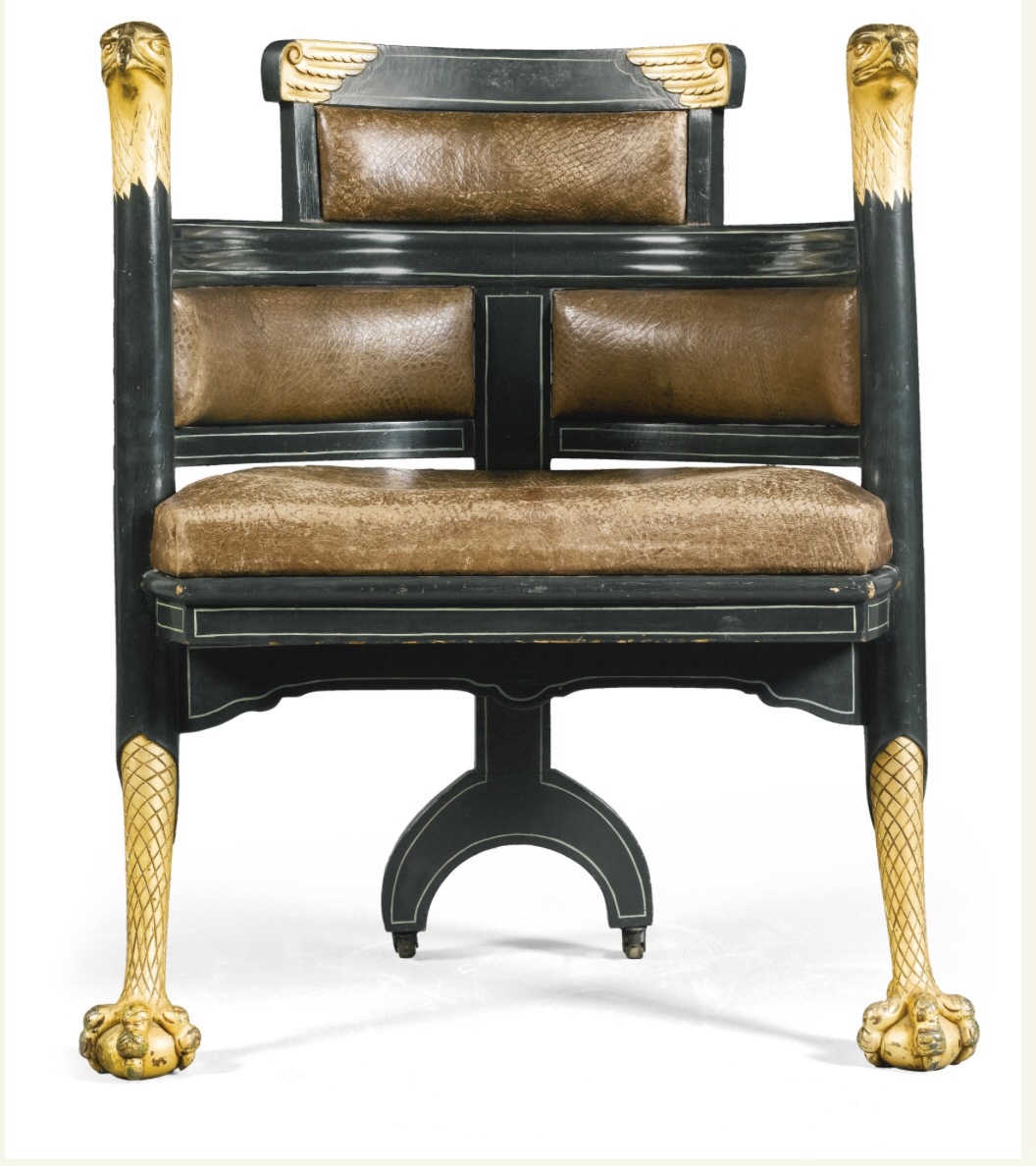
After yesterday’s post about Dromore Castle, County Limerick it transpires that tomorrow in London Sotheby’s will be selling a chair the original of which was designed by Godwin for the library of the house. The ‘Eagle’ Chair is more Egyptian than Gothic in inspiration and indicates how eclectic were Dromore’s interiors. Like all the other furnishings, it was manufactured by William Watt’s Art Furniture Company and some pieces including this one featured in the company’s 1877 catalogue.
It is unknown how many ‘Eagle’ chairs were subsequently produced: a version in oak with variant stretcher and reupholstered in brown leather was sold at Christie’s, London in May 1995 for £18,400. This one carries a pre-sale estimate of £8,000-£12,000.
For more information on the lot, see: http://www.sothebys.com/en/auctions/ecatalogue/2014/1000-ways-seeing-l14313/lot.248.html

All Tied Up in a Bow

IMG_6678

The double doors leading from drawing to dining room at Ballinlough Castle, County Westmeath are recessed within a large arched bow. And there are further bows evident in the delicate plasterwork that runs around the alcove and features garlands of flowers and leaves caught up in ribbon. The style is essentially rococo in spirit even though the room and its decoration date from c.1790, one of those anachronisms that one encounters in Ireland where a fondness for certain forms could sometimes linger long after they had fallen out of fashion elsewhere.

IMG_6674

Gallia Urba est Omnis Divisa in Partes Tres*

IMG_8646

In a book of his photographs published the year he died (2011) architectural historian Maurice Craig included the image above of Gaulstown, County Westmeath which he had taken in 1975. He recalled seeing the house then for the first time and commented, ‘It looked a bit neglected, but it seemed to be all there, especially the roof. I saw a new house only a few yards away (out of frame on the left) and drew the obvious conclusion: that my pet would soon be bundled away. I was wrong.’
In fact Maurice was wrong on two counts. Firstly there never was a new house only a few yards away, it is actually hundreds of yards away and completely invisible from Gaulstown. And of course its construction did not mean the loss of the old house which continues to stand almost four decades after it was noted by Maurice.

IMG_0538

IMG_0604

As is unfortunately all too often the case, we know little about the origins of Gaulstown. It bears similarities to a pair of similarly miniature Irish villas, Whitewood Lodge, County Meath (1735) and Ledwithstown, County Longford (1746) both of which are attributed to Richard Castle. Both are also larger and more refined in their details, and one has a sense that Gaulstown, the earliest of the trio (dating from c.1730) was something of a trial run for the other two. Casey and Rowan propose that it might have been designed by Sir Edward Lovett Pearce or perhaps his associate William Halfpenny. Maurice Craig was inclined to agree with this assessment but it seems too grand an attribution for such a modest dwelling. Might not Gaulstown instead have been the work of an amateur, perhaps even the original owner, a member of the Lill family generations of which lived here in the 18th and 19th centuries (although they would change their name to de Burgh for the sake of an inheritance)? Without wishing to disparage its considerable charms and its importance Gaulstown has the appearance of a building containing a variety of architectural motifs borrowed from books but, as the interior layout reveals, without these being necessarily completely understood or interpreted.

IMG_0540

IMG_0544

Casey and Rowan describe Gaulstown as being of only one storey over raised basement and with an attic, but this is not really the case since it possesses a trio of reasonably substantial floors. The roughcast rendered exterior is rigorously plain of three bays, that in the centre of the south-facing facade projecting forward. A long flight of steps leads to the substantial cut-limestone doorframe, which is an adapted Venetian window above which floats a small Diocletian window beneath the pediment: the only other openings on the front are windows on either side of the entrance, so that the building has an ascetic rigour that is most appealing.
Inside the main floor was originally divided (just like ancient Gaul) into three parts. The centre space formed one room running south to north for the full, albeit not terribly considerable, depth of the house. However at some date, probably for reasons of greater comfort and warmth, a partition wall was inserted dividing it into entrance hall with drawing room behind: the latter has a Venetian window mirroring that used for the entrance. To the east is a dining room, to the west the staircase and, behind it, a small boudoir or office. The stairs are lit by a large window on the return and they lead to a surprising number of bedrooms. Meanwhile the basement is also more generously spacious than would superficially appear to be the case.

IMG_0608

IMG_0594

IMG_0568

‘This appealing structure,’ comments the author of Gaulstown’s assessment in http://www.buildingsofireland.ie ‘was designed with obvious architectural aspirations and is extremely well-proportioned, having instant visual appeal. It is strangely imposing for a structure built on such a small scale and this is down to the quality of the massing.’ This is an admirable summary of the house, which further benefits from its setting, being reached at the end of a long straight drive and surrounded by open countryside. To the immediate west are the remains of the old brick-walled garden, behind is a still-working farmyard. These elements enhance the impression that Gaulstown was always intended as the residence of a gentleman farmer even though Casey and Rowan rightly refer to it possessing ‘an aristocratic or cultivated rusticity.’

IMG_0558

IMG_0554

IMG_0546

Gaulstown apparently changed hands on a number of occasions before being acquired by the current owner’s grandfather. Today it is a family home, the present generation of occupants keenly aware of the building’s need for some remedial work: damp is something of a problem on the gable walls and, as these pictures make clear, the fenestration could be improved. Yet these issues are not insuperable, and one of the pleasures of the house is that it looks to have retained so many of its original features such as the panelled doors and shutters with their chunky lugging, the plain but deep cornicing, the understated stair balustrades and so forth. It could, and ought to, be restored to better condition and the aspiration is that this will happen before too long. A little gem like Gaulstown deserves to be preserved, not least because today there are too few of its kind left in Ireland.

IMG_0620

*Readers who studied Latin will no doubt recall the observation in Julius Caesar’s Gallic Wars ‘Gallis est omnis divisa in partes tres’ (Gaul as a whole is divided into three parts).

Going Up the Chimney

parnell square chimney piece

A splendid example of Irish 18th century craftsmanship, this George III chimney piece of white marble, Spanish brocatello and scagliola features a frieze inlaid with foliage, rosettes and husk swags centred on a similarly-framed rectangular tablet while carved trophies on either side sit above jambs with tapering panels each inlaid with a nightingale atop a pole wrapped with flowering rose stems. It is believed to have come from 4 Parnell Square, Dublin, a house built in 1754 by Henry Darley, one of a family of stone cutters and developers who was responsible for several other properties in this part of the city. A year later he sold it to Ralph Howard, later first Viscount Wicklow who was presumably responsible for much of the interior decoration including rococo plasterwork attributed to Robert West. No. 4 subsequently passed into the hands of the County Clare Vandeleur family before becoming a residence of the Roman Catholic Archbishops of Dublin. Since 2000 the building has been occupied by a primary school, Gaelscoil Choláiste Mhuire.
Evidently at some date in the last century the chimneypiece which stands just a few inches shy of five feet, was removed from the premises since after being purchased from a Dublin dealer it entered a London collection in the late 1960s. Later this week it comes up for auction in Dorchester where the expected price is £20-40,000. The likelihood of the piece returning to its original location seems remote, but one never knows…
See: http://www.the-saleroom.com/en-gb/auction-catalogues/dukes/catalogue-id-2896743/lot-20953363?searchitem=true

Keep It Clean

IMG_3092

The ceiling of the former dining room at Townley Hall, County Louth, a masterpiece of neo-classical architecture designed by Francis Johnston c.1794 for his well-informed patron Blayney Townley Balfour. Very spare, very pure, this is design at its most ascetic and at the same time most refined. (For more information on Townley Hall, and especially its matchless staircase, see Là, tout n’est qu’ordre et beauté*, June 10th 2013)

Into Recess

IMG_3620

One of the two niches on either side of a door in the oval saloon at Castle Coole, County Fermanagh. Designed 1789-96 by James Wyatt for the first Earl of Belmore the building’s heating system has been discussed here before (see It’s All in the Detail, August 10th 2013). This is one of a pair of cast-iron stoves topped with urns made to a design by Wyatt in order to provide warmth for the room which, owing to its shape and the disposition of doors and windows, does not have a fireplace. It is flanked by two of the dozen scagliola pilasters by the Italian craftsman Domenico Bartoli with plaster decoration inside the upper section of the recess being made by on-site by workmen sent over from England.