In Limbo

IMG_4427

Tyrrell is a common Irish surname but as with so many others, its origin is Anglo-Norman. At a date around the 1170s Hugh Tyrel (or Tirrell) came to this country and acquired the Barony of Fertullagh, County Westmeath running to some 39,000 acres, as well as land in Castleknock closer to Dublin. The Tyrrells thereafter flourished, in part because like so many others of their ilk they gradually became integrated with the indigenous population. The best-remembered member of the family is Captain Richard Tyrrell who in July 1597 defeated a superior force of English soldiers at a place in Westmeath thereafter known as Tyrrellspass. The Berminghams likewise were a Norman family, the first of whom Richard de Bermingham came to Ireland in the 1170s. Initially they settled in County Galway but also became established further east. Thomas Bermingham, the last Baron of Athenry and Earl of Louth died without a male heir in 1799 and with his death the main branch came to an end. More than half a century earlier, the Tyrrells and the Berminghams had coincided when in 1735 Walter Bermingham sold Grange Castle, County Kildare to Thomas Tyrrell.

IMG_4502
IMG_4520
IMG_4526
IMG_4498
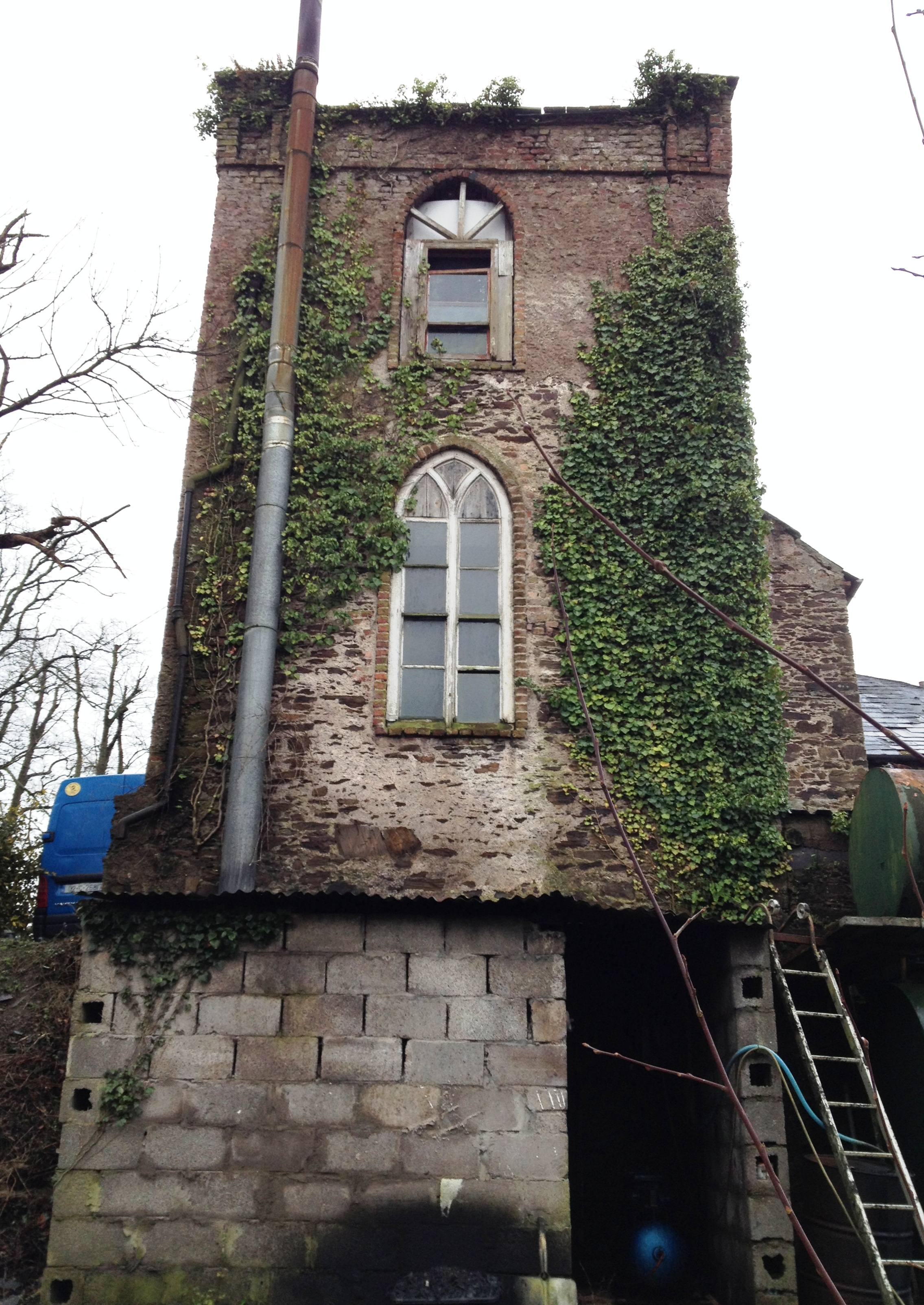
Today set in the midst of a series of stone enclosures Grange Castle is most likely a 15th century tower house, one of a number of defensive properties built by the Berminghams in this part of the country, not least nearby Carrick Castle, which is earlier in date but now in poorer condition. Grange has survived better no doubt because it remained in use as a domestic residence. In addition, at some date in the late 16th/early 17th century it was modernised, as can be seen by the larger window openings, the tall chimney stacks (indicating an increased number of hearths) and the ornamental crenellations around the roofline. Further improvements appear to have occurred not long after the castle was acquired by the Tyrrells when a single storey house was added to the immediate west. Linked to the castle at the rear, this evidently contained the main reception rooms, with the older section presumably being utilised as sleeping quarters. The main point of access was through the house, via a fine carved limestone doorcase, its pediment containing the Tyrrell coat of arms and their motto Veritas Via Vitae (a variant of Christ’s words in St John’s Gospel, ‘I am the way, the truth and the life.’).

IMG_4494
IMG_4482
IMG_4480
IMG_4490
Grange Castle remained in the ownership of the Tyrrells until 1988 when responsibility for the mediaeval structure was handed over to the state. However the later house, and surrounding outbuildings remain in the ownership of the family. In the mid-1990s a charitable trust was established to restore the property with the intention that it be opened to the public. Over the course of several years a considerable amount of work was undertaken to improve both house and grounds. However in 2003 this enterprise came to a close and it appears that ever since the place has sat empty, and a prey to vandals. The castle itself is secure, the only access being via a locked door to the rear of the house. The latter however is easily accessed and accordingly has suffered some despoliation. At the same time the damage is not so grave to render the project beyond re-activation, and perhaps this will occur. For the moment Grange Castle appears to be in limbo.

IMG_4442

Down with Mrs Delany

IMG_3852
In June 1743 Mary Pendarves (née Granville) married as her second husband the Anglican clergyman Dr Patrick Delany who a year later was made Dean of Down. As a result, although the couple’s main residence was at Delville on the outskirts of Dublin, they often spent time in the Dean’s diocese there occupying a house not far from Downpatrick with the distinctive name of Mount Panther. Much embellished after its acquisition by the future first Earl Annesley in 1770, for two centuries Mount Panther was judged one of the finest properties in County Down with especially fine plasterwork in the ballroom and drawing rooms. It survived until the 1960s but is now a ruin. However, a few souvenirs of Mount Panther have been incorporated into a house in neighbouring County Antrim including these curved doorcases and doors which were a feature of the staircase hall. Also rescued from Mount Panther were the neo-classical plasterwork wall decorations which incorporate a variety of motifs including the head of a big cat, although it looks more like that of a lion than a panther.

IMG_3857

An Architectural Conundrum

IMG_1345
In Three Homes, a memoir published in 1938, playwright and author Lennox Robinson, together with his siblings Tom and Nora, recalled their childhood in late 19th century County Cork. Robinson was born in Douglas, now a dormitory suburb of Cork city but then still a separate village lying a few miles to the south-east. The youngest child of a stockbroker-turned-clergyman, he was born in a since-demolished property called Westgrove but often visited his aunt Eleanor, who had married a wealthy brewer, John Frazer Crichton, in Donnybrook House which still stands. This the Robinsons in their recollections describe as being ‘lowbuilt, old and charmingly planned, rooms open one into the other on the ground floor a bedroom opened off the dining room, the drawing room on the opposite side of the hall had its back drawing room and the same plan was repeated in the bedrooms upstairs.’ More than a century later, although the condition of the building has somewhat deteriorated, the layout remains unchanged.

IMG_3005
IMG_3012 IMG_3003
IMG_3009
The origins of Donnybrook House are unclear. We know that by the mid-18th century the land on which it stands had come into the ownership of the Davies family as the Rev Boyle Davies, Dean of Cloyne died there in 1763. He was the son of another of those ambitious Anglican clerics so common to the era, in this case the Rev Rowland Davies whose father of the same name had come to Ireland from Herefordshire probably in the 1640s: Rowland Davies was born in Cork in 1649. He entered Trinity College Dublin in 1665 and initially seemed destined for a career in medicine before switching to the church. After taking orders in 1671 he held several minor offices and then became Dean of Cloyne in 1679. An ardent supporter of the Anglican faith (in 1716 he published a treatise called A truly Catholick and Old Religion, shewing that the Established Church in Ireland is more truly a member of the Catholick Church than the Church of Rome), he participated in the Battle of the Boyne, and the Sieges of both Limerick and Cork before returning to his pastoral duties. In 1707 he became Precentor of Cork and three years later Dean of the same diocese. He died in 1721. Rowland Davies may have been responsible for the purchase of Donnybrook’s land. On the other hand, he is known to have been a tenant of the Blarney estate, where two of his sons were born, until it was sold in 1702 to Lord Chief Justice Sir Richard Pyne for £3,000. It is said that the winged cherub heads seen above the arched ground floor windows of Donnybrook’s wings came from Blarney. Furthermore Rowland Davies built himself a house called Dawstown on part of what had formerly been McCarthy land north of Blarney. Here he died and here one branch of his descendants continued in occupation until the early 19th century. One wonders therefore whether the Donnybrook estate might have been bought by the Dean for his son, or whether Boyle Davies himself bought it. Curiously a year after the latter’s death his widow Mary, whose maiden name was Travers, leased the place to one Boyle Travers, who was a cousin of both her and her late husband (the reason for their shared first name is that they were both descendants of Elizabeth Boyle whose father Richard Boyle had become Archbishop of Tuam in 1638).

IMG_2906
IMG_2926
IMG_2923
IMG_2912
The Davies/Travers/Boyle family synopsis above helps to explain why it is not easy to work out the origins of Donnybrook House. Douglas emerged as an urban settlement from the early 18th century onwards thanks to the development here of mills associated with the textile and weaving industries which produced linen sailcloth. Tellingly the first such to open was Donnybrook Mills in 1726 (it was also one of the very last to close in the 20th century). A large pond which stood in front of the house (it can be seen in the watercolour above which dates from the first half of the 19th century) is now dried out. However formerly it served as catchment for a millrace that twenty feet below drove the millwheel. The site on which Donnybrook House stands is therefore at the top of a slope, the ground dropping sharply to the immediate north of the building. A substantial basement beneath the main rooms could be the earliest part of the fabric, dating back to before the arrival of the Davieses; in other words, as was so often the case, a newer residence was created incorporating parts of an older one. It has been proposed that a McCarthy castle stood here, thereby establishing another link with Blarney.
As one sees it today, the central block of the house, facing east, is of five bays and features a fine carved limestone doorcase with pretty fanlight above. The building initially looks single storey but this is not the case: a mid-18th century staircase directly beyond the front door leads to a first floor, the only evidence of which on the outside of the building is a solitary dormer window likely dating from the late 19th century and lighting the upper landing. The two slightly projecting tower ‘wings’ are believed to have been added in the early 1800s. They served both to increase accommodation and to give the house a more ancient, picturesque appearance (hence the gothic arched windows). As can be seen in that early watercolour, like the rest of the exterior the towers were originally rendered but subsequently covered in weather slates. Various additions were also made to the rear of the building over the course of two centuries, including a rather fine Edwardian bathroom that opens off the staircase return.

IMG_2948
IMG_2971
IMG_2955
IMG_2950
Donnybrook House’s original setting has long since gone: the surrounding gardens no longer exist, nor do any mills that once operated in the vicinity. Likewise most of the other historic houses and villas once dotting the landscape in this part of the country are gone: today almost the entire area is given over to housing estates. As is apparent, the building at present needs some attention. The roof of the south tower (that to the left of the entrance) has collapsed, bringing down the floors inside and making this part of the building unsafe. Meanwhile the north tower is suffering from water ingress and risks becoming similarly hazardous. This damage is not visible from the exterior because blind gothic windows on the upper level were designed to conceal the pitched roofs. On the other hand, the central section of the property appears to be in relatively good condition although rather damp, and has continued to be used and occupied. Internally some of the original 18th and early 19th century wooden joinery, including wainscot panelling, has survived, as have a number of the old sash windows. The spirit of the house invoked by Lennox Robinson and his siblings can still be felt.
Here is a building waiting to be rescued from what too often has been the fate of such properties in Ireland: ruin and disappearance. Wonderfully the present owner is keen to restore Donnybrook House and bring it back to residential use. Rescue and refurbishment is still feasible and must be encouraged. Donnybrook House is an important and rare testament to Cork’s architectural and industrial history. Its preservation merits everyone’s support.

IMG_3068

With special thanks to Ciara O’Flynn, Built Heritage Conservation Consultant/Buildings Archaeologist, for generously sharing her research into Donnybrook House.


After the Earl-Bishop

IMG_5021
The fondness of Frederick Augustus Hervey, Bishop of Derry and Earl of Bristol for building projects has been discussed here more than once, and attention paid to that on which he embarked around 1787/88 at Ballyscullion (see Let the Door be Instantly Open, For There is Much Wealth Within…, March 31st 2014). Within ten years of the Earl-Bishop’s death in 1803 the property here had already fallen into decay, with significant portions of its structure removed for re-use elsewhere. The estate was inherited by a kinsman, the Rev. Sir Henry Hervey Bruce and in 1840 Charles Lanyon designed a handsome new residence for his son, Admiral Sir Henry Bruce (who at the age of 13 had fought at the Battle of Trafalgar and went on to command the British fleet in the Pacific). Above and below are views of the garden front, entirely stuccoed except for the sandstone Doric columns flanking the tripartite window providing access to the drawing room: these are in the same material and style as the entrance porch on the other side of the house. Ballyscullion Park remained in the possession of the Bruce family until sold in 1938 to the Hon. Sir Harry Mulholland, first Speaker of the Northern Ireland Parliament at Stormont: it is now cared for by Sir Harry’s grandson Richard and his wife Rosalind.

IMG_5016

On with the Dance

IMG_5534
How fitting that this week’s funeral of Captain Sir John Leslie, otherwise universally known as Jack, should have taken place in glorious sunshine, the same kind he shed on so many peoples’ lives. Jack died last Monday just eight months shy of reaching his centenary, having been born in December 1916. Over the course of ten decades he witnessed many changes in the world but somehow still behaved as though it was much the same as that into which he had emerged: I remember on the first occasion we met our conversation turned to the Romanian author Princess Marthe Bibesco, and he produced a book she had given and signed to him. His own memoirs, Never a Dull Moment, written ten years ago are full of entertaining reminiscences and suggest a personal history untouched by setbacks or misfortune. Of course this was not the case, as evidenced by Jack’s experience during the Second World War. Commissioned in the Irish Guards, he and his platoon crossed to France in May 1940 where they were almost immediately captured by the German army: Jack spent the next five years in a Bavarian Prisoner of War camp with all its attendant privations.
Although he returned to Ireland on his release and was expected to assume responsibility for Castle Leslie, within a few years Jack left again, eventually settling in Rome where he occupied a small palazzo in the Trastevere district, as well as embarking on the restoration of an ancient monastery outside the city, the Badia di San Sebastiano di Alatri. Some twenty years ago he finally came back to Castle Leslie, by this time in the care of his niece Sammy Leslie, and settled down as resident guide and anecdotalist, always delighted to engage with visitors and explain the history of his family and their property.
In later years Jack also became well-known for his fondness for nightclubs where he would energetically dance to what he liked to call ‘boom boom’ music. I accompanied him on these expeditions more than once, initially in the self-appointed role of chaperone. However, like everyone else I discovered he was invariably received with wild enthusiasm, and would soon be surrounded by a coterie of solicitous admirers, on average only a quarter of his age. But there were other instances, notably a tea held in his honour some years ago at Bellamont Forest, where Jack demonstrated older forms of dancing: supported by a sixteen-piece band, that afternoon he gave a lively demonstration of the Black Bottom. So one likes to remember him, light of heart and light of foot. Wherever you may now be Jack: on with the dance.

IMG_5543

By a Long Stretch

IMG_3924
The canal at Antrim Castle, County Antrim is laid out in two sections, the original (seen above, on the cusp of yet another recent storm) believed to date from either the late 17th or early 18th century: if the former, then it was the work of John Skeffington, second Viscount Massereene (died 1695), if the latter his son, Clotworthy Skeffington, the third Viscount. Approached by a yew walk, it is thirty feet wide and runs to 660 feet, a rare surviving example of the formal French-style gardens then in vogue. In the 19th century John Foster-Skeffington, tenth Viscount Massereene added an upper canal (below) the two lengths separated by a short cascade. A survey of Antrim conducted by James Boyle in the 1830s describes the water as being edged by a lime hedge of eighteen feet. Although the castle was gutted by fire in 1922 and later demolished, the gardens were restored some years ago by the local authority and are now a public park.

IMG_3932

Big House, Little House

IMG_4069
A little house in the yard of the big house at Bovagh, County Derry. This thunderbox* is rather unusual, since not only does it contain two compartments with a dividing wall between them, but each chamber held a pair of adjacent seats, thereby allowing dual occupation (and as can be seen above, a communal chute dropped waste into the same hole). Below is a photograph showing the view enjoyed by users through the thunderbox’s gothic windows.
Dating from the mid-18th century Bovagh was originally a Beresford house, most likely built as an agent’s residence. It will be one of the properties discussed by Daniel Calley next Tuesday evening, 19th April in his talk ‘John Beresford “the king of Ireland” and some Beresford Family Houses’ at the RSAI, 63 Merrion Square, Dublin. For more information, see https://www.igs.ie/events/detail/john-beresford-the-king-of-ireland-and-some-beresford-family-houses.

IMG_3982
*For those unfamiliar with the term, a thunderbox is an outdoor latrine once commonly found in country house yards.

An Echo of Lost Grandeur

FullSizeRender 2
Now providing access to Dolly’s Grove, County Meath, this limestone triumphal arch seemingly once stood at the entrance to Summerhill in the same county. Among Ireland’s very finest country houses Summerhill was built in the 1730s but is no more, having been burnt in February 1922, after which its dramatic shell survived another thirty-five years before being demolished (for more on the house, see My Name is Ozymandias, April 1st 2013). Summerhill’s design has traditionally been attributed to Sir Edward Lovett Pearce and some of his stylistic tics, such as blind niches and oculi, can be seen here in the Dolly’s Grove arch suggesting the architect was responsible for this piece of work also.

FullSizeRender

Lost and Found

IMG_3239
Like many words in the English language, ‘lost’ is open to diverse use. It can, for example, mean missing or misplaced but just as often is employed to denote something that has vanished, perished or been destroyed. Such is the case with an engrossing – albeit chastening – book recently published, Lost Ireland: 1860-1960. Author William Derham has trawled through thousands of photographs to select 500 images of buildings throughout the island, the majority of which have entirely disappeared or else been so altered/mutilated that they no longer bear any semblance to their original state.

IMG_3240
In a thoughtful introductory essay, Derham provides an historical context for why so many older buildings in Ireland should come to have been lost and laments the disappearance of certain building types such as the early unfortified house represented by Eyrecourt, County Galway: dating from the second half of the 17th century and still intact less than 100 years ago, it is now a roofless shell. Likewise Ireland has no examples of the ‘cagework’ urban house in which the frame would be of wood and the spaces between filled with wattle and daub. The last of these to survive, in Dublin on the corner of Castle and Werburgh Streets, was demolished as long ago as 1812. Likewise the once-widespread brick gabled townhouses known as Dutch Billies are now almost extinct, or else subsumed into later buildings.

IMG_3242
Some losses – notably among the ranks of the Irish country house – are already well-known, but even here Derham finds examples likely to be unfamiliar to most readers, and explains the shameful role played in the erosion of their number by that state body the Land Commission. However he covers many other areas of depletion and, frankly, dissipation, such as the damage inflicted on Roman Catholic churches and cathedrals in the aftermath of the second Vatican Council. Using the excuse of a new liturgy, members of the Irish clergy stripped interiors of the buildings for which they were responsible: one of the most egregious examples being the gutting of Pugin’s Killarney Cathedral at the instigation of then-bishop Eamon Casey. Tellingly their clerical equivalents in other countries did not feel impelled to engage in similar acts of vandalism. But valuable secular buildings were also squandered for no good reason, such as the demolition in 1964 of a fine mid-18th century market house in Mountrath, County Laois – supposedly because a public lavatory was needed (although this was never built). As much as an exhortation to protect what remains as a requiem to what has gone, this is a beautifully produced book and allows us to find again, if only in photographic form, what has been lost. Do acquire a copy while you can as it is certain to sell out.

IMG_3234
Lost Ireland: 1860-1960 by William Derham is published by Hyde Park Editions, price £39.95/€49.95. The photographs above were taken at a recent exhibition in Dublin Castle to coincide with the launch of the book. They show (from top), Roxborough Castle, County Tyrone (burnt 1922), Longford Castle, Longford (demolished 1972), Woodstock, County Kilkenny (burnt 1922) and Ballynastragh, County Wexford (burnt 1923). The exhibition has now ended but deserves to travel to other venues around the country in coming months; why not encourage your local arts centre/library to borrow it?

Forgotten Virtuosi

IMG_7050
The stuccowork found in Irish houses is rightly renowned for its exceptional combination of vivacity and virtuosity. Yet the attention given to this field of design has focussed primarily on practitioners in the 18th century, with little notice paid to those who came later. It is curious that this should be the case: in the decades between the 1800 Act of Union and the onset of the Great Famine in the mid-1840s several waves of house building occurred across the country, and many of these properties were elaborately decorated. By this date plasterwork was no longer created ‘free-hand’ on site but instead frequently made elsewhere in sections and then installed under supervision. But who were the people who carried out this work? While we often know who was responsible for the architecture, the names of firms and craftsmen who created the interiors seen today seem to be unknown, or at least not to have excited scholarly interest. The three houses featured today demonstrate that more could be done to honour and celebrate these virtuosi who did so much to enhance the properties on which they were employed.

IMG_7036
IMG_7034
IMG_7039
Although a much older property existed on this site, Borris House, County Carlow was comprehensively redesigned for the McMorrough Kavanaghs in the second decade of the 19th century by Sir Richard Morrison (see An Arthurian Legend, November 4th 2013). In terms of decoration, the finest room in the building is the one seen first by visitors: the entrance hall. We believe Morrison was responsible for every element of the design here, ceiling plasterwork, scagliola columns, doorcases and chimney piece. Although the room is almost square it appears to be a circular space due to a radiating ceiling and the carefully proportioned screen of paired columns forming a ring around the perimeter wall. On the ceiling eight beams emanate from a central coffered section to meet florid plaster embellishment that includes festoons of fruit, flowers and leaves resting on masked heads, sheaves of wheat and the crescent moon, and a sequence of immense eagles, their heads thrusting into space beyond outstretched wings. The capitals on top of the columns display equal creativity, as they do not correspond to any of the classical orders but are of Morrison’s own design, incorporating a band of lion heads. The skill involved in carrying out this programme of work is outstanding – but who did Morrison employ to transform his ideas on paper into a three-dimensional reality?

FullSizeRender 8
IMG_1446
FullSizeRender 9
Emo Court, County Laois has been discussed here on a couple of recent occasions (see Seen in the Round, February 1st last and Of Changes in Taste, March 14th last). Designed in the 1790s by James Gandon, the house’s interiors were only gradually completed over the next seventy years. One of the first spaces to be completed was the dining room, decorated in the early 1830s under the supervision of London architect Lewis Vulliamy. It is likely that Gandon would have proposed a spare, neo-classical scheme here but Vulliamy came up with something altogether more sumptuous, especially on the ceiling which has been divided into a series of sections centred on a rectangle containing a highly elaborate rose (looking more like a chrysanthemum) from which a chandelier would have been suspended. On either side thick bands running the length of the ceiling are filled with ribboned hexagons from which overflow vine leaves and bunches of grapes: this same motif is used again on the perimeter of the ceiling. Meanwhile a pair of demi-lunes immediately above and below the chandelier rose contain an eagle standing on a rippling band of ribbon, its wings stretching beyond crown of oakleaves encircling the bird. Closer again to the edge bare-breasted maidens are flanked by spirals of foliageputti stand on either side of ornamental urns and pairs of doves flutter within floral coronets. Extravagantly absurd and yet executed with such assurance and aplomb somehow the whole scheme comes together. Who deserves the credit for this feat?

IMG_0946
IMG_0962 IMG_0943
Ballyfin, County Laois (see The Fair Place, July 21st 2014) has been superlatively restored in recent years and now functions as an hotel that sets a standard for all others in this country and beyond. Ballyfin was designed for the Coote family in the early 1820s by Sir Richard Morrison, on this occasion partnered by his son William Vitruvius. The entire house is an exercise in opulent splendour of the kind John Nash was then creating for George IV at Buckingham Palace. Nowhere is this more manifest than the saloon which at either end has screens of green scagliola columns beneath rich Corinthian capitals. These lead the eye up to the coved ceiling over which once more ornament has been incited to run riot. Here panels contain figures of bare-breasted maidens surrounded by scrolled foliage so similar to those found on the dining room ceiling at Emo Court that both must have been executed by the same craftsmen. Likewise in the corners of the saloon ceiling in Ballyfin are pairs of putti, in this instance jointly supporting a lyre. The bordered runs of vine leaves and grapes seen at Emo are here replaced by long garlands of flowers but the spirit and style are consistent between the two houses. The most striking difference can be found on the Ballyfin’s ceiling entablature where snarling lions (or perhaps leopards) face each other separated by a crowned mask. It’s both deft and daft, and above all thrilling to realise craftsmanship of this calibre was available to patrons in 19th century Ireland. Time surely to celebrate the persons responsible, and to ensure their names and contribution to our heritage no longer remain unknown.

IMG_0765