In June 1743 Mary Pendarves (née Granville) married as her second husband the Anglican clergyman Dr Patrick Delany who a year later was made Dean of Down. As a result, although the couple’s main residence was at Delville on the outskirts of Dublin, they often spent time in the Dean’s diocese there occupying a house not far from Downpatrick with the distinctive name of Mount Panther. Much embellished after its acquisition by the future first Earl Annesley in 1770, for two centuries Mount Panther was judged one of the finest properties in County Down with especially fine plasterwork in the ballroom and drawing rooms. It survived until the 1960s but is now a ruin. However, a few souvenirs of Mount Panther have been incorporated into a house in neighbouring County Antrim including these curved doorcases and doors which were a feature of the staircase hall. Also rescued from Mount Panther were the neo-classical plasterwork wall decorations which incorporate a variety of motifs including the head of a big cat, although it looks more like that of a lion than a panther.
An Architectural Conundrum

In Three Homes, a memoir published in 1938, playwright and author Lennox Robinson, together with his siblings Tom and Nora, recalled their childhood in late 19th century County Cork. Robinson was born in Douglas, now a dormitory suburb of Cork city but then still a separate village lying a few miles to the south-east. The youngest child of a stockbroker-turned-clergyman, he was born in a since-demolished property called Westgrove but often visited his aunt Eleanor, who had married a wealthy brewer, John Frazer Crichton, in Donnybrook House which still stands. This the Robinsons in their recollections describe as being ‘lowbuilt, old and charmingly planned, rooms open one into the other on the ground floor a bedroom opened off the dining room, the drawing room on the opposite side of the hall had its back drawing room and the same plan was repeated in the bedrooms upstairs.’ More than a century later, although the condition of the building has somewhat deteriorated, the layout remains unchanged.


The origins of Donnybrook House are unclear. We know that by the mid-18th century the land on which it stands had come into the ownership of the Davies family as the Rev Boyle Davies, Dean of Cloyne died there in 1763. He was the son of another of those ambitious Anglican clerics so common to the era, in this case the Rev Rowland Davies whose father of the same name had come to Ireland from Herefordshire probably in the 1640s: Rowland Davies was born in Cork in 1649. He entered Trinity College Dublin in 1665 and initially seemed destined for a career in medicine before switching to the church. After taking orders in 1671 he held several minor offices and then became Dean of Cloyne in 1679. An ardent supporter of the Anglican faith (in 1716 he published a treatise called A truly Catholick and Old Religion, shewing that the Established Church in Ireland is more truly a member of the Catholick Church than the Church of Rome), he participated in the Battle of the Boyne, and the Sieges of both Limerick and Cork before returning to his pastoral duties. In 1707 he became Precentor of Cork and three years later Dean of the same diocese. He died in 1721. Rowland Davies may have been responsible for the purchase of Donnybrook’s land. On the other hand, he is known to have been a tenant of the Blarney estate, where two of his sons were born, until it was sold in 1702 to Lord Chief Justice Sir Richard Pyne for £3,000. It is said that the winged cherub heads seen above the arched ground floor windows of Donnybrook’s wings came from Blarney. Furthermore Rowland Davies built himself a house called Dawstown on part of what had formerly been McCarthy land north of Blarney. Here he died and here one branch of his descendants continued in occupation until the early 19th century. One wonders therefore whether the Donnybrook estate might have been bought by the Dean for his son, or whether Boyle Davies himself bought it. Curiously a year after the latter’s death his widow Mary, whose maiden name was Travers, leased the place to one Boyle Travers, who was a cousin of both her and her late husband (the reason for their shared first name is that they were both descendants of Elizabeth Boyle whose father Richard Boyle had become Archbishop of Tuam in 1638).


The Davies/Travers/Boyle family synopsis above helps to explain why it is not easy to work out the origins of Donnybrook House. Douglas emerged as an urban settlement from the early 18th century onwards thanks to the development here of mills associated with the textile and weaving industries which produced linen sailcloth. Tellingly the first such to open was Donnybrook Mills in 1726 (it was also one of the very last to close in the 20th century). A large pond which stood in front of the house (it can be seen in the watercolour above which dates from the first half of the 19th century) is now dried out. However formerly it served as catchment for a millrace that twenty feet below drove the millwheel. The site on which Donnybrook House stands is therefore at the top of a slope, the ground dropping sharply to the immediate north of the building. A substantial basement beneath the main rooms could be the earliest part of the fabric, dating back to before the arrival of the Davieses; in other words, as was so often the case, a newer residence was created incorporating parts of an older one. It has been proposed that a McCarthy castle stood here, thereby establishing another link with Blarney.
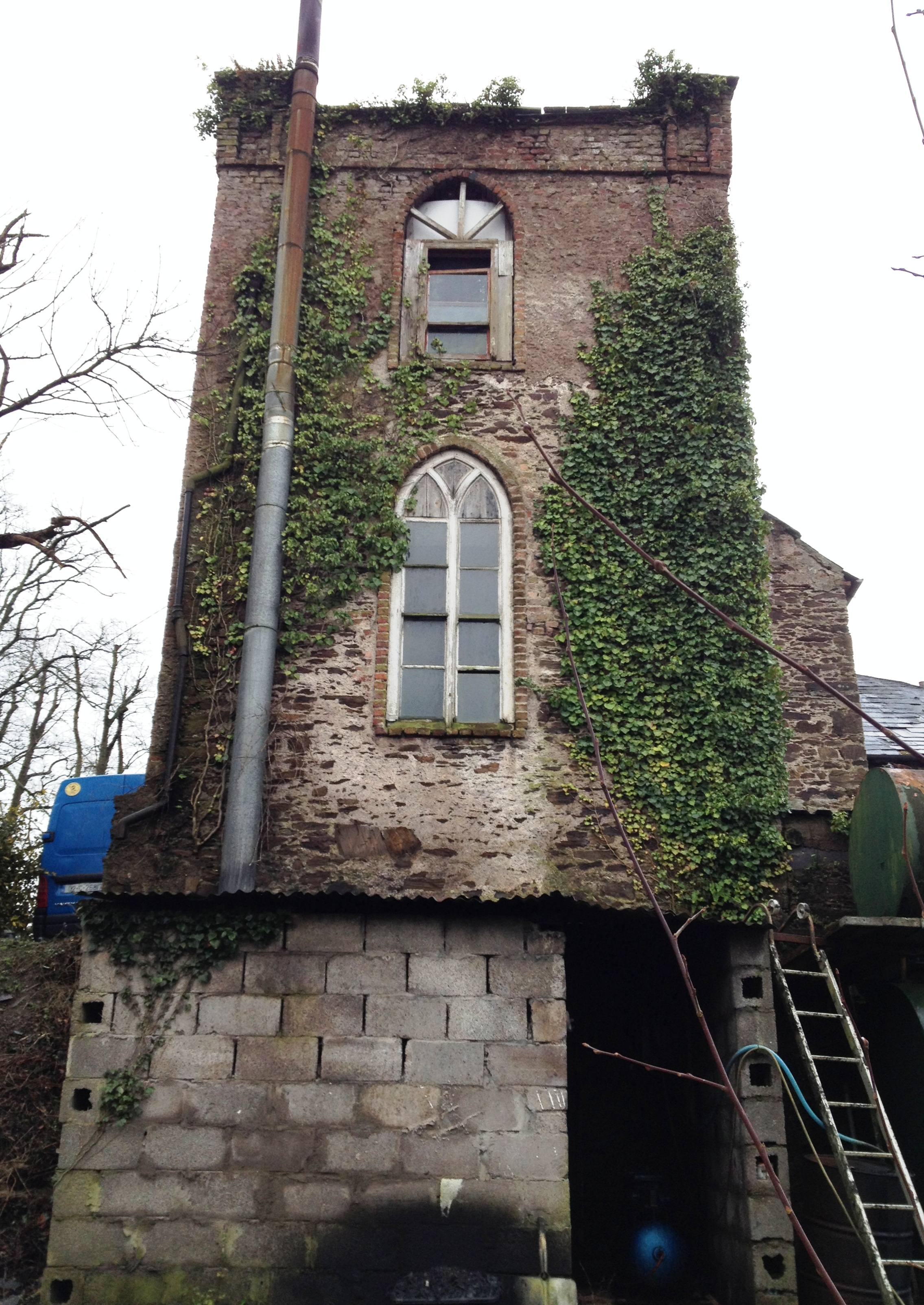
As one sees it today, the central block of the house, facing east, is of five bays and features a fine carved limestone doorcase with pretty fanlight above. The building initially looks single storey but this is not the case: a mid-18th century staircase directly beyond the front door leads to a first floor, the only evidence of which on the outside of the building is a solitary dormer window likely dating from the late 19th century and lighting the upper landing. The two slightly projecting tower ‘wings’ are believed to have been added in the early 1800s. They served both to increase accommodation and to give the house a more ancient, picturesque appearance (hence the gothic arched windows). As can be seen in that early watercolour, like the rest of the exterior the towers were originally rendered but subsequently covered in weather slates. Various additions were also made to the rear of the building over the course of two centuries, including a rather fine Edwardian bathroom that opens off the staircase return.


Donnybrook House’s original setting has long since gone: the surrounding gardens no longer exist, nor do any mills that once operated in the vicinity. Likewise most of the other historic houses and villas once dotting the landscape in this part of the country are gone: today almost the entire area is given over to housing estates. As is apparent, the building at present needs some attention. The roof of the south tower (that to the left of the entrance) has collapsed, bringing down the floors inside and making this part of the building unsafe. Meanwhile the north tower is suffering from water ingress and risks becoming similarly hazardous. This damage is not visible from the exterior because blind gothic windows on the upper level were designed to conceal the pitched roofs. On the other hand, the central section of the property appears to be in relatively good condition although rather damp, and has continued to be used and occupied. Internally some of the original 18th and early 19th century wooden joinery, including wainscot panelling, has survived, as have a number of the old sash windows. The spirit of the house invoked by Lennox Robinson and his siblings can still be felt.
Here is a building waiting to be rescued from what too often has been the fate of such properties in Ireland: ruin and disappearance. Wonderfully the present owner is keen to restore Donnybrook House and bring it back to residential use. Rescue and refurbishment is still feasible and must be encouraged. Donnybrook House is an important and rare testament to Cork’s architectural and industrial history. Its preservation merits everyone’s support.
With special thanks to Ciara O’Flynn, Built Heritage Conservation Consultant/Buildings Archaeologist, for generously sharing her research into Donnybrook House.
Respected and Lamented by All Who Knew Him

In the rarely opened south transept of Cloyne Cathedral, County Cork the end wall is dominated by this splendid early 18th century monument to members of the Longfield family, the first listed John Longfield having acquired a nearby estate and named it Castle Mary, perhaps in honour of his heiress wife, Mary Hawnby of Mallow. Successive generations are listed, the first (and last) Viscount Longueville being the grandson of John and Mary Longfield: note how the word ‘respected’ had to be tucked into the available space. On Lord Longueville’s his death without an heir, Castle Mary was inherited by a cousin, Colonel Mountifort Longfield. The house was burnt by the IRA in 1920, so this is now the best-preserved memorial to the family.
After the Earl-Bishop

The fondness of Frederick Augustus Hervey, Bishop of Derry and Earl of Bristol for building projects has been discussed here more than once, and attention paid to that on which he embarked around 1787/88 at Ballyscullion (see Let the Door be Instantly Open, For There is Much Wealth Within…, March 31st 2014). Within ten years of the Earl-Bishop’s death in 1803 the property here had already fallen into decay, with significant portions of its structure removed for re-use elsewhere. The estate was inherited by a kinsman, the Rev. Sir Henry Hervey Bruce and in 1840 Charles Lanyon designed a handsome new residence for his son, Admiral Sir Henry Bruce (who at the age of 13 had fought at the Battle of Trafalgar and went on to command the British fleet in the Pacific). Above and below are views of the garden front, entirely stuccoed except for the sandstone Doric columns flanking the tripartite window providing access to the drawing room: these are in the same material and style as the entrance porch on the other side of the house. Ballyscullion Park remained in the possession of the Bruce family until sold in 1938 to the Hon. Sir Harry Mulholland, first Speaker of the Northern Ireland Parliament at Stormont: it is now cared for by Sir Harry’s grandson Richard and his wife Rosalind.
Opportunity Knocks

Opportunism and those who practise it are not, as a rule, judged very favorably. Yet there are times when our verdict on opportunists can be inaccurate or imperceptive. Much of Georgian Dublin is a manifestation of opportunism at work: the result of a handful of perspicacious developers – another now-detested term – recognising an opportunity and responding to it. This was certainly the case with the first Luke Gardiner who piecemeal built up landholdings on the northside of the city and there created new streets and terraces to meet growing demand for residential property. Gardiner’s first venture in this arena, and the basis of his future success, was the development from the late 1720s onward of Henrietta Street.


Luke Gardiner was a man of modest origins, far removed at the start of his professional life from the wealth he would come to enjoy. Much the same could be said of his protégé Nathaniel Clements who, although enjoying somewhat less humble beginnings, was the youngest of five sons and very much expected to make his own way. This he did, like Gardiner, by building houses and then selling them on: the parallels between the past and the present can sometimes be discomfiting. Henrietta Street was also Clements’ first venture into property development, as he took on several sites from Gardiner. One of these was number 4 (originally 5) Henrietta Street which he completed around 1740-41 and sold to George Stone, then Bishop of Ferns. Stone occupied the building but did not finish paying for it, until 1747 when he was appointed Archbishop of Armagh and, in turn, opportunistically moved into a still-grander residence on the street before selling No.4. Its second owner was John Maxwell, MP for County Cavan who nine years later would be created first Lord Farnham. Of Scottish ancestry, Maxwell was the descendant of three generations of clerical opportunists: the Farnham estate in County Cavan had originally been purchased by his grandfather, the Anglican Bishop of Kilmore and Ardagh. When John Maxwell acquired No.4 Henrietta Street, it came with a plot of land to the immediate east, perhaps serving as a garden. In 1754 Maxwell’s only daughter married another MP, Owen Wynne of Sligo, likewise the descendant of opportunists, although in this instance they had been army men. Around the time of his marriage the plot next to No.4 passed into Wynne’s hands and a house was built here. Today it is No.3 Henrietta Street.


There are unanswered questions remaining about the history of 3 Henrietta Street, not least who was responsible for its design. The house is sometimes attributed to Nathaniel Clements because like its neighbour – which he almost certainly did build – there is a semi-circular bow at the back of the building. On the other hand, by the time of No.3’s construction, Clements had moved on to other projects and, more critically, he and Maxwell were political opponents, so it seems unlikely his assistance would have been sought here. Perhaps when Wynne embarked on the enterprise he decided to copy some features of his father-in-law’s adjacent residence. The interior shows alterations believed to date from 1830. Originally the entrance hall – like other houses on this side of the street – would have been of two storeys with the stairs visibly rising to the first floor. In the 19th century this staircase was taken out and a smaller one inserted, divided by a wall from the front of the house with the new entrance hall made just one storey high. But the first floor reception rooms retain much of their original decoration, the pair to the front of the room having a deep frieze with strapwork and festoons, while below the walls are sectioned by plaster panelling. To the rear at this level is a wonderful room with rococo stuccowork in the coved ceiling which extends into the bow, and gives the space a more intimate character than any of the others possess.


As already mentioned, in the 19th century 3 Henrietta Street, like almost all other houses in the vicinity, underwent changes both of design and usage. The advent of the King’s Inns at the top of the street, and the gradual departure of private owners in the aftermath of the 1800 Act of Union meant many of the buildings came to be used as solicitors’ offices: in the decades leading up to his death in 1885 some three-quarters of the street were bought by the lawyer Tristram Kennedy and let to other members of his profession. However, his property portfolio was subsequently acquired by another – altogether less attractive – opportunist, former Dublin Lord Mayor Joseph Meade. Seeing a chance to get a good return on his investment, notoriously he converted most of the houses into tenements. The original interior spaces were divided to fit in more rooms for entire families to occupy and valuable items such as chimney pieces were stripped out and sold off. This was the fate of 3 Henrietta Street for a large portion of the last century, and evidence of its decline, as much as of its glory, can still be seen in the building. But the house is now on the market, and awaits a new owner who can offer it a viable future. What will happen next? As has been the case here over the past two and a half centuries, opportunity knocks – and 3 Henrietta Street once more awaits the advent of an opportunist.
On with the Dance

How fitting that this week’s funeral of Captain Sir John Leslie, otherwise universally known as Jack, should have taken place in glorious sunshine, the same kind he shed on so many peoples’ lives. Jack died last Monday just eight months shy of reaching his centenary, having been born in December 1916. Over the course of ten decades he witnessed many changes in the world but somehow still behaved as though it was much the same as that into which he had emerged: I remember on the first occasion we met our conversation turned to the Romanian author Princess Marthe Bibesco, and he produced a book she had given and signed to him. His own memoirs, Never a Dull Moment, written ten years ago are full of entertaining reminiscences and suggest a personal history untouched by setbacks or misfortune. Of course this was not the case, as evidenced by Jack’s experience during the Second World War. Commissioned in the Irish Guards, he and his platoon crossed to France in May 1940 where they were almost immediately captured by the German army: Jack spent the next five years in a Bavarian Prisoner of War camp with all its attendant privations.
Although he returned to Ireland on his release and was expected to assume responsibility for Castle Leslie, within a few years Jack left again, eventually settling in Rome where he occupied a small palazzo in the Trastevere district, as well as embarking on the restoration of an ancient monastery outside the city, the Badia di San Sebastiano di Alatri. Some twenty years ago he finally came back to Castle Leslie, by this time in the care of his niece Sammy Leslie, and settled down as resident guide and anecdotalist, always delighted to engage with visitors and explain the history of his family and their property.
In later years Jack also became well-known for his fondness for nightclubs where he would energetically dance to what he liked to call ‘boom boom’ music. I accompanied him on these expeditions more than once, initially in the self-appointed role of chaperone. However, like everyone else I discovered he was invariably received with wild enthusiasm, and would soon be surrounded by a coterie of solicitous admirers, on average only a quarter of his age. But there were other instances, notably a tea held in his honour some years ago at Bellamont Forest, where Jack demonstrated older forms of dancing: supported by a sixteen-piece band, that afternoon he gave a lively demonstration of the Black Bottom. So one likes to remember him, light of heart and light of foot. Wherever you may now be Jack: on with the dance.
By a Long Stretch

The canal at Antrim Castle, County Antrim is laid out in two sections, the original (seen above, on the cusp of yet another recent storm) believed to date from either the late 17th or early 18th century: if the former, then it was the work of John Skeffington, second Viscount Massereene (died 1695), if the latter his son, Clotworthy Skeffington, the third Viscount. Approached by a yew walk, it is thirty feet wide and runs to 660 feet, a rare surviving example of the formal French-style gardens then in vogue. In the 19th century John Foster-Skeffington, tenth Viscount Massereene added an upper canal (below) the two lengths separated by a short cascade. A survey of Antrim conducted by James Boyle in the 1830s describes the water as being edged by a lime hedge of eighteen feet. Although the castle was gutted by fire in 1922 and later demolished, the gardens were restored some years ago by the local authority and are now a public park.
Living in Eternity’s Sunrise
Big House, Little House

A little house in the yard of the big house at Bovagh, County Derry. This thunderbox* is rather unusual, since not only does it contain two compartments with a dividing wall between them, but each chamber held a pair of adjacent seats, thereby allowing dual occupation (and as can be seen above, a communal chute dropped waste into the same hole). Below is a photograph showing the view enjoyed by users through the thunderbox’s gothic windows.
Dating from the mid-18th century Bovagh was originally a Beresford house, most likely built as an agent’s residence. It will be one of the properties discussed by Daniel Calley next Tuesday evening, 19th April in his talk ‘John Beresford “the king of Ireland” and some Beresford Family Houses’ at the RSAI, 63 Merrion Square, Dublin. For more information, see https://www.igs.ie/events/detail/john-beresford-the-king-of-ireland-and-some-beresford-family-houses.

*For those unfamiliar with the term, a thunderbox is an outdoor latrine once commonly found in country house yards.
An Echo of Lost Grandeur

Now providing access to Dolly’s Grove, County Meath, this limestone triumphal arch seemingly once stood at the entrance to Summerhill in the same county. Among Ireland’s very finest country houses Summerhill was built in the 1730s but is no more, having been burnt in February 1922, after which its dramatic shell survived another thirty-five years before being demolished (for more on the house, see My Name is Ozymandias, April 1st 2013). Summerhill’s design has traditionally been attributed to Sir Edward Lovett Pearce and some of his stylistic tics, such as blind niches and oculi, can be seen here in the Dolly’s Grove arch suggesting the architect was responsible for this piece of work also.