
The cast-iron railings surrounding a tomb in Beauparc Graveyard, County Meath feature an unusual detail around the top: a skull and crossbones. There is no information on who was responsible for this work, and the tombstone is unfortunately too worn to be able to read whose resting place it marks.
Overlooked II

Another often overlooked building in central Dublin: the Printing House in Trinity College. It was designed in 1734 by Richard Castle to conclude an allée at the other end of which was the Anatomy House built in 1711 to a design by Thomas Burgh (and long-since demolished). The building’s most notable feature is its pedimented Doric portico with rusticated façade behind, all of Portland stone, which suggests this is a classical temple rather than a more mundane printing house. Nevertheless it was here that the first book in Ireland entirely in Greek (an edition of Plato’s Dialogues) was produced, followed by many other works. A plaque in Latin above the doorway indicates the building is dedicated to the Anglican clergyman John Sterne, Bishop of Clogher, who in 1726 provided £1,000 for its construction; on his death in 1745 he left his considerable collection of manuscripts to the college library. At the moment, this part of the campus is rather a mess owing to building work, not least student accommodation on a site to be called Printing House Square: when this finishes, one hopes due attention will be paid to the building whence the development derives its name.
Golden Memories


‘GOLDEN, a village and post town, in the parish of Relickmurry, barony of Clanwilliam, county of Tipperary, and province of’ Munster, 3½ miles (W.) from Cashel (to which it has a sub post-office), and 82 (S.) from Dublin, on the road from Cashel to Tipperary. containing 114 houses and 648 inhabitants. It is a neat and improving village, situated in what is called “the Golden Vale,” and is divided into two parts by the river Suir, over which is a stone bridge. on which King William signed the Charter of Cashel, and near it is an old circular stone tower. Here are flour and oat meal-mills, and constabulary police station fair are held on May 18th, Aug. 26th, Oct. 26th, and Dre. 15th, and petty sessions once a fortnight The parochial church was erected here in 1808, and a tower was added by aid of a loan of £700 from the late Board of First Fruits, in 1812. There is also a large R.C. chapel.’
From Samuel Lewis’ Topographical Dictionary of Ireland (1837)


In the last census (taken April 2016) the village of Golden, County Tipperary had a population of 267, a drop of some 9 per cent on what it had been a quarter of a century earlier, and barely 40 per cent of the figure given by Lewis 180 years ago. The ongoing and seemingly unstoppable decline of Ireland’s rural towns and villages has been the subject of much debate in recent years. At least part of the explanation for this phenomenon lies in the fact that these smaller urban centres now rarely generate much economic activity and employment, Golden appearing typical in this respect. Such was not always the case: the buildings shown here are what remain of a larger mill complex, dating from the early 19th century when a considerable number of these industrial complexes were developed in response to improved agricultural practices, and increased demand for corn and other grains. The majority of these mills closed fifty or more years ago because they were no longer economically viable, but the evidence of their presence – and the important role they once played in the commercial prosperity of a village like Golden – remain, at least for the moment. In the middle of last month, a large and splendid mill complex in the heart of Drogheda, County Louth was gutted by fire. It had been allowed to stand empty and neglected for many years, and accordingly the building’s eventual destruction was entirely predictable. The loss is considerable and unnecessary, and means that part of Drogheda’s history has disappeared. Looking around the detritus in Golden’s old mill, it would seem a similar fate awaits here, even though the building is (like that recently burnt in Drogheda) listed by the relevant local authority as a Protected Structure. When that happens part of the area’s collective memory will be forever lost.
A Commemoration


With superlative views across Dundalk Harbour towards the Cooley and Mourne Mountains, this is Moonveigh Tower, a 19th century folly erected by Sir Patrick Bellew. Member of an Angl0-Norman family which despite the Penal Laws managed to retain both the Roman Catholic faith and lands of its forbears, Sir Patrick was among the first Catholics elected to Parliament after Emancipation in 1829. In 1832 he stood aside to let his younger brother Richard Montesquieu Bellew take the seat but was returned in 1835 and again two years later. It was to mark the latter occasion that the tower, on the site of an old windmill, was constructed, a spiral staircase inside climbing up to offer a wonderful outlook from the top. A plaque above the now-cemented doorcase declares ‘This tower was erected to commemorate the election to parliament in January 1837 of Sir Patrick Bellew Bart and Richard M. Bellew Esq. As members for this County. It was commenced in the year of the Coronation of Her Majesty, Queen Victoria whom God long preserve.’
Overlooked

Preoccupied with inevitable traffic jams, the many motorists using Dublin’s Pearse Street are unlikely to throw a glance at the old church on their right-hand side. This is St Mark’s, which dates from the early 18th century when a new parish was created separate from that of St Andrew’s. Building work began in 1729 but the church was only roofed 23 years later. The architect responsible is unknown, but in any case the building is notable primarily for its want of external ornamentation, with sturdy limestone rubble walls. The entrance at the west end has a substantial cut-granite door with a smaller Diocletian window above: the arrow slits on either side, now blocked, once held glass to admit light to the interior spaces. The sides of the building have five tall and five short windows, one above the other and the east end has a Venetian window to light the chancel. Much altered in the 19th century, the interior retains its galleries supported by Corinthian columns. Unlike many other Church of Ireland churches in the city, St Mark’s is still in use, now by an evangelical Christian group for services.
The Advantages of Generous Patronage

It is difficult to visualize today, but the mediaeval friary in the centre of Ennis, County Clare originally stood on an island at a point where the river Fergus divided. The exact date of its establishment is uncertain, but the Franciscan order is believed to have been invited to open a new house here towards the middle of the 13th century: Donnchadh Ó Briain, King of Thomond is often credited with being responsible for this shortly before his death in 1242. Thereafter the friary and its grounds became the preferred burial place for generations of O’Briens and MacNamaras, the two ruling families in this part of the country. Frequently in reparation for their misdeeds over the next three centuries they gave the friars, who had little source of income, many gifts such as vestments, chalices, stained glass and books.


The advantages of having rich and generous patrons can be seen throughout what remains of Ennis Friary. As the community expanded, so the building work continued. In 1314, for example, Maccon Caech MacNamara added a sacristy and refectory to the site. And a the start of the 15th century, the handsome cloister – only sections of which survive – was constructed along with the south transept: the belfry tower dates from around 1475.


Ennis Friary contains many fine limestone carvings, mostly dating from the 15th and early 16th centuries. One of these depicts St Francis, founder of the Franciscan order, with his stigmata on display. Another shows the Virgin and Child, and a third is an affecting image of Ecce Homo, the words uttered by Pontius Pilate in St John’s Gospel when Christ, having been scourged and crowned with thorns, was presented to a hostile crowd. One of the most interesting features in the building is a series of carved panels with scenes from Christ’s Passion dating from a late-15th century tomb erected by the MacMahon family and recycled in the 1840s for a monument to the Creagh family. Unfortunately this has been placed behind glass and spotlit – making it almost impossible to photograph. A copy of the tomb stands on the site of the original in the former chancel.


Ennis Friary, like other such establishments, was suppressed in the 16th century but seemingly members of the Franciscan order continued in residence until at least 1570, thereafter being obliged to remain secretly in Ennis. In the early 17th century, Donough O’Brien, fourth Earl of Thomond handed over the site to the Church of Ireland, and services began to be held in the old church. Other parts of the site were used for legal proceedings, the former sacristy becoming a courtroom. The Church of Ireland remained here until 1871 when a new church elsewhere in the town opened and within a couple of decades the friar’s church had lost its roof. It was returned to the Franciscan order in 1969 but is now managed by the Office of Public Works which ten years ago embarked on a somewhat controversial programme of restoration when the decision was taken to re-roof the main body of the church and, as mentioned, to place the MacMahon/Creagh Tomb behind glass.
Rags and Tatters

The remains of Ardclinis church, County Antrim, believed to have been founded in the early Christian period by St MacNissi, or perhaps St MacKenna: the present ruins are from the later Middle Ages. A crozier, called the Bachil McKenna, used to be set into the building and was used by local people for the taking of oaths and detection of false statements. However, it was subsequently acquired by a local farmer called Galvin. He and his successors, when not employing the crozier as a hook in the family home, would dip it into water being given to sick cows: in the early 1960s it was acquired by the National Museum of Ireland. In front of the ruins is a blackthorn ‘Rag Tree.’ Traditionally rags, belonging to someone sick or with a particular problem, are tied to a tree in the belief that this will resolve the issue.
Scant Evidence

The bungalow-strewn village of Stratford on Slaney, County Wicklow looks as though it could be a modern suburb almost anywhere. However a handful of houses indicate the place has an older pedigree. The name derives from founder Edward Stratford, second Earl of Aldborough whose architectural ambitions have been discussed here before (see Splendours and Follies, September 30th 2013, A Thundering Disgrace, January 13th 2014 and A Thundering Disgrace No More?, February 27th 2017). He developed the village during the last quarter of the 18th century, intending it to be a centre for the textile industry, specifically cotton and printing works. At its height in the 1830s, Stratford on Slaney contained 104 houses (and thirteen public houses) with a population of 2,833 people, 1,00o of them employed in the fabric factory. Lord Aldborough built places of worship for Anglicans, Roman Catholics and Presbyterians, a dispensary and several shops. The famine and its attendant woes in the following decade put an end to the business, and so to Stratford where the factory closed and people moved away: in the census of 2016, the village had a population of just 241 persons. These few houses, dating from c.1840 are all that remain of Lord Aldborough’s ambitions.
A Short and Bloody Existence
‘One summer night, when there was peace, a score of Puritan troopers, under the pious Sir Frederick Hamilton, broke through the door of the Abbey of White Friars at Sligo. As the door fell with a crash they saw a little knot of friars gathered about the altar, their white habits glimmering in the steady light of the holy candles. All the monks were kneeling except the abbot, who stood upon the altar steps with a great brass crucifix in his hand. “Shoot them!” cried Sir Frederick Hamilton, but nobody stirred, for all were new converts, and feared the candles and the crucifix. For a little while all were silent, and then five troopers, who were the bodyguard of Sir Frederick Hamilton, lifted their muskets, and shot down five of the friars.’
From The Curse of the Fires and of the Shadows (1897) by W.B. Yeats.


Sir Frederick Hamilton was born in Scotland in the late 16th century, youngest surviving son of Claud Hamilton, first Lord Paisley. As youngest son, he was obliged to make his own way and, like so many of his fellow countrymen, saw opportunities in Ireland. Here in 1620 he married Sidney Vaughan whose father, Sir John Vaughan, was a member of the Privy Council for Ireland and Governor of Londonderry (responsible for commanding the garrison and fortifications of Derry, and of nearby Culmore Fort). Two years later he received a grant of land in County Leitrim, he and his wife gradually building up a holding of some 18,000 acres, much of which had been seized from the O’Rourke family, against whom thereafter he remained almost constantly at war. At the centre of his land, he established a town next to an existing settlement called Clooneen (from the Irish Cluainín Uí Ruairc, meaning O’Rourke’s small meadow). This was given the name Manorhamilton and here in 1634 he built a large fortified house. Come the outbreak of the Confederate Wars in the 1640s Hamilton, who during the previous decade had spent time in the Swedish army, once more found himself under attack from the O’Rourkes. In July 1642, in retaliation for their latest assault, he sacked Sligo and burnt much of the town, including the abbey (an event described above by W.B. Yeats). In 1643, after Manorhamilton was unsuccessfully attacked again, he hanged 58 of his opponents from a scaffold erected outside the castle. Ultimately in 1647 he was forced to return to Scotland, having lost hold of the land he had taken in Ireland. He died soon afterwards in Edinburgh.
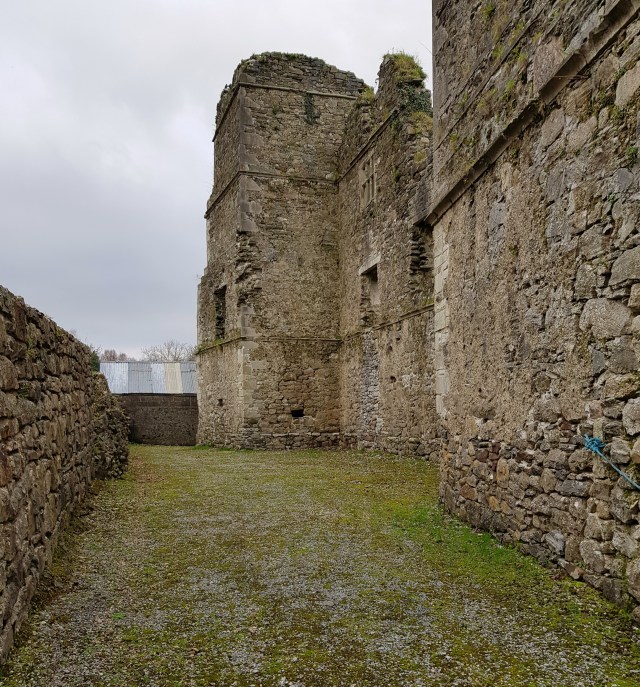


Manorhamilton Castle, County Leitrim is one of six late 16th/early 17th century fortified houses considered as a group by Maurice Craig (in The Architecture of Ireland, 1982). The others are Rathfarnham Castle (A Whiter Shade of Pale, August 26th 2013), Kanturk Castle (An Abandoned Project, December 7th 2015), Portumna Castle (Jacobean Sophistication, August 2nd 2017), Raphoe Palace (From Bishops to Bullocks, July 24th 2017) and Burncourt (Burnt Out, July 4th 2016). All six display an awareness of Renaissance architecture while displaying defensive features such as a flanking tower at each corner. Manorhamilton Castle is the least well-preserved of these properties, and it had one of the shortest lifespans. As mentioned, it was built by Frederick Hamilton in 1634, soon after his return from fighting in Germany with the Swedish army of Gustavus Adolphus (one of Hamilton’s sons was named Gustavus and he would later become first Viscount Boyne). Five years after Hamilton had retired to Scotland and died, his mansion at Manorhamilton was attacked and burnt by the army of Ulick Burke, fifth Earl of Clanricarde, Roman Catholic leader of the Royalist army in Ireland. Badly damaged, Manorhamilton Castle never recovered and soon fell into ruin.
The Big Castle

What survives of Castlemore, County Cork. Standing on a limestone outcrop, this once-substantial building (caisleán mór: big castle) is believed to have been constructed in the 15th century by the McCarthys, then the dominant family in this part of the world. Towards the end of the 16th century it was held for them by the MacSwineys but then passed into the hands of the Ryes whose main seat, Rye Court, lay just a few miles away (see June 1921 II, January 26th 2019). It was subsequently owned, and occupied, by the Travers family but must have been abandoned by them because photographs of the castle taken by Robert French in the late 19th/early 20th show it as a ruin. Still, at least then it was relatively clear of vegetation and also of other properties. Today Castlemore lies in the middle of a quarry and is in very poor condition.


