Mellowed by Time

IMG_9631

An arched niche on one of the quadrants of Powerscourt House, Dublin. Dating from 1771-74 and designed by stone-cutter Robert Mack, the building’s front is entirely faced in granite from the 3rd Viscount Powerscourt’s Wicklow estate. Since 1981 Powerscourt House has been a shopping centre and while the interior is currently a mess of signage, at least the exterior remains relatively clear, allowing us to enjoy what Christine Casey has described as an example of ‘last-gasp Palladianism.’

Sturdy as an Oak

IMG_8319

In recent months this site has featured more than a few derelict historic properties, and is likely to do so again in the months ahead. Today however the focus is on a house which might easily have been lost altogether but instead has been admirably and impeccably restored. Ballinderry Park, County Galway was built during the first half of the 18th century, perhaps some date in the 1740s. For much of the Middle Ages the lands on which it stood belonged to the Franciscan friars of nearby Kilconnell (see Where There is Darkness, Light, November 18th 2013) but in the late 16th/early 17th century they passed into the hands of English-born judge Sir Charles Calthorpe who in 1584 was made Attorney-General for Ireland. Sometime after his death in 1616, they came into the possession of the Church of Ireland Diocese of Clonfert which thereafter remained the landlord until the third quarter of the 19th century.

IMG_8244

IMG_8261

Ballinderry was leased by the Church of Ireland to the Stanford family, one of whom was a revenue collector in the area in the 1680s. The Stanfords, who are recorded as living not far away in Aughrim Castle in 1837, in turn sub-let the Ballinderry estate to the Wards of Ballymacward. The latter were long-settled in the area, having served as hereditary poets to the O Kellys, Lords of Uí Maine, since ancient times the dominant family in this part of the country. In 1786 the tenant was Lewis Ward whose sister Sabina that year married Andrew Comyn, tenant of a small property at Ryefield, County Roscommon. Ultimately their son Nicholas inherited the tenancy and after the Church of Ireland was disestablished in 1871 he purchased the freehold of Ballinderry on 547 acres. His son, another Andrew Comyn, married Mary O’Connell, grand-daughter of Daniel O’Connell. In the 1911 Census he is listed as aged 79 and living in the house with his three sons along with two male and three female servants. The Comyns remained at Ballinderry until 1947. Following the family’s departure the Irish Land Commission subdivided the land with the house, yards and a few immediate acres being bought by Mr. Callanan, a local man.

IMG_8248

IMG_8252

IMG_8257

Ballinderry Park’s current owners George and Susie Gossip write so eloquently that it is best to rely on their own description of the building: ‘The house dates from the first half of the eighteenth century and is largely unaltered, with the exception of a two-storied return at the rear. Two stone-built stable ranges, one mid 19th century and the other considerably earlier, form an enclosed courtyard behind the house, with a pair of tall gates at either end.
Ballinderry is a comparatively small building; seven bays wide and of two stories over a basement. The steeply pitched roof has end gables and hides a third storey, lit by small windows high in the gables. Unusually, the roof over the full-height central bow is taken right up to the level of the main ridge, rather than being returned at a lower level. This gives the house the appearance of having a central tower, rather like a small French château. Apart from the heavy cornice at the eaves and the fine pedimented door case, the façade is free from decoration.
The blank monotony of the end elevations is relieved by the massive stacks, while the rear has been considerably altered, probably on several occasions. In front, the basement is below ground, with its windows opening onto a sunken area like a Dublin town house, but it is several feet above the level of the yard at the rear.
As befits a house of this size the interior is plain, with good shouldered architraves, panelled doors and shutters of heavy 1750s joinery. The staircase, while slightly lighter in style, is the finest internal feature and appears to be original. Were it not for this one would be tempted to suggest that the house could even be earlier, perhaps dating from the 1730s, and this may even be the case. Ballinderry’s chief interest lies in the main façade and in the arrangement and details of the staircase and principal rooms – solid rural grandeur in a miniature scale.’

IMG_8278

IMG_8269

IMG_8266

When the Gossips bought Ballinderry in 2001, ‘it was in a sorry state, used as a store for country furniture, old farm carts, and an amazing variety of agricultural implements and artifacts. While the roof looked intact from the front, the three large Victorian dormer windows at the rear had collapsed, causing considerable damage, both to roof and to the internal fabric. In addition, vandals had smashed the windows and looted the chimneypieces (which in any case were Victorian replacements).’
The first task was to strip the roof so that its main timbers could be repaired and made good while surviving slates were either saved or replaced. The house is constructed of fieldstone covered in lime render which had become defective and had to be removed. This revealed stone lintels, which showed the original positions of the drawing room and dining room windows since reinstated by local masons. As for the windows these were restored to what the Gossips believed to be their original appearance with unequal sashes on the ground floor using heavy early-Georgian glazing bars in the main house and thin Regency glazing bars in the wing, all specially made for the house.
Internally, although the floors were extremely decayed it was possible to save most of the joists; the boards have now been replaced with wide pine boards sawn from old reclaimed beams. The decorative woodwork had been badly attacked by woodworm but all principal doors and most of the shutters were salvaged, together with enough architrave for it to be copied. The skirting had deteriorated beyond repair and the chair-rail had been removed many years ago, so these also had to be replaced.
Apart from shutters and doors, nothing remained of the original decoration in either the drawing or dining rooms. Both were given new ceilings and the walls paneled in the early 18th century style. The drawing room now contains an early Kilkenny marble chimneypiece from a house in County Waterford, the dining room has an early 18th century slate chimneypiece. Similar extensive work took place in the staircase hall and the first floor bedrooms.

IMG_8280

IMG_8286

Thanks to the ministrations of the Gossips, one suspects that Ballinderry today looks better than at any time in its history. The house has a particularly evocative atmosphere, extremely comfortable and aesthetically satisfying. None of the rooms is especially large but there is everywhere a sense of generous space. In part this is due to the ample staircase, its treads wide and deep, and leading to a first floor landing lit from front and rear and of such generous dimensions that it might serve as another sitting room.
Just as importantly, Ballinderry serves as an example of what can be done to save a house that looks on the verge of being lost forever. Of course it takes imagination and patience to bring back a building like this from the brink of ruination but as the accompanying photographs indicate the result more than justifies the effort. Many abandoned houses in Ireland could still be restored provided prospective owners approach the task with the same determination and flair as did the Gossips. The name Ballinderry derives from the Irish Baile an Daoire meaning town, or town-land, of the oak trees. Today the house is once more as sturdy as an oak and ought to survive for as long.

IMG_8015

Ballinderry Park welcomes guests. For more information about the house, including further details of its restoration, see: http://ballinderrypark.com

Wyatt Thing

IMG_9684

A detail of the plaster frieze running around the walls of the staircase hall at Ardbraccan, County Meath. We know that in 1773 James Wyatt produced drawings for the centre block of the house. These were commissioned by Henry Maxwell, Bishop of Meath whose brother Barry Maxwell, Earl of Farnham would likewise employ Wyatt to design a new house for him in County Cavan a few years later. In the event, the architect’s plans for Ardbraccan were modified to incorporate elements from schemes by both Thomas Cooley and Daniel Beaufort, the latter a gifted amateur who was also Rector of nearby Navan. However, the staircase hall’s plasterwork is distinctly Wyatt’esque and so it is surely not too fanciful to imagine that at least this part of his proposal was executed without intervention from other hands.

Gateway to the New Year

IMG_8196

Situated on a quiet country backroad, this is the Volunteer’s Arch at Lawrencetown, County Galway. The monumental gateway was built in 1782 as the principal entrance to an estate called Bellevue owned by Colonel Walter Lawrence, an ardent supporter of the Volunteer movement and of Henry Grattan’s efforts to achieve legislative independence for the Irish parliament. Following the achievement of the latter, Lawrence erected the arch which consists of a main entrance flanked by smaller openings which in turn are connected to two-room lodges. The entrance is surmounted by a pediment topped with an urn and with a carved medallion beneath, while sphinxes rest on either side. A recessed panel directly beneath the pediment bears a Latin inscription which translated reads ‘Liberty after a long servitude was won on the 16th April 1782 by the armed sons of Hibernia, who with heroic fortitude, regained their Ancient Laws and established their Ancient Independence.’ Bellevue is long gone and the gateway, together with a couple of follies, is all that remains of Colonel Lawarence’s efforts. The lodges have recently been restored and perhaps in the coming months might find a use or occupant. And the local authority might like to straighten, or better yet remove, the telegraph pole that mars the appearance of this delightful structure.
The Irish Aesthete takes this opportunity to thank all readers for their invaluable support and interest during the past twelve months, and to wish them a very Happy New Year. There will be lots more of Ireland’s architectural heritage to explore and share in 2014.

Unfurling the Foliage

IMG_8932

A section of the stair hall ceiling at Powerscourt House, Dublin. Designed in the early 1770s by Robert Mack, this served as the town residence for the Viscounts Powerscourt until sold to the government in 1807 for £500 less than it had cost to build. The house is rightly famous for its ebullient decoration, not least this ceiling by stuccodore James McCullagh which, along with the surrounding walls, features a riot of compartmentalised acanthus scrolls. The plasterwork in Powerscourt House is of superior quality but difficult to appreciate since the building, which has served as a shopping centre for the past three decades, is excessively cluttered with confusing signage.

In a Gentleman’s Park

IMG_7183

In the early 18th century Joshua Dawson, MP for County Wicklow and Secretary for Ireland during the reign of Queen Anne, laid out the street in Dublin that still bears his name and there built himself a residence which subsequently became the Mansion House. Around the same time he also had a new property constructed at Castle Dawson, the County Derry estate acquired by his grandfather Thomas Dawson in the 1630s.
This house was subsequently demolished by Joshua’s son Arthur who in the mid-1760s built another, called Moyola Park, the garden front of which can be seen here. The building has been subject to several alterations: the block to the left, for example, was only added in the 1920s. But more importantly, the three-sided bows at either end, as well as the plate-glass windows, are 19th century additions. At that point the staircase was moved from the centre of the single bay pedimented breakfront overlooking the gardens garden to elsewhere in the house. One wonders if the original stairs might have been incorporated within some kind of bow, since an arch of cut stone in the middle of the bay differs somewhat in colour from that on either side. Moyola Park has remained in the hands of its original builder’s family although passing through the female line so that the occupants are now called Chichester-Clark; the late James Chichester-Clark, who served as Northern Ireland Prime Minister until his resignation in March 1971, was subsequently created Baron Moyola.

A Place of Magic

Ievers 17

The earliest recorded mention of the County Clare village Sixmilebridge is in the 1681 journal of the English antiquary Thomas Dinely. As its name indicates, Sixmilebridge is located approximately six miles from Thomondgate in Limerick and is the site of a bridge erected over the O’Garney river in 1610 by Donough O’Brien, fourth Earl of Thomond.
Of particular interest in Dinely’s account of this part of the country is his reference to a castle ‘belonging to Henry Ivers, Esq, well scituate and capable of very considerable improvement, a draught whereof I took on the other side of this leaf…The gentleman, owner hereof, came over (a young man, clerk to one Mr Fowles, a Barrister), since the King’s Restoration, and hath in this time by his Industry, acquired one Thousand pounds a year. The first and chiefest of his rise was occasioned by being concerned in the Revenue as Clerk to the King’s Commissioners for settling the Quit Rents, and afterwards became their Deputy receiver, is now in commission one of his Ma’ties Justice of the Peace, not worth less than sixteen hundred pounds a year.’
Dinely is not altogether accurate since Henry Ivers had actually come to Ireland prior to the Restoration of 1660, being one of the beneficiaries of Cromwell’s sweep across the country. Quit rent was a tax imposed on new settlers granted land by the government and clearly whoever was responsible for its collection could do well, as indeed Ivers did. (By the time of his death in October 1691 he had acquired some 12,000 acres, of which almost half was deemed to be ‘profitable.’) But the great merit of Dinely’s work is that, as he wrote, he included a ‘draught’ or drawing of the old castle owned by Ivers and showing it to be a typical tall tower house of the kind built throughout Ireland in the 16th and early 17th centuries. A massive stone chimney piece in the south hall of the castle’s replacement, presumed to have been salvaged when the latter was demolished, carries the date 1648, which would have made its construction very late for such a building.

Ievers 38

Ievers 34

Ievers 33

When Henry Ivers died, he left his estate to a second son, the eldest having been disinherited for marrying without his father’s approval, perhaps to a Roman Catholic. John Ievers (as the family now began to spell its name) was Colonel-in-Chief of the Clare Militia Dragoons and an MP for sixteen years. When he died in 1731, his heir – another Henry – clearly decided Dinely had been right half a century before that the old castle was ‘capable of very considerable improvement’ since he knocked it down and built a new house on the site, ever after called Mount Ievers.
We are in the rare position of knowing a great deal about the origins of the house, since the accounts for its construction survive. Mount Ievers was designed by the architect John Rothery (with his son Isaac assuming responsibility for the project after Rothery senior’s death in 1736) and work began in 1733 with completion four years later.
During this time masons working on site were paid five shillings a week, and general labourers five pence. In an average week 11 of the former and 48 of the latter were employed, with the labourers receiving not just their wages but also food and clothes including shoes and supplies of coarse linen woven at Mount Ievers. The house cost £1,478 pounds, seven shillings and nine pence to build, but Henry Ievers noted sundry other expenses incurred such as two horses he had given the architect valued at £15, as well as two mules (£4 and twelve shillings) and 3,000 laths (£1 and ten shillings). Slates priced at nine shillings six pence per thousand came from Broadford ten miles away, while the oak roof timbers, thirty-four tons in weight, came from Portumna; they were brought by boat to Killaloe and then hauled twenty miles overland to the site.

Ievers 39

Ievers 30

Ievers 32

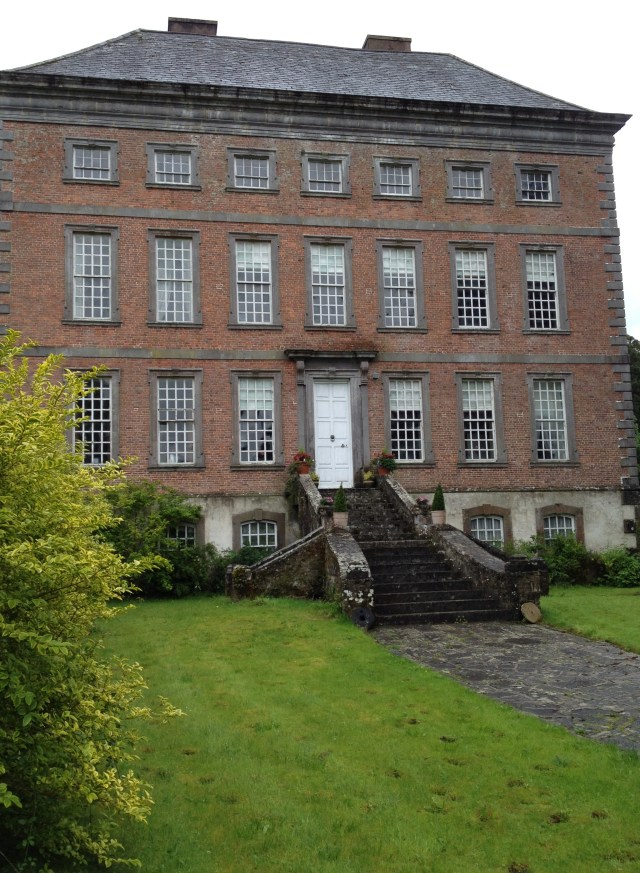
Writing about Mount Ievers in Country Life in November 1962, Mark Girouard proposed its design derived from that of Chevening in Kent, a house attributed to Inigo Jones and featured in the second volume of Colen Campbell’s Vitruvius Brittanicus (1717). Certainly there are many similarities between the two buildings and as Girouard pointed out, ‘an unusual feature shared by both houses, which makes it unlikely that the relation is a coincidence, is the stone cornice with pulvinated frieze below the eaves.’ Of course Mount Ievers was rather anachronistic by the time it was built, but that somehow adds to the place’s charm, as do the two fronts, that to the north faced in brick, that to the south in cut limestone, both of them of seven bays, three storeys over raised basement and with entrances approached by flights of steps. A detail missing from the accounts of the house is the source for the bricks; it is customarily proposed that they came from Holland, a Dutch mill owner who lived near Sixmilebridge shipping rape seed oil to his native country and the vessels on their return bringing bricks to act as ballast. Today after almost three centuries they have mellowed to a soft pink hue lightly dusted with lichen. The west and east sides of the house are rendered with very few windows other than those at either end of corridors running along the centre of each floor.
The tall narrow windows with their thick glazing bars (some of them restored in the last century having been earlier replaced by larger panes of glass), add to the impression of height as does a curious feature of the design whereby each storey is several inches narrower than that below, something almost undetectable to the eye until it is pointed out. The walls are very thick, between four and five feet, and so the entirety of the basement is a series of vaulted chambers needed to support this immense weight.

Ievers 22

Ievers 12

Ievers 13

The interior of Mount Ievers is relatively simple, with most of the rooms retaining their original plaster panelling, elaborate cornices and panelled doors set in doorcases eight and half feet high. The north entrance hall, which takes up about a third of the ground floor includes a wonderful carved staircase, barley-sugar and fluted balusters alternating. This in turn leads to a very substantial first-floor hall off which open the main bedrooms. On the top floor is a long vaulted gallery, intended to provide a space in which ladies could walk on wet days or to serve as a ballroom, or possibly both. There are some very attractive chimneypieces in the ground floor rooms but these date from the second half of the 18th century and were installed around 1850.
In fact, these small changes made at that time were really the only significant ones the house has experienced. The Ievers family, although initially wealthy and powerful, gradually became neither, and it was a want of funds and of the need to impress that led their house to remain largely unaltered. A mural painted over the mantel in the drawing room not long after the house was completed shows the north front exactly as it is today, and while much of the surrounding formal gardens shown have disappeared other elements like the two brick sentry boxes at the end of the garden remain.
Mount Ievers is a place of quite haunting loveliness, a house that captures the hearts of everyone who has ever visited. ‘Magic is an overworked word,’ commented Mark Girouard, ‘but there is undoubtedly a magic about Mount Ievers. It is a mysterious house, shut away among woods with no outlet to the outer world.’ Similarly Maurice Craig, although observing that the house’s interior ‘is very grand but very, very inconvenient’ had to acknowledge ‘But for the pleasure of living in such a house one would endure much.’ Mount Ievers remains in the hands of the same family for whom it was first built. This adds to its exceptional character and so one hopes that long may an Ievers continue to be in residence.

Ievers 18

Charity Edifieth

IMG_8733

The principal entrance to the former Southwell Charity and Parochial Schools on English Street, Downpatrick, County Down. This long two-storey, red-brick building is centred on a clock tower (directly above the archway seen here) and terminates in a substantial three-bay pavilion at either end. With fine views on a sloping site overlooking the town and providing almshouses for six old men and six old women as well as schools for ten poor boys and ten poor girls, the charity was established in 1733 by Edward Southwell who like his father and grandfather served as Secretary of State for Ireland. As is far too often the case, we do not know who was the architect responsible: in 1996 Maurice Craig proposed Sir Edward Lovett Pearce but five years later Dr Edward McParland declared ‘its mannerisms are not Pearce’s’. Although looking as though a refurbishment would be beneficial, the Southwell Buildings remain one of the most important architectural ensembles in Downpatrick.

Dun and Dusted

dunsandle alive

While they claimed direct kinship with Dalaigh, tenth in descent from the 4th century Irish High King Niall of the Nine Hostages, the actual origins of the Dalys of Dunsandle, County Galway are unclear. However they were certainly descended from Dermot Ó Daly (d.1614), described by one recent historian as ‘a chancer whose rapid advancement was due to the success of the Presidency of Connaught and his ability to turn opportunity to advantage…he was an ardent crown supporter and the supposed stability which would accrue as a repercussion of adopting English customs and laws.’ His great-grandson Denis Daly proved equally opportunistic, building up large land-holdings through money made with a thriving legal practice during the turmoils of the late 17th century. In the reign of James II he was made a Judge and Privy Councillor and although a Roman Catholic he managed to hold onto his estates in the aftermath of the Williamite Wars. In fact, both he and his brother Charles continued to acquire more land, supposedly spending some £30,000 so doing: in 1708 Denis Daly paid £9,450 for Dunsandle which had hitherto belonged to the Burkes, Earls of Clanricarde.

IMG_8181

IMG_8185

IMG_8167

As is far too often the case, we do not know a great deal about who was responsible for designing or building the great house at Dunsandle. And great it certainly was until just over half a century ago. Of finely cut limestone, the centre block rose three storeys over basement, of five bays, both the entrance and garden fronts having a three-bay pedimented breakfront. On either side of the main house ran a single-storey screen wall with pedimented doorways and niches which in turn were linked to substantial two-storey courtyard wings. In 1967 the Knight of Glin tentatively attributed the house to the Italian-born architect and engineer Davis Ducart (Daviso De Arcort) and to-date nobody has come up with a satisfactory alternative.
A handful of late 19th/early 20th century photographs give us the only clear idea of what the interior looked like. The saloon had elaborate and very pretty rococo plasterwork not dissimilar to that seen at Castletown Cox, County Kilkenny (which was designed by Ducart) or that of 86 St Stephen’s Green, Dublin which dates from c.1765. The drawing room is said to have had an ‘Adamesque’ ceiling while the entrance hall contained later plasterwork almost certainly designed by James Wyatt (Denis Daly, of whom more later, in 1780 married the heiress of the first Lord Farnham who had likewise commissioned Wyatt to work on his house). Staircases with carved balusters rose on either side of the hall, leading to bedrooms and sitting rooms on the first floor.
In his 1978 guide to Irish Country Houses, Mark Bence-Jones rightly called Dunsandle ‘until recently the finest C18 house in Co Galway’ and one cannot argue with that, since it was long attested by other sources. As far back as 1786 William Wilson in The Post-Chaise Companion or Traveller’s Directory Through Ireland described Dunsandle as ‘the most magnificent and beautiful seat, with ample demesnes of the Rt. Hon, Denis Daly.’ This makes its loss all the greater.

IMG_8125

IMG_8117

IMG_8119

The Rt Hon Denis Daly (1748–1791) seems to have been a man of exceptional character. In his memoirs, Henry Grattan who was a close friend, describes Daly as ‘an individual singularly gifted. Born a man of family, of integrity, of courage and of talent, he possessed much knowledge and great good-nature, an excellent understanding and great foresight…In person Denis Daly was handsome, of a pleasing and agreeable address, and so excellent a manner that by it he conciliated everybody… He was a friend to the Catholics and he always supported them. There were men who possessed more diligence and information, but he surpassed them all in talent.’
A fine portrait by Sir Joshua Reynolds testifies to Daly’s good looks. As has been mentioned in 1780 he married Lady Henrietta Maxwell, only daughter of the first Earl of Farnham, and thus increased his estates (in the early 19th century they ran to over 33,000 acres) as well as inheriting a house on Dublin’s Henrietta Street. Here he entertained with flair, but also displayed his intellectual interests: elsewhere Grattan wrote ‘at Mr Daly’s we dined among his books as well as at his table – they were on it – they were lying around it…’ Decades after his death Hely Dutton in A Statistical and Agricultural Survey of the County of Galway (1824) observed that Dunsandle’s late owner had ‘not only collected the best editions of the great authors of antiquity, but read books with the ardour of a real lover of literature. His library was uncommonly valuable.’ At least part of that library passed to his younger son Robert Daly who in 1843 became Bishop of Cashel and Waterford.

IMG_8145

IMG_8147

IMG_8150

In 1845 Denis Daly’s elder son James was created first Baron Dunsandle and Clanconal. He does not appear to have inherited his father’s charm and was widely reported to be unpopular with his tenantry, many of whom supported the cause of the pro-Catholic Ribbonmen in the 1820s; it should be noted that his brother, Bishop Robert Daly was notoriously anti-Catholic. So too was the second Lord Dunsandle who in 1893 disinherited his elder son William when the latter married a Catholic. In any case, William Daly could not have succeeded to the title since he was illegitimate, his parents only marrying twelve years after his birth. It was William Daly’s son Colonel Denis Daly who in 1931 bought Russborough, County Wicklow and thereby ensured that house survived to the present day. Meanwhile William Daly’s brother – yet another Denis (and like his sibling born out of wedlock) – appears to have taken over Dunsandle after their father’s death in 1893. He in turn was succeeded by his son, Major Denis Bowes Daly who was the last of the family to live there.
It is not altogether clear why the Dalys finally sold up and left Dunsandle in 1954. Obviously there was pressure from the Land Commission which wished to acquire the estate so that it could be broken up and distributed among smallholders. But there were also most likely personal reasons too. In 1950 Major Bowes Daly had divorced his first wife to marry Melosine Hanbury (née Cary-Barnard) with whom he had been joint Master of the Galway Blazers for the previous few years. Mrs Hanbury had already had two husbands, her first Wing-Commander Marcus Trundle being in the news a decade ago when it was revealed that in the mid-1930s London police reported he was the secret lover of Wallis Simpson. Whatever the truth about that, it appears that the Major Bowes Daly’s divorce and re-marriage caused a stir in County Galway in the early 1950s with local Catholic clergy advising farmers to boycott the hunt. Eventually the Dalys moved for a few years to Africa, Dunsandle was sold and in 1958 the house unroofed.
As is so often the case, one could write a great deal more about Dunsandle and its owners, although not too much else about the house. Still, as indicated by these photographs taken only last month, it was clearly a building that ought to have been preserved, with only the vestiges of its former splendour remaining. The wings and linking passages are gone, all that remains is the main block and that looks likely to surrender to vegetation in the near future. Soon even the final traces of that elegant plasterwork will be gone and with them three centuries of Irish cultural history, yet another irreparable loss. Below is a photograph of the main façade of Dunsandle included in the 5th volume of the Irish Georgian Society Records published in 1913.

IMG_8876

Feed My Lambs

IMG_5715

A beautifully-carved stone plaque attached to the wall of a single-room extension built onto the south-west end of the early 18th century St Colman’s church in Farahy, County Cork. As Charles Smith noted in his survey of the county (published 1750) this little structure served as ‘an English Protestant school, with an acre of land set apart by virtue of the statute for the education of poor children in the Protestant religion.’ Perhaps because of its diminutive size, the school does not seem to have lasted long: by the time Nicholas Carlisle produced the Topographical Dictionary of Ireland in 1810 there was no mention of it in the entry on Farahy. One longs to know why Mrs Elizabeth Bridges of the City of London had chosen to endow such an establishment in this part of Ireland in 1721. Farahy today is best-known as the parish beside which stood Bowen’s Court, ancestral home of Elizabeth Bowen which was sadly demolished soon after she sold the estate in 1959.