A Vanishing World


Many people will be familiar with the photographs taken during the last century by the Jesuit priest, Fr Francis Browne, both those of the Titanic (which he boarded for its maiden voyage before disembarking prior to its ill-fated voyage across the Atlantic Ocean) and those depicting everyday life in Ireland. Much less well-known are the series of country house pictures that Browne began to take from the late 1940s until a few years before his death in 1960. In 1947 he received the first of a series of commissions from the Irish Tatler & Sketch, which described itself as ‘Ireland’s Premier Social & Sporting Monthly.’ Many of these pieces featured not only photographs by Browne but also texts which he had written.
No information has been found to explain how the Irish Tatler & Sketch initiated contact with Browne, but by then, thanks to his work with the various other organisations, he was well-known as a photographer of exceptional ability. Furthermore, he had already been taking pictures of historic houses for some time, since during this period quite a number of them were occupied by Catholic religious orders. His earliest images of Rathfarnham Castle, for example, date from 1920, just seven years after the building had been bought by the Jesuit order. Similarly, he often photographed Emo Court in the years after it was acquired by the same order, for many of which he lived in the building.
However, Browne now began to take pictures of houses still in secular hands. In April 1945, in a letter to his Provincial Superior, he explained that earlier that year, while in Portlaw, County Waterford to give a Triduum (a Catholic religious observance lasting three days), he had received permission to visit nearby Curraghmore, home to the de la Poer Beresfords, Marquises of Waterford. ‘I did so,’ he elaborated, ‘because I am collecting a set of Georgian Houses, & Curraghmore was on the list given me by the Georgian Society.’ It is unclear which organisation he means, since the original Georgian Society had come to an end in 1913 and its eventual successor, the Irish Georgian Society, was not established until 1958; it may be that he was using the fifth volume of the Georgian Society Records (published 1913) which contained a catalogue of important country houses throughout the country, or else perhaps another work, Georgian Mansions in Ireland by Thomas Sadleir and Page L. Dickinson, which appeared in 1915 and which devoted several pages to Curraghmore.   In any case, it says a great deal about Fr Browne’s character and a reflection of his personal charm that he was able to gain access to so many houses at a time when they were still in private hands and not open to the public.

Killeen Castle, County Meath

The first country house photographed by Browne to appear in the Irish Tatler & Sketch was Shelton Abbey, County Wicklow, home for some 200 years to the Howards, Earls of Wicklow. By now it was home to the last of the family to live there, William Howard, eighth earl who in 1932 had converted to Catholicism, much to the disgust of his father (seemingly, he was appalled at the idea of Shelton Abbey’s heir attending the same church as the servants). Browne had visited the house in November 1946, but the following April he sought permission to go there again, as Lord Wicklow had recently told him ‘that owing to his circumstance, he proposes utilising Shelton Abbey as a kind of hotel or “Country Club”.’ He therefore wanted Browne to return to the house and take further photographs ‘before the necessary alterations are made.’ The building was then still filled with treasures accumulated by generations of Howards, many of them captured in situ by Browne as he and his camera went from room to room. He visited in good time because the hotel venture was not a success and after just three years Lord Wicklow was obliged to sell Shelton Abbey’s contents in a spectacular auction that lasted for 13 days. The great majority of lots went to overseas buyers and left Ireland, making Browne’s pictures priceless as a guide to how the house once looked. Shelton Abbey is today an open prison and much of its interior badly affected by institutional use.


Rockingham. County Roscommon

Some of the houses photographed by Browne have either since been demolished, such as Rockingham and Frenchpark, both in County Roscommon, or left a ruin, like Killeen Castle, County Meath. A number of others that he visited – the likes of Adare Manor, County Limerick and Dromoland Castle, County Clare – are now hotels. Many more, among them Knocklofty, County Tipperary and Glananea, County Westmeath, have changed hands on more than one occasion and long lost their original contents. Happily, the story of what has happened since that time is not all bad. Some of the houses Browne visited, not least Castletown, County Kildare and Malahide Castle, County Dublin, are now in public ownership and open to visitors, while the Ormond Castle, County Tipperary has, since passing into the care of the Office of Public Works, benefitted from an extensive programme of restoration. And a few of the houses shown over the coming pages remain in the same hands and have experienced relatively little change, among them the aforementioned Curraghmore and Lismore Castle, both in County Waterford, and Dunsany Castle, County Meath.

Shelton Abbey, County Wicklow

While Browne photographed more than 50 country houses, he did not cover all of Ireland. Had he been a free agent, he might have taken pictures of a great many other places but he could only go where he was permitted to go by his superiors in the Jesuit order; many visits to these historic properties were tagged on to other trips undertaken in the course of his work as a Catholic priest. In consequence, there are omissions. An obvious absence is Northern Ireland which, in the decades after Independence, Browne does not appear to have visited. Most of the houses he photographed were in the east, the Midlands and the south. Other than the two Roscommon properties already mentioned, the West is unrepresented, and, aside from two houses in County Louth and one in County Monaghan, he took no pictures of houses north of Dublin.
These gaps are regrettable but, given the photographer’s circumstances, understandable. We must be grateful that Browne managed to visit so many old houses and record them for posterity before the majority underwent irrevocable change. Not all of them feature in a new book, A Vanishing World: The Irish Country House Photographs of Father Browne, published this week. Limitations of space and the desire to give adequate space to the houses included in the present work means many more had to be left out. In a small number of cases, the pictures are not of the best quality or of insufficient number to merit their presence. In others, the houses have already been well documented, and images of them are easily available to anyone interested. Pictures of a few more are included in the book’s introduction, such as Mespil House in Dublin, home for many years of the pioneering artist Sarah Purser, which Browne photographed just a couple of months after her death in August 1943. Within a decade, the mid-18th century building had been demolished, although thankfully three of its remarkable ceilings, attributed to the stuccodore Barthelemy Cramillion, were salvaged; two of them are now in Dublin Castle, and one in Aras an Uachtaráin. Then there was Lamberton, County Laois, a large two-storey Georgian houses which Browne visited in January 1944, just a few months before it was stripped of everything worth salvaging and then demolished. Heywood, also in Laois, had been acquired by the Salesian order in 1941 and Browne photographed it on two occasions, in July 1943 and September 1945. Again, these images are important because in January 1950 the house was gutted by fire and later levelled.
After the pictures of Shelton Abbey appeared in the Irish Tatler & Sketch in 1947, further examples of Browne’s country house photographs continued to appear in the magazine for a number of years, as they did in other publications, including Ireland of the Welcomes in 1953-54, and then The Irish Digest. By then he had stopped travelling so much – he was, after all, in his mid-seventies – and would lead a more retired life until his death in 1960. Like the rest of his output, for a long time his photographs of Irish country house were forgotten and even when other pictures had been rediscovered and published, this particular group has not been given much attention. This new publication therefore serves two purposes: it allows us to see how these buildings looked in the middle of the last century and it gives us an opportunity to celebrate once more the outstanding talents of Fr Francis Browne, photographer.

Frenchpark, County Roscommon

A Vanishing World: The Irish Country House Photographs of Father Browne is published by Messenger Publications

The Irish Aesthete is generously supported by 

A New Vision


The narrative of the Irish country house as a place of dishevelment and decay has a long and melancholic history, stretching back to the publication of Maria Edgeworth’s seminal novel Castle Rackrent in 1800. Her vision of properties and their owners both being hopelessly atrophied found many fictional heirs for almost two centuries, continuing as late as Caroline Blackwood’s Great Granny Webster, which appeared in 1977 and Molly Keane’s Good Behaviour published four years later. These accounts present variations on the same theme: that the Irish country house, dank, gloomy and bitterly cold, has no viable future and is doomed to sink into ruin. In truth, the notion of the Big House – as such buildings are traditionally known in Ireland – being in terminal decline frequently had its basis in fact. In March 1912, Violet Martin, one half of the writing duo Somerville and Ross, informed her c0-author Edith Somerville about a recent visit to Tyrone House, County Galway which she found ‘rather dilapidated and ‘where rioted three or four generations of St. Georges – living with country-women, occasionally marrying them, all illegitimate four times over. No so long ago eight of these awful half-peasant families roosted together in that lovely house, and fought, and barricaded and drank, till the police had to intervene.’ Tyrone House duly served as the inspiration for Somerville and Ross’s 1925 novel, The Big House of Inver.


Fortunately, in recent decades there have been other, and happier, stories deserving to be told, as will be discovered in The Irish Country House: A New Vision. The fifteen houses featured offer an alternative narrative, not just about historic Irish properties but about Ireland herself. Once dogged by persistent poverty and a pervasive atmosphere of dejection, since the 1990s the country has undergone something of a transformation. This change of circumstances has brought with it fresh opportunities and the promise of a better future for Irish country houses. Formerly, the sale and abandonment of big old properties was a common occurrence, but this is no longer the only or even most frequent option. Instead, the possibility of a new life has become viable. Which is not to suggest that every historic house can be assured of a secure future; there are still buildings being lost, like so many of their equivalents in the past. But the chances of salvation are now much better than used to be the case.


Almost all the properties featured in The Irish Country House: A New Vision have had to undergo extensive restoration since the start of the present century, some of them are still in the process of being restored. Had they not been acquired or inherited by the present generation of owners it is probable that at least some of them would have been lost forever.
It takes a particular kind of pluck, or perhaps madness, to assume responsibility for a house much larger than the average family home, and constructed in an era when staff to maintain the building were plentiful and cheap. Fortunately, there are people gifted with this kind of pluck, along with generous quantities of imagination and determination. These traits are particularly necessary when the house in question is currently in poor condition, sometimes even downright ruinous. Not everyone possesses the character required for the task, just as not everyone wants to take on the challenge of bringing an old house back to life. Providentially, Ireland is blessed that there are increasing numbers of them who relish the opportunity, with all its potential highs and lows. Some of them feature in the book, but there are many more who are at different stages of the journey towards the creation of a viable, comfortable family home. The hazards of taking on an historic house are obvious, cost being just one of them. But there are advantages too, not least the chance to put your own stamp on a building. Along with installing new plumbing and electric wiring, with repairing gutters and replacing damaged windows, comes the possibility of further enhancing the character of a place, of adding another distinctive chapter to its story. This is what sets apart these properties. They disprove the long-standing narrative of the Irish country house as being in irremediable decline and instead inform us that these buildings have been blessed with an irresistible and dynamic new spirit.


The Irish Country House: A New Vision is published by Rizzoli


Left Without a Handkerchief


The Irish Aesthete is delighted to announce the publication of his latest book, Left without a Handkerchief. A long time in the making, this tells the stories of ten Irish families across the centuries, leading up to the moment when each of their homes was attacked and most often burned during the troubles of the early 1920s. Whence the title? On January 10th 1923 Louise Bagwell wrote a short letter to her mother-in-law Harriet describing what had taken place during the previous night. Around 12.30am, a large number of men had arrived at Marlfield, County Tipperary, home to generations of the Bagwell family for some 230 years, and informed the occupants they had ten minutes to dress and gather up whatever items they could. Meanwhile, the intruders sprinkled petrol around the ground floor rooms and applied a match. ‘Then’, Louise Bagwell explained, ‘for an hour we had to stand and watch the darling old home burn.’ Only when the fire had done sufficient damage to the building did the men depart: afterwards its chatelaine discovered they had taken her bag and coat with them. Everything had been lost, she lamented, all the family’s possessions going back generations, leaving them with little other than the clothes they had hastily donned: ‘We hadn’t even a handkerchief.’


Photograph shows Ardfert, County Kerry, burnt on 3rd August 1922 and subsequently demolished. Left without a Handkerchief is published by Lilliput Press (please see Left Without a Handkerchief by Robert O’Byrne – The Lilliput Press


Of the Highest Standard


Townley Hall, County Louth is an Irish country house which has featured here more than once before (see Là, tout n’est qu’ordre et beauté* « The Irish Aesthete). Without doubt, one of the most perfectly designed buildings in Ireland, it was the result of a happy collaboration between architect Francis Johnston and his client Blayney Townley Balfour – and also, crucially, the latter’s sister Anna Maria Townley Balfour whose involvement in the project has until recently been insufficiently understood and appreciated. The result was a masterpiece of neo-classical architecture, a work of impeccable refinement and flawless taste, with the staircase hall at the centre of the house being one of the masterpieces of late 18th century European architecture. Like all such properties in Ireland, Townley Hall has faced challenges, its future at times uncertain, but the present custodians of the building – the School of Philosophy and Economic Science – have carried out much work on site to ensure the survival of this most-important building in our national heritage. And it has now produced a sumptuous book celebrating the glories of the house and its place in the architectural pantheon, to which the Irish Aesthete has contributed several chapters. The standards of the publication are every bit as high as those of Townley Hall, making this a book of interest to anyone possessed of an aesthetic sensibility.


You can also watch me discuss Townley Hall in a short film made for the Institute of Classical Architecture & Art last summer, which is available to view at Townley Hall, Ireland | ICAA Travel Revisited – YouTube

Green Fingered


Regular readers will be aware that over the past couple of years, the Irish Aesthete has devoted much time and attention to the subject of the Irish country house garden and its evolution since the early 17th century. This study has taken a number of forms, including an exhibition of paintings of walled gardens (which show, incidentally, can at present be seen in Kylemore Abbey, County Galway, which has its own restored walled garden), a two-part television documentary, and a conference on the subject. The last of these, held last autumn, has now spawned a book, Digging New Ground: The Irish Country House Garden 1650-1900. Co-edited by Professor Finola O’Kane, the publication contains essays from a wide variety of knowledgeable experts in this field of study, all of whom offer fresh insights into their chosen topic. 


Country house gardens, like country houses themselves, only really begin to appear in Ireland from c.1600 onwards; prior to that date, the only cultivated areas resembling gardens as we know them would have been attached to religious houses, monasteries and convents. In her contribution, Vandra Costello looks at these early domestic gardens and what form they took, much influenced by ideas from Italy, France and Holland, while Terence Reeves-Smyth explores the evolution of the walled garden, once an essential feature of any country house of substance. But while early gardens almost celebrated their artifice, from the mid-18th century onwards, the natural and the romantic – sometimes in conflict, sometimes in harmony – came to dominate horticultural theory and practice alike, influenced by such notable English practitioners as Capability Brown and Humphry Repton. However, during this period Ireland produced her own distinguished garden designers, not least John Sutherland whose highly successful career is examined by Patrick Bowe. Thomas Pakenham looks at the creation of arboretums in this country, and Seamus O’Brien explores the explorers: those intrepid botanical hunters forever in search of new plant species to bring back to Ireland. There are essays on garden buildings by Ruth Musielak, on the effect of technological advances in the production of glass and iron by Laura Johnstone, on evaluations of and improvements in gardening during the 19th century by Finola O’Kane, and an assessment of the Irish country house garden in the 21st century by Catherine FitzGerald. Plus, the Irish Aesthete tells the story of John Hennessy Saul, born into a family of gardeners, who emigrated to the United States where he established a thriving horticultural business, involved in the design and creation of gardeners throughout that country.


John Hennessy Saul was born in December 1819 at Carey’s Wood, a dower house on the Castlemartyr estate owned by the Boyles, Earls of Shannon: appropriately enough, the place, now called Carewswood, is a garden centre. Both Saul’s grandfather and father were gardeners, so it was almost inevitable that this would also be his choice of profession, as was also the case for several of his brothers. After working first in Ireland and then in England for some years, in 1851 he emigrated to the United States where he was almost immediately employed by the country’s most influential landscape architect Andrew Jackson Downing, with whom he then worked on the layout of the National Mall in Washington, D.C. Following Downing’s untimely death in July 1852, Saul established his own business in the city, and within a few years was running an 80-acre nursery supplying plants to customers from the Atlantic to the Pacific, not least Frederick Law Olmsted, designer of Central Park and Prospect Park in New York City, along with many other public and private commissions. Saul’s catalogues often offered opportunities to buy varieties of plants that he had cultivated: charmingly, he tended to call these after his wife. He also wrote regular specialist articles for all the leading horticultural publications of the time, won prizes in all the major competitions then being held and served on a number of important horticultural boards and committees. When the District of Columbia’s Board of Works established a Parks Commission in Washington in 1871, Saul was one of its founding board members and produced plans to increase the number of trees throughout the city: he was serving as the commission’s chairman at the time of his death, aged 77, in May 1897. John Hennessy Saul was clearly a remarkable man, and an outstanding horticulturist who learnt his skills while young and working in an Irish country house garden. Across the centuries, emigration has sent millions of Irish men and women around the world, and it seems probable that at least some of them worked in the same field as Saul, and perhaps enjoyed similar success. Their stories wait to be rediscovered and told, thereby enriching Ireland’s own gardening history.

Hot Off the Presses


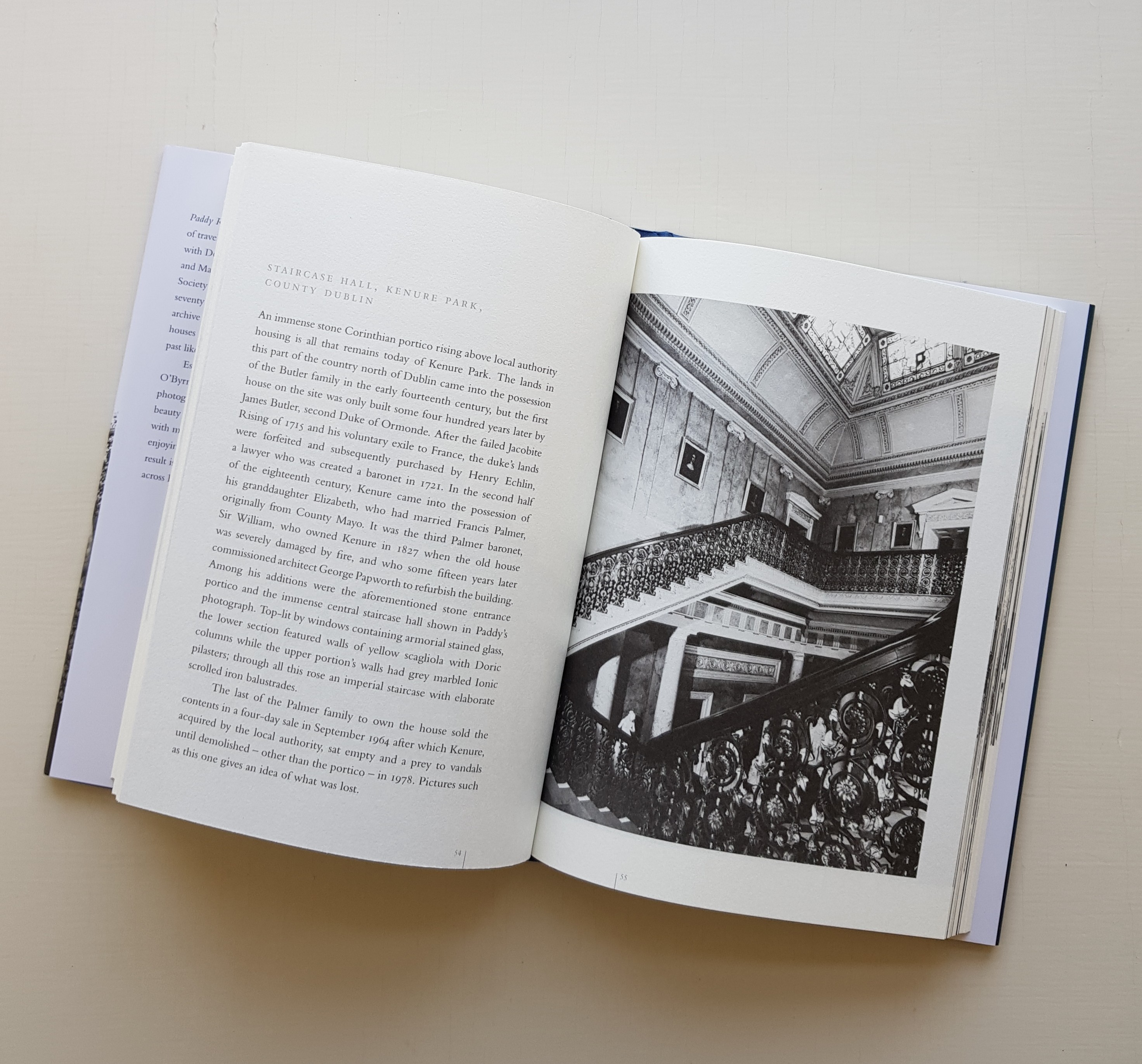
Due to be officially launched tomorrow, Paddy Rossmore: Photographs is a collection of images of Irish buildings taken over half a century ago. For several years in the 1960s, Paddy journeyed around the country, often in the company of Mariga Guinness and the Knight of Glin, exploring our architectural heritage and recording buildings which, sadly too often, have subsequently been lost. Although not a professional photographer, he had an intuitive eye (and excellent travelling companions) and soon discovered a natural talent for composition. Only a handful of his pictures have ever been published (some in Country Life) and I am very happy to have collaborated with Paddy in producing a representative collection of the work. While the majority of the houses included still stand, and a few have even been restored, others – as mentioned – are no more. Below is a representative example of the latter category, Kenure Park, County Dublin which other than its monumental portico was demolished in 1978.


Paddy Rossmore: Photographs is published by Lilliput Press and is available from all good bookshops (and online from http://www.lilliputpress.ie), price €25.00

Presents of Mind III


A niche in the façade of Dublin’s Lying-In Hospital, otherwise known as the Rotunda. Designed by Richard Castle, what is now the world’s oldest continuously operating maternity hospital opened on this site in 1757 and takes its popular name from the adjacent Round Room which with accompanying assembly rooms were constructed to raise income for the institution. The hospital’s façade is of Wicklow granite, the use of which is discussed in The Building Site in Eighteenth-Century Ireland written by the late Arthur Gibney (and edited for publication by Livia Hurley and Edward McParland). While a certain amount of investigation has been conducted into the architecture of the Georgian period, the process of construction during the same era is relatively little studied. This is what makes Gibney’s book so fascinating: he has studied contemporary records to discover how buildings both public and private were put together at the time. The first two chapters examine who was responsible for what on a building site, and the various form of contractual arrangements employed whenever work was undertaken. Regarding the latter, several options were available, some of which involved fixing the final cost in advance (carrying an attendant risk that contractors keen to make a good profit might skimp on materials and finish) while what was known as a measured contract ‘paid each trade separately for measured quantities of work based on agreed rates.’ The potential financial gains to be made by builders, especially in large-scale public schemes, were exposed following a parliamentary enquiry in 1752 into a national barracks building programme: this led to the dismissal of the Surveyor General Arthur Jones Nevill in 1752 (he was expelled from Parliament the following year).
Gibney follows with chapters looking at different areas of the building trade covering carpentry, joinery and the timber trade, wall construction, brickwork and stone, roofing and glazing, plastering and painting. The emergence of builder architects like George Semple and the Ensor brothers is also considered; as Gibney observes, ‘Eighteenth-century craftsmen in Irish cities were essentially part of a middle-class milieu with access to the same opportunities as members of the merchant community.’ By the book’s conclusion, the reader has a full understanding of how buildings were constructed in the 18th century and what characteristics distinguished them from equivalent structures in Britain and elsewhere (it transpires the differences are most immediately evident in the way floors were made). Gibney’s work is a most welcome addition to the field of Irish architectural studies and helps to provide a fuller picture of building work in this country during the Georgian period.


The Building Site in Eighteenth-Century Ireland by Arthur Gibney (edited by Livia Hurley and Edward McParland) is published by Four Courts Press.

Presents of Mind I


One of the gates at the entrance of the Keep Gate standing in the grounds of Birr Castle, County Offaly incorporating the Parsons family coat of arms. With machicolations, slit and loop windows, and crenellated battlements, this two-storey miniature castle was designed by Mary, third Countess of Rosse in 1847-8 and constructed as a famine relief project. Well inside the grounds of the estate, the Keep Gate forms part of a star-shaped moat around the castle, the moat being designed by the Countess’s uncle Captain Richard Wharton Middleton.
The Keep Gate is one of many buildings to feature in a splendid new publication Flights of Fancy: Follies, Families and Demesnes in Offaly written by County Architect Rachel McKenna. After initial chapters investigating the nature of follies and other demesne architecture, McKenna goes on to consider in depth fifteen different estates in Offaly, some well-known – like Birr and Charleville – others less familiar such as Ballycumber, Prospect and Acres’ Hall. Running to 348 pages, the work is extensively and admirably illustrated with abundant colour photographs, maps and plans, drawings old and new and many other images to complement the text. Published by Offaly County Council, this is a model of the kind of book all local authorities should be producing: one hopes others will follow Offaly’s lead in demonstrating such pride in the region’s built heritage. Hard to fault and impossible to resist, not least because the volume’s price is a very affordable €30.


Flights of Fancy: Follies, Families and Demesnes in Offaly by Rachel McKenna is published by Offaly County Council.

Brought to Book


In September 1753 Michael O’Reilly wrote from Dublin to the Roscommon-based antiquarian Charles O’Conor ‘I think a man should read books as he eats victuals; surfeits of either cannot be digested; and too many books as too many dishes will cause surfeit.’ The problem for O’Reilly, as for many readers today, was that more volumes were being produced than could be consumed: the market seemed to be ahead of supply. Toby Barnard’s newly-published Brought to Book: Print in Ireland 1680-1784 examines the history of publication here during this period. Barnard notes the steady rise in work being brought out. In the 1680s the average number of new titles published in Dublin was 52: by the 1790s that figure had risen to 480. For a long time Irish authors preferred, if possible, to publish in England, the understandable expectation being that they would thereby earn more and reach a larger audience. Furthermore, because the British government’s Copyright Act of 1710 did not apply to Ireland, authors who published here enjoyed no legal entitlement to payment for their work. While this had an impact on the development of Irish publishing, ultimately the drive towards an indigenous industry was too strong to be resisted.


Barnard notes how many of the books produced here were local editions of work already successful in other countries. Initially interest in books about Ireland attracted little interest, one dealer noting that such volumes were ‘very little noticed by them whom they did most concern.’ But with the passage of time, increased communication and greater awareness of the need to improve the state of the country, work of Irish subject matter increased in appeal – and sales. Then as now, criticism was not always well-received: the English agronomist Arthur Young was much admired when he wrote about his own country – the Dublin Society made him an honorary member in 1771 – but drew a less favourable response when he turned his attention to matters Irish: the first edition of his Tour of Ireland had to be published in London when insufficient subscribers could be found here. Contrary to what is often thought and despite the Penal Laws, devotional books for Roman Catholics were published in Ireland from the 1720s onwards, albeit under a suppositious mainland European imprint. The first work in the Irish language known to have been produced in Dublin for Catholic readers appeared in 1736: intended as an aid for other members of the clergy, it was a series of sixteen sermons by Bishop Gallagher of Raphoe, County Donegal. By the end of the period covered, books such as Charlotte Brooke’s The reliques of Irish poetry (1788) were both recording and celebrating the nation’s ancient culture. As Barnard points out ‘the venerable was valued as evidence of the complex culture in an earlier Ireland.’ The course of this transition is traced in his own book, illustrating how complex cultures also existed here during the early modern period.


Brought to Book: Print in Ireland 1680-1784 by Toby Barnard is published by the Four Courts Press.

Presents of Mind III

turner-de-lond
A view of the northern end of Sackville (now O’Connell) Street as shown in William Turner de Lond’s depiction of the entry of George IV into Dublin on August 17th 1821. The king had actually landed at Howth five days earlier, on his fifty-ninth birthday and in a state of some inebriation: it may have been as a result of the latter that his ‘official’ arrival only took place when it did. The scene shows George IV, the first British monarch to visit Ireland in 130 years (and the first for much longer to come without bellicose intent), standing in his carriage to acknowledge the cheering crowds. This was not a piece of fiction: a contemporary report in The Patriot observed that ‘they never saw any manifestation of popular enthusiasm so heartfelt, as that which hailed his Majesty from, at least, 100,000 persons of all ranks and estates.’ The painting was only one among several produced to commemorate the occasion (a number of artists recognised its commercial potential) and is of interest for showing the Rotunda Hospital in the background as well as the east side of Rutland (now Parnell) Square.
It is one of a number of such works included in a recently-published book, Creating History: Stories of Ireland in Art which accompanies an exhibition of the same name currently running at the National Gallery of Ireland. While at least some of the works discussed are imaginative recreations (such as Samuel Watson’s portrayal of the 11th century Battle of Clontarf, painted in 1844, and James Barry’s Baptism of the King of Cashel by St Patrick, c.1800-1), others provide an invaluable record of how parts of this country looked in the past. Such is the case with the picture shown below, Francis Wheatley’s 1780 picture of the Irish House of Commons. For some observers the interest here would be in identifying some of the political parties included in the work. For others, however, it is especially important for showing how this chamber, designed by Sir Edward Lovett Pearce, looked before being seriously damaged by fire in 1792. Although reconstructed to a simpler design, the House of Commons was abolished eight years later and, as is well-known, when the Parliament building was subsequently bought by the Bank of Ireland, the British government insisted structural changes were made to ensure it could not revert to its original purpose. Creating History: Stories of Ireland in Art examines more than fifty works of art and includes essays by the likes of Professors Tom Dunne and Roy Foster, Róisin Kennedy and Emily Mark-Fitzgerald.

wheatley
Creating History, edited by Brendan Rooney, is published by Irish Academic Press, €24.99. The accompanying exhibition at the National Gallery of Ireland continues until January 15th.