The central entrance on the north front of the Royal Hospital Kilmainham, Dublin, a building begun in 1680 to the design of Sir William Robinson. The previous year Arthur Forbes, 1st Earl of Granard and Marshal of the Garrisons of Ireland, had visited Paris and seen the newly-completed Invalides. He proposed to Charles II that a similar military hospital for elderly or disabled veterans be built in Dublin and the king duly commanded that this should be (work on its equivalent in Chelsea started two years later). The foundation stone was laid by then-Viceroy James Ormond, 1st Duke of Ormond and it is his coat of arms that can be seen above the doorway’s segmental pediment flanked by Corinthian pilasters. As Christine Casey has observed, the impact of this classical building on what was still essentially a mediaeval city must have been enormous: ‘It was such a sight that in 1684 a rule was introduced forbidding residents to accept gratuities from visitors who came to see it.’ Currently undergoing structural repair, since 1990 the Royal Hospital has housed the Irish Museum of Modern Art.
Author Archives: theirishaesthete
Restoration Drama
Since last October work has been underway restoring the City Assembly House on South William Street, Dublin. This week it will be possible for members of the public to see the results of this enterprise and to (re)discover an important part of the city’s 18th century architectural heritage.
The City Assembly House dates from the second half of the 1760s and was built by and for the Society of Artists of Ireland. It was an idealistic organisation which believed the best means of advancing interest in and awareness of the creative arts in the country was to have a venue where these skills could be taught and the results put on display. Thus the core of the building is a top-lit octagonal space 40 feet wide and 33 feet high. Today this is the oldest purpose-built exhibition gallery in Britain and Ireland.
While the gallery occupies the rear of the City Assembly House, the front section was intended to hold offices for the society as well as rooms where students could learn to draw, paint and sculpt. It is this forward area which has now been restored by the Irish Georgian Society, wishing to give the old building a new lease of life.
The City Assembly House has had a somewhat chequered career, since the society responsible for its erection had gone out of existence by 1780. Thereafter the premises were used for debates, shows, balls, masques and so forth until the building was acquired by Dublin Corporation in the early 1800s. It then acted as City Hall for half a century before becoming a law court and, in more memory, a civic museum. The last of these ceased to operate out of the building a decade ago and since then the City Assembly House has stood empty.
Now the IGS has assumed responsibility for the City Assembly House and for its complete restoration. The first phase was completed a few weeks ago, returning the front of the structure to its original understated elegance. Of particular interest is a top-lit staircase that cleverly climbs up and accommodates landings at different levels to front and rear. The stairs terminate in a handsome oval gallery beneath a glazed dome that provides light down to the ground floor and in particular draws attention to the pretty rococo cornice. Much of this had become indiscernible behind layers of paint and while certain sections required repair, a surprising amount of the original plasterwork has survived intact. Other discoveries included splendid neo-classical decoration in the large first floor room overlooking South William Street, and a granite wall on the ground floor return. Original floors have been cleaned and repaired, chimney pieces reinstated and doors repaired. The result is an absolute delight.
As of last month the City Assembly House is the headquarters of the IGS, but it has always been intended the building should open to the public. And so it will from Wednesday on, with a reception area and bookshop just inside the front door and the main gallery used for temporary exhibitions, beginning with photographs from the Vanishing Ireland project of James Fennell and Turtle Bunbury (until August 31st). Admission is free, so anyone visiting Dublin – or indeed living there – should take this opportunity to delight in one of the city’s lesser-known architectural gems, and to learn more about the work of the IGS. Incidentally, funds permitting it is hoped to begin full restoration of the main exhibition gallery next year.
For more information about the City Assembly House, and the work of the Irish Georgian Society, see http://www.igs.ie
Thinking Periodically
Rathfarnham Castle, County Dublin as depicted in a watercolour by the Huguenot artist Gabriel Beranger in 1774. It shows the structure, built around 1583 for Adam Loftus, Lord Chancellor of Ireland and Protestant Archbishop of Dublin as a semi-fortified residence, after it had been extensively altered by his descendants in the 18th century.
In state ownership since 1987, today and tomorrow Rathfarnham Castle is the venue for the Period Buildings Show, an event organised by the Irish Georgian Society & South Dublin County Council, in partnership with the Office of Public Works. Ireland’s leading conservation practitioners will demonstrate everything from sash window repairs and stained glass and fanlight conservation to stone carving and traditional wallpaper making. Inside the house will be talks on a variety of topics relating to conservation. The occasion ought not to be missed especially since, mirabile dictu, admission is free.
For further information see: http://www.igs.ie/Programmes/Conservation-Outreach.aspx
Tunnel Vision
Built 1883-89 Newtownbarry, County Wexford is one of the last country houses designed by Belfast architect Sir Charles Lanyon, assisted by his pupil W.H. Lynn and his son John. Somewhat austere in style, the building’s character constrasts with that of the lush surrounding grounds. These are probably of earlier date and include a two-acre sunken garden which terminates at one end in this densely foliated rustic tunnel.
Shanid a Boo
For some seven hundred years the romantically-titled Knights of Glin lived in the same area of County Limerick overlooking the Shannon estuary. The family traced its descent from Maurice fitz Gerald, son of Gerald fitzWalter of Windsor and his wife the Welsh Princess Nesta. In 1169 Maurice participated with Richard de Clare, Earl of Pembroke (otherwise known as Strongbow) in the Norman invasion of Ireland and thereafter remained in the country. His grandson, John fitz Thomas, a forebear of the mighty Earls of Desmond, greatly expanded the family territory, especially in the regions of Kerry and West Cork before being killed with his legitimate son Maurice at the Battle of Callann in 1261. It is now widely accepted that John fitz Thomas had a number of illegitimate offspring, one of whom was John fitz John, founder of the Glin line. (Apologies for this multiplicity of names beginning with fitz…) His was one of three lines of Knights who appear around this time – the Knights of Glin (or Black Knight) and of Kerry (or Green Knight), and the White Knight – the two other titles originating with his siblings or their descendants. We cannot be absolutely certain such was the case: much of this story rests on the chronicle of Nesta’s grandson, the historian known as Giraldus Cambrensis who to quote a later historian was the author of absurd eulogiums lauding the Geraldines.
As for the title Knight of Glin, it has been proposed this was bestowed on John fitz John by his kinsman John fitz Thomas who in 1316 was ennobled as first Earl of Kildare (and was accordingly ancestor of the Dukes of Leinster). Thereafter the Knighthood of Glin was inherited by prescriptive right. It was not, however, recognised in the British peerage: an attempt in 1814 to have all three Knights’ titles officially recognised was unsuccessful and there is no mention of the Knights of Glin in the likes of Debretts.
Until the late 17th century, successive Knights of Glin were perforce warriors: it was always a struggle to hold onto their lands the extent of which rose and fell as one generation followed another. Granted Shanid in West Limerick in 1197, the family adopted the motto ‘Shanid A Boo’ which means ‘Shanid for ever’ and this was always their war cry. However, once peace settled on Ireland in the 18th century, so too did the Knights not least by seeking to create a permanent residence to replace various castles which had suffered damage during the upheavals of the previous 200 years. The oldest part of the present Glin Castle was a long thatched house built in the 17th century; this was probably turned into a T after an eastern extension was added in the area now occupied by the secondary staircase, smoking room and dining room.
It was Colonel John Bateman FitzGerald, 23rd Knight of Glin who in the 1780s decided it was time to build something more splendid for himself and his descendants, and therefore commissioned the large three-storey block which on the ground floor contains the entrance and staircase halls as well as drawing room and library. In 1789 Col. John married a beautiful English heiress, Margaretta Maria Fraunceis and no doubt it was her money which helped to pay for the building.
Colonel John’s portrait can still be seen over the entrance hall chimneypiece at Glin. Depicting him in the uniform of the Royal Glin Artillery, it was commissioned from Joseph Wilson in 1782 when the subject was attending the Dungannon Convention of Volunteers, a reflection of the uncertainty of the era when the threat of French invasion inspired many members of the gentry and nobility to raise their own militias. Below the picture is the presentation sword made by Read of Dublin in 1800 and presented to Col. John for keeping the peace in West Limerick during the 1798 Rebellion.
Elsewhere in the same hall hang other portraits of earlier Knights, not least Richard FitzGerald, the 22nd Knight painted by Herman van der Mijn. A famous duellist, he is here seen receiving a challenge to a duel proffered by his servant. The mid-18th century Irish baroque mahogany table beneath carries the arms of the FitzMaurice family of Kerry and has always stood in the house. This is a rare survival from Col. John’s era since after his death in 1803 the family’s indebtedness meant almost everything had to be sold out of the house except old portraits and some silver.
We do not know who designed the present house or the names of the craftsmen responsible for its decoration, not least that in the entrance hall which contains highly elaborate plasterwork. During the closing decades of the 18th century there were a number of skilled architects working in this part of the country, including the Italian-born Davis Ducart who built Limerick city’s splendid Custom House (now the Hunt Museum). He or someone influenced by him may have had a hand in the design of Glin. The exterior is fairly plain (and its toy battlements were only added in the 1820s) which makes the interior richness all the more appealing.
This is especially true of the entrance hall, where the neo-classical plasterwork is of a very high standard and may have been produced by either Michael Stapleton or Charles Thorpe, both stuccadores based in Dublin. The cornice blends antique motifs such as sphinxes and Roman foliage with more indigenous forms, not least the shamrock! The central part of the ceiling is given over to a trompe l’oeil scalloped dome containing a series of Etruscan figurative medallions connected by be-ribboned garlands. Although Desmond FitzGerald, 29th and last Knight of Glin who died in September 2011 (see Knight and Day, October 1st last) carried out extensive restoration work elsewhere in the house he never wanted this ceiling cleaned, believing its patina reflected the character of his forbears. In this way Glin Castle maintains a sense of history and a visible link with the family’s ancient past.
I shall be publishing a small tribute to the Knight of Glin this autumn; more on the subject closer to the time.
The Irish Aesthete Recommends II
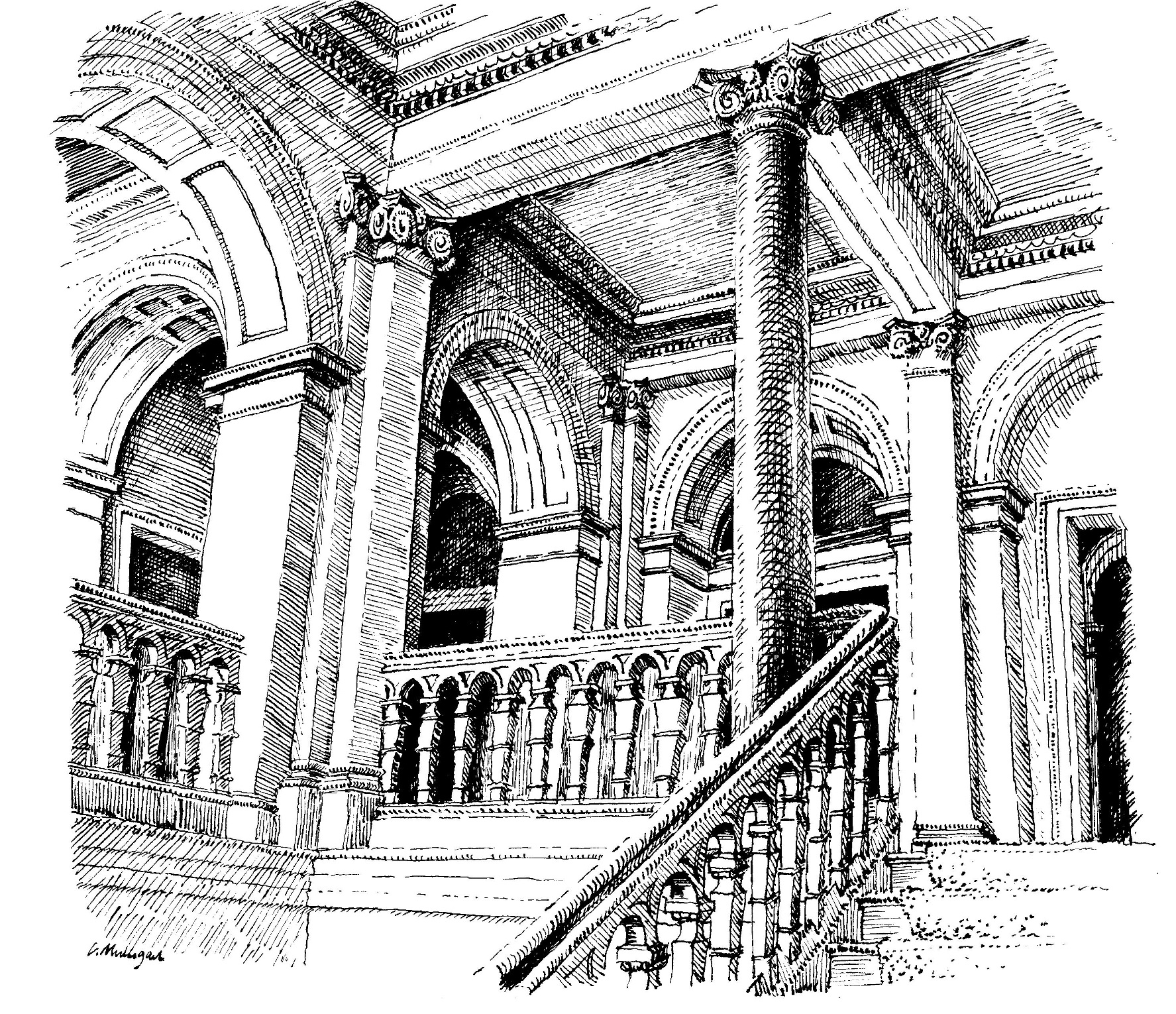
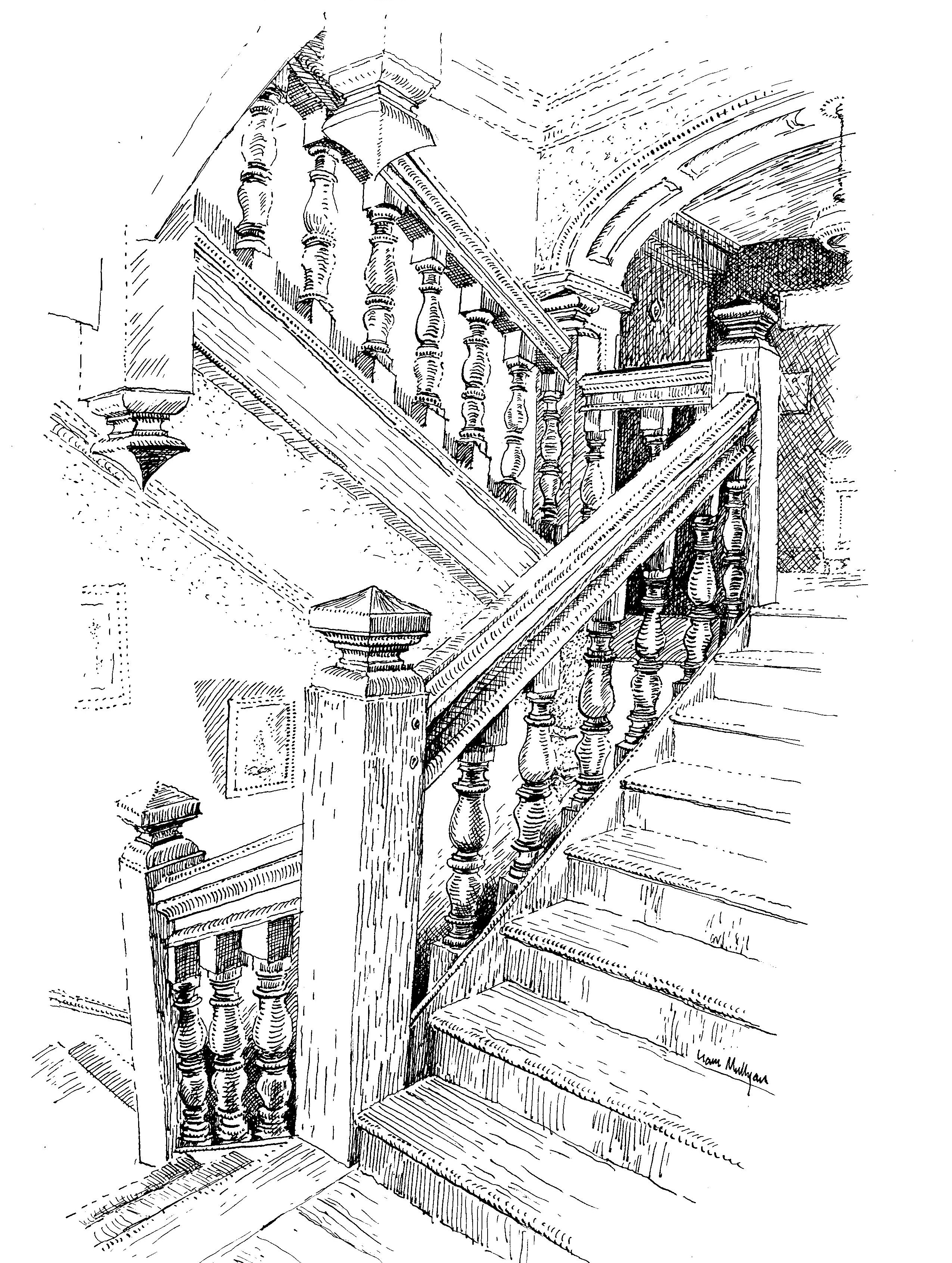
The Buildings of England architectural series begun by Sir Nikolaus Pevsner in 1945 is justifiably celebrated, but the Irish equivalent is less well-known most likely because this remains a work-in-progress. The first volume, devoted to North-West Ulster and written by Professor Alistair Rowan, appeared in 1979 and since then a handful more have been published. The latest to come out covers South Ulster (Counties Armagh, Cavan and Monaghan) and has been compiled by Kevin Mulligan. Like its predecessors, the book makes for fascinating reading, not least thanks to the author’s engaging prose (I like his description of Gosford Castle as ‘a great brawny pile’). One of the most important aspects of these books is that they are not unduly reverential about either the past or the present: there is a frankness of language that one rarely finds in architectural discussion. And the work comes with ample illustration, both colour and black and white. Included here are two illustrations by the author’s brother Liam Mulligan, that above showing the main staircase at Castle Leslie, County Monaghan (designed by W.H. Lynn and dating from the 1870s) and that below of the 17th century oak staircase at Richhill Castle, County Armagh. Text and pictures alike make this an essential addition to the library – together with the earlier volumes, of course.
The Buildings of Ireland: South Ulster by Kevin V Mulligan is published by Yale University Press at £35.
You Ain’t Nothin’ But a Hound Dog
A couple of details of the plasterwork on the main staircase at Russborough, County Wicklow. The walls here are smothered with flamboyant but finely finished decoration – thought to be the work of Irish stuccodores – celebrating the delights of the hunt, hence the profusion of hounds’ heads together with trophies of the chase. Russborough will be hosting a Hints of History festival this coming weekend. For more information, see http://www.russboroughhouse.ie/images/downloads/hintsofhistory.pdf
The Wind Beneath My Wings
A key figure in the emergence of neo-classicism in the 18th century, James ‘Athenian’ Stuart was apprenticed as a child to a London fan painter. In 1742 at the age of 29 he set out on foot for Italy – no Grand Tour for this impoverished young man – and once there worked as both a painter and a guide to antiquities. At some point he met the affluent Suffolk gentleman Nicholas Revett and in 1748 the two men, together with painter Gavin Hamilton and architect Matthew Brettingham visited Naples in order to study Greek monuments in that part of the country.
As a result of their Neapolitan excursion, Stuart and Revett determined to travel to Greece to measure and record some of that country’s antiquities; while detailed scholarly studies of Roman ruins had already been undertaken, no equivalent work existed for Greek remains. The pair sought funds to undertake a “new and accurate description of the Antiquities &c. in the Province of Attica.” Under the auspices of the Society of Dilettanti and with donations from other patrons, in 1751 Stuart and Revett set off for Greece – then part of the Ottoman Empire – and remained there for several years during which they took accurate measurements and made drawings of various ancient buildings examined.
Although Stuart and Revett returned to London in 1755, it was only seven years later that the first of their influential five-volume Antiquities of Athens and Other Monuments of Greece appeared. Among the buildings included in this work was the Tower of the Winds or Horologium in Athens. Erected around 100-50 B.C. by Andronicus of Cyrrhus to measure time, it is an octagonal structure 42 feet high and 26 feet wide; each of the building’s eight sides faces a point of the compass and was decorated with a frieze representing a different wind deity and a sundial below. Originally the roof was topped with a weather vane in the form of a bronze triton while the interior contained a water clock to record time when the sun was not shining. By the mid-18th century only half the tower was above ground and in order to produce accurate drawings Stuart and Revett had to organise for a fifteen-feet deep trench to be dug, and for a further seven feet of debris to be removed from its interior, then being used by whirling dervishes.
The ancient Tower of the Winds in Athens was the inspiration for two garden buildings designed by Stuart, the first a Temple of the Winds completed in 1765 at Shugborough, Staffordshire and originally surrounded by an ornamental lake. Almost twenty years later Stuart revisited the concept to create another Temple of the Winds, this time at Mount Stewart, County Down for Robert Stewart, future first Marquess of Londonderry. As their surname indicates, the Stewarts were a Scottish settler family; their wealth was immeasurably increased when Robert’s father married Mary Cowan, an heiress with shares in the East India Company. It was her money that paid for the purchase of the Mount Stewart estate overlooking Strangford Lough. The site chosen for Stuart’s Temple of the Winds is at the top of a rise in the parkland, and offers sweeping views across the lough and towards the Mourne Mountains.
Stuart, who died only a couple of years after the building’s completion, never visited Ireland to see his design put into effect. Nevertheless the quality of workmanship throughout is flawless. Mount Stewart’s Temple of the Winds owes much of its inspiration to the Athens original but is not an exact copy (see the gouache of that building made by Stuart while still in Greece). Faced in local Scrabo sandstone, it does not have a frieze running around the upper walls, and the side porticos are not pedimented but have balustrades or viewing platforms to take advantage of the views. To the rear, as at Shugborough, there is a domed three-quarter-round extension holding a spiral staircase. The interior is of three storeys: a basement for services; a relatively plain ground floor reception room; and, the real glory of the building, a saloon or banqueting hall on the first floor. Every detail of this space is superlatively decorated, from the marble chimneypiece supplied by London carver John Adair through the low relief plasterwork ceiling by Dublin stuccadore William Fitzgerald to the complementarily decorated marquetry floor composed of mahogany, walnut, sycamore, box and bog oak: the result is a room of restrained sumptuosity. In the care of the National Trust for the past half-century, the Temple of the Winds is without question one of the most perfect small buildings in Ireland.
A Room with a View
In this instance the view is on the ceiling and best viewed while lying on the floor. In the drawing room at Beaulieu, County Louth, the compartmental plasterwork ceiling climaxes in an oval central panel filled with painted canvas. Attributed to 18th century Dutch artist Willem van der Hagen, the trompe-l’œil scene extends upwards through a classical arcade and into the open air whence Icarus can be seen taking a tumble after flying too close to the sun. Hovering putti seem remarkably indifferent to the poor fellow’s fate.
Going Head to Head
Ancestral home of the Mcmorrough Kavanaghs, ancient High Kings of Leinster, the present Borris House, County Carlow is an 18th century house incorporating parts of an older castle. Around 1810-20, the father and son team of architects Richard and William Morrison tricked out the building’s exterior in vaguely Tudor-Gothic style. Among the flourishes they added were these sandstone hood moulds above each window, all of them concluding in coroneted heads so as to emphasise the residents’ former royal status.