The gothick drawing room at Grey Abbey, County Down. Dating from the early 1760s the main part of the house was built in the classical manner by William Montgomery. Following his death in September 1781 while leading British troops at the Battle of Groton Heights during the American War of Independence, the estate was inherited by his brother Hugh. In 1793 the latter married the Hon Emilia Ward, daughter of the first Viscount Bangor who lived on the other side of Strangford Lough at Castle Ward. This house is famous for its dual architecture and decoration: owing to the differing tastes of Lord and Lady bangor one half is in the classical style, the other in gothick. It would appear the Hon Emilia preferred her mother’s predilection and thus caused the redecoration of Grey Abbey’s drawing room.
Author Archives: theirishaesthete
Relishing the Society of Friends
‘Our eyes were charmed with the sweetest bottom where, through lofty trees, we beheld a variety of pleasant dwellings. Through a road that looked like a fine terrace walk, we turn to this lovely vale, where Nature assisted by Art, gave us the utmost contentment. It is a colony of Quakers, called by the name of Ballitore.’ Thus wrote an unknown visitor to this part of County Kildare in 1748. Ballitore has long been an area where members of the Religious Society of Friends settled. The sect was established in the late 1640s by the English dissenter George Fox but its tenets quickly found a response in Ireland where the first recorded Friends meeting for worship took place in 1654 at a house in Lurgan, County Armagh belonging to William Edmundson.
Before converting to Quakerism and adopting its pacifist principles, he had been a member of Oliver Cromwell’s Parliamentarian Army, as was his almost exact contemporary Colonel John Fennell who like Edmundson moved from England to Ireland. In 1675 Edmundson’s diary records travelling from Wales and attending a meeting at Fennell’s Irish house: ‘The wind coming fair we put to sea again and landed at Cork where Friends were glad of my coming. When I had visited Friends’ meetings in that quarter, I went to John Fennell’s in company with several Friends, where we had a refreshing, heavenly meeting. Here divers Friends from Mountmellick and thereabouts came to meet me, in whose company I returned home, where I met with my wife and children in the same love of God that had made us willing to part one with another for a season for the Lord’s service and truth’s sake.’ By this time Edmundson was settled in Rosenallis, County Laois (not far from another Quaker settlement, the aforementioned Mountmellick) while Fennell had acquired land at Kilcommon on the outskirts of Cahir, County Tipperary.
Despite being in (quietly reflective) opposition to the established church and its practitioners accordingly incurring various penalties, Quakerism soon established a presence in Ireland. Already by 1660, the sect had some thirty meeting houses around the country and their numbers continued to grow through the remainder of the 17th and early years of the 18th centuries. Their minority status meant Quakers often gathered together in settlements such as that at Ballitore. The land on which the village stands was purchased in 1685 by two Quakers John Barcroft and Abel Strettel, supposedly after they had discovered the spot while resting their horse en route from Dublin to Cork. The first planned Quaker settlement in these islands, it quickly grew and some forty years later saw the foundation of a boarding school by the Yorkshire-born Abraham Shackleton. Although run on Quaker principles, it was open to children of all denominations and its most celebrated ex-pupil was the orator, statesman and philosopher Edmund Burke.
Not far from Ballitore stands Burtown, originally built for the Quaker Robert Power in 1710 and marked on early maps as Power’s Grove. The house’s original appearance was somewhat different to what can be seen today: of three bays but only one room deep, it seems to have had wings of which just a faint outline remains. In the second half of the 18th century, the property was extended to the rear, notably by the addition of two large bow-fronted rooms one above the other and linked by a splendid staircase accessed via a broad elliptical arch. It is surmised that the ground floor room was intended for dining: it has a charming arched alcove filled with plasterwork representing tendrils of grapevine and flanked by Corinthian-capped pilasters on which sit classical vases. The space seems made for a sideboard which would certainly support the dining room theory. Meanwhile the equally fine room directly above, although now serving as a bedroom, would originally have been a piano nobile drawing room.
Burtown’s plasterwork, probably the work of a travelling stuccadore offering what were then fashionable flourishes, is one of the house’s greatest delights. There is more of it found in the entrance hall, rather Wyatt’esque in style compared with that seen elsewhere in the house. The ceiling is mostly covered in a sequence of swags while the walls have small oval medallions and, a delightfully quirky detail, classical busts on brackets in each of the corners. More work took place to the house in the early 19th century when the front was given its fan-lighted door and the roof those deep eaves so typical of the period.
Traditionally Quakers were renowned for their plain living with all forms of ornamentation eschewed. Burtown’s decoration suggests its owners were perhaps not the strictest adherents of their faith; tellingly William James Fennell who inherited the property in 1890 and was a keen horseman, was ‘asked to leave the Quaker persuasion because of his fondness for driving a carriage with uniform flunkies on the back.’ William James was a direct descendant of Colonel John Fennell and came to live at Burtown through his mother, Jemima Wakefield. The Wakefields had married into the Haughton family who in turn had married members of the Power family, Burtown thus passing several times through the female line. Jemima Wakefield had not expected to come into the property until her brother died after being hit by a stray cricket ball; who knew the game could be so dangerous?
William James Fennell was the great-grandfather of Burtown’s present owner, photographer James Fennell who lives in the house with his wife Joanna and three children. The latest generation has added its own mark while preserving the property’s character and cherishing its history. In particular Burtown’s gardens, which are now open to the public, continue to be expanded and developed. Across three hundred years and four different but inter-related families Burtown has acquired a patina only possible provided there is sufficient time and care. As had that visitor to the area in 1748, today it is still possible to be charmed here when ‘through lofty trees, we beheld a variety of pleasant dwellings.’ Few such houses as Burtown remain in Ireland and it is therefore fortunate that the current owners bring such enthusiasm and commitment to the task of preserving the place into the future.
For more information about Burtown and its gardens, see: http://www.burtownhouse.ie
It’s All in the Detail
One of four large urns placed in niches on the first-floor inner landing at Castle Coole, County Fermanagh; two of them (including that shown here) double as stoves, Irish winters being pretty chilly. Although this does not feature, certain architectural details of Castle Coole and a number of other houses in this country are discussed in a recent essay by Calder Loth, Senior Architectural Historian for the Virginia Department of Historic Resources and Member of the Institute of Classical Classical Architecture & Art‘s Advisory Council. Calder was one of the group of ICAA members who toured Ireland last May and who I had the pleasure of meeting on several occasions. You can find his very informative and beautifully-illustrated piece at: http://blog.classicist.org/?p=6620
Written in the Stars
A detail of the frieze that runs around the hemispherical ceiling of what was originally Lord Charlemont’s study in the Casino at Marino in Dublin (see Casino Royale, March 25th). Located in the eastern arm of the Greek Cross building, this is known as the Zodiac Room since, as can be seen, the frieze is decorated with astrological signs. It has been proposed that originally the ceiling was painted to represent the northern firmament but today only the plasterwork remains.
Knock Knock
The popularity of the gothic style for domestic buildings in early 19th century Ireland owed something to a desire among landed families to suggest longer residence here than was often actually the case. The Levinges, for example, only came to this country in the aftermath of the Williamite Wars when the Derbyshire-born lawyer William Levinge was appointed Irish Solicitor-General and Speaker of the House of Commons; he later became Attorney-General and Lord Chief Justice. As a reward for his services, in 1704 he received a baronetcy and duly became Sir Richard Levinge of High Park in the County of Westmeath.
Today the property is known as Knockdrin, built close to a late mediaeval castle once belonging to the Tuite family; it was their lands that Sir Richard acquired and on which he built a new house. However by the early 19th century this had fallen into disrepair and so the sixth baronet, also called Sir Richard Levinge, embarked on a rebuilding programme that would give him a splendid gothic castle and all the links with an ancient past this implied.
It is not known for certain who was responsible for the design of Knockdrin Castle. Sir Richard Morrison produced a design for the entrance front but while elements of this were incorporated into the eventual building it cannot be attributed to him. Instead Knockdrin is assigned to James Shiel, believed to have trained in the office of Francis Johnston an architect who created some of the finest gothic revival castles in Ireland, not least Charleville, County Offaly. Like Charleville, Knockdrin’s late-mediaeval trappings are lightly worn: this is essentially a Georgian country house in fancy dress. The entrance front presents a degree of asymmetry, primarily thanks to a long castellated curtain wall leading to a two-storey gatehouse providing access to the service courtyard. But the battlemented main block, of rubble limestone with dressed window surrounds and featuring a wide fanlit doorway flanked by square towers, has only superficial quirks, such as a slim turret on the south corner. And notice how standard rectangular sash windows are used on the upper storeys.
A similarly familiar sense of order can be found inside where once more the usual forms are followed, albeit decked out in gothic flummery. As in so many Irish houses the rear of the entrance hall has a screen but in this instance it is composed of three pointed arches supported on slender cluster-shafted columns. Doors to either side open onto the library and dining room (the latter now regrettably divided in two). But another door provides access to Knockdrin’s most striking feature: a top-lit staircase with the stairs (like the doors throughout the building) made of carved oak. The elaborate first floor is decorated with a gallery of fluted shafts and sequence of ogee-headed niches around the walls. Abundant light provided by a central glazed dome helps to create a fluid, elegant space possessing none of the heaviness customarily associated with the Gothic Revival movement. On the other hand, despite high ceilings emblazoned with plasterwork of Tudor roses and the like, the enfilade of ground floor reception rooms – ballroom, drawing room, library – is less distinguished, although a line of full-length, south-facing windows means that like the staircase hall they are exceptionally bright.
Knockdrin remained in the possession of the Levinge family until the last century. Within weeks of the outbreak of the First World War the tenth baronet, another Sir Richard Levinge, was dead after being hit in the neck by a bullet as he walked along a trench at Ypres. His widow and only son moved to England and the house was let to various tenants; at one point it served as a school and in the early 1940s was occupied by members of the Irish army who inevitably inflicted a certain amount of damage on the building. Finally in 1943, the greater part of the estate having already been broken up by the Land Commission, the castle and surrounding land was sold by the Levinges, thereby ending a link of almost 250 years. The present owners bought the place in 1961 and have cared for it ever since. One should not try to make exaggerated claims for Knockdrin. It is certainly not a house of the first importance, but can be considered noteworthy as an example of the transition from classicism to gothic, when the latter was still a style and not yet an ideology and the former’s principles survive beneath a veneer of ornamentation. Below is a portrait of Sir Richard, the sixth baronet who commissioned the house. The picture was painted by the minor English artist Thomas Shew in 1828 and includes a view of Knockdrin, presumably imaginary since Shew never came to Ireland.
The Irish Aesthete Recommends III
The drawing room at Rossana, County Wicklow as painted by Maria Spilsbury Taylor (1777-1823) an English artist who moved to Ireland after marrying an Anglican clergyman and thereafter became friendly with the Tighes of Rossana, known for their religious fervour. Rossana was originally built around 1742 by William Tighe but extended later in the century when wings were added. One of these contained the drawing room with the elaborate panelling seen above and often attributed to Grinling Gibbons (which would suggest it came from another, earlier, building). In the last century the wings were demolished and the panelling taken to the United States.
Rossana was a house well-known to poet Mary Tighe (née Blachford) who often stayed there, although she would die in March 1810 at Woodstock, County Kilkenny (see Of Wondrous Beauty Did the Vision Seem, May 13th). Mary Tighe is the subject of a new biography by Miranda O’Connell which brings this once-famous author of the six-canto allegorical poem Psyche back to public attention after a long period of unjustified neglect. Acknowledged as much for her beauty as her literary skills, Tighe’s early death transformed her into a figurehead of the Romantic Movement. Miranda O’Connell’s book not only considers the poems but also places her subject in the context of Ireland before and after the Act of Union, a fascinating period in the country’s history. Much to be recommended, it also contains many fascinating pictures and photographs.
Mary Tighe by Miranda O’Connell is published by Somerville Press (see http://www.somervillepress.com).
Roman Evenings
A princely villa in the former Papal States? No, this is a view taken below the terrace of Ballynatray, County Waterford. Situated on the banks of the Blackwater river, the house dates from the closing years of the 18th century but was subsequently refaced in stucco, hence its radiant exterior thanks to a wash of colour responding to evening sunlight.
*In case you have not already done so, today is the last chance to nominate me for an Irish Blog Award (see Number One, July 25th).
Abbey Road
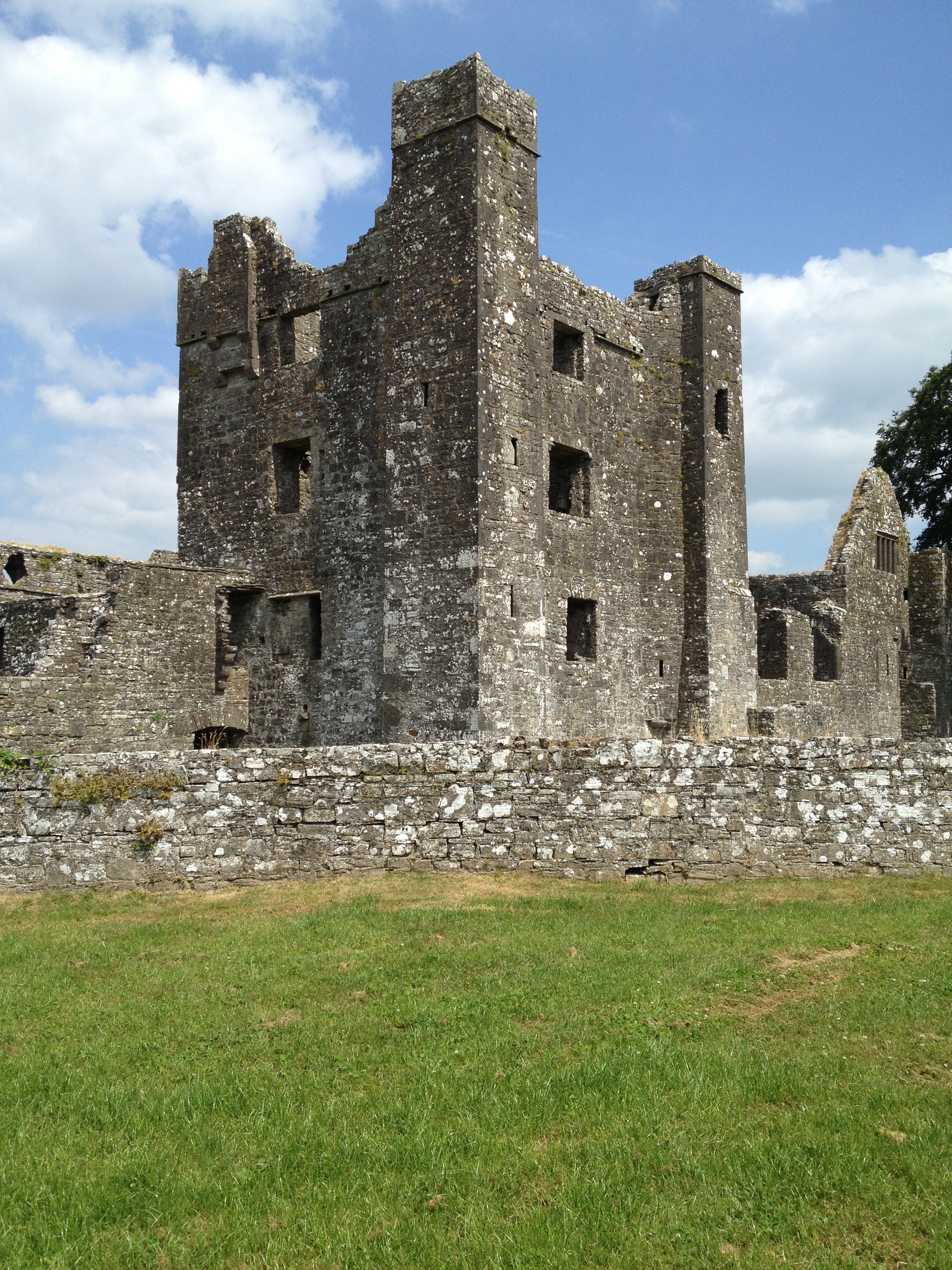
In 1142 St Malachy of Armagh was responsible for founding Ireland’s first Cistercian monastery at Mellifont, County Louth. Five years later a small group of this house’s residents walked some 35 miles to establish a second monastery close to the banks of the Boyne river at Bective, County Meath. Built on land granted by Murchadh O’Melaghlin, King of Meath the new monastery was dedicated to the Virgin Mary and quickly grew into a thriving community. Half a century after its foundation, such was the importance of Bective Abbey that in 1196 the body of the Anglo-Norman Lord of Meath Hugh de Lacy was interred here; it was later moved to St Mary’s Abbey in Dublin. By the start of the following century Irish Cistercians would appear to have slipped into laxness; attempts by the church authorities to initiate a programme were rebuffed, not least by the Abbot of Bective who in 1217 participated in a ‘riot’ at Jerpoint Abbey, County Kilkenny and was further charged with imprisoning a man in a tree stump until he died. The Abbot was subsequently sent to Clairvaux in France for trial and prior of the Norman Abbey of Beaubec appointed to take responsibility for Bective.
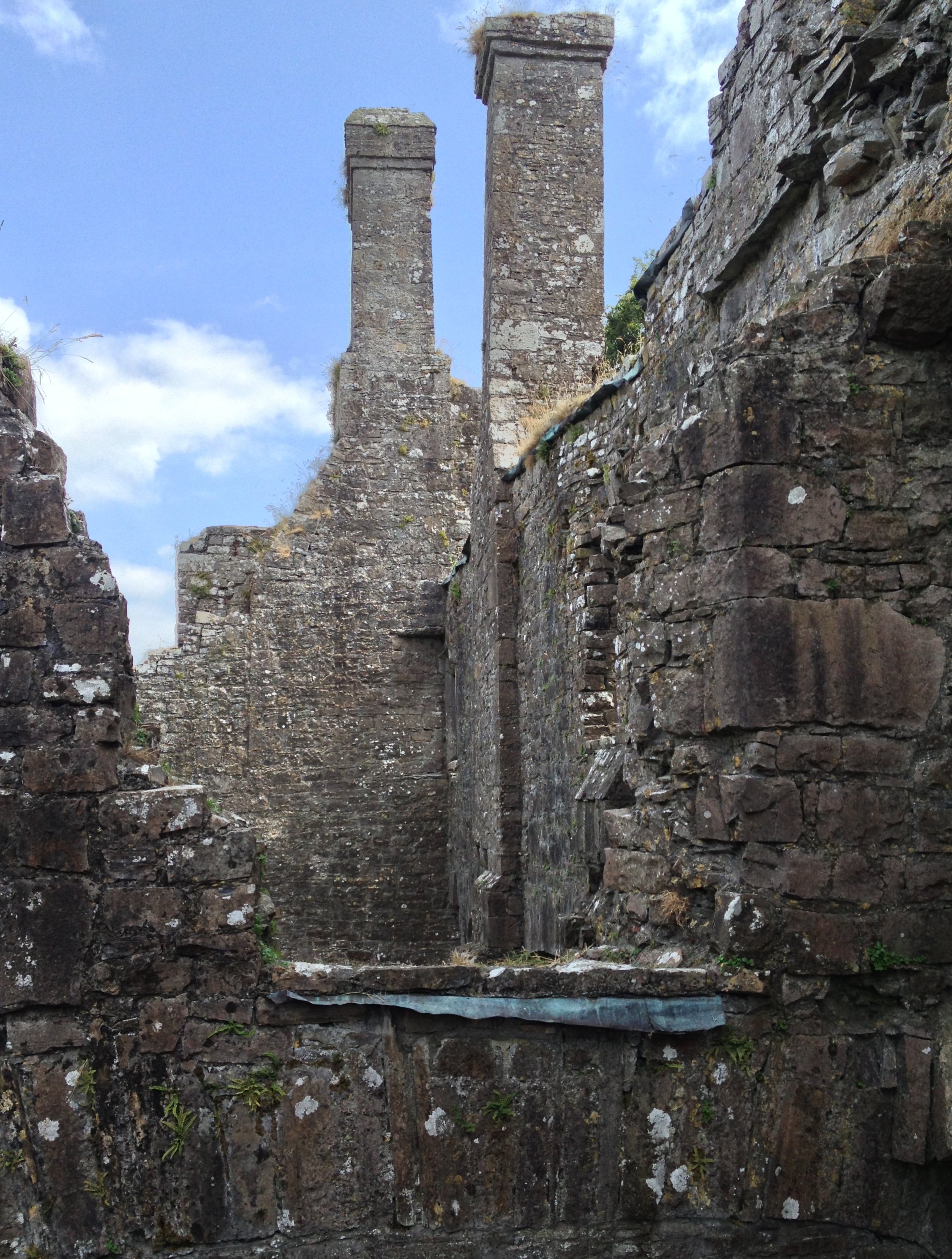
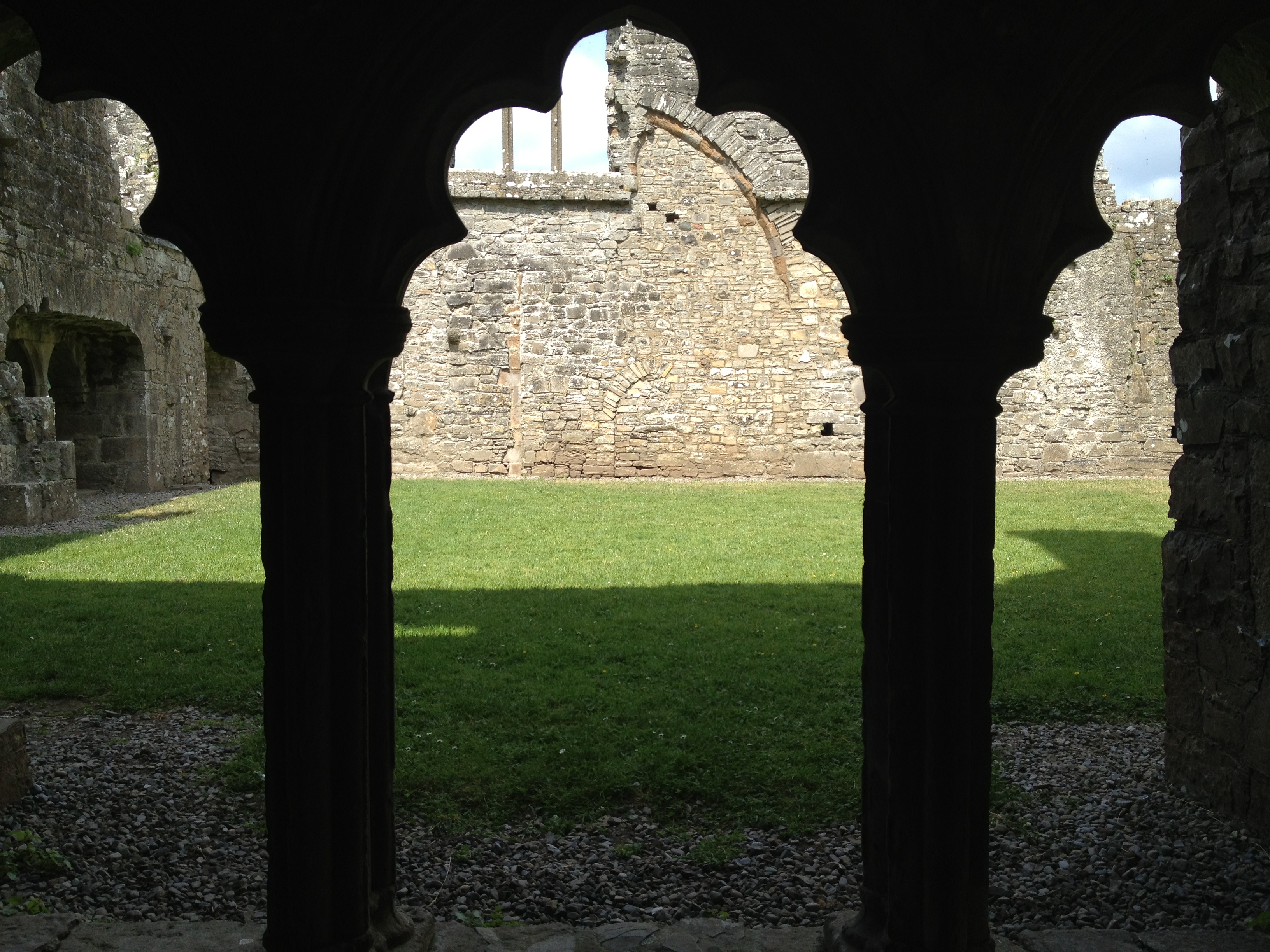
Nothing remains of the original monastic establishment at Bective; the earliest part of the present range of buildings dates from the 12th – 13th century buildings and include there remain the chapter house on the south-east side, a plain rectangular building with central column, also part of the west range and fragments of the aisled cruciform church. By the 15th century a serious decline in numbers had occurred and the premises were reduced in size. The church, for example, was substantially shortened and its south aisles demolished which in turn blocked off the adjoining arcades. Massive fortified towers were erected on the church’s west façade and on the south-west corner of the monastery, giving Bective the appearance more of a castle than a religious establishment. The most striking feature to the modern eye is the cloister that was built at this time, smaller than its predecessor (measuring no more than 33 feet square) and now the best-preserved Cistercian cloister in Ireland. The passages are set not beyond the walls but within them and are thus recessed, with each arcade composed of three miniature arches supported by double-column shafts. In one instance a panel between inner and outer shaft is decorated with the carved figure of an unidentified cleric set into an ogee-headed niche with his arms including three fleur-de-lys (see the top-most picture for a detail of this feature).
Despite having fewer occupants, Bective Abbey remained a considerable land owner; at the time of the dissolution of the monasteries in 1537, this establishment was recorded as possessing a total of 4,400 acres in Meath. And the land was of high quality, so there was no shortage of lay people eager to acquire it, beginning with the Staffordshire-born Thomas Agard who came to Ireland in the crown service and charged with the task of assessing the country’s mineral resources and the possibility of developing lead mines. He began the process of converting the former monastery into a domestic residence, with the cloister transformed into an internal courtyard and the refectory turned into a Great Hall. Larger openings were inserted to create windows and tall chimneys rose above the roofline. After Agard’s death house and estate were briefly owned by Ireland’s Lord Chancellor John Allen before being bought in 1552 by Andrew Wyse, Vice-Treasurer of Ireland for £1,380 16s 7d. It passed through a couple of generations of his family but already by 1619 the abbey was described as being deserted. Twenty years later the property came into the possession of Sir Richard Bolton, like Agard originally from Staffordshire but by this date Lord Chancellor of Ireland. The estate remained in the possession of the Boltons for the next two centuries although they usually rented it out and by 1800 had built Bective House on the other side of the Boyne. In 1884 Bective was inherited by the Rev. George Martin, Rector of Agher, County Meath and ten years later he vested the abbey ruins to the Board of Public Works. It has remained in state ownership ever since but has recently been made more accessible than hitherto the case. The surrounding flat land and its high towers make Bective Abbey easy to spot and since access to the site has recently been improved exploration of this wondrous relic of late-mediaeval/early modern Irish architecture is a delight.
That’s Coole
Two details of the plasterwork in the dining room at Castle Coole, County Fermanagh. Constructed between 1789 and 1796 for Armar Lowry-Corry, first Earl of Belmore the house is considered to be architect James Wyatt’s Neoclassical masterpiece. For the decoration he used his usual team of London craftsmen including stuccadore James Rose who sent five of his regular plasterers to do the job. John Martin Robinson in his recently published monograph on Wyatt quotes a contemporary report that the workers were unhappy in Fermanagh, finding it ‘an unhealthy place, that most of them are ill and there is not lodging for them but in damp rooms.’ None of this discontent is reflected in the graceful plasterwork, with each room given a distinctive frieze pattern.
P.S. Apologies to anyone who was trying to nominate me for the Irish Blog Awards (see Number One from last Thursday, July 25th) and had problems because I gave the wrong email address: this has now been corrected , so please forgive my incompetence and try again. And thanks to all who have already nominated me.
Number One
The annual Irish Blog Awards are now open to nominations and the Irish Aesthete would therefore ask readers at home and abroad to consider taking the time to give this site your vote (you don’t have to be Irish or living in Ireland to do so).
Unfortunately, there is no category for Most Aesthetically Minded Blog, and therefore it is probably wisest for you to vote in the Best Newcomer section. Please spread the word and encourage others to do likewise; the more support, the better for all things aesthetic in Ireland. And thank you in advance for your assistance and interest.
To make things as simple as possible, please follow instructions below.
Where you will find the nominations: http://www.blogawardsireland.com/nominations-open/
There are five pieces of information you must give, as follows.
1. Email of blog you are nominating (This is required, only blogs with valid emails will be considered): theirishaesthete@gmail.com
2. Name of Blog You Are Nominating:
The Irish Aesthete
3. Web Address Of Blog You are nominating:
http://www.theirishaesthete.com
4. Date blogged started:
24th September 2012
5. Please state why you are nominating this blog for this category. Let us know why this is such a remarkable blog:
(This last question, gentle readers, you must answer without my assistance).
P.S. Closing date for nominations is next Wednesday, July 31st.
*Apologies to those trying to nominate me: I gave an incorrect email address but have now corrected this.