This page from the Dublin Penny Journal of December 5th 1835 shows the casino at Marino, Dublin completed sixty years earlier to the designs of Sir William Chambers. As discussed here before (see Casino Royale, March 25th 2013) the casino was only one of a number of buildings erected in the grounds of the first Earl of Charlemont’s estate. Close to the casino, for example, stood a tall Gothic tower known as ‘Rosamund’s Bower’ and likely designed by Johann Heinrich Muntz, a Swiss-born painter and architect encouraged by Horace Walpole to move to England where he worked with Chambers. Unfortunately Lord Charlemont’s architectural ambitions exceeded his income, leaving his heirs somewhat impoverished and resulting in the park at Marino soon falling into decay: the Dublin Penny Journal notes that Rosamund’s Bower was already in ruins and strangers seldom visited the place any more.
Ultimately all except the casino was swept away, and at the moment that building plays host to a fascinating exhibition Paradise Lost: Lord Charlemont’s Garden at Marino which is demands to be seen (and is accompanied by a very smart and informative catalogue). Next Tuesday, June 10th the Office of Public Works and the Irish Georgian Society are holding a study day in the latter’s Dublin headquarters on South William Street exploring this long-vanished parkland and its legacy. For booking and more information, please see http://www.igs.ie/events.
Intelligent Recycling
As a rule, old farm buildings in Ireland are allowed to slide into neglect and decay: it is rare to find an owner with the vision to see the possibility of alternative use. But as these photographs from County Cork show, it is possible to give a simple former barn new purpose and convert the building into an extremely attractive residence. If only there were more instances of such intelligent recycling to be found…
Strait is the Gate, and Narrow is the Way
This church at Coolcarrigan, County Kildare has rightly been described by art historian Nicola Gordon Bowe as ‘a tiny gem of the Hiberno-Romanesque Celtic Revival.’ The building is not large and was built primarily – although not exclusively – for members of the family on whose land it stands. Seemingly prior to the church’s construction the first-floor room of a thatched house in the nearby farmyard was used for religious services, so one understands why in the early 1880s Robert Mackay Wilson decided to build something more suitable: the completed church was consecrated in 1885 by William Plunket, fourth Baron Plunket and, since the previous year Archbishop of Dublin (his statue can be seen on Kildare Place in central Dublin). Located in an opening of woodland, it has been in continuous use ever since, and services are held there on two Sundays each month.
Coolcarrigan church’s design derives from that of the 12th century Temple Finghin and McCarthy’s Tower at Clonmacnoise, County Offaly, believed to be the earliest instance of these two structures combined together (as opposed to being placed adjacent to each other). In the latter instance, they are part of a larger architectural ensemble, whereas here they stand alone. Furthermore, an unusual feature of the County Kildare site is that it is surrounded by a circular dry moat, access to the building only being gained by passing through a lych gate with its red-tiled roof: this is an architectural element more commonly found in the eastern counties of England than in Ireland. However, thereafter the Celtic spirit reigns throughout in this sturdy little granite building.
There has been some discussion about who might have been responsible for the church’s design, with the names of both James Franklin Fuller and Sir Thomas Drew advanced as the possible architect. No papers concerning the commission are known to survive, and a reference to the building in the Irish Ecclesiastical Gazette of January 5th 1884, while noting the construction of the building ‘following the example of some ancient Irish churches,’ does not credit anyone with the work. In favour of Fuller is the fact that he was Diocesan Architect at this date, worked in the Hiberno-Romanesque style and built a number of other private churches. On the other hand, Drew’s 1910 obituary apparently mentions additions to Coolcarrigan and, like the estate’s owners, he was an Ulsterman. Unless new evidence comes to light, like so many other matters associated with religion, the architect’s name must remain a mystery.
We know a great deal more about the parties responsible for the church’s interior decoration. One of those who literally had a hand in the work was Douglas Hyde, himself the son of a Church of Ireland rector (indeed his grandfather and great-grandfather had likewise been Anglican clergymen). The future first President of Ireland and leading figure in the Gaelic Revival movement was an undergraduate at Trinity College Dublin at the same time as the Wilson’s elder son Robert and so came to know the family. Sadly, as one of the church’s windows explains, Robert Wilson died in 1887, three years after his younger brother; two of the Wilson’s daughters likewise predeceased their parents. All the siblings are commemorated here in stained glass.
Since he graduated from university in 1884, it must have been around that time that Douglas Hyde came up with the scheme for the texts which are painted onto the walls using a distinctive Irish alphabet. Given his background, Hyde would have been well-placed to choose apposite scriptural quotations. It is worth noting that the various items of church furniture such as table, lectern, reading desk, chairs and so forth are likewise carved in traditional Celtic patterns.
The two earliest of Coolcarrigan church’s splendid stained glass windows, memorials to the Wilsons’ deceased sons, were, according to Paul Larmour, not of Irish manufacture: ‘I would guess they are by Heaton Butler & Bayne the English firm. They did the stained glass in Clane and also in St. Brigid’s Cathedral, Kildare (where J.F. Fuller was in charge, restoring the east end in the 1880s or 90s).’ However, the other three windows on the south and north walls, installed in 1911, 1912 and 1927 respectively, were all made by Clare-born Catherine O’Brien who for almost forty years from 1906 worked at An Túr Gloine (The Tower of Glass) the co-operative studio established in Dublin in 1903 by artist Sarah Purser at the instigation of Edward Martyn (a co-founder of the Abbey Theatre). An Túr Gloine’s output did much to encourage interest in the emergence of a national style in this medium, since for much of the 19th century new churches had imported insipid and generic stained glass from Germany and other countries. Hence the abundant use of Celtic designs in the Coolcarrigan windows, as also in the large pair in the west wall (dating from 1916), likewise designed by Catherine O’Brien and commemorating Robert Mackay Wilson and his wife Elizabeth. That above the altar on the east wall is the most recent window, installed in 1980 and designed by Patrick Pollen who almost three decades before had moved to Ireland in order to study at An Túr Gloine, and who only died four years ago.
As has been mentioned, Coolcarrigan church continues to serve the function for which it was originally intended, and continues to be scrupulously maintained by the present generation of the family who commissioned the building 130 years ago. So many churches, especially those formerly in the care of the Church of Ireland, have closed over recent years it is a rare pleasure to find one, particularly as here embodying the ideals of the Celtic Revival, still loved and in active use. Long may this remain the case.
The church is located inside the grounds of Coolcarrigan, the lovely gardens of which are open to the public at certain times of the year. For more information, see: http://www.coolcarrigan.ie
Music of the Spheres
A coved ceiling at Somerville, County Meath. As has already been mentioned (see Rise Above It All, April 19th), the house dates from c.1730 but underwent considerable alteration about 100 years later when the entrance was moved from south to north front and a new hall created. Although the room containing this ceiling is now classified as the dining room, an examination of its decoration, which certainly looks to be pre-19th century, reveals clusters of musical instruments in each of the four corners. Might it therefore originally have been intended to serve as a ballroom?
Life is Colour
Through dense planting, a glimpse of the lake at Mount Stewart, County Down. The gardens around the house, created from the mid-1920s onwards by Edith, seventh Marchioness of Londonderry, are justly famous but the attention they attract can mean the rest of the estate receives less attention. This part of the demesne dates from the first half of the 19th century, following the marriage of the third Marquess to the great heiress Frances Anne Vane-Tempest: her wealth allowed the creation of the lake to the north of the house on the site of a former gravel pit, and extensive planting around its borders.
A Gentle Evolution
The settled nature of County Kildare, the fertile quality of its land and proximity to Dublin, all have long combined to give this part of the country a peacefulness and prosperity not always found elsewhere in Ireland. These qualities are evident at Furness, a property which, unusually, has changed ownership on only a handful of occasions over the past eight hundred years.
On a hill behind the present house stands a longstone rath, an earth ring some 200 feet in diameter with a fourteen foot granite standing stone in the centre: created around 4,000 years ago, it testifies to how long there has been human settlement here. Of more recent vintage are the nearby remains of an old church (a nave and a chancel separated by an arch) built on the site of an earlier religious establishment. In 1210 this church was granted with tithes to the Regular Canons of St Augustine based in the Abbey of St Thomas, Dublin who were considerable landowners in the neighbourhood. They remained in occupation for over three centuries until the advent of the Reformation in the 1530s saw the acquisition of such properties by lay owners. In this instance, the Augustinians were replaced by the Ashes, a mercantile family from nearby Naas who were kinsmen and friends of the powerful Eustace clan. Then, most likely in the 1670s, Furness passed into the hands of the Nevilles (sometimes spelled without the ‘e’).
The Nevilles are believed to be an Anglo-Norman family settled in County Wexford. The first of their number known to be resident at Furness was Richard Neville, listed as Sheriff of County Kildare in 1678. More than twenty years before, he had married Margaret, daughter of Sir William Ussher (the man responsible for the publication of the first New Testament translated into Irish): curiously this family, which is remembered by the Usher’s Quay and Usher’s Island in Dublin, is supposed originally to have been called Neville but their forebear on coming to Ireland in 1185 as usher to King John changed his name to that of his office.
In any case, the next generation, also called Richard Neville was Sheriff of Kildare in 1692, and Sovereign of Naas (that is to say, the town’s mayor) in the same year. He subsequently became Recorder of Naas and its Member of Parliament in 1695, and again in 1708. On his death in 1720, the estate passed to a third Richard Neville, a captain in the army who never married and probably therefore had the wherewithal to embark on the building of a new residence, the three-bay block at the centre of the present house. On his death, Furness passed to a nephew, Arthur Jones whose mother Mary had married Richard Edward Jones, colonel of the regiment in which his brother-in-law served. Even before coming into his inheritance, young Arthur had the good sense to change his surname to Neville.
Arthur Jones Neville had a colourful career. Born c.1712, by 1742 he was a member of the Dublin Society and the following year he was appointed Surveyor General, having purchased the office for £3,300 from its previous holder Arthur Dobbs; during his time in the position he was responsible, amongst other work, for drawing up the plans for barracks at Charles Fort in County Cork and for developing the Bedford Tower range at Dublin Castle. In 1748 he succeeded in having his salary increased and three years later entered the Irish House of Commons as MP for County Wexford. However, his troubles then began and in August 1752 he was dismissed as Surveyor General on the grounds of maladministration in relation to barrack building (he was, however, permitted to sell it on to the next holder). Then in 1753 during what is believed to have been a politically-motivated campaign of vilification he was expelled from the House of Commons. While this setback caused a stir at the time it does not seem to have done him permanent damage, since he returned to represent the same constituency in 1761 (and continued to do so until his death a decade later), and became Sheriff of County Kildare in 1762.
From our perspective, and much more importantly, Arthur Jones Neville seems to have been a man of exceptional taste and discernment, even during a period when – unlike our own era – such characters were found in abundance in Ireland. For a house he built at 40 St Stephen’s Green, Dublin in 1746, he commissioned the elaborate Apollo ceiling (by an unknown stuccadore): at the time of the building’s demolition, this was rescued and is now, appropriately enough, in the State Apartments of Dublin Castle. Similarly the following decade when he embarked on another building project at 14 Rutland (now Parnell) Square, he commissioned painted lunettes after Pietro da Cortona’s decorations in the Palazzo Pitti, Florence from Jacob Ennis who he had sent to Italy. A subscriber to several volumes on architecture and surveying, during his second period in parliament, he introduced a number of excellent bills, including proposals ‘For the further encouragement of planting timber trees’ (1765) and ‘For the better regulating of buildings in the city of Dublin, the liberties and suburbs thereof’ (1769).
On his death, Arthur Jones Neville was succeeded by his eldest son, once more named Richard Neville. He too became a Member of Parliament for Wexford, holding this position with intervals even after the Act of Union until 1819. He was also Teller of the Exchequer under the Irish Parliament, described as ‘a remarkably pleasant office to hold’ not least because it came with an annual salary of £2,835’ of which £835 went to a deputy who did all the work, leaving the balance to the office holder: he appears to have retained this sinecure until his death in 1822. He is judged to have been an improving landowner, based on an account of Furness given in Arthur Young’s A Tour in Ireland. Young visited the estate in 1777 and afterwards described his host as being ‘a landlord remarkably attentive to the encouragement of his tenantry,’ paying half the cost of houses built on his land, and providing premiums to encourage planting.
Richard Neville left two daughters, Henrietta and Marianne dividing his property equally between the two although ‘Furnace, house, offices, garden, front lawn, and back lawn to the river, cottage, and thirty acres’ were bequeathed to Marianne, with an option to take over the demesne at a valuation. Soon the place was sold to another family, the Beaumans who remained there until they in 1895 when they in turn sold Furness to Nicholas Synnott whose wife Barbara was a granddaughter of the seventh Viscount Netterville of Dowth Hall, County Meath(for more on this house, see Netterville! Netterville! Where Have You Been?, December 24th 2012). The Synotts continued to live at Furness until the late 1980s.
As the photographs above show, Furness has undergone gentle evolution since the original house was built, probably in the early 1730s. The Knight of Glin attributed the building to Francis Bindon, a name that has occurred here on many previous occasions, not least because it is difficult to say with certainty what was and was not from his hand. The ashlar-faced central block is actually quite small, and one wonders whether it was intended to be larger. Of three bays and three storeys, it has a lunette window above a pedimented first-floor window flanked by Ionic columns, beneath which is the entrance with coupled Doric columns with a Doric entablature. Behind this originally were the entrance hall, still with its handsome staircase of Spanish chestnut, and a study, with a number of reception rooms beyond. Were the wings of the same date or added later? In the 1780s the Nevilles certainly enlarged the house and soon after added a dining room with a large bow. It must have been during this period of expansion that the drawing room ceiling received its neo-classical plasterwork, attributed to Michael Stapleton, the central panel depicting a goddess showing the Greeks how to cultivate olive trees (which would harmonise with Richard Neville’s reputation as an improving landlord), as well as the fine white and Siena marble chimney piece. Presumably limited funds meant further such decoration was not possible elsewhere in the house. The next major change came after the estate was acquired by the Synotts when the entrance hall was enlarged by breaking a large arch through into the former study.
Furness has been owned by the same family for more than twenty years but now they have decided to put the house on the market, for only the third time in 280 years. It is a moment of change but, given the peacefulness and prosperity of County Kildare, one trusts Furness will continue to benefit from the same sympathy and love it has hotherto received throughout its history.
Amongst the Elect
Here is a portrait of Richard Boyle, fourth Earl of Shannon painted by a relatively little-known mid-19th century artist, the Hon Henry Richard Graves. Prior to inheriting his title, Boyle sat in the House of Commons representing County Cork. However, in the aftermath of the 1832 Reform Act with its attendant increase in the size of the electorate, he lost his seat, one of those returned in his place being Garret Standish Barry, the first Roman Catholic to enter Parliament since the Catholic Relief Act three years earlier.
Once notable landowners in East Cork where they owned the Castlemartyr estate, the Earls of Shannon are a branch of the Boyle dynasty established in Ireland by Richard Boyle, the great Earl of Cork. Until the fourth Earl’s unseating, they had enjoyed an active association with this country’s politics: the first Lord Shannon Henry Boyle served as Speaker of the Irish House of Commons for more than two decades before being raised to the peerage in 1756.
The picture above is one of a collection depicting members of the family which from next week will be on show in the Irish Georgian Society’s headquarters, the City Assembly House, Dublin. To mark the opening of the exhibition, at 6pm on Tuesday, May 27th I will be holding a public discussion about his forebears with Harry Boyle, tenth Earl of Shannon. This event is free, but advance booking advised. For further information, see: http://www.igs.ie/events/detail/earls-of-shannon-portraits-launch
A Lost Palace
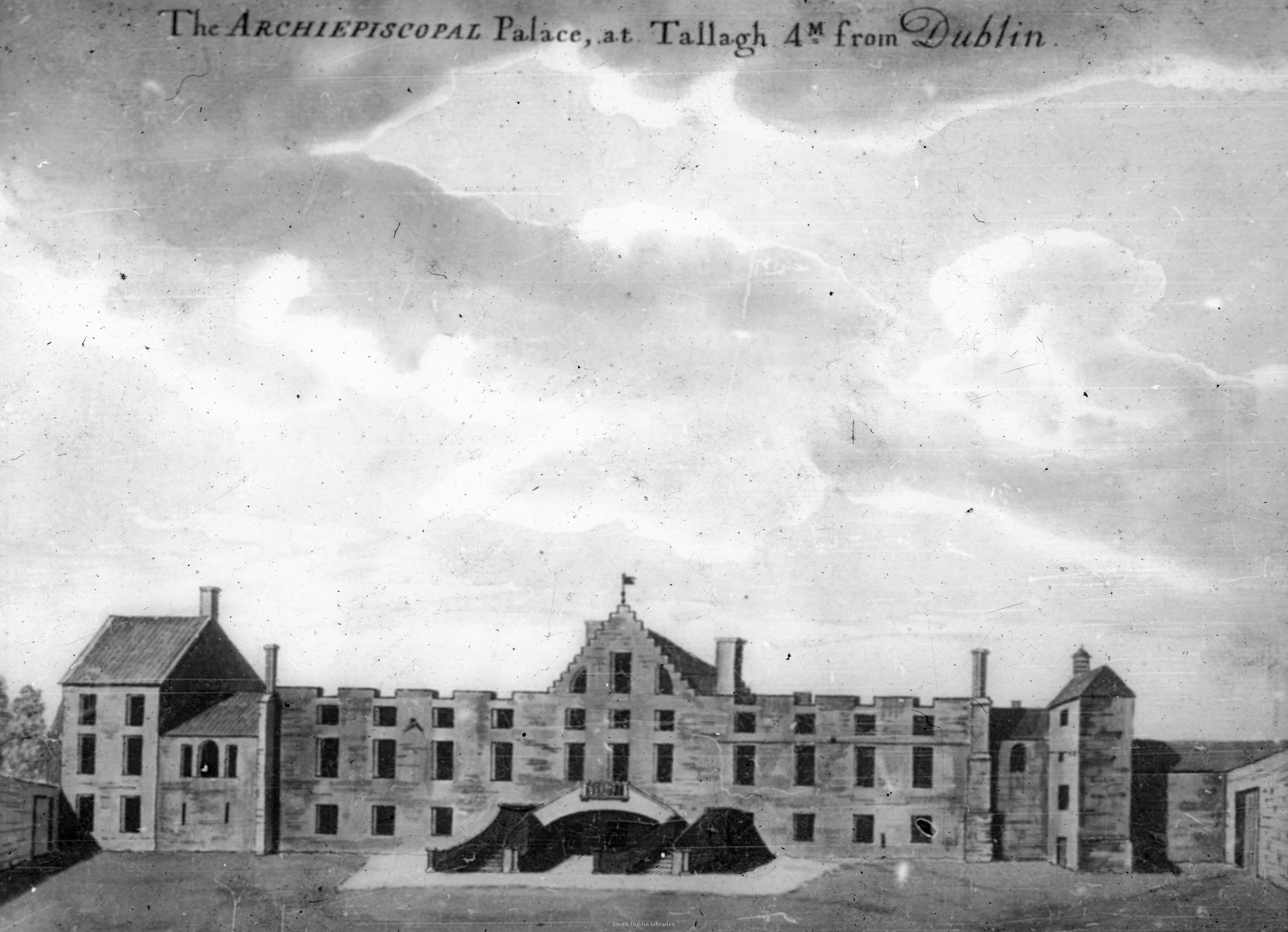
Today an unremarkable suburb of Dublin, Tallaght was for many centuries a frontier settlement, marking the edge of the Pale beyond which the Irish Aesthete’s more bellicose ancestors were inclined to engage in assault and pillage. A monastery had been established here in the eighth century by St Maelruan but it was sacked by the Vikings in 811 and suffered sundry other attacks thereafter. However, the religious link meant that when Tallaght came under the authority of the Archbishop of Dublin in 1179, a castle was built and this in turn became an archiepiscopal retreat. The old castle having fallen into dilapidation, it was largely rebuilt soon after 1729 by then-Archbishop John Hoadly but within a century this property too was deemed no longer suitable for habitation: in 1821 Archbishop Lord John Beresford disposed of the property by act of parliament and it passed into private hands. Another programme of rebuilding followed before the place was acquired in 1856 by members of the Dominican order whose St Mary’s Priory remains on the site still, incorporating a single tower of the original castle.
The engraving above shows the archiepiscopal palace not long before it ceased to serve this function and was largely demolished. A contemporaneous account by James Norris Brewer offers fascinating information about its appearance, the palace described as being ‘a spacious, but long and narrow, building, composed of the grey stone of the country, and is destitute of pretensions to architectural beauty. The interior contains many apartments of ample proportions but none that are highly embellished.’ These included a hall measuring twenty-one foot square and lit by two tiers of windows, and a drawing room thirty-three feet wide and twenty-one feet wide. All now long gone and recalled only by a handful of images such as this one.
A Dash of Panache
‘In an orderly country,’ chided the German travel writer and ethnographer Johann Georg Kohl after a visit to Ireland in September 1842, ‘ruins should really not be tolerated. They should be demolished either in order that the material of which they consist can be availed of in constructing new and more useful buildings, or the site that they occupy can be put to different use, or because they threaten to collapse completely and endanger human activity, or because they present an unpleasant sight.’
Kohl believed that members of ‘an orderly, vigilant and progressive human community’ should eradicate all ruins, before he went to note that, ‘In Ireland, the opposite to all this has happened, as it is unique in all of Europe for its many ruins. One finds here a plethora of ruins from all periods of history, like in no other country.’ Furthermore, he remarked, this melancholy condition was not unique to ancient buildings since ‘down to our days every century – one could say every decade – has deposited its ruins on the land. For everywhere one sees a multitude of dilapidated houses that have only recently fallen into ruin but yet seem also to have been built only recently.’
More than 170 years after Kohl made his observations, they remain pertinent: Ireland continues to be a country of ruins, many of them of recent vintage. Indeed in the last decade we have acquired a fresh crop, so to speak, of ruins thanks to the advent of ‘ghost estates’, those ill-planned, ill-sited and incomplete spatterings of houses begun during the badly-managed economic boom and then abandoned at the onset of the downturn. They join the throng of architectural decrepitude which has been so noted by visitors to Ireland over hundreds of years and yet seems to pass unnoticed by the indigenous population.
What is especially noticeable is the gratuitous abandonment of buildings for no apparent reason other than the fallacious notion that they have ceased to be fit for purpose. This is especially true of the country’s older domestic dwellings, ripe for adaptation to contemporary use but instead deserted in favour of something newer – something which will in turn no doubt suffer the same fate. Hence throughout the countryside one comes across a superabundance of farmhouses which with just a modicum of inventiveness and panache could be given a fresh leases of life as an alternative to their more common fate, which is to moulder into ruin.
Such might well have been the fate of the house seen here today, had it not been discovered a decade ago by the present owner. Located in a remote part of County Cork and originally lying at the centre of a 100-acre holding, the building dates from the late 19th/early 20th century and is in a style that had remained almost unaltered over the previous hundred years. As the American historian Kerby Miller has noted, such houses which belonged to relatively affluent farmers, tended to be ‘well-built – perhaps two-storied, with stone walls and roofs which were slated rather than thatched – and well furnished.’
Whatever furniture it once contained had long since disappeared by the time the house was rescued and restored. Unoccupied for more than half a century since the death of a previous owner, its isolation seems to have discouraged anybody else from settling there. Today that remoteness gives the place romantic appeal, as do the surrounding vistas of rolling fields on three sides of the property, the fourth offering an uninterrupted view of the Irish Sea several hundred feet below: during the summer months, the owner has been known to descend to the shore for a swim.
Aside from inaccessibility, another reason why the building would not have won widespread favour is its understated design: unlike smaller and more overtly endearing thatched cottages, the average Irish farm house was never known for superfluous embellishment. Indeed this particular example possesses an unpretentious simplicity typical of the genus. It rightly celebrates the virtues of clean, unfussy composition.
But before these could be celebrated an extensive programme of refurbishment was called for because at the time of purchase the building was close to collapse. The roof demanded immediate attention, as did walls, doors and windows. Internally the main feature to be salvaged was the old staircase although even here sections required repair and replacement. While this was going on, changes were made to the south, sea-facing front with the three existing windows lowered to create a trio of double doors opening onto a terrace flagged with limestone. More recently the terrace has been enclosed by a full-length conservatory that now serves as sitting room, dining room and, as we Irish like to say, whatever you’re having yourself. In addition the first floor plate-glass windows were changed to double sashes with glazing bars, a modification which immediately softened the house’s unadorned exterior. As was the custom with such properties, the walls are cement-rendered and then left without even a lime wash but weathered by time and exposure to the elements. Several out-buildings have also been restored, a vegetable garden created and a secure area for hens and geese devised. Otherwise the rest of the 20 acres acquired by the owner has been left in its familiar state of fields interspersed with copses of trees.
The same low-key approach has been adopted inside the house. The kitchen, for example, retains its original tiled floor and as much of the old ochre wall colouring as could be preserved; new cupboards have been sympathetically painted to harmonise with what was already in situ. The diningroom opposite is equally understated, with clay plaster used to cover the walls, an old oven used as open fireplace and the furnishings of plain pine. A slightly more elaborate approach was taken to the decoration of the two reception rooms to the front of the house – the chimneypieces here are clearly not original – but they share the same comfortable, unassuming character found throughout the building. Chairs, tables and other items of furniture have been picked up over a period of time and during the course of extensive travels, none of them for great price. Most of the pictures were acquired in the same way or were painted by friends.
The result offers a model of how to convert an old farmhouse into a comfortable, smart private residence. In every county throughout Ireland, there are many similar properties sliding into what looks like inexorable decay and thus adding to our already ample list of ruins. Were Johann Georg Kohl to visit our island today, he would find little had changed since the last time he was here – except in this little corner of the country. Here, for once, a house has been saved from ruin and its character improved rather than destroyed in the process.
In Exchange
A 1792 print by James Malton of the Tholsel in Dublin. Seemingly the word Tholsel derives from the old English ‘toll’ meaning tax and ‘sael’ meaning hall, and it was thus a place where taxes and the like were paid. But in the mediaeval city it also served as court house, custom-house, guildhall and merchants’ meeting place. By the 17th century the original Tholsel had fallen into disrepair and in the 1680s was replaced by the structure seen here, standing on Skinner’s Row (opposite Christ Church Cathedral). This baroque building had an open arcade on the ground floor where mercantile business could be conducted, and a chamber for council meetings of Dublin Corporation upstairs. Its façade was adorned with two niches containing statues of Charles II and his brother the Duke of York (later and briefly James II) behind which rose a tower and weather vane. However, by the time Malton’s print was published the towner had been taken down and early in the following century the entire building was demolished, its functions superseded by Thomas Cooley’s Exchange (now City Hall) on Dame Street, and the City Assembly House on South William Street where the local authority preferred to meet. Next Wednesday evening, May 21st, I shall be introducing a talk by Andrew Bonar Law on Malton’s Irish prints to be given in the self-same City Assembly House, now headquarters for the Irish Georgian Society. For further information, see: http://www.igs.ie/events/detail/the-irish-prints-of-james-malton-lecture-by-andrew-bonar-law