Hail Glorious Knights of St Patrick

OLYMPUS DIGITAL CAMERA

Above is a portrait of George III’s fifth son Ernest Augustus, Duke of Cumberland and, from 1837 until his death fourteen years later, King of Hanover: he was also Earl of Armagh in the Irish peerage. The picture is of interest because it shows the Duke in the robes of a Knight Companion of the Order of St Patrick to which he was appointed in August 1821.
Dormant without being extinct, the Illustrious Order of St Patrick was established in February 1783 by George III ‘to distinguish the virtue, loyalty and fidelity of his subjects in Ireland.’ Note that its creation came the year after Grattan and his supporters had secured greater autonomy for the Irish parliament; the new chivalric order was intended to ensure firmer ties, at least among members of the peerage, to the British crown. Modelled on the very much older Order of the Garter, initially it consisted of the ruling Sovereign, a Grand Master (always the current Lord Lieutenant) and fifteen Knights Companions (this number later increased). In addition the Archbishop of Armagh served as Prelate of the Order, the Archbishop of Dublin as Chancellor, the Dean of St Patrick’s Cathedral, Dublin as Registrar and other posts included a Secretary, Genealogist, Usher and King of Arms. Naturally St Patrick was patron of the order, its motto being ‘Quis separabit?’ Latin for ‘Who will separate us?’ (an allusion to St Paul’s enquiry in his Letter to the Romans, ‘Who will separate us from the love of Christ?’).

IMG_8786

IMG_2395

As can be seen above, the first Knights were invested on 11th March 1783 in a ceremony held in the great ballroom of Dublin Castle, renamed St Patrick’s Hall and forever after known as such. The Order’s statutes restricted membership to men who were both knights and gentlemen, the latter being defined as having three generations of ‘noblesse’, that is ancestors bearing coats of arms on both their father’s and mother’s side. In fact only Irish Peers, and the occasional foreign princes, were ever created Knights of St Patrick.
Among the Knights Founders were George III’s fourth son, Prince Edward Augustus, later Duke of Kent and father of the future Queen Victoria: in his absence he was represented by Robert Deane, first Baron Muskerry. The only other absentee was Henry Loftus, Earl of Ely, then taking the waters in Bath in what proved to be an unsuccessful attempt to improve his health (he would be dead within two months); he was represented by John Joshua, second Baron Carysfort. The other new Knights were all present, including the second Duke of Leinster, the 12th Earl of Clanrickarde, the 6th Earl of Westmeath, the fifth Earl of Inchiquin, the second Earl of Shannon, the second Earl of Mornington (father of the future Duke of Wellington) and the great Earl of Charlemont. Only one peer declined to join the new order, Randal MacDonnell, Earl of Antrim because he was already a Knight Companion of the Order of the Bath, and it was not permitted to hold both knighthoods: his place was taken by Arthur Gore, second Earl of Arran.

Order_of_St_Patrick_installation_banquet 17 March 1783

Installation of P of Wales (later Edward VII) as Kn of St P

Formal ceremonies to mark the foundation of the Order took place on 17th March 1783. The day began with a ceremony in St Patrick’s Cathedral to which the Knights, after gathering at Dublin Castle, had all processed in their robes. The cathedral’s old choir was now designated the Chapel of the Order, in which each knight was required to affix his arms to his stall and to display his family banner above. Investiture of new Knights continued to take place in the cathedral choir until the official disestablishment of the Church of Ireland by Gladstone’s Liberal government in January 1871.
Following a service at St Patrick’s Cathedral, the Knights returned to Dublin Castle where the Lord Lieutenant, George Nugent-Temple-Grenville, Earl Temple held a banquet in St Patrick’s Hall. The first picture shows this occasion with Lord Temple at the centre and the other Knights in all their finery, including cloaks and plumed tricornes, disposed on either side of him. Lady Temple is shown seated on the extreme left although in fact she was in the gallery behind her husband. This commemorative picture was created by a Sussex-born artist called John Keyse Sherwin who began his working life as a wood-cutter but subsequently acquired fame for his prints. However he hungered to become known as a painter, and so laboured on large canvases such as one some fifty feet long representing the Installation of the Knights of St Patrick. It was not a success, with one observer deriding the result as ‘a wretched daub.’ Still, this work, which became a popular engraving, helps to give us some idea of the occasion.
The second painting, by the Waterford-born artist Michael Angelo Hayes, depicts the March 1868 investiture as a Knight of St Patrick of Albert Edward, Prince of Wales (later Edward VII). The ceremony took place after St Patrick’s Cathedral had been extensively restored earlier in the decade thanks to the beneficence of brewer Benjamin Lee Guinness. It was one of the last occasions when such a ceremony involving the Order took place at this location.

IMG_2356

IMG_8792

Although the Order’s original statutes were quite strict, they gradually became more relaxed. For example, when George IV visited in Ireland in 1821 the event was marked by the investiture of an additional six Knights of St Patrick (its membership was eventually increased to twenty-two). One of those appointed by the king was the first Roman Catholic to be so honoured, Arthur Plunkett, 8th Earl of Fingall. His family had always remained loyal to the old faith, and Lord Fingall was a leading supporter of Catholic Emancipation. This was not a position meeting with the King’s approval (nor that of his younger brother the aforementioned Duke of Cumberland who was vehemently opposed to the repeal of the old Penal Laws). Nevertheless in August 1821 Lord Fingall became a Knight of St Patrick. Strangely the most articulate opposition to his investiture came from Lord Byron, by then living in Italy (he would die less than three years later while trying to help Greece achieve independence from the Ottoman Empire). Hearing of the king’s visit to Ireland, and of the enthusiastic manner in which he was received, the poet wrote The Irish Avatar in which he castigated this country’s natives for their servile behaviour before the monarch. Specifically he wrote, ‘Will thy yard of blue riband, poor Fingal, recall/The fetters from millions of Catholic limbs?/Or, has it not bound thee the fastest of all/The slaves, who now hail their betrayer with hymns?’

IMG_8802

IMG_8798

As already mentioned, once Gladstone’s government saw through legislation for the disestablishment of the Church of Ireland and thus ended its link with the state, the connection between the Knights of St Patrick and St Patrick’s Cathedral was also broken, the latter no longer serving as a venue for the former’s investiture ceremonies (these were subsequently moved to St Patrick’s Hall in Dublin Castle). It was decided that the heraldic banners of all knights at the time of the change would be left hanging over their respective choir stalls, along with their helmets and swords. And as can be seen above, so they remain to the present day, a reminder of a minor but fascinating detail of Irish history.
As for the Illustrious Order of St Patrick the last peer to be appointed to its ranks was James Hamilton, third Duke of Abercorn in June 1922. Three members of the British royal family followed: Edward, Prince of Wales (later Duke of Windsor) in 1927; Henry, Duke of Gloucester in 1934 and George, Duke of York (later George VI) in 1936. Although there have been no new Knights since then and there are no living ones since the death of the Duke of Gloucester in 1974, the order was never abolished and in theory could be revived. It seems an unlikely prospect, but then so once did a State Visit by the President of Ireland to Britain, and that takes place next month…
Happy St Patrick’s Day to all readers and followers of The Irish Aesthete.

IMG_2386

Completely Floored, Part Two

IMG_0984

The entrance hall of Ballyfin, County Laois is paved with an elaborate marble floor the centre of which features a large antique Roman mosaic. Along with many other decorative elements, this was sent to Ireland from Italy in 1822 and incorporated into the Morrisons’ design for the house, a triumph of early 19th century neo-classicism.

La nature est un temple*

IMG_5957

This small domed stone temple was originally erected around 1740 by Sir Compton Domville on his estate at Templeogue, Dublin. Later moved to Santry Court, it was lying in pieces on the ground when discovered in the late 1940s by architectural historian Maurice Craig. He encouraged Oonagh Guinness to rescue the monument and re-erect it at Luggala, County Wicklow on the shores of Lough Tay. In recent years her son Garech has further restored the temple and replaced its lost ball finial.

*from Baudelaire’s Correspondences.

Charity Begins at Home

image

From George Benn’s The History of the Town of Belfast, with an Accurate Account of its Former and Present State (published 1823):
‘The Belfast Incorporated Charitable Society, or as it is more generally denominated the Poor House, for the reception of aged and infirm persons, as well as for the support and instruction of children destitute of protectors, has long remained a noble proof of the general philanthropy which prevails among the inhabitants of this town. It stands at the extremity of Donegall Street, in an elevated and healthful situation. The ground was granted by the late Marquis of Donegall, the building completed by subscriptions and the produce of a lottery, and first opened for the purposes above stated in the year 1774. Since its commencement, it has preserved annually about three hundred individuals, old and young; the former from want and misery, the latter from idleness and vice. The children are here instructed in the elementary branches of education, till they are capable of being apprenticed out to trades. The old are carefully attended to, being permitted to increase their comforts by their own industry; and it is a proof not less of the instability of fortune than of the great benefits of the establishment, that an individual was lately received into the Poor House who had, in more prosperous times, contributed to its support. All its inmates, varying in number but commonly about three hundred and fifty, are fed and clothed at the expense of the society. The dress of the children is uniform; they walk on the Sabbath Day, hand in hand, to the respective houses of worship; and due care is taken, in every respect, of their moral and religious habits. The whole government of the Institution is conducted in the most methodical manner, and it receives contributions from every denomination of Christians, all being anxious for the continuance of an establishment which is as invaluable to the poor as it is creditable to the opulent.’

image

image

In the 18th century Belfast was a small but growing market town and port: as late as 1801 its population stood at just 19,000. Nevertheless, the town’s spirit of enquiry and liberalism can be seen through several developments during this period, such as the publication of what is now the world’s oldest surviving English language daily newspaper, the Belfast News Letter, (started 1737), the creation of the Belfast Academy (now Belfast Royal Academy) in 1785 and the setting up of a library (later to become the Linenhall Library and still extant) three years later. Of interest here today are the origins of another organisation which continues to the present day, the Belfast Charitable Society.
In 1631 Edward Holmes, a former Sovereign of Belfast (as the city’s mayors were called until 1842) left in his will ‘to the poore decayed inhabitants of Belfast 40 pounds.’ This created a fund to which further sums were added over the next hundred years. However by the middle of the 18th century, it was apparent that more was required to assist the poor and needy. Hence in late August 1752 a group of concerned citizens met at an establishment called the George Inn and there resolved ‘to consider a proper way to raise a sum for the building of a poor House & Hospital & a new Church in or near the town of Belfast.’

image

image

A site of eight acres for the project was granted by Arthur Chichester, fifth Earl (and later first Marquess) of Donegall, whose family had long owned most of the land on which Belfast developed. The funds required to build the Poor House, at an estimated cost of ₤7,000, were raised through private donations and also by running a lottery based on the model of that already existing in Dublin. Work started promptly and in December 1774 the new premises were officially opened by Lord Donegall with the following accommodation: seven beds for the sick, four double beds for the beggars, twenty-two double beds for the poor and four single beds for vagrants.
The building’s design has an interesting history. Both the Scottish-born architect Robert Mylne and his former draughtsman and clerk Thomas Cooley submitted proposals, but eventually the person responsible was a local amateur, Robert Joy (1722-1785). He and his brother Henry were co-proprietors of the aforementioned Belfast News Letter, which had been founded by their father Francis Joy; they were also uncles of the United Irishman, Henry Joy McCracken. The siblings were among the key figures behind the Poor House’s foundation and hence it is understandable that Robert Joy should have been permitted to have the final say in its design. However, extant drawings by Mylne indicate that his work provided a basis for the eventual structure. Corridors off a passage behind the entrance hall, for example, retain walled-up Tuscan columns, part of what was once an open-air colonnade, a feature of Mylne’s scheme. On the other hand, Joy replaced the dome and lantern proposed by Mylne with an octagonal stone tower and spire rising behind the brick facade the appearance of which mimics that of a Palladian country house. Despite the spire, the church which was originally intended to be part of the scheme was never built.

image

image

It is instructive, if a little disturbing, to read the role played by the Poor House’s more youthful occupants in the establishment of the cotton industry in Ulster. This account is taken from Philip Dixon Hardy’s 1820 publication The Northern Tourist:
‘In 1771, at which time there was not a single cotton loom in the whole North of Ireland, the late Robert Joy conceived the scheme of introducing into this then desponding kingdom the cotton manufacture which had proved an unfailing source of industry and consequent opulence to the sister country. Having, in conjunction with Thomas M’Cabe, suggested that the spinning of cotton yarn might, as an introductory step to the establishment of the manufacture, be at once a fit and profitable employment for the children in the Belfast Poor-house, several of them were set to work…And shortly after an experienced spinner was brought over by Mr Joy from Scotland, to instruct the children in the Poor-house. Also, under the same direction, and at the expense of the gentlemen mentioned, a carding machine was erected at Mr Grimshaw’s, to go by water, which was afterwards removed to the Poor-house, and wrought by hand. A firm was now formed of the original projectors, and others, under the name of Joys, M’Cabe and M’Cracken, who contracted with the same charitable institution for the employment of a number of its children, as well as for the use of its vacant rooms…In less than ten years from their first introduction in the country, several thousand looms were employed in the manufacture of cotton in the towns of Belfast, Lisburn and Hillsborough.’

image

image

During its first decades of operation, the Poor House looked after inmates well, not least by providing them with all necessary clothing and food. With regard to the latter, daily meals included bread, cheese, milk, broth, rice and porridge. Beef and veal were added to the diet on Sundays. On Sundays, the meal included beef and veal, this at a time when around a third of the country’s population lived on potatoes and buttermilk.
Local physicians attended the sick in the Poor House, their services provided without charge, and there was also a dispensary where the same doctors would see the unwell from outside the house on Tuesdays and Saturdays. In 1794 the Belfast Charitable Society opened Ireland’s first Fever Hospital in a rented building on Factory Row (now Berry Street) and soon afterwards, as a means of raising funds, it started a cemetery in the city. Other methods of generating income included taking responsibility for Belfast’s water supply, which it did from 1795 to 1840, and then charging households for access to fresh water.
By the time the society gave up this role (in return for financial compensation), much else had changed, not least new Poor Laws and a more active role by the state in the provision of assistance to those citizens unable to support themselves. However, the Poor House remained true to its original purpose and indeed expanded premises during the course of the 19th century. In 1821 and 1825 respectively extensions were made behind each of the end wings and then in 1867 a block was built at right angles to these; five years later it was linked to the rest of the property by further additions thereby creating a quadrangle as had originally been envisaged by Robert Mylne.
After the Belfast Charitable Society celebrated its 250th anniversary in 2002, a decision was taken to build a new nursing home elsewhere in the city. The old property was handed over on a seventy-year lease to another charity, Helm Housing Association, the funds thus generated allowing for a programme of necessary renovation. Since then the building has been shared between the two organisations, offering sheltered accommodation and operating as an old persons’ home. This year marks the 240th anniversary of the opening of Belfast’s Poor House (now called Clifton House), the oldest complete surviving building in the city, a wonderful example of 18th century philanthropy, a landmark structure and yet somehow little known even by the local population.

image

Ascension to Heaven

IMG_0518

Despite its name, there is nothing defensive about Bracklyn Castle, County Westmeath. On the contrary, the house dates from c.1790 and in style has been likened to the work of the young John Soane. Behind an entrance hall is the staircase, lit from above by an oval dome. A gallery with wrought-iron balusters occupies a substantial portion of the first-floor landing from which are accessed the main bedrooms.

An Angel at my Gate

IMG_8100

Once home to the D’Arcy family and likely dating from the very start of the 18th century and distinguished by exceptionally tall chimney stacks, Kiltullagh, County Galway is now a hollow ruin, its walls propped up by a grid of internal scaffolding. One of the approaches to the house is accessed via these gateposts which are probably passed daily by many travellers without a second glance. But closer inspection reveals that the topmost stone of each features a winged cherubic head in mid-relief with largely indecipherable letters to either side. The style suggests these carvings might be contemporaneous with the house, and gives an indication of what has been lost with its destruction.

IMG_8097

And a Little Bit More Dromore

image

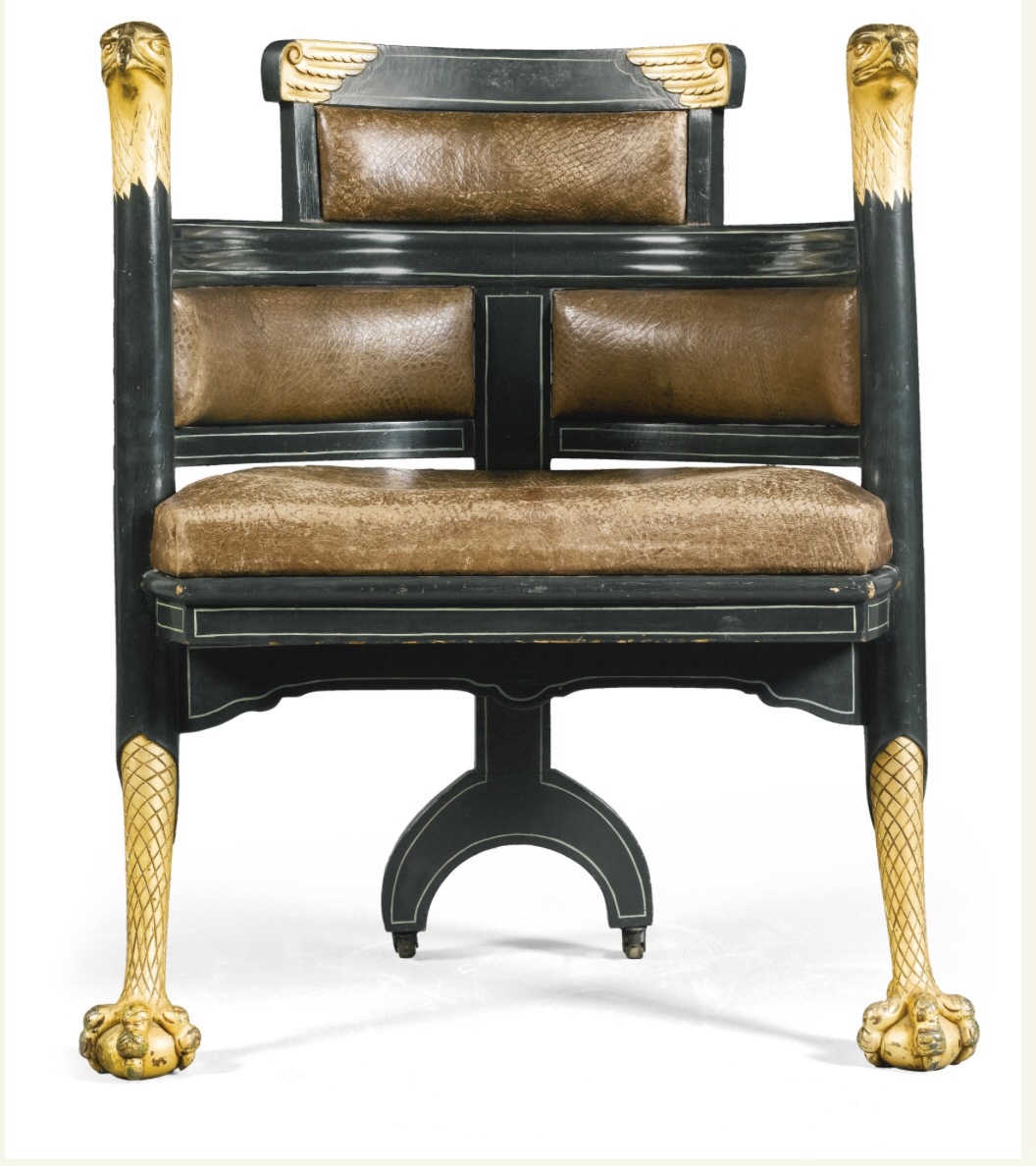
After yesterday’s post about Dromore Castle, County Limerick it transpires that tomorrow in London Sotheby’s will be selling a chair the original of which was designed by Godwin for the library of the house. The ‘Eagle’ Chair is more Egyptian than Gothic in inspiration and indicates how eclectic were Dromore’s interiors. Like all the other furnishings, it was manufactured by William Watt’s Art Furniture Company and some pieces including this one featured in the company’s 1877 catalogue.
It is unknown how many ‘Eagle’ chairs were subsequently produced: a version in oak with variant stretcher and reupholstered in brown leather was sold at Christie’s, London in May 1995 for £18,400. This one carries a pre-sale estimate of £8,000-£12,000.
For more information on the lot, see: http://www.sothebys.com/en/auctions/ecatalogue/2014/1000-ways-seeing-l14313/lot.248.html

More and More Dromore

IMG_1722

The history of Dromore Castle, County Limerick and the work of its architect Edward William Godwin were discussed here some weeks ago (see Une Folie de Grandeur, 30th December 2013). Today the focus is on what remains of the building’s remarkable interiors since every aspect of their original decoration – furniture, wall paintings, chimney pieces, stained glass, tiles, brass- and ironwork – was likewise overseen by Godwin.
It was in the mid-1860s that William Pery, third Earl of Limerick decided to rectify his lack of a country seat in Ireland where the family had long owned thousands of acres of land in Counties Limerick and Cork. Hitherto when not in England he and his forebears had occupied an 18th century house in Limerick city but this was no longer deemed satisfactory. His decision to create a new rural residence coincided with Lord Limerick’s friendship with Godwin, the two men then respectively serving as President and Vice-President of the Architectural Society in England.

IMG_1498

IMG_1504

IMG_1506

An article on Dromore Castle written by Marian Locke and published in the Winter 2011 issue of the Old Limerick Journal states that Godwin thoroughly explored his prospective client’s estates in search of a site without finding anywhere he deemed suitable before coming across a small shooting lodge owned by the Earl on a piece of land of some forty acres overlooking Dromore Lake. This the architect decided was the perfect spot, ‘a dream-like situation on the edge of a wood…overlooking the water, which would reflect the castle one hundred feet below.’ As indeed it still does, Lord Limerick buying up a further 200 acres, seventy of which were covered by aforementioned water.
So the rocky outcrop on which Dromore stands, and the views offered from this position, made certain other decisions inevitable, not least that the greater part of the accommodation would face north, hardly the best way to ensure the building’s interior would retain heat, or receive much sunlight.

IMG_1693

IMG_1696

IMG_1672

Access to Dromore Castle is through a gateway on the western side and immediately to the south, only accessible by first stepping outside, was the large double-height banqueting hall seen here. This still has its hooded stone chimneypiece, but the minstrels’ gallery has gone along with the pitched timber roof. A door at the far end of the hall gave access to a slender three-storey Chaplain’s Tower which on the first floor in turn opened onto south-facing battlements, concluding in the easterly corner with a small block that originally served as a bakery.
The main portion of the castle runs west to east, with a chapel located on the first floor over the main gateway; above this looms the round tower that is one of Dromore’s more unusual features. Most of the northwest corner is taken up by a stone staircase leading to the first floor where it terminates in an arched gothic window. The shape of this window is echoed by stepped barrow vaulting above the steps, one of Godwin’s most striking effects to survive.

IMG_1650

IMG_1630

IMG_1678

On reaching the top of the main staircase, one turned west along a corridor off which opened a succession of reception rooms inside what, from the exterior, looks like an enormous fortified keep. Thus the entire ground floor was given over to servants’ quarters, with a typically massive kitchen occupying the central portion. A consequence of this arrangement is that the central courtyard was primarily a service area, although a door leading from the southern end of the drawing room opened onto another run of battlements, this time looking eastwards down to the lake (or west into the courtyard). Still, it must have been a drawback that the castle’s owners could not directly enter the surrounding gardens. Perhaps they might not have wished to do so, given the splendour of their surroundings. The drawing room, for example, featured an elaborately carved pink marble chimney piece (which survives, suspended in space), and arched recesses with marble columns (some of which remain in situ) beneath more carved capitals.
Meanwhile up another flight of stairs one reached a further north-facing corridor, its windows set inside deep arched recesses, off which ran the main bedrooms. At the very end of the passage, the north-east corner was given over to the countess’s bedroom which had a stone balcony providing views of the lake far below but this was an advantage enjoyed by nobody else. The third floor was given over to servants’ bedrooms and then, once more in the north-east corner one ascended to the fourth floor billiard room, something of a break with the spirit of medievalism pervading elsewhere.

IMG_1591

IMG_1714

IMG_1613

Although the exterior walls of Dromore Castle are up to six feet thick, from the start it suffered from problems of damp. In an attempt to overcome this problem, Godwin designed a brick lining with a cavity of about two inches from the stonework, but to no avail. In an article on the building carried by Country Life in November 1964, Mark Bence-Jones quotes from a lecture the architect gave in 1878, that is less than a decade after completing his commission, in which he commented ‘Whenever it was going to rain…the walls showed it like a weather glass.’ Thus the elaborate murals he designed for the main rooms never had a chance of survival. At least some of these were executed by Academician Henry Stacy Marks, an artist who specialised in painting birds. At Dromore, however, the plan was for him to cover the walls of the first-floor corridor were to depict the four seasons, twelve months and day and night (complemented by stained glass windows showing the six days of earth’s creation). The dining room murals featured the eight virtues, those of the drawing room the four winds and the four elements. Alas, none could withstand the harsh Irish elements and before long all had perished. Nevertheless, according to Bence-Jones Lord Limerick was ‘extremely delighted’ with his new property, even if this delight did not encourage him to spend much time at Dromore.

IMG_1716

IMG_1605

IMG_1609

According to Marian Locke, Dromore cost in the region of £80,00-£100,000 to build, and yet it was only intermittently occupied by the Limericks for fifty years. After the First World War the family effectively abandoned the property and finally in 1939 the castle and many of its contents along with the surrounding land were sold, reputedly for just £8,000, to a local timber merchant Morgan McMahon. Although he bought the estate primarily for the value of its woodland, Dromore’s new owner was so engaged by the place that he and his family carried out necessary repairs and moved in. They remained in residence until the mid-1950s when it was again sold, but this time there was no reprieve. Faced with costly maintenance and rates, the new owners removed the roof and stripped out the interior. Since then the castle has stood empty, the dividing floors long gone so that now there is no difference between those areas once occupied by master and by servant: today all are equally open to sun and rain, and all share the same patina of neglect. Yet somehow enough of Godwin’s decorative scheme lingers on. It offers a tantalising sense of what Dromore must have looked like during its all too brief, but wondrous, heyday.

IMG_1523

All Tied Up in a Bow

IMG_6678

The double doors leading from drawing to dining room at Ballinlough Castle, County Westmeath are recessed within a large arched bow. And there are further bows evident in the delicate plasterwork that runs around the alcove and features garlands of flowers and leaves caught up in ribbon. The style is essentially rococo in spirit even though the room and its decoration date from c.1790, one of those anachronisms that one encounters in Ireland where a fondness for certain forms could sometimes linger long after they had fallen out of fashion elsewhere.

IMG_6674

Spiralling into Oblivion

IMG_1683

A stone spiral staircase leading from first-floor reception rooms to the bedchambers above in Dromore Castle, County Limerick. The exterior of this building, designed by Edward Godwin in the late 1860s, has featured here before (see Une Folie de Grandeur, 30th December 2013). Next Monday’s page will be devoted to exploring what remains of Dromore’s quite extraordinary interiors.