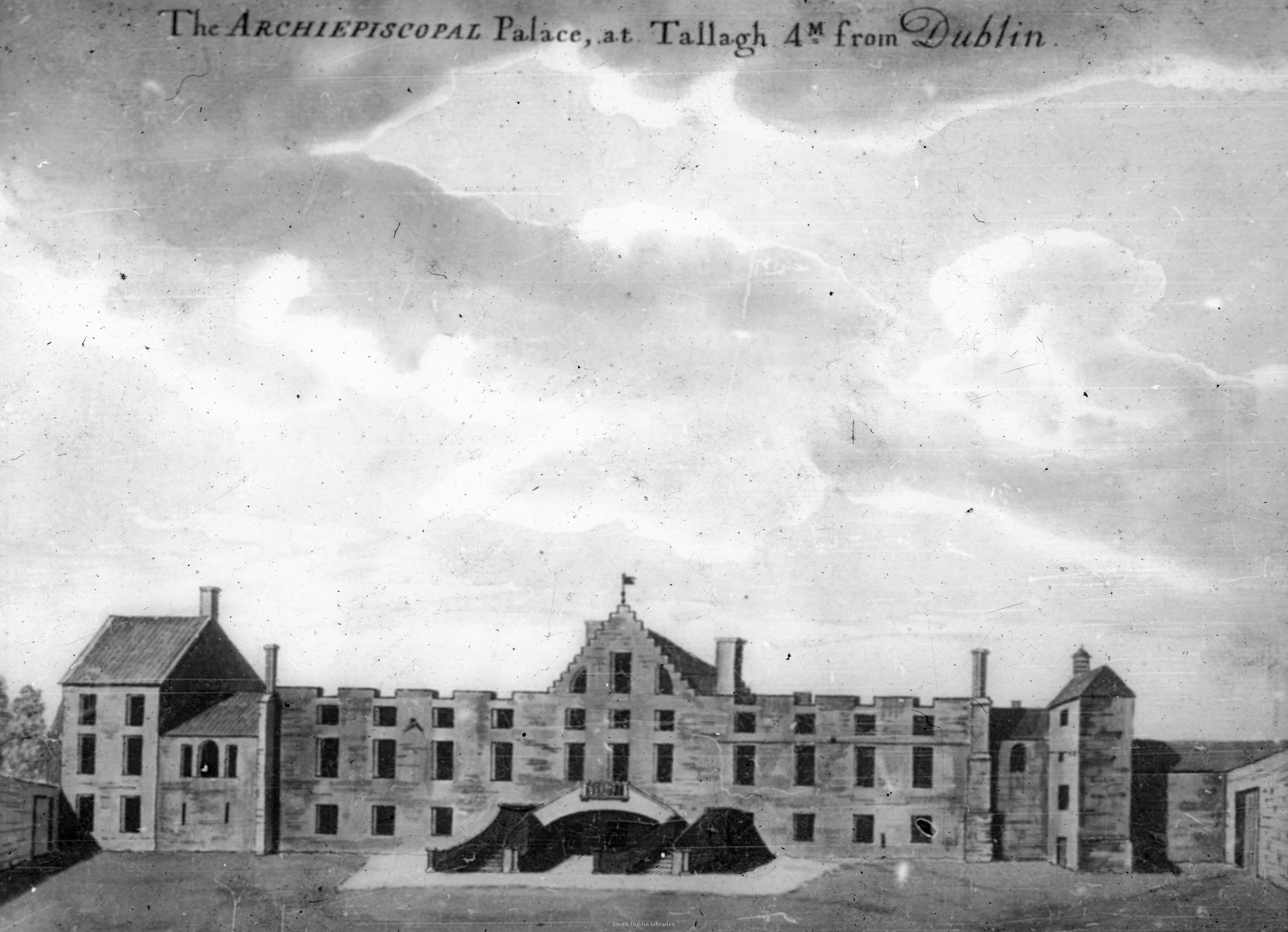
A Lost Palace

4

Today an unremarkable suburb of Dublin, Tallaght was for many centuries a frontier settlement, marking the edge of the Pale beyond which the Irish Aesthete’s more bellicose ancestors were inclined to engage in assault and pillage. A monastery had been established here in the eighth century by St Maelruan but it was sacked by the Vikings in 811 and suffered sundry other attacks thereafter. However, the religious link meant that when Tallaght came under the authority of the Archbishop of Dublin in 1179, a castle was built and this in turn became an archiepiscopal retreat. The old castle having fallen into dilapidation, it was largely rebuilt soon after 1729 by then-Archbishop John Hoadly but within a century this property too was deemed no longer suitable for habitation: in 1821 Archbishop Lord John Beresford disposed of the property by act of parliament and it passed into private hands. Another programme of rebuilding followed before the place was acquired in 1856 by members of the Dominican order whose St Mary’s Priory remains on the site still, incorporating a single tower of the original castle.
The engraving above shows the archiepiscopal palace not long before it ceased to serve this function and was largely demolished. A contemporaneous account by James Norris Brewer offers fascinating information about its appearance, the palace described as being ‘a spacious, but long and narrow, building, composed of the grey stone of the country, and is destitute of pretensions to architectural beauty. The interior contains many apartments of ample proportions but none that are highly embellished.’ These included a hall measuring twenty-one foot square and lit by two tiers of windows, and a drawing room thirty-three feet wide and twenty-one feet wide. All now long gone and recalled only by a handful of images such as this one.

A Dash of Panache

IMG_3327

‘In an orderly country,’ chided the German travel writer and ethnographer Johann Georg Kohl after a visit to Ireland in September 1842, ‘ruins should really not be tolerated. They should be demolished either in order that the material of which they consist can be availed of in constructing new and more useful buildings, or the site that they occupy can be put to different use, or because they threaten to collapse completely and endanger human activity, or because they present an unpleasant sight.’
Kohl believed that members of ‘an orderly, vigilant and progressive human community’ should eradicate all ruins, before he went to note that, ‘In Ireland, the opposite to all this has happened, as it is unique in all of Europe for its many ruins. One finds here a plethora of ruins from all periods of history, like in no other country.’ Furthermore, he remarked, this melancholy condition was not unique to ancient buildings since ‘down to our days every century – one could say every decade – has deposited its ruins on the land. For everywhere one sees a multitude of dilapidated houses that have only recently fallen into ruin but yet seem also to have been built only recently.’

IMG_3337

IMG_3343

IMG_3345

More than 170 years after Kohl made his observations, they remain pertinent: Ireland continues to be a country of ruins, many of them of recent vintage. Indeed in the last decade we have acquired a fresh crop, so to speak, of ruins thanks to the advent of ‘ghost estates’, those ill-planned, ill-sited and incomplete spatterings of houses begun during the badly-managed economic boom and then abandoned at the onset of the downturn. They join the throng of architectural decrepitude which has been so noted by visitors to Ireland over hundreds of years and yet seems to pass unnoticed by the indigenous population.
What is especially noticeable is the gratuitous abandonment of buildings for no apparent reason other than the fallacious notion that they have ceased to be fit for purpose. This is especially true of the country’s older domestic dwellings, ripe for adaptation to contemporary use but instead deserted in favour of something newer – something which will in turn no doubt suffer the same fate. Hence throughout the countryside one comes across a superabundance of farmhouses which with just a modicum of inventiveness and panache could be given a fresh leases of life as an alternative to their more common fate, which is to moulder into ruin.

IMG_3356

IMG_3362

IMG_3301

Such might well have been the fate of the house seen here today, had it not been discovered a decade ago by the present owner. Located in a remote part of County Cork and originally lying at the centre of a 100-acre holding, the building dates from the late 19th/early 20th century and is in a style that had remained almost unaltered over the previous hundred years. As the American historian Kerby Miller has noted, such houses which belonged to relatively affluent farmers, tended to be ‘well-built – perhaps two-storied, with stone walls and roofs which were slated rather than thatched – and well furnished.’
Whatever furniture it once contained had long since disappeared by the time the house was rescued and restored. Unoccupied for more than half a century since the death of a previous owner, its isolation seems to have discouraged anybody else from settling there. Today that remoteness gives the place romantic appeal, as do the surrounding vistas of rolling fields on three sides of the property, the fourth offering an uninterrupted view of the Irish Sea several hundred feet below: during the summer months, the owner has been known to descend to the shore for a swim.

IMG_3319

IMG_3321

IMG_3385

Aside from inaccessibility, another reason why the building would not have won widespread favour is its understated design: unlike smaller and more overtly endearing thatched cottages, the average Irish farm house was never known for superfluous embellishment. Indeed this particular example possesses an unpretentious simplicity typical of the genus. It rightly celebrates the virtues of clean, unfussy composition.
But before these could be celebrated an extensive programme of refurbishment was called for because at the time of purchase the building was close to collapse. The roof demanded immediate attention, as did walls, doors and windows. Internally the main feature to be salvaged was the old staircase although even here sections required repair and replacement. While this was going on, changes were made to the south, sea-facing front with the three existing windows lowered to create a trio of double doors opening onto a terrace flagged with limestone. More recently the terrace has been enclosed by a full-length conservatory that now serves as sitting room, dining room and, as we Irish like to say, whatever you’re having yourself. In addition the first floor plate-glass windows were changed to double sashes with glazing bars, a modification which immediately softened the house’s unadorned exterior. As was the custom with such properties, the walls are cement-rendered and then left without even a lime wash but weathered by time and exposure to the elements. Several out-buildings have also been restored, a vegetable garden created and a secure area for hens and geese devised. Otherwise the rest of the 20 acres acquired by the owner has been left in its familiar state of fields interspersed with copses of trees.

IMG_3272

IMG_3353

IMG_3387

The same low-key approach has been adopted inside the house. The kitchen, for example, retains its original tiled floor and as much of the old ochre wall colouring as could be preserved; new cupboards have been sympathetically painted to harmonise with what was already in situ. The diningroom opposite is equally understated, with clay plaster used to cover the walls, an old oven used as open fireplace and the furnishings of plain pine. A slightly more elaborate approach was taken to the decoration of the two reception rooms to the front of the house – the chimneypieces here are clearly not original – but they share the same comfortable, unassuming character found throughout the building. Chairs, tables and other items of furniture have been picked up over a period of time and during the course of extensive travels, none of them for great price. Most of the pictures were acquired in the same way or were painted by friends.
The result offers a model of how to convert an old farmhouse into a comfortable, smart private residence. In every county throughout Ireland, there are many similar properties sliding into what looks like inexorable decay and thus adding to our already ample list of ruins. Were Johann Georg Kohl to visit our island today, he would find little had changed since the last time he was here – except in this little corner of the country. Here, for once, a house has been saved from ruin and its character improved rather than destroyed in the process.

IMG_3303

In Exchange

tholsel

A 1792 print by James Malton of the Tholsel in Dublin. Seemingly the word Tholsel derives from the old English ‘toll’ meaning tax and ‘sael’ meaning hall, and it was thus a place where taxes and the like were paid. But in the mediaeval city it also served as court house, custom-house, guildhall and merchants’ meeting place. By the 17th century the original Tholsel had fallen into disrepair and in the 1680s was replaced by the structure seen here, standing on Skinner’s Row (opposite Christ Church Cathedral). This baroque building had an open arcade on the ground floor where mercantile business could be conducted, and a chamber for council meetings of Dublin Corporation upstairs. Its façade was adorned with two niches containing statues of Charles II and his brother the Duke of York (later and briefly James II) behind which rose a tower and weather vane. However, by the time Malton’s print was published the towner had been taken down and early in the following century the entire building was demolished, its functions superseded by Thomas Cooley’s Exchange (now City Hall) on Dame Street, and the City Assembly House on South William Street where the local authority preferred to meet. Next Wednesday evening, May 21st, I shall be introducing a talk by Andrew Bonar Law on Malton’s Irish prints to be given in the self-same City Assembly House, now headquarters for the Irish Georgian Society. For further information, see: http://www.igs.ie/events/detail/the-irish-prints-of-james-malton-lecture-by-andrew-bonar-law

On a Clare Day

IMG_1923

The tower of the church at Quin Friary, County Clare seen through one of its transept windows. Another of the outstanding Franciscan houses in Ireland, Quin Friary was established in the mid-14th century by members of the local MacNamara family. However, it was built on the site, and incorporated parts, of a castle built in 1280 by the Norman Richard de Clare in an unsuccessful attempt to subdue the same family: six years later this structure was attacked and burnt by Cuvea MacNamara who slaughtered most of its occupants. The subsequent friary had an equally bloody and incendiary history. In 1584, for example, Donough Beg O’Brian, having been half-hanged from a cart and his bones broken with the back of an axe was strung up while still alive from this same tower by Sir John Perrot; a few years later the building was again set alight by another of the O’Brians. Somehow, and with intermittent breaks, Franciscan friars continued to live on the site, the last resident only dying in 1820. Today there is little evidence of the friary’s turbulent past.

To Smooth the Lawn, To Decorate the Dale

IMG_3487

Travellers in Ireland during the 18th and 19th centuries seem rarely to have visited Laois, or Queen’s County as it was known until 1922. The preference was to head either south or north or west, by-passing the midlands with the result that references to this part of the country are not so easy to find. One suspects this continues to be the case, a pity since land-locked Laois has much to offer, not least the Lutyens-designed gardens at Heywood.
The main outlines of the estate here were created by Michael Frederick Trench, son of the Rev. Frederick Trench; one of those visitors to Ireland who did explore the area, English antiquary Owen Brereton, in 1763 wrote of the cleric’s property, describing it as ‘a sweet Habitation’ with ’24 Acres Walld round 10 feet high.’ Both the habitation and the grounds were enlarged by his son who in 1773 built a new house which he named Heywood after his mother-in-law’s maiden name. A barrister and amateur architect, Trench is believed to have been responsible for the building’s design, perhaps in consultation with James Gandon: Thomas J Mulvany’s biography of the latter (published 1846) states that in 1785 Trench ‘anxiously superintended’ the erection of the Rotunda Assembly Rooms in Dublin, being a member of the building committee. He has also been credited with the design of the two pavilions which terminated the colonnades on either side of the lying-in hospital.
At Heywood, Trench embarked on large-scale improvements to the surrounding parkland beginning with a gothic entrance gate and featuring various other decorative features, most notably a striking ruin on the adjacent hill, composed from elements of the mediaeval Dominican friary at Aghaboe some twelve miles away. When Samuel Lewis published his Topographical Dictionary of Ireland in 1837, a year after Michael Frederick Trench’s death, he was able to call Heywood a ‘richly varied demesne ornamented with plantations and artificial sheets of water.’

IMG_3403

IMG_3418

When Michael Frederick Trench’s only son General Sir Frederick William Trench died in 1859, he left Heywood to the family of his sister Helena who in 1815 had married the euphoniously-named Sir Compton Pocklington Domvile. This couple’s granddaughter Mary Adelaide Domvile in turn became an heiress and in 1886 she married William Hutcheson Poë. There has always been some confusion about how to pronounce the family name, but William’s younger brother Edmund once explained, ‘I have been sat upon by women and held at arm’s length by men, but my name is pronounced p-o-a-y.’
Sons of a Queen’s County barrister, both men were educated at Dr Burney’s Academy in Gosport, near Portsmouth before joining the navy. Edmund rose to be promoted to Rear-Admiral in 1902, second in command of the Home Fleet the following year and Commander of the 1st Cruiser Squadron in 1904. A year later he was appointed Commander-in-Chief, East Indies Station, then Commander-in-Chief, Cape of Good Hope Station in 1907 and Commander-in-Chief, Mediterranean Fleet in 1910. Finally he became First and Principal Aide-de-Camp to George V in 1912, retiring two years afterwards.
William Hutcheson Poë meanwhile served in the Royal Marines and from 1884 was in Sudan, commanding a unit of the Camel Corps in the Relief of Khartoum in 1885 during which period he had a leg amputated. The following year he married Mary Adelaide Domvile and retired from service in 1888 when promoted to Lieutenant Colonel. The rest of his public life can be summarised as follows: in 1891 became High Sheriff for Queen’s County, and in 1893 for County Tyrone. He was a member of the Land Conference in 1904, was appointed a Governor of the National Gallery of Ireland in 1904 and created a baronet eight years later. In 1915 to 1916 he served in Egypt in the First World War, and from 1916 to 1919 with the Red Cross in France. From 1922 to 1925 he served as a Senator of the Irish Free State.

IMG_3420

IMG_3434

At Heywood Colonel Hutcheson Poë was responsible for substantial alterations to both house and grounds. With regard to the former, Sir Charles Coote in his Statistical Survey of Queen’s County (published 1801) having discussed Trench’s various enterprises on the estate says ‘The Mansion house has also been built after his own plan, and is of a curious, though not regular order of architecture, being a square building composed of four fronts, and, from the irregularity of the ground, on which it stands, presents at one front three stories, at another four, at the third five, and six at the fourth. The apartments are as commodious as could be wished for, and are considerably more extensive, than we should suppose from the outside view.’
In the 1890s this building was enlarged and almost engulfed by extensions to either side, designed by one of the period’s most indefatigable architects Sir Thomas Drew. Sadleir and Dickinson’s 1915 Georgian Mansions of Ireland describes the result as ‘a large building, embodying extensive recent additions, and has been in fact so completely re-edified that one room only retains its entire Georgian character. This is the large and well proportioned dining-room, a singularly handsome apartment, and one of the finest examples of the Adam style in this country…the walls are covered with plaster panels and festoons, which, like the ornament of the over-doors, are very delicately modelled. The mantel, purchased by the present owner in London, exhibits Adam decoration with wedgwood plaques, and there is a steel grate…A series of Minerva heads in the frieze conceal the electric light bulbs, this ingenious device obviating the introduction of unsightly electroliers. In the adjoining drawing-room, which also retains some Georgian features, are a number of valuable pictures, including the fine full-length of John Musters, of Colwick, in Nottinghamshire, by Sir Joshua Reynolds…’ A series of photographs taken by A.E. Henson in 1917 and published in Country Life two years later testify to Colonel Hutcheson Poë’s discerning taste as a collector of pictures and furniture, even if not of architecture.

IMG_3400

IMG_3460

Outside also Colonel Hutcheson Poë set about leaving his mark. The house at Heywood was built at the top of a south-west facing ridge from which the ground drops steeply to a lake out of which runs a stream in turn feeding two further lakes. As well as being a successful army man, Sir Frederick William Trench was a talented artist (just as his father was an amateur architect), and in 1818 he produced several drawings of the demesne from which lithographs were produced; these give an excellent idea of how the view swept away from the house across water and trees towards distant mountains, the very incarnation of the romantic landscape.
Nevertheless in 1906 Hutcheson Poë commissioned Edwin Lutyens to come up with a design for gardens in the vicinity of the house, occupying the area to the immediate south, east and west. As has already been explained, this part of the parkland is on a slope, and so the first and most important task was to build a massice retaining wall with buttressing to protect the house above from any risk of slippage. Thereafter the main features of the scheme begin with a pair of central terraces relatively uncluttered so as not to obscure views from the building; other than flagged walks and grass lawns, the most notable feature here is a pair of columns topped with stone balls and carrying carved milestones. Presumably Lutyens recycled these from elsewhere, as he did a series of Ionic columns which were once part of a Temple of the Winds erected by Michael Frederick Trench elsewhere in the grounds. The columns can now be seen in a pergola walk which Lutyens constructed to the west of the main terrace and where they support a line of oak beams. This walk, from which there is a sharp descent to the lake, is otherwise composed of rough-hewn stone, with an open prospect at its southern end and an apsidal niche at the northern: the latter once held a copy of the Capitoline Venus but now contains a more respectably clothed figure.

IMG_3463

IMG_3456

Colonel Hutcheson Poë was not an easy client and Lutyens’ letters indicate his time at Heywood was rather stressful. In February 1910, for example, he wrote to his wife, ‘Colonel Poë, you know, has a wooden leg and he sits on a chair and watches the men lay stones – stone by stone – and finds endless fault. I couldn’t stand it.’ Two years later he wrote again, ‘The gardens promise well, but he is so cross to his workmen, to me and to all under him, and his wife, who is very rich, is left alone and ignored almost. At least she goes her own way, ignores as much as she is ignored.’
On an earlier occasion Lutyens had announced that the colonel’s ‘cross period has damaged the garden as there is, I think, evidence in my work of my attitude or despondency towards him.’ There is in fact no evidence of the sort apparent, particularly not in the marvellous elliptical sunken garden which is Lutyens’ greatest legacy at Heywood. The approach to this was most likely intended to have been via a short sequence of yew enclosed spaces which lead to a curved flight of stone steps bringing the visitor right into the garden. Today however, the more customary point of access is from the main terrace, passing tall piers to a pleached lime walk. Here a low stone wall to the south offers open views of the countryside, the wall to the north being higher and carrying a series of cut stone niches: originally these contained lead busts but they are now filled with stone urns. At the end of this walk, wrought iron gates provide access to the sunken garden, its centre occupied by a large pond once fed by spouting bronze tortoises and holding a basin formerly topped by another piece of sculpture. At the easternmost point of the sunken garden is a slender, single-room pavilion, the rear wall of which contains four Ionic capitals set into the rough stone and said to have come from the 18th century Irish House of Commons designed by Sir Edward Lovett Pearce (for more about this discovery, see Jane Meredith’s article on the subject in the Irish Arts Review Yearbook 2001, Vol. 17).

IMG_3506

IMG_3480

Like so many other Irish country houses and estates, Heywood experienced mixed fortunes in the last century. After its owner’s death in 1934, the house stood empty and then the Land Commission moved in to divide up the property. In 1941 the house and surrounding 160 acres was acquired by members of the Salesian religious order who originally used the place as a novitiate. Unfortunately in 1950 the house was badly damaged by fire, after which a decision was taken to demolish it; a new building was erected on a site to the north-east adjacent to the former stable yard. This became a school run by the Salesians but since 1990 has been a community school. Three years later the Lutyens gardens were transferred to state ownership and they have since been the responsibility of the Office of Public Works.
Visiting Heywood today is a curious experience. On the one hand, it is wonderful that Lutyens’ work here has been preserved, on the other it is difficult properly to appreciate his vision without the presence of the house for which the gardens were intended to provide a setting: the context for which they were created has gone (see the plan below for a better understanding of this). And the 18th century parkland devised by Michael Frederick Trench is even harder to envisage since it has received very little attention, and some of it has been altogether lost. The defiant ugliness of the school buildings also plays its part in suppressing any impulse towards romanticism. Conversely, once properly inside the gardens equivocation slips away, and the genius of Lutyens takes over. It is, as I say, a curious experience but with the accompaniment of a little imagination by no means an unpleasant one.

Heywood%20Gardens%2001%20-%20Plan

With thanks to Máirtín D’Alton for his advice and information.

The Swan of Erin

IMG_2171

This weekend sees the Irish Georgian Society’s annual Traditional Building Skills exhibition take place at the Hunt Museum in Limerick. Visitors might care to look across the road to the current poor state of Patrick Street, including this house No.4, birthplace of the 19th century soprano Catherine Hayes. One of the most celebrated singers of her generation, she performed in opera houses throughout Europe (as well as giving a recital for Queen Victoria in Buckingham Palace in June 1849) before touring to the United States – where P.T. Barnum sponsored her concerts in California – Australia and India. She deserves to be better remembered today in her native city than the condition of this building and its neighbours would indicate.
For further information on the IGS’s activities in Limerick this weekend, see: http://www.igs.ie/uploads/IGS_2014_Traditional_Building_Skills_Brochure_May.pdf

Beneath a Starry Dome

IMG_0790

A section of the coffered dome in the Rotunda at Ballyfin, County Laois. According to Kevin V. Mulligan, the plasterwork fronds and stars were originally gilded and set against a Prussian blue background. Although the space is clearly inspired by the Pantheon in Rome, its central oculus is not open to the elements but rises through a cloud of gilded stars to a further dome filled with coloured glass.

Marvellous Mariga

photo
Derek Hill’s portrait of Mariga which perfectly captures her shyness sometimes misconstrued as hauteur

This week marks the 25th anniversary of the death on May 8th 1989 of Mariga Guinness at the age of only 56. It seems an opportune moment to celebrate her life, especially since an entire generation has since grown up without having had the opportunity to meet Mariga and to benefit in person from her influence.
For those unfamiliar with her story, Marie-Gabrielle von Urach was born in September 1932, the only child of Prince Albrecht von Urach and Rosemary Blackadder. Her mother’s family were from the Scottish borders, her father’s a junior branch of the royal house of Württemberg in southern Germany; her grandfather was briefly King of Lithuania, a great-aunt Queen of Belgium and a great-grandaunt the Empress Elizabeth of Austria. Although her father had been expected to succeed to the principality of Monaco (an extraordinary story in itself), in the aftermath of the First World War this arrangement was abandoned and so he came of age with little money and no prospects. Both Mariga’s parents were artists and in the mid-1930s they and their daughter moved to Japan where Prince Albrecht was attached to the German embassy as a government photographer. However in 1937 Rosemary von Urach decided the Japanese Emperor was being misled into aggression by his generals, and taking Mariga with her somehow gained admission into the imperial palace to offer him advice. Arrested and sedated by security guards, she was sent back to Britain where she had a breakdown followed by a lobotomy and spent the rest of her life in a Scottish mental hospital. Meanwhile Mariga’s father continued working for the German government throughout the Second World War and did not see his daughter again until she was sixteen and he had remarried (when they reunited he did not tell her this himself and she only found out indirectly). In the intervening years Mariga had been raised in England by a septuagenarian unmarried friend of her grandmother’s who died in 1951, leaving her charge possessed of little other than great intelligence and beauty. That same year she was introduced to the Hon Desmond Guinness by her cousin Prince Rupert Löwenstein. The couple married in June 1954 and moved to Ireland the following year.

image

image

image
Desmond and Mariga on their honeymoon photographed by Anthony Armstrong-Jones (later Earl of Snowdon); these pictures courtesy, and property, of their son Patrick Guinness.

Mariga first visited Ireland (at the invitation of the late Mark Bence-Jones) in 1953. He later remembered that she arrived in a ball dress having gone straight from a dance in London to catch an early flight. ‘The first thing they asked me when I got off the ‘plane was “Have you been on a farm?”’ she said with her unerring sense of the incongruous (there had recently been an outbreak of foot and mouth disease in England). Afterwards she wrote, ‘Ireland is HEAVEN, everyone is so dotty and delicious and no one dreams of taking anything seriously; except, perhaps the Horse Show.’ Of course, after moving here Mariga took the country very seriously, not least in her ceaseless campaigns to preserve its architectural heritage and her founding with Desmond of the Irish Georgian Society in 1958.
The society was run from the couple’s home at Leixlip Castle, County Kildare which they had bought and restored after looking at countless other houses around Ireland. Leixlip represented Mariga’s highly distinctive and influential taste. As architectural historian Mark Girouard has written, ‘In the 1960s Mariga Guinness made Leixlip Castle an unforgettable place: a solid, four-towered mediaeval castle converted in the early 18th century with huge, thick-barred windows and spacious, simple rooms looking down to the Liffey; a massive front door that was never locked; and inside an inspired assembly of mainly Irish 18th-century furniture and pictures, put together and set off with a sense of color and occasion, a mixture of informality and showmanship, to make a setting in which it seemed that anything could happen and anyone might turn up.
One would turn up oneself, pull open the front door and wander into empty rooms with log fires smoldering, until people would, perhaps, begin to appear: millionaires, Irish professors, Anglo-Irish lordlings, pop stars, German princes, architects, priests, art historians, students, all revolving around Mariga, with her drawling voice and mischievous smile, and Desmond, with his charm and blazing blue eyes.
A party might develop or a picnic, or both or neither; intrigues and dramas would get under way, champagne might or might not flow, and the whole charade was given point by the crusade for Irish Georgian architecture, to save or rediscover which forays would be made from the castle all over Ireland.’

IMG_9368

IMG_9374
Two photographs of Mariga taken by Horst P. Horst when he visited Leixlip Castle in 1968

Many people can testify, and have done so, to the abiding impact of Mariga’s exceptional taste. Interior designer John Stefanidis has remembered her ‘A wit, a tease, an intelligent and enchanting beauty, gifted with impeccable taste. She had panache…whether in a fur hat and muff, or in fancy dress with a large hat and feather boa, she always looked marvellous. A wonderful hostess, Leixlip Castle was an example on how to live in an historic house – despite it being freezing cold in winter (she longed for central heating).’
It was thrilling to stay there surrounded by marvellous furniture she had found and not an ugly thing in sight. She was the inspiration behind the founding of the Irish Georgian Society – not only did she find houses and restore them but also doggedly charmed her way through bureaucratic red tape in Dublin.’
Likewise in his 1985 book The Inspiration of the Past, architectural historian John Cornforth described Leixlip as ‘the key country house in the British Isles in the late 1950s and 1960s,’ before going on to write that ‘The process of restoring, decorating and furnishing the house was very much a shared enthusiasm, with complementary contributions from two remarkable people; but it always seemed to me that the overall look of the house owed more to Mrs Guinness, who has a rare gift for composing objects and rooms in a stimulating way and combining unlikely, and occasionally uncompromising, objects to create memorable effects…Ultimately it was the feeling for scale in the house and the combination of the Irish pictures and furniture with the simple decoration supported by prints, piles of books and quantities of shells that made it such a complete and convincing Irish country house, very carefully thought out but achieved with such brio and confidence that it seemed natural and not contrived. It managed to be stylish and unfussy; quite grand and yet informal and cut-back; and everywhere there was both a vivid historical air and a sense of fantasy.’ In this context, Cornforth referenced Nancy Lancaster before recalling an observation made by Christopher Gibbs that while Mrs Lancaster’s taste had been ‘patrician’ that of Mariga was ‘princely.’

IMG_9371

78
Two sides of Mariga: up a ladder painting in Castletown, and modelling in Leixlip Castle at a fund-raising fashion show for the Irish Georgian Society

Although less actively involved with the Irish Georgian Society during the last years of her life, Mariga’s commitment and engagement with the organisation during its early decades was of vital importance. After her death, the late Professor Kevin B Nowlan noted how, ‘In the 1960s and 1970s Mariga Guinness gave a sparkle to the grim struggle to save our heritage of 18th century architecture.’ Indeed, it was her crusading spirit and her exceptional ability to inspire other people that deserve to be forever remembered. As the Knight of Glin commented, ‘She had that vital talent of leading every sort of person into the then often unappreciated world of Irish architecture, decoration, furniture and paintings.’ The society’s membership swelled as a direct result of her passionate advocacy of conservationism; she was a force of persuasive charm impossible to resist. ‘Not a painter, not a writer, not a musician,’ wrote her great friend Maureen Charlton while Mariga was still alive, ‘what she does is to transform life itself into a work of art, to make each passing day a new creation.’
Mariga was always especially good at inspiring the young, who would quickly be beguiled into voluntarily working for the Irish Georgian Society, and in a thoroughly practical way too. During the course of an interview given less than two months before her death, she spoke of the restoration, indeed the salvation of Castletown, County Kildare in 1967 when students were at the top of ladders painting cornices, children scrubbed floors, ‘and even the oldest of the old were able to polish the beautiful door handles and do something to help.’ Mariga too threw herself into activity and led by example, being prepared to climb a ladder with a pot of paint, or wield a banner during a protest against the threatened demolition of an historically important building. A feature in the Irish Independent during this period noted of Mariga that when not in Leixlip ‘dispensing informal hospitality and discussing current such finds as a document-packed sealskin trunk or an ancient set of stocks in a Meath courthouse, she’s paint-stripping or picture hanging at Castletown.’ Although she could sometimes give the impression of being rather vague – she was notorious for introducing even relatively close friends as ‘Mr Thingummy’ – a strong core of practicality ran through her character. And there was a streak of seriousness too. As she told a reporter from the Irish Times shortly before her death, when speaking of the Irish Georgian Society, ‘It was definitely very serious, what we were doing.’

IMG_9372

image
Mariga showing Castletown to Jacqueline Kennedy who visited the house in 1967, and wearing one of the many historical costumes she collected

Although we met in passing on a couple of occasions when I was still a student, it was only after she had divorced and I had graduated that Mariga and I came to know each other. By then she had perforce moved out of Leixlip Castle and was living in Tullynisk, the dower house of Birr, County Offaly. It was definitely a house of contrasts, on the one hand a grim little kitchen (out of which surprisingly delicious meals were produced) and on the other the main rooms which were decorated with Mariga’s customary flair and discernment. Despite chaos forever appearing imminent, life at Tullynisk was actually rather well-ordered: overnight guests found their rooms perfectly prepared, logs neatly piled beside the grate (the house was always cold), fresh linen on the beds, and carefully chosen reading matter on an adjacent stand. No matter how late we had all scattered – and it was often very late – the followed morning Mariga would be the first to rise, moving about the house with trays laden for the breakfast table.
At the same time, disorder reigned behind the scenes: Mariga’s unparalleled collection of historical costume, for example, remained heaped in a tempting Everest on one bedroom floor, periodically raided for dressing-up on her instruction during parties. And her wonderful library, although the majority of books were eventually shelved, never had any real order put on it. Meanwhile she continued to drive a battered old Citroen, which periodically refused to move and would sometimes spend months outside the house. I remember Mariga’s bafflement when she was summoned to appear in court in Birr for failing to tax the vehicle, her logic being that since it was immobile no taxation ought to be required.
The truth was that during those final years Mariga was deeply unhappy, the melancholia to which I suspect she had always been vulnerable threatening to overwhelm her. Although she tried to keep herself busy and organised regular house parties and outings – a caravan of cars driving slowly down pot-holed laneways in pursuit of an alleged architectural gem that more often turned out to be an undistinguished farmhouse, its owners baffled by the spectacle of this troupe of eccentric gawkers – she was often alone. At such times she must have felt the world of which she had once been so vital a part had moved on and forgotten her. Of course it hadn’t, and more importantly it still hasn’t. All of us remained heavily indebted to Mariga Guinness and her inspirational leadership. Through her dynamism and commitment, Ireland’s architectural heritage became better known and appreciated, and preserved, than would otherwise have been the case. This week’s anniversary of her untimely death allows us an opportunity once more to pay due acknowledgement to a remarkable woman.

Conollys_Folly_-_the_obelisk
The Conolly Folly beneath which Mariga is buried

Mariga Guinness, 21st September 1932 – 8th May 1989

Love and a Cottage

IMG_3390

On the edge of a country road in County Cork, this cottage testifies to centuries of living for the greater part of the Irish population. Its simple allure lies in the uneven slope of the thatched roof, the use of colour inside the window surrounds, the retention of the old double door, the whitewashed walls: all these factors combine to make the building as irresistibly photogenic as any grand country house.

A Reflection of the Past

IMG_2997

An engraving showing a cross-section of the interior of the Irish House of Commons in Dublin. Work on this, part of the world’s first purpose-built parliament, began in 1729 to designs by Sir Edward Lovett Pearce. The engraving was made in 1767 by the artist Peter Mazell after a drawing by architect Rowland Omer. It is a valuable source of information about how the House of Commons looked since the original domed chamber was destroyed by fire in 1792 and, for the last years of the Irish parliament’s life prior to the 1800 Act of Union, replaced by a simpler structure. The engraving hangs on the stairs of Furness, County Kildare (the upper landing window can be seen reflected in the glass): appropriate because in the second half of the 18th century the house was owned by Richard Nevill who, like his father and grandfather before him, sat as an M.P. in the Irish House of Commons.