One of a pair of 18th century rococo gilt pier glasses that hang in the first-floor back drawing room of 5 Clare Street, Dublin, now used for board meetings by the National Gallery of Ireland. The two have belonged to the NGI since the early 1900s after being included in the Milltown Gift, that is the bequest made to the institution by Geraldine, Countess of Milltown following the death of her husband the seventh Earl. Previously the pier glasses had been part of the decoration of the saloon at Russborough, County Wicklow for which it is believed they were commissioned some time around 1750. We do not know who was responsible for carving them, but the craftsmanship is certainly superb. When the Countess of Kildare visited in 1759, she reported to her husband that ‘the house is really fine and the furniture magnificent.’ Since much of that furniture was of similar calibre, her praise was more than justified.
Tag Archives: County Wicklow
Read All About It
In the library at Russborough, County Wicklow an open page of James Malton’s A Picturesque and Descriptive View of the City of Dublin displayed in a Series of the most Interesting Scenes taken in the Year 1791. In 1799 Malton, an architectural draughtsman by training, published in a single volume his series of twenty-five engravings showing key buildings in the Irish capital, noting ‘The entire of the views were taken in 1791 by the author, who, being experienced in the drawing of architecture and perspective, has delineated every object with the utmost accuracy; the dimensions, too, of the structures described were taken by him from the originals, and may be depended upon for their correctness.’ Malton’s images remain one of our most important sources of information about the appearance of Dublin at the end of the 18th century.
For more about Russborough, see my article on the house in the September issue of American Elle Decor: http://www.elledecor.com/design-decorate/interiors/irish-heritage?click=main_sr#slide-1
The Irish Aesthete Recommends III
The drawing room at Rossana, County Wicklow as painted by Maria Spilsbury Taylor (1777-1823) an English artist who moved to Ireland after marrying an Anglican clergyman and thereafter became friendly with the Tighes of Rossana, known for their religious fervour. Rossana was originally built around 1742 by William Tighe but extended later in the century when wings were added. One of these contained the drawing room with the elaborate panelling seen above and often attributed to Grinling Gibbons (which would suggest it came from another, earlier, building). In the last century the wings were demolished and the panelling taken to the United States.
Rossana was a house well-known to poet Mary Tighe (née Blachford) who often stayed there, although she would die in March 1810 at Woodstock, County Kilkenny (see Of Wondrous Beauty Did the Vision Seem, May 13th). Mary Tighe is the subject of a new biography by Miranda O’Connell which brings this once-famous author of the six-canto allegorical poem Psyche back to public attention after a long period of unjustified neglect. Acknowledged as much for her beauty as her literary skills, Tighe’s early death transformed her into a figurehead of the Romantic Movement. Miranda O’Connell’s book not only considers the poems but also places her subject in the context of Ireland before and after the Act of Union, a fascinating period in the country’s history. Much to be recommended, it also contains many fascinating pictures and photographs.
Mary Tighe by Miranda O’Connell is published by Somerville Press (see http://www.somervillepress.com).
You Ain’t Nothin’ But a Hound Dog
A couple of details of the plasterwork on the main staircase at Russborough, County Wicklow. The walls here are smothered with flamboyant but finely finished decoration – thought to be the work of Irish stuccodores – celebrating the delights of the hunt, hence the profusion of hounds’ heads together with trophies of the chase. Russborough will be hosting a Hints of History festival this coming weekend. For more information, see http://www.russboroughhouse.ie/images/downloads/hintsofhistory.pdf
The Irish Aesthete Recommends I
Located by the Glencullen river, Enniskerry, County Wicklow is one of the most charming villages in Ireland and essentially owes both its existence and appearance to the Wingfield family, Viscounts Powerscourt who for over 350 years lived on the neighbouring Powerscourt estate. Its relative proximity to Dublin has always given Enniskerry a particular appeal to residents of the city, yet despite recent developments the place has managed to maintain its distinctive character and charm.
One of the reasons this may be the case is an abundance of ardent local historians; they have charted the village’s narrative, and thereby ensured memory cannot be obliterated by change. And none more enthusiastic than Michael Seery who in 2011 published Enniskerry: A History. Now he has produced a second volume, Enniskerry: Archives, Notes and Stories from the Village which, in addition to featuring all the above contains many photographs and images of village and surrounding area over the centuries. It is a model of local history diligence and brio and commitment, and deserves to be widely read – and emulated.
To buy a copy of the book or to learn more about Enniskerry, see http://www.enniskerryhistory.org
Visitors Welcome
Here is Russborough, County Wicklow, a house long close to my heart. Engraved from a drawing by John Preston Neale, this image appeared in the second series of Views of the Seats of Noblemen and Gentlemen in the United Kingdom published in 1826. Russborough opens to the public for the season tomorrow so do think of paying a visit in the coming months, whether by horse or other means of transport.
“A Luscious Account…”
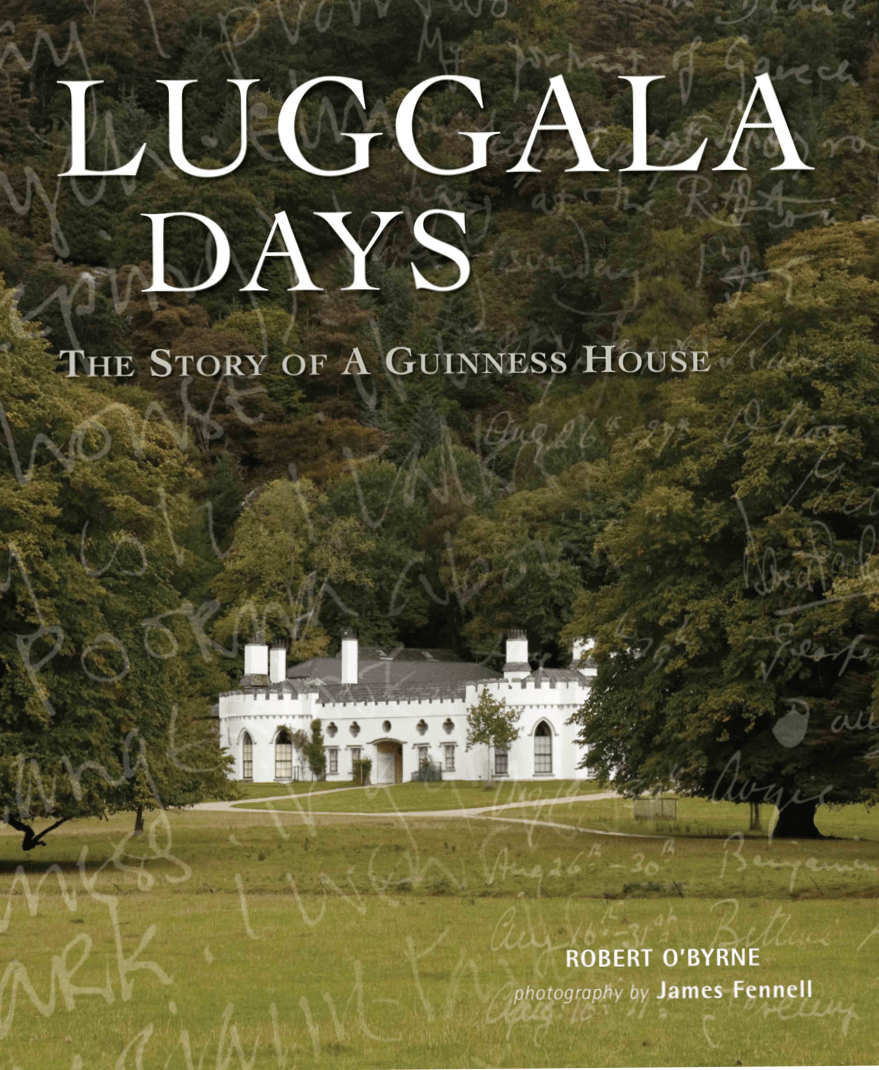
My New York pal James Andrew has written some kind words about Luggala Days in http://www.whatisjameswearing.com. Read it for yourself and simultaneously discover the delights of James’ own blog.
Divine Light
Perfection is the Child of Time
Russborough, County Wicklow on a fresh morning earlier this week. Built in the 1740s to the design of Richard Castle, at almost 700 feet it has the longest facade of any house in Ireland, the entirety fronted in granite from a local quarry. Even after some 270 years the stone has kept its crispness, as can be seen in the march of parapet urns, but mellowed through exposure to the elements, bringing Russborough to a perfection only achieved by the passage of sufficient time.
Nature Full of Poetry
‘In this sequester’d, wild, romantic dell
Where nature loves in solitude to dwell,
Who would expect ‘midst such a lonely park
The charms of fancy and the plans of art,
Whilst the neat mansion, formed with simple taste,
Amidst a wilderness for comfort plac’d,|
Adorns the scene and hospitably shews
The seat of pleasure and serene repose.’
So in 1807 wrote, Joseph Atkinson, an army officer-turned-playwright, of Luggala, County Wicklow. For more than 200 years, this secluded valley tucked deeo into the Wicklow Mountains has been the subject of many such encomia, generations of visitors captivated by what they have found there.
Yet until the onset of the Romantic era at the end of the 18th century Luggala, along with much of the surrounding region, lay unoccupied, untended and largely unknown. Only following its discovery around 1787 by Peter La Touche, a rich banker in search of seclusion, did Luggala come to public notice. Having remained free from the intervention of man for millennia the site, La Touche wisely realised, demanded nothing other than a dwelling with a character to match the setting. Designed by a now-unknown architect, this is Luggala Lodge, facing Lough Tay at the other end of the valley and terminating a vista that stretches from lake shore to steep ground immediately behind. As James Brewer remarked in 1825 the building ‘is well adapted to the recluse parts of Ireland, where nature reigns in wild and mysterious majesty.’
Three years before Brewer the Rev. George Newenham Wright, a cleric with literary aspirations, published A Guide to the County of Wicklow. Several pages of the book are devoted to Luggala, the author awe-struck that the first view of the site ‘is of a bold, awful and sublime character’ and the sheer mass of mountainside closing the prospect ‘exhibiting a continued mass of naked granite to the very summit, forming the most complete representation of all that is wild, dreary and desolate in nature, and defying all attempts at innovation that the aspiring genius of man has ever dared to undertake.’ Not long afterwards, Prince Herman von Pückler-Muskau, an impoverished German aristocrat travelling through Britain and Ireland in search of a wife wealthy enough to fund his inclination towards extravagance, visited County Wicklow and afterwards reported:, ‘I reached the summit of the mountain above the magnificent valley and lake of Luggelaw, the sun gilded all the country beneath me, though the tops of the hills were yet shrouded in mist. This valley belongs to a wealthy proprietor, who has converted it into a delightful park…It is indeed a lovely spot of earth, lonely and secluded; the wood full of game, the lake full of fish and nature full of poetry.’ When American film director John Huston wrote his memoir An Open Book in 1980 he recalled the first time he had visited Luggala twenty-nine years earlier. Arriving late at night and in the dark, he had seen little. ‘The next morning at dawn I went to the window and looked out upon a scene I have never forgotten. Through pines and yews in the garden I saw, across a running stream, a field of marigolds and beyond the field – surprisingly – a white sandy beach bordering a black lake…Above the lake was a mountain of black rock rising precipitously, and on its crest – like a shawl over a piano – a profusion of purple heather. I was to go back to Luggala many times, but I’ll never forget that first impression. I was Ireland’s own from that moment.’
Luggala Lodge, wrote the Knight of Glin in 1965, is an example of ‘that special brand of eighteenth-century gothick that rejoices in little battlements, crochets, trefoil and quatrefoil windows and ogee mantelpieces: in fact, the gothick of pastrycooks and Rockingham china.’ The building observed Michael Luke some twenty years ago, shines ‘like the discarded crown of a prima ballerina.’ Bulgarian-born author Stephane Groueff who stayed in the house during the 1950s remembered it ‘looking like an illustration from a nursery book of “The Queen of Hearts”.’ And actress Anjelica Huston recalls Luggala from her childhood: ‘It was like going into a fairy tale. Descending into the dell with the ferns and the overhanging trees, the flocks of deer and the pheasants, and then coming on the magical lake with its sand made up of chips of mica.’
Diarist Frances Partridge came to stay in the early 1950s and afterwards recorded, ‘What a magical atmosphere that house had, charmingly furnished and decorated to match its style, dim lights, soft music playing and Irish voices ministering seductively to our needs.’ Sixty years later, author and critic Francis Wyndham remembers Luggala as being ‘the most romantic place I’ve ever known,’ and recalls ‘that sparkling little jewel of a house with the black lake before it.’
And here is the present custodian of Luggala, the Hon. Garech Browne, wonderfully photographed by Neil Gavin in the house’s drawing room. Like each of his predecessors, Garech has ensured the special character of this spot be preserved. Luggala today remains as it was in the time of Joseph Atkinson, ‘the seat of pleasure and serene repose.’
My new book, Luggala Days: The Story of a Guinness House, has now been published.