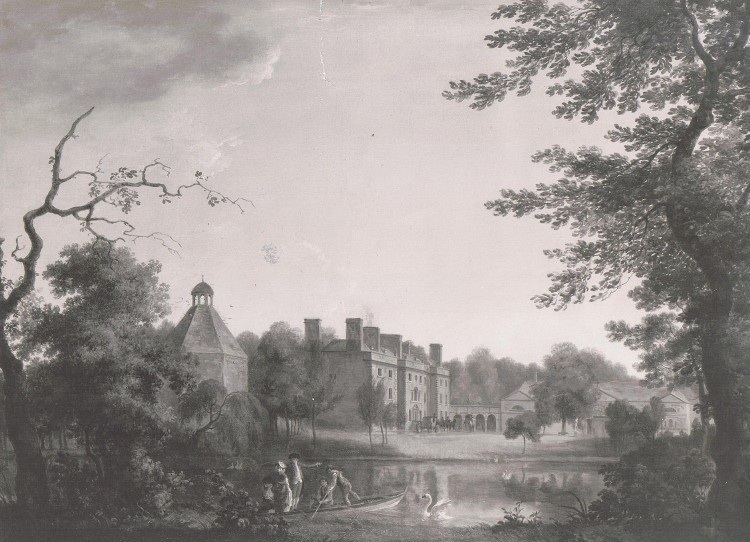
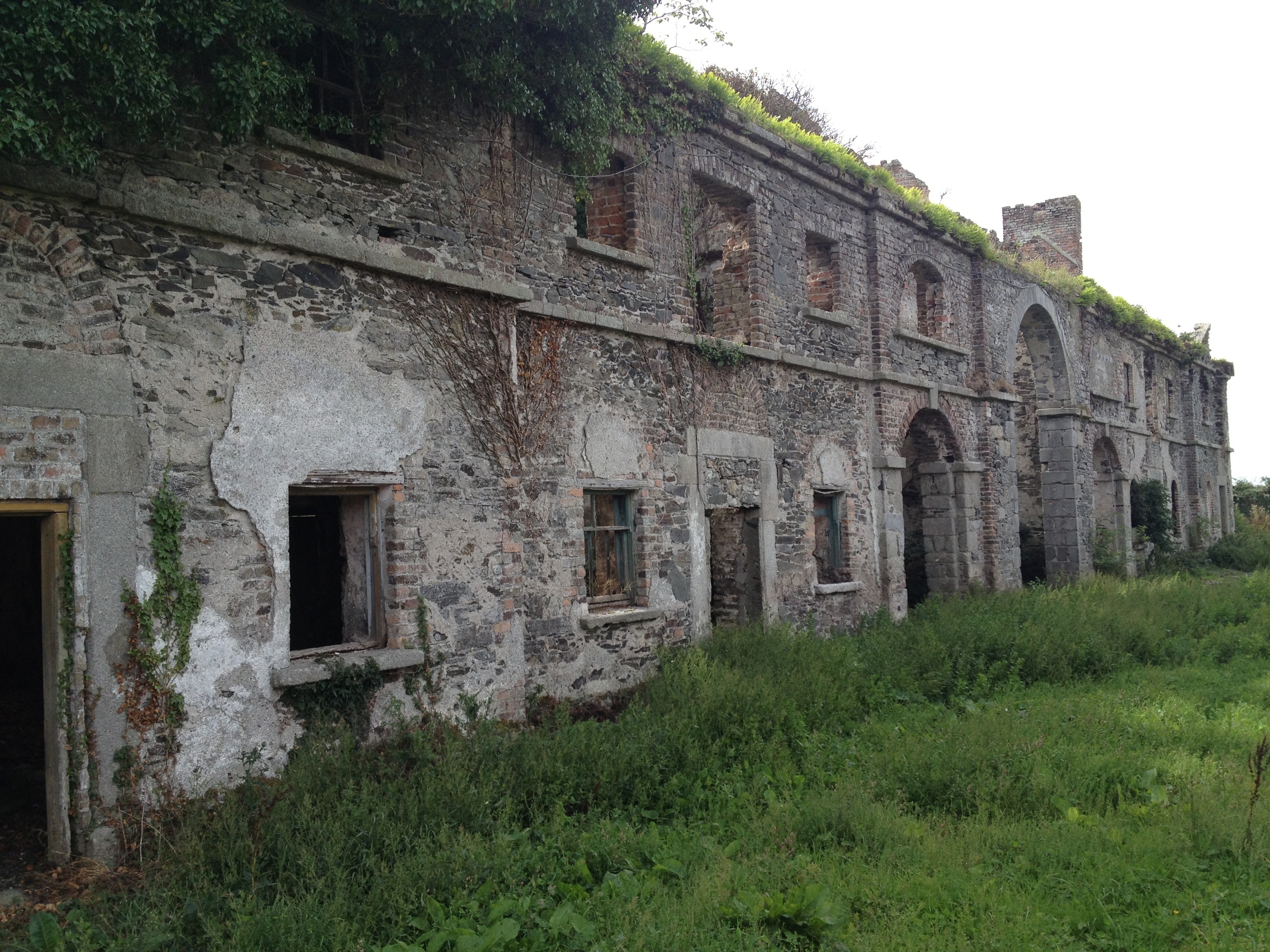
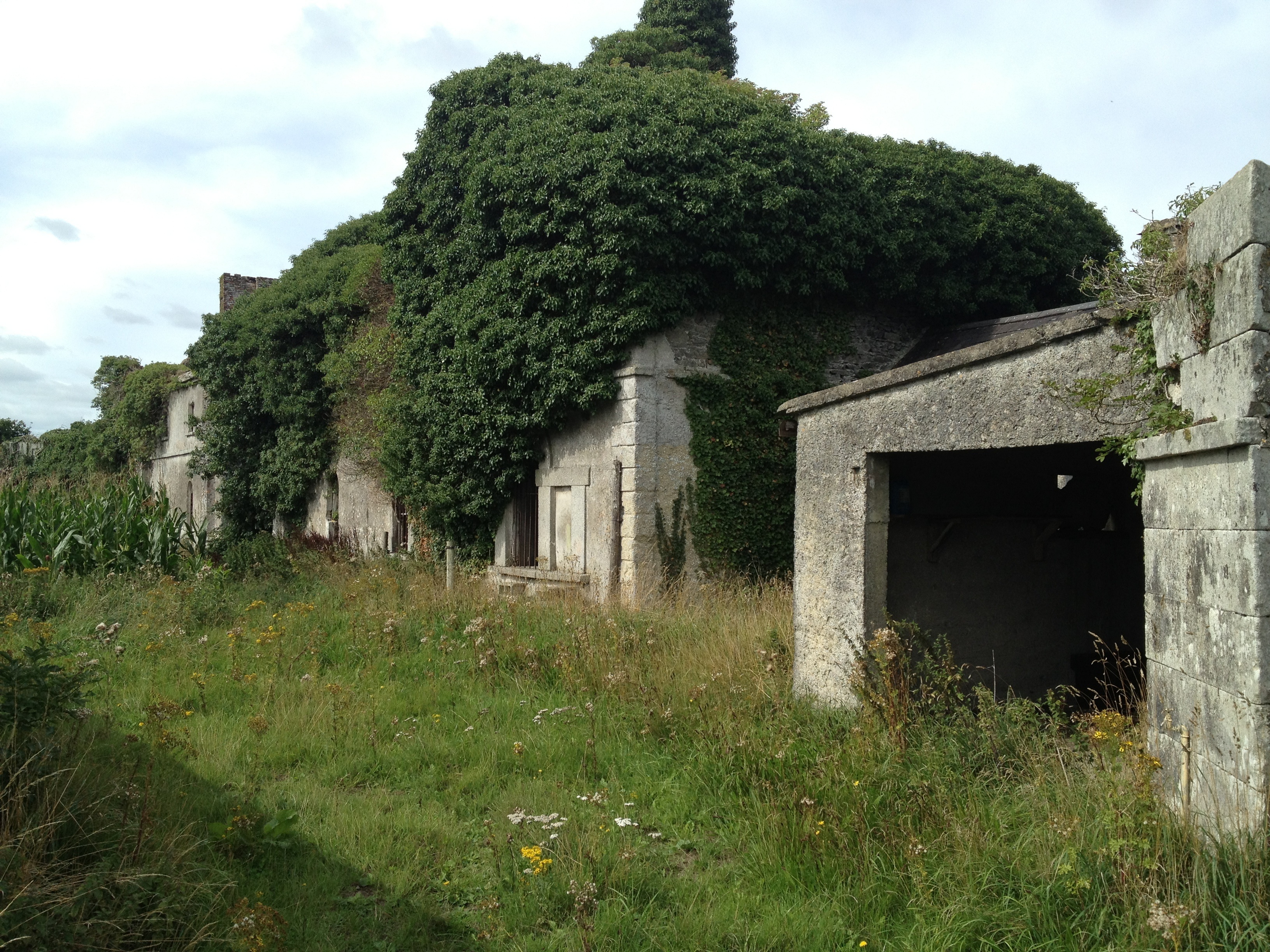
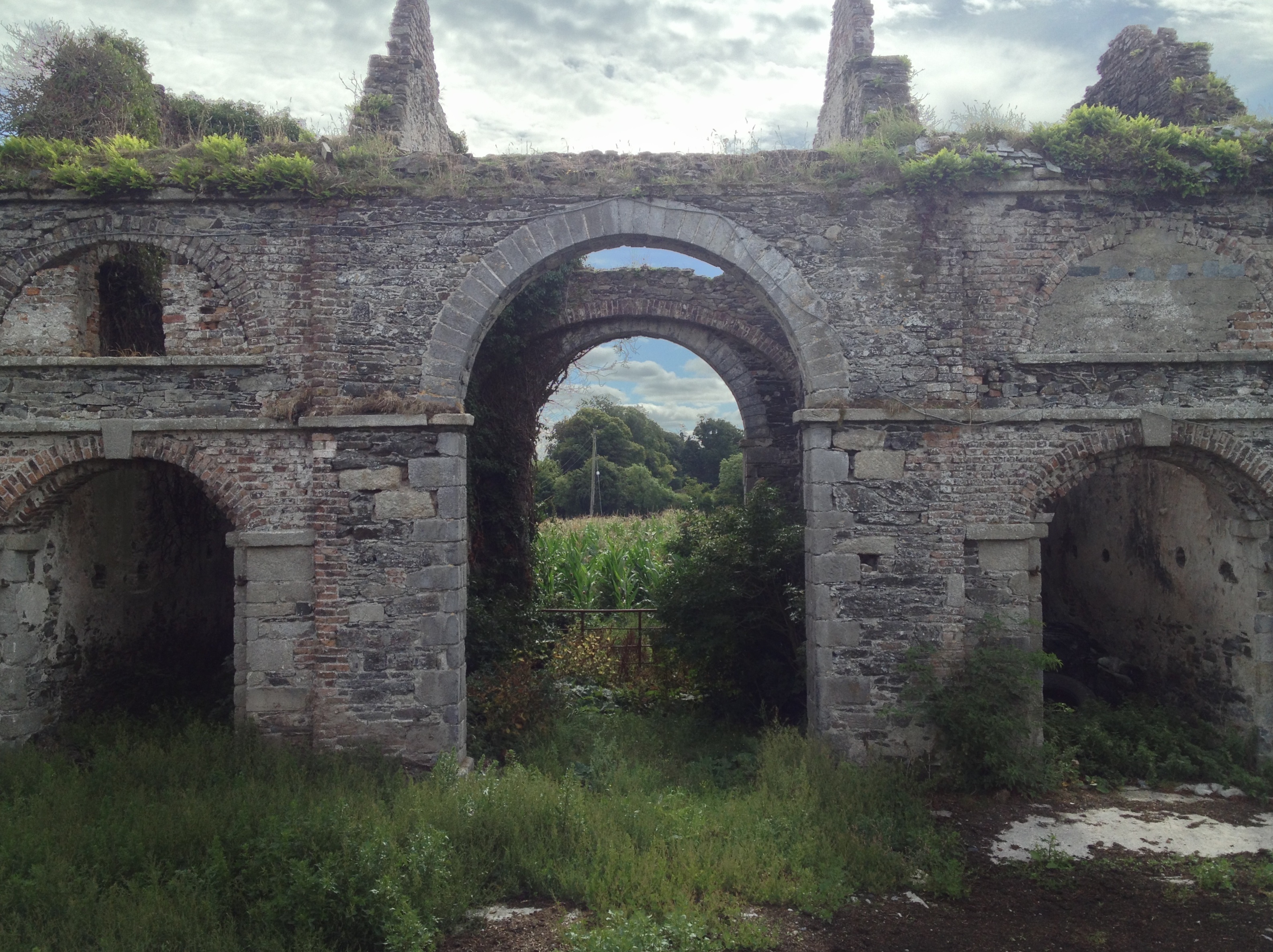
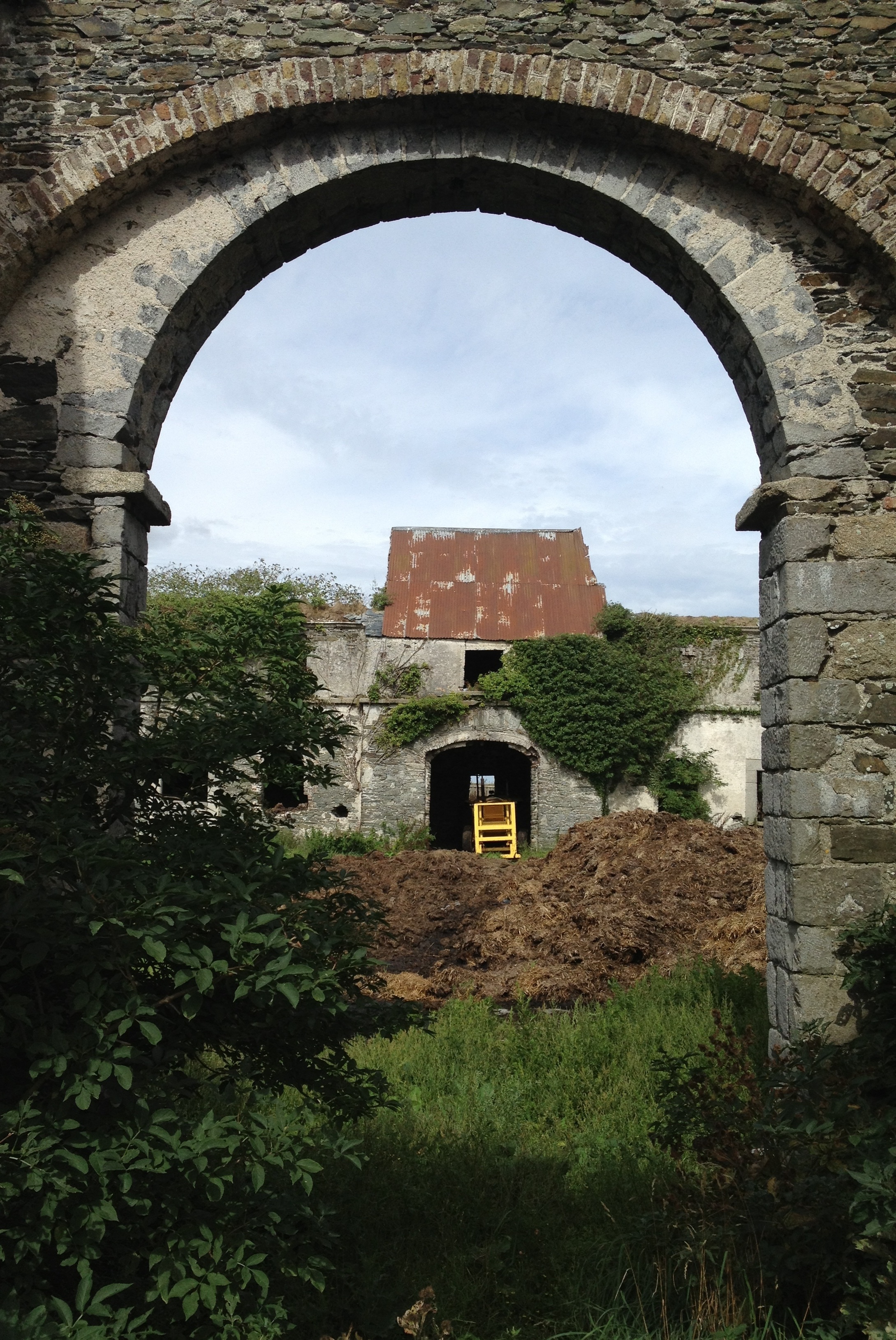
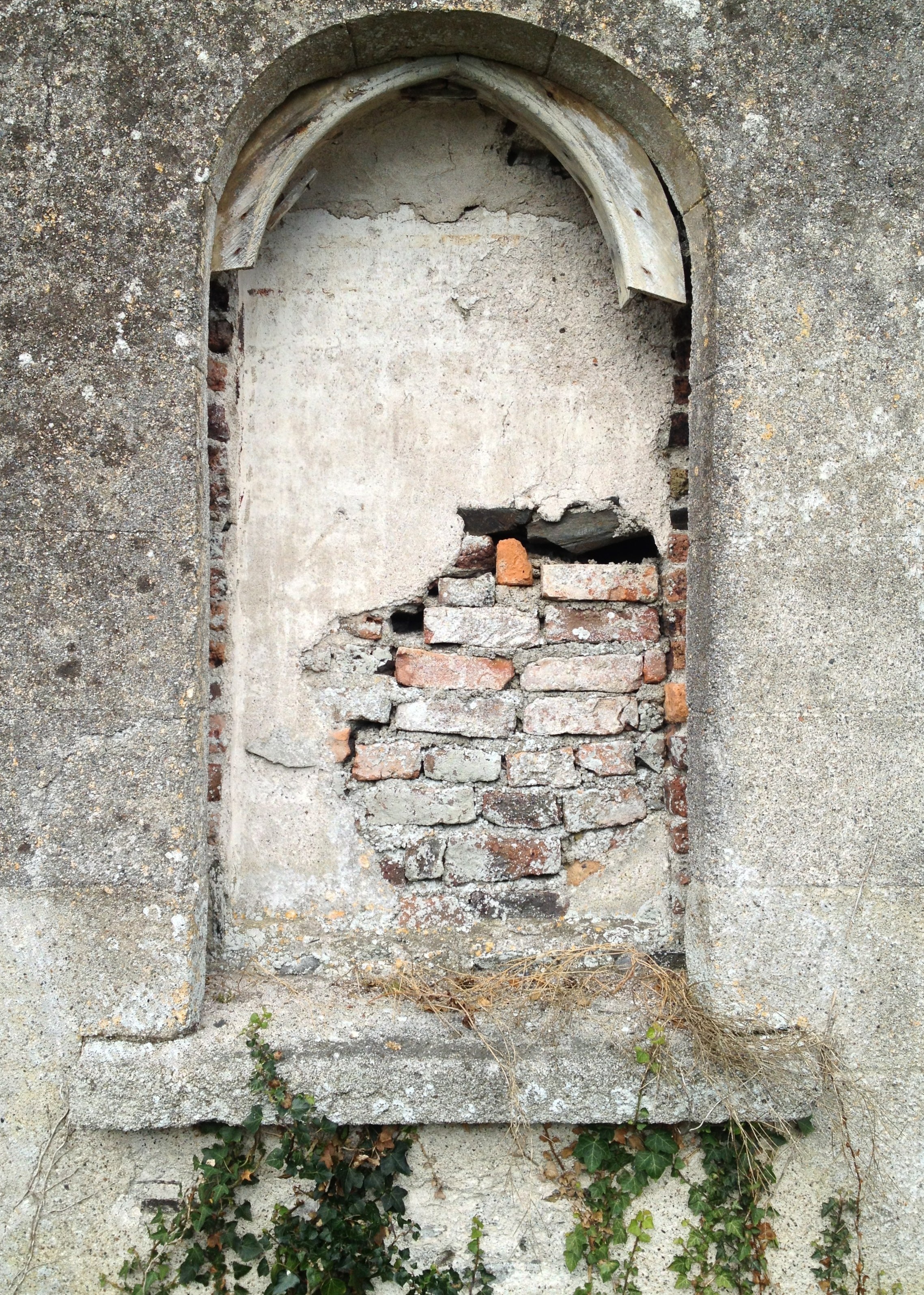
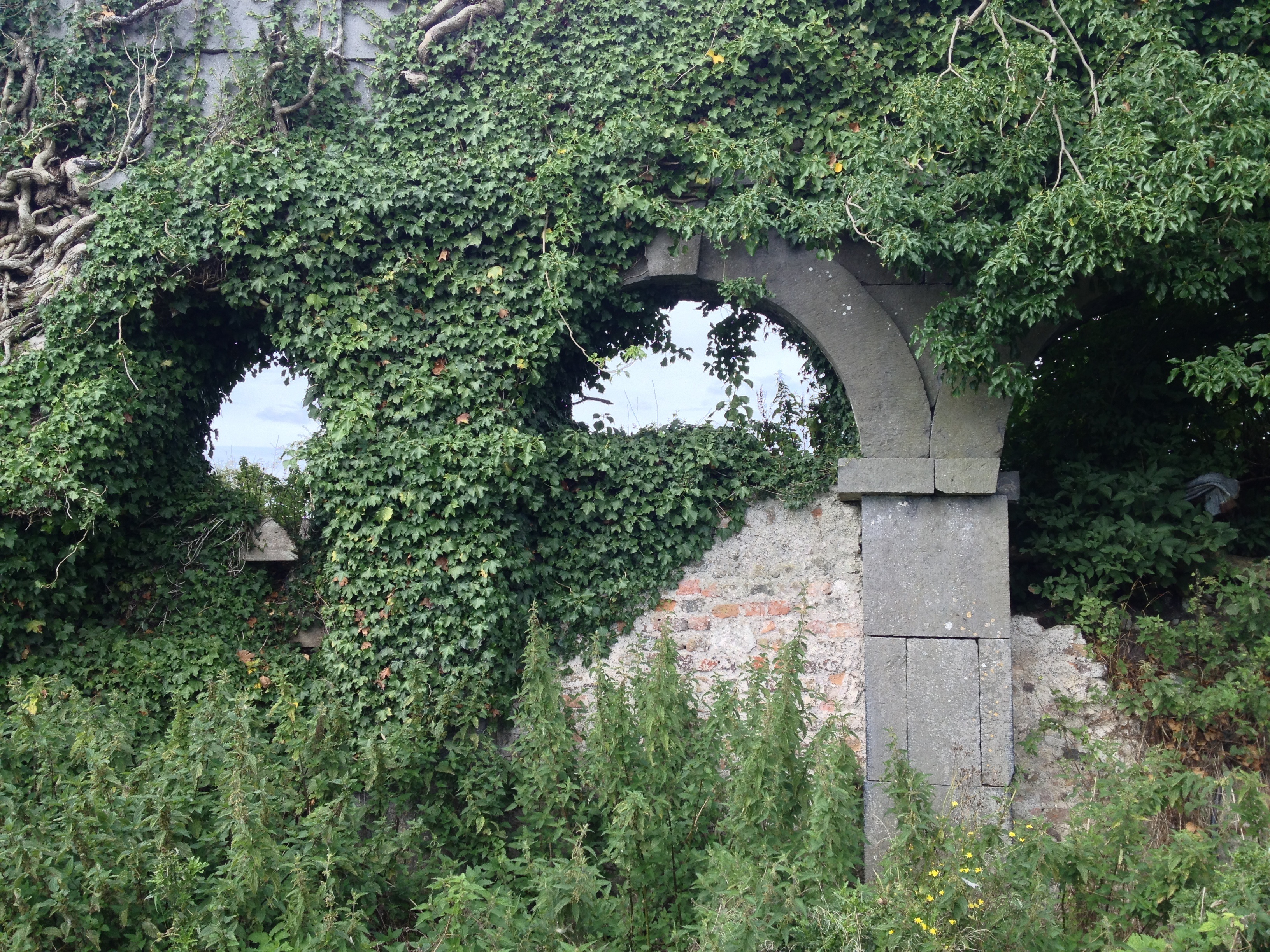
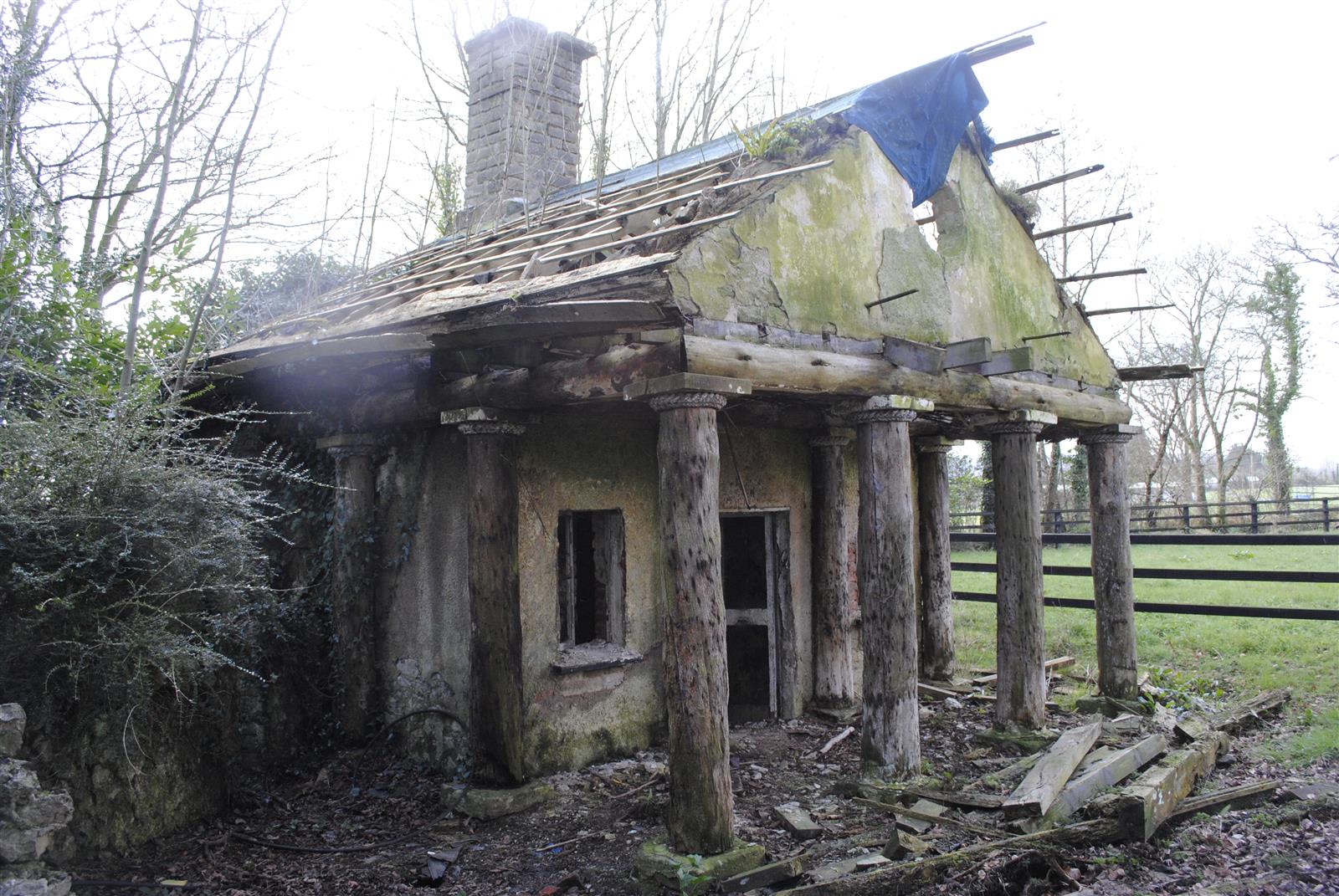
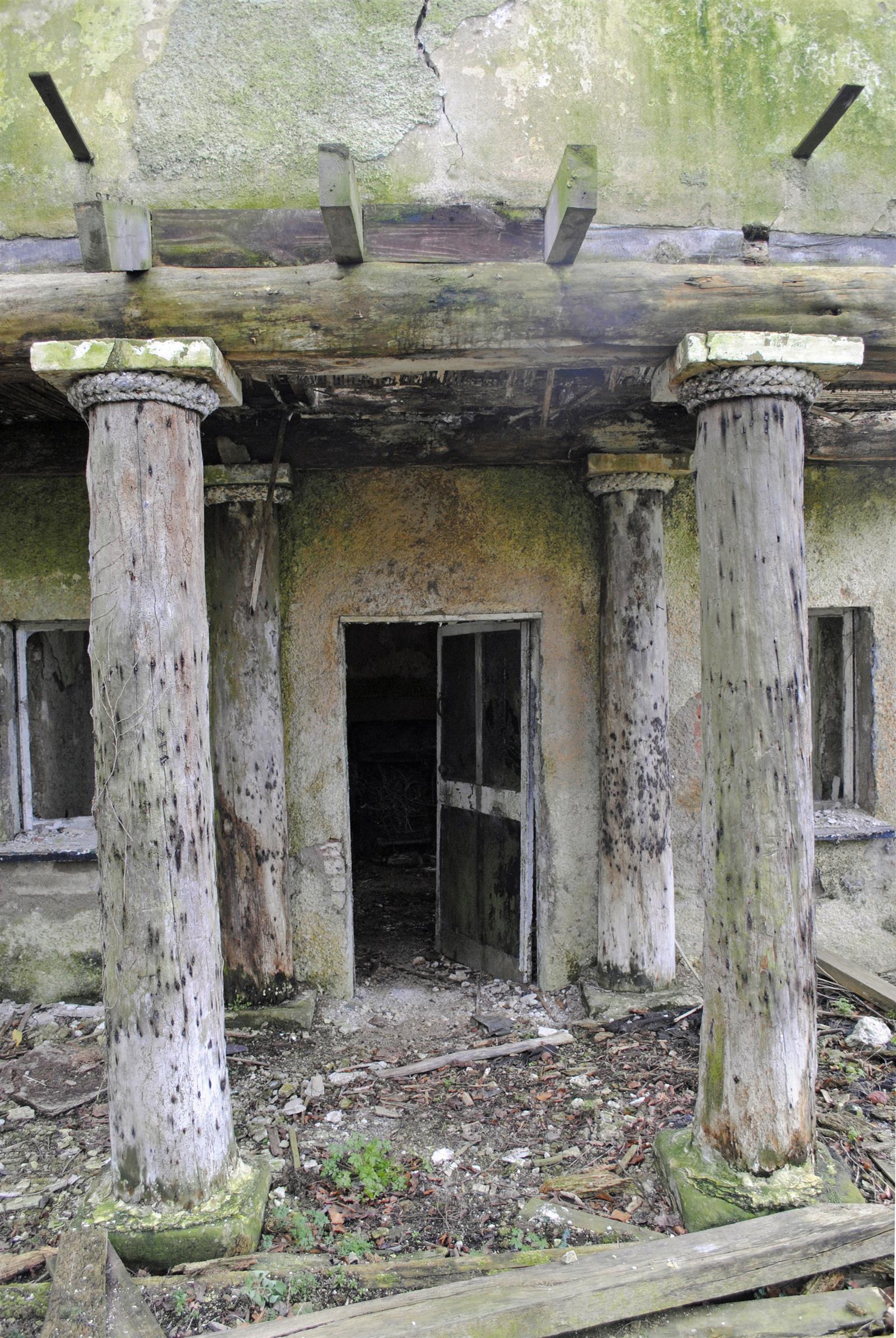
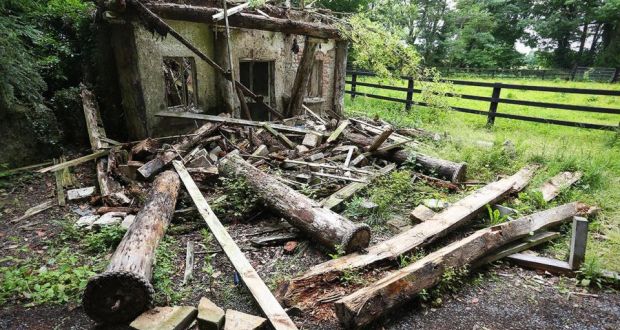
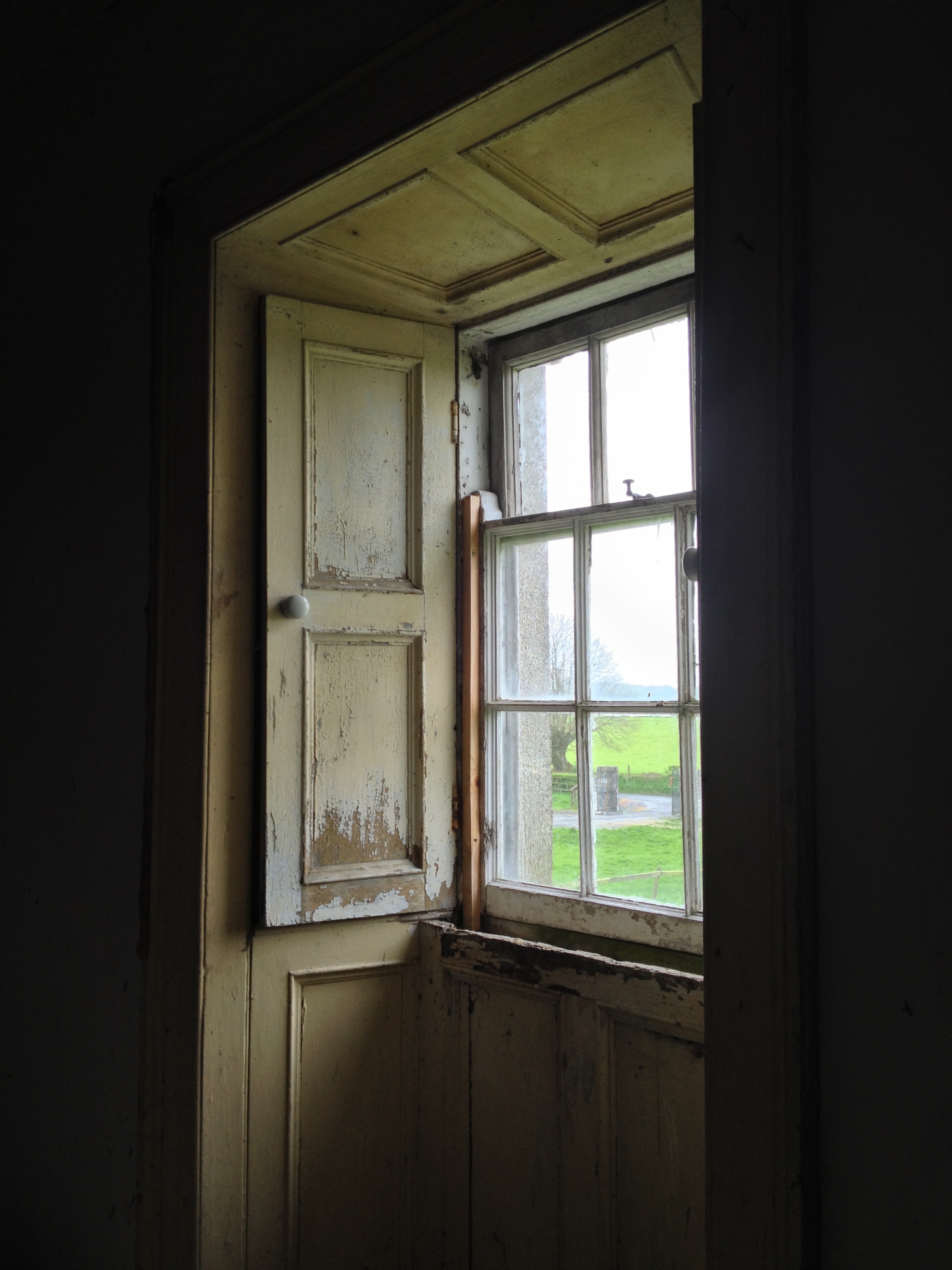
Earlier this week photographer James Fennell took a number of extraordinary pictures showing an old house at the entrance to the 18th century planned Quaker village of Ballitore, County Kildare being enveloped within a new structure; once the latter is complete, the old house will be demolished. The company responsible for this undertaking is Glanbia plc which grandiloquently describes itself as ‘a global nutritional solutions and cheese group’ and which on Wednesday announced a 13 per cent rise in revenue to €1.68 billion in the first half of 2013. Glanbia already has a plant in Ballitore and last year applied for planning permission to extend the premises, which involved the demolition of the house, referred to in the application as a ‘two storey office building’ thereby conveniently ignoring its history as part of a long-standing residential settlement.
Permission for this work to proceed was duly granted by Kildare County Council, after its conservation advisors advised that the structure had been so altered and refurbished that it ‘no longer retains any features of special significance’ and could accordingly ‘be deemed to be of little significance within the architectural heritage of Kildare.’ Leaving aside the fact that the local authority permitted those alterations and refurbishments to take place, the approval also ignored the house’s importance within the overall framework of the village of Ballitore, a unique collection of houses that are each part of a greater whole; damage one element and you damage the entire site and thereby irreparably alter its distinctive character. Glanbia is not some foreign entity (its origins lie in the Irish co-operative movement and it ought therefore to have a sense of community) so neither this organisation nor Kildare County Council can claim ignorance of the history of Ballitore. No doubt the inevitable economic arguments will be trotted out in justification for this act of cultural vandalism. Tourism is also an enormously important money-generating industry in Ireland: this is not Soviet Russia and tourists do not come here to look at factories. By assisting in the demolition of a fine old house and its replacement with a characterless monolith, the two bodies responsible will have inflicted damage on both the appearance of Ballitore and on the local economy.
Tag Archives: Heritage at Risk
No Room at the Inn
Seen from a towpath on the opposite side of the Grand Canal, the old hotel at Robertstown, County Kildare retains its charm. Originally opened in 1801, this hostelry attracted so much business that within three years it had to be extended. But with the advent of railways came a decline in canal business and by 1869 the Royal Irish Constabulary had been granted a lease on the premises. In the last century the building was used for various purposes; from the mid-1960s onwards it was the centrepiece of an annual summer festival in which the Irish Georgian Society became involved. Famously on one occasion a demonstration was given by Desmond Leslie of water-skiing on the canal. What made his activity distinctive was that Leslie was pulled by a horse being ridden at speed along the bank. Now the hotel is empty and falling into dereliction (all window openings are filled with painted boards). A five-year old planning application attached to the main door proposes a four-storey, 44-bedroom extension and sundry other changes but that option now seems unlikely. Although listed as a protected structure, the future does not look good for this important vestige of Irish transport history.
Lost Horizon
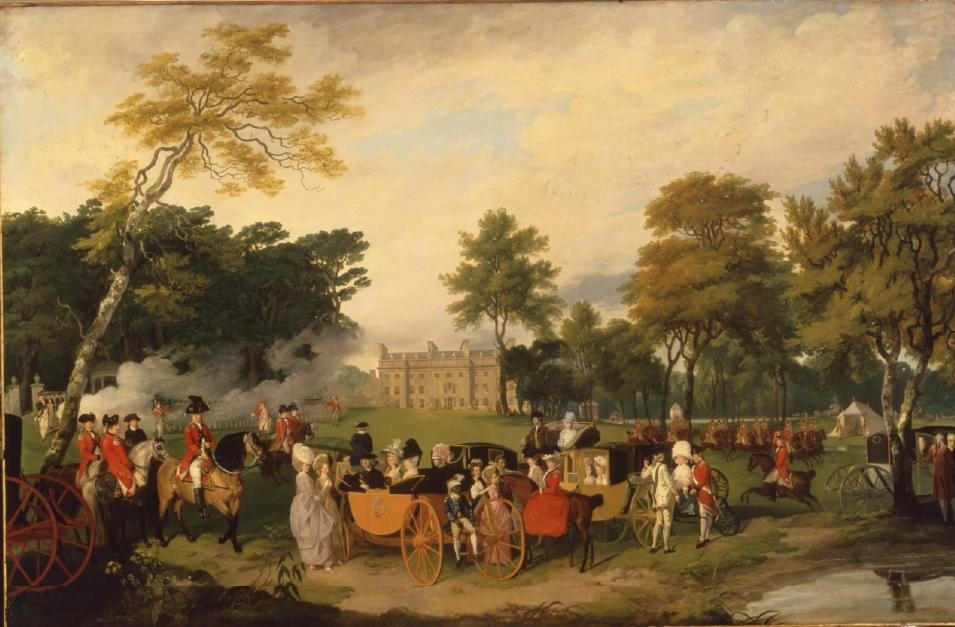
Travelling along Belfast’s Outer Ring Road through the the Newtownbreda area one passes signs for Belvoir Park. The picture above, dating from 1805 and painted by Vice Admiral Lord Mark Kerr, shows a house of that name. Today the name is almost all that remains of what was once the largest private residence in this part of the country. An keen amateur watercolourist of some ability Lord Mark, the third son of the 5th Marquess of Lothian, enjoyed a successful career in the Royal Navy until 1805. His connection with Ireland came through marriage in 1799 to Lady Charlotte McDonnell who would later become Countess of Antrim in her own right. During the early 1800s the Kerrs stayed at Belvoir Park, which belonged to Lady Charlotte’s half-brother and it was during this period that Lord Mark painted this picture along with another, both of which were in the collection of the Knight of Glin until sold at Christie’s in 2009.
There are earlier, and finer, views of Belvoir Park, the first of which is shown immediately above. This is one of four oils painted by the artist Jonathan Fisher (fl. 1763 – d. 1809) at the request of the house’s then-owner Arthur Hill-Trevor, 1st Viscount Dungannon. Fisher is believed to have been born in the 1740s and to have spent some time in England, first coming to attention here in 1763 when he was awarded a premium for a landscape by the Dublin Society (he would receive another five years later). He exhibited some 57 pictures with the Society of Artists in Ireland between 1765 and 1780, including the four views of Belvoir which were shown in the organisation’s premises on South William Street, Dublin (now the headquarters of the Irish Georgian Society, see Restoration Drama, July 15th). The pictures are highly significant because they show us the house from different aspects when it was newly completed and before alterations were made towards the close of the 18th century. They also offer us views of the landscape around Belfast before the city had much expanded and show how lovely this region looked prior to the onset of the industrial revolution (the last of the pictures at the end of this post offers Fisher’s bucolic view of the area as it would have been seen from the house).
Sir Moyses Hill was the first member of his family to settle in Ireland in the 1570s and it was his descendant Michael Hill who purchased for £2,000 the land on which stood Belvoir, then called Ballyenaghan, although the family’s main estate was at Hillsborough. Michael Hill’s wife Anne Trevor, subsequently married to Viscount Midleton, is reputed to have given the place its new name, in part owing to the view (‘Belle Vue’) and in part in recollection of Belvoir Castle, the Duke of Rutland’s seat in England where she had spent a large part of her childhood. Thanks to Lady Midleton, the property was inherited by her younger son Arthur who in 1766 was created Viscount Dungannon.
When Walter Harris published his survey of County Down in 1744 he described Belvoir as being ‘laid out lately in Taste; the Avenue is large and handsome, the Fruitery, from an irregular Glyn, is now disposed in regular Canals, with Cascades, Slopes and Terraces, and the Kitchin Ground inclosed with Espaliers, the best of the Gardens lying over the Lagan River, which is navigable to this Place. The Offices are finished, but the House not yet build.’ There does appear to have been a small residence on site but building work on something more splendid must have started soon afterwards. Even so when the indefatigable Mrs Delany came to stay in October 1758 she described it as a ‘charming place, a very good house, though not quite finished.’
Faced in brick, Belvoir Park’s main elevation looked north with views over the Lagan river and thence to the mountains beyond. This front was of seven bays, the three centre ones incorporating immense Ionic pilasters beneath a pediment with carved wooden mouldings. The entrance front faced west while the south side featured a canted bow. Belvoir Park is often attributed to Richard Castle, although if this were so it would have been a very late work since he died in 1751. He certainly designed the nearby Knockbreda Church for Lady Midleton (it can be seen to the left of the house in the first of Fisher’s pictures above). More recently the proposal has been made that a lesser known architect Christopher Myers was responsible for Belvoir Park.
Following the first Lord Dungannon’s death in 1771, title and property alike passed to a young grandson (his only son having predeceased him by a year). The second viscount appears to have lived and entertained lavishly and as a result further work was undertaken on the house, notably by the addition of a third attic storey which can be seen in Lord Mark Kerr’s watercolour. In the mid-1790s Lord Dungannon moved to his Welsh estate and Belvoir Park was left unoccupied except by the agent, and by the Kerrs for a period. Eventually the entire place was sold in 1809 and after passing through various hands was acquired in 1818 by Belfast banker and landowner Robert Bateson around the time he became a baronet. He did much to improve the Belvoir, as did his son Sir Thomas Bateson (later first Lord Deramore) who around 1865 commissioned Newry architect William Barre to carry out some alterations to the house, including balustrades around the roof parapet and a balustraded entrance porch. At that stage the estate ran to more than 6,000 acres but decline set in soon after Lord Deramore’s death in 1890. Belvoir was let to various tenants but by this time Belfast was fast expanding and the land on which house and grounds stood just a few miles from the city centre was wanted for housing. In the 1920s part of the estate became a golf course while it was suggested the house become a residence for the Governor of Northern Ireland (ironically the Hill family’s former principle property, Hillsborough Castle, was instead selected). During the Second World War the site was used by the Admiralty, but from 1950 onwards the buildings started to fall into ruin. The succession of photographs seen here show the building in 1961 shortly before it was blown up by members of the army; today only parts of the old yard remain. 185 acres of the former estate are a forest park but the rest of the land is given over to suburban housing. The loss of Belvoir Park must be judged a grievous one but thankfully the paintings of Jonathan Fisher survive as evidence of this once-fine house. Privately owned, the pictures have been loaned for inclusion in an exhibition on Irish landscape art currently running at the Ulster Museum in Belfast.
An Irishman’s Home is His Tower House
All across Ireland can be seen buildings commonly known as castles but which ought more correctly be called tower houses. The tower house is not exclusive to this country, similar structures being found along the Scottish Borders. However, the sheer quantity of these edifices make them one of the most distinctive features of the Irish landscape: it has been estimated that between 1400 and 1650 in the region of 3,000 tower houses were constructed.
A statute issued by Henry VI in 1429 declared, ‘It is agreed and asserted that every liege man of our Lord, the King of the said Counties, who chooses to build a Castle or Tower House sufficiently embattled or fortified, wither the next ten years to wit 20 feet in length, 16 feet in width and 40 feet in height or more, that the commons of the said Counties shall pay to the said person, to build the said Castle or Tower ten pounds by way of subsidy.’ It is often proposed that this piece of legislation, with its financial incentive, did much to encourage the popularity of tower houses, and also their uniformity of design.
There is some dispute whether the tower house’s primary purpose was defensive or residential; one suspects it varied according to geographic and political circumstances. Typically the building is rectangular and constructed of irregular stones, the walls in excess of four feet thick at base level and rising four or five storeys high. A single arch doorway offered admission with the large arched ground floor devoted to diverse purposes including storage of foodstuff and livestock. Above the entrance was an opening called the Murder Hole, through which boiling liquids or arrows could be directed in the event of an attack. Windows at this level were little more than slits although they were larger further up. The family lived on the tower’s top storeys, but levels of comfort were pretty minimal.
Various descriptions of life in a tower house have come down to us and none of them make it sound especially luxurious. For example the Spaniard Cuillar wrote in 1588 ‘The Irish have no furniture and sleep on the ground, on a bed of rushes, wet with rain and stiff with frost…’ Half a century later the French traveller, M. de la Bouillaye le Gouz observed ‘The castles of the nobility consist of four walls, extremely high and thatched with straw but to tell the truth, they are nothing but square towers without windows or at least having such small apertures as to give no more light than a prison. They have little furniture and cover their rooms with rushes, of which they make their beds in Summer and straw in Winter. They put rushes a foot deep on their floors and on their windows and many of them ornament their ceilings with branches.’
In many respects Kilbline Castle, County Kilkenny is a typical Irish tower house. Rising five storeys high, it has round bartizans or wall-mounted turrets at each corner of the east front and a slender chimney-stack between them. The surrounding bawn wall survives in part but some sections were demolished in the last century to permit the erection of modern farm sheds. Kilbline is usually dated to the 14th/15th centuries but a large limestone chimneypiece on the first floor carries the date 1580 so it is possible that was when the building was completed. On the other hand, there is reference to Kilbline Castle being forfeited by one Thomas Comerford of Ballymac in 1566 so perhaps the chimneypiece was inserted into the tower by its subsequent owner.
That person may have been a member of the Shortall family of Rathardmore Castle in the same county. Thomas Shortall of Rathardmore died in 1628 and not long after his heir Peter moved to the castle of Kilbline, where he subsequently lived. His estates, which ran to some 1,500 acres were declared forfeited by the Cromwellian government in 1653 and his sons ordered to be sent to Connaught, although one of them seems to have returned to Kilbline, perhaps after the restoration of Charles II in 1660. Nevertheless, Kilbline once more changed hands during this period.
Originally from Newcastle in Northumberland, William Candler is believed to have served as an officer in Oliver Cromwell’s army during the Irish wars of 1649-53. As a reward for his endeavours, he was promoted to the rank of Lieutenant Colonel and granted lands in County Kilkenny, including those on which stands Kilbline Castle. He and his wife Anne Villiers had two sons, the younger of whom John is known to have lived at Kilbline. John Candler had a single son Thomas who, in turn, had only the one child, Walsingham; he never married and so that line of Candlers came to an end.
To return to Lt.Col. Candler, his older son Thomas who lived at Callan Castle had four sons, the youngest of whom Daniel caused a rumpus within the family by marrying an Irishwoman, possibly a Roman Catholic, called Hannah and as a result was obliged to leave first County Kilkenny and then Ireland. Around 1735 Daniel and Hannah Candler moved to the America Colonies, initially settling in North Carolina before they moved to Bedford, Virginia. Their great, great, great-grandson was Asa Griggs Candler, the entrepreneur who in 1888 bought the formula for Coca Cola and made himself fabulously rich as a result.
Kilbline Castle continued to be occupied until just a few decades ago. At some point, probably in the 19th century, a two storey three-bay house was added on the west end of the tower house and a further single storey structure abuts this. The interior of the house remains relatively intact and suggests a degree of affluence on the part of the occupants.
However, the most architecturally significant feature of Kilbline is a wonderful panelled room on the south-east corner of the ground floor. Most likely of oak (it was hard to tell with certainty) this looks to date from the late 17th or early 18th centuries and must therefore have been created while the building was occupied by the Candlers. Although the ceiling is now covered in tongue-and-groove boards, all the wall panelling is intact, as is the old chimneypiece (the latter marred only by a shelf added at some later date). This rare instance of early Irish interior decoration is some 300 years old and given that the house has been empty for some time it remains in remarkably good condition, as can be seen in the pictures above. The present owners, although they do not live in the building, are aware of its importance and would dearly love to restore Kilbline and ensure its future.
Killeen with Kindness
A watercolour of Killeen Castle, County Meath, painted by Lady Emma Frances Plunkett (1826-1866), daughter of the ninth Earl of Fingall. The Plunketts are of Norman origin and established themselves in this part of Ireland at the end of the 14th century. The Earls of Fingall were notable for remaining Roman Catholic throughout the Penal era, unlike their neighbouring cousins, the Lords Dunsany who converted to Anglicanism. The picture is significant because it shows Killeen prior to extensive changes made to the structure from 1841 onwards by Lady Emma’s father, in other words it must have been painted while she was still an adolescent. At the age of 24 she married William Ince Anderton, member of an old Lancashire recusant family and together they embarked on the construction of a new chapel on his estate at Euxton Hall to the designs of Edward Welby Pugin; following Lady Emma’s death in 1866, a large stained glass window was installed in the chapel which shows her kneeling at the foot of the cross.
Killeen remained in the ownership of the Plunkett family until it was sold by the twelth and last Earl of Fingall in 1951. Thirty years later, after changing hands a couple of times more, the castle was gutted in an arson attack. It then stood ruinous until the estate was bought in 1997 by a development company which undertook to restore the building as centrepiece of a luxury hotel and spa. The rest of the same organisation’s scheme, including the inevitable championship golf course and series of commuter houses went ahead but of course the castle’s restoration stalled: when I visited some years ago, the roof had been repaired and concrete floors installed but little further work undertaken. Below is another watercolour by Lady Emma Plunkett, this one showing Dunsany Castle which happily remains intact and in the ownership of its original family. Both pictures, and three more by the same amateur artist, are included in an exhibition opening next week in Dublin’s Gorry Gallery (see http://www.gorrygallery.ie).
Of Wonderous Beauty Did the Vision Seem*
Writing to a friend in September 1795, the English Romantic poet Anna Seward, known during her lifetime as the Swan of Lichfield, reported ‘I must not conclude my letter without observing, that, on my second visit to the fairy palace [Llangollen Vale], a lovely Being cast around its apartments the soft lunar rays of her congenial beauty. — Mrs. Tighe, the wife of one of my friend’s nephews, an elegant and intelligent young woman, whom I should have observed more had his wife’s beauty been less. I used the word “lunar” as characteristic of that beauty, for it is not resplendent and sunny, like Mrs. Plummer’s, but, as it were, shaded, though exquisite. She is scarce two-and-twenty. Is it not too much that Aonian inspiration should be added to the cestus of Venus? She left an elegant and accurate sonnet, addressed to Lady E. Butler and her friend, on leaving their enchanting bowers.’
The ‘Mrs Tighe’ to whom Seward here refers was another poet, Mary Tighe, while ‘Lady E. Butler and her friend’ were the famous Ladies of Llangollen, and a house in Ireland, today a ruin, links them all together: Woodstock, County Kilkenny. Lady Elinor, who grew up in Kilkenny Castle, knew the place well since it was here in 1768 that she met her lifelong companion, Sarah Ponsonby. Lady Elinor was then aged 28, Miss Butler some fifteen years younger but they formed so close a bond that more than a decade later, braving the opprobrium of their respective families, and of society at large, they ran away together and set up home at Plas Newydd, near the Welsh town of Llangollen. Although living quietly and on a relatively modest income, they soon became famous and attracted visitors from throughout Britain and Ireland: Queen Charlotte wanted to see their house and persuaded George III to grant them a pension. Writers in particular were especially fascinated by the Ladies of Llangollen and among those who travelled to see them were Lord Byron, Wordsworth, Shelley, and Sir Walter Scott. Plus, of course, both Anna Seward and Mary Tighe.
Mary Tighe (née Blachford) was born in 1772, the daughter of a Church of Ireland clergyman who died when she was very young. Her mother Theodosia Tighe was an early supporter of John Wesley and Mary had a severely religious upbringing. At the age of twenty-one she married her first cousin Henry Tighe but it appears the union was not happy. In addition Mary soon began to manifest signs of the tuberculosis that would eventually kill her.
From an early age she had written both poetry and prose but only in 1805 was her long poem Psyche, or the Legend of Love privately printed in an edition of just fifty copies. Nevertheless, it brought her considerable fame: in the same year Thomas Moore wrote his own poem To Mrs Henry Tighe on Reading her Psyche which opens with the lines, ‘Tell me the witching tale again/For never has my heart or ear/Hung on so sweet, so pure a strain/So pure to feel, so sweet to hear.’
Psyche is a six-canto allegorical poem in Spenserian stanzas recounting the classical myth of the love between Cupid and Psyche, and the travails the couple must endure before they can achieve happiness. In sentiment it is of its own era and not of ours, but stylistically the work is highly accomplished and one can understand why it achieved such renown in the early 19th century. A year after the death of the poem’s lovely young author in 1810 a new edition of Psyche, along with some of her other verses, was published and this helped to cement Mary Tighe’s fame across Europe.
Mary Tighe spent the final months of her short life at Woodstock which belonged to her brother-in-law William Tighe. Wonderfully located on high ground above the village of Inistioge and the river Nore, the house dates from around 1745 and is believed to have been designed by the architect Francis Bindon for Sir William Fownes. Its north-east front of six bays and three storeys over part-raised basement is notable for having an elaborate central doorway comprising the door itself and two flanking windows immediately above which is a niche which originally contained a life-size statue, and an oculus over that again. So deep is the building that it has a small inner courtyard to light the central rooms.
Woodstock was inherited by Sir William Fownes’ grandson William Tighe and c. 1804 he was responsible for adding the flanking single-storey wings with pedimented breakfronts, the designer of these being local architect William Robertson. The interior was especially noted for its fine library and a couple of old photographs show ceilings with elaborate rococo plasterwork. The main hall contained a white marble figure representing Mary Tighe carved by the Tuscan Lorenzo Bartolini some five years after her death. This has gone but her mausoleum survives in the graveyard attached to the former Augustinian priory of St Columbkill is Inistioge. Inside the severe neo-classical limestone structure is another life size figure carved by the English sculptor John Flaxman and showing the recumbent poet with a small winged figure – Inspiration perhaps? – crouching beside her head.
Set on sloping ground, the gardens of Woodstock were originally laid out in the ‘natural’ style popularized by Capability Brown. However they were transformed in the middle of the 19th century by Lady Louisa Tighe, wife of another William Tighe; Lady Louisa was the daughter of the fourth Duke of Richmond and therefore the great-niece of the Lennox sisters who made such an impact on Ireland during the previous century (as anyone familiar with Stella Tillyard’s 1995 book Aristocrats will remember). Late in life, Lady Louisa who was born in 1803 recalled attending her mother the Duchess of Richmond’s legendary ball in Brussels, held three days before the Battle of Waterloo: ‘I well remember the Gordon Highlanders dancing reels at the ball. My mother thought it would interest foreigners to see them…some of the poor men who danced in our house died at Waterloo.’ (A piece of trivial information: four years after Waterloo, the Duke, by then Governor General of Canada, was bitten by a pet fox and subsequently died of rabies.)
Working with her then-head gardener Pierce Butler, Lady Louisa’s interventions at Woodstock were extensive, beginning with a series of three terraces to the immediate west of the walled garden. The middle of these three was aligned to the south with a large circular conservatory designed by the Dublin iron master Richard Turner. This work completed and Pierce Butler having died, Lady Louisa then embarked on another major project with her new head gardener Scotsman Charles McDonald: the creation of a winter garden to the immediate rear of the house. Consisting of four sunken panels each filled with elaborately planted parterres, its creation involved the removal of more than 200,000 cubic yards of soil and the building of massive granite embankments. Extant photographs indicate the style of these gardens to be of the kind now found only in municipal parks, with lines of bright bedding plants and even at Woodstock pathways of different coloured gravel. Less lurid elements elsewhere in the demesne included an arboretum, yew walk and rose garden, Monkey Puzzle and Noble Fir avenues, a grotto, rustic summer house and various other features.
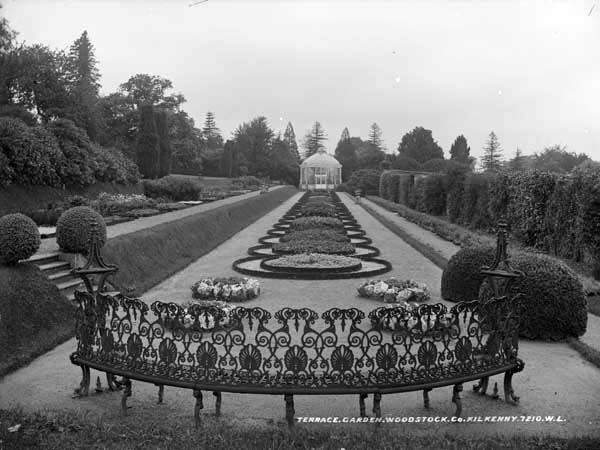
Lady Louisa and William Tighe had no living children and although she remained in residence at Woodstock until her death in 1900 the estate passed to her husband’s nephew Frederick Tighe who in turn left it to his son Edward. Perhaps because Lady Louisa continued to live in the house, this branch of the family spent less time at Woodstock and once the War of Independence broke out the Tighes brought the house’s more valuable furniture and pictures to England. It proved a judicious move since the building was occupied first by members of the hated Black and Tans and then by the Free State Army. The latter left Woodstock on July 1st 1922 and the following day it was set alight, most probably by anti-Treaty forces. All the remaining contents, including the library and Bartolini’s statue of Mary Tighe, were destroyed in the blaze. It was, like so many similar occurrences of the period, an entirely gratuitous act of vandalism that did nothing other than rob Ireland of another part of her cultural heritage.
Woodstock has stood a ruin ever since, its external walls now needing support if they are not to fall down. In recent years Kilkenny County Council has undertaken extensive restoration of the gardens which are open to the public and much prized. The pity is that the once splendid house which was their centerpiece and source of meaning provided should remain a hollow shell. If only in memory of the poet Mary Tighe, Woodstock deserves better than its present condition.
*From the first Canto of Psyche.
A new biography of Mary Tighe by Miranda O’Connell has just been published by the Somerville Press.
Keeper of the Gate
The former main entrance to Donadea Castle, County Kildare. Donadea was granted to the Aylmer family in 1597 and remained in their possession until the death in 1935 of the last descendant, a Miss Alymer, who bequeathed the estate to the Church of Ireland. That body sold on the place and in the 1950s the main house was unroofed. Since 1981 the demesne, much of it woodland, has been a public park. It is unknown who was the architect for this fine gateway, the lodge echoing the design of Donadea Castle which has at its core an early 17th century tower house. It may have been Sir Richard Morrison who in the early 1800s was employed by Donadea’s then-owner Sir Fenton Aylmer; the latter’s wife was a Freke of Castle Freke, County Cork which Morrison castellated around 1807. Donadea Castle is now a shell and its main entrance not much better; the unsightly rubbish bin in this photograph is explained by a modern residence on the other side of the gatewway.
Putting on a Good Front
Broad Street, Limerick, November 1949
Thirty years ago I was involved in the production of a little book about the traditional shopfronts of Roscrea, County Tipperary. A typical midlands market town, Roscrea had many old stores the appearance of which both inside and out dated back to the late 19th century. Largely due to insufficient funds the majority of these properties had since remained unaltered. However from the late 1960s onwards retailers here as elsewhere embarked on a determined programme of modernisation for their premises. Anything old was regarded as outmoded and a bar to progress, and so the old shopfronts with their painted fascias were swept away. Up in their place went expanses of plastic and fluorescent lighting, the same as could be found in innumerable other towns around the world. It may be that on strictly economic grounds the decision to discard the old made sense, but at what cost to the town’s character?
Awareness of this rapidly vanishing element of Roscrea’s heritage led to the project to record its still-extant shopfronts. The book contained pen and ink drawings of each premises included, together with as much information as could be ascertained about the shop and its history. It was a timely exercise: last time I passed through the town very few of the old shopfronts were still to be seen. Had the book not been published, today there would most likely be no record of what had gone.
Cigar Divan, Carlow, October 1958
Shopfronts, Askeaton, County Limerick, February 1978
I remembered the little book of Roscrea shopfronts when looking through a recently published collection of photographs taken by the late Maurice Craig. For the best part of a half century wherever he travelled about Ireland Maurice brought his camera, and the result was a wondrous record of a country which within living memory has all but disappeared. ‘I do not think of myself as a photographer,’ he writes in his Introduction, ‘merely somebody who has taken a great many photographs, usually with a purpose in mind…Unconsciously I was collecting the materials for a history of buildings, which I came to realise were at risk of destruction or mutilation.’
A brief biography of Maurice will be helpful for those to whom his name is unfamiliar. Born of Presbyterian stock in Belfast in 1919 he was educated at Shrewsbury before winning a scholarship to Magdalene College, Cambridge where he occupied the same rooms as had the nationalist leader Charles Stewart Parnell some eighty years earlier. Maurice then went on to write a doctorate on the poet Walter Savage Landor at Trinity College, Dublin. His first book, a biography of the Earl of Charlemont (see Casino Royale, March 25th) appeared in 1948 but four years later he wrote the work with which he has ever after been associated: Dublin 1660-1860. It took 13 years for the 2,000 copies of the book’s first edition to sell but since being republished in 1969 Dublin 166-1860 has rightly been regarded as a peerless piece of architectural history. Impeccably written, packed with information and anecdote, more than sixty years after first appearing this remains the best work to read about the city’s evolution during the Georgian period. If I were to choose only one of his other books to recommend it would have to be Classic Irish Houses of the Middle Size (1976), a volume as distinctive – and memorable – as its title indicates.

Shopfront, Rathcormick, County Cork, March 1979

Hacketts Shop, Killkenny, June 1948
At the close of his preface to Dublin 1660-1860, Maurice comments, ‘I have done my best to get out of the way of the buildings and let them be seen for themselves, relying on a possibly fallacious belief that architecture cannot lie.’ He adopted the same approach to his photography, allowing buildings to make their own eloquent case. Amateur though he was Maurice proved an instinctively gifted photographer. Other people, of course, were taking pictures of Irish architecture before he started doing so in the 1940s, but usually the focus was on friends or family standing in front of or inside a building, or the place was being photographed for commercial purposes, most often to be reproduced as a postcard. Maurice was interested in a structure’s inherent qualities and in capturing these for posterity (somehow he knew of the wave of demolition that lay ahead). But he brought a romantic’s eye to his self-imposed task. Look at the way he frames the house in Limerick in the first picture by enclosing it with the sides of a lane on the other side of the street. And one must be either brave or perhaps foolhardy to devote so much of an image to empty roadway as in the photograph immediately above. Yet that expanse enhances appreciation of the building, not least because the outlines of this are lightly echoed on the surface of wet tarmac.
At the age of 91 Maurice died some eighteen months before the publication of the book from which these pictures are taken, having spent his last years in a little house in Monkstown, County Dublin. Anyone who visited him there will recall walls densely packed with books, Maurice contented in the midst of them with his pipe and a cat called Minna, seemingly surrounded by chaos but actually anchored by a wealth of index cards on which all necessary information on countless subjects was inscribed in impeccable script. Like the old shopfronts of Roscrea he has now gone, but there remains ample testimony to his presence on this earth in words and pictures alike. The photographs shown here are just a handful of those featured in his last book, which includes buildings great and small, many of them long since lost, all of them worthy of being immortalised by Maurice’s camera.

O’Carroll Street, Tullamore, County Offaly, July 1957
Maurice Craig: Photographs is published by Lilliput Press (www.lilliputpress.ie)
Avert Your Gaze
Here is 20 Kildare Street, Dublin, a house dating from around the mid-18th century. The large first-floor Venetian window recalls a similar building that once stood almost directly opposite on Kildare Place, the design of which was attributed to Richard Castle. This was demolished for no good reason by the government in 1957 and replaced by a nondescript blank wall (see below for photograph of the building during its demolition). Decades ago 20 Kildare Street suffered the indignity of having its groundfloor turned into a hotel car park, but in recent years even that function has gone. Now, as can be seen, the house is falling steadily into decay. So too is no.19 to the immediate left and it cannot be long before this duo’s future becomes imperilled. Ironically the Department of Heritage occupies premises almost immediately to the right of this picture; one must assume its officials are far too busy with other matters to notice the dereliction on their doorstep.
My Name is Ozymandias
In February 1879 Elisabeth, Empress of Austria, popularly known then and since as Sisi, arrived in County Meath. Unhappily married, restless and inclined to melancholy, she found distraction in hunting and it was this sport which brought her to Ireland. Throughout her six-week stay in the country she followed the hounds almost daily with the Ward Union, the Meath and the Kildare Hunts, always accompanied by the most proficient horseman of his generation Captain William ‘Bay’ Middleton, widely rumoured to be her lover. Her own animals not proving suitable for the Irish terrain, local owners lent or sold the Empress their mounts although the Master of the Meath Hunt Captain Robert Fowler of Rahinstown was heard to expostulate ‘I’m not going to have any damned Empress buying my daughter’s horse.’ Nevertheless before her departure, Elisabeth presented a riding crop to Fowler: it was sold by Adam’s of Dublin in September 2010 for €28,000.
During her 1879 visit and on a second occasion the following year the Empress stayed in an immense baroque palace that would not have looked out of place among the foothills outside Vienna. This was Summerhill, one of Ireland’s most remarkable houses the loss of which, as the Knight of Glin once wrote, ‘is probably the greatest tragedy in the history of Irish domestic architecture.’
Summerhill was constructed for the Hon. Hercules Langford Rowley who in 1732 married his cousin Elizabeth, daughter and heiress of Clotworthy Upton. It is generally agreed that work on the house began around this date, perhaps to commemorate the union. Also, although impossible to prove absolutely, the most widespread supposition is that Summerhill’s architect was Sir Edward Lovett Pearce. There are echoes in its design of Vanbrugh in whose office Pearce is thought to have trained. Indeed writing of the building in 1752 the Anglican clergyman and future Bishop of Meath Richard Pococke specifically described it as ‘a commanding Eminence, the house is like a Grand Palace, but in the Vanbrugh Style.’
There was already a residence in the immediate vicinity, the ruins of which survive to the present. Known as Lynch’s Castle, it is a late 16th century tower house probably occupied up to the time of Summerhill’s construction. The position selected for Rowley’s new house could scarcely have been better – the 19th century English architect C.R. Cockerell thought ‘few sites more magnificently chosen – the close of a long incline so that the gradual approach along a tree-lined avenue created the impression of impending drama. Finally one reached the entrance front, a massive two-storey, seven-bay block the central feature of which were four towering Corinthian columns, the whole executed in crisply cut limestone. On either side two-storey quadrants swept away from the house towards equally vast pavilions topped by towers and shallow domes.
We must imagine the original interiors of Summerhill to have been as superb as its exterior since little record of them survive. The house was seriously damaged by fire in the early 19th century and thereafter successive generations of the Rowley owners – it had passed to a branch of the Taylours of Headfort, the first of whom was elevated to the peerage as Baron Langford in 1800 after voting in favour of the Act of Union – never seem to have had sufficient funds to oversee a comprehensive refurbishment. In fact in 1851 the estate was offered for sale. However, some work was done on the house, including a new main staircase, in the 1870s, not long before Summerhill was taken by the Empress Elisabeth. A handful of photographs, reproduced in the invaluable Irish Georgian Society Records of 1913 and shown above give us an idea of the house’s decoration, not least that of the double-height entrance hall with its then-compulsory potted palms (just as the wall above the stairs carries an equally inevitable reproduction of Raphael’s Sistine Madonna). We know the drawing room and small dining room both contained elaborate plasterwork and there were clearly some splendid chimneypieces. The IGS Records also lists many significant paintings in the main rooms.
Before the end of the 19th century the large gothic mausoleum likewise built by Hercules Langford Rowley in 1781 not far from the house had fallen into a ruinous state; some of its exterior walls survive, along with a handful of their curious arched niches. Originally it contained a large memorial carved by Thomas Banks and commemorating the death of a beloved granddaughter, the Hon Mary Pakenham (Rowley’s daughter had married Lord Longford, another of whose children Catherine would in turn marry the Hon Arthur Wellesley, future Duke of Wellington). The Banks memorial was rescued from the mausoleum and moved into the main house at Summerhill, there seemingly safe from any damage.
On the night of 4th February 1921 the Rowleys were away but five staff remained in the house. When a knock came on the back door, the butler refused to open it but shortly afterwards he heard the door being knocked down. He and the others escaped through an exit in the basement and walked towards the farm; turning around, they saw flames rapidly spreading through the house which by morning was left a smoking shell.
It has never been ascertained who was responsible for the burning of Summerhill or why it was attacked in this way, but most likely as elsewhere during the same period it was perceived as representing the old regime and therefore a target for republicans. Afterwards, like other house owners whose property had suffered a similar fate, the Rowleys applied to the new Free State government for compensation, asking for £100,000 to rebuild Summerhill; initially they were offered £65,000 but by April 1923 this had been cut to £16,775 with the condition that at least £12,000 of the sum had to be spent on building some kind of residence on the site, otherwise only £2,000 would be given.
The compensation figure was later raised to £27,500 with no obligation to build but by then the Rowleys left the country (one member of the family had already declared ‘Nothing would induce me to live in Ireland if I was paid to do so…’). For the next thirty-five years Summerhill stood an empty shell. The late Mark Bence-Jones who saw the house during this period later wrote, ‘Even in its ruinous state, Summerhill was one of the wonders of Ireland; in fact like Vanbrugh’s Seaton Delaval, it gained added drama from being a burnt-out shell. The calcining of the central feature of the garden front looked like more fantastic rustication; the stonework of the side arches was more beautiful than ever mottled with red lichen; and as the entrance front came into sight, one first became aware that it was a ruin by noticing daylight showing through the front door.’ In 1947 Maurice Craig visited the site. His wonderfully atmospheric photographs from that time corroborate Bence-Jones’ description.
Seaton Delaval still stands, but Summerhill is no more. In 1957 the house was demolished, apparently without any objection. Today the site is occupied by a bungalow of the most diminutive proportions surrounded by evergreens which thereby obscure the view which made this spot so special. The difference in scale and style between the original house and its replacement would be hilarious was the loss of Summerhill not so tragic. The village at its former entrance gates gives visitors no indication that close by stood one of Ireland’s greatest architectural beauties. Indeed one suspects local residents themselves are mostly unaware of what they have lost since there is scant evidence of concern for the welfare of other old buildings in the vicinity.
If Summerhill still stood it could be a significant tourist attraction, bringing visitors to this part of the country, not least from Austria and surrounding countries where the Empress Elisabeth enjoys near-cult status. In other words, what went with the house was not just an important piece of Ireland’s architectural heritage but also the opportunity for local employment and income. It is typical, if perhaps the worst instance, of Ireland’s failure to appreciate the potential of her historic buildings, as well as their inherent aesthetic qualities. I think it was Bence-Jones who once called Summerhill Ireland’s Versailles but a more apt comparison would be with Marly, another vanished treasure now known only through a handful of images. As Shelley wrote in 1818,
‘”Look on my works, ye Mighty, and despair!”
Nothing beside remains. Round the decay
Of that colossal wreck, boundless and bare…’