Majestic Though in Ruin

IXSMBURCOHJONBP-03b5704419b1465c8a20e1614a7b13aa

IXSMBURCOHJONBP-4c3e2e2438904107bb6fb651f07ff123

On August 29th last, the Irish Times reported that the portico of a small 18th century lodge in County Kilkenny had collapsed. Not, one might reasonably think, a matter of great import, certainly not as momentous as the disintegration of other buildings reported by the Irish Aesthete over the past year. But this is to ignore the architectural significance of the structure in question, and what its neglect over the past decade says about our failure to care for the built heritage.
The temple or columnar lodge stands within the grounds of Belline, an estate not far from Piltown. In the second half of the 18th century Belline was occupied by Peter Walsh (d. 1819), whose family appear to have been agents for the Ponsonbys, Earls of Bessborough whose Irish seat Bessborough House was in the same part of the country. Walsh may well have been a tenant of the Ponsonbys; it is known that Lady Caroline Lamb, daughter of the third Lord Bessborough, stayed at Belline with her husband William (the future Lord Melbourne and future Prime Minister at the time of Queen Victoria’s accession) in September 1812 in the aftermath of her highly-publicised affair with Lord Byron.
Whatever Peter Walsh’s precise status, he was regarded in Ireland as an improving landholder, much given to agricultural improvements and to bettering the circumstances of less-fortunate residents in the region. Of particular relevance to the subject under consideration here is the fact that he was also an ardent antiquarian, commissioning and collecting architectural drawings of Ireland’s ancient monuments, and keen to preserve the relics of our history, some of which have since passed into national collections. Both during his lifetime and after his death Walsh was held in high regard; James Norris Brewer in his Beauties of Ireland (1825) declared ‘we are well convinced that every reader, to whom he was known, will join in the warmth of our admiration and the sincerity of our regret; so general was the esteem created by his unassuming virtues!’

IXSMBURCOHJONBP-25bc5ea9a8fe4a4597a32546dce94af4

IXSMBURCOHJONBP-b15c7f1626f34d30a1dd3370337507d9

IXSMBURCOHJONBP-4630672feba4472ebbd0f6298141de97

Dating from around 1770, Belline House was built by Peter Walsh who then went on to construct a number of other splendid edifices in the surrounding grounds, the majority of which survive to the present day. These included a detached gallery, known as the ‘Drawing School’ since according to Brewer, it ‘was constituted as a sort of academy for students by the active liberality of the late Mr Walsh…several children of the peasantry in this neighbourhood have lately evinced a considerable degree of genius for drawing. Such as were of greatest promise, Mr. Walsh took under his immediate protection, and supported in the pursuit of the art to which they aspired.’ Then there was ‘a most admirable pattern for a farm house; it is an octagon of two stories, inclosing a yard in the centre; below is a dairy, a residence for the dairy-man, cow-house, stable, and other offices, above is a loft for corn, extended over the whole building.’ And in addition there is a pair of circular pavilions behind Belline House, each three storeys high, the top floors serving as pigeon houses, and a pair of octagonal stone gate lodges (one still standing) at the southern entrance to the demesne.
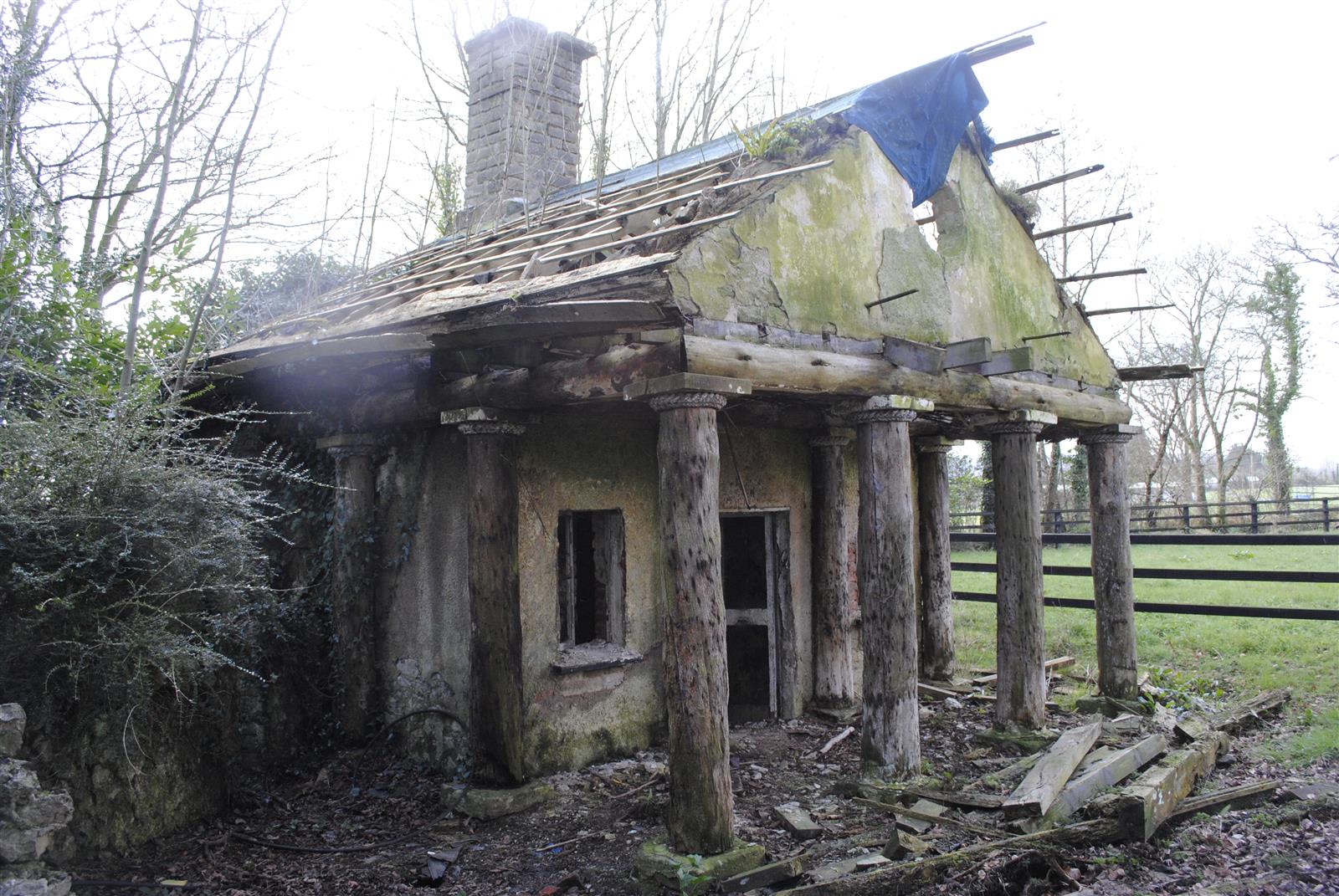
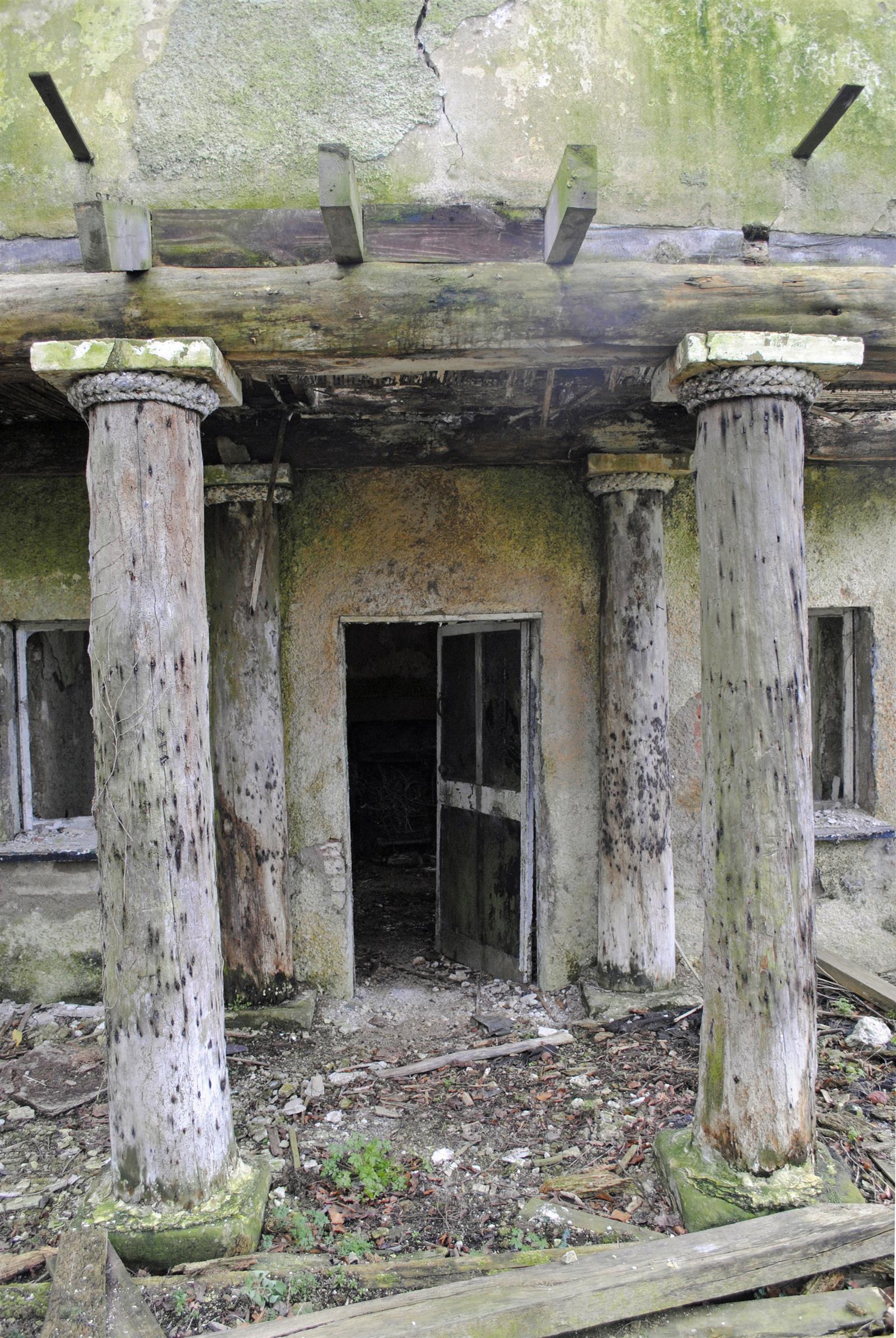
Finally we come to the smallest but perhaps most remarkable of Peter Walsh’s buildings: the temple lodge. Comprising portico, front room and two rear chambers, its precise date of construction and purpose are unclear; standing in the midst of the estate and not beside an entrance it was unlikely to have been a gate lodge but might have been intended as a summer pavilion or model dairy. But what is most important is that Belline’s temple lodge has been judged the earliest known example in Britain and Ireland of the 18th century ‘rustic hut’ inspired by theories on the origins of man-made structures expounded first in 1753 by the French Jesuit and philosopher Marc-Antoine Laugier in his Essai sur l’architecture (translated into English in 1755) and then by Sir William Chambers in A Treatise on the Decorative Part of Civil Architecture (1759). In fact it has sometimes been proposed that the Belline lodge was designed by Chambers since it shares similarities with a drawing he made in 1759 for just such a building. The identity of the architect responsible may never be known but we can be confident that the Belline lodge is an important expression of the 18th century’s interest in exploring the past, and that its composition reflects the ideas proposed by Laugier and Chambers. Hence the building is intentionally ‘primitive’ incorporating tree trunks bound with ropework on every side and a pedimented portico to the front below the gabled roof that extends beyond the walls to end in stone blocks.
Recent 3

Recent 2

Recent 1

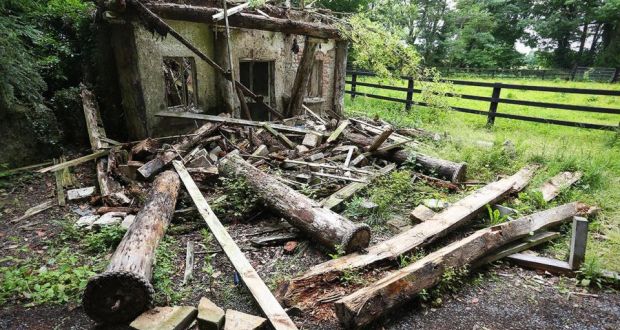
By the mid-19th century Belline had reverted to the Bessboroughs and remained in their ownership until 1934 after which the estate changed hands a number of times until being bought ten years ago for €3 million by businessman James Coleman. Managing director of a company called Suirway Forklifts based in Carrick-on-Suir, County Tipperary Mr Coleman has in the past declared himself a passionate enthusiast of motor rallying and indeed his business has sponsored a number of events for this sport. On the other hand, he seems less keen to support and sustain the national heritage, since over the past decade Belline’s temple lodge has fallen into such dilapidation that, as was reported by the Irish Times less than a fortnight ago, the building’s portico has now collapsed.
It is inconceivable that the lodge’s deteriorating condition was unknown to its owner: there have been two reports on the building and its importance, one compiled by architect John Redmill in 2005, the other by chartered surveyor Frank Keohane earlier this year. Furthermore the National Inventory of Architectural Heritage designated the lodge as being of architectural interest under the Categories of Special Interest. On the other hand as Frank Keohane noted in his report, to which I am much indebted, until now the lodge has not been designated a protected structure in its own right but rather ‘deemed to be protected owing to its being located within the cartilage of Belline House which is a protected structure.’ Clearly this has proven inadequate.
Keohane wisely makes the point that the lodge at Belline must be regarded as of international importance both in its own right and as part of a planned 18th century demesne in which diverse complementary elements contributed to the resultant whole. As he writes, ‘The temple lodge is not an artefact to be appreciated in isolation. It is in fact an important element in a group of related structures within the demesne.’ Destroy one of those related structures and you disrupt the entire picture: it is not unlike cutting a section out of a painting.
According to the Irish Times, John McCormack who is a Director of Services at Kilkenny County Council with responsibility for heritage said the authority had served a planning enforcement notice on Mr Coleman in May 2012 ‘for failing to undertake works to prevent this protected structure from becoming or continuing to be endangered.’ Legal proceedings commenced the following October and since then ‘there have been four separate court appearances in relation to this prosecution while the council sought to negotiate with the owner. A full hearing of the case is listed for October 7th next at Carrick-on-Suir District Court.’
One waits to see what will happen in four weeks’ time since not only is the survival of Belline’s temple lodge at stake but the forthcoming hearing represents something of a test case. If owners of protected structures can ignore their responsibilities with impunity, then still worse misfortunes lie ahead for our architectural heritage. The national patrimony is at risk in a way that would, one imagines, have appalled Peter Walsh.
The first two photographs show Belline’s temple lodge as it looked in the 19th century, note how at one time the building was thatched. The next three show the lodge in 2005, already with its slates removed from the roof, followed by another three photographs taken earlier this year. Finally below is a picture of the lodge as shown in the Irish Times with its portico in ruins.
image

Read All About It

IMG_2255

In the library at Russborough, County Wicklow an open page of James Malton’s A Picturesque and Descriptive View of the City of Dublin displayed in a Series of the most Interesting Scenes taken in the Year 1791. In 1799 Malton, an architectural draughtsman by training, published in a single volume his series of twenty-five engravings showing key buildings in the Irish capital, noting ‘The entire of the views were taken in 1791 by the author, who, being experienced in the drawing of architecture and perspective, has delineated every object with the utmost accuracy; the dimensions, too, of the structures described were taken by him from the originals, and may be depended upon for their correctness.’ Malton’s images remain one of our most important sources of information about the appearance of Dublin at the end of the 18th century.
For more about Russborough, see my article on the house in the September issue of American Elle Decor: http://www.elledecor.com/design-decorate/interiors/irish-heritage?click=main_sr#slide-1

Vanity of Vanities; All is Vanity

IMG_6043

Some buildings make better ruins than do others. But few look as splendid as Duckett’s Grove in County Carlow. Fantastically towered and turreted and castellated, the remains of this large house rise about the surrounding flat agricultural land, like some 19th century interpretation of a castle in the Très Riches Heures du Duc de Berry. Originally at the centre of a 12,000 acre estate the core of the structure is older, probably dating from the early 1700s and taking the form of a regular three-storey over basement, five-bay residence. Precise information about this building does not exist, but one may assume it was built for one of the first Ducketts to settle in this part of the world, perhaps Thomas Duckett who came from Grayrigg in Westmoreland and bought land here in 1695. He had the sense to marry an heiress, as did several of his successors with the result that the family grew ever-more prosperous, with an average annual income of £10,000. This wealth allowed John Dawson Duckett to embark on a transformation of the old house from 1818 onwards.

IMG_6006

IMG_6057

IMG_6055

For his architect, Duckett picked someone little known outside the immediate area, perhaps because he received so many commissions in County Carlow and its environs that he had no time to take on work further afield. This was Thomas Alfred Cobden, believed to have been born in Chichester in 1794. It is unknown how this young man came to be in Ireland, or how he came to be so much in demand in the Carlow/Wexford area where he designed churches (and even a cathedral) and public buildings as well as private houses, all in a variety of styles. But nothing else quite matches his work at Duckett’s Grove where, presumably at the request of the client, he let rip with almost every decorative motif available. The old house was smothered in a superfluity of turrets, crenellations, arches and niches, oriel windows and quatrefoil decoration before being further embellished with busts and urns and statuary, some of it attached to the building, some free-standing in the immediate grounds. Furthermore the structure was given what has been described as ‘wilful asymmetry’ through the addition of sundry towers, none of which correspond to the others in either shape or height. Further work was undertaken in the 1840s by another relatively obscure architect John Macduff Derick who designed the immense granite entrance gates to the estate as almost a castle in their own right. Given the style of this work, one wonders whether he was also responsible for the more rugged elements of Duckett’s Grove, those parts of the building (likewise in granite) which are Norman rather than High Gothic in inspiration?

IMG_6028

IMG_6031

IMG_6029

The history of Duckett’s Grove in the 20th century was not a happy one. John Dawson Duckett’s son William inherited the estate on his father’s death and although twice married he had no children. When he in turn died in 1908 he left everything to his second wife, Marie who had a daughter from her own first marriage but likewise no other offspring. By 1916 Marie Duckett had moved out of the house and moved to Dublin where her late husband had bought her a place, and thereafter Duckett’s Grove was looked after by an agent. Because the family had been good landlords, always permitting access to the gardens (until 1902 when they felt their hospitality was being exploited by visitors) and looking after their workforce, Duckett’s Grove suffered no damage during the War of Independence. But already a lot of the estate had been parcelled off for sale to former tenants, and in 1923 Marie Duckett disposed of the contents of Duckett’s Grove in a three-day auction. Even before then she had sold the house and remaining 1,300 acres to a group of local farmers who together took out a £32,000 loan. However, they quarrelled over its division and failed to repay the bank, so eventually the Land Commission assumed responsibility and divided up the land between another 48 small holders. Duckett’s Grove and its immediate 11 acres were acquired by a Carlow businessman in 1931 for £320. He demolished some of the outbuildings (stone from these was used to construct a new Christian Brothers school in Carlow town) but had not yet decided what to do with the house when it was mysteriously gutted by fire in April 1933.

IMG_6054

IMG_6003

IMG_5996

Marie Duckett does not appear to have been in any way troubled about the destruction of her late husband’s family home, perhaps because by this date she was already enmeshed in the delusions and squabbles that overwhelmed her last years (the story of her will, in which she effectively dispossessed her daughter, and of the court case after her death can easily be found elsewhere). For over seventy years Duckett’s Grove stood open to the elements and largely unprotected. Finally in 2005 Carlow County Council acquired the property and has since restored the old walled gardens, and installed various facilities in part of the old stables.
The main house remains a shell and frankly one wonders if in this instance that is not the best fate for the place. Duckett’s Grove, as overhauled in the 19th century, can never have been an object of much beauty. All that over-ornamentation, all those statues and busts and other decorative flourishes must have been somewhat excessive, redolent of the era’s likewise immoderately decorated interiors with their potted palms and red plush sofas and antimacassars. Stripped of the accretions Duckett’s Grove today possesses a grandeur that probably eluded it when still roofed and occupied. The line of towers on the skyline now has a greater dignity than was ever formerly the case. Duckett’s Grove was made to be a ruin, and as such it is rather splendid.

IMG_6094

The Comet’s Pulsing Rose

image

The Mussenden Temple erected in 1785 by Frederick Hervey, Bishop of Derry in memory of a deceased cousin. The temple is located in County Derry, the same part of the world in which poet Seamus Heaney was later born. A craftsman with words rather than with brick or stone, Seamus died yesterday and so this image commemorates his passing from our midst. He will be much missed by all of us fortunate to have known him.

Lost Horizon

belvoir by Kerr 2

Travelling along Belfast’s Outer Ring Road through the the Newtownbreda area one passes signs for Belvoir Park. The picture above, dating from 1805 and painted by Vice Admiral Lord Mark Kerr, shows a house of that name. Today the name is almost all that remains of what was once the largest private residence in this part of the country. An keen amateur watercolourist of some ability Lord Mark, the third son of the 5th Marquess of Lothian, enjoyed a successful career in the Royal Navy until 1805. His connection with Ireland came through marriage in 1799 to Lady Charlotte McDonnell who would later become Countess of Antrim in her own right. During the early 1800s the Kerrs stayed at Belvoir Park, which belonged to Lady Charlotte’s half-brother and it was during this period that Lord Mark painted this picture along with another, both of which were in the collection of the Knight of Glin until sold at Christie’s in 2009.

Belvoir 3a

???????????????????????????????

There are earlier, and finer, views of Belvoir Park, the first of which is shown immediately above. This is one of four oils painted by the artist Jonathan Fisher (fl. 1763 – d. 1809) at the request of the house’s then-owner Arthur Hill-Trevor, 1st Viscount Dungannon. Fisher is believed to have been born in the 1740s and to have spent some time in England, first coming to attention here in 1763 when he was awarded a premium for a landscape by the Dublin Society (he would receive another five years later). He exhibited some 57 pictures with the Society of Artists in Ireland between 1765 and 1780, including the four views of Belvoir which were shown in the organisation’s premises on South William Street, Dublin (now the headquarters of the Irish Georgian Society, see Restoration Drama, July 15th). The pictures are highly significant because they show us the house from different aspects when it was newly completed and before alterations were made towards the close of the 18th century. They also offer us views of the landscape around Belfast before the city had much expanded and show how lovely this region looked prior to the onset of the industrial revolution (the last of the pictures at the end of this post offers Fisher’s bucolic view of the area as it would have been seen from the house).

Belvoir 3b

Belvoir entrance to yard 1

Belvoir entrance to yard 2

Sir Moyses Hill was the first member of his family to settle in Ireland in the 1570s and it was his descendant Michael Hill who purchased for £2,000 the land on which stood Belvoir, then called Ballyenaghan, although the family’s main estate was at Hillsborough. Michael Hill’s wife Anne Trevor, subsequently married to Viscount Midleton, is reputed to have given the place its new name, in part owing to the view (‘Belle Vue’) and in part in recollection of Belvoir Castle, the Duke of Rutland’s seat in England where she had spent a large part of her childhood. Thanks to Lady Midleton, the property was inherited by her younger son Arthur who in 1766 was created Viscount Dungannon.
When Walter Harris published his survey of County Down in 1744 he described Belvoir as being ‘laid out lately in Taste; the Avenue is large and handsome, the Fruitery, from an irregular Glyn, is now disposed in regular Canals, with Cascades, Slopes and Terraces, and the Kitchin Ground inclosed with Espaliers, the best of the Gardens lying over the Lagan River, which is navigable to this Place. The Offices are finished, but the House not yet build.’ There does appear to have been a small residence on site but building work on something more splendid must have started soon afterwards. Even so when the indefatigable Mrs Delany came to stay in October 1758 she described it as a ‘charming place, a very good house, though not quite finished.’
Faced in brick, Belvoir Park’s main elevation looked north with views over the Lagan river and thence to the mountains beyond. This front was of seven bays, the three centre ones incorporating immense Ionic pilasters beneath a pediment with carved wooden mouldings. The entrance front faced west while the south side featured a canted bow. Belvoir Park is often attributed to Richard Castle, although if this were so it would have been a very late work since he died in 1751. He certainly designed the nearby Knockbreda Church for Lady Midleton (it can be seen to the left of the house in the first of Fisher’s pictures above). More recently the proposal has been made that a lesser known architect Christopher Myers was responsible for Belvoir Park.

Belvoir 3c

Belvoir just before being blown up

Following the first Lord Dungannon’s death in 1771, title and property alike passed to a young grandson (his only son having predeceased him by a year). The second viscount appears to have lived and entertained lavishly and as a result further work was undertaken on the house, notably by the addition of a third attic storey which can be seen in Lord Mark Kerr’s watercolour. In the mid-1790s Lord Dungannon moved to his Welsh estate and Belvoir Park was left unoccupied except by the agent, and by the Kerrs for a period. Eventually the entire place was sold in 1809 and after passing through various hands was acquired in 1818 by Belfast banker and landowner Robert Bateson around the time he became a baronet. He did much to improve the Belvoir, as did his son Sir Thomas Bateson (later first Lord Deramore) who around 1865 commissioned Newry architect William Barre to carry out some alterations to the house, including balustrades around the roof parapet and a balustraded entrance porch. At that stage the estate ran to more than 6,000 acres but decline set in soon after Lord Deramore’s death in 1890. Belvoir was let to various tenants but by this time Belfast was fast expanding and the land on which house and grounds stood just a few miles from the city centre was wanted for housing. In the 1920s part of the estate became a golf course while it was suggested the house become a residence for the Governor of Northern Ireland (ironically the Hill family’s former principle property, Hillsborough Castle, was instead selected). During the Second World War the site was used by the Admiralty, but from 1950 onwards the buildings started to fall into ruin. The succession of photographs seen here show the building in 1961 shortly before it was blown up by members of the army; today only parts of the old yard remain. 185 acres of the former estate are a forest park but the rest of the land is given over to suburban housing. The loss of Belvoir Park must be judged a grievous one but thankfully the paintings of Jonathan Fisher survive as evidence of this once-fine house. Privately owned, the pictures have been loaned for inclusion in an exhibition on Irish landscape art currently running at the Ulster Museum in Belfast.

Belvoir 3

Up and Away

IMG_5981

A view of the circular lantern at the top of the back stairs in Tullynally, County Westmeath. Dating from the early 19th century, this was probably designed by James Shiel as part of a programme of work intended to make the house more gothic in style. Yet there is nothing heavy or oppressive about the space. On the contrary, thanks to Shiel’s lightness of approach, the lantern seems not to sit upon but to hover effortlessly above the stairs.

Rather Arch

IMG_2492

The gothick drawing room at Grey Abbey, County Down. Dating from the early 1760s the main part of the house was built in the classical manner by William Montgomery. Following his death in September 1781 while leading British troops at the Battle of Groton Heights during the American War of Independence, the estate was inherited by his brother Hugh. In 1793 the latter married the Hon Emilia Ward, daughter of the first Viscount Bangor who lived on the other side of Strangford Lough at Castle Ward. This house is famous for its dual architecture and decoration: owing to the differing tastes of Lord and Lady bangor one half is in the classical style, the other in gothick. It would appear the Hon Emilia preferred her mother’s predilection and thus caused the redecoration of Grey Abbey’s drawing room.

Relishing the Society of Friends

IMG_5808

‘Our eyes were charmed with the sweetest bottom where, through lofty trees, we beheld a variety of pleasant dwellings. Through a road that looked like a fine terrace walk, we turn to this lovely vale, where Nature assisted by Art, gave us the utmost contentment. It is a colony of Quakers, called by the name of Ballitore.’ Thus wrote an unknown visitor to this part of County Kildare in 1748. Ballitore has long been an area where members of the Religious Society of Friends settled. The sect was established in the late 1640s by the English dissenter George Fox but its tenets quickly found a response in Ireland where the first recorded Friends meeting for worship took place in 1654 at a house in Lurgan, County Armagh belonging to William Edmundson.
Before converting to Quakerism and adopting its pacifist principles, he had been a member of Oliver Cromwell’s Parliamentarian Army, as was his almost exact contemporary Colonel John Fennell who like Edmundson moved from England to Ireland. In 1675 Edmundson’s diary records travelling from Wales and attending a meeting at Fennell’s Irish house: ‘The wind coming fair we put to sea again and landed at Cork where Friends were glad of my coming. When I had visited Friends’ meetings in that quarter, I went to John Fennell’s in company with several Friends, where we had a refreshing, heavenly meeting. Here divers Friends from Mountmellick and thereabouts came to meet me, in whose company I returned home, where I met with my wife and children in the same love of God that had made us willing to part one with another for a season for the Lord’s service and truth’s sake.’ By this time Edmundson was settled in Rosenallis, County Laois (not far from another Quaker settlement, the aforementioned Mountmellick) while Fennell had acquired land at Kilcommon on the outskirts of Cahir, County Tipperary.

IMG_5791

IMG_5794

Despite being in (quietly reflective) opposition to the established church and its practitioners accordingly incurring various penalties, Quakerism soon established a presence in Ireland. Already by 1660, the sect had some thirty meeting houses around the country and their numbers continued to grow through the remainder of the 17th and early years of the 18th centuries. Their minority status meant Quakers often gathered together in settlements such as that at Ballitore. The land on which the village stands was purchased in 1685 by two Quakers John Barcroft and Abel Strettel, supposedly after they had discovered the spot while resting their horse en route from Dublin to Cork. The first planned Quaker settlement in these islands, it quickly grew and some forty years later saw the foundation of a boarding school by the Yorkshire-born Abraham Shackleton. Although run on Quaker principles, it was open to children of all denominations and its most celebrated ex-pupil was the orator, statesman and philosopher Edmund Burke.

IMG_5798

IMG_5800

Not far from Ballitore stands Burtown, originally built for the Quaker Robert Power in 1710 and marked on early maps as Power’s Grove. The house’s original appearance was somewhat different to what can be seen today: of three bays but only one room deep, it seems to have had wings of which just a faint outline remains. In the second half of the 18th century, the property was extended to the rear, notably by the addition of two large bow-fronted rooms one above the other and linked by a splendid staircase accessed via a broad elliptical arch. It is surmised that the ground floor room was intended for dining: it has a charming arched alcove filled with plasterwork representing tendrils of grapevine and flanked by Corinthian-capped pilasters on which sit classical vases. The space seems made for a sideboard which would certainly support the dining room theory. Meanwhile the equally fine room directly above, although now serving as a bedroom, would originally have been a piano nobile drawing room.
Burtown’s plasterwork, probably the work of a travelling stuccadore offering what were then fashionable flourishes, is one of the house’s greatest delights. There is more of it found in the entrance hall, rather Wyatt’esque in style compared with that seen elsewhere in the house. The ceiling is mostly covered in a sequence of swags while the walls have small oval medallions and, a delightfully quirky detail, classical busts on brackets in each of the corners. More work took place to the house in the early 19th century when the front was given its fan-lighted door and the roof those deep eaves so typical of the period.

IMG_5829

IMG_5831

Traditionally Quakers were renowned for their plain living with all forms of ornamentation eschewed. Burtown’s decoration suggests its owners were perhaps not the strictest adherents of their faith; tellingly William James Fennell who inherited the property in 1890 and was a keen horseman, was ‘asked to leave the Quaker persuasion because of his fondness for driving a carriage with uniform flunkies on the back.’ William James was a direct descendant of Colonel John Fennell and came to live at Burtown through his mother, Jemima Wakefield. The Wakefields had married into the Haughton family who in turn had married members of the Power family, Burtown thus passing several times through the female line. Jemima Wakefield had not expected to come into the property until her brother died after being hit by a stray cricket ball; who knew the game could be so dangerous?
William James Fennell was the great-grandfather of Burtown’s present owner, photographer James Fennell who lives in the house with his wife Joanna and three children. The latest generation has added its own mark while preserving the property’s character and cherishing its history. In particular Burtown’s gardens, which are now open to the public, continue to be expanded and developed. Across three hundred years and four different but inter-related families Burtown has acquired a patina only possible provided there is sufficient time and care. As had that visitor to the area in 1748, today it is still possible to be charmed here when ‘through lofty trees, we beheld a variety of pleasant dwellings.’ Few such houses as Burtown remain in Ireland and it is therefore fortunate that the current owners bring such enthusiasm and commitment to the task of preserving the place into the future.

IMG_5857

For more information about Burtown and its gardens, see: http://www.burtownhouse.ie

It’s All in the Detail

IMG_3593

One of four large urns placed in niches on the first-floor inner landing at Castle Coole, County Fermanagh; two of them (including that shown here) double as stoves, Irish winters being pretty chilly. Although this does not feature, certain architectural details of Castle Coole and a number of other houses in this country are discussed in a recent essay by Calder Loth, Senior Architectural Historian for the Virginia Department of Historic Resources and Member of the Institute of Classical Classical Architecture & Art‘s Advisory Council. Calder was one of the group of ICAA members who toured Ireland last May and who I had the pleasure of meeting on several occasions. You can find his very informative and beautifully-illustrated piece at: http://blog.classicist.org/?p=6620

Knock Knock

IMG_5427

IMG_5453

The popularity of the gothic style for domestic buildings in early 19th century Ireland owed something to a desire among landed families to suggest longer residence here than was often actually the case. The Levinges, for example, only came to this country in the aftermath of the Williamite Wars when the Derbyshire-born lawyer William Levinge was appointed Irish Solicitor-General and Speaker of the House of Commons; he later became Attorney-General and Lord Chief Justice. As a reward for his services, in 1704 he received a baronetcy and duly became Sir Richard Levinge of High Park in the County of Westmeath.
Today the property is known as Knockdrin, built close to a late mediaeval castle once belonging to the Tuite family; it was their lands that Sir Richard acquired and on which he built a new house. However by the early 19th century this had fallen into disrepair and so the sixth baronet, also called Sir Richard Levinge, embarked on a rebuilding programme that would give him a splendid gothic castle and all the links with an ancient past this implied.

IMG_5406

IMG_5402

IMG_5408

It is not known for certain who was responsible for the design of Knockdrin Castle. Sir Richard Morrison produced a design for the entrance front but while elements of this were incorporated into the eventual building it cannot be attributed to him. Instead Knockdrin is assigned to James Shiel, believed to have trained in the office of Francis Johnston an architect who created some of the finest gothic revival castles in Ireland, not least Charleville, County Offaly. Like Charleville, Knockdrin’s late-mediaeval trappings are lightly worn: this is essentially a Georgian country house in fancy dress. The entrance front presents a degree of asymmetry, primarily thanks to a long castellated curtain wall leading to a two-storey gatehouse providing access to the service courtyard. But the battlemented main block, of rubble limestone with dressed window surrounds and featuring a wide fanlit doorway flanked by square towers, has only superficial quirks, such as a slim turret on the south corner. And notice how standard rectangular sash windows are used on the upper storeys.

IMG_5380

IMG_5377

IMG_5390

A similarly familiar sense of order can be found inside where once more the usual forms are followed, albeit decked out in gothic flummery. As in so many Irish houses the rear of the entrance hall has a screen but in this instance it is composed of three pointed arches supported on slender cluster-shafted columns. Doors to either side open onto the library and dining room (the latter now regrettably divided in two). But another door provides access to Knockdrin’s most striking feature: a top-lit staircase with the stairs (like the doors throughout the building) made of carved oak. The elaborate first floor is decorated with a gallery of fluted shafts and sequence of ogee-headed niches around the walls. Abundant light provided by a central glazed dome helps to create a fluid, elegant space possessing none of the heaviness customarily associated with the Gothic Revival movement. On the other hand, despite high ceilings emblazoned with plasterwork of Tudor roses and the like, the enfilade of ground floor reception rooms – ballroom, drawing room, library – is less distinguished, although a line of full-length, south-facing windows means that like the staircase hall they are exceptionally bright.

IMG_5350

IMG_5340

IMG_5342

Knockdrin remained in the possession of the Levinge family until the last century. Within weeks of the outbreak of the First World War the tenth baronet, another Sir Richard Levinge, was dead after being hit in the neck by a bullet as he walked along a trench at Ypres. His widow and only son moved to England and the house was let to various tenants; at one point it served as a school and in the early 1940s was occupied by members of the Irish army who inevitably inflicted a certain amount of damage on the building. Finally in 1943, the greater part of the estate having already been broken up by the Land Commission, the castle and surrounding land was sold by the Levinges, thereby ending a link of almost 250 years. The present owners bought the place in 1961 and have cared for it ever since. One should not try to make exaggerated claims for Knockdrin. It is certainly not a house of the first importance, but can be considered noteworthy as an example of the transition from classicism to gothic, when the latter was still a style and not yet an ideology and the former’s principles survive beneath a veneer of ornamentation. Below is a portrait of Sir Richard, the sixth baronet who commissioned the house. The picture was painted by the minor English artist Thomas Shew in 1828 and includes a view of Knockdrin, presumably imaginary since Shew never came to Ireland.

IMG_5393

IMG_5417