Faith of Our Fathers

IMG_4275

In his 1997 book Grace’s Card, the late Charles Chenevix Trench debunked the notion that after the passage of Penal Laws at the start of the 18th century all Irish landowners who remained loyal to the Roman Catholic faith were deprived of their property. Certainly a great many members of the old order were dispossessed of their land, and often left the country as a result. But this was by no means always the case; in fact, as Trench demonstrates, some families were able to hold onto their ancient estates and even improve their circumstances through advantageous marriage, even though they were not permitted to hold public office or sit in the Irish Houses of Parliament. Having a single heir was certainly helpful: where there were several male children born into the same family, it was possible one of them would join the Established Church and then make claim to the estate. This happened, for example, with the O’Conors of Balanagare: in 1777 the then-O’Conor Don, Charles – a notable antiquarian – found himself fighting for retention of the family property after his younger brother Hugh became an Anglican (in the end Charles won, and Hugh returned to Catholicism). But there are many other instances of families remaining firmly in possession of their land, such being the case in Meath with the Prestons (as Gormanston Ireland’s premier Viscountcy) and Plunkett (as Fingall Ireland’s premier Earldom). Both these old estates are now broken up but in a neighbouring county another family continues to practise the faith of its forebears and to hold onto some of its ancestral lands.

IMG_6708

IMG_6730

Ballinlough Castle, County Westmeath has been rightly described as offering ‘all that anyone might hope for in an Irish country house. A wooded lakeside setting, a charming and eccentric house of several building periods and a family history of distinction.’ To begin with the family, originally their surname was O’Reilly and they have lived in this spot since the Middle Ages. In 1795 Hugh O’Reilly, despite being a Roman Catholic, was created a baronet but then in 1812 he changed his name to Nugent in order to receive an inheritance from his maternal uncle. It would seem not everyone approved of this switch of nomenclature, since the phrase went around, ‘Better an Old Reilly than a New Gent.’ Nevertheless ever since the family has been called Nugent.
As for their house, high above the main entrance can be seen a carving of the O’Reilly coat of arms carrying the date 1614 but this is considered not to be accurate. It may be that the original southernmost section of the castle is older, perhaps a late-Mediaevel fortified tower although subsequent changes make it hard to assign precise dates to this part of the building. In any case, the block looks to have been modernised in the first half of the 18th century when it was transformed into a two-storey, seven bay house with breakfront centre. At the same time long narrow windows were inserted and larger rooms created inside.

IMG_6710

IMG_6720

Around 1790 the previously mentioned Hugh O’Reilly chose to enlarge the house by adding a central attic with castellations to the old block and then a range immediately to the north featuring slender corner towers. As is ever the case in Ireland, we cannot be certain who was responsible for the design: a chimney piece in the drawing room is identical to one in Curraghmore, County Waterford known to have been the work of James Wyatt, so his name is sometimes proposed as architect. More frequently however the extension at Ballinlough is attributed to an amateur enthusiast called Thomas Wogan Browne who lived at Castle Browne, County Kildare, which from 1788 he had elaborately reconstructed in the gothic style. Two years after his death in 1812, Castle Browne was sold by Wogan Browne’s brother (a Roman Catholic and general in the army of the King of Saxony) to the Jesuit Order which opened there a boarding school for boys known ever since as Clongowes Wood College.
The extension at Ballinlough bears similarities with similar work carried out around the same time at Malahide Castle, County Dublin; the latter property was then occupied by Hugh O’Reilly’s sister Margaret who would later be created Baroness Talbot of Malahide. Hogan Browne is believed to have been the designer of this, and therefore Ballinlough’s extension is likewise attributed to him.

IMG_6736

IMG_6738

While the rooms in the newer section of Ballinlough are certainly very fine (and will be given consideration here on another occasion) all today’s photographs are of one particular area of the house: its glorious double-height entrance hall with stairs climbing to an unusual bridge gallery. Presumably dating from around the time the building received its first refurbishment, the decoration is exuberant if on occasion somewhat unsophisticated, as though whoever was in charge had discovered a manual on current taste in design and applied its contents liberally throughout. This is part of the hall’s charm: its sheer gusto. The oak panelling is relatively restrained – note the exceptionaly tall and slender lugged door and window frames – but a freer hand has been employed for the carving on the stairs with their fluted balusters and foliate scrolls on both sides of the gallery base. This work is supplemented on the upper sections of the walls, the plasterwork embellished by swags and drapes of foliage and flowers and diverse musical instruments. In this instance, Casey and Rowan in their Buildings of Ireland guide to North Leinster reference similarities to nearby Drewstown, County Meath which is attributed to Francis Bindon but perhaps Ballinlough’s entrance hall was merely influenced by what had been done in the former house rather than designed by the same person.

IMG_6742

IMG_6772

As all these images indicate, Ballinlough Castle survives in wonderful condition but the house was almost lost in the last century. When Sir Hugh Nugent inherited the estate in 1927 he found it in poor condition and much reduced in size by the Land Commission which proposed to demolish the family home. Fortunately this did not come to pass and today Ballinlough is occupied by the eighth baronet, Nick along with his wife Alice and their children. They host a variety of events on the estate during the year, not least the highly successful Body & Soul Festival each summer.
To conclude with one more picture, the portrait reflected in a mirror below hangs on the stairs at Ballinlough and represents George Nugent-Temple-Grenville, 1st Marquess of Buckingham who in the 1780s served as Lord Lieutenant of Ireland and while in this country established by Royal Warrant the Order of St Patrick. His wife was Lady Mary Nugent, who as her name indicates was related to the family at Ballinlough. A Roman Catholic, in 1798 Lady Mary invited the Reverend Charles O’Conor to become her chaplain and librarian at Stowe, her husband’s seat in Buckinghamshire. Fr Charles was the grandson of the Charles O’Conor already mentioned. He was also brother of another O’Conor Don, Matthew another notable historian and, like the Nugents of Ballinlough, a loyal adherent to the faith of his fathers.

IMG_6782

For more information on Ballinlough, see: http://www.ballinloughcastle.ie
Ballinlough will be hosting the third Katie Nugent Duathlon on Sunday October 20th. To sign up or to find out more information about this event, see: http://precisiontiming.primo-solutions.co.uk/ps/event/KatieNugentDuathlon2013

The Wall of China

IMG_7024

A view of the contents of a cabinet in the dining room at Borris House, County Carlow. Diffused light through windows to the left disposes a radiance over an assortment of bowls, plates and vases displayed on the mahogany shelves. More on Borris in a few weeks’ hence.
And in other news, The Irish Aesthete has been included amongst the finalists for Ireland’s 2013 Blog Awards in two categories: Best Arts & Culture, and Best Newcomer. The winners will be announced on October 12th next.

The Luck of the Barrys

image

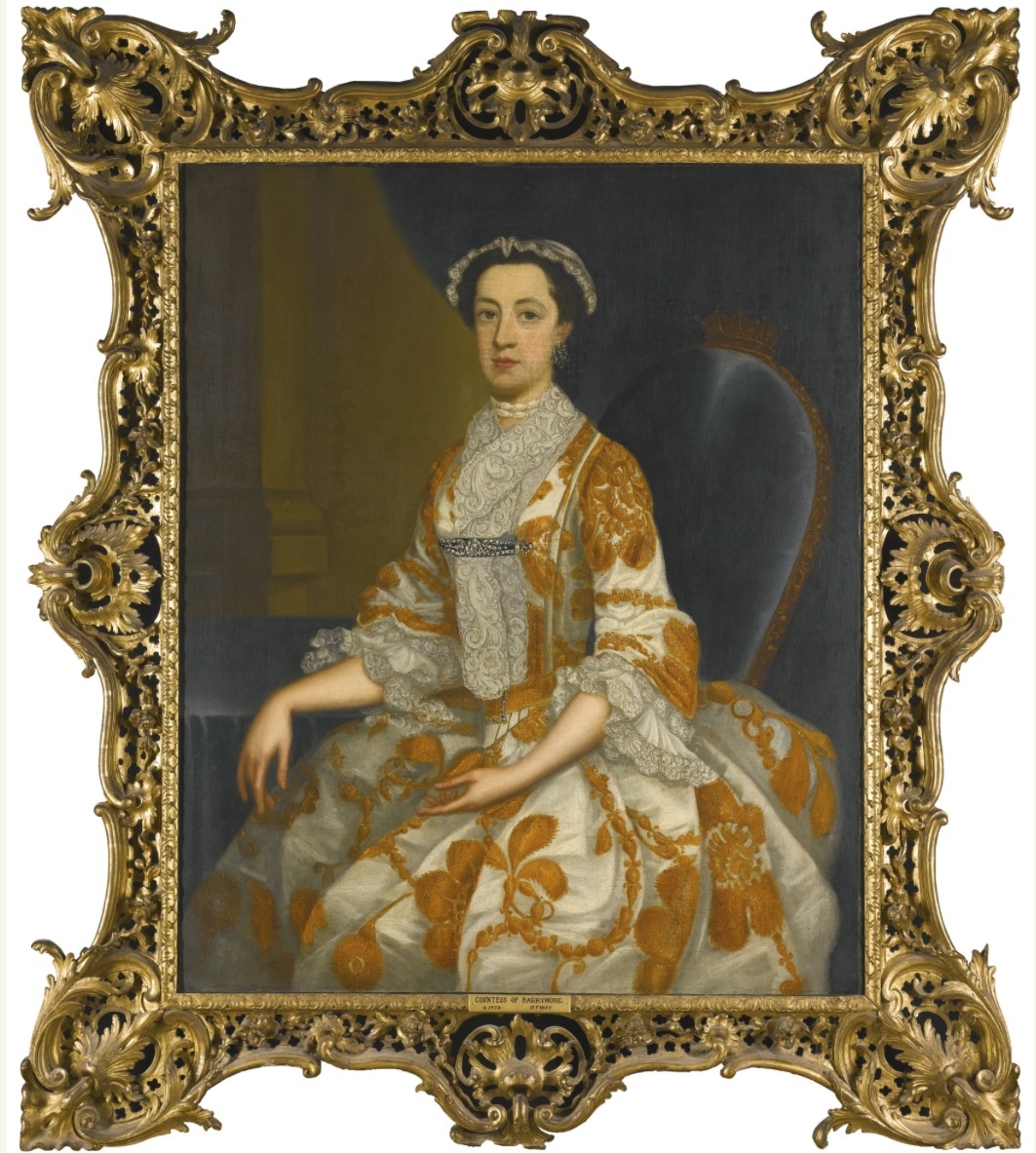
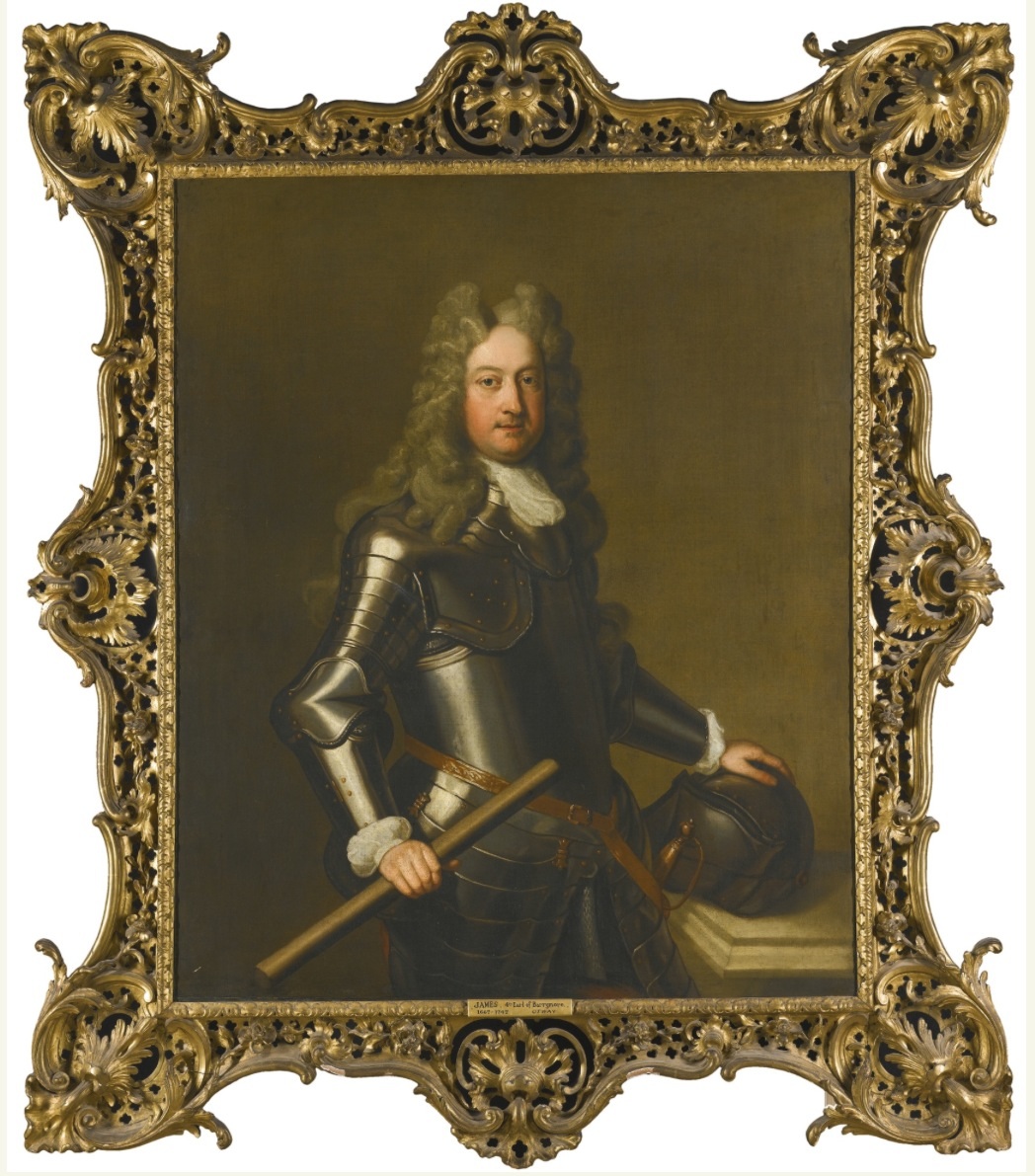
These two portraits of James Barry, fourth Earl of Barrymore and his third wife Lady Anne Chichester are being offered for sale today at Sotheby’s in London. The Barrys were an old, but relatively impoverished Irish family although their finances were greatly improved by the fourth Earl making a succession of advantageous marriages. In the later 18th century they also became noted for their eccentricity: the seventh (and penultimate) Earl who died at the age of 23 in 1793 was one of the period’s most infamous rakes, commonly known as ‘Hellgate.’ (His sister was nicknamed ‘Billingsgate’ owing to her dreadful language, while his younger brothers were respectively called ‘Cripplegate’ due to a club foot and ‘Newgate’ since, as it was a women’s prison, he had never spent time there; in 1791 James Gillray produced a splendid caricature of the three men mocking their various distinctive characteristics). Their rackety lives were not dissimilar from that of another man with the same surname, Redmond Barry, eponymous hero of Thackeray’s 1844 picaresque novel The Luck of Barry Lyndon, and like him they all ended badly.
Meanwhile descendants of the fourth Earl’s fourth son became Smith Barrys and inherited a large estate on Fota Island, County Cork at the centre of which stood what was originally a hunting lodge. This building was enlarged and embellished c.1820 to the designs of Sir Richard Morrison and his son William Vitruvius Morrison. In their charming George II rococo fames, the two portraits (that above judged to be from the studio of Sir Godfrey Kneller, that below attributed to Philip Hussey) formerly hung in Fota House which today is managed by the Irish Heritage Trust and open to the public. How wonderful it would be if this tale concluded better than did that of the Barrys, and after today the portraits once more returned to the house…

image

Update: on Tuesday, 24th September the two portraits sold for ₤60,000 and ₤43,750 respectively.

Bon anniversaire

image

In 1970 the early 18th century Damer House in Roscrea, County Tipperary stood empty and unused, and plans were announced to demolish the building; the local authority intended to replace the house with an amenity centre comprising swimming pool, car park, playground and civic centre. North Tipperary County Council chairman Tom Shanahan justified this proposal with the argument that as long as the house stood, ‘it reminds the Irish people of their enslavement to British rule’ and dismissed objectors to the scheme as ‘a crowd of local cranks.’ The notion that Damer House represented the outstanding qualities of Georgian craftsmanship, or that it might be a major tourist attraction for the area clearly never occurred to Mr Shanahan.
Both these factors have since come to be understood, but four decades ago, the building’s inherent worth was grossly under-appreciated. Damer House dates from the 1720s and is believed to have been built for John Damer soon after he bought the town of Roscrea in 1722. Damer’s uncle, Joseph Damer, originally from Dorset, settled in Ireland in the aftermath of Charles II’s restoration in 1660 and prospered as a Dublin moneylender, to the extent that he was able to purchase estates in North Tipperary. Having no children of his own, he brought over his nephew John both to assist him in the business and to inherit his wealth.

image

image

Damer House is unusual in that it stands in the centre of a 13th century castle on which work commenced during the reign of King John although the present structure is of a slightly later date; it survives largely intact, not least the immense gate tower rising more than 90 feet with walls some eight feet thick. This castle was under the control of the Butler family, if only sometimes theoretically, until 1703 when the second Duke of Ormonde sold his Roscrea territory to the King’s Hospital in Kilmainham; less than twenty years later the place was sold again, this time to John Damer whose uncle had since died and left him extremely wealthy. Given that peace had only recently come to the country, one can understand why Roscrea’s latest owner might have thought it best to build his new residence within the protective walls of the castle, but he and his descendants do not seem to have spent much time there, since they also developed a large estate elsewhere in the county and, following John Damer’s own death without direct heirs, his nephew – another Joseph Damer – preferred to live in England where in 1792 he was created first Earl of Dorchester; in the following century Damer House passed into the hands of another branch of the family, the Dawson-Damers who were Earls of Portarlington and whose main seat was Emo Court, County Laois. Meanwhile the house in Roscrea became an army barracks, then at the start of the last century successively a school, a tuberculosis sanatorium and a local library.

image

image

Of three storeys over basement and with unusually tall narrow windows spread across nine bays, the pre-Palladian Damer House has a large annexe to one side, probably added during its time as a military barracks. Internally the finest extant feature is a carved pine staircase, in style not dissimilar to that of the slightly later Cashel Palace. Whatever other decorative features the Damers may have commissioned did not survive changes of use, but the building retains a purity of form that makes it of enormous importance in the history of Irish architecture.
Yet by the early 1970s Damer House was suffering from the consequences of long-term neglect, hence the local authority’s proposal to sweep it away rather than engage in a programme of restoration. Fortunately at this point the Irish Georgian Society then intervened and offered to take over the building on a lease and assume responsibility for its salvation. Work on this project began in August 1974 and was overseen by one of the IGS’s most industrious and committed members, Brian Molloy whose death four years later is still to be regretted. Much of the work was undertaken by volunteers who cleared away accumulated rubbish and debris, and removed unsightly additions to the house such as partition walls while professionals worked on repairing the roof and so forth. In 1976 the early 18th century carved pine staircase, which was coated in centuries of paint, was cleaned and restored to its original splendour and the following year the house was officially opened to the public.
With aid from a number of public bodies, the house’s annexe was next restored for use as a heritage centre; the first of its kind in Ireland, this opened to the public in 1983 and shortly afterwards won a special award from the adjudicators of European Museum of the Year. At the end of that year, control of Damer House was handed over to the Roscrea Heritage Society which later in turn leased the premises to the Irish State; by this means Damer House’s future has been secured. During the 1990s more work was completed not just on the house, but also on Roscrea Castle and its gardens. Today the entire complex has been refurbished and welcomes visitors.

image

image

image

Aside from its evident merits, Damer House is personally special because in 1983 my first job after university was to act as curator of the building, contentedly living in a first-floor flat on the premises (those two windows furthest right on the first floor were my bedroom) and gaining knowledge that has proven invaluable ever since; this month marks the thirtieth anniversary of my taking up that position.
Meanwhile this week marks the first anniversary of the advent of The Irish Aesthete. It has been a fascinating year in which I have likewise learnt an enormous amount (and become something of a proselytiser on behalf of social media). I should like to thank all those who have been following the site for the twelve months past and hope that you will continue to do so for the twelve ahead during which there will be abundant opportunities to explore further Ireland’s architectural heritage. Comments and enquiries are always welcome, as are suggestions of where else might be discussed; every writer needs readers and I am most appreciative of anyone who has taken the trouble to participate in and engage with The Irish Aesthete since September 2012.
It is also worth noting that The Irish Aesthete has been short-listed for the 2013 Ireland Blog Awards in two categories: Best Arts and Culture and Best Newcomer. Finalists will be announced next week.
In conclusion, today provides an opportunity to remember Brian Molloy the twenty-fifth anniversary of whose death fell recently and whose dedication to the causes many of us hold dear remains an inspiration.

image

London Calling

image

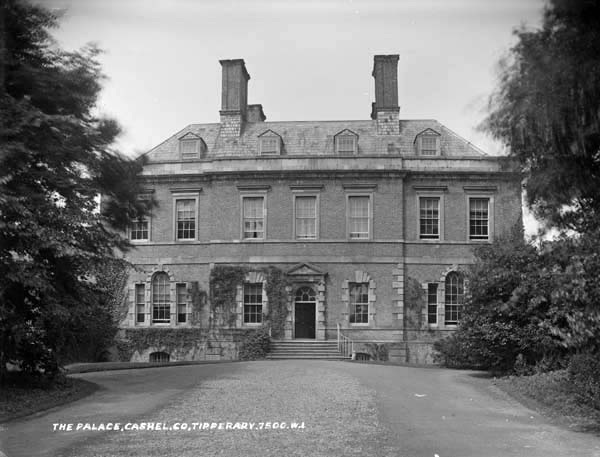
A view of the former Archbishop’s Palace in Cashel, County Tipperary. Now an hotel, the palace was built c.1732 for Theophilus Bolton, its design usually credited to Sir Edward Lovett Pearce. For those in London next Monday evening 23rd September, I will be offering the Irish viewpoint at an event organised by the National Trust and Apollo magazine to consider contemporary perspectives on the English country house. For further information, see: http://events.spectator.co.uk/nationaltrust.html

Read All About It

IMG_2255

In the library at Russborough, County Wicklow an open page of James Malton’s A Picturesque and Descriptive View of the City of Dublin displayed in a Series of the most Interesting Scenes taken in the Year 1791. In 1799 Malton, an architectural draughtsman by training, published in a single volume his series of twenty-five engravings showing key buildings in the Irish capital, noting ‘The entire of the views were taken in 1791 by the author, who, being experienced in the drawing of architecture and perspective, has delineated every object with the utmost accuracy; the dimensions, too, of the structures described were taken by him from the originals, and may be depended upon for their correctness.’ Malton’s images remain one of our most important sources of information about the appearance of Dublin at the end of the 18th century.
For more about Russborough, see my article on the house in the September issue of American Elle Decor: http://www.elledecor.com/design-decorate/interiors/irish-heritage?click=main_sr#slide-1

Vanity of Vanities; All is Vanity

IMG_6043

Some buildings make better ruins than do others. But few look as splendid as Duckett’s Grove in County Carlow. Fantastically towered and turreted and castellated, the remains of this large house rise about the surrounding flat agricultural land, like some 19th century interpretation of a castle in the Très Riches Heures du Duc de Berry. Originally at the centre of a 12,000 acre estate the core of the structure is older, probably dating from the early 1700s and taking the form of a regular three-storey over basement, five-bay residence. Precise information about this building does not exist, but one may assume it was built for one of the first Ducketts to settle in this part of the world, perhaps Thomas Duckett who came from Grayrigg in Westmoreland and bought land here in 1695. He had the sense to marry an heiress, as did several of his successors with the result that the family grew ever-more prosperous, with an average annual income of £10,000. This wealth allowed John Dawson Duckett to embark on a transformation of the old house from 1818 onwards.

IMG_6006

IMG_6057

IMG_6055

For his architect, Duckett picked someone little known outside the immediate area, perhaps because he received so many commissions in County Carlow and its environs that he had no time to take on work further afield. This was Thomas Alfred Cobden, believed to have been born in Chichester in 1794. It is unknown how this young man came to be in Ireland, or how he came to be so much in demand in the Carlow/Wexford area where he designed churches (and even a cathedral) and public buildings as well as private houses, all in a variety of styles. But nothing else quite matches his work at Duckett’s Grove where, presumably at the request of the client, he let rip with almost every decorative motif available. The old house was smothered in a superfluity of turrets, crenellations, arches and niches, oriel windows and quatrefoil decoration before being further embellished with busts and urns and statuary, some of it attached to the building, some free-standing in the immediate grounds. Furthermore the structure was given what has been described as ‘wilful asymmetry’ through the addition of sundry towers, none of which correspond to the others in either shape or height. Further work was undertaken in the 1840s by another relatively obscure architect John Macduff Derick who designed the immense granite entrance gates to the estate as almost a castle in their own right. Given the style of this work, one wonders whether he was also responsible for the more rugged elements of Duckett’s Grove, those parts of the building (likewise in granite) which are Norman rather than High Gothic in inspiration?

IMG_6028

IMG_6031

IMG_6029

The history of Duckett’s Grove in the 20th century was not a happy one. John Dawson Duckett’s son William inherited the estate on his father’s death and although twice married he had no children. When he in turn died in 1908 he left everything to his second wife, Marie who had a daughter from her own first marriage but likewise no other offspring. By 1916 Marie Duckett had moved out of the house and moved to Dublin where her late husband had bought her a place, and thereafter Duckett’s Grove was looked after by an agent. Because the family had been good landlords, always permitting access to the gardens (until 1902 when they felt their hospitality was being exploited by visitors) and looking after their workforce, Duckett’s Grove suffered no damage during the War of Independence. But already a lot of the estate had been parcelled off for sale to former tenants, and in 1923 Marie Duckett disposed of the contents of Duckett’s Grove in a three-day auction. Even before then she had sold the house and remaining 1,300 acres to a group of local farmers who together took out a £32,000 loan. However, they quarrelled over its division and failed to repay the bank, so eventually the Land Commission assumed responsibility and divided up the land between another 48 small holders. Duckett’s Grove and its immediate 11 acres were acquired by a Carlow businessman in 1931 for £320. He demolished some of the outbuildings (stone from these was used to construct a new Christian Brothers school in Carlow town) but had not yet decided what to do with the house when it was mysteriously gutted by fire in April 1933.

IMG_6054

IMG_6003

IMG_5996

Marie Duckett does not appear to have been in any way troubled about the destruction of her late husband’s family home, perhaps because by this date she was already enmeshed in the delusions and squabbles that overwhelmed her last years (the story of her will, in which she effectively dispossessed her daughter, and of the court case after her death can easily be found elsewhere). For over seventy years Duckett’s Grove stood open to the elements and largely unprotected. Finally in 2005 Carlow County Council acquired the property and has since restored the old walled gardens, and installed various facilities in part of the old stables.
The main house remains a shell and frankly one wonders if in this instance that is not the best fate for the place. Duckett’s Grove, as overhauled in the 19th century, can never have been an object of much beauty. All that over-ornamentation, all those statues and busts and other decorative flourishes must have been somewhat excessive, redolent of the era’s likewise immoderately decorated interiors with their potted palms and red plush sofas and antimacassars. Stripped of the accretions Duckett’s Grove today possesses a grandeur that probably eluded it when still roofed and occupied. The line of towers on the skyline now has a greater dignity than was ever formerly the case. Duckett’s Grove was made to be a ruin, and as such it is rather splendid.

IMG_6094

A Whiter Shade of Pale

IMG_6315

It cannot be claimed that in the 17th and 18th centuries, Ireland’s senior Anglican clergy devoted themselves exclusively to matters religious. Indeed, they were often more preoccupied with politics and the acquisition of material goods than with spirituality, but in at least some instances we are today all the beneficiaries of their activities in these fields. The man who might be said to have set the tone for what followed in the Church of Ireland was Adam Loftus. Born in Yorkshire in 1533, apparently while still an undergraduate at Trinity College, Cambridge he met and impressed Queen Elizabeth and thereafter enjoyed her patronage. Embracing Protestantism, he began to climb through the ranks of the Anglican Church but only really achieved power after serving as chaplain to Thomas Radclyffe, Earl of Sussex following the latter’s appointment as Lord-Lieutenant of Ireland in 1559. By 1561 Loftus was chaplain to the Bishop of Kildare and the same year was appointed to his first living. Thereafter his rise was rapid: in 1563 he was consecrated Archbishop of Armagh at the age of only 28, swapping this four years later for the Archbishopric of Dublin. In 1581 he was appointed Lord Chancellor of Ireland and then strove to ensure that the country’s first university would be located on a site of his choosing: in 1593 he became the first Provost of Trinity College, Dublin, named after his old alma mater. Meanwhile in addition to building up his political as well as ecclesiastical authority, he was acquiring land so as to leave something for his heirs: he and his wife had twenty children, of whom eight died in infancy.

IMG_6219

IMG_6279

IMG_6218

One of the parcels of land which came into Loftus’s possession was located at Rathfarnham at the foothills of the Dublin mountains, confiscated from James Eustace, 3rd Viscount Baltinglass after he had rebelled against the crown. A castle of some kind existed on the site but soon after Loftus was granted Rathfarnham in 1583 at a nominal rent of thirty shillings he began work on a new residence, which remains to the present day. Although the interiors were said to have been luxurious, the castle’s external appearance was very much defensive being rectangular in shape with four massive corner flanking towers to allow guards watch for any approach to the building. Four storeys high,its walls are on average some five feet thick and running east-west through the centre of the entire castle is another wall almost ten feet thick: this seems solid but it is now proposed that in fact the wall actually held a series of chambers or corridors from which access was gained to rooms on either side. Nevertheless, Loftus was right to construct such a solid building since its location left Rathfarnham vulnerable to attack from the Wicklow clans. Five years before his death in 1605 it withstood assault from this source, and did so again during the 1641 rebellion before passing back and forth between different sides in the Irish Confederate Wars. It was only towards the late 1650s that the Loftus family was able to regain control of the place.

IMG_6184

IMG_6216

IMG_6172

In the early 18th century Rathfarnham passed to Philip Wharton, who at the age of 19 was created first (and last) Duke of Wharton by George I; Wharton’s mother had been Lucy Loftus, only child of Adam Loftus, Viscount Lisburne. Wharton seems to have been a hopelessly character. His father Thomas Wharton although notoriously dissipated was at least politically astute and one of the leaders of the opposition to James II. Philip Wharton on the other hand, despite having every advantage, set out on a course of ruination that saw him end his days a hopeless drunk in a Spanish monastery, dead at the age of 32. In 1723 indebtedness caused by over-investment in the South Sea Bubble obliged him to sell his Irish estates including Rathfarnham which was bought by William Conolly, Speaker of the Irish House of Commons. He paid £62,000 for house and lands but never lived there, presumably because he had already begun work on his own house at Castletown, County Kildare (see Up Pompeii, June 17th). Instead the castle was let to various tenants who began to refurbish it before the whole place was sold in 1742 to another Anglican cleric, John Hoadly who had just been made Archbishop of Armagh. On his death Rathfarnham passed to Hoadly’s son-in-law Bellingham Boyle but like Philip Wharton he also suffered from chronic indebtedness and so in 1767 Rathfarnham was sold to Nicholas Hume-Loftus, second Earl of Ely, a descendant of the castle’s original builder. On his death without children it was inherited by his uncle Henry Loftus who also had no issue (compared to their forebear with his twenty offspring, these later Loftuses proved to be an unfecund set) and so Rathfarnham was inherited by a nephew Charles Tottenham who in 1800 would become first Marquess of Ely.

IMG_6179

IMG_6178

IMG_6248

The Elys, who owned several estates, spent little time at Rathfarnham which at some date before 1852 was sold to Francis Blackburne, then Lord Chancellor of Ireland; he and his descendants lived there until 1913 when the place was bought by the Jesuit Order who used it as a seminary and added two long wings on the north- and south-east sides of the main building (they also seem to have taken out the main staircase which is a great shame). The Jesuits in turn put the place up for sale in the mid-1980s when it was bought by a firm of property developers. As the area by this date had become a suburb of Dublin and much of the immediately surrounding land was given over to housing estates, there were concerns that the castle itself would be left to fall into ruin or pulled down. In 1987 the Irish State acquired the building and immediate acreage and under the auspices of the Office of Public Works has been engaged in a process of restoration and refurbishment ever since (see http://www.heritageireland.ie/en/Dublin/RathfarnhamCastle).
There is a great deal more one could write about Rathfarnham Castle, and perhaps might on another occasion. For the present, the accompanying photographs will give an idea of a notable feature of the building which attracts relatively little notice: its fine plasterwork. Throughout the 18th century a succession of different owners and occupiers did much to improve and update the building, and its interiors reflect changes in taste over that period. Different rooms are decorated in different styles, so that the whole castle becomes a history of fashion in stuccowork, ranging from the lightest rococo to severe neo-classicism (both Sir William Chambers and James ‘Athenian’ Stuart had a hand in the design of some of the interiors). All of it is of high quality and serves as an example of the level of Irish craftsmanship – and the ability to adapt to an evolving clientele – throughout the period. It is a pity more is not made of this aspect of the building since Rathfarnham Castle’s diverse decoration gives it a unique character and deserves to be celebrated. Hence the decision to feature only details of the house’s plasterwork today.

IMG_6198

Next Saturday morning, I shall be speaking about Adam Loftus, as well as many of his successors, in the course of a talk entitled ‘Building Bishops: Architectural Ambitions among 18th Century Irish Clergy’ at the Roe Valley Arts and Cultural Centre in Limavady, County Derry as part of a three-day conference devoted to Frederick Hervey, the great Earl-Bishop of Derry. For more information about this event, see: http://www.herveysummerschool.com/

Lost Horizon

belvoir by Kerr 2

Travelling along Belfast’s Outer Ring Road through the the Newtownbreda area one passes signs for Belvoir Park. The picture above, dating from 1805 and painted by Vice Admiral Lord Mark Kerr, shows a house of that name. Today the name is almost all that remains of what was once the largest private residence in this part of the country. An keen amateur watercolourist of some ability Lord Mark, the third son of the 5th Marquess of Lothian, enjoyed a successful career in the Royal Navy until 1805. His connection with Ireland came through marriage in 1799 to Lady Charlotte McDonnell who would later become Countess of Antrim in her own right. During the early 1800s the Kerrs stayed at Belvoir Park, which belonged to Lady Charlotte’s half-brother and it was during this period that Lord Mark painted this picture along with another, both of which were in the collection of the Knight of Glin until sold at Christie’s in 2009.

Belvoir 3a

???????????????????????????????

There are earlier, and finer, views of Belvoir Park, the first of which is shown immediately above. This is one of four oils painted by the artist Jonathan Fisher (fl. 1763 – d. 1809) at the request of the house’s then-owner Arthur Hill-Trevor, 1st Viscount Dungannon. Fisher is believed to have been born in the 1740s and to have spent some time in England, first coming to attention here in 1763 when he was awarded a premium for a landscape by the Dublin Society (he would receive another five years later). He exhibited some 57 pictures with the Society of Artists in Ireland between 1765 and 1780, including the four views of Belvoir which were shown in the organisation’s premises on South William Street, Dublin (now the headquarters of the Irish Georgian Society, see Restoration Drama, July 15th). The pictures are highly significant because they show us the house from different aspects when it was newly completed and before alterations were made towards the close of the 18th century. They also offer us views of the landscape around Belfast before the city had much expanded and show how lovely this region looked prior to the onset of the industrial revolution (the last of the pictures at the end of this post offers Fisher’s bucolic view of the area as it would have been seen from the house).

Belvoir 3b

Belvoir entrance to yard 1

Belvoir entrance to yard 2

Sir Moyses Hill was the first member of his family to settle in Ireland in the 1570s and it was his descendant Michael Hill who purchased for £2,000 the land on which stood Belvoir, then called Ballyenaghan, although the family’s main estate was at Hillsborough. Michael Hill’s wife Anne Trevor, subsequently married to Viscount Midleton, is reputed to have given the place its new name, in part owing to the view (‘Belle Vue’) and in part in recollection of Belvoir Castle, the Duke of Rutland’s seat in England where she had spent a large part of her childhood. Thanks to Lady Midleton, the property was inherited by her younger son Arthur who in 1766 was created Viscount Dungannon.
When Walter Harris published his survey of County Down in 1744 he described Belvoir as being ‘laid out lately in Taste; the Avenue is large and handsome, the Fruitery, from an irregular Glyn, is now disposed in regular Canals, with Cascades, Slopes and Terraces, and the Kitchin Ground inclosed with Espaliers, the best of the Gardens lying over the Lagan River, which is navigable to this Place. The Offices are finished, but the House not yet build.’ There does appear to have been a small residence on site but building work on something more splendid must have started soon afterwards. Even so when the indefatigable Mrs Delany came to stay in October 1758 she described it as a ‘charming place, a very good house, though not quite finished.’
Faced in brick, Belvoir Park’s main elevation looked north with views over the Lagan river and thence to the mountains beyond. This front was of seven bays, the three centre ones incorporating immense Ionic pilasters beneath a pediment with carved wooden mouldings. The entrance front faced west while the south side featured a canted bow. Belvoir Park is often attributed to Richard Castle, although if this were so it would have been a very late work since he died in 1751. He certainly designed the nearby Knockbreda Church for Lady Midleton (it can be seen to the left of the house in the first of Fisher’s pictures above). More recently the proposal has been made that a lesser known architect Christopher Myers was responsible for Belvoir Park.

Belvoir 3c

Belvoir just before being blown up

Following the first Lord Dungannon’s death in 1771, title and property alike passed to a young grandson (his only son having predeceased him by a year). The second viscount appears to have lived and entertained lavishly and as a result further work was undertaken on the house, notably by the addition of a third attic storey which can be seen in Lord Mark Kerr’s watercolour. In the mid-1790s Lord Dungannon moved to his Welsh estate and Belvoir Park was left unoccupied except by the agent, and by the Kerrs for a period. Eventually the entire place was sold in 1809 and after passing through various hands was acquired in 1818 by Belfast banker and landowner Robert Bateson around the time he became a baronet. He did much to improve the Belvoir, as did his son Sir Thomas Bateson (later first Lord Deramore) who around 1865 commissioned Newry architect William Barre to carry out some alterations to the house, including balustrades around the roof parapet and a balustraded entrance porch. At that stage the estate ran to more than 6,000 acres but decline set in soon after Lord Deramore’s death in 1890. Belvoir was let to various tenants but by this time Belfast was fast expanding and the land on which house and grounds stood just a few miles from the city centre was wanted for housing. In the 1920s part of the estate became a golf course while it was suggested the house become a residence for the Governor of Northern Ireland (ironically the Hill family’s former principle property, Hillsborough Castle, was instead selected). During the Second World War the site was used by the Admiralty, but from 1950 onwards the buildings started to fall into ruin. The succession of photographs seen here show the building in 1961 shortly before it was blown up by members of the army; today only parts of the old yard remain. 185 acres of the former estate are a forest park but the rest of the land is given over to suburban housing. The loss of Belvoir Park must be judged a grievous one but thankfully the paintings of Jonathan Fisher survive as evidence of this once-fine house. Privately owned, the pictures have been loaned for inclusion in an exhibition on Irish landscape art currently running at the Ulster Museum in Belfast.

Belvoir 3

Up and Away

IMG_5981

A view of the circular lantern at the top of the back stairs in Tullynally, County Westmeath. Dating from the early 19th century, this was probably designed by James Shiel as part of a programme of work intended to make the house more gothic in style. Yet there is nothing heavy or oppressive about the space. On the contrary, thanks to Shiel’s lightness of approach, the lantern seems not to sit upon but to hover effortlessly above the stairs.