Ave Maria

Maria Edgeworth

On this day in 1849 the wondrous Maria Edgeworth died at the age of 81. She is rightly best remembered for her 1800 novel Castle Rackrent, a remarkable work that had no precedent but many successors, both in Ireland and elsewhere. While nothing else in her output matched its originality, at the same time Edgeworth’s other Irish novels in particular The Absentee (1812) are worth reading for insights into the state of the country in the aftermath of the Act of Union. Her family home, and the place where she produced many of her books, was Edgeworthstown House, County Longford. From around 1770 onwards it was much enlarged and altered by her father Richard Lovell Edgeworth, the result notable for the distinctive interiors which he designed in an idiosyncratic fashion. The house still stands and has long been a nursing home run by a religious order: the last time I visited the nuns in charge seemed to have little knowledge of or interest in its most famous resident. Sadly the building today bears little resemblance to its appearance during Maria Edgeworth’s lifetime having been ruthlessly stripped of decoration and character. Below is an engraving showing the house’s library as it looked a few years after her death.

Library in Edgeworthstown House

A Hundred Little Pieces

IMG_3076

Radiating Portland stone lozenges cover the floor of the staircase hall at Townley Hall, County Louth. Dating from the late 1790s, the house is architect Francis Johnston’s masterpiece, one of the purest examples of neo-classicism in Ireland.
This also marks the hundredth piece from the Irish Aesthete since the site made its debut last September. And so readers, you are cordially invited to offer feedback: what subjects most interest you; about what would you like to read more; are there buildings or subjects you wish to see featured? As ever, comments of the literate and temperate variety are welcomed.
I shall be writing further about matchless Townley Hall in a few weeks’ hence.

Of Wonderous Beauty Did the Vision Seem*

IMG_2688

Writing to a friend in September 1795, the English Romantic poet Anna Seward, known during her lifetime as the Swan of Lichfield, reported ‘I must not conclude my letter without observing, that, on my second visit to the fairy palace [Llangollen Vale], a lovely Being cast around its apartments the soft lunar rays of her congenial beauty. — Mrs. Tighe, the wife of one of my friend’s nephews, an elegant and intelligent young woman, whom I should have observed more had his wife’s beauty been less. I used the word “lunar” as characteristic of that beauty, for it is not resplendent and sunny, like Mrs. Plummer’s, but, as it were, shaded, though exquisite. She is scarce two-and-twenty. Is it not too much that Aonian inspiration should be added to the cestus of Venus? She left an elegant and accurate sonnet, addressed to Lady E. Butler and her friend, on leaving their enchanting bowers.’
The ‘Mrs Tighe’ to whom Seward here refers was another poet, Mary Tighe, while ‘Lady E. Butler and her friend’ were the famous Ladies of Llangollen, and a house in Ireland, today a ruin, links them all together: Woodstock, County Kilkenny. Lady Elinor, who grew up in Kilkenny Castle, knew the place well since it was here in 1768 that she met her lifelong companion, Sarah Ponsonby. Lady Elinor was then aged 28, Miss Butler some fifteen years younger but they formed so close a bond that more than a decade later, braving the opprobrium of their respective families, and of society at large, they ran away together and set up home at Plas Newydd, near the Welsh town of Llangollen. Although living quietly and on a relatively modest income, they soon became famous and attracted visitors from throughout Britain and Ireland: Queen Charlotte wanted to see their house and persuaded George III to grant them a pension. Writers in particular were especially fascinated by the Ladies of Llangollen and among those who travelled to see them were Lord Byron, Wordsworth, Shelley, and Sir Walter Scott. Plus, of course, both Anna Seward and Mary Tighe.

IMG_2670

IMG_2704

Mary Tighe (née Blachford) was born in 1772, the daughter of a Church of Ireland clergyman who died when she was very young. Her mother Theodosia Tighe was an early supporter of John Wesley and Mary had a severely religious upbringing. At the age of twenty-one she married her first cousin Henry Tighe but it appears the union was not happy. In addition Mary soon began to manifest signs of the tuberculosis that would eventually kill her.
From an early age she had written both poetry and prose but only in 1805 was her long poem Psyche, or the Legend of Love privately printed in an edition of just fifty copies. Nevertheless, it brought her considerable fame: in the same year Thomas Moore wrote his own poem To Mrs Henry Tighe on Reading her Psyche which opens with the lines, ‘Tell me the witching tale again/For never has my heart or ear/Hung on so sweet, so pure a strain/So pure to feel, so sweet to hear.’
Psyche is a six-canto allegorical poem in Spenserian stanzas recounting the classical myth of the love between Cupid and Psyche, and the travails the couple must endure before they can achieve happiness. In sentiment it is of its own era and not of ours, but stylistically the work is highly accomplished and one can understand why it achieved such renown in the early 19th century. A year after the death of the poem’s lovely young author in 1810 a new edition of Psyche, along with some of her other verses, was published and this helped to cement Mary Tighe’s fame across Europe.

main-house-woodstock-inistioge

IMG_2759

Mary Tighe spent the final months of her short life at Woodstock which belonged to her brother-in-law William Tighe. Wonderfully located on high ground above the village of Inistioge and the river Nore, the house dates from around 1745 and is believed to have been designed by the architect Francis Bindon for Sir William Fownes. Its north-east front of six bays and three storeys over part-raised basement is notable for having an elaborate central doorway comprising the door itself and two flanking windows immediately above which is a niche which originally contained a life-size statue, and an oculus over that again. So deep is the building that it has a small inner courtyard to light the central rooms.
Woodstock was inherited by Sir William Fownes’ grandson William Tighe and c. 1804 he was responsible for adding the flanking single-storey wings with pedimented breakfronts, the designer of these being local architect William Robertson. The interior was especially noted for its fine library and a couple of old photographs show ceilings with elaborate rococo plasterwork. The main hall contained a white marble figure representing Mary Tighe carved by the Tuscan Lorenzo Bartolini some five years after her death. This has gone but her mausoleum survives in the graveyard attached to the former Augustinian priory of St Columbkill is Inistioge. Inside the severe neo-classical limestone structure is another life size figure carved by the English sculptor John Flaxman and showing the recumbent poet with a small winged figure – Inspiration perhaps? – crouching beside her head.

L_ROY_04458

IMG_2716

Set on sloping ground, the gardens of Woodstock were originally laid out in the ‘natural’ style popularized by Capability Brown. However they were transformed in the middle of the 19th century by Lady Louisa Tighe, wife of another William Tighe; Lady Louisa was the daughter of the fourth Duke of Richmond and therefore the great-niece of the Lennox sisters who made such an impact on Ireland during the previous century (as anyone familiar with Stella Tillyard’s 1995 book Aristocrats will remember). Late in life, Lady Louisa who was born in 1803 recalled attending her mother the Duchess of Richmond’s legendary ball in Brussels, held three days before the Battle of Waterloo: ‘I well remember the Gordon Highlanders dancing reels at the ball. My mother thought it would interest foreigners to see them…some of the poor men who danced in our house died at Waterloo.’ (A piece of trivial information: four years after Waterloo, the Duke, by then Governor General of Canada, was bitten by a pet fox and subsequently died of rabies.)
Working with her then-head gardener Pierce Butler, Lady Louisa’s interventions at Woodstock were extensive, beginning with a series of three terraces to the immediate west of the walled garden. The middle of these three was aligned to the south with a large circular conservatory designed by the Dublin iron master Richard Turner. This work completed and Pierce Butler having died, Lady Louisa then embarked on another major project with her new head gardener Scotsman Charles McDonald: the creation of a winter garden to the immediate rear of the house. Consisting of four sunken panels each filled with elaborately planted parterres, its creation involved the removal of more than 200,000 cubic yards of soil and the building of massive granite embankments. Extant photographs indicate the style of these gardens to be of the kind now found only in municipal parks, with lines of bright bedding plants and even at Woodstock pathways of different coloured gravel. Less lurid elements elsewhere in the demesne included an arboretum, yew walk and rose garden, Monkey Puzzle and Noble Fir avenues, a grotto, rustic summer house and various other features.
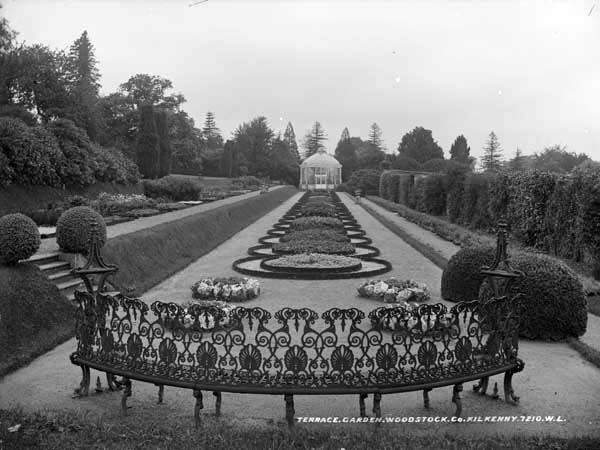
L_ROY_07210

IMG_2733

Lady Louisa and William Tighe had no living children and although she remained in residence at Woodstock until her death in 1900 the estate passed to her husband’s nephew Frederick Tighe who in turn left it to his son Edward. Perhaps because Lady Louisa continued to live in the house, this branch of the family spent less time at Woodstock and once the War of Independence broke out the Tighes brought the house’s more valuable furniture and pictures to England. It proved a judicious move since the building was occupied first by members of the hated Black and Tans and then by the Free State Army. The latter left Woodstock on July 1st 1922 and the following day it was set alight, most probably by anti-Treaty forces. All the remaining contents, including the library and Bartolini’s statue of Mary Tighe, were destroyed in the blaze. It was, like so many similar occurrences of the period, an entirely gratuitous act of vandalism that did nothing other than rob Ireland of another part of her cultural heritage.
Woodstock has stood a ruin ever since, its external walls now needing support if they are not to fall down. In recent years Kilkenny County Council has undertaken extensive restoration of the gardens which are open to the public and much prized. The pity is that the once splendid house which was their centerpiece and source of meaning provided should remain a hollow shell. If only in memory of the poet Mary Tighe, Woodstock deserves better than its present condition.

Mary Tighe

*From the first Canto of Psyche.
A new biography of Mary Tighe by Miranda O’Connell has just been published by the Somerville Press.

Step Inside

IMG_0908

The entrance to a bedroom on the first floor gallery of Ballinlough Castle, County Westmeath. Probably dating from c.1740, the oak door frame is notable for exaggerated height and narrowness. Its geometric formality and that of the adjacent wainscotting provide a decisive contrast to the exuberant rococo plasterwork above the frame, a feature repeated throughout the two-storey hall and stairs to create an enchantingly theatrical interior.

A Bibliophile’s Bliss

IMG_0320

In 1971 when Anthony Powell published the tenth volume of his roman fleuve A Dance to the Music of Time he gave it the title Books Do Furnish a Room. Perhaps he was thinking of the library at Tullynally, County Westmeath? After all, Powell was married to Lady Violet Pakenham whose family has been based at Tullynally since the mid-17th century. This has to be one of the most enticing rooms in Ireland, not least because books provide the greater part of its furnishing. Discovering the weighted shelves at Tullynally is akin to attending a party and encountering lots of old friends while being introduced to just as many new ones. (It has to be said the success of this metaphor is assisted by the presence of a drinks table in one corner of the room).
Previously known as Pakenham Hall, Tullynally was deservedly deemed, ‘an early 19th century Gothic Palace,’ by John Betjeman when Britain’s future Poet Laureate stayed there in September 1939. As the late Mark Bence-Jones observed, ‘with its long, picturesque skyline of towers, turrets, battlements and gateways stretching among the trees of its rolling park, Tullynally covers a greater area than any other country house in Ireland’ and looks ‘not so much like a castle as a small fortified town; a Camelot of the Gothic Revival.’ But buried far beneath its romantic carapace of castellations and battlements lies a plain two-storied Georgian house that once served as home to the Pakenham family.
Thomas Pakenham believes the first alterations to the old building were made soon after the marriage of his forebear and namesake Thomas Pakenham to heiress Elizabeth Cuffe; most likely with her money a third storey was added to the house. That earlier Thomas was created Baron Longford in 1756 and almost twenty years later his widow became Countess of Longford in her own right. The second Baron Longford’s accounts record improvements carried out to the building around 1780, mostly raising ceiling heights and altering windows but perhaps more was done since the person responsible for this work was a ‘Mr Myers.’ He could be the Christopher Myers responsible for gothicising Moore Abbey, County Kildare some years earlier.

IMG_1704

IMG_1708

In any case it was the second Earl of Longford who initiated the real transformation of Tullynally from house to castle. Two of his brothers were professional soldiers and a portrait of one, Major General Sir Edward Pakenham hangs over the polished limestone chimneypiece in the library. He was killed at the Battle of New Orleans in 1815 and for purposes of preservation his body was returned to Ireland in a cask of rum; since he had been known to have a surly temper, one of his relatives laconically remarked, ‘The General has returned home in better spirits than he left.’
Despite his soldier brothers, and his brother-in-law being the first Duke of Wellington, the Earl of Longford seems to have preferred less militant pursuits and carried out extensive improvements on his Irish residence. Between 1801 and 1806 the pre-eminent Irish architect of the period, Francis Johnston worked at Tullynally, adding what one observer has since called ‘little more than a Gothic face-lift for the earlier house,’ notably two round towers projecting from the corners of the main block and battlements around the parapet. In 1817 Lord Longford married and no doubt it was the incentive of a new bride and soon-expanding family that encouraged him a few years later to embark on a second round of work at Tullynally, this time using Johnston’s former clerk, James Shiel. From 1839 to 1842 the third Earl, a bachelor, employed architect Sir Richard Morrison to embellish Tullynally further and to design two castellated wings linking the house with its stable courtyard; a final flourish was added by the fourth Earl in 1860 with the construction of a pinnacled tower at the northern end of the site.
Records show a ‘bookroom’ existed within the house from 1740 onwards, and the first inventory of books there was compiled in 1790, with a second made in the mid-19th century. Thomas once told me he could reconstruct the whole library as it was on either of those dates and compare them with its present holdings. The current contents of 6,000 volumes representing 2,000 titles have been meticulously catalogued across 14 different fields including author, name, subject, language and date of publication.

IMG_1673

IMG_1682

It comes as no surprise that Tullynally is such a bookish house since the Pakenhams are a dauntingly literary family. Earlier generations might have been renowned for their military prowess but the pen has now decisively vanquished the sword. Thomas’ uncle Edward, sixth Earl of Longford wrote many plays as well as several volumes of poetry. He and his wife Christine (also a playwright) were generous supporters of Dublin’s Gate Theatre from 1930 onwards and later founded the Longford Players. Following his death, he was succeeded by his brother Frank, well-known politician and human rights campaigner as well as author and his wife Elizabeth was an historian. Their children include authors Antonia Fraser and Rachel Billington as well as Thomas who is another distinguished historian but probably now more widely known for his books on trees. Thomas’ wife Valerie has written a number of excellent books and a few years ago their daughter Eliza wrote a history of the Pakenhams in the late 18th/early 19th century.
Examples of all their works can be found in Tullynally’s library, the form if not the finish of which dates from the time of Francis Johnston’s intervention. He enlarged the room by stealing a bay from its immediate neighbour so the library now has three south-east facing windows and one facing south-west. It is worth considering what are the elements that make this room aesthetically so satisfying. Obviously its ample proportions help, as does the want of superfluous decoration: the gothic ornamentation found elsewhere is employed very sparingly here. The mellow oak bookshelves covering all four walls and rising from floor to cornice make the greatest impact, especially since most of them carry an amplitude of complementarily-toned leather bindings. Note how the sequence of ten shelves is graduated in height, with smaller volumes occupying the upper levels. The only other feature of note is a set of handsome busts running along the top shelf in one corner of the room. Predating the present library by more than half a century, they represent what were then deemed ancient and modern writers of note. While the library has shutters the absence of poles or even marks in the window embrasures to indicate supports suggests there have never been curtains here. Aside from some Turkey rugs, abundant and comfortable seating, a scattering of mahogany tables and enough lamps to provide light when evening falls, nothing more is required. The library at Tullynally indicates that books do not just furnish a room, they also make it beautiful.

IMG_0319

Tullynally’s splendid gardens (and tearoom) are now open and well worth a visit especially since the weather has, at last, improved. For information, see: http://www.tullynallycastle.com

A Touch of La Touche

IMG_2615

On this beautiful bank holiday weekend, morning sunlight in the entrance hall of Harristown House, County Kildare. The original building, of nine bays and three storeys over basement, is believed to have been designed by the 18th century Irish architect Whitmore Davis. He had a decidedly chequered career, seemingly often neglecting his responsibilities and in 1797 being declared bankrupt. The original owners of Harristown were a branch of the wealthy banking family of La Touche. In the 19th century it was here that Rose La Touche, the adolescent girl with whom John Ruskin fell in love, lived with her parents who were ardent evangelical Christians. In 1891 the house was gutted by fire and although subsequently rebuilt to the designs of James Franklin Fuller it is now one storey lower than was previously the case. The large east-facing entrance hall is a near-cube extended further back beyond a screen of Doric columns to provide access to darwing room and main staircase.

Strait is the Gate

IMG_2662

An admirable pair of stone piers in the grounds of Borris House, County Carlow, ancestral home of the MacMorrough Kavanaghs (once High Kings of Leinster). The original 18th century building, having been damaged during the 1798 Rising, was refurbished some twenty years later in Tudor Gothic style by the Morrisons père et fils. But these gates look to pre-date that overhaul; elsewhere an entrance to the estate features granite ashlar piers topped with ball finials and dates from c.1780. Perhaps these gateposts, grander in scale and splendidly finished with slender urns are from around the same period?

Practical Palladianism

image

Palladian is a much-abused term in this country, frequently applied to buildings which visibly have no link with Palladio but which happen to be old. Rather than attempt to re-write an already admirable summary, I here quote from the Encyclopaedia Britannica: ‘Palladianism, style of architecture based on the writings and buildings of the humanist and theorist from Vicenza, Andrea Palladio (1508–80), perhaps the greatest architect of the latter 16th century and certainly the most influential. Palladio felt that architecture should be governed by reason and by the principles of classical antiquity as it was known in surviving buildings and in the writings of the 1st-century-bc architect and theorist Vitruvius. Palladianism bespeaks rationality in its clarity, order, and symmetry, while it also pays homage to antiquity in its use of classical forms and decorative motifs.’
Palladianism as we see it in Ireland emerged in the early 18th century, heavily influenced by English practitioners and theorists such as Colen Campbell whose Vitruvius Britannicus was published in 1715, and his patron Richard Boyle, 3rd Earl of Burlington (and also, let it not be forgotten, 4th Earl of Cork, since he was a large landowner in this country). The first indisputably Irish Palladian house is Castletown, County Kildare on which work began c.1722 with its facade designed by Florentine architect Alessandro Galilei (1691-1737), today best known for his work at the basilica of San Giovanni in Laterano in Rome.

image

image

One aspect of Palladianism often overlooked is its functionality: seduced by the beauty of the overall design we are inclined to forget these buildings were intended to serve a practical purpose. In the 16th century many of Palladio’s clients were wealthy Venetians who owned country estates on which they wished to spend the summer months. The estates were working farms, and the houses Palladio created at their centre reflect this reality. Because of his admiration for classical design and the importance of symmetry, rather than permit a variety of stand-alone farm buildings scattered across the site as had customarily been the case, he consolidated them into a single unit.
Thus the archetypal Palladian villa is dominated by a central residence with a facade inspired by Roman temples (hence the frequency of pedimented porticos). On either side of this block run a series of lower wings symmetrical in appearance and practical in purpose. Behind their calm and orderly exteriors a quantity of different activities would take place, whether the preparation of meals or the storage of grain, the housing of livestock or the washing of clothes. There would be stables and dovecots, piggeries and chicken coops, all of them part of a single harmonious unit. The concept was both simple and yet sophisticated, rational yet handsome. In the late 19th century the American architect Louis Sullivan proclaimed ‘form ever follows function.’ Palladio’s villas demonstrate the truth of this maxim. As his influence spread beyond Italy, so too did his designs and the practical philosophy that underlay them. This approach found a particularly warm reception in Ireland where from the late 17th century onwards landowners sought to bring order to their estates and to create new residences at their core.

image

IMG_2336

One such estate was Ardbraccan, County Meath. This had been the seat of a bishopric for over a thousand years and in the 16th century a large Tudor house called St Mary’s stood there. However by the early 18th century the old residence had become so dilapidated that a new house was deemed essential. In 1734 then-Bishop of Meath Arthur Price made a start on the project but within a few years he had been transferred to the Archbishopric of Cashel (where incidentally he was responsible for unroofing the old cathedral, seemingly because he found his carriage could not easily be driven to the top of the hill on which it stands). It would be another 30 years before the work initiated by Price was brought to completion, but the two wings of the building he commissioned were completed before his departure.
The architect employed for this task was Richard Castle, whose personal history remains somewhat shrouded in mystery. He is believed to have grown up in Dresden, where his father, an English-born Jew named Joseph Riccardo, served as Director of Munitions and Mines to Friedrich Augustus, Elector of Saxony and King of Poland. By 1725 Castle, sometimes called Cassels, had come to England where he is likely to have encountered Lord Burlington and his circle of Palladians. Three years later he moved to Ireland, supposedly at the request of Sir Gustavus Hume, to design Castle Hume, County Fermanagh. Not long after Castle began working as a draughtsman for Sir Edward Lovett Pearce on the plans of the new Parliament House then being built in Dublin. Following Pearce’s death in 1733 Castle took over some of his unfinished commissions and also became the most notable designer of country houses in Ireland. He was, therefore, the obvious choice when Bishop Price sought an architect for the new residence at Ardbraccan.

IMG_2582

image

Understandably visitors to Ardbraccan focus their attention on the main house, finished in the 1770s to the designs of no less than three architects: James Wyatt, Thomas Cooley and the Rev. Daniel Beaufort. As a result, the rest of the structure receives less notice, even though it offers one of the purest examples of Palladianism in Ireland. To north and south of the central block run arcaded quadrants that link to two-storey, five-bay wings, their entrances facing one another across the house’s forecourt. The facade presented to the world is one of order and equilibrium, harmony and proportion. In classic Palladian fashion Castle provided facilities for a wealth of complementary domestic and agricultural activities, all housed in splendidly constructed outbuildings that remain intact. These include stables and carriage houses, kitchens and laundry yard, pump yard and slaughter house, piggeries, granary, dovecotes, cattle sheds and fowl yards, accommodation for the large community of workers who engaged in diverse activities, and rising above them all a clock tower to ensure time was kept on the day’s tasks.
One of the pleasures of these buildings is the quality of their finish, a tribute to Irish workmanship at the time. It is worth noting the way different sections interact; the mixture of cut and uncut stone within the stable block to the north, for example, is surprisingly successful. On this side of the house a Gibbsian door permitted the bishop to descend to the yard via a flight of handsome steps, and then climb another short sequence to the mounting block for his horse. Inside the wing itself look at the superlative groin vaulting in the stables, the vaults carried on solid Tuscan column. Elsewhere the interplay of curved wall and staircase is another delight. These were all practical spaces, intended to ensure the estate operated smoothly and would be almost self-sufficient. Nonetheless as much attention was paid to their design and construction as to the episcopal residence. Here are the tenets of Palladianism put into practice and showing their mettle.

IMG_2312

Follow the Light

IMG_0890

The first floor bedroom corridor of Birr Castle, County Offaly, essentially a simple classical passage overlaid with Gothic decoration such as the Perpendicular sprung ceiling which contrasts with the plain panelled doors. The other pleasure of this space comes from the way it has been decorated with a mixture of family portraits, mahogany furniture and blue & white china to form a harmonious whole.

Holding the Fort

Qih1BhAXBmcGJ09l6LQysC0Bs32IzyipWtFSv8gvS8M

Next week, on Tuesday 23rd April the contents of Fort William, County Waterford are due to be auctioned (see http://www.fonsiemealy.ie for more information). The sale will close a memorable period in many people’s lives; there have been few Irish houses in recent years more welcoming, more filled with joie de vivre than this.
Located a couple of miles west of Lismore and on a superb site above the Blackwater river, Fort William dates from the 1830s when it was erected to the designs of those prolific brothers James and George William Pain, both of whom worked as apprentice architects for John Nash in London before moving to Ireland. The Pains produced houses in whatever style was requested by their clients and at Fort William they came up with a benign form of Tudor Revival. Faced in local sandstone which has a wonderfully mottled appearance, the exterior is ornamented with an abundance of gables and pinnacles and angled chimneys but these are decorative flourishes on what is essentially a classical building, as can be seen by the regular sash windows.
Fort William was built for John Bowen Gumbleton whose family, originally from Kent, had settled in the area by the early 18th century. Their main residence – once called Castlerichard but later renamed Glencairn – lies a little further upriver. The property on that site was substantially transformed around 1814 by John Gumbleton’s father into fashionable High Gothic (complete with faux cloister) and this may be the explanation for Fort William’s appearance: in every sense a chronological continuation of the parent house.

ZIFFwi1ImU24PM9fc3PxpM5b1kd2HX2gMhIY-_F7CwY

zhF0iJUewuIxHrrnikZv4IzoXN20QEEdKIUBr4Z_l5w

Ever since being built, Fort William has regularly changed hands. On John Bowen Gumbleton’s death in 1858, the estate was inherited by his son 17-year old John Henry but he died at sea eight years later. Ownership of Fort William then passed to his two sisters but they lived elsewhere and so the house was rented to tenants. In 1910 the place was taken by Lt-Col. Richard Keane, whose older brother Sir John Keane of nearby Cappoquin I discussed a few weeks ago (Risen from the Ashes, 4th March). A note in the forthcoming auction catalogue notes that Richard Keane and his wife Alice ‘had two cars, one of which – replete with a cocktail cabinet – was commandeered by the IRA during the War of Independence and never returned.’ Furthermore during the subsequent Civil War the servants’ wing at Fort William was occupied by Free State troops; this may help to explain why Sir John Keane’s house was burnt out in 1923 by the opposition.
Richard Keane died in 1925 following the accidental discharge of his shotgun and seven years later the estate was sold to a local man who continued the established pattern of renting the house; among the tenants at this time was Adele Astaire, sister of Fred, who in 1932 had married Lord Charles Cavendish, younger son of the ninth Duke of Devonshire; for centuries the Devonshires have owned the neighbouring estate of Lismore Castle.

xXELfnzC-oOprqgNGKBKYsSyvI7W0Fre3C6uplJ1GF4

yaxFV3_i14wCVLnlmOfuuPa8JwtNb1By0_FPJFy5O0E

The ducal connections continue because after a brief Gumbleton interlude in 1946 Fort William was bought for £10,000 by the second Duke of Westminster. This was the famed Bend’Or, one-time lover of Chanel (among many others) who following the failure of his third marriage had fallen in love with Nancy Sullivan, daughter of Brigadier-General Edward Sullivan. An outstanding horsewoman she had grown up in Glanmire on the outskirts of Cork city. This may explain why the Duke acquired Fort William, although it is worth remembering that a daughter from his first marriage, Lady Ursula Grosvenor, together with her second husband Major Stephen Vernon lived at Fairyfield outside Kinsale, County Cork. Whatever the explanation, the Duke certainly spent some time in the house: the dining room panelling is said to have come from the interior of one of his yachts and he is also believed responsible for installing the French painted and gilded boiseries in the drawing room. Following his death in 1953 his widow (who only died in 2003) retained Fort William but spent the greater part of her time at Eaton Lodge, Cheshire where her stables held many fine racehorses, not least Arkle who won the Cheltenham Gold Cup three times in succession.
Fort William was sold again in 1969 to an American couple, Murray and Phyllis Mitchell. Following her death, it was bought by Ian Agnew, one-time Deputy Chairman of Lloyd’s. Ian acquired the place on a whim but he had strong Irish connections through his mother, Ruth Moore who had grown up at Mooresfort, County Tipperary. The Moores were an old Roman Catholic family. Ian’s great-grandfather, Arthur Moore was created a Papal Count in 1879; the previous year he had provided most of the funds necessary to establish the Cistercian monastery of Mount St Joseph outside Roscrea, County Tipperary. Curiously Glencairn, the estate immediately adjacent to Fort William is today occupied by Cistercian nuns.
Ian and I never spoke much of his forebears but among the most remarkable was his maternal grandmother, Lady Dorothie Feilding. A much decorated volunteer nurse and ambulance driver during the First World War, in September 1916 she became the first woman to be awarded the Military Medal for bravery in the field. After she died in 1935 her husband Captain Charles Moore moved to England to become manager of the Royal Stud. Continuing those links, Ian’s father Sir Godfrey Agnew was for 21 years Clerk of the Privy Council.

WvZE-BY4cgx0mwW0Xg4fxVWNDVvNDZ_1xfU1yVvh2CY

qVklmb4zCXhsbmOEGsa16dJBZ9KGsAj8F_ljHcrhp_0

A wonderful man with seemingly boundless gusto, Ian Agnew went to enormous trouble to restore and modernise Fort William while ensuring none of the patina it had accumulated was lost. (He also put in some time trying to teach me the finer nuances of fly fishing on the Blackwater, with less successful results.) The outcome was a house of tremendous comfort and warmth, very much a reflection of his personality and that of his beloved wife Sara. Sadly Ian died four years ago and since then Sara has been literally holding the fort, and continuing the tradition of abundant hospitality already established while her husband was alive. I could not begin to enumerate the charmed days I have spent at Fort William, but I have also managed to work there with equal delight: more than one piece for this blog has been written while sitting at the George III secretaire which can be seen in a corner of the morning room above.
I cherish all those memories because the time has now come for Sara regretfully to pass on the baton, hence next week’s sale. Without question she is going to be enormously missed by everyone in the area but one wishes the new owners as much delight in Fort William as was enjoyed by Ian and Sara – and their lucky houseguests. Below is a final image summing up Fort William in recent years: a passage leading to the ever-welcoming kitchen bathed in sunshine (something the house’s spirit has seemed to radiate even on days of rain). And there on the rug is Alfie who despite his recumbent pose for the camera has been ever a faithful and tireless companion on Fort William walks no matter how far the distance or how bad the weather.

crcc4JNizYI5pCFul-DVY68le0YDR4R0dMMVuCzE9WA

All photographs by James Fennell (www.jamesfennell.com)