An Irishman’s Home is His Tower House

image

All across Ireland can be seen buildings commonly known as castles but which ought more correctly be called tower houses. The tower house is not exclusive to this country, similar structures being found along the Scottish Borders. However, the sheer quantity of these edifices make them one of the most distinctive features of the Irish landscape: it has been estimated that between 1400 and 1650 in the region of 3,000 tower houses were constructed.
A statute issued by Henry VI in 1429 declared, ‘It is agreed and asserted that every liege man of our Lord, the King of the said Counties, who chooses to build a Castle or Tower House sufficiently embattled or fortified, wither the next ten years to wit 20 feet in length, 16 feet in width and 40 feet in height or more, that the commons of the said Counties shall pay to the said person, to build the said Castle or Tower ten pounds by way of subsidy.’ It is often proposed that this piece of legislation, with its financial incentive, did much to encourage the popularity of tower houses, and also their uniformity of design.

image

image

There is some dispute whether the tower house’s primary purpose was defensive or residential; one suspects it varied according to geographic and political circumstances. Typically the building is rectangular and constructed of irregular stones, the walls in excess of four feet thick at base level and rising four or five storeys high. A single arch doorway offered admission with the large arched ground floor devoted to diverse purposes including storage of foodstuff and livestock. Above the entrance was an opening called the Murder Hole, through which boiling liquids or arrows could be directed in the event of an attack. Windows at this level were little more than slits although they were larger further up. The family lived on the tower’s top storeys, but levels of comfort were pretty minimal.
Various descriptions of life in a tower house have come down to us and none of them make it sound especially luxurious. For example the Spaniard Cuillar wrote in 1588 ‘The Irish have no furniture and sleep on the ground, on a bed of rushes, wet with rain and stiff with frost…’ Half a century later the French traveller, M. de la Bouillaye le Gouz observed ‘The castles of the nobility consist of four walls, extremely high and thatched with straw but to tell the truth, they are nothing but square towers without windows or at least having such small apertures as to give no more light than a prison. They have little furniture and cover their rooms with rushes, of which they make their beds in Summer and straw in Winter. They put rushes a foot deep on their floors and on their windows and many of them ornament their ceilings with branches.’

image

image

In many respects Kilbline Castle, County Kilkenny is a typical Irish tower house. Rising five storeys high, it has round bartizans or wall-mounted turrets at each corner of the east front and a slender chimney-stack between them. The surrounding bawn wall survives in part but some sections were demolished in the last century to permit the erection of modern farm sheds. Kilbline is usually dated to the 14th/15th centuries but a large limestone chimneypiece on the first floor carries the date 1580 so it is possible that was when the building was completed. On the other hand, there is reference to Kilbline Castle being forfeited by one Thomas Comerford of Ballymac in 1566 so perhaps the chimneypiece was inserted into the tower by its subsequent owner.
That person may have been a member of the Shortall family of Rathardmore Castle in the same county. Thomas Shortall of Rathardmore died in 1628 and not long after his heir Peter moved to the castle of Kilbline, where he subsequently lived. His estates, which ran to some 1,500 acres were declared forfeited by the Cromwellian government in 1653 and his sons ordered to be sent to Connaught, although one of them seems to have returned to Kilbline, perhaps after the restoration of Charles II in 1660. Nevertheless, Kilbline once more changed hands during this period.

image

image

Originally from Newcastle in Northumberland, William Candler is believed to have served as an officer in Oliver Cromwell’s army during the Irish wars of 1649-53. As a reward for his endeavours, he was promoted to the rank of Lieutenant Colonel and granted lands in County Kilkenny, including those on which stands Kilbline Castle. He and his wife Anne Villiers had two sons, the younger of whom John is known to have lived at Kilbline. John Candler had a single son Thomas who, in turn, had only the one child, Walsingham; he never married and so that line of Candlers came to an end.
To return to Lt.Col. Candler, his older son Thomas who lived at Callan Castle had four sons, the youngest of whom Daniel caused a rumpus within the family by marrying an Irishwoman, possibly a Roman Catholic, called Hannah and as a result was obliged to leave first County Kilkenny and then Ireland. Around 1735 Daniel and Hannah Candler moved to the America Colonies, initially settling in North Carolina before they moved to Bedford, Virginia. Their great, great, great-grandson was Asa Griggs Candler, the entrepreneur who in 1888 bought the formula for Coca Cola and made himself fabulously rich as a result.

image

image

Kilbline Castle continued to be occupied until just a few decades ago. At some point, probably in the 19th century, a two storey three-bay house was added on the west end of the tower house and a further single storey structure abuts this. The interior of the house remains relatively intact and suggests a degree of affluence on the part of the occupants.
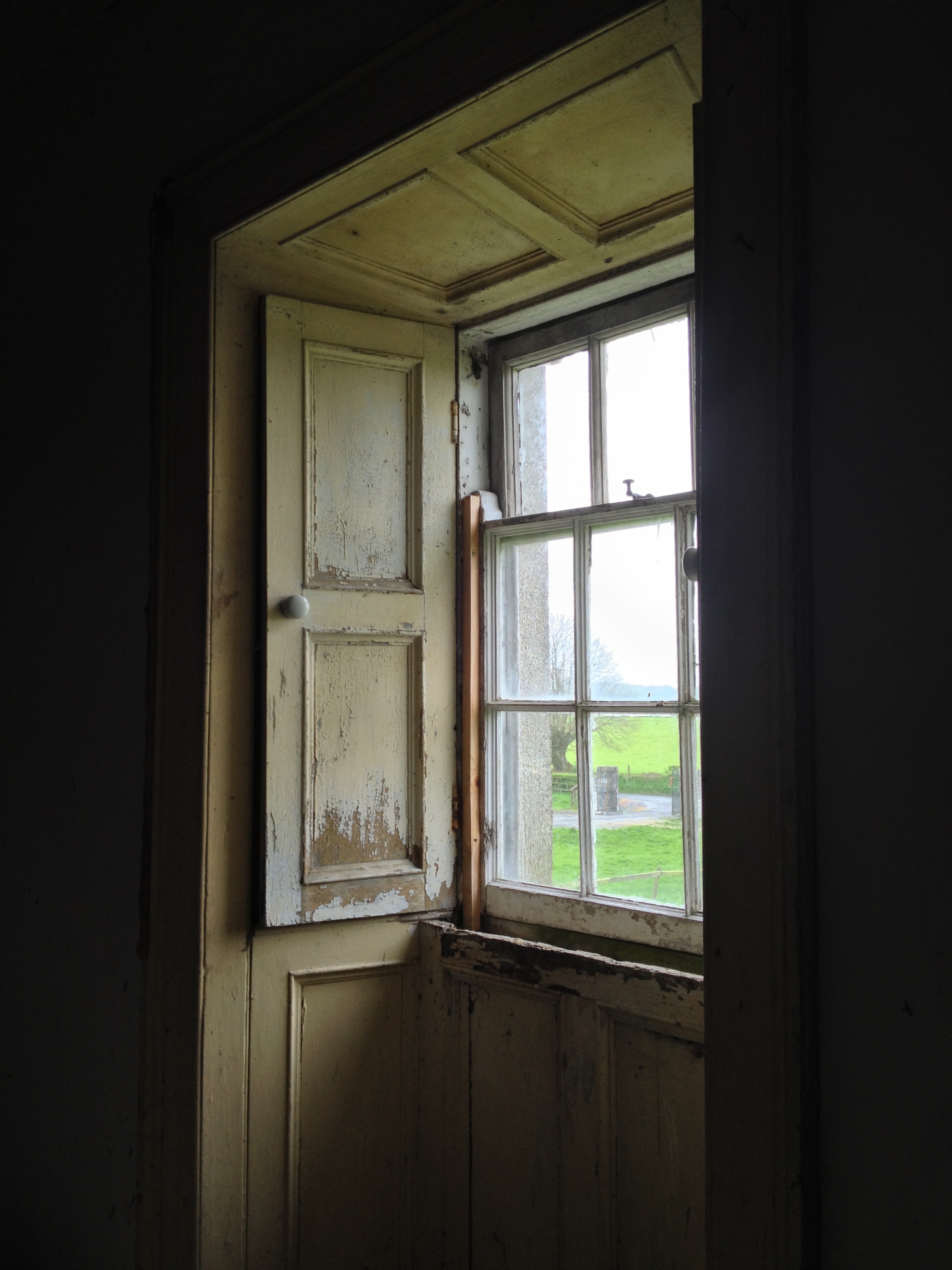
However, the most architecturally significant feature of Kilbline is a wonderful panelled room on the south-east corner of the ground floor. Most likely of oak (it was hard to tell with certainty) this looks to date from the late 17th or early 18th centuries and must therefore have been created while the building was occupied by the Candlers. Although the ceiling is now covered in tongue-and-groove boards, all the wall panelling is intact, as is the old chimneypiece (the latter marred only by a shelf added at some later date). This rare instance of early Irish interior decoration is some 300 years old and given that the house has been empty for some time it remains in remarkably good condition, as can be seen in the pictures above. The present owners, although they do not live in the building, are aware of its importance and would dearly love to restore Kilbline and ensure its future.

image

Open Wide

IMG_3666

Readers of Selina Guinness’ memoir The Crocodile by the Door ought to recognise the open-mouthed beast seen above. It was shot in Persia by the brother of the author’s great-granfather, the head then stuffed amd mounted by a taxidermist in London before being sent to Ireland to serve as a letterbox. Ever since the crocodile’s bonce has been found in the entrance hall of Tibradden, County Dublin although today more conventional methods of despatching letters are employed. Designed by Dublin architect Joseph Maguire, Tibradden was built in 1859 to mark the marriage of that same great-grandfather, Thomas Hosea Guinness, to Mary Davis.
I will be in conversation with both Selina Guinness and author and broadcaster Polly Devlin next Saturday June 8th at the Borris House Festival of Writing and Ideas, County Carlow. For further information see http://festivalofwritingandideas.com

Within a Budding Grove

IMG_3545

The west front of Mount Stewart, County Down speckled in sunlight last weekend. This was the original entrance to the house designed c.1804 by English architect George Dance the younger. Some thirty years afterwards Mount Stewart was greatly enlarged by William Vitruvius Morrison and Dance’s work relegated to being a mere wing. The elaborate gardens are of a later date, created by Edith, seventh Marchioness of Londonderry between the two world wars (see In Circe’s Circle, November 28th). Now in the care of the National Trust they have recently benefitted from extensive replanting.

Simply Divine

St Werburgh's Dublin

St Werburga was born in Staffordshire in the seventh century, the daughter of King Wulfhere of Mercia and his wife Ermenilda who is likewise deemed a saint. Werburga spent most of her life as a nun and ended her days as Abbess of Ely (like her mother, grandmother and great-aunt before her: the odour one detects is a subtle blend of sanctity and nepotism). Dying c.699 she was initially buried in Hanbury, Staffordshire but owing to the threat of Viking invaders her tomb was moved to Chester Abbey (since 1540 Chester Cathedral), and she remains the patron of that city. The cult of St Werburga was sufficiently strong for churches to be founded in her name elsewhere, not least in Dublin where the original St Werburgh’s was established close to Dublin Castle around 1178.

werburghsfront

0124

DublinCastleMalton

The first church was burnt down in 1300 and rebuilt. It subsequently underwent many vicissitudes, being rebuilt in 1601 and enlarged sixty years later but remained in use and Jonathan Swift was baptised here in 1667. At the start of the 18th century, Dublin’s then-Anglican Archbishop William King, who was responsible for restoring many of the city’s old churches, decreed that St Werburgh’s should once more be rebuilt. Ireland’s Surveyor General Thomas Burgh, also responsible for the likes of the library at Trinity College and Dr Steevens’ Hospital, was given the job of designing a new church for the site. It is sometimes suggested that Alessandro Gallilei (original architect of Castletown, County Kildare) had a hand in the task and certainly the original facade was distinctly Italianate in character.

IMG_3287

IMG_3336

That original facade’s octagonal tower crowned with a cupola – seen above – was replaced in 1729 by a square tower with Corinthian pilasters, the whole being finished by a spire in the late 1760s. It rose to a height of 160 feet and must have been a marvellous spectacle. However in the aftermath of Robert Emmet’s abortive rebellion of 1803, the government authorities were suspicious that the spire St Werburgh’s overlooked Dublin Castle’s Upper Yard (as can be seen in James Malton’s 1792 print above) and so arranged for no less than seven architects to declare the structure unsafe. Although another architect, Francis Johnston, offered to secure the spire, it was nevertheless taken down in 1810. Twenty-six years later the tower, and it is presumed the upper section of the facade, was likewise removed. What remains, looking magisterial but decidedly truncated, is a building of three bays faced in sandstone and dominated by towering Doric pilasters, the centrepiece being a powerful segmental-pedimented Doric doorcase. From the exterior St Werburgh’s conveys the impression of a scarred but still noble giant.

IMG_3315

IMG_3342

In 1754 St Werburgh’s had suffered another grievous fire when the roof of the church fell ‘all at once’ into the main body of the building (with such an unfortunate history of conflagrations, no wonder the entrance porch continues to hold a number of ancient fire-fighting devices). The interior was accordingly rebuilt seemingly as a re-creation of what had been lost. The main body of the church is a long high hall with a simple coved ceiling. The recessed chancel’s upper walls are decorated with paired and tripled Ionic columns on the parapet above which rest a sequence of oversized urns, interspersed with masks and garlands of flowers; the plasterwork was executed by Michael McGuire and Thomas Tierney. The main body of the stone-flagged church is filled with dark stained boxed oak pews, above which runs a gallery with additional seating. In 1767 a wonderful new organ was installed at the west end of the gallery, its elaborate case designed by John Smyth. Immediately in front was the vice-regal ‘box’ rather like that in an old theatre, faced with a large carved and painted panel featuring the royal coat of arms.

IMG_3348

IMG_3357

In the early 19th century, St Werburgh’s lost not only its spire but also its status as vice-regal church since during this period Francis Johnson was responsible for building the Chapel Royal within the walls of Dublin Castle. Yet ultimately St Werburgh’s gained something from this deprivation since in 1878 it acquired the oak pulpit designed by Johnston and carved by Richard Stewart for the aforementioned Chapel Royal. In high Gothick manner, the octagonal pedestal is reached by a flight of steps with thin traceried balusters and is supported by a single slender column. On a swollen base sits a copy of the bible from which rises a cluster of colonnettes, their capital being composed of heads of the four Evangelists on each of whose heads can be found a copy of his own gospel. The sides of the pedestal are likewise heavily carved and carry sundry royal and religious coats of arms. Quite different in spirit from the rest of the interior, this virtuosic piece of work somehow finds a place within St Werburgh’s.

IMG_3388

IMG_3403

Despite its association with the vice-regal court, even in the 18th century St Werburgh’s was never a rich parish; by that period, fashion had moved north and east, and Toby Barnard (in his 2003 book A New Anatomy of Ireland) noted that of 114 named pew holders in 1725 a mere five were listed as ‘esquires’ with the majority being grocers, goldsmiths, printers and so forth, explaining why the previous decade the parishioners had been described as ‘mostly shopkeepers and tradesmen.’ There were a few notable incumbents, not least Dr Patrick Delany (subsequently husband of the wondrous Mary Delany) who was rector in 1730. But mostly St Werburgh’s was left to slumber. The advantage to this state of affairs is that, whatever about its exterior, after the 1760s very little was done to alter the inside of St Werburgh’s probably because of shortage of funds. It therefore remains as an admirable example of the 18th century Anglican church, box pews and gallery still in place, even the windows’ clear glass remaining in place. Even better, unlike many other city centre parishes services continue to be held at St Werburgh’s and the building has undergone a certain amount of refurbishment in recent years, without any loss of its distinctive ambience. At the moment the church is open for a certain number of hours each day, and a visit is to be encouraged.

IMG_3306

Killeen with Kindness

40 Plunket A

A watercolour of Killeen Castle, County Meath, painted by Lady Emma Frances Plunkett (1826-1866), daughter of the ninth Earl of Fingall. The Plunketts are of Norman origin and established themselves in this part of Ireland at the end of the 14th century. The Earls of Fingall were notable for remaining Roman Catholic throughout the Penal era, unlike their neighbouring cousins, the Lords Dunsany who converted to Anglicanism. The picture is significant because it shows Killeen prior to extensive changes made to the structure from 1841 onwards by Lady Emma’s father, in other words it must have been painted while she was still an adolescent. At the age of 24 she married William Ince Anderton, member of an old Lancashire recusant family and together they embarked on the construction of a new chapel on his estate at Euxton Hall to the designs of Edward Welby Pugin; following Lady Emma’s death in 1866, a large stained glass window was installed in the chapel which shows her kneeling at the foot of the cross.
Killeen remained in the ownership of the Plunkett family until it was sold by the twelth and last Earl of Fingall in 1951. Thirty years later, after changing hands a couple of times more, the castle was gutted in an arson attack. It then stood ruinous until the estate was bought in 1997 by a development company which undertook to restore the building as centrepiece of a luxury hotel and spa. The rest of the same organisation’s scheme, including the inevitable championship golf course and series of commuter houses went ahead but of course the castle’s restoration stalled: when I visited some years ago, the roof had been repaired and concrete floors installed but little further work undertaken. Below is another watercolour by Lady Emma Plunkett, this one showing Dunsany Castle which happily remains intact and in the ownership of its original family. Both pictures, and three more by the same amateur artist, are included in an exhibition opening next week in Dublin’s Gorry Gallery (see http://www.gorrygallery.ie).

38 Plunket A

Ave Maria

Maria Edgeworth

On this day in 1849 the wondrous Maria Edgeworth died at the age of 81. She is rightly best remembered for her 1800 novel Castle Rackrent, a remarkable work that had no precedent but many successors, both in Ireland and elsewhere. While nothing else in her output matched its originality, at the same time Edgeworth’s other Irish novels in particular The Absentee (1812) are worth reading for insights into the state of the country in the aftermath of the Act of Union. Her family home, and the place where she produced many of her books, was Edgeworthstown House, County Longford. From around 1770 onwards it was much enlarged and altered by her father Richard Lovell Edgeworth, the result notable for the distinctive interiors which he designed in an idiosyncratic fashion. The house still stands and has long been a nursing home run by a religious order: the last time I visited the nuns in charge seemed to have little knowledge of or interest in its most famous resident. Sadly the building today bears little resemblance to its appearance during Maria Edgeworth’s lifetime having been ruthlessly stripped of decoration and character. Below is an engraving showing the house’s library as it looked a few years after her death.

Library in Edgeworthstown House

Terms and Conditions May Apply

St Werburgh's

Seen on the rear wall of St Werburgh’s, Dublin. The church was built to the design of Thomas Burgh around 1715 but extensively refurbished after a fire less than forty years later. As can be seen, this elegantly composed notice dates from June 1728 and carries a full list of charges for the services on offer, along with their respective fees. Note how non-parishioners were charged considerably more, so for example muffled bells cost a parishioner £1 and a shilling while a ‘foreigner’ had to pay an additional six shillings. And for the former burial within the church’s vault was almost half the price it was for the latter. Conclusion: one way or another in the 18th century you paid your dues at St Werburgh’s.
More on St Werburgh’s in the coming weeks.

A Hundred Little Pieces

IMG_3076

Radiating Portland stone lozenges cover the floor of the staircase hall at Townley Hall, County Louth. Dating from the late 1790s, the house is architect Francis Johnston’s masterpiece, one of the purest examples of neo-classicism in Ireland.
This also marks the hundredth piece from the Irish Aesthete since the site made its debut last September. And so readers, you are cordially invited to offer feedback: what subjects most interest you; about what would you like to read more; are there buildings or subjects you wish to see featured? As ever, comments of the literate and temperate variety are welcomed.
I shall be writing further about matchless Townley Hall in a few weeks’ hence.

Of Wonderous Beauty Did the Vision Seem*

IMG_2688

Writing to a friend in September 1795, the English Romantic poet Anna Seward, known during her lifetime as the Swan of Lichfield, reported ‘I must not conclude my letter without observing, that, on my second visit to the fairy palace [Llangollen Vale], a lovely Being cast around its apartments the soft lunar rays of her congenial beauty. — Mrs. Tighe, the wife of one of my friend’s nephews, an elegant and intelligent young woman, whom I should have observed more had his wife’s beauty been less. I used the word “lunar” as characteristic of that beauty, for it is not resplendent and sunny, like Mrs. Plummer’s, but, as it were, shaded, though exquisite. She is scarce two-and-twenty. Is it not too much that Aonian inspiration should be added to the cestus of Venus? She left an elegant and accurate sonnet, addressed to Lady E. Butler and her friend, on leaving their enchanting bowers.’
The ‘Mrs Tighe’ to whom Seward here refers was another poet, Mary Tighe, while ‘Lady E. Butler and her friend’ were the famous Ladies of Llangollen, and a house in Ireland, today a ruin, links them all together: Woodstock, County Kilkenny. Lady Elinor, who grew up in Kilkenny Castle, knew the place well since it was here in 1768 that she met her lifelong companion, Sarah Ponsonby. Lady Elinor was then aged 28, Miss Butler some fifteen years younger but they formed so close a bond that more than a decade later, braving the opprobrium of their respective families, and of society at large, they ran away together and set up home at Plas Newydd, near the Welsh town of Llangollen. Although living quietly and on a relatively modest income, they soon became famous and attracted visitors from throughout Britain and Ireland: Queen Charlotte wanted to see their house and persuaded George III to grant them a pension. Writers in particular were especially fascinated by the Ladies of Llangollen and among those who travelled to see them were Lord Byron, Wordsworth, Shelley, and Sir Walter Scott. Plus, of course, both Anna Seward and Mary Tighe.

IMG_2670

IMG_2704

Mary Tighe (née Blachford) was born in 1772, the daughter of a Church of Ireland clergyman who died when she was very young. Her mother Theodosia Tighe was an early supporter of John Wesley and Mary had a severely religious upbringing. At the age of twenty-one she married her first cousin Henry Tighe but it appears the union was not happy. In addition Mary soon began to manifest signs of the tuberculosis that would eventually kill her.
From an early age she had written both poetry and prose but only in 1805 was her long poem Psyche, or the Legend of Love privately printed in an edition of just fifty copies. Nevertheless, it brought her considerable fame: in the same year Thomas Moore wrote his own poem To Mrs Henry Tighe on Reading her Psyche which opens with the lines, ‘Tell me the witching tale again/For never has my heart or ear/Hung on so sweet, so pure a strain/So pure to feel, so sweet to hear.’
Psyche is a six-canto allegorical poem in Spenserian stanzas recounting the classical myth of the love between Cupid and Psyche, and the travails the couple must endure before they can achieve happiness. In sentiment it is of its own era and not of ours, but stylistically the work is highly accomplished and one can understand why it achieved such renown in the early 19th century. A year after the death of the poem’s lovely young author in 1810 a new edition of Psyche, along with some of her other verses, was published and this helped to cement Mary Tighe’s fame across Europe.

main-house-woodstock-inistioge

IMG_2759

Mary Tighe spent the final months of her short life at Woodstock which belonged to her brother-in-law William Tighe. Wonderfully located on high ground above the village of Inistioge and the river Nore, the house dates from around 1745 and is believed to have been designed by the architect Francis Bindon for Sir William Fownes. Its north-east front of six bays and three storeys over part-raised basement is notable for having an elaborate central doorway comprising the door itself and two flanking windows immediately above which is a niche which originally contained a life-size statue, and an oculus over that again. So deep is the building that it has a small inner courtyard to light the central rooms.
Woodstock was inherited by Sir William Fownes’ grandson William Tighe and c. 1804 he was responsible for adding the flanking single-storey wings with pedimented breakfronts, the designer of these being local architect William Robertson. The interior was especially noted for its fine library and a couple of old photographs show ceilings with elaborate rococo plasterwork. The main hall contained a white marble figure representing Mary Tighe carved by the Tuscan Lorenzo Bartolini some five years after her death. This has gone but her mausoleum survives in the graveyard attached to the former Augustinian priory of St Columbkill is Inistioge. Inside the severe neo-classical limestone structure is another life size figure carved by the English sculptor John Flaxman and showing the recumbent poet with a small winged figure – Inspiration perhaps? – crouching beside her head.

L_ROY_04458

IMG_2716

Set on sloping ground, the gardens of Woodstock were originally laid out in the ‘natural’ style popularized by Capability Brown. However they were transformed in the middle of the 19th century by Lady Louisa Tighe, wife of another William Tighe; Lady Louisa was the daughter of the fourth Duke of Richmond and therefore the great-niece of the Lennox sisters who made such an impact on Ireland during the previous century (as anyone familiar with Stella Tillyard’s 1995 book Aristocrats will remember). Late in life, Lady Louisa who was born in 1803 recalled attending her mother the Duchess of Richmond’s legendary ball in Brussels, held three days before the Battle of Waterloo: ‘I well remember the Gordon Highlanders dancing reels at the ball. My mother thought it would interest foreigners to see them…some of the poor men who danced in our house died at Waterloo.’ (A piece of trivial information: four years after Waterloo, the Duke, by then Governor General of Canada, was bitten by a pet fox and subsequently died of rabies.)
Working with her then-head gardener Pierce Butler, Lady Louisa’s interventions at Woodstock were extensive, beginning with a series of three terraces to the immediate west of the walled garden. The middle of these three was aligned to the south with a large circular conservatory designed by the Dublin iron master Richard Turner. This work completed and Pierce Butler having died, Lady Louisa then embarked on another major project with her new head gardener Scotsman Charles McDonald: the creation of a winter garden to the immediate rear of the house. Consisting of four sunken panels each filled with elaborately planted parterres, its creation involved the removal of more than 200,000 cubic yards of soil and the building of massive granite embankments. Extant photographs indicate the style of these gardens to be of the kind now found only in municipal parks, with lines of bright bedding plants and even at Woodstock pathways of different coloured gravel. Less lurid elements elsewhere in the demesne included an arboretum, yew walk and rose garden, Monkey Puzzle and Noble Fir avenues, a grotto, rustic summer house and various other features.

L_ROY_07210

IMG_2733

Lady Louisa and William Tighe had no living children and although she remained in residence at Woodstock until her death in 1900 the estate passed to her husband’s nephew Frederick Tighe who in turn left it to his son Edward. Perhaps because Lady Louisa continued to live in the house, this branch of the family spent less time at Woodstock and once the War of Independence broke out the Tighes brought the house’s more valuable furniture and pictures to England. It proved a judicious move since the building was occupied first by members of the hated Black and Tans and then by the Free State Army. The latter left Woodstock on July 1st 1922 and the following day it was set alight, most probably by anti-Treaty forces. All the remaining contents, including the library and Bartolini’s statue of Mary Tighe, were destroyed in the blaze. It was, like so many similar occurrences of the period, an entirely gratuitous act of vandalism that did nothing other than rob Ireland of another part of her cultural heritage.
Woodstock has stood a ruin ever since, its external walls now needing support if they are not to fall down. In recent years Kilkenny County Council has undertaken extensive restoration of the gardens which are open to the public and much prized. The pity is that the once splendid house which was their centerpiece and source of meaning provided should remain a hollow shell. If only in memory of the poet Mary Tighe, Woodstock deserves better than its present condition.

Mary Tighe

*From the first Canto of Psyche.
A new biography of Mary Tighe by Miranda O’Connell has just been published by the Somerville Press.