Awaiting Restoration


In need of repair: the conservatory attributed to Richard Turner which is attached to the west side of Marlfield, County Tipperary. This house was built for the Bagwell family in c.1785-90. The conservatory here is a later addition, thought to have been added around 1835, which is two years later than that at Colebrooke. Although Marlfield was burnt by Anti-Treaty forces during the Civil War (it was subsequently rebuilt), the conservatory survived intact and is therefore an important example of Turner’s early work.


Restoration Glory


The conservatory at Kilshane, County Tipperary. The house dates from the 1820s when designed for the Lowe family by John Hargrave, a son of the successful Cork-based architect Abraham Hargrave. The curvilinear conservatory, thought to be the most ambitious of its kind to survive in Ireland, was added around 1860; while very much in the style of Richard Turner, it cannot with certainty be ascribed to him. Along with the house, it was restored by the present owners at the start of the present century.


Escaping the Wreckers’ Ball


In 1961, the April-June issue of the Irish Georgian Society’s Bulletin advised readers that a house in County Carlow called Browne’s Hill ‘is to be demolished if a buyer does not come forward within the next month. Situated in a large park with fine timber, Browne’s Hill is in first-rate structural repair and would make a lovely, easily run family home. Although it is on top of a hill with panoramic views, it is not remote, the town of Carlow being only 1 ½ miles away, and Dublin 50 miles.
The house was built in 1763 by an architect named Peters for Robert Browne, in whose family it remained until recently. The three reception rooms have rich plaster ceilings and the original mantlepieces, the front hall is paved with black and white squares, and the kitchen (with Aga) is on the ground floor. The grand staircase leads up to ten bedrooms of various sizes, he principal one being octagonal with windows facing in three directions. There are two bathrooms, three lavatories, oil fired central heating and E.S.B. main electricity.
The courtyard comprises 15 stables, garages, loose boxes, dairy and groom’s house with excellent living accommodation, approximately 5,000 square feet of lofting, all in good condition. For permission to view, apply to – William Mulhall, Auctioneer and Valuer, 60 Dublin St., Carlow.
Price £2,500 with five acres.
A further 68 acres is available, if required, £7,000.’


Browne’s Hill was occupied by successive generations of the same family until 1951 when William Browne-Clayton offered the house for sale with 700 acres. Two years later an English syndicate purchased the estate, along with another nearby, the 1,500 acre Oak Park. These purchases were not well-received locally, farmers in the area believing the land ought to have been divided up among them by the Land Commission. Eventually in 1961 the syndicate, faced with growing hostility, negotiated a deal with the commission, whereby the estate underwent division and the house with its immediate five acres were put on the market with an asking price of £2,500. It was at this point that the Irish Georgian Society placed a notice in its bulletin warning supporters that unless a sympathetic buyer could be found – and soon – the house would be demolished. This news understandably caused alarm among those who were fighting to ensure the survival of the country’s steadily diminishing architectural heritage. Among them was author Anita Leslie, then dividing her time between her own family home, Castle Leslie in County Monaghan, and Oranmore Castle, County Galway, a property she had bought with her husband Bill King. Anita Leslie was also battling to save Dalyston, an important mid-18th century house that had just been sold to a County Longford firm that specialized in stripping old buildings of all saleable assets. Seeing Dalyston unroofed and gradually picked bare, she was determined the same fate should not befall Browne’s Hill and embarked on a campaign to save the property. For a time, she thought it might perhaps be bought by one of her friends, such as the wealthy Simone, Baronne de Bastard who had just spent huge sums restoring the 17th century château de Hautefort in the Dordogne, but it seems Mme de Bastard did not care to purchase a house in the Irish countryside.
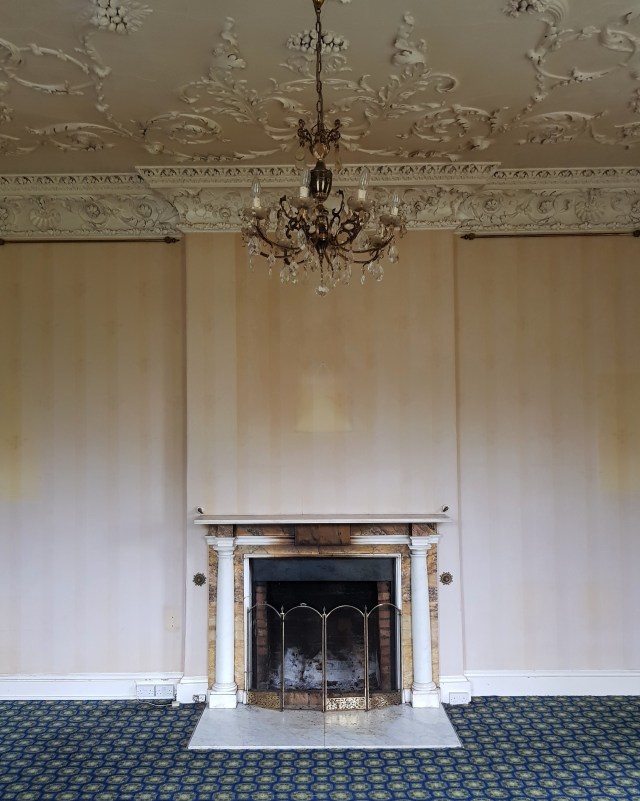


As June 1961 drew to a close, the fate of Browne’s Hill seemed sealed: it was destined to be demolished since the best purchase offer had come from the same company that had stripped and unroofed Dalyston. But then the Land Commission, in a rare gesture of sympathy, advised the Irish Georgian Society that it would allow a further six months’ grace before a decision over the house’s future was made. Anita Leslie battled on, helped by another stalwart of the society, Eoin ‘The Pope’ O’Mahony (he had been nicknamed ‘The Pope’ while still a schoolboy after declaring his ambition in life was to hold this title). A wonderfully eccentric character, one-time barrister, orator, genealogist and supporter of many lost causes, in this instance O’Mahony announced that he had persuaded a Fellow of St Catherine’s College, Cambridge to back a scheme whereby Browne’s Hill would be bought for 2,000 guineas, to be used as a student hostel. Extensive correspondence survives between Anita Leslie, Eoin O’Mahony, and Desmond and Mariga Guinness of the Irish Georgian Society as all of them – sometimes at cross-purposes – sought the best means of securing Browne’s Hill’s long-term future, each of them, and others besides, hounding the local auctioneer William Mulhall for information about possible rival bids for the place. On July 10th, Anita Leslie wrote somewhat histrionically to the Guinnesses, ‘I feel like Atlas holding up the last Georgian houses in Ireland on drooping shoulders & slender purse.’ If necessary, and as a last resort, she was prepared to pay the £2,500 required for Browne’s Hill, thinking it could either be let to a tenant or else run as a guesthouse. Finally, despairing that demolition awaited without her intercession and without telling her husband of the decision, she sent the auctioneer a cheque for the deposit. The cheque was promptly returned: it transpired that another offer for the property had been made – and not by any firm with demolition in mind. Instead, Browne’s Hill was bought by a local travel agent Frank Tully and his wife Patty. They subsequently moved into Browne’s Hill, which remained a family home until Mr Tully died in November 2018. Last month Browne’s Hill came on the market for only the second time since it was built more than 250 years ago.


The original entrance gates to the Browne’s Hill estate, which took the form of a splendid triumphal arch, were sold during this period and bought by University College Dublin, which in 1962 purchased the Lyons estate in County Kildare to run as a research farm. The gates can still be seen there at the entrance to the now-private house at Lyons.

Another Melancholy Anniversary


From The Tuam Herald of Saturday, September 4th 1920: ‘A correspondent gives some interesting but sad details of the malicious burning of Tyrone House [County Galway]. It was in the late Georgian style and the finest house in Ireland. The ceilings were all painted by Italian masters and were regular works of art. The mantle pieces were all of rare Italian marble and very costly. In the hall was a fine full sized marble statue of Baron St George the founder of that once great family. It was the work of an Italian artist. The head was broken off the night of the raid deliberately it must be said. All the ceilings are now ruined and the mantle pieces also, and the entire structure an empty shell and ruin. There was no grounds for the report that the military or police intended or were to occupy the house, and agrarian motives are believed to have inspired and instigated this most foul and reprehensible act of purely wanton destruction. Of late years the place was freely allowed to be used by pleasure parties who came out from Loughrea and other places to have a dance which cost them nothing and to enjoy themselves, and who were never prevented from having their pleasure and a dance on the spacious floor of the dining room, and they can now no longer do so, and where in olden days the finest balls in the Co. Galway took place.’
This month marks the sad centenary of the burning of Tyrone House. For further information on the building and its former owners, the St George family, see https://theirishaesthete.com/2017/09/18/tyrone-house/ or watch on the Irish Aesthete’s YouTube channel: https://www.youtube.com/results?search_query=irish+aesthete

A Less Austere Residence


Rathcoffey Castle, County Kildare has a complex history, involving multiple changes of ownership. The first to be recorded dates from the late 12th century when lands in this part of the country were granted by the Anglo-Norman knight Adam de Hereford (responsible for building Leixlip Castle elsewhere in the same county) to his brother John. When that line of the family failed, the land reverted to the crown and in the early 14th century Edward II granted it to John de Wogan, Justiciar of Ireland. The Wogans, thought to be originally from Wales, retained the property (albeit with a certain amount of the inevitable internecine feuding) until the mid-18th century, despite remaining Roman Catholic, and rising against the Crown in 1581 and again in 1642. They also supported James II, the last of the line and so went into exile. The last of the male line, Charles Wogan, led a rather romantic existence, escaping from London’s Newgate Prison in 1716 on the eve of his trial for high treason. He managed to reach France where he joined a regiment under the authority of another Irish exile, Colonel Arthur Dillon. Next, he became involved in securing a bride for the Old Pretender: this included securing her release after she had been captured by the Austrians, for which he was made a Roman Senator by Pope Clement XI. The Old Pretender (James III to loyal Jacobites) made him a baronet, while in France he was known as the Chevalier Wogan. Next he joined the Spanish army where he was promoted to the rank of Brigadier-General and made Governor of La Mancha. While living there he corresponded with Jonathan Swift in Dublin, sending the latter more than one cask of wine and some writings which he hoped Swift would help to get published. This never happened, although Swift described Wogan as ‘a Scholar, a Man of Genius and of Honour. As late as 1746 he was still trying to help the Jacobite cause, travelling to France in the hope of joining the Young Pretender (Bonnie Prince Charlie) in England, an aspiration never realized. He died, it appears back in La Mancha in 1752.


With the death of the Chevalier Wogan and then his younger brother Nicholas, what remained of the family’s Kildare estate was divided between the latter’s two daughters, one of whom Frances married John Talbot of Malahide. In the 1780s their grandson, Richard Wogan Talbot, second Baron Talbot of Malahide, sold Rathcoffey to another fascinating character, Archibald Hamilton Rowan who just a few years later would be a founding member of the Dublin Society of United Irishmen. In 1792 he was first arrested for seditious libel and two years later was jailed in Dublin. However, just like Charles Wogan, he managed to escape and to flee to France. Finding the Revolutionary climate too unstable, in July 1795 he moved to the United States, settling first in Philadelhia and then Wilmington, Delaware, borrowing money to operate a calico mill in the area. Finally in 1799, following persistent appeals from his wife Sarah to the British government, he was allowed to return to Europe, being reunited with his family in Hamburg. Then in 1803 he was permitted to live in England and finally, following the death of his father in 1805, back in Ireland. Thereafter he divided his time between the family’s original home, Killyleagh Castle, County Down and Rathcoffey where his loyal wife, then his eldest son and finally he all died in the same year, 1834. After which the contents of the building were auctioned and the estate leased, then sub-leased before being taken back by the Hamilton Rowan family. However, as early as 1902 the house was described as being a ruin, in which state it has remained ever since.


The site at Rathcoffey contains a number of substantial ruins, the oldest being an L-plan late-medieval gate house, possibly dating from the 15th century. This would have provided access to the main castle enclosed within a bawn wall, which has since gone. The gate house has undergone changes since first constructed and, it is speculated by Andrew Tierney, may have been converted into a coachhouse in the 18th century. That is certainly when the old castle, which stood a short distance to the east, was radically altered and given the form it still retains. The work is thought to have occurred after the estate was acquired by Archibald Hamilton Rowan in the 1780s: in his Beauties of Ireland (1826) James Norris Brewer noted that Hamilton Rowan had ‘commenced a less austere residence’ at Rathcoffey. Its design has been attributed to amateur architect and neighbour Thomas Wogan Browne, a relation of the previous owners. It will be remembered that the Wogan property was inherited by two sisters, one of whom married a Talbot. The other married a Browne, who lived not far away on an estate called Clongowes Wood (since 1814 a school run by the Jesuit order)*. Thomas Wogan Browne was responsible for giving his family home its Gothick appearance, but Rathcoffey on the other hand, although already a castle, was now thoroughly classicized. The older building to the rear and occupying the north-east corner of the site, was incorporated into the new and the greater part of the ground floor is groin-vaulted, even the handsome ashlar, three-bay loggia that sits between the three-storey façade’s projecting wings, each once finished with pedimented gables. Since it has stood empty for so long, little of the interior survives; one of the small reception rooms to the south-east has an internal bow-end and its equivalent in the south-west retains a number of niches. Otherwise it is impossible to determine what the house looked like when occupied by the Hamilton Rowans.


*There was another, and later link between Rathcoffey Castle and Clongowes Wood, since for much of the last century the Jesuits resident in the latter owned the land on which the former stands.

An Unhappy Tale


It was the late Nuala O’Faolain who, almost 25 years ago, told me the unhappy story of Marianne Talbot, a story Nuala later incorporated into her 2001 novel, My Dream of You. The tale can be summarized as follows: in January 1845 John Talbot-Crosbie, a younger son of the Rev John Talbot-Crosbie of Ardfert Abbey, County Kerry, married Marianne McCausland. A year later the couple’s only child, a daughter also called Marianne, was born. In May 1851 John Talbot-Crosbie’s uncle William Talbot died, and left his nephew an estate in County Roscommon called Mount Talbot. However, the will stated that John was only to enjoy lifetime occupancy and full ownership rested on his having a male heir. A year later, John, who by royal licence had now dropped Crosbie from his surname, claimed to have discovered his wife Marianne with a groom called Mullen in the latter’s room, the door to which was locked; curiously the couple’s little daughter was also in the room. However, immediately separated from her child, the following day Marianne Talbot was brought by the local rector to Dublin and there kept in confinement. It is said that Mullen followed Marianne to the city and tried to see her there, but was not allowed to do so. Some time later she was declared insane, taken to England and placed in a lunatic asylum where she is believed to have spent the rest of her life. Meanwhile, her husband initiated divorce proceedings against Marianne on the grounds of adultery and although his application was granted, it was repeatedly challenged by Marianne’s family, the case going all the way to the House of Lords where the couple’s divorce was confirmed in July 1856. As can be imagined, the matter attracted considerable public attention, and it was widely believed that John Talbot, knowing his wife was unlikely to have any further children and certainly not a boy, had fabricated her adultery with the groom so as to allow a divorce. Having succeeded in this ambition, he was able to marry again – in October 1858 – and a year later his second wife, Gertrude Caroline Bayley, had a son. Divine justice then intervened: John Talbot died a fortnight after the birth.


The Talbots were a family long settled in Ireland, the first of them being Richard de Talbot who around 1185 was granted land in Malahide where his descendants lived in a castle until 1973. Another branch was based in Templeogue, County Dublin until, in the aftermath of the Cromwellian Wars, Sir Henry Talbot had his lands seized and was transplanted to County Roscommon. Restored to his original lands in the aftermath of the Restoration, all seemed well until Sir Henry’s son James took up the cause of James II and was killed at the Battle of Aughrim in 1691. Once again, the family lost its property in the Dublin region, but somehow managed to hold onto the Roscommon estate, which eventually passed to James Talbot’s nephew Henry. In the 1730s he embarked on building the core of what remains today of the house at Mount Talbot. The design of this has been attributed to that prolific architect of the period, Richard Castle. Certainly, the building as originally constructed conformed to the Castle’s Palladian model, the main block being flanked by wings set at an angle of 45 degrees and linked to them by curved open arcades with a series of urns along the parapets. So far, so standard but then around 1820 the era’s Tudor Gothic craze hit Mount Talbot’s then owner, the aforementioned William Talbot (the terms of whose will would later be the cause of so much unhappiness). The consequences were startling.


The architect chosen to oversee Mount Talbot’s transformation was a local man, Richard Richards, of whom relatively little is known although he did design a number of churches. This was certainly his most important commission and he clearly wanted to make an impression. What presumably had been a symmetrical classical house was given a great square keep at one end of the façade and a smaller polygonal turret at the other; between them the entrance to the building was now flanked by similar turrets. The centre of the garden front received a three-storey projecting block with arched Gothic windows and pinnacles at the corners of the roofline, all of which was castellated. One more turret rose above all the others in the middle of the building. Further work undertaken in the early 1880s when a new entrance front approached by a grand stone staircase was added in the north-east corner of the house. Yet while the main block was dressed up to look like a castle, the arcades and wings retained their original classical appearance, an altogether bizarre juxtaposition of styles. It was not to last long. William John Talbot, the heir born to John Talbot just two weeks before his death, in due course came of age and into his inheritance when he embarked on the additional work mentioned above. Known as Johnnie, in 1897 he married a wealthy heiress, Julia Molyneux, only child of Sir Capel Molyneux of Castle Dillon, County Armagh, meaning the couple were exceedingly wealthy. All was well until the onset of the War of Independence and its aftermath, the Civil War. During the first of these, British troops were garrisoned in the house and grounds of Mount Talbot, the Talbots seemingly living during this period at Castle Dillon. Following the signing of the Treaty, they returned to Mount Talbot but in early April 1922, a group of armed Republicans arrived at the house and assaulted the now-elderly Johnnie Talbot, giving the couple 24 hours to leave the place or face worse. The next day the Talbots departed, never to return, he to go into a nursing home in Dublin, his wife to the Shelbourne Hotel, where she died that night, supposedly from shock brought on by the attack at Mount Talbot. Johnnie Talbot died the following year in London. Meanwhile, as the Civil War continued, Free State troops occupied Mount Talbot which in July 1922 was attacked by Anti-Treaty forces who placed a mine under the main entrance and other bombs around the building, causing considerable damage. The Talbots had no children, and following his death, the estate was broken up by the Land Commission and the house, along with its contents, sold. All that remains today is a stump of the central block and one of the wings. No trace survives of the other wing, nor of either linking arcade. After all that John Talbot had done to ensure Mount Talbot remained in his family, and all the suffering he had caused to his first wife Marianne, this was the end result.

Contrasting Styles II


Two country houses, both in County Meath and both now hotels. Today, Dunboyne Castle which dates from the mid-1760s and in its present form was designed by Drogheda architect George Darley for the widowed Sarah Hamilton. Although only 15 or so years later than Bellinter (see the previous post), Dunboyne Castle’s interiors are quite different, rococo having usurped baroque as the preferred style of decoration. The plasterwork of the ground floor saloon’s ceiling is reminiscent of work from the same period at Dowth Hall which was also designed by Darley (see https://theirishaesthete.com/2012/12/24/netterville-netterville-where-have-you-been) and which has been attributed to Robert West.

Contrasting Styles I


Two country houses, both in County Meath and both now hotels. Today, Bellinter which dates from c.1750 and was designed by Richard Castle for brewer and M.P. John Preston, whose son would become first (and last) Baron Tara. Since Castle died in 1751, he is unlikely to have overseen the work, which is vigorous but somewhat unsophisticated in execution, as demonstrated by the ceiling of the ground floor saloon. Its exuberant baroque plasterwork looks indebted to the Lafranchini brothers but probably executed by lesser hands.

A Photographic Record


In 1650 Captain Theophilus Sandford, who came from the town of Audenshaw, a few miles east of Manchester, sailed from Liverpool to Ireland at the head of 80 horsemen, and joined the English army then suppressing the Irish uprising. Following the end of hostilities, Captain Sandford was rewarded for his services with a large grant of land, formerly held by the O’Conor family, in County Roscommon. To this he added further lands by purchase, as did his heir Henry Sandford in the aftermath of the Williamite wars. The Sandfords were based in Castlerea where on the edge of the town they erected a substantial house in the early 18th century, of seven bays and three storeys over basement. The centre block of this building was seriously damaged by fire in 1895 and replaced by a single storey, prefabricated house linking what survived of the two wings. Following the departure of the family from the area in the aftermath of the First World War, and the division of their former estate by the Land Commission, Castlerea House was demolished and nothing now remains of the property.


Through marriage and a seat in parliament the Sandfords rose to become respectable members of the Landed Gentry and, in 1800, Henry Sandford was rewarded with the title Baron Mount Sandford. Having no children, he was succeeded by his nephew, another Henry Sandford who in June 1828 at the age of only 23 met an unfortunate end. He and some friends stopped in Windsor on their way to Ascot for the races and observed a drunken brawl taking place on the street. Lord Mount Sandford was attacked by one of the brawlers who knocked him down and then kicked him in the head; he died from his injuries nine days later. An elderly uncle then inherited but he had no children, so eventually the estate was jointly inherited by the first baron’s two daughters, one of whom married a Pakenham (and her eldest son Henry married Grace Mahon, heiress to another Roscommon estate, Strokestown). The other sister Mary married William Robert Wills who also had an estate, Willsgrove, not far from Castlerea but the couple and their children lived in the old Sandford home and changed their name to Wills-Sandford. Their great-grandson Thomas George Wills-Sandford was the last of the family to occupy Castlerea House, while his younger brother Edward lived a few miles west of the town in the property seen here today, Cashlieve.


It is difficult to date the origins of Cashlieve which may have begun in the 19th century as a hunting lodge. However, the building was most likely enlarged following Edward Wills-Sandford’s marriage to Amy Guinness in 1889; the couple would have two daughters. The manner in which the entrance is wedged in a canted bay between the main block and a long wing, seems to suggest the latter was added to an earlier structure. Inside a handsome hallway contains the main staircase lit by a glazed dome and doors to the main reception rooms on one side; the single storey canted bays in both dining and drawing room in this portion of the building appear to be later additions and between them is a little vestibule which was clearly the original entrance before the whole site was turned around. Speculation about, and research into, Cashlieve’s history will need to occur soon, because it looks set to meet the same fate as Castlerea House before long. As was the case there, the surrounding lands were sold by the Land Commission and the property then seems to have been owned by a number of different persons. It has now stood empty for a number of years and much of what can be taken from a house – such as chimneypieces – has been taken, in a rather cack-handed fashion. Another house, one suspects, soon destined to be known only through old photographs.

Very Plain, Too Bald


The limestone portico of Loughcrew, County Meath re-erected, at least in part. This singularly unlucky house was thrice burnt within a century and twice re-constructed. But after the third fire the building was demolished and Greek Ionic portico lay in pieces on the surrounding ground until partially reassembled a few years ago. Loughcrew was a neo-classical house designed by Charles Robert Cockerell in the early 1820s for the Naper family. It was always an exceptionally severe looking building, and as has been noted, recalled a courthouse rather than a residence. Even its architect judged the finished work ‘very plain, too bald’, whereas what remains of the portico is wonderfully evocative and might almost serve as a symbol for all the other ruined country houses in Ireland.