Come Rain or Come Shine


Lovely even in the rain: the facade of Castlegar, County Galway. This elegant villa was designed in the early 1800s by Richard Morrison for Ross Mahon, later created first baronet. The south front with its two-storey bow was originally conceived as entrance to the building, but this was later moved to the north side.  Originally the tripartite windows on either side of the bow were set within segmental arches, as was the two-bay breakfront of the east side. However, at the end of the 19th century, alterations and additions were made to the house (not least a large extension to the west) and the whole given cement render.

Knocked from a Lofty Place


Around 11pm on June 4th 1974, John Hely-Hutchinson, 7th Earl of Donoughmore and his wife Dorothy returned to their home, Knocklofty, County Tipperary having been out to dinner. As the couple got out of the car, a number of men ran towards them waving guns. They seized the elderly pair and when Lord Donoughmore, then aged 71, resisted, he was struck on the head a number of times. He and his wife were then forced into a car and driven away their eyes covered so that they could not see where they were being taken. The kidnap made international headlines, not least because there appeared to be no motive for the crime. In fact, the Donoughmores had been picked almost at random, their captors being members of a maverick IRA unit who sought to influence official policy on an on-going hunger strike in British jails by five IRA prisoners, including the Price sisters. But at the time this was unknown and the family thought that perhaps ransom money was sought. Later the couple explained that once they reached their place of captivity, they had been well treated and well fed. Senior Stewart of the Irish Turf Club, Lord Donoughmore was always keen to hear the racing results, and was provided with newspaper sports pages, the details of which he was evidently happy to share with his captors. ‘We did not talk about politics with them,’ he said, ‘but they know a lot more about racing now.’ Meanwhile, nationwide efforts were underway to find the couple and protests held in the local town of Clonmel against the kidnapping. Those responsible now found themselves in bad odour with senior IRA figures because a ntionwide police and army search had caused considerable problems for the organisation. Then, happily ongoing mediation led to the hunger-strike being called off and after four days, the Donoughmores were driven to Dublin and in the early hours of the morning released in the middle of Phoenix Park.



The Hely-Hutchinsons can be traced back to the Ó hÉalaighthe or O’Healy clan in County Cork, based around Donoughmore which lies some 12 miles south-west of Mallow. Like so many other families, they lost much of their territory and power during the 17th century, However, by the early 18th century one Francis Hely, described in contemporary reports as a gentleman, was living in Gortroe, to the west of Mallow. In 1724 he and his wife Prudence had a son, John Hely, who after studying at Trinity College Dublin was called to the Bar and rose to become one of the most notable lawyers and politicians of the period, also serving as Provost of his Alma Mater for many years. In 1751 John Hely married Christiana Nickson of Wicklow, great-niece and heiress of one Richard Hutchinson whose own forebear had been granted by the English crown some 1,200 acres of land around Knocklofty in County Tipperary: the married couple duly changed their name to Hely-Hutchinson. Despite his brilliant career, John Hely-Hutchinson declined a peerage but instead his wife was created Baroness Donoughmore, a recollection of her husband’s family background. Their eldest son Richard duly inherited the title on his mother’s death, before in turn being created Viscount Donoughmore and then in 1800 Earl of Donoughmore. He commissioned the construction of the present house at Knocklofty, the entrance front of which had a central block of seven bays and three storeys flanked by gable-ended two-storey wings that come forward to create a forecourt. At some point, a third inner bay was added to these wings while in the early 19th century along the front of the house a single storey corridor was added, with a three-bay domed projection at its centre. Other extensions were made to the building later in the same century, resulting in a very substantial house, along with several adjacent service wings. Inside, curiously, the largest reception space is not the drawing room but, at the centre of the house overlooking the gardens, a double-height library, a wrought-iron gallery running around three sides. Some of this work was presumably undertaken by the second Earl who inherited title and estate from his unmarried elder brother; rising to the rank of General the former had enjoyed a distinguished military career, not least in Egypt during the French Wars, and as a result had been granted his own title as Baron Hutchinson of Alexandria and Knocklofty. But he too died unmarried and so title and estate passed to a nephew John Hely-Hutchinson, from whom subsequent generations were descended.


Seven years after being kidnapped, the seventh Lord Donoughmore died in 1981 and soon afterwards Knocklofty was placed on the market. In 1984 the house and 105 acres were bought by a couple for £750,000 and sections of it developed as apartments in a time-share scheme, then a new concept in Ireland, while the rest was turned into an hotel. A nine-hole golf course was installed in the grounds, a swimming pool in the building and other facilities like tennis and squash courts created. Initially the business seemed to go well but within a decade it had failed badly. Protracted court proceedings with creditors ensued and in October 1991 the property was placed on the market with an asking price of £1.5 million. Failing to secure a buyer, Knocklofty went into receivership and in 1993 was again advertised for sale, this time with an expected price of £500-600,000. The complexity of dealing with the established timeshare commitments made by the previous owners seems to have deterred many potential purchasers. In any case, again there were no takers, so at the end of the year the place was once more offered on the market, this time with a disclosed reserve of £360,000, less than half of what had been paid for it a decade earlier, and less than a quarter of the asking price in 1991. Finally it sold to a local businessman, Denis English, who had previously bought another historic house in the same area, Marlfield (currently on the market) which he divided into self-contained apartments.


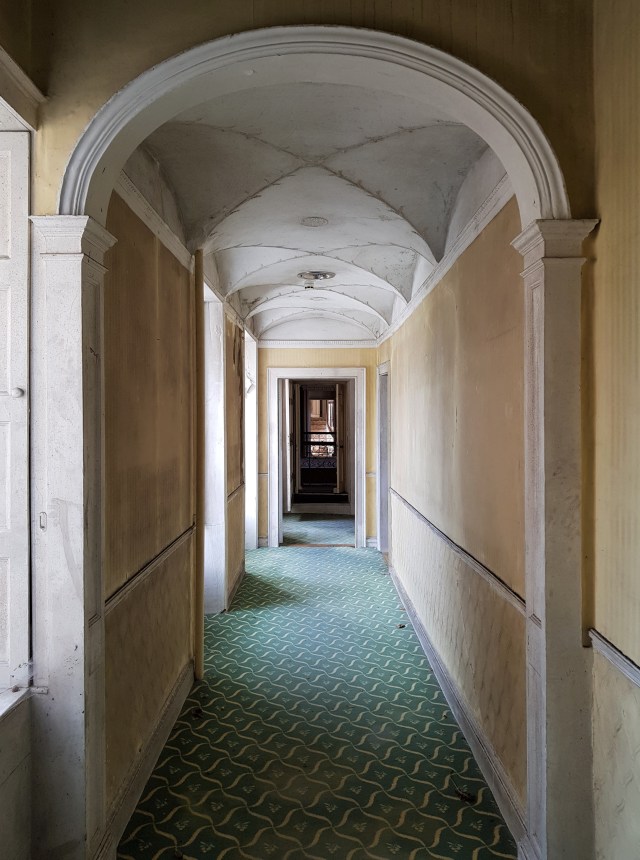
After buying the place, Denis English announced his intentions to convert Knocklofty into a series of apartments, as he had already done at Marlfield. However, the place continued to operate as before as an hotel until the advent of an economic recession at the end of the last decade. In 2013 the house was once more offered for sale, this time on 80 acres and for a price of €3 million. Two years later, that figure appears to have dropped to €1.9 million. Matters then grew more complicated when court proceedings were taken by US private equity group Cerberus Capital Management for possession of the property; it transpired that in 2014 the company had acquired a loan portfolio from Ulster Bank, which included a number of loans made to Knocklofty’s owner. He in turn disputed the matter and further legal arguments ensued until, in May 2017, it was announced that the High Court had granted Cerberus the right to take control of the property. All should have been resolved then but, alas, that does not look to have been the end of the matter. Although there has been no further reports on the matter, it looks as though dispute between relevant parties continues. Meantime, the looser in this, Knocklofty, has stood empty and falling into ever-greater disrepair. As these photographs demonstrate, unless circumstances are resolved soon, this has all the makings of a Jarndyce v Jarndyce scenario, with an equally unsatisfactory outcome.


Very Strange


The former Castle Strange in County Roscommon derived its name from a family who held this land in the late Middle Ages, called L’Estrange. There seems some confusion about whether they were of Norman origin, or whether this was an Anglicised version of an old Irish name. In Edward MacLysaght’s Surnames of Ireland (1969) the author proposes that the L’Estranges in County Westmeath had originally been called Mac Conchoigcriche, meaning border hound. Was this also true of the family of the same name in Roscommon? In any case, by the second half of the 17th century the L’Estranges, like so many other old families, had been driven out of their territory, the land in this instance passing into the hands of one Thomas Mitchell, a Scottish soldier sent to Ireland by General Monck in 1659 and seven years appointed by then-Lord Lieutenant James Butler, Duke of Ormonde, to serve as Cornet to a troop of horse under the command of Captain Nicholas Mahon. Mitchell subsequently settled in this part of the country and married, producing a large family, generations of which would live at Castle Strange. In the 19th century, successive members served in the British army, John Wray Mitchell rising to the rank of Major-General, while his son Edward became a Colonel. But further information about them, and their home, is not easy to find.


The first two photographs shown here show what remains of Castle Strange today: little other than sections of the two gable ends with portions of their chimney stacks. Seemingly built in the 1830s (after the estate was inherited General Mitchell’s father, another Edward), there appears to be nothing on record about its appearance when still intact and occupied, nor how it came to be in its present state (should anyone have such material, do please share). Meanwhile, the nearby yard to the east is in much better condition, in that at least the outer walls and sections of the roof remain in place. This very large, U-shaped block is constructed of limestone ashlar and, older images indicate, features a carved coat of arms above the central carriage arch, now impossible to see due to the thickness of ivy covering the building. The scale of this development indicates the affluence of the Mitchell family at the time, as do further ranges of farm buildings to one side. The other building of architectural interest is the now-derelict east lodge, again thought to date from the early 1830s and an exercise in romantic Gothic, with arched windows on either side of a central two-bay canted projection with a door on one side. Like so much else on this site, information about the building is scarce, making it another instance where a place’s history has been almost entirely obliterated. All very strange.


A Grand Approach II


The façade of Oak Park, County Carlow, designed by William Vitruvius Morrison in the early 1830s for Colonel Henry Bruen. The building incorporates an earlier house and was originally a grand villa, of two storeys and five bays, one on either side of the giant tetrastyle portico. The latter, featuring four Ionic columns with wreaths in the frieze above, is almost identical to that at Ballyfin, County Laois and can also be seen at Barons Court, County Tyrone and Mount Stewart, County Down, on all of which buildings the Morrisons, father and son, worked. Oak Park was greatly extended in the 1870s and also extensively restored after a fire in 1902, but some of the original interior decoration survives, notably in the entrance hall and the former library. The last of the Bruen family to live in the house died in 1954; some time earlier his wife had run away with an impoverished Montenegran prince, Milo Petrovic-Njegos.  After various legal disputes and changes of ownership had occurred, Oak Park and several hundred acres was acquired by the Irish State; today it serves as the headquarters of Teagasc, the Agriculture and Food Development Authority.


Figure of Eight


2012: Dowth Hall, County Meath (https://theirishaesthete.com/2012/12/24/netterville-netterville-where-have-you-been/)


2013: Hazelwood, County Sligo (https://theirishaesthete.com/2013/02/25/sola-perduta-abbandonata/ and https://theirishaesthete.com/2018/12/03/hazelwood/


2014: Moore Hall, County Mayo (https://theirishaesthete.com/2014/06/30/when-moore-is-less/)


2015: Kilshannig, County Cork (https://theirishaesthete.com/2015/05/18/exuberance/)

This week marks the Irish Aesthete’s eighth anniversary. The first post appeared in September 2012 and soon the format was established, with thrice-weekly texts and photographs that have continued to the present and – Deo volente – will continue into the future. As always, sincerest thanks to everyone who has shown interest in and engagement with this site: your support helps to sustain the work. Ireland is a country rich in architectural heritage (albeit not always in the best state of repair) so there’s lots more to see yet. I look forward to your company over the next 12 months. Meanwhile, stay safe, stay well.


2016: Lambay, County Dublin (https://theirishaesthete.com/2016/06/27/a-central-idea-beautifully-phrased/)


2017: Florence Court, County Fermanagh (https://theirishaesthete.com/2017/05/15/florencecourt/)


2018: Larchill, County Kildare (https://theirishaesthete.com/2018/09/17/larchill-gardens/)


Kilwaughter Castle, County Antrim (https://theirishaesthete.com/tag/kilwaughter-castle/)

Bleak House


As is well known, many Irish country houses would have been lost forever in the last century had they not been purchased and maintained by members of Roman Catholic religious orders. Often these buildings had to be converted or adapted for their new use and, as a rule, the work was sensitively done, or at least carried out in such a way that any alterations were reversible. Occasionally, however, a more aggressive and unsympathetic approach was taken, as can be seen Loughglynn, County Roscommon. The land on which the house stands had been acquired in somewhat questionable circumstances by a branch of the old Anglo-Norman Dillon family, which had hitherto been based in County Westmeath. In 1622 Theobald Dillon was created first Viscount Dillon of Costello-Gallen and following his death two years later a younger son, Lucas Dillon appears to have settled in Loughglynn with his wife, occupying an old castle that stood on the site. Eventually his descendant, another Theobald, became seventh Viscount Dillon, after the senior branch failed. The Dillons remained owners, although not always occupiers, of the property until the end of the 19th century.


Loughglynn has undergone a number of changes since first built. It has been proposed that Richard Castle was the house’s architect; after all, he did receive other commissions in County Roscommon, including Strokestown, Frenchpark and, possibly, Mount Talbot (see https://theirishaesthete.com/2020/08/03/mount-talbot/). On the other hand, the date of 1715 is sometimes given for Loughglynn’s construction; if this were the case, it cannot have been designed by Castle as he only came to Ireland in the late 1720s. Stylistically, the house is not dissimilar to other work by the same architect such as Hazelwood, County Sligo (see https://theirishaesthete.com/2018/12/03/hazelwood/) so he may well have been responsible, but at a somewhat later date. Dressed in limestone ashlar, the centre block was larger than what can be seen today, of two storeys over basement with a dormered attic storey on the high-pitched roof. The ten-bay entrance front had the three centre bays and those at either end breaking forward while on the garden side, there were canted bows on either side of the three-bay centre. On the east side, a single storey quadrant leads to a two-storey wing which forms part of the stable courtyard beyond (curiously, there is no equivalent wing on the other side of the house). So the building stood for a century until 1838 when Dublin architect James Bolger was requested to add another storey to the top of the building, sitting above the original cornice. A fire in 1896 left Loughglynn seriously damaged, and soon afterwards the Dillons sold house and estate. In 1904 the new owners, an order of nuns called the Franciscan Missionaries of Mary, embarked on an extensive programme of repairs to the damaged property. This involved taking off the top storey of the building, and making the outer bays on either side single-storey. It may also have been at this time that the west wing, if it existed, was demolished, thereby explaining the lop-sided appearance of the house today.


During the 19th century the Dillons had little direct association with Loughglynn, preferring to live in England on their estate, Ditchley Park in Oxfordshire. Therefore a succession of land agents occupied the house in Ireland and looked after the Dillons’ estates. One of them, Charles Strickland (whose nephew Walter Strickland would serve as Registrar of the National Gallery of Ireland and publish the two-volume Dictionary of Irish Artists in 1913) is remembered for his generous support of the local people during the years of the Great Famine. On his employer’s land in County Mayo, he also established Charlestown, which is named after Strickland. It was during his successor’s time as agent that Loughglynn suffered its catastrophic fire, and that the Dillons decided to sell house and surrounding land. In 1899 the former, along with 100 acres of surrounding demesne land, was bought by the Roman Catholic Bishop of Elphin; in 1903 he handed over the property to the Franciscan Missionaries of Mary, and it was soon afterwards that restoration work was undertaken on the house. The nuns here ran a school teaching various skills such as lace-making and domestic science, as well as establishing a dairy farm from which cheese was made on the premises. In 1960, during a time when admission to religious orders was at its height, the Franciscan Missionaries needed more space and so constructed a large block between the main house and the east wing. It cannot be claimed that this addition is a thing of beauty, or is in harmony with the older buildings. On the contrary, the 1960s development is ill-conceived and inconsiderate. Perhaps wisely the name of the architect responsible is unknown. The entrance front is now dominated by a pitched roofed former chapel, the centre part of which holds what remains of a window. Meanwhile, to the rear, the impression is given that some old-fashioned vision of a space craft has been ignominiously dumped on the site. Within a few decades, like many other religious orders the Franciscan Missionaries found their numbers in decline and before the end of the last century they were using the buildings as a nursing home, not least for their own elderly residents. Finally, in 2003 the place was sold to a development company which, it seems, had ambitious plans for an hotel, golf resort and so forth. By the time the economic recession had begun towards the end of the decade, little had happened and some years later Loughglynn changed hands again. Meanwhile the house suffered extensive vandalism, with the removal or destruction of almost everything it contained, including lead from the roof. As these photographs show, easy access is no longer possible, but other than the exterior walls there’s little left of the building to preserve. Another of Ireland’s historic houses left to fall into ruin.

Mount Massey, The Flower of Macroom


How I long to remember those bright days of yore
Which sweetly with joy I beguiled
The friends that frequented my old cabin floor
And the comrades I loved as a child
How I longed for to roam, by Mount Massey’s green groves
Or poach by the light of the moon
That spot of my birth, there’s no place on earth
Like Mount Massey, the flower of Macroom


In the sweet summer time, when the season was fine
What fun would be there at the gate
The colleens would smile as they sat on the stile
While the sweethearts their love tales relate
When dancing was over, we’d stroll thru the park
Each lad with his lassie in bloom
That spot of my birth, there’s no place on earth
Like Mount Massey, the flower of Macroom


For now I must roam, from my own native home
And cross o’er the wild raging sea
To leave friends behind both loving and kind
And the colleens who dearly loved me
Though fortune may smile far away from our isle
I’ll pray that the day will come soon
When I’ll stray once again, by the lovely domain
Mount Massey, the flower of Macroom

So friends come with me and ’tis there you will see
The apples and cherries in bloom
And ’tis you I’ll invite, where I first saw the light
In Mount Massey, the flower of Macroom

Mount Massey, The Flower of Macroom is an old Irish ballad.
Mount Massy, County Cork appears to have been built in the 1780s on land which at the time belonged to the Hutchinson family, but following the marriage of Mary Hutchinson to Captain Hugh Massy it was subsequently inherited by their son, Massy Hutchinson Massy whose descendants owned the house and surrounding estate until the building was burnt in December 1920 during the War of Independence. 

Standing Tall


While the two lodges designed by George Fowler Jones for Castle Oliver, County Limerick are today derelict, the main house itself is in fine condition, having been extensively restored in recent years. Jones was not yet aged 30 when he received this commission, the reason being that his clients – the Misses Mary Isabella and Elizabeth Oliver Gascoigne – had already employed him to design some almshouses near their Yorkshire estate, Parlington Hall. When therefore in the mid-1840s the sisters decided to build a new house at Castle Oliver, the old one having fallen into disrepair, Jones was the obvious candidate for the job. Constructed of local pink sandstone, the house’s Scottish baronial character may be due to Jones having been born in Inverness. The resolutely asymmetrical exterior is notable for its many stepped gables and corbelled oriels.


Reopening


Partying putti in the gardens of Headfort, County Meath: they have evidently heard the news that the building is to reopen its doors as a school next month. Its design attributed to George Semple (a Dublin-based builder and self-taught architect), the house dates from the mid-1760s when constructed for the first Earl of Bective. In the following decade, the latter commissioned Robert Adam to  produce decorative schemes for a suite of rooms in the newly completed Headfort. Adam, who never visited this country, duly came up with designs for the entrance and staircase halls, as well for as a series of three adjacent spaces on the garden front culminating in a double-height saloon that was known as the ‘Eating Parlor.’ Even if not all his proposals were fully implemented, the interiors are of immense importance as the only extant examples of Adam’s work in Ireland. In 1949 the property was opened as a school which remained in operation until last March, when the institution’s then-board took the decision to close down. However, since then a group of supporters, many of them past-pupils, have come together to raise funds and re-open the establishment, thereby ensuring the future of this very important house.


A Pioneer Passes


As many readers will be aware, Desmond Guinness, the pioneer of architectural conservation in Ireland. died last Thursday, at the age of 88. Led by Ireland’s President, Michael D Higgins, many tributes have quite correctly been paid to Desmond and his decades-long defence of the country’s architectural heritage. So, it is easy to forget that for much of that time, he and his supporters received not encomiums but abuse, not praise but criticism, not support but hostility. And yet he continued on his crusade, one which has left this country and its citizens considerably richer than would otherwise be the case.
Although a member of the Irish Guinness family, Desmond spent the greater part of his life in England until, following his marriage to Hermione Marie-Gabrielle von Urach – universally known as Mariga – he moved with her to Ireland and they began looking for somewhere to make their home. It was while engaged in this quest and travelling about the country that the couple became aware of how many old buildings of note in Ireland were being either neglected or demolished. The 1950s were an especially lean era here and, understandably, the losses to her architectural heritage provoked little, if any, protest or regret among the greater part of the Ireland’s impoverished population. Most of them had other, more immediate, concerns than what happened to properties with which they felt no great affinity; in the popular mind, historic houses were associated with the old regime. Inspecting many sites over a couple of years had the effect of refining Desmond and Mariga’s already intuitive aesthetic sensibilities, and it made them acutely aware of just how many 18th and 19th century buildings around the country were at risk of being lost forever. However, it was the demolition of Georgian buildings in Dublin rather than the disappearance of another country house that inspired the couple to establish the Irish Georgian Society in 1958. On their visits to the capital from 1956 onwards, the Guinnesses had seen Dublin Corporation workers clear away magnificent mansions on Lower Dominick Street and Hardwicke Place and replacing them with blocks of local authority flats. Most of these old properties had long ago deteriorated into squalid tenements; their loss, though unwelcome, was comprehensible. But in July 1957 the government authorised the demolition of two 18th century houses on Kildare Place, only a matter of yards from the Dail in Leinster House. No. 2 Kildare Place had been designed by Richard Castle and executed after his death in 1751 by John Ensor; its neighbour was of a slightly later date. Both houses were in excellent condition and there was no reason for their destruction other than an unwillingness on the part of the State to maintain the buildings. This barbarous act on the part of government spurred Desmond and Mariga into direct action, and the Irish Georgian Society was born.


Prior to the establishment of the Irish Georgian Society there had been no organization, or individuals, taking up the cudgels on behalf of the country’s historic properties. Building up credibility was a long and arduous process: during the first decades of its existence the Society – and its founders – had to fight many battles. Some of these were won, others lost. But the biggest battle was against ignorance and indifference: these twin demons had to be faced down over and over again. Desmond experienced much personal hostility, often from those in positions of power who did not like their decisions being called into question. However, he remained resolute in his enterprise, and never wavered in his determination to conserve the architectural legacy left by earlier generations and to encourage wider appreciation of this legacy. The most important example of his industry and imagination can be seen at Castletown, County Kildare. This important building, the first great Palladian house in Ireland dating from the early 18th century, was at risk of being lost forever when Desmond stepped in and found the necessary funds to save the property. Today Castletown is owned by the Irish State and is rightly lauded as a splendid example of Irish design and craftsmanship. But if it had not been for Desmond’s brave initiative, and then the restoration work that he and Mariga oversaw on the house – helped by the many volunteers they inspired – Castletown would now be nothing more than a handful of old black and white photographs. There are many, many other instances of bold decisions being taken by Desmond leading to the survival of important properties throughout the country. It is worth noting that from the mid-1960s onwards, he regularly visited the United States where his mission, and that of the Irish Georgian Society, was better received and supported than was the case back home. The IGS, like many of the buildings it championed, would not be here still were it not for American friends.


A brief personal note. I first met Desmond Guinness when an undergraduate, but only in passing. In the early 1980s and by then living in the Damer House in County Tipperary (an early 18th century house which the Irish Georgian Society had saved from demolition), I met him again and over the next 35 years had the opportunity to come to know him well. Desmond was a man blessed with many advantages; he was exceptionally handsome (those famous pale blue eyes) and possessed an abundance of personal charm, well able to captivate whoever was in his company. He had a deliciously mellifluous voice and engaging manner, which he put to excellent effect on his fund-raising visits to the United States; even today there are elderly American women who shyly blush when they recall being in his presence over half a century ago. In his heyday, he was a tireless advocate, running the society from a room in his County Kildare home, Leixlip Castle where – when not working elsewhere for the society – he was an unfailingly generous host with flawless manners. Leixlip Castle was always the most hospitable of houses, where Desmond was at his easiest and most charming, ensuring it was always a delight to be in his company. There are a great many people, myself included, who are grateful to have benefited from his unflagging kindness and support.
Unlike most countries, Ireland has no official honours system. During his lifetime, Desmond never received the acknowledgement that he deserved for his pioneering work in the area of architectural conservation. Now that he is dead, the best way the Irish state could honour his legacy is by giving more attention to our country’s historic buildings. Otherwise, like Desmond, it will be too late to give them the attention they merit.