
The upper yard of Crocknacrieve, County Fermanagh, described in 1833 as being ‘the seat and fee farm of John Johnston, Esq., and comprehends a nice new built house on the summit of a noble elevation, standing above a demesne of about 100 Irish plantation acres, beautifully dressed and planted.’ The following year, an ordinance survey report called Crocknacrieve ‘a neat and handsome building of modern architecture…It was built and the demesne laid out in 1817…The offices, which are attached to the house are very commodious.’ As they remain to the present day.
Category Archives: Country House
Light and Shade

After political events of the past week, many people across the globe are understandably overwhelmed with feelings of melancholia and premonitions of catastrophe. However the study of history teaches us that our forebears went through worse afflictions – and somehow survived. They faced infinitely more terrible examples of hatred and low conduct, and found the strength to carry on. They did so because, for all its failings and foibles, the human spirit is resilient. So too is the urge, the need to create beauty, even in the midst of turmoil and disorder. The determination of previous generations to overcome adversity, and to find the beautiful in the midst of ugliness can serve as our own inspiration.


The gardens at Huntington Castle, County Carlow demonstrate how beauty is able to survive across centuries of war and upheaval. The origins of settlement here go back to the Middle Ages when a Franciscan friary was established on the site: a souvenir of that period is the Yew Walk, comprising 120 English yews planted along a stretch of ground 130 yards long and believed to be at least six centuries old. In the 17th century the property passed into the ownership of the Esmondes who in the 1680s laid out much of the rest of what can be seen today, including the parterre and a French lime avenue. Other elements from this period include the stew ponds (for the cultivation of fish that could be eaten) and an ornamental lake, while later work further enhanced the gardens thanks to various specimen trees that continue to thrive. More recent additions include the creation of a rose garden and the planting of thousands of snowdrops.


The gardens at Huntington remain an ongoing project, tended by the latest generation of the family that first came here almost 400 years ago. Over that period, and well before, this country experienced many instances of upheaval, war, famine and other dreadful afflictions. And yet somehow the gardens at Huntington not only endured but were regularly augmented and improved by their owners. Those owners and the outcome of their labour offer us an example of how, even under the worst circumstances, the human spirit continues to crave beauty. Taken one afternoon in early autumn, today’s photographs show that light and shade naturally co-exist, without the latter ever being able to crush the former. In these dark days, we should remember that. The light still shines through.
Vastly More Beautifull Than I Expected

Writing to his daughter Alicia in May 1747, Edward Synge, Bishop of Elphin, County Roscommon described the new residence he was then building: ‘The Scaffolding is all down, and the House almost pointed, and It’s figure is vastly more beautifull than I expected it would be. Conceited people may censure its plainess. But I don’t wish it any further ornament than it has. As far as I can yet judge, the inside will be very commodious and comfortable.’ He had to wait a further two years to find out whether or not this was the case, but finally in early June 1749 was finally able to advise Alicia, ‘The House is as dry as you could wish. I lay last night as well and as Warm as ever I did in my life, and quite free from the only nuisance I fear’d, the smell of paint and am, I bless God, as well to day, as I was, when I wrote from Palmer’s…’ The design of the Bishop’s Palace at Elphin is attributed to Dublin architect Michael Wills, not least because a ‘Mr Wills’ is frequently mentioned in Synge’s correspondence in relation to the house’s construction. Very much in the Irish Palladian mode, it consisted of a three-storey, east-facing central block, its first-floor Venetian window of the same style and proportions as the main entrance below: quadrants linked this building to wings on either side. Unfortunately the main block was destroyed by an accidental fire in 1911 and subsequently demolished, leaving the quadrants and wings on either side looking rather lost. In recent years, the south wing as been restored as a family residence. However, its match to the north is a ruin with a bungalow built immediately in front, making the site look even more lop-sided.
This Little St Cloud

‘I went on Friday last to receive you remainders of rents in the county of Wicklow and lay at Killruddery two nights…Capt. Ed Brabazon has and will make great improvements there, the park for his colts is long time since finished and he is making also a deer park and decoy. The decoy will be the finest in the kingdom or I believe in the 3 kingdoms. The pond is already made and the reed wall is making, round a out which he will built a wall at so great a distance that the fowl shall not be frightened thereat, the south and north ends of which wall shall without and against the other two…a dry wall. Against the south wall without and against the north wall within he will plant fruit of all sorts and will make a treble ditch without the south wall and quickset the fen to the end that the deer may not get to the fruit and that the park may be completed.’
Letter from Oliver Cheyney, agent to the third Earl of Meath, 1682.


‘Killruddery…being a large house with four flankers and terraces, and a new summer-house built by the said earl…with pleasure garden, cherry garden, kitchen garden, wilderness, gravel walks, and a bowling green, all walled about and well planted with fruit trees, with several canals or fish-ponds, well stored with carp and trench…’
From a report in The Dublin Intelligence, April 1711.


‘The demesne of Kilruddery [sic] occupies a narrow valley, which separates the mountain termed the Smaller Sugarloaf from the promontory called Bray Head, and is marked by many circumstances of great natural beauty. The grounds are laid out in a manner peculiarly adapted to the character of the present building, and present nearly a unique instance in this country of the old Dutch style of gardening. From the natural grandeur of the surrounding country, the formality of this mode stands revealed with peculiar distinctness. The enclosing mountains rise boldly and at once, with all their brilliancy of purple and brown colouring, above the long avenues of stately elms, the close cut yew hedges, and regular terraces of this little St Cloud.’
From The Beauties of Ireland by James Norris Brewer, 1825.
Sic Transit Gloria Mundi

The only remaining evidence of Ashfort, County Roscommon: its entrance gates, beyond which it is best not to venture. The estate formerly belonged to the Waldron family whose residence stood on raised ground behind the trees to the right. It was long-since demolished, and the lodge here is now used to house animal feed. Sic transit…
Here the River is Beautified

In 1739 an Anglican clergyman called William Henry wrote a descriptive account of the area around Ulster’s Upper Lough Erne in which he mentioned that a river (which he calls ‘of Ballyhaise’ but which is now known as the Annalee) ‘ murmurs by Rathkenny, the seat of the Clements’ family. Here the river is beautified by an elegant house, improvements and large plantations on the southern shore, and on its northern bank by extensive gardens and terraces.’ It appears that Daniel Clements, originally from Warwickshire, came to Ireland in the 1640s as a soldier and by 1657 was in possession of the estate of almost 2,000 acres at Rathkenny, County Cavan which remained in the possession of his descendants (whose name in the 19th century became Lucas-Clements) until sold just a few years ago. His son Robert succeeded to the property in 1680 and remained there until his own death in 1722. One of Robert’s sons was Nathaniel, of whom mention has been made here before (see A Man of Taste and Influence, August 3rd 2015).


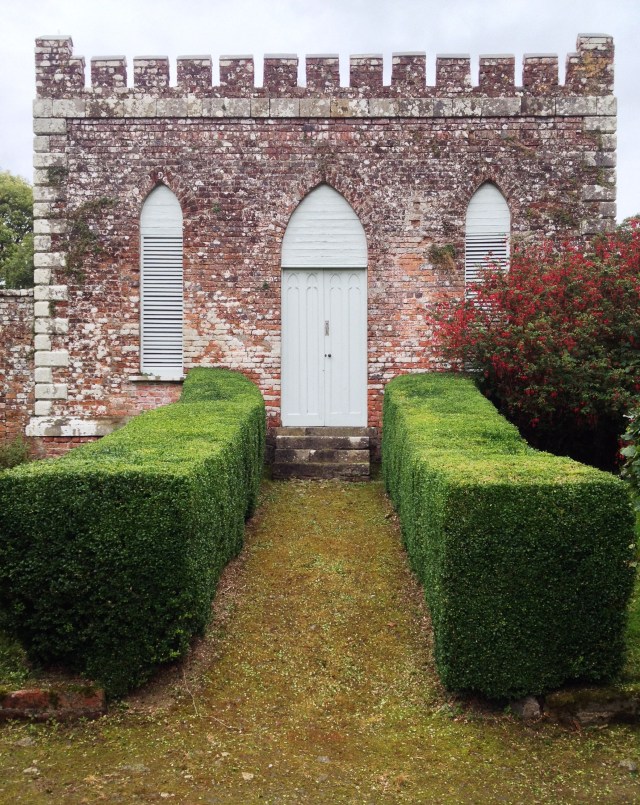
The Clements family would seem to have built a house for themselves on the south bank of the river which bisected their property. Nothing is known of the appearance or character of this building since it was demolished, likely around the late 1820s when work began on a new residence. This neo-classical block was designed by William Farrell who was the architect for a number of other such places in the vicinity. A sunken lawn to the immediate east appears to indicate where was the previous house but directly across the river is a survivor from the earlier property: a terraced walled garden. Today this is approached by a narrow concrete bridge but presumably something more elegant once offered access, since the garden itself is rather splendid. Cut limestone walls support banks on either side of limestone gate piers: paths to the immediate left and right lead to enclosing red brick walls which, on the river frontage, conclude in tall piers topped with urns. A gate to the east leads beyond the wall to the remains of a small pavilion built on the water’s edge; only one wall of this remains with a gothic arched window at its centre. One has a sense of what this little building must have been like since at the top and centre of the main terraces (supported by a sequence of low brick walls) is a summer house. Flanked by quadrant walls it is in the gothick style, constructed of brick with stone quoins, a battlemented parapet and arched windows on each side of the door. Inside is a single high-ceilinged room which once had further windows, since blocked up, and a chimneypiece which has gone. To the rear of the building there is access to another room below: one imagines this was used by servants looking after the needs of those upstairs.


Relatively little is known of the history of the walled garden at Rathkenny: Lucas-Clements lore proposed that it dated to 1695, which means construction soon after Robert Clements returned from England (he had been attainted by James II’s parliament in 1689 and fled to England) and around the time he became high sheriff of County Cavan. Nothing like it survives in this part of the country, but evidently at one point it was not the only such terraced garden. In 1739 the aforementioned Rev. Henry wrote of Ballyhaise, some nine miles to the west, ‘‘This seat, for beauty and magnificence, may vie with any in Ireland. There is an ascent to it by several terraces from the river, which are adorned with ponds, jets d’eau, fruit and flowers.’ Designed for Colonel Brockhill Newburgh, probably in the third decade of the 18th century, and attributed to Sir Edward Lovett Pearce, the main house at Ballyhaise is of red brick with cut stone dressings: with later additions the building survives although the river-fronting terraced gardens are long gone (for more on Ballyhaise, see Made to Last For Ever, March 9th 2015). Then barely three miles to the east of Rathkenny is Bellamont Forest (La Belle au Bois Dormant, January 21st 2013), another red-brick and stone house almost certainly designed by Pearce, and then a few miles further north again are the remains of the former early 18th century stables at Dartrey, County Monaghan (Now Unstable, October 1st 2014), once more employing the same materials. One has the impression that even if the same architect was not involved in all these neighbouring estates, the same spirit was at work, and the same influences and tastes being shared. More research remains to be done in this area but meanwhile the terraced gardens at Rathkenny are a rare survivor from the early Georgian period. Thankfully the property’s new owner appreciates their significance and is ensuring that they will continue to offer us an insight into early 18th century horticultural design.
The Well Improved Seat

What remains of The Grange, County Limerick. Dating from the second half of the 18th century, it was described by William Wilson in 1786 as ‘the beautiful and well improved seat of Standish O’Grady.’ The property remained with the O’Gradys until that branch of the family died out in 1861 after which it passed to the Crokers, to whom they were related by marriage. But Captain Edward Croker likewise had no heirs and The Grange was inherited by his two sisters. The house was still intact in the 1940s but thereafter began to deteriorate and is now just a shell. The 19th century entrance gates give an idea how this beautiful and well improved seat must once have looked.
A White Elephant

A fortnight ago the BBC reported that the Department of Agriculture in Northern Ireland had spent almost £400,000 maintaining an equestrian centre in County Fermanagh that it stopped using four years ago. ‘The Necarne Estate in Irvinestown has been lying empty since equine courses were moved to Enniskillen. In 2012, the department said Necarne had become surplus to its requirements. But it had signed a 25-year lease for £500,000 that runs until 2023 without an early opt-out clause.’ At the centre of this property, which runs to 228 acres, are the remains of a residence called Castle Irvine.


Castle Irvine, sometimes known as Necarne Castle, was originally built around 1618-19 by a Scottish settler called Gerard Lowther: given the uneasy times, the four-storey rectangular building was defensive in appearance, with walls seventeen feet thick and two towers to the rear. The castle and surrounding lands were subsequently acquired by another Scottish settler Christopher Irvine whose descendants remained there until the last century. In 1788 Major Gorges Irvine married the Meath-born heiress Elizabeth D’Arcy, after which the family was known as D’Arcy-Irvine. Thanks to this injection of money, the castle underwent a major overhaul in the first half of the 1830s, the architect responsible being John Benjamin Keane, former assistant to Sir Richard Morrison. Perhaps for this reason the appearance of Castle Irvine bears some similarities to that of Borris, County Carlow which had been revamped some years earlier by Morrison in the same Tudor-Gothic idiom. A new range was added in front of the old castle, of five bays with an arcaded central porch and octagonal turrets at the corners. Further towers and crenellations were scattered liberally elsewhere, so that the whole building became an elaborate gothic fantasy. However, again like Borris, while the exterior of Castle Irvine was in one style, the interiors adopted another, being strictly classical. The entrance hall, for example, was flanked by red scagliola columms with Corinthian columns (once more the entrance hall of Borris is called to mind).


In 1922 Major Charles Cockburn D’Arcy-Irvine gave up living at Castle Irvine: his son Captain Charles William D’Arcy-Irvine had been killed in the Dardanelles seven years earlier. In 1925 a Captain Richard Outram Hermon from Sussex bought the castle and estate and lived there with his own family until the outbreak of the Second World War. During the subsequent period it was used as a military hospital by British and American forces but thereafter Castle Irvine was never occupied. Following Captain Hermon’s death in 1976 the estate was put up for sale and bought first by a local entrepreneur who had developed several other hotels in the Fermanagh region. However, in 1987 Castle Irvine was acquired by the local District Council for about £300,000, after which the same authority spent some £4 million developing equestrian facilities on the site including a 300-seat indoor arena, 80 stables, 16 bedrooms, two dressage arenas, and courses for cross-country, point-to-point and steeplechase. Ultimately this ambitious project came to a premature end, although it continues to cost the NI Department of Agriculture money every year. Throughout this time no funds were spent on the old castle, which despite being a listed building in the care of the council, has deteriorated to the point where it is now just a shell: as one of the authority’s officials told the BBC, ‘Unfortunately a use for the castle has not been found and it would take a very serious amount of money to put it back together.’ It is hard to imagine who might now want to spend such money for what has become a large and derelict white elephant.
Knox’s Folly

Close to the shores of Lough Conn and from there looking not unlike a ‘cottage’ constructed for the Vanderbilts in Newport, Long Island, this is Errew Grange, County Mayo designed in the early 1870s by James Franklin Fuller for Granville Knox following the latter’s marriage to heiress Ellen Farrer. Unfortunately Mrs Knox’s resources proved not to be limitless and by the mid-1880s her husband was declared bankrupt: he and his family are believed to have emigrated to Nova Scotia and the newly-completed Errew Grange – otherwise known as ‘Knox’s Folly’ – was seized by bailiffs. After which the building had a somewhat chequered career, serving on several occasions as an hotel (in which capacity it might almost have been the model for the fictional Majestic in J.G. Farrell’s 1970 novel Troubles) and for a short period as a convent school. In 1949 Errew Grange was gutted by fire and the shell thereafter stood empty until some years ago the property was converted into what were intended to be luxury apartments: this scheme appears to have failed since it now stands empty and rather desolate.
A Light Touch

The double return Imperial staircase in Crom Castle, County Fermanagh. The house was designed in the mid-1830s by Edward Blore, a protégé of Sir Walter Scott who specialised in Gothic Revival architecture. Here a mixture of timber and plaster was employed to create a feather-light sequence of soaring arcades in the late Perpendicular style leading up to an octagonal lantern.


