The Gates to Nowhere

20131103-154510.jpg

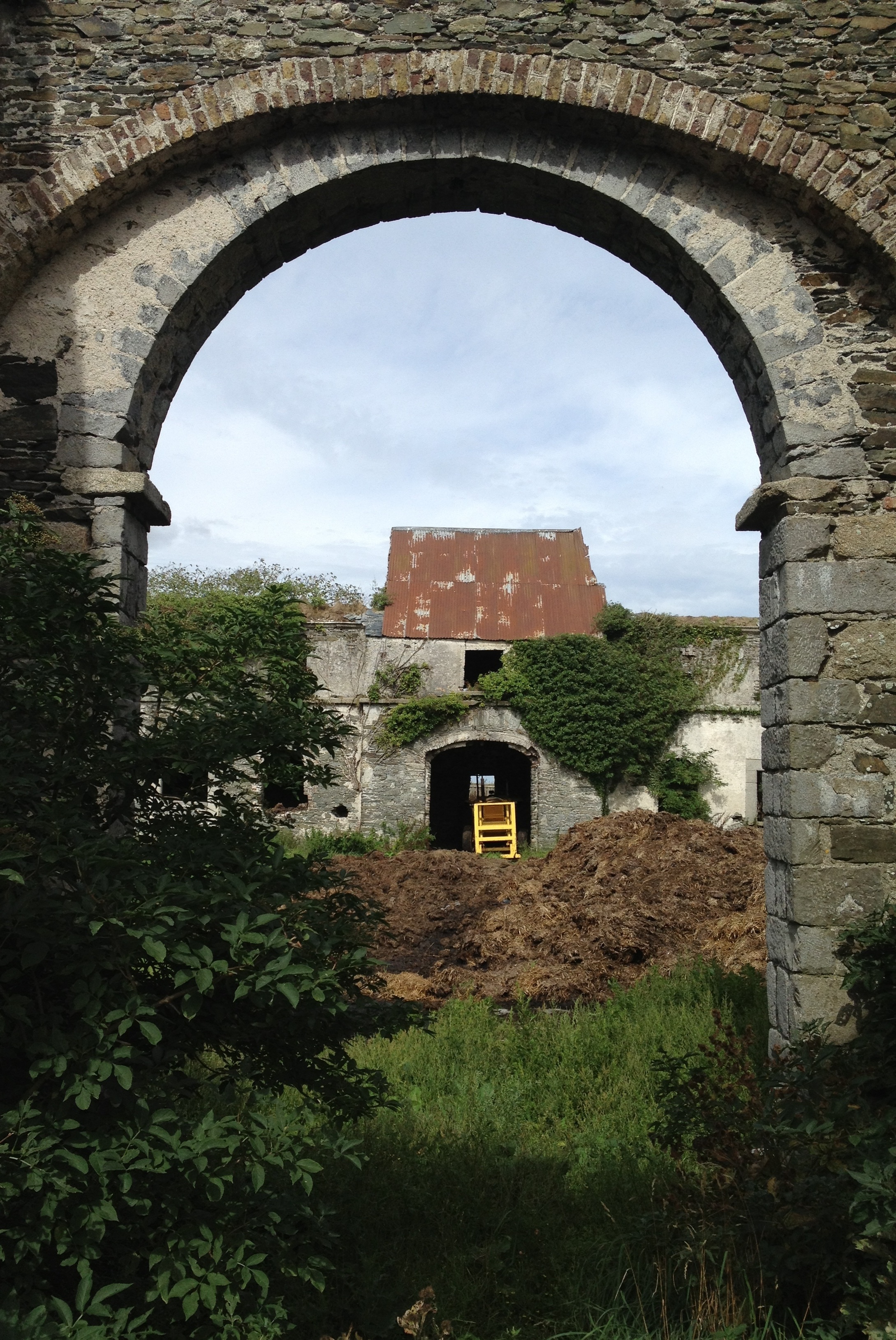
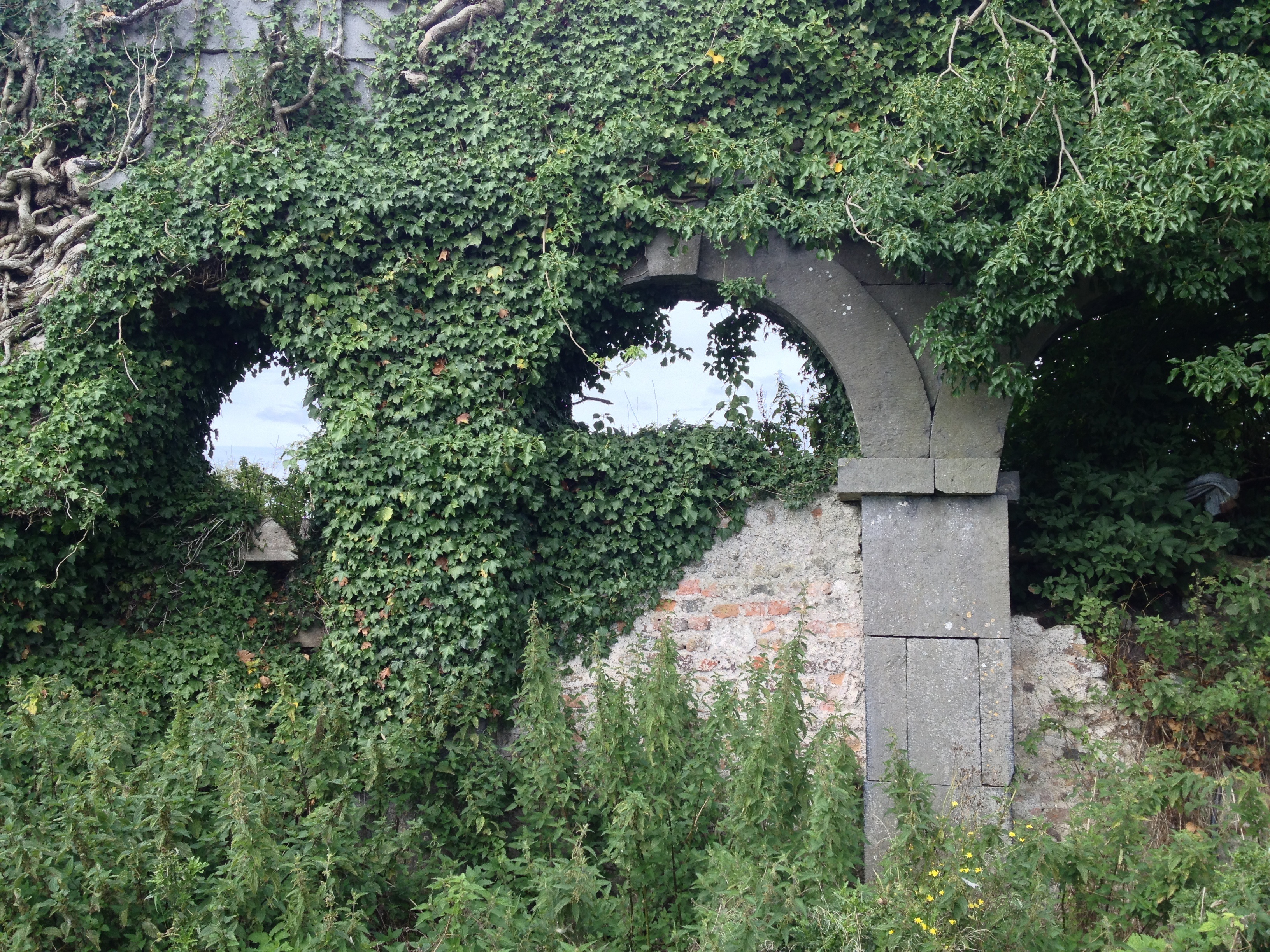
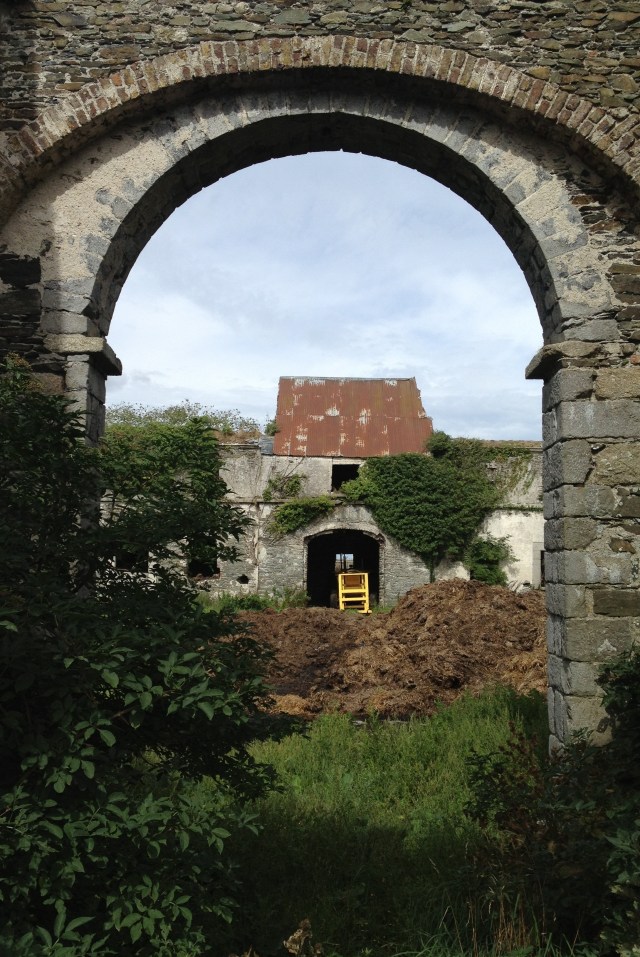
A gateway arch looking rather desolate on the side of the road at Northbrook, Aughrim, County Galway. This was not its original location, since the arch came from an estate in neighbouring County Roscommon, possibly Mote Park. The house there, belonging to the Crofton family, was demolished in the 1960s, its contents sold two decades earlier. Little now remains except another entrance gate, a much more substantial Doric triumphal arch surmounted by a lion which dates from c.1800 and is sometimes attributed to James Gandon. If the gateway shown here did come from Mote, it presumably marked a secondary entrance into the demesne.

A Plucky Survivor

IMG_5610

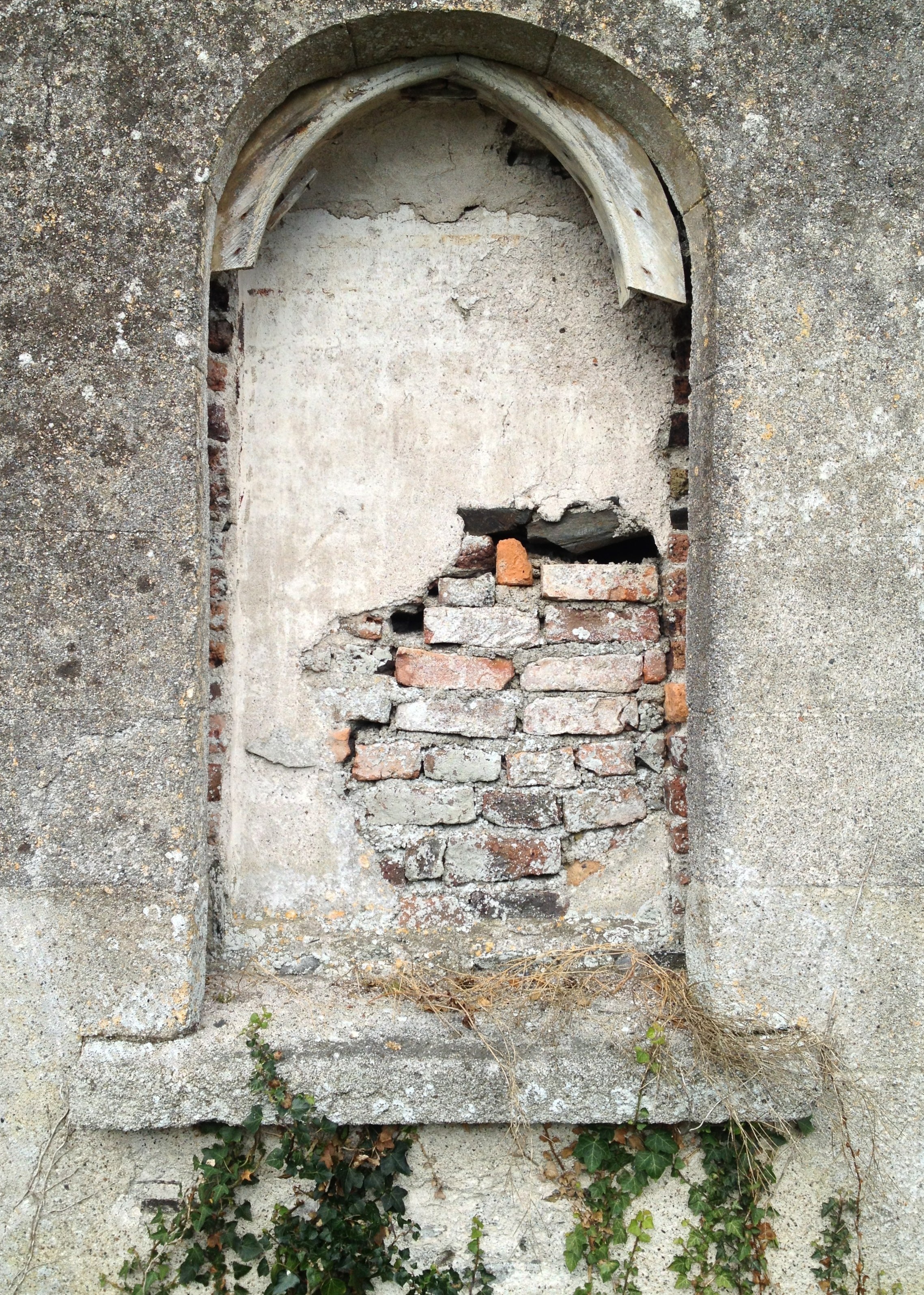
The entrance to the last remaining 18th century house on O’Connell Street, Dublin. Set in the red brick façade, No. 42’s limestone door case has a handsome carved tablet centred on a lion mask not unlike those one finds on Irish mahogany tables of the period; the lintel above has been damaged for as long as I can remember. On a site leased in 1752 to Robert Robinson, State Physician and Professor of Anatomy at Trinity College, the building appeared four years later on Roque’s map of the city. The first floor contains a fine room to the front with very pretty rococo decoration on its ceiling.
At the time of the house’s construction, O’Connell Street (then called Sackville Street) was the city’s finest residential thoroughfare and not the grubby strip of fast-food outlets and slot-machine arcades the local authority has of late encouraged it to become. Yet one wonders whether this building can survive when it has suffered such sore neglect for years. The site to the immediate north, for example, formerly occupied by the decidedly mediocre Royal Dublin Hotel is now an vacant plot with obvious consequences for this structure. Somehow it still stands but for how much longer…

Splendours and Follies

image

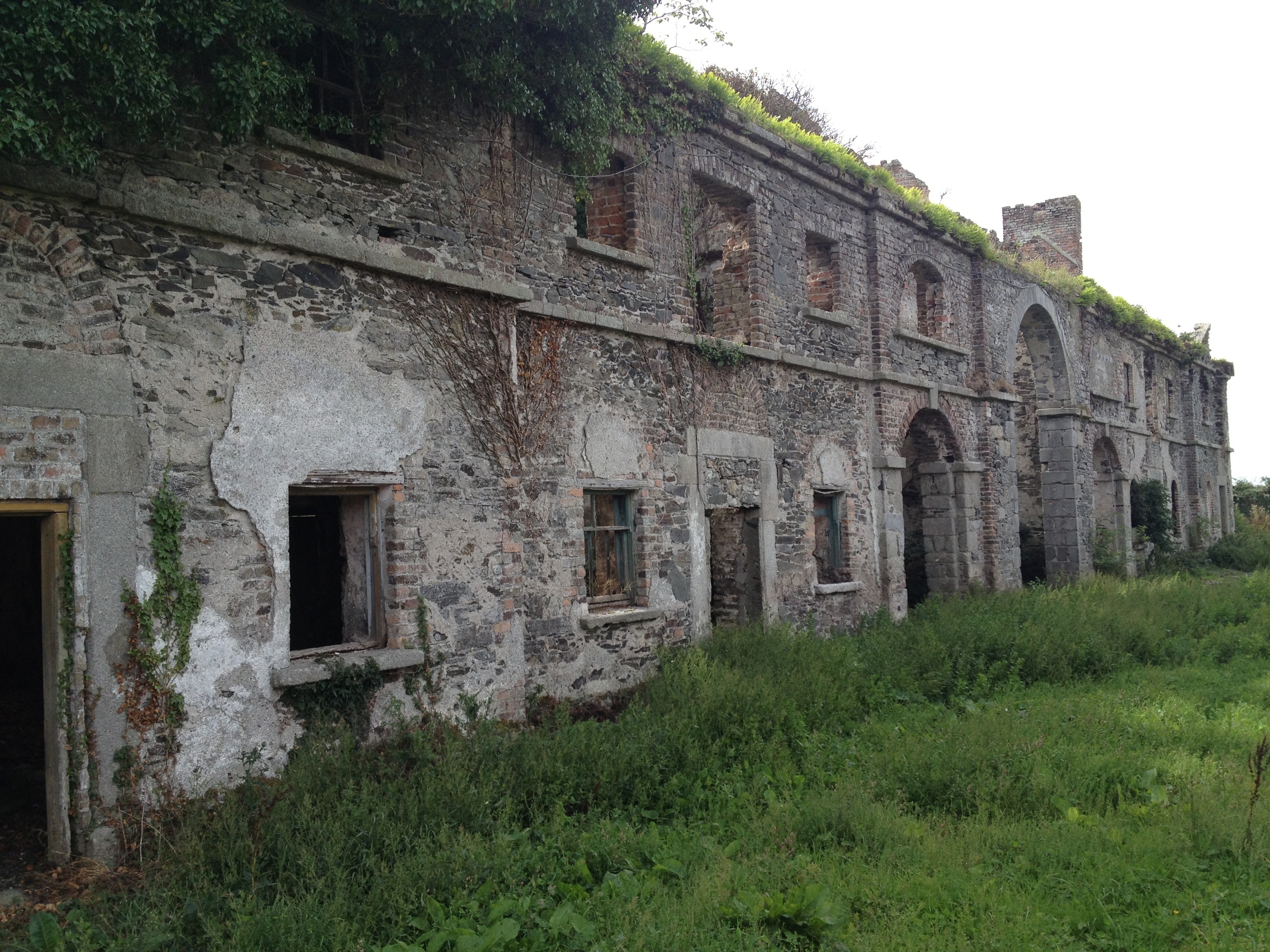
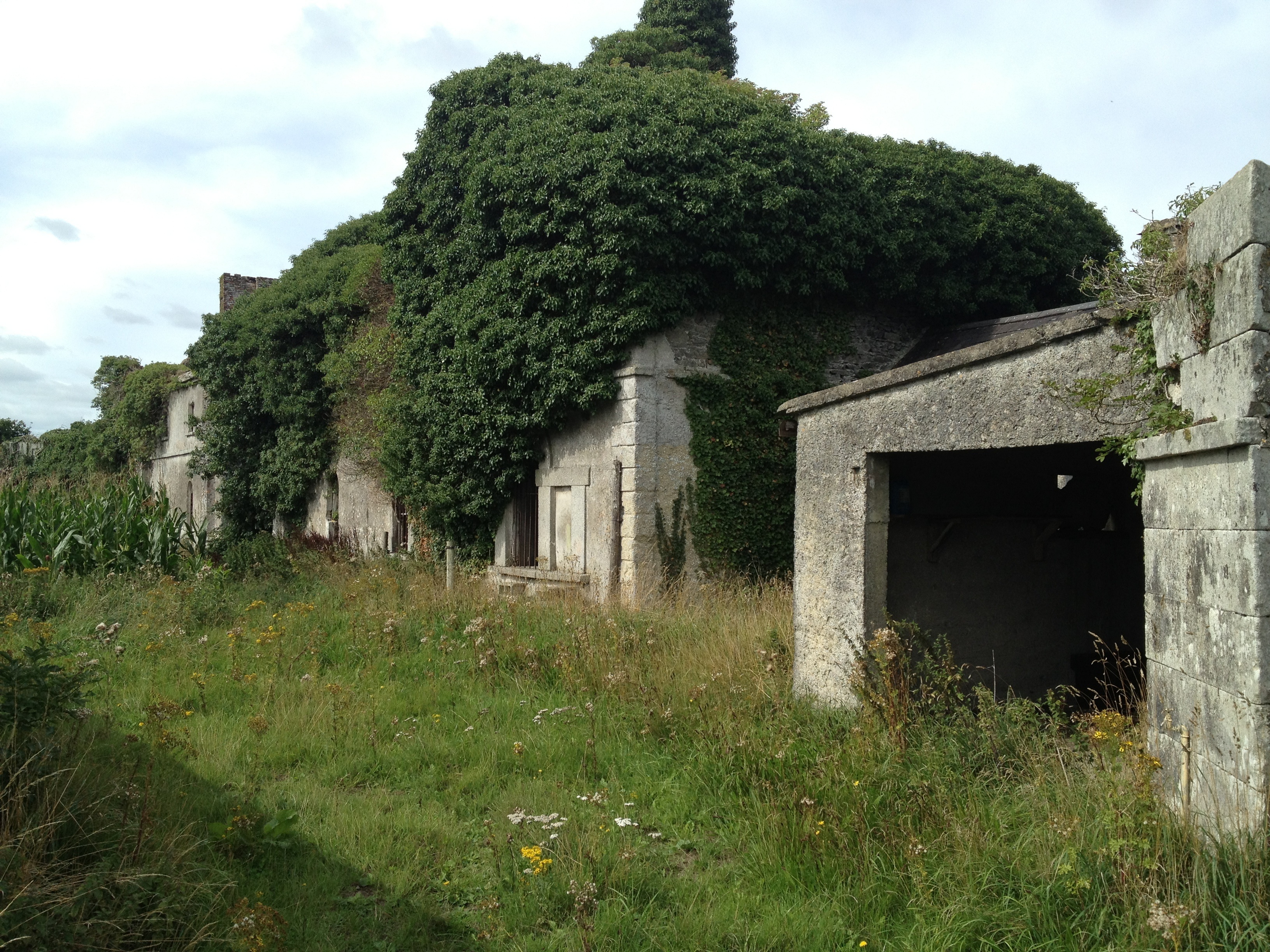
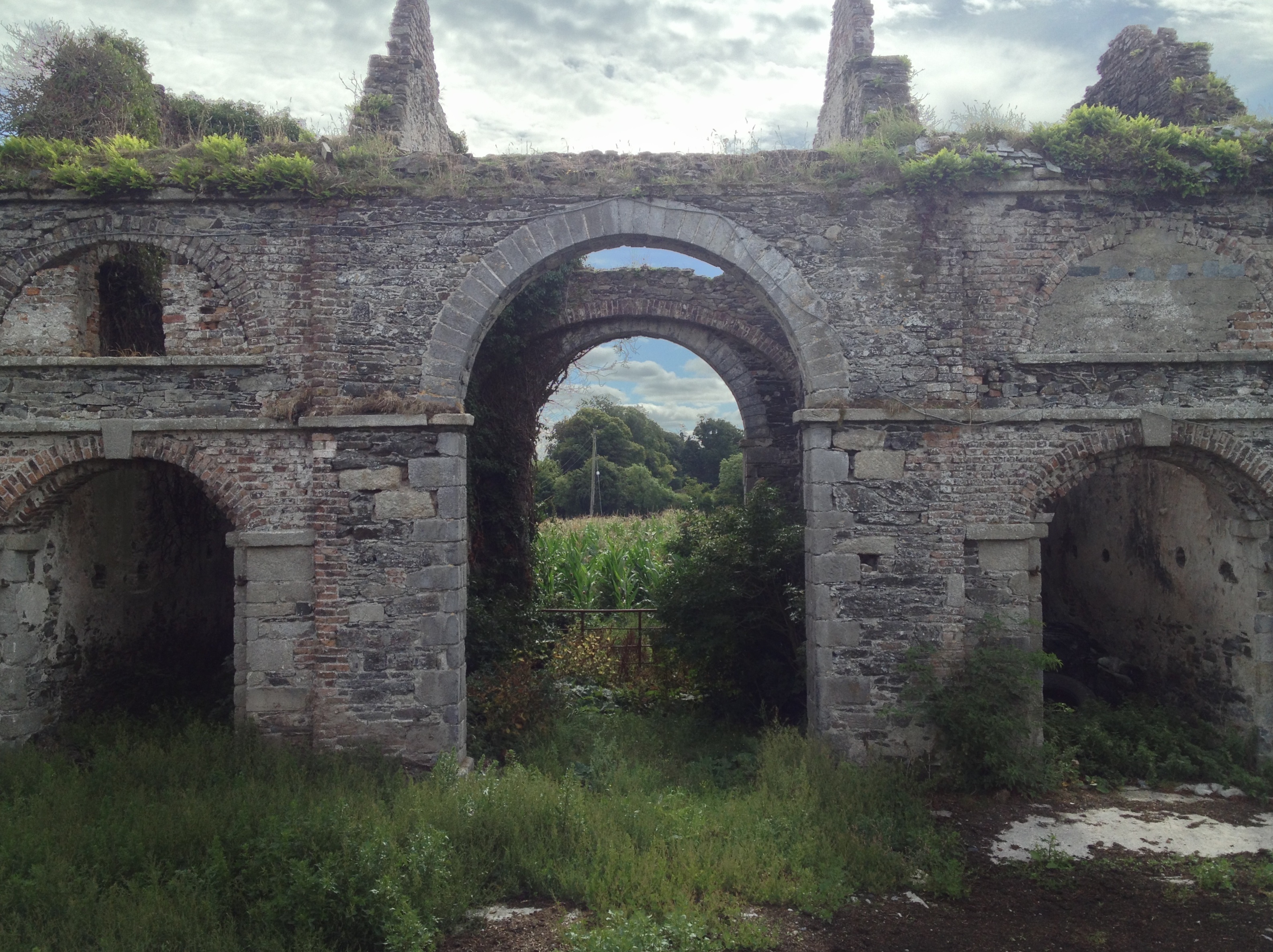
Driving along a minor road in south County Kildare, one’s eye is caught by the sight of ruins rising high above a field of maize. These roofless blocks were once the stables attached to and now all that remain of Belan, seat of the Stratford family, Earls of Aldborough. That Belan was once rather splendid cannot be doubted: in 1786 George Powell who was related to the family through marriage, wrote ‘The Mansion House of Belan is most Magnificent as is also the Demesne thereto, containing 12 porters Lodges Erected by the present Earl at the six Approaches, who hath also added thereto a Fruitery, Green, Hot and Tea Houses, a Square of Offices, a Chappel & a Theatre & Expended near £8000 on the Estate…’
Almost all of this is now gone, and the only evidence of Belan’s former resplendence are the aforementioned stables, the shell of an octagonal tea house, a few obelisks and a small domed temple. For once, however, decline and fall occurred not during the last century but earlier and while members of the Stratford family were still, if only nominally, great landowners.

image

image

Originally from Warwickshire, the Stratfords seem to have settled in Ireland about the time of Charles II’s restoration in 1660. Within a few years Robert Stratford had acquired land around Baltinglass, County Wicklow and thereafter their rise was assured, not least through the ability to return two members to the Irish House of Commons. By 1690 they already owned property at Belan, since in July of that year Edward Stratford found himself successively entertaining the two rival Kings James and William, his personal sympathies lying with the latter. As William ultimately proved the victor, the Stratfords’ political and financial status was further strengthened. Edward Stratford’s third son John (who was made first Earl of Aldborough shortly before he died in 1777) inherited Belan around 1740 and soon afterwards commenced either to build anew or to enlarge his residence there. The architects for this property are held to have been Richard Castle and Francis Bindon.
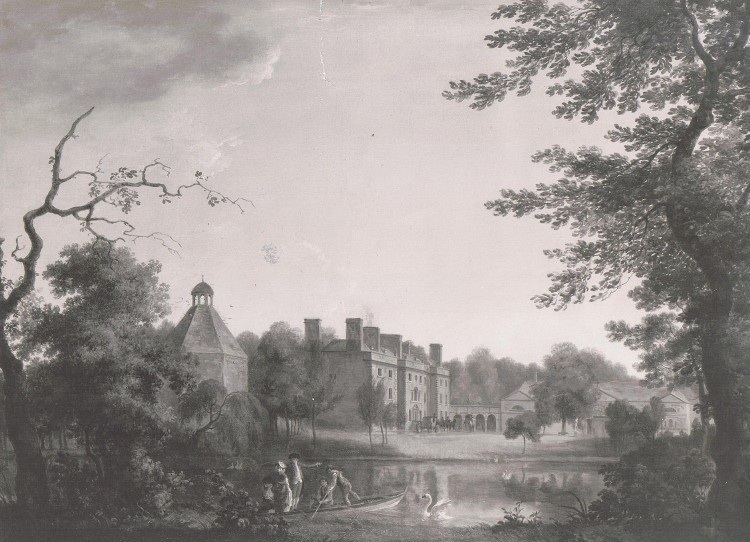
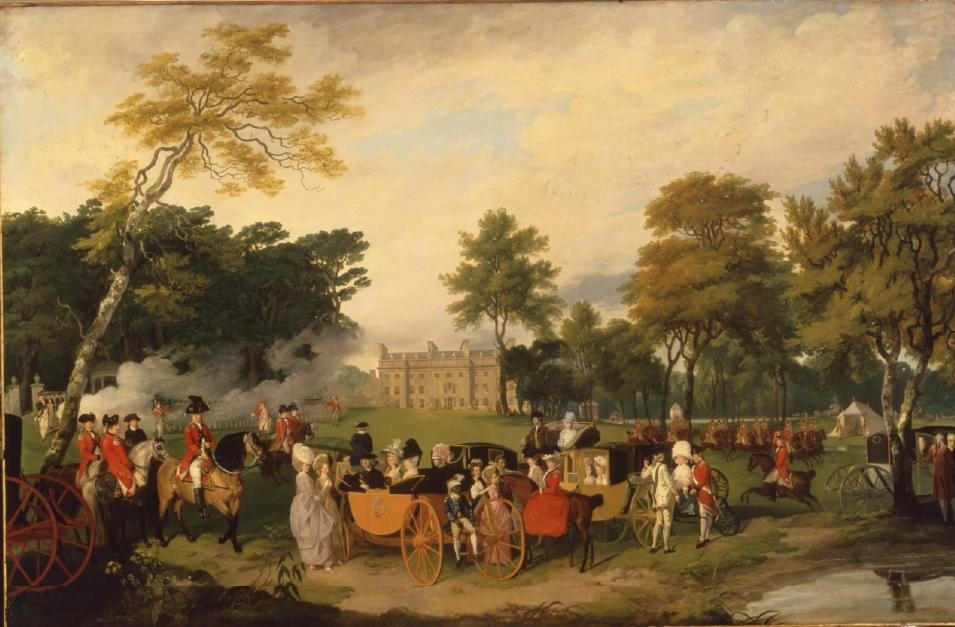
We cannot say for certain what the house looked like since paintings in which it features by William Ashford (from which the engraving at the top of this piece is taken) and Francis Wheatley (see the very last picture, showing the second Earl reviewing the Aldborough Volunteers at Belan) display differences that suggest to some extent they reflected the owner’s aspirations for the building rather than its actual appearance. Nevertheless we do know the main block, large and plain, was 120 feet long and 44 feet deep, of three storeys with a gabled attic and projecting end bays. To its right were the pair of parallel stable blocks that still survive (albeit in ruinous state), the first of them linked to the house by a curved portico.

image

image

Here are some extracts from the delightful reminiscences of Georgina Sartoris (née Lyster) published in the Journal of the Kildare Archaeological Society in January 1908 during which she recalls visiting Belan as a little girl in the 1830s:…’a fine stone mansion, a magnificent flight of granite steps, with two stone vases at the top, led to the entrance door. Though uninhabited for fully ten years, the house was in perfect repair, no trace of damp or decay and to all appearance, might have been lived in a week before. I have not a distinct recollection of all the rooms; but the dining room is fresh in my memory, also the saloon, and his late lordship’s bedroom. The dining room, not very large was panelled, family portraits being set in the panelling. I was too young to care much about them, but feel sure they were all of men. Had there been lovely ladies or pretty children amongst them, I should have remembered them. The saloon was lovely, with a polished floor of narrow oak boards…. on one occasion (why I know not) my sister and myself occupied his late lordship’s bedroom, very comfortable it was of moderate size, the fireplace like those of the other bedrooms surrounded with the prettiest tiles I have ever seen, the ground white with pink and blue landscapes, figures and flowers on it; a fine four post mahogany bedstead, Indian chintz curtains, some Chippendale chairs, and a wardrobe are all I remember of its furniture…The grounds of Belan were very beautiful, and of considerable extent. On one side though not seen from the house, were the celebrated fish ponds (not that in my time there was a fish in them), large and deep, the trees around them giving them a secluded and fascinating look. Here, on hot summers’ evenings, we used to sit and watch the dragon flies. I had never seen dragonflies before, and could not associate them with flies – I could only think of them as tiny winged spirits, whispering messages from afar to the reeds and irises which grew at the water’s edge. The gardens were at some distance from the house, and were large and walled in. I do not think I was often in them. What struck me most was the enormous quantity of lily of the valley. I have never seen anything like it elsewhere and its scent lingers with me still…’

image

image

The fall of the house of Stratford was as spectacular as its rise. The second Earl, a man of great energy, not only greatly improved the house and demesne at Belan but was also responsible for developing Stratford Place in London and for building the immense (and now sadly dilapidated) Aldborough House in Dublin in the years preceding his death in 1801. Although twice married, he had no children and so a younger brother inherited. The last member of the family to live at Belan, he was likewise childless meaning everything passed to another brother, the fourth Earl who preferred to occupy a house elsewhere on the estate, Stratford Lodge (subsequently destroyed by fire) and who abandoned Belan to an agent more interested in helping himself than in looking after his employer’s property. The next heir, Mason Gerard Stratford, fifth Earl was a hopeless spendthrift who, when short of funds, would visit London money lenders with a gun and threaten to shoot himself if they did not give him cash. He was also a bigamist, possibly even a trigamist, and on his death the eldest son from one of these marriages had trouble claiming a right to the title and what remained of the family property. Sixth and final Earl of Aldborough, he died without heirs in 1875.
By that date Belan was already in poor condition and some thirty years later Mrs Sartoris, who remembered the house intact, could write that ‘Beautiful Belan lies in ruins, the wind blowing where it listheth, sighs over the desolate grounds and gardens once so beautiful, a herd lives in the yard, sole occupant of that once lovely demesne.’ As late as the 1940s the main walls of the house still stood, but this shell was subsequently swept away. Today only the remnants of the stables survive to remind us of what once stood on this site and to serve as a warning that nothing is eternal.

image

Castles in the Air

image

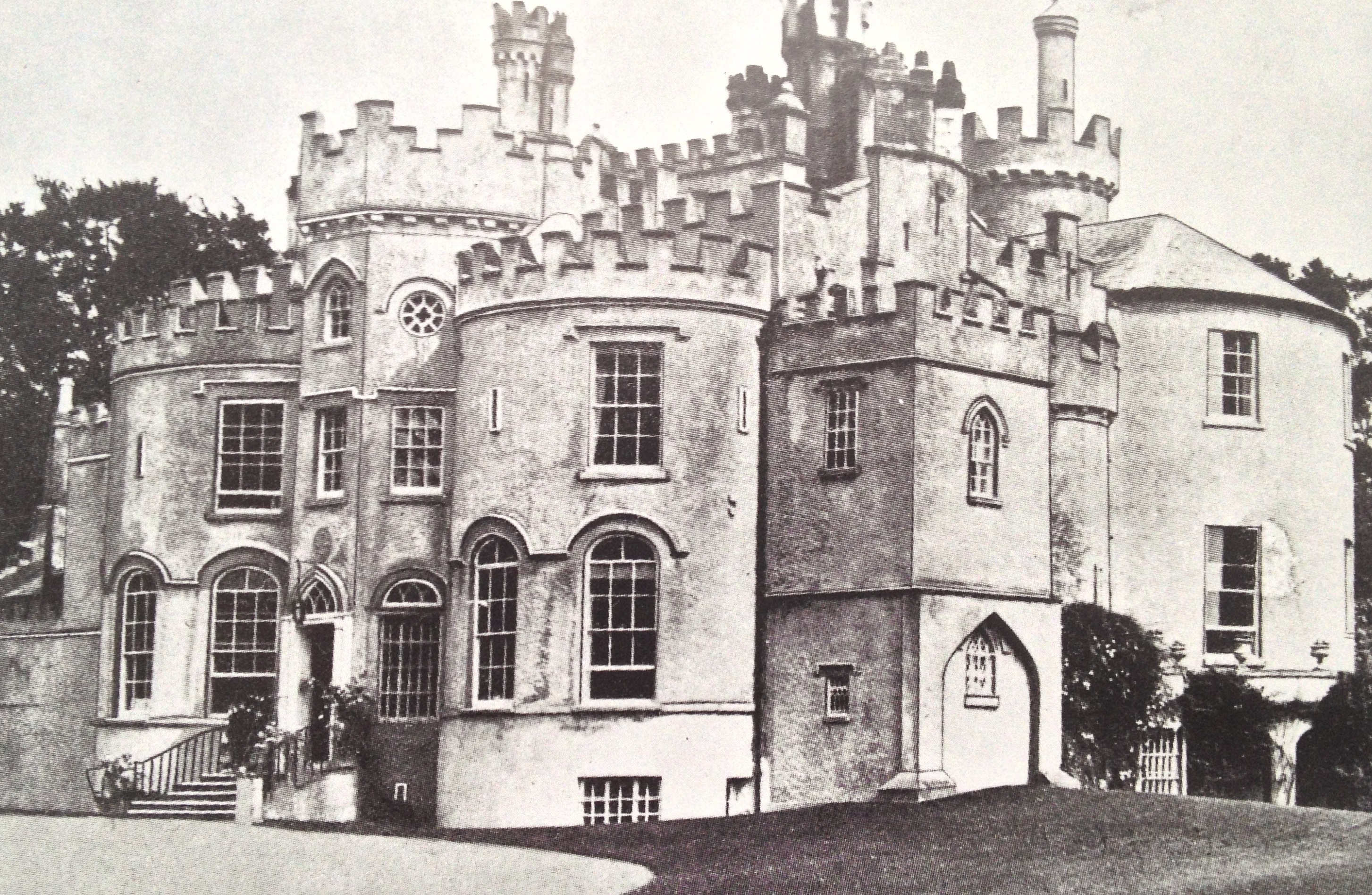
An old photograph of Shanganagh Castle, County Dublin showing the house when all its external decoration was still intact (some has since been removed/lost). Although there have been buildings of that name on the site since the early 15th century, the core of the present structure dates from c.1760 when a plain classical residence was constructed. At the start of the 19th century the property was bought by Major-General Sir George Cockburn who in 1805 commissioned Sir Richard Morrison to remodel the house: the addition of what has been accurately described as ‘a profusion of battlements and turrets’ transformed the place into a fantastical toy fort. The interiors were more restrained not least because Cockburn, who was something of an aesthetically-minded career soldier and had acquired a collection of antiquities, sculptures and paintings during his military career, required a top-lit gallery in which these could be displayed.
As with so many Irish houses, the history of Shanganagh in the last century was not a happy one: after serving for some time as a Church of Ireland college of education it was converted into an open prison and remained such until closed ten years ago. Since then the building has suffered from being left vacant, but earlier this month Dún Laoghaire-Rathdown County Council announced it had acquired Shanganagh and immediately surrounding acreage as part of a complex land-exchange programme. Inevitably the property is now in poor condition and so remedial work must be undertaken to make it secure. One awaits further developments, not least whether Shanganagh will be returned to the appearance it presents in this photograph.

Majestic Though in Ruin

IXSMBURCOHJONBP-03b5704419b1465c8a20e1614a7b13aa

IXSMBURCOHJONBP-4c3e2e2438904107bb6fb651f07ff123

On August 29th last, the Irish Times reported that the portico of a small 18th century lodge in County Kilkenny had collapsed. Not, one might reasonably think, a matter of great import, certainly not as momentous as the disintegration of other buildings reported by the Irish Aesthete over the past year. But this is to ignore the architectural significance of the structure in question, and what its neglect over the past decade says about our failure to care for the built heritage.
The temple or columnar lodge stands within the grounds of Belline, an estate not far from Piltown. In the second half of the 18th century Belline was occupied by Peter Walsh (d. 1819), whose family appear to have been agents for the Ponsonbys, Earls of Bessborough whose Irish seat Bessborough House was in the same part of the country. Walsh may well have been a tenant of the Ponsonbys; it is known that Lady Caroline Lamb, daughter of the third Lord Bessborough, stayed at Belline with her husband William (the future Lord Melbourne and future Prime Minister at the time of Queen Victoria’s accession) in September 1812 in the aftermath of her highly-publicised affair with Lord Byron.
Whatever Peter Walsh’s precise status, he was regarded in Ireland as an improving landholder, much given to agricultural improvements and to bettering the circumstances of less-fortunate residents in the region. Of particular relevance to the subject under consideration here is the fact that he was also an ardent antiquarian, commissioning and collecting architectural drawings of Ireland’s ancient monuments, and keen to preserve the relics of our history, some of which have since passed into national collections. Both during his lifetime and after his death Walsh was held in high regard; James Norris Brewer in his Beauties of Ireland (1825) declared ‘we are well convinced that every reader, to whom he was known, will join in the warmth of our admiration and the sincerity of our regret; so general was the esteem created by his unassuming virtues!’

IXSMBURCOHJONBP-25bc5ea9a8fe4a4597a32546dce94af4

IXSMBURCOHJONBP-b15c7f1626f34d30a1dd3370337507d9

IXSMBURCOHJONBP-4630672feba4472ebbd0f6298141de97

Dating from around 1770, Belline House was built by Peter Walsh who then went on to construct a number of other splendid edifices in the surrounding grounds, the majority of which survive to the present day. These included a detached gallery, known as the ‘Drawing School’ since according to Brewer, it ‘was constituted as a sort of academy for students by the active liberality of the late Mr Walsh…several children of the peasantry in this neighbourhood have lately evinced a considerable degree of genius for drawing. Such as were of greatest promise, Mr. Walsh took under his immediate protection, and supported in the pursuit of the art to which they aspired.’ Then there was ‘a most admirable pattern for a farm house; it is an octagon of two stories, inclosing a yard in the centre; below is a dairy, a residence for the dairy-man, cow-house, stable, and other offices, above is a loft for corn, extended over the whole building.’ And in addition there is a pair of circular pavilions behind Belline House, each three storeys high, the top floors serving as pigeon houses, and a pair of octagonal stone gate lodges (one still standing) at the southern entrance to the demesne.
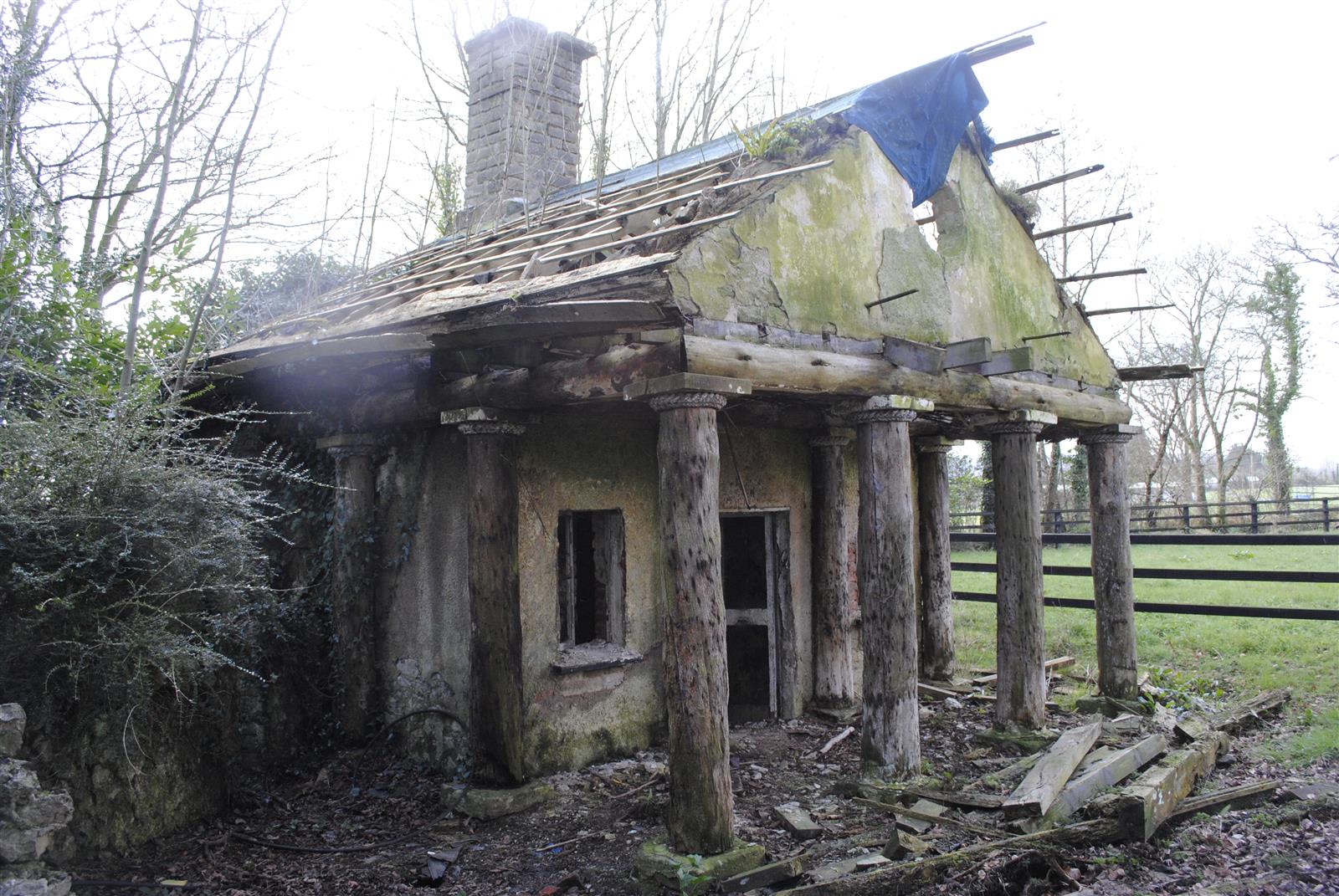
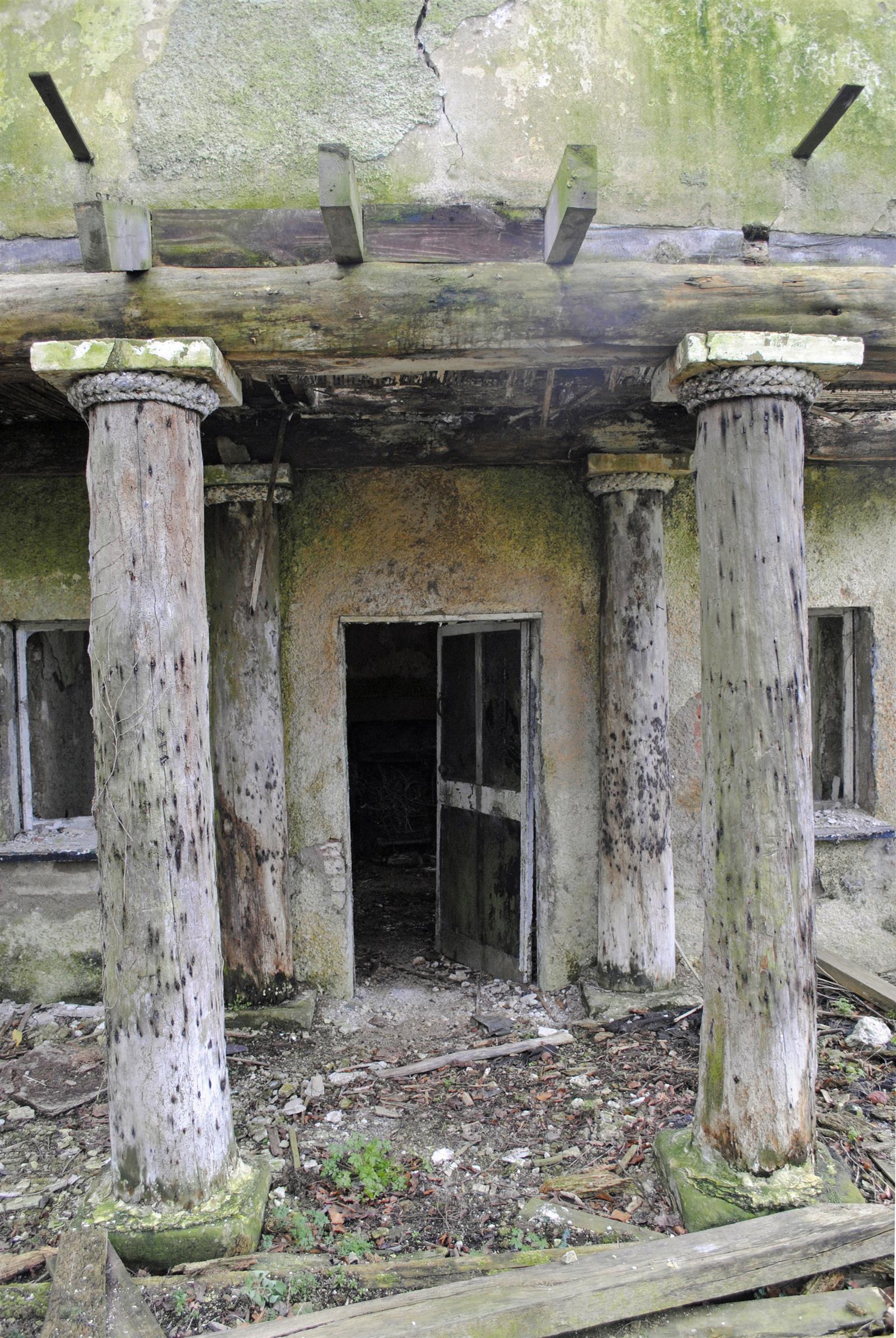
Finally we come to the smallest but perhaps most remarkable of Peter Walsh’s buildings: the temple lodge. Comprising portico, front room and two rear chambers, its precise date of construction and purpose are unclear; standing in the midst of the estate and not beside an entrance it was unlikely to have been a gate lodge but might have been intended as a summer pavilion or model dairy. But what is most important is that Belline’s temple lodge has been judged the earliest known example in Britain and Ireland of the 18th century ‘rustic hut’ inspired by theories on the origins of man-made structures expounded first in 1753 by the French Jesuit and philosopher Marc-Antoine Laugier in his Essai sur l’architecture (translated into English in 1755) and then by Sir William Chambers in A Treatise on the Decorative Part of Civil Architecture (1759). In fact it has sometimes been proposed that the Belline lodge was designed by Chambers since it shares similarities with a drawing he made in 1759 for just such a building. The identity of the architect responsible may never be known but we can be confident that the Belline lodge is an important expression of the 18th century’s interest in exploring the past, and that its composition reflects the ideas proposed by Laugier and Chambers. Hence the building is intentionally ‘primitive’ incorporating tree trunks bound with ropework on every side and a pedimented portico to the front below the gabled roof that extends beyond the walls to end in stone blocks.

Recent 3

Recent 2

Recent 1

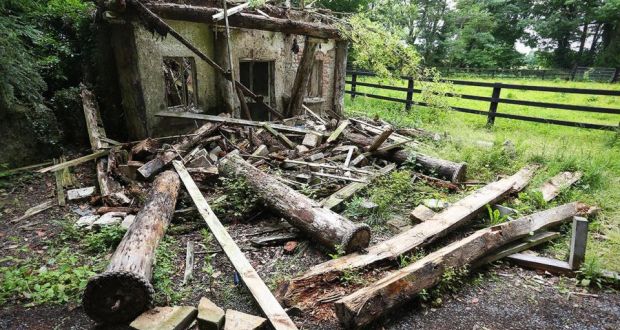
By the mid-19th century Belline had reverted to the Bessboroughs and remained in their ownership until 1934 after which the estate changed hands a number of times until being bought ten years ago for €3 million by businessman James Coleman. Managing director of a company called Suirway Forklifts based in Carrick-on-Suir, County Tipperary Mr Coleman has in the past declared himself a passionate enthusiast of motor rallying and indeed his business has sponsored a number of events for this sport. On the other hand, he seems less keen to support and sustain the national heritage, since over the past decade Belline’s temple lodge has fallen into such dilapidation that, as was reported by the Irish Times less than a fortnight ago, the building’s portico has now collapsed.
It is inconceivable that the lodge’s deteriorating condition was unknown to its owner: there have been two reports on the building and its importance, one compiled by architect John Redmill in 2005, the other by chartered surveyor Frank Keohane earlier this year. Furthermore the National Inventory of Architectural Heritage designated the lodge as being of architectural interest under the Categories of Special Interest. On the other hand as Frank Keohane noted in his report, to which I am much indebted, until now the lodge has not been designated a protected structure in its own right but rather ‘deemed to be protected owing to its being located within the cartilage of Belline House which is a protected structure.’ Clearly this has proven inadequate.
Keohane wisely makes the point that the lodge at Belline must be regarded as of international importance both in its own right and as part of a planned 18th century demesne in which diverse complementary elements contributed to the resultant whole. As he writes, ‘The temple lodge is not an artefact to be appreciated in isolation. It is in fact an important element in a group of related structures within the demesne.’ Destroy one of those related structures and you disrupt the entire picture: it is not unlike cutting a section out of a painting.
According to the Irish Times, John McCormack who is a Director of Services at Kilkenny County Council with responsibility for heritage said the authority had served a planning enforcement notice on Mr Coleman in May 2012 ‘for failing to undertake works to prevent this protected structure from becoming or continuing to be endangered.’ Legal proceedings commenced the following October and since then ‘there have been four separate court appearances in relation to this prosecution while the council sought to negotiate with the owner. A full hearing of the case is listed for October 7th next at Carrick-on-Suir District Court.’
One waits to see what will happen in four weeks’ time since not only is the survival of Belline’s temple lodge at stake but the forthcoming hearing represents something of a test case. If owners of protected structures can ignore their responsibilities with impunity, then still worse misfortunes lie ahead for our architectural heritage. The national patrimony is at risk in a way that would, one imagines, have appalled Peter Walsh.
The first two photographs show Belline’s temple lodge as it looked in the 19th century, note how at one time the building was thatched. The next three show the lodge in 2005, already with its slates removed from the roof, followed by another three photographs taken earlier this year. Finally below is a picture of the lodge as shown in the Irish Times with its portico in ruins.

image

Ignorance is Never Better than Knowledge

Ballitore 2

Earlier this week photographer James Fennell took a number of extraordinary pictures showing an old house at the entrance to the 18th century planned Quaker village of Ballitore, County Kildare being enveloped within a new structure; once the latter is complete, the old house will be demolished. The company responsible for this undertaking is Glanbia plc which grandiloquently describes itself as ‘a global nutritional solutions and cheese group’ and which on Wednesday announced a 13 per cent rise in revenue to €1.68 billion in the first half of 2013. Glanbia already has a plant in Ballitore and last year applied for planning permission to extend the premises, which involved the demolition of the house, referred to in the application as a ‘two storey office building’ thereby conveniently ignoring its history as part of a long-standing residential settlement.
Permission for this work to proceed was duly granted by Kildare County Council, after its conservation advisors advised that the structure had been so altered and refurbished that it ‘no longer retains any features of special significance’ and could accordingly ‘be deemed to be of little significance within the architectural heritage of Kildare.’ Leaving aside the fact that the local authority permitted those alterations and refurbishments to take place, the approval also ignored the house’s importance within the overall framework of the village of Ballitore, a unique collection of houses that are each part of a greater whole; damage one element and you damage the entire site and thereby irreparably alter its distinctive character. Glanbia is not some foreign entity (its origins lie in the Irish co-operative movement and it ought therefore to have a sense of community) so neither this organisation nor Kildare County Council can claim ignorance of the history of Ballitore. No doubt the inevitable economic arguments will be trotted out in justification for this act of cultural vandalism. Tourism is also an enormously important money-generating industry in Ireland: this is not Soviet Russia and tourists do not come here to look at factories. By assisting in the demolition of a fine old house and its replacement with a characterless monolith, the two bodies responsible will have inflicted damage on both the appearance of Ballitore and on the local economy.

Ballitore 3

No Room at the Inn

IMG_6114

Seen from a towpath on the opposite side of the Grand Canal, the old hotel at Robertstown, County Kildare retains its charm. Originally opened in 1801, this hostelry attracted so much business that within three years it had to be extended. But with the advent of railways came a decline in canal business and by 1869 the Royal Irish Constabulary had been granted a lease on the premises. In the last century the building was used for various purposes; from the mid-1960s onwards it was the centrepiece of an annual summer festival in which the Irish Georgian Society became involved. Famously on one occasion a demonstration was given by Desmond Leslie of water-skiing on the canal. What made his activity distinctive was that Leslie was pulled by a horse being ridden at speed along the bank. Now the hotel is empty and falling into dereliction (all window openings are filled with painted boards). A five-year old planning application attached to the main door proposes a four-storey, 44-bedroom extension and sundry other changes but that option now seems unlikely. Although listed as a protected structure, the future does not look good for this important vestige of Irish transport history.

IMG_6101

Lost Horizon

belvoir by Kerr 2

Travelling along Belfast’s Outer Ring Road through the the Newtownbreda area one passes signs for Belvoir Park. The picture above, dating from 1805 and painted by Vice Admiral Lord Mark Kerr, shows a house of that name. Today the name is almost all that remains of what was once the largest private residence in this part of the country. An keen amateur watercolourist of some ability Lord Mark, the third son of the 5th Marquess of Lothian, enjoyed a successful career in the Royal Navy until 1805. His connection with Ireland came through marriage in 1799 to Lady Charlotte McDonnell who would later become Countess of Antrim in her own right. During the early 1800s the Kerrs stayed at Belvoir Park, which belonged to Lady Charlotte’s half-brother and it was during this period that Lord Mark painted this picture along with another, both of which were in the collection of the Knight of Glin until sold at Christie’s in 2009.

Belvoir 3a

???????????????????????????????

There are earlier, and finer, views of Belvoir Park, the first of which is shown immediately above. This is one of four oils painted by the artist Jonathan Fisher (fl. 1763 – d. 1809) at the request of the house’s then-owner Arthur Hill-Trevor, 1st Viscount Dungannon. Fisher is believed to have been born in the 1740s and to have spent some time in England, first coming to attention here in 1763 when he was awarded a premium for a landscape by the Dublin Society (he would receive another five years later). He exhibited some 57 pictures with the Society of Artists in Ireland between 1765 and 1780, including the four views of Belvoir which were shown in the organisation’s premises on South William Street, Dublin (now the headquarters of the Irish Georgian Society, see Restoration Drama, July 15th). The pictures are highly significant because they show us the house from different aspects when it was newly completed and before alterations were made towards the close of the 18th century. They also offer us views of the landscape around Belfast before the city had much expanded and show how lovely this region looked prior to the onset of the industrial revolution (the last of the pictures at the end of this post offers Fisher’s bucolic view of the area as it would have been seen from the house).

Belvoir 3b

Belvoir entrance to yard 1

Belvoir entrance to yard 2

Sir Moyses Hill was the first member of his family to settle in Ireland in the 1570s and it was his descendant Michael Hill who purchased for £2,000 the land on which stood Belvoir, then called Ballyenaghan, although the family’s main estate was at Hillsborough. Michael Hill’s wife Anne Trevor, subsequently married to Viscount Midleton, is reputed to have given the place its new name, in part owing to the view (‘Belle Vue’) and in part in recollection of Belvoir Castle, the Duke of Rutland’s seat in England where she had spent a large part of her childhood. Thanks to Lady Midleton, the property was inherited by her younger son Arthur who in 1766 was created Viscount Dungannon.
When Walter Harris published his survey of County Down in 1744 he described Belvoir as being ‘laid out lately in Taste; the Avenue is large and handsome, the Fruitery, from an irregular Glyn, is now disposed in regular Canals, with Cascades, Slopes and Terraces, and the Kitchin Ground inclosed with Espaliers, the best of the Gardens lying over the Lagan River, which is navigable to this Place. The Offices are finished, but the House not yet build.’ There does appear to have been a small residence on site but building work on something more splendid must have started soon afterwards. Even so when the indefatigable Mrs Delany came to stay in October 1758 she described it as a ‘charming place, a very good house, though not quite finished.’
Faced in brick, Belvoir Park’s main elevation looked north with views over the Lagan river and thence to the mountains beyond. This front was of seven bays, the three centre ones incorporating immense Ionic pilasters beneath a pediment with carved wooden mouldings. The entrance front faced west while the south side featured a canted bow. Belvoir Park is often attributed to Richard Castle, although if this were so it would have been a very late work since he died in 1751. He certainly designed the nearby Knockbreda Church for Lady Midleton (it can be seen to the left of the house in the first of Fisher’s pictures above). More recently the proposal has been made that a lesser known architect Christopher Myers was responsible for Belvoir Park.

Belvoir 3c

Belvoir just before being blown up

Following the first Lord Dungannon’s death in 1771, title and property alike passed to a young grandson (his only son having predeceased him by a year). The second viscount appears to have lived and entertained lavishly and as a result further work was undertaken on the house, notably by the addition of a third attic storey which can be seen in Lord Mark Kerr’s watercolour. In the mid-1790s Lord Dungannon moved to his Welsh estate and Belvoir Park was left unoccupied except by the agent, and by the Kerrs for a period. Eventually the entire place was sold in 1809 and after passing through various hands was acquired in 1818 by Belfast banker and landowner Robert Bateson around the time he became a baronet. He did much to improve the Belvoir, as did his son Sir Thomas Bateson (later first Lord Deramore) who around 1865 commissioned Newry architect William Barre to carry out some alterations to the house, including balustrades around the roof parapet and a balustraded entrance porch. At that stage the estate ran to more than 6,000 acres but decline set in soon after Lord Deramore’s death in 1890. Belvoir was let to various tenants but by this time Belfast was fast expanding and the land on which house and grounds stood just a few miles from the city centre was wanted for housing. In the 1920s part of the estate became a golf course while it was suggested the house become a residence for the Governor of Northern Ireland (ironically the Hill family’s former principle property, Hillsborough Castle, was instead selected). During the Second World War the site was used by the Admiralty, but from 1950 onwards the buildings started to fall into ruin. The succession of photographs seen here show the building in 1961 shortly before it was blown up by members of the army; today only parts of the old yard remain. 185 acres of the former estate are a forest park but the rest of the land is given over to suburban housing. The loss of Belvoir Park must be judged a grievous one but thankfully the paintings of Jonathan Fisher survive as evidence of this once-fine house. Privately owned, the pictures have been loaned for inclusion in an exhibition on Irish landscape art currently running at the Ulster Museum in Belfast.

Belvoir 3

It’s a Lock Out

IAA Front Elevation

The largest house on Merrion Square today is no. 45 which dates from 1785. As mentioned before (see The Fashionable Side, September 24th), it was built by Gustavus Hume who when not acting as a medical surgeon dabbled in property development, being also responsible for laying out Ely Place and Hume Street to the south-west of Merrion Square. Five bays wide and rising four storeys over basement, no. 45 has a restrained neo-classical interior with ground and first floor rooms radiating off an immense cantilevered Portland stone staircase.
For the past decade the building has been home to the Irish Architectural Archive. Founded in 1976 the IAA is an independent charity which receives some state assistance but relies on private support to sustain its services. The organisation’s holdings at present include 2.5 million drawings and documents, 500,000 photographs and 30,000 books, pamphlets and periodicals: the greatest single source of information on Ireland’s buildings and those who designed them, this material is freely available for research to all visitors.
Unfortunately at the moment the IAA like so many other cultural bodies is suffering from inadequate funding and unless additional monies are found, it will have to shut for the months of July and August, with the small body of staff made temporarily redundant. One must worry that if this is permitted to happen, a precedent will have been set, not just for the IAA but similar establishments too. Anybody interested in helping to ensure the IAA’s future can find more information at http://www.iarc.ie/sponsors/funding-appeal. With its graceful late 18th century plasterwork by Michael Stapleton, the door shown below faces the top of the main staircase. How dreadful were it, along with all the others in the building, to be closed in a few weeks’ time.

IMG_4357

An Irishman’s Home is His Tower House

image

All across Ireland can be seen buildings commonly known as castles but which ought more correctly be called tower houses. The tower house is not exclusive to this country, similar structures being found along the Scottish Borders. However, the sheer quantity of these edifices make them one of the most distinctive features of the Irish landscape: it has been estimated that between 1400 and 1650 in the region of 3,000 tower houses were constructed.
A statute issued by Henry VI in 1429 declared, ‘It is agreed and asserted that every liege man of our Lord, the King of the said Counties, who chooses to build a Castle or Tower House sufficiently embattled or fortified, wither the next ten years to wit 20 feet in length, 16 feet in width and 40 feet in height or more, that the commons of the said Counties shall pay to the said person, to build the said Castle or Tower ten pounds by way of subsidy.’ It is often proposed that this piece of legislation, with its financial incentive, did much to encourage the popularity of tower houses, and also their uniformity of design.

image

image

There is some dispute whether the tower house’s primary purpose was defensive or residential; one suspects it varied according to geographic and political circumstances. Typically the building is rectangular and constructed of irregular stones, the walls in excess of four feet thick at base level and rising four or five storeys high. A single arch doorway offered admission with the large arched ground floor devoted to diverse purposes including storage of foodstuff and livestock. Above the entrance was an opening called the Murder Hole, through which boiling liquids or arrows could be directed in the event of an attack. Windows at this level were little more than slits although they were larger further up. The family lived on the tower’s top storeys, but levels of comfort were pretty minimal.
Various descriptions of life in a tower house have come down to us and none of them make it sound especially luxurious. For example the Spaniard Cuillar wrote in 1588 ‘The Irish have no furniture and sleep on the ground, on a bed of rushes, wet with rain and stiff with frost…’ Half a century later the French traveller, M. de la Bouillaye le Gouz observed ‘The castles of the nobility consist of four walls, extremely high and thatched with straw but to tell the truth, they are nothing but square towers without windows or at least having such small apertures as to give no more light than a prison. They have little furniture and cover their rooms with rushes, of which they make their beds in Summer and straw in Winter. They put rushes a foot deep on their floors and on their windows and many of them ornament their ceilings with branches.’

image

image

In many respects Kilbline Castle, County Kilkenny is a typical Irish tower house. Rising five storeys high, it has round bartizans or wall-mounted turrets at each corner of the east front and a slender chimney-stack between them. The surrounding bawn wall survives in part but some sections were demolished in the last century to permit the erection of modern farm sheds. Kilbline is usually dated to the 14th/15th centuries but a large limestone chimneypiece on the first floor carries the date 1580 so it is possible that was when the building was completed. On the other hand, there is reference to Kilbline Castle being forfeited by one Thomas Comerford of Ballymac in 1566 so perhaps the chimneypiece was inserted into the tower by its subsequent owner.
That person may have been a member of the Shortall family of Rathardmore Castle in the same county. Thomas Shortall of Rathardmore died in 1628 and not long after his heir Peter moved to the castle of Kilbline, where he subsequently lived. His estates, which ran to some 1,500 acres were declared forfeited by the Cromwellian government in 1653 and his sons ordered to be sent to Connaught, although one of them seems to have returned to Kilbline, perhaps after the restoration of Charles II in 1660. Nevertheless, Kilbline once more changed hands during this period.

image

image

Originally from Newcastle in Northumberland, William Candler is believed to have served as an officer in Oliver Cromwell’s army during the Irish wars of 1649-53. As a reward for his endeavours, he was promoted to the rank of Lieutenant Colonel and granted lands in County Kilkenny, including those on which stands Kilbline Castle. He and his wife Anne Villiers had two sons, the younger of whom John is known to have lived at Kilbline. John Candler had a single son Thomas who, in turn, had only the one child, Walsingham; he never married and so that line of Candlers came to an end.
To return to Lt.Col. Candler, his older son Thomas who lived at Callan Castle had four sons, the youngest of whom Daniel caused a rumpus within the family by marrying an Irishwoman, possibly a Roman Catholic, called Hannah and as a result was obliged to leave first County Kilkenny and then Ireland. Around 1735 Daniel and Hannah Candler moved to the America Colonies, initially settling in North Carolina before they moved to Bedford, Virginia. Their great, great, great-grandson was Asa Griggs Candler, the entrepreneur who in 1888 bought the formula for Coca Cola and made himself fabulously rich as a result.

image

image

Kilbline Castle continued to be occupied until just a few decades ago. At some point, probably in the 19th century, a two storey three-bay house was added on the west end of the tower house and a further single storey structure abuts this. The interior of the house remains relatively intact and suggests a degree of affluence on the part of the occupants.
However, the most architecturally significant feature of Kilbline is a wonderful panelled room on the south-east corner of the ground floor. Most likely of oak (it was hard to tell with certainty) this looks to date from the late 17th or early 18th centuries and must therefore have been created while the building was occupied by the Candlers. Although the ceiling is now covered in tongue-and-groove boards, all the wall panelling is intact, as is the old chimneypiece (the latter marred only by a shelf added at some later date). This rare instance of early Irish interior decoration is some 300 years old and given that the house has been empty for some time it remains in remarkably good condition, as can be seen in the pictures above. The present owners, although they do not live in the building, are aware of its importance and would dearly love to restore Kilbline and ensure its future.

image