Pocket Gothick


A pocket Gothick house on Castle Road, forming the upper portion of O’Mahoney Avenue in Bandon, County Cork. This is one of a six such properties located immediately outside the demesne wall of Castle Bernard, former home of the Earls of Bandon, which was burnt out in June 1921 (see A-Bandon « The Irish Aesthete). Originally a classical house, around 1815 Castle Bernard was given a gothic makeover by an unknown architect, and these two-storey cottages. of rough cast stone with ornamental brick surrounds on the door and windows, were presumably built at some date thereafter to reflect that style; the architect responsible is unknown, and it seems impossible to find any further information about them. While some are still occupied, others have sadly been allowed to fall into ruin.

Nine for Nine

2012 Rush Hill, County Roscommon

2013 Beaulieu, County Louth

2014 New Hall, County Clare

This week, rather to one’s own surprise, the Irish Aesthete celebrates a ninth birthday, the first, somewhat tentative, post having been made in late September 2012. Anybody who has embarked on such a venture, will testify to a want of certainty about how long it will last, and indeed many such enterprises fall by the wayside after a few months. When this site made its debut, blogs were highly popular whereas now they are less frequently encountered, not least because there are now many more alternative online options. Instagram, for example, had already existed for two years, but had yet to reach anything like the audience it now enjoys (incidentally, the Irish Aesthete can also be found on Instagram, see @theirishaesthete). But as a rule those alternatives are only good for quick soundbites, and do not allow for substantial communication or investigation. And that is why this site continues to appear thrice-weekly: because often something more than a picture and a couple of explanatory lines of text is required. 

2015 Ballynagall, County Westmeath

2016 Lackeen Castle, County Tipperary

2017 Aldborough House, Dublin

A year or so after the Irish Aesthete first appeared, regular enquiries were made about whether there might be enough material to sustain it for much longer. Well, it appears that there has been – and still is – more than enough. Even during the past 18 months when the country was intermittently in lockdown, enough could be found to ensure not a post was missed. Of course, maintaining a site such as this can sometimes be a chore, but the task has always been fascinating, not least because over nine years many places that might otherwise have remained unvisited have instead been explored, investigated, studied, sometimes celebrated, ofttimes  mourned. And this period of time and the visits undertaken therein have always been enjoyed in the company – metaphorical if not literal – of the friends and followers who have been so good as to stay loyal to the Irish Aesthete. To all of you, many thanks and here’s to 2022 when we will be able to mark a tenth anniversary together. Meanwhile, stay safe everyone. 

2018 Castletown, County Kildare

2019 Doneraile Court, County Cork

2020 Dunmain, County Wexford

Recalling a Lavish Host


Many people in Ireland will be familiar with the name of Theobald Mathew, a 19th century Roman Catholic priest who became known as the Apostle of Temperance. A member of the Capuchin order, in 1838 Fr Mathew, witnessing the problems arising from excessive consumption of alcohol, founded the Total Abstinence Society in Cork city, where he was then living. Within nine months some 150,000 persons had enrolled in this organisation and at its height during the late 1840s it is estimated that half the population of Ireland were members. What may be less well known is that Theobald Mathew was related to a wealthy, and Protestand, landed family and grew up at Thomastown Castle, County Tipperary where his father acted as agent to a cousin, the first Earl of Landaff. Now a striking ruin, Thomastown was for several centuries the seat of the Mathew family. Of Welsh origin (hence the choice of name for their title), they were connected through marriage to the Butlers, and thus acquired land in this part of the country. As was so often the case, a series of judicious marital alliances made them exceedingly rich, allowing the construction of a large residence in the late 17th/early 18th centuries. In Town and Country in Ireland under the Georges (1940) Constantia Maxwell provides an excellent account of life there in the years after the house had been built by Thomas Mathew. The building was ‘surrounded by gardens adorned with terraces, statuary, and fish ponds, and by a park of some two thousand acres stocked with deer. Mr Mathew, besides being very rich, was held to be one of the finest gentlemen of the age, and, having travelled much on the Continent and lived in London and Dublin, had a large circle of friends. Nothing gave him so much pleasure as to invite these to Thomastown, where he had no less than forty guest-rooms, besides handsome accommodation for servants. The guests in his house were invited to order anything they might wish for, as at an inn; they might seat themselves at the dining-room table without paying irksome respect to rank, or, if they preferred it, dine with chosen companions in their own rooms. A large room was fitted up as a city coffee-house with newspapers and chessboards, where servants had been ordered to bring refreshments at any time of the day. For those who liked sport fishing tackle was provided, as well as guns and ammunition, while hounds and hunters were available in the stables. But, although everything at Thomastown was on such a lavish scale, there was no disorder or waste, for Mr Mathew rose early every morning to look over the accounts, and his servants were well paid, and forbidden to take tips.’ A description of life at Thomastown was provided by Thomas Sheridan in his biography of Jonathan Swift described how the later was so delighted with Thomas Mathew’s hospitality that instead of staying for a fortnight, as originally intended, he remained there for four months. 


As mentioned, the house at Thomastown was once surrounded by splendid gardens. Writing in 1778, Thomas Campbell noted that not only was the setting perfect, with the Galtee Mountains ‘set at such a due distance that they are the finest termination for a prospect a painter could desire’ but ‘behind the house is a square parterre, with flowers, with terraces thickly studded with busts and statues; before it, a long and blind avenue, planted with treble rows of well-grown trees, extends its awkward length. In the centre of this, and on the acclivity of the hill, are little fish ponds, pond above pond. The whole park is thrown into squares and parallelograms, with numerous avenues fenced and planted.’ By the time Campbell visited, this style of garden had fallen out of fashion, so he tut-tutted that ‘if a hillock dared to interpose its little head, it was cut off as an excrescence, or at least cut through; that the roads might be everywhere as level as they are straight. Thus was this delightful spot treated by some Procrustes of the last age.’ A few years later, Joseph Cooper Walker was just as critical of Thomastown’s gardens. ‘They lie principally on the gentle declivity of an hill,’ he explained, ‘resting on terraces, and filled with “statues thick as trees”. A long fish pond, sleeping under “a green mantle” between two rectilineous banks, appears in the midst. And in one corner stands a verdant theatre (once the scene of several dramatic exhibitions) displaying all the absurdity of the architecture of gardening. Thus did our ancestors, governed by the false taste which they imbibed from the English, disfigure, with unsuitable ornaments, the simple garb of nature.’  Not much later, perhaps when the second Earl of Landaff, who inherited title and estate on his father’s death in 1806, transformed the house, these by-now old-fashioned gardens were largely swept away in favour of open parkland. 


Thomastown, as previously mentioned, was originally a late 17th/early 18th century house of two storeys, the centre just one room deep with projecting wings forming a short entrance courtyard. However, it appears that the generous Thomas Mathew enlarged the house by filling in the space between the wings to create a dining room, some 50 feet long and 20 feet deep, no doubt to feed all the guests he entertained. Several generations later, the second Earl of Landaff decided to alter the building’s appearance by giving it a Gothick makeover. In 1812 the architect Richard Morrison was commissioned to come up with a design for the place. The original entrance arcade was now glazed to create a Great Hall, while the first-floor gallery became a gothic-style library. However, the drawing room retained its classical decoration, with screens of scagliola columns at either end, a typical Morrison flourish which can still be seen in the library at Ballyfin, County Laois. Meanwhile, the exterior was ornamented with a crenellated parapet and a series of octagonal turrets topped with dart-like finials. As Mark Bence-Jones noted, from a distance these look like rabbits’ ears. A kitchen and service wing at right-angles to the house was also thoroughly dressed in Tudor-Gothic decoration, although a stone tower at the corner of the range is in Norman style. The entire building was covered in stucco, which was then rather oddly painted pale blue. An engraving of the completed work made by John PrestonNeale in 1819 although this included an unexecuted family wing and a more simple service range than that actually constructed. The second earl had no children and following his death, Thomastown passed to a sister Lady Elizabeth Mathew who in turn left the estate to a cousin of her mother, the Vicomte de Chabot. Before the end of the 19th century, it had come into the possession of the Dalys of Dunsandle, County Galway but seemingly by then the house was already falling into ruin. And so it has remained, with much of the central block, where those hospitable dinners were once given, long since collapsed. Today the only diners seen here are cattle.

Famously Abandoned I


One of Ireland’s most famous abandoned country houses: Woodlawn, County Galway. The original building was just the central, three-storey block, constructed for the Trench family, raised to the peerage in 1800 as Barons Ashtown. In 1859 the second Lord Ashtown had the house much enlarged by the addition of two-storey wings on either side, the whole then refaced in an Italianate manner: this work was undertaken by the local County Surveyor James Forth Kempster, who was also much employed by another branch of the Trench family, the third Earl of Clancarty. Woodlawn was eventually sold by the fourth Lord Ashtown in 1947 and has had a somewhat chequered history ever since. Part of the building was badly damaged by a fire in the 1970s although the roof was subsequently repaired. However, for much of the past 50 years the house has sat empty and a prey to vandals, with anything of worth in the interior long since gone.


A Castle in Miniature


After Monday’s post about the Widows’ Almshouses in Castlebellingham, County Louth, here is a view of the gatehouse originally built to gain admission to the property from which the village derived its name, Bellingham Castle. As mentioned, the ‘castle’ was an 18th century house to which battlements and other faux-Gothic decoration was added by Sir Alan Bellingham in the mid-1830s. The architect responsible for this work was Thomas Smith who received a not-dissimilar commission from Sir Patrick Bellew at Barmeath Castle elsewhere in the county. At Barmeath Smith designed a Norman gateway into the yard, so it would appear he can also be credited with the gatehouse at Castlebellingham, a miniature castle comprising a sophisticated mixture of rubble and dressed stone and render. Today the building no longer serves its intended purpose but stands as an island surrounded by roads. 


O’Fallons’ Country


‘The sept of the O’Phelans is recorded in the earliest annals of Ireland. They were styled Princes of Desies, a territory comprising the greater part of the County of Waterford, with a portion of Tipperary. Malachy O’Phelan was their chief at the time of the Anglo-Norman invasion, and his was the principal native force that, in co-operation with the Danes of Waterford, sought, but unsuccessfully, to hold that city against the newcomers. Malachy was taken prisoner, and condemned to die, but his life was spared on the intercession of Dermod McMurrough, who had on that day come down from Ferns to celebrate the marriage of his daughter with Strongbow.’ 


‘A King of the Desies was long after recognised, and was summoned, as such, in 1245 to aid Henry the Third in the Scottish war; but the sept, having been subsequently expelled from their old homes, some, after a brief sojourn in Westmeath, crossed the Shannon into Connaught, where they spelt their name, O’Fallon, and a district in Roscommon, between Athlone and the County of Galway, was hence known as O’Fallons’ country, while the sept was distinguished as the O’Fallons of Clanhudach.’


‘In the time of Queen Elizabeth Redmond O’Fallon was the Chief. Of his estates Edmund O’Fallon had livery, as his son and heir, in 1606, of which in the ‘unsettling’ settlements of James the First, he thought it prudent to take out a fresh patent. It bore date in 1612, and confirmed to him the manor, castle, town, and land of Miltown, in the barony of Athlone, with sundry lands and a water-mill annexed; part of Ballyforan near the Suck, its island and fishing weir, the castle of Turrock, ‘moieties’ of the castles of Newtown and Ballyglass, with lands and chiefries in the County of Roscommon, and markets and fairs at Miltown, besides other premises at Balrath, in Westmeath. These interests he was obliged to claim on petition to the Commissioners at Athlone after the civil war of 1641, as were eight other proprietors within the O’Fallons’ country, the claims of all seeking restoration as to their ancient ancestral estates. The Supreme Council of Catholics in 1646 was attended by two members of this sept, William Fallon of Miltown and Stephen Fallon of Athlone. In 1677 another Edmund O’Fallon, styled of Mote, passed patent for 344 acres in Galway, as did a John Fallon for 131 in Roscommon.’


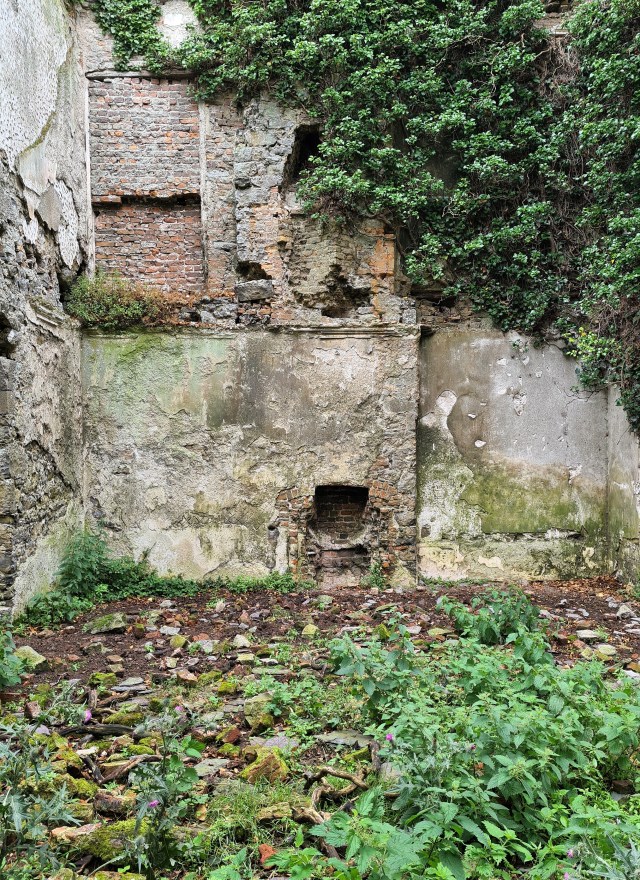
Text taken from King James II’s Irish Army List, 1689 by John d’Alton (published 1855). Pictures show the now-ruined – and thoroughly pillaged – remains of Cloonagh, County Roscommon, an early 18th century house which was built and occupied by a branch of the O’Fallon family. James O’Fallon, who was Roman Catholic Bishop of Elphin for thirty years, lived in the house, dying there in December 1786. A pity to see this link with the area’s history about to be lost.

A Very Sumptuous Establishment


A PhD thesis presented by Michael Ahern in 2003 (and subsequently published) explores the history of the Society of Friends, otherwise known as Quakers, in County Tipperary from the mid-17th to early 20th centuries. In the text, Dr Ahern notes how, ‘One of the most remarkable achievements of this persecuted minority, consisting of farmers, tradesmen and small business people, was the manner in which they triumphed over adversity and, in the course of time, became successful and prosperous members of the middle class. Participation in the affairs of their own Society provided a sound training which enabled members to cope with the business procedures of the secular world. Although the administrative meetings of the Society generally related to religious concerns, a large proportion of their activities was strictly practical in content and created an environment which cultivated business and administrative expertise.’ During the second half of the 18th century, one of the businesses in which they came to have a powerful presence was milling. Certain urban centres likewise became centres for this activity, among them Clonmel, County Tipperary.’ Legislation passed by the Irish parliament in 1757 offered financial incentives for the land carriage of corn to Dublin; for every five hundred-weight of flour brought to market, a premium of three pence per mile (excluding the first 10 miles) was paid. The result was an explosion in both the production of wheat and corn, and the establishment of mills, especially in areas like Clonmel, which benefitted from fast-moving water (in this case, the river Suir). Anner Mill, the first such Quaker operation, was opened here in 1771 by John Grubb, whose family would become synonymous with the industry. Many more followed, so that in 1797 when legislation was proposed to abolish financial incentives, the business was sufficiently well-established as to be in no need of subsidy: ‘The principal millers in the neighbourhood of Clonmell,’ declared John FitzGibbon, Lord Clare, ‘a part of the kingdom from which there is a considerable influx of corn to the city, do not complain of the bill; on the contrary many have declared that they will not suffer any loss from it.’


Of English origin, the Sparrow family had settled in Ireland in the mid-17th century and soon converted to the Quaker faith. They were based in the Wexford region where one of them, Samuel Sparrow, participated in the 1798 Rebellion and then fled to the United States, were he remained for the rest of his life. Long before then, at some date during the first decades of the 18th century, Richard Sparrow moved from Wexford to Clonmel where he established himself as a baker. His son, Simmons Sparrow, was more ambitious and, like many other members of his church, became involved in the area’s burgeoning milling industry. In 1778 he opened a large mill on the north side of Suir Island, which looked across to Clonmel’s quays and which could take advantage of the river’s fast-moving water. This building continued in operation until 1801 when it was destroyed by fire; eight years later the site was sold by the Sparrows to another Quaker, Thomas Hughes. In the meantime, Simmons Sparrow opened another mill to the immediate west of the town at Toberaheena while for a period in the mid-1790s his son Richard leased another two mills still further west along the Suir. Following Simmons Sparrow’s death the business was continued by Richard but he seems to have lived beyond his means and eventually lost everything, dying in Clapham, outside London in 1814 after which his estate in Tipperary was auctioned to pay the deceased’s debts.


In 1798, the American Quaker preacher and abolitionist William Savery visited this country and noted with dismay that ‘Friends in Ireland seemed to live like princes of the earth, more than in any country I have seen – their gardens, horses, carriages, and various conveniences, with the abundance of their tables, appeared to me to call for much more gratitude and humility, than in some instances, it is feared is the case’. While in Clonmel, where he stayed with the successful miller (and Quaker) Sarah Grubb, Savery visited the home of Richard Sparrow, judging it to be ‘a very sumptuous establishment indeed, which I did not omit to tell him was quite too much so’, his stables being fit for a nobleman. The house in question was Oaklands, seen in today’s photographs. Little information exists about the building, the fine entrance to which was shown here last Saturday. Of three storeys over basement, it has four bays, with a central breakfront accommodating two and a plain limestone portico supported by paired Doric columns, behind which was a doorcase with fan- and substantial sidelights. The garden front featured a substantial canted bow and a flight of cast-iron steps giving access to one of the reception rooms. This was one of four such spaces on the ground floor of the ‘sumptuous’ interior, of which little now remains. Following Richard Sparrow’s financial collapse, Oaklands passed to the Rialls, another Quaker family involved in banking. However, within a few years their own fortunes suffered a setback when the bank, like many other such private establishments in the aftermath of the Napoleonic Wars, failed and was forced to close in 1820 (its premises, for a long time part of the Clonmel Arms Hotel, have stood vacant and awaiting redevelopment for some time). In due course they were followed by Colonel Pownoll Phipps, a fascinating character who – for reasons too complicated to explain here – had as a teenage boy found himself stranded with is siblings, but without their parents, in Revolutionary France, and had then gone on to serve in the British army in India under the future Duke of Wellington; he died at Oaklands in 1858 and the estate was, at least for a while, owned by his eldest son. It then passed through a succession of different hands, and was still occupied, but in poor condition, fifteen years ago, later standing empty. The inevitable consequence of this was that the house attracted the attention of vandals and finally was gutted by fire in October 2017, leaving it in the state seen today.

Just an Inch


The somewhat scant remains of Inch Abbey, County Down. Originally on an island in the Quoile marshes (but since these were drained now on the banks of the river Quoile, the first monastic settlement here was established c.800 but few traces of it survive: the buildings were plundered more than once in the 11th and 12th centuries by the Vikings. The present monastery dates from 1180 when Cistercian monks from Furness in Lancashire were settled here by the Anglo-Norman knight John de Courcy and his wife Affreca as an act of atonement for his destruction of another religious house at nearby Erinagh.


Although wealthy, Inch Abbey seems never to have had a particularly large community; growth in numbers weren’t helped by Parliament restricting admission to the monastery to the English or Anglicised Irish. This helps to explain why in the 15th century, the transepts were blocked off and a small church created out of the chancel and the first bay of the nave, the rest of the space being abandoned. The tall east windows survive, as do those to the immediate north and south, but not much else, with few parts of the ancillary buildings still above ground. Inch Abbey was suppressed in 1541 and the site, together with some 850 acres, was granted to Gerald FitzGerald, 11th Earl of Kildare.