Waiting in the Wings

IMG_9869

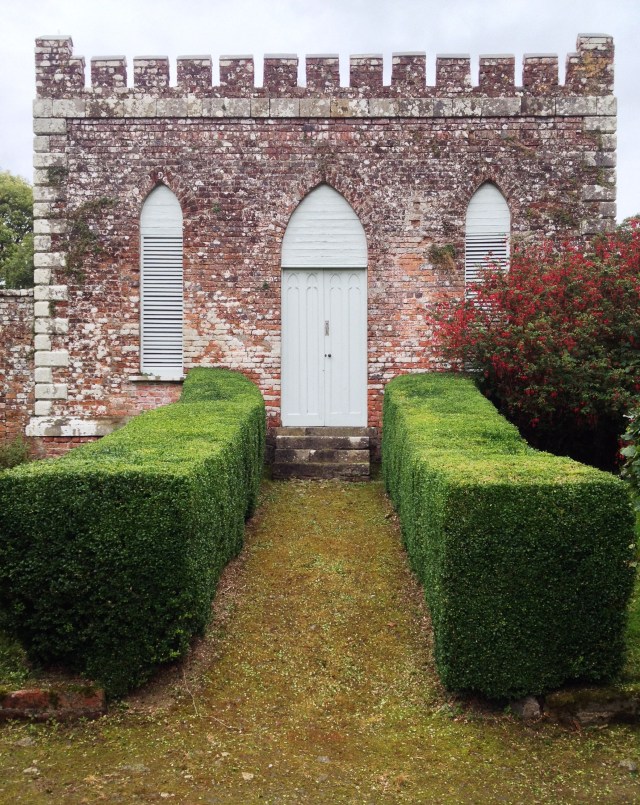
When it comes to country houses, architectural historians and conservationists often, and understandably, focus their attention on the main property. But it is usually only one part of a larger conglomerate of buildings, all of which interact with each other and are also worthy of study – and preservation. Here are the two stable blocks at Bantry House, County Cork, added to the estate by Richard White, Viscount Berehaven (later second Earl of Bantry) around 1845 and very much intended to be seen as part of the site’s architectural ensemble. Distinguished by their copper-domed cupolas, from sufficient distance the pair appear to serve as free-standing wings to the house between them. While one has found alternative use in recent years, the other sadly awaits attention (and thus for the present is best seen from the aforementioned distance).

IMG_6577

Burnt Out

IMG_6662
Although the Everard family is said to have come to Ireland around 1177, only from the fifteenth century onwards does it come to prominence as effective owner of the town of Fethard, County Tipperary, and of the surrounding territory. In 1578 John Everard entered the Inner Temple and twelve years later was called to the Bar, being appointed justice of the  Court of King’s Bench (Ireland)  in 1602 and subsequently knighted. As evidence of his authority in this part of the country, in 1608 he secured the new charter for Fethard from the English crown, according to the terms of which the town’s Corporation was renewed and enlarged, ‘and was endowed with such liberties and privileges as were needed to draw more people to the town and to increase its trade and commerce.’ The previous year Sir John had surrendered all his property to the English authorities, and then received it back again, evidence of the esteem in which he was held. What makes this notable is that the Everards were, and remained, adherents of the Roman Catholic faith. As a judge he was expected to take the Oath of Allegiance to the crown but, his conscience making this impossible, he resigned the position. Ultimately the Everards’ loyalty to the old religion would lead to tragedy, but first came farce. In 1613 the only Irish Parliament  held during the reign of James I was called, to which Sir Jhn was returned as member of the House of Commons for Tipperary.  He was the Catholic choice for the position of Speaker of the House of Commons, but they were iin a minority, the government’s choice being Sir John Davies, Attorney General for Ireland. When the vote was taken, Sir John Everard installed himself in the Speaker’s chair and refused to move. According to a contemporary source, ‘Sir Thomas Ridgway, Sir Richard Wingfield, Sir Oliver St John and others, brought Sir John Davies to the chair, and lifted him into Sir John Everard’s lap; the Knights perceiving Sir John Everard would not give place to their speaker, they lifted Sir John Everard out of the chair, and some of Sir John Everard’s part holding him by the collar of the gown to keep him in the chair…’ Ultimately this undignified incident ended in Everard’s defeat, not least because Sir John Davies was a much heavier man who literally crushed his opponent by sitting on top of him.

IMG_6630
IMG_6650
IMG_6658
Despite his embarrassing setback over occupation of the Speaker’s chair in the House of Commons – after which he was temporarily imprisoned in the Tower of London – Sir John Everard continued to flourish, to remain in possession of his lands, and of a judicial pension, and to practice as a Roman Catholic until his death in 1624. He had three sons, the most prominent being the middle child Richard who even while his father was still alive was created a baronet. Like his father Sir Richard remained resolutely Roman Catholic, and as before this brought him into difficulties with the English authorities, especially after the Confederate War began in Ireland in 1641. It seems that initially Sir Richard ‘kept aloof from both parties; but for not joining with them, the “old” Irish took away from him “160 cows, 33 stud mares, and 2,000 sheep.” The tenants on his Estate were subject to similar treatment: the richest of whom with their flocks and goods Sir Richard conveyed to “safe quarters”.’ This account continues, ‘Later on, when the object of the Catholic Confederation was clearly known and defined, Sir Richard readily joined the popular movement, and in 1646 was one of the Confederate Catholics who sat in what might be designated the “Irish Parliament at Kilkenny”.’ Following Oliver Cromwell’s arrival in this country in 1649, Sir Richard was one of the leaders of the opposing Confederate army. He was involved in defending Limerick against the Cromwellian forces but following the city’s surrender was one of those hanged by Henry Ireton.

IMG_6638
IMG_6726
IMG_6689
Before strife once again overwhelmed Ireland, Sir Richard embarked on building a new residence in the midst of a fertile plain lying between the Galtee Mountains and the small town of Clogheen, County Tipperary. Commonly called Everard’s Castle, this has at its centre a substantial four-bay, three-storey over basement rectangular block with square flanking towers of four storeys (again over basement) at each of the corners. This is the last of a group of such semi-fortified houses, beginning with Rathfarnham Castle, County Dublin built for Archbishop Adam Loftus in the late 1580s (see A Whiter Shade of Pale, August 26th 2013) and taking in others like Kanturk Castle, County Cork (see An Abandoned Project, December 7th 2015), Leamaneagh Castle, County Clare and Portumna Castle, County Galway. However, whereas many of these were castellated, Everard’s Castle is notable for its gables, all twenty six of them: it would also have had seven chimney stacks. It is, therefore, closer to the English model of manor house than the familiar Irish tower house, and suggests Sir Richard was expecting years of peace, not war, to follow. On the other hand, deep corbels above the first-floor windows were intended to carry a defensive wooden gallery, so he must have reckoned with the possibility that his new property would be subject to attack. The front has a low door placed asymmetrically which again suggests certain caution on the part of the original builder. However one of the other sides of the house features a finer and larger cut stone doorcase with hood mould and carved decoration. And there are many two- and three-mullioned windows throughout the structure, which would have made it much lighter and airier than was the norm in this country at the time.

IMG_6654
IMG_6678
IMG_6670
A stone formerly over the entrance but now elsewhere on the site carries the date 1641, presumably the year in which work on Everard’s Castle was completed. The family was not to enjoy occupation for long. After a couple of years Sir Richard became embroiled in the Confederate Wars and, as has been mentioned, was hanged by Ireton in 1651. The year before, as Cromwell’s army advanced south Lady Everard set the house on fire, rather than allow it fall into enemy hands: it has stood a ruin ever since, and became known as Burncourt (or sometimes Burntcourt). Legend has it the building took seven years to build, was occupied for seven years and took seven days to burn. As for the family, following Sir Richard’s death they forfeited their lands but these were restored to his eldest son Sir Redmond Everard following the restoration of Charles II in 1660. In turn his son, Sir John Everard, was attainted for supporting James II, and although some of the family property was subsequently returned, their baronetcy and presence in this part of Ireland ended with the death of another Sir Redmond Everard around 1740. In 1751 the Fethard territories were sold to wealthy Bordeaux wine merchant Thomas Barton, while the area around Burncourt was acquired by a Dublin lawyer, Cornelius O’Callaghan. His great-grandson, another Cornelius O’Callaghan who was created first Viscount Lismore, was responsible for building another immense castle nearby: Shanbally designed by John Nash. Notoriously this was blown up by the Irish Land Commission in 1960. So while Shanbally is gone, Burncourt remains, thereby providing a partial memory of Tipperary’s architectural heritage.

IMG_6758

Pray for the Soul

IMG_4742
Like many other religious sites, the former Franciscan friary at Ross Errilly, County Galway continued to serve as a burial site long after it had officially been put out of commission during the 16th century Reformation. Later visitors often commented on the poorly interred bodies here: in 1851 the Rev. John Hervey Ashworth claimed he had counted no less than sixty skulls scattered about the semi-ruinous buildings (see To Walk the Studious Cloisters Pale, July 14th 2014). Today there are no corpses to be seen, but many handsome tombstones inserted into the mediaeval walls, such as the two examples seen here dating from the early 18th century.

IMG_4722

End of the Road

IMG_6864
A fine five-bay townhouse on the Doneraile Road in Castletownroche, County Cork. Of two storeys over basement, this is the end of a terrace of such buildings on the street dating from c.1810 and distinguished by their handsome doorcases and wide roof eaves. Unfortunately in this instance the property’s condition suggests it may also soon be the end of the line here.

IMG_6862

Accommodating the Dead

IMG_4093
The remains of the old church at Ballykelly, County Derry, a building which suffered from successive assaults – it is known to have been badly damaged in both the 1640s and the 1690s – but continued to be used for religious services until 1795 when a new church was built not far away. Internally its most significant remaining feature is the sandstone semicircular arch presumably added in 1719 when the church was extended by the addition of a chancel. More peculiarly in 1848 the south wall of the church was taken down to accommodate one end of a large neo-classical mausoleum dedicated to the Cather family, with its oversized anthemion acroteria at each corner. Unfortunately this monument’s poor condition suggests it could soon go the same way as the adjacent ruined church.

IMG_4096

The Curfew Tolls the Knell of Parting Day

IMG_6454
Beneath those rugged elms, that yew-tree’s shade,
Where heaves the turf in many a mouldering heap,
Each in his narrow cell for ever laid,
The rude forefathers of the hamlet sleep.

The breezy call of incense-breathing morn,
The swallow twittering from the straw-built shed,
The cock’s shrill clarion, or the echoing horn,
No more shall rouse them from their lowly bed.

IMG_6471
IMG_6474
IMG_6466
For them no more the blazing hearth shall burn,
Or busy housewife ply her evening care:
No children run to lisp their sire’s return,
Or climb his knees the envied kiss to share.

Oft did the harvest to their sickle yield,
Their furrow oft the stubborn glebe has broke;
How jocund did they drive their team afield!
How bowed the woods beneath their sturdy stroke! 

IMG_6477
IMG_6487
IMG_6478
Let not Ambition mock their useful toil,
Their homely joys, and destiny obscure;
Nor Grandeur hear with a disdainful smile,
The short and simple annals of the poor.

The boast of heraldry, the pomp of power,
And all that beauty, all that wealth e’er gave,
Awaits alike the inevitable hour.
The paths of glory lead but to the grave.

IMG_6491
Lines taken from Thomas Gray’s ‘Elegy Written in a Country Graveyard’ (1751).
Photographs are of the now-abandoned St Mary’s Church, Mocollop, County Waterford.

…To New

IMG_6125
As mentioned in the last post, when the Musgraves gave up living in the old tower house and its additions at Tourin, County Waterford, they moved into a new residence on higher ground. Dating from the early 1840s the house’s rendered exterior, its design sometimes attributed to local architect Abraham Denny, is relieved by wonderfully crisp limestone used for window and door cases, quoins, pilasters, cornice and stringcourse . Here is the garden front, centred on a single storey bow.

FullSizeRender


From Old…

IMG_6096
Seen across a sea of buttercups, the tower house known as Tourin Castle, County Waterford. The building is believed to date from the mid-15th century and was long occupied by members of the Roche family who some 200 years later added a more modern residence at right angles to the older. This e-shaped house with gable-ends and tall chimneys was acquired by Sir Richard Musgrave in 1778 and his descendants continued to live there until c.1840 when they moved to a smart Italianate villa some distance away possibly designed by Waterford architect Abraham Denny. The tower house has remained empty since then.

IMG_6104

A Garden of Earthly Delights

IMG_5911
In the mid-1830s George Harpur, a merchant based in Drogheda, County Louth who had made his money in the salt trade, bought an estate called Killineer a few miles north of the town. A century earlier the land here had been granted by the local corporation on a 999-year lease to Sir Thomas Taylor, whose family lived at Headfort, County Meath. It then passed to the Pentlands whose main residence was to the immediate east at Blackhall. At some date in the 18th century a house was built on the property: it appears on early maps but little now remains other than one room which still retains sections of plaster panelling. Located to the rear of the walled garden, this space now serves as a toolshed.

IMG_5854
IMG_5864
IMG_5902
IMG_5923
Following his purchase, George Harpur embarked on the construction of a new house, on a site a little below the earlier one. Unfortunately we do not know who was the architect responsible for designing this building, which is not dissimilar from the Pentlands’ nearby Blackhall. Of two storeys over basement, it has a six-bay rendered façade centred on a Tuscan portico. Deep windows admit abundant light into the four ground-floor reception rooms which have elaborate plasterwork cornice friezes. But the most striking features of the house are its octagonal entrance hall with arched niches on four sides, and the splendid imperial staircase leading to that long-standing feature of the Irish country house: the first floor top-lit gallery from which bedrooms are accessed. One of the reasons we know so little about the house’s early years is that when George Harpur died in 1888 he left no heir and Killineer accordingly changed hands, passing into the ownership of another local family, the Montgomerys of Beaulieu. When it was next offered for sale in 1918, the auction notice advised prospective purchasers ‘Everything that taste or comfort could suggest for the embellishment of the house and demesne was done by the late owner regardless of expense.’

IMG_5868
IMG_5886
IMG_5968
IMG_5871
In addition to building himself a new house, George Harpur also laid out gardens at Killineer, beginning with a series of formal Italianate terraces that descend from the front of the main building. Eventually these reach a long serpentine stretch of water, created from what was shown on earlier maps as a relatively small pond. A series of islands on this lake help to break up the vista so that the prospect constantly alters as one wanders along paths meandering on either side. To the immediate east is a woodland garden, rich in ferns, mosses and other moisture-loving plants, while to the north west is a great laurel ‘lawn’, a piece of 19th century garden design once common but now more rare: that at Killineer is today the largest in the country. On this side also is a lakeside summer pavilion, its façade a miniature version of the house. Behind the stables and yards is the old walled garden which runs to an acre and a half and is still used for growing fruit, vegetables and flowers: it is here the remnant of the original Killineer can be found. Dotted around the grounds are garden ornaments originally made for other properties, some of which have since been lost, including St Anne’s in Clontarf, Dundalk House further north in County Louth, and Stackallen, County Meath. As today’s photographs testify, Killineer’s present owners keep the place in marvellous repair and make it a garden of earthly delights.

IMG_5915

With Panoramic Views

IMG_5233
The former Franciscan friary at Kilcrea, County Cork has been discussed here before (see Lo Arthur Leary, November 2nd 2015). Not far away is a five storey tower house completed around 1465 by Cormac Láidir Mór, Lord of Muskerry then-head of the McCarthy clan. As Coyne and Wills wrote in The Scenery and Antiquities of Ireland (1841), ‘The ruins evince it to have been a place of considerable extent and rude magnificence.’ It was also intentionally built within sight of the friary which Cormac Láidir Mór had established around the same time: As the photograph below shows, a perfect view of one from the other can be seen through a window on the uppermost level of the old castle, reached via a stone spiral staircase.

IMG_5242