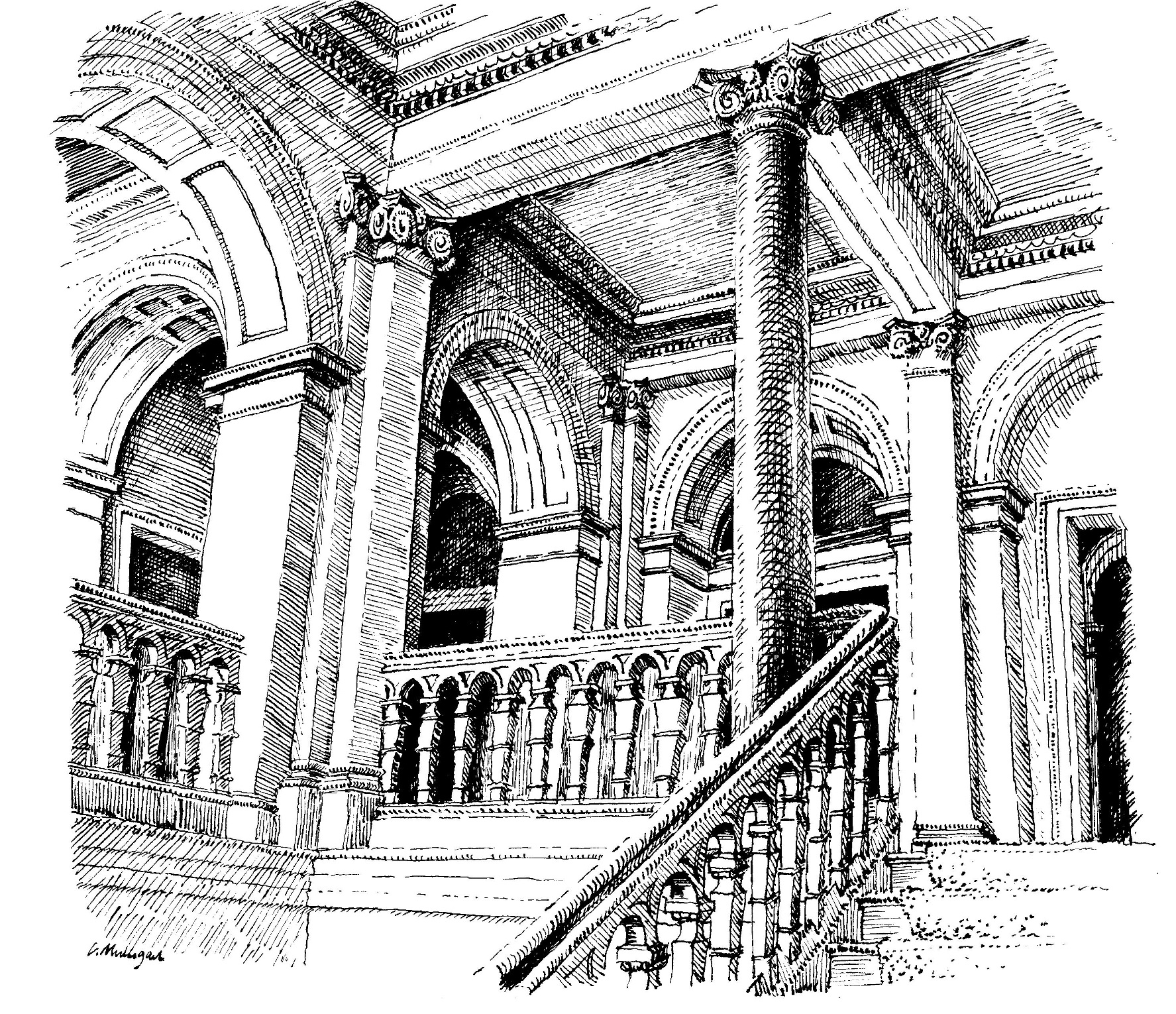
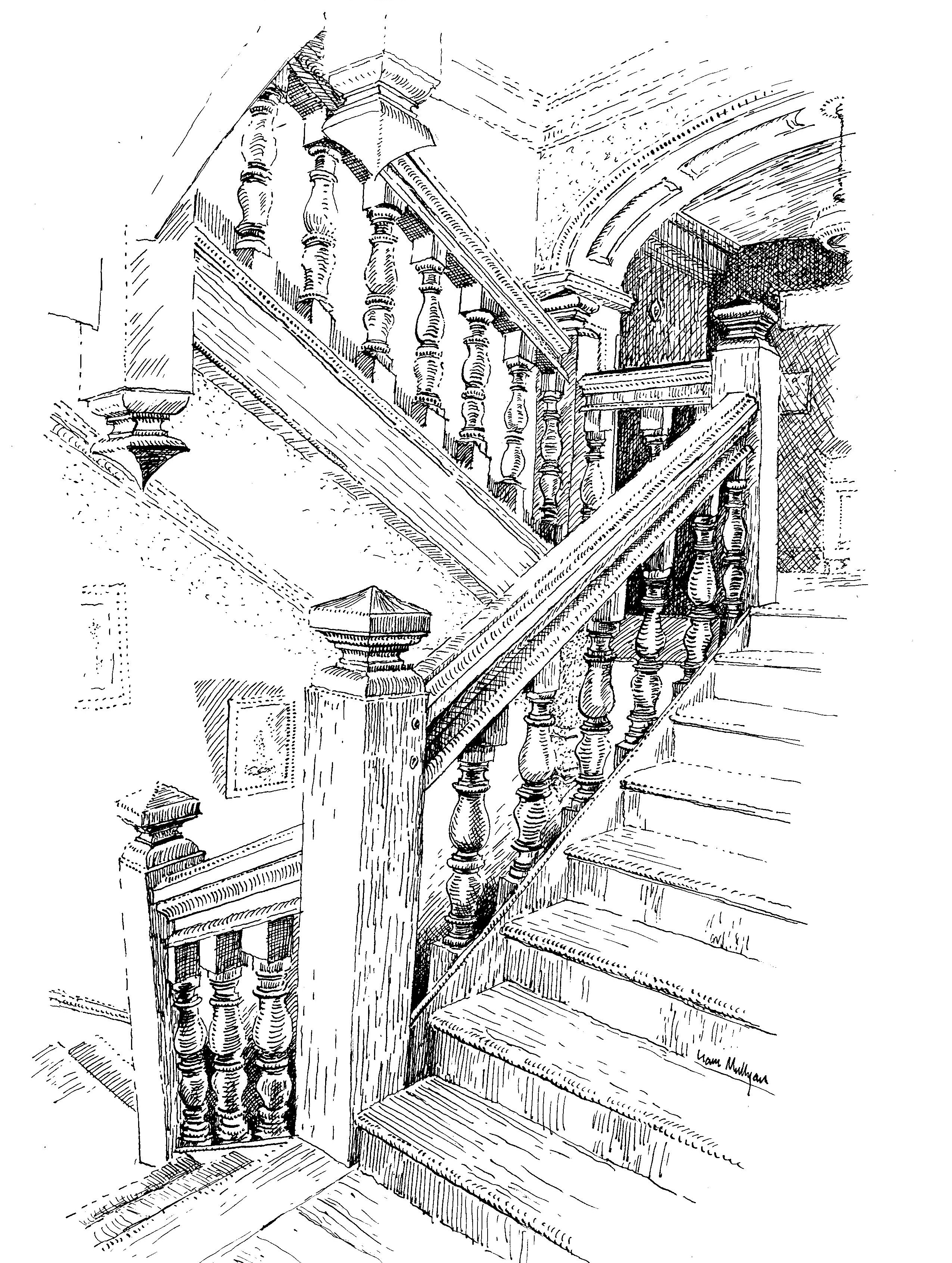
The Buildings of England architectural series begun by Sir Nikolaus Pevsner in 1945 is justifiably celebrated, but the Irish equivalent is less well-known most likely because this remains a work-in-progress. The first volume, devoted to North-West Ulster and written by Professor Alistair Rowan, appeared in 1979 and since then a handful more have been published. The latest to come out covers South Ulster (Counties Armagh, Cavan and Monaghan) and has been compiled by Kevin Mulligan. Like its predecessors, the book makes for fascinating reading, not least thanks to the author’s engaging prose (I like his description of Gosford Castle as ‘a great brawny pile’). One of the most important aspects of these books is that they are not unduly reverential about either the past or the present: there is a frankness of language that one rarely finds in architectural discussion. And the work comes with ample illustration, both colour and black and white. Included here are two illustrations by the author’s brother Liam Mulligan, that above showing the main staircase at Castle Leslie, County Monaghan (designed by W.H. Lynn and dating from the 1870s) and that below of the 17th century oak staircase at Richhill Castle, County Armagh. Text and pictures alike make this an essential addition to the library – together with the earlier volumes, of course.
The Buildings of Ireland: South Ulster by Kevin V Mulligan is published by Yale University Press at £35.
Tag Archives: Architectural History
You Ain’t Nothin’ But a Hound Dog
A couple of details of the plasterwork on the main staircase at Russborough, County Wicklow. The walls here are smothered with flamboyant but finely finished decoration – thought to be the work of Irish stuccodores – celebrating the delights of the hunt, hence the profusion of hounds’ heads together with trophies of the chase. Russborough will be hosting a Hints of History festival this coming weekend. For more information, see http://www.russboroughhouse.ie/images/downloads/hintsofhistory.pdf
The Wind Beneath My Wings
A key figure in the emergence of neo-classicism in the 18th century, James ‘Athenian’ Stuart was apprenticed as a child to a London fan painter. In 1742 at the age of 29 he set out on foot for Italy – no Grand Tour for this impoverished young man – and once there worked as both a painter and a guide to antiquities. At some point he met the affluent Suffolk gentleman Nicholas Revett and in 1748 the two men, together with painter Gavin Hamilton and architect Matthew Brettingham visited Naples in order to study Greek monuments in that part of the country.
As a result of their Neapolitan excursion, Stuart and Revett determined to travel to Greece to measure and record some of that country’s antiquities; while detailed scholarly studies of Roman ruins had already been undertaken, no equivalent work existed for Greek remains. The pair sought funds to undertake a “new and accurate description of the Antiquities &c. in the Province of Attica.” Under the auspices of the Society of Dilettanti and with donations from other patrons, in 1751 Stuart and Revett set off for Greece – then part of the Ottoman Empire – and remained there for several years during which they took accurate measurements and made drawings of various ancient buildings examined.
Although Stuart and Revett returned to London in 1755, it was only seven years later that the first of their influential five-volume Antiquities of Athens and Other Monuments of Greece appeared. Among the buildings included in this work was the Tower of the Winds or Horologium in Athens. Erected around 100-50 B.C. by Andronicus of Cyrrhus to measure time, it is an octagonal structure 42 feet high and 26 feet wide; each of the building’s eight sides faces a point of the compass and was decorated with a frieze representing a different wind deity and a sundial below. Originally the roof was topped with a weather vane in the form of a bronze triton while the interior contained a water clock to record time when the sun was not shining. By the mid-18th century only half the tower was above ground and in order to produce accurate drawings Stuart and Revett had to organise for a fifteen-feet deep trench to be dug, and for a further seven feet of debris to be removed from its interior, then being used by whirling dervishes.
The ancient Tower of the Winds in Athens was the inspiration for two garden buildings designed by Stuart, the first a Temple of the Winds completed in 1765 at Shugborough, Staffordshire and originally surrounded by an ornamental lake. Almost twenty years later Stuart revisited the concept to create another Temple of the Winds, this time at Mount Stewart, County Down for Robert Stewart, future first Marquess of Londonderry. As their surname indicates, the Stewarts were a Scottish settler family; their wealth was immeasurably increased when Robert’s father married Mary Cowan, an heiress with shares in the East India Company. It was her money that paid for the purchase of the Mount Stewart estate overlooking Strangford Lough. The site chosen for Stuart’s Temple of the Winds is at the top of a rise in the parkland, and offers sweeping views across the lough and towards the Mourne Mountains.
Stuart, who died only a couple of years after the building’s completion, never visited Ireland to see his design put into effect. Nevertheless the quality of workmanship throughout is flawless. Mount Stewart’s Temple of the Winds owes much of its inspiration to the Athens original but is not an exact copy (see the gouache of that building made by Stuart while still in Greece). Faced in local Scrabo sandstone, it does not have a frieze running around the upper walls, and the side porticos are not pedimented but have balustrades or viewing platforms to take advantage of the views. To the rear, as at Shugborough, there is a domed three-quarter-round extension holding a spiral staircase. The interior is of three storeys: a basement for services; a relatively plain ground floor reception room; and, the real glory of the building, a saloon or banqueting hall on the first floor. Every detail of this space is superlatively decorated, from the marble chimneypiece supplied by London carver John Adair through the low relief plasterwork ceiling by Dublin stuccadore William Fitzgerald to the complementarily decorated marquetry floor composed of mahogany, walnut, sycamore, box and bog oak: the result is a room of restrained sumptuosity. In the care of the National Trust for the past half-century, the Temple of the Winds is without question one of the most perfect small buildings in Ireland.
A Room with a View
In this instance the view is on the ceiling and best viewed while lying on the floor. In the drawing room at Beaulieu, County Louth, the compartmental plasterwork ceiling climaxes in an oval central panel filled with painted canvas. Attributed to 18th century Dutch artist Willem van der Hagen, the trompe-l’œil scene extends upwards through a classical arcade and into the open air whence Icarus can be seen taking a tumble after flying too close to the sun. Hovering putti seem remarkably indifferent to the poor fellow’s fate.
Going Head to Head
Ancestral home of the Mcmorrough Kavanaghs, ancient High Kings of Leinster, the present Borris House, County Carlow is an 18th century house incorporating parts of an older castle. Around 1810-20, the father and son team of architects Richard and William Morrison tricked out the building’s exterior in vaguely Tudor-Gothic style. Among the flourishes they added were these sandstone hood moulds above each window, all of them concluding in coroneted heads so as to emphasise the residents’ former royal status.
Speaking of ’98
This time of year always has a special resonance for the people of Wexford since it marks the anniversary of the suppression of the 1798 Rebellion in that part of the country. Readers unfamiliar with Irish history might not be aware of the uprising, initiated by members of an organisation called the Society of United Irishmen. Founded in 1791 this body as its name indicates welcomed members of all religious persuasions and strove to achieve more democratic government within Ireland, inspired by the ideals of the American Revolution. However, it was also stimulated by what was taking place in France at the time and after the British government went to war against the French in 1793 the United Irishmen movement was proscribed, with the result that it went underground and became more extreme in intent: an independent republic was now the goal.
Finally in May 1798 the United Irishmen movement, which now had over 250,000 members, saw key leaders arrested by the government and uprisings in various parts of the country, most notably County Wexford. The degree of violence and destruction which took place here was greater than anywhere else, and one of the houses which is known to have suffered damage during the period was Woodbrook, near Killanne in the north-west of the county.
Killanne is a townland at the foot of the Blackstairs Mountains. It was here that John Kelly, a leader of the 1798 insurrection in Wexford grew up. He seems to have been only 21 when he participated in a battle against government forces on May 30th that led to the capture of Wexford town. Several days later Kelly was involved in the Battle of New Ross where he received a serious wound to his leg. In order to recuperate he moved to Wexford where one of his sisters lived. However, following the Battle of Vinegar Hill outside Enniscorthy on June 21st the British army regained control of Wexford and Kelly was discovered. Sentenced to death, on or near this day 215 years ago he was first hanged and then decapitated, his body subsequently thrown into the river Slaney, his head kicked about the streets before being set on a pike. His remains were later interred in a grave at Killanne. He is remembered in a well-known song:
‘Tell me who is that giant with the gold curling hair,
He who rides at the head of your band.
Seven feet is his height with some inches to spare,
And he looks like a king in command.
Ah, my lads, that’s the pride of the bold Shelmaliers,
Among our greatest of heroes a man,
Fling your beavers aloft and give three ringing cheers,
For John Kelly, the Boy from Killane.’
Woodbrook is believed to date from the late 1770s/early 1780s and was built for the Venerable Arthur Jacob who had purchased the estate on which the house stands in 1752. By the time construction commenced, he had been Rector of Killanne for some twenty years and for much of the same period was also Archdeacon of Armagh. The latter explains why in 1784 Susan his only child and heiress should have married Captain William Blacker whose family lived in that part of the country. The Blackers trace their descent from Blacar, a Norse chief who arrived in Ireland in the early 10th century. Among his more questionable achievements was the plunder of Clonmacnoise in 940 and the following year the slaying of Muirchertach, King of Ailech, after which he sacked the city of Armagh. One suspects there was not much mourning when he finallyy fell in battle in 946.
As for the modern line of Blackers, they are known to have settled more peaceably in County Armagh in the 17th century where in 1692 they built a house called Carrickblacker (after being acquired by Portadown Golf Club it was demolished some years ago). Captain William Blacker, who married Susan Jacob, was a younger son so he had the good fortune to find a rich wife. It may have been his connection with the British armed forces that led to her County Wexford house, Woodbrook, to suffer assault in 1798. Or it may have been because his nephew and namesake Col. William Blacker had been one of the founders of the sectarian Orange Order two years earlier. Or the explanation may simply be that Woodbrook, like a number of other big houses in this part of the country, was attacked by rebels looking for arms and other goods.
Woodbrook as seen today is the result of what must have been an extensive renovation programme by the Blackers in the early 19th century. A big handsome building, the main block is of three bays and three storeys, the south-facing entrance front saved from austerity by the embellishment of a wide tetrastyle Ionic granite portico (and pretty fanlight over the door beyond). There are tripartite Wyatt windows on all three floors (and on three sides) diminishing in size as they rise, so the interiors have an abundance of light as well as wonderful views across the parkland and towards the Blackstairs. The ceilings of the main rooms are exceptionally high and very generously proportioned; the drawing room, for example, is forty foot long with inlaid doors and elegant ceiling plasterwork.
The airiness and grace of Woodbrook is exemplified by its remarkable ‘flying’ staircase which spirals up the double-height hall from ground to first floor. The main structure is wood, with wrought iron balusters and a polished mahogany banister and although linked by metal bands to the surrounding walls in several places, it gives the impression of floating in space, a fancy enhanced by the slight bounce evident as one ascends or descends the steps. One wonders whether the civil engineer Charles Blacker Vignoles who was born in the house in 1793 (his father was a friend of the family) and who in the 1830s was responsible for the design and construction of Ireland’s first railway, running from Dublin to Kingstown (now Dun Laoghaire) might have had a hand in the creation of this unique staircase.
The last of the Blackers left Woodbrook in 1995 and three years later – on the 200th anniversary of the place being damaged during the 1798 Rebellion – it was sold to Giles and Alexandra FitzHerbert who have lived there ever since and together with their children have made the house marvellously welcoming and vibrant. Woodbrook is always full of activity and entertainment, and always a pleasure to visit. You can find out more about it by looking at: http://www.woodbrookhouse.ie
Decorative Dining
A detail of the plasterwork around a door leading from dining room to drawing room at Ballinlough Castle, County Westmeath. This extension to the much earlier house dates from c.1790, its design generally attributed to the amateur architect Thomas Wogan Browne. Browne also undertook similar work at Malahide. where the chatelaine Margaret Talbot was sister to Ballinlough’s then-owner Sir Hugh O’Reilly. The style is an eclectic blend of classical and gothic, and yet the assured delicacy with which it is applied (who can resist an ‘eggcup’ urn perched atop the pilaster) makes the result irresistible. As for Browne, he died – seemingly by his own hand – in 1812, two years after which his brother sold the family estate in County Kildare to the Jesuit order; ever since it has been a boarding school for boys known as Clongowes Wood College.
Pyra-Mania
Dense with blossoming pyracantha, this section of the yard behind Huntington Castle, County Carlow has been converted into a picturesque residence. Home to the Durdin-Robertson family (members of which created a Temple of Isis in its basement in the 1970s), Huntington’s core is a tower house dating from 1625 but it has been much altered and enhanced ever since, not least by the addition of battlements in the 19th century so that it has an exceptionally pretty toy-like exterior. The gardens include a yew walk believed to be at least 600 years old.
Up Pompeii
As is widely known, in August 79 A.D. Mount Vesuvius in southern Italy erupted, sending a plume of ashes, pumice and other rocks, and scorching-hot volcanic gases so high into the sky that people could see it hundreds of miles away. ‘I believed I was perishing with the world, and the world with me,’ afterwards wrote Pliny the Younger, who saw the eruption from the other side of the Bay of Naples and whose uncle Pliny the Elder, an admiral of the Roman fleet, died in the catastrophe. Many residents of the nearby town of Pompeii quickly fled but those who remained behind soon found it impossible to do so: falling ash clogged the air and made breathing difficult, buildings started to collapse and then a 100-miles-per-hour torrent of hot poisonous gas and pulverized rock – called a pyroclastic surge – poured down the mountain and covered everything and everyone in its path.
Buried beneath at least thirteen feet of volcanic ash, Pompeii was forgotten until 1599 when the digging of an underground channel exposed a few walls. However, the site was covered up and not explored again until the mid-18th century. First in 1738 came the excavation of the former town of Herculaneum, which had also been destroyed in the eruption of Vesuvius and which was found by workmen digging the foundations for a summer palace for the King of Naples. A decade later work on Pompeii was intentionally initiated.
The excavations at Pompeii and Herculaneum excited widespread interest, and were much visited by affluent Irish and English travelers in Italy participating in the Grand Tour. Furthermore books were published with engravings of what had been uncovered on these sites, in particular the elaborate painted decorative schemes that covered the walls of ancient Roman houses. Some of these ideas had been emulated in the 16th century thanks to the discovery around 1500 of sections of Nero’s Domus Aurea in Rome, the inspiration in that city for work by Raphael and his successors in the Vatican loggie and the Villa Madama, and in turn for French artists of the Fontainebleau school.
The style took longer to win adherents in England and Ireland, but began to attract interest with the appearance from 1757 onwards of successive volumes of the official Le Antichità di Ercolano which contained engravings of wall paintings. A stir was caused by the creation c.1759 of the Painted Room in Spencer House, London designed by that great advocate of neo-classicism, James ‘Athenian’ Stuart. The Adam brothers then undertook similar decorative schemes in such houses as Syon on the outskirts of London and Kedleston Hall in Derbyshire, and later Osterley Park, London. In the 1770s the interiors of Fawley Court, Buckinghamshire were designed in pure ‘Etruscan’ style by James Wyatt, an early commission which helped to establish his reputation.
Only one room painted in the Pompeian style exists in Ireland: the Long Gallery in Castletown, County Kildare. The house was built in the 1720s and initially this space was used as a picture gallery but this looked old-fashioned even by the time Thomas Conolly took up residence at Castletown in 1759. When in Rome the previous year he had his portrait painted by Anton Raphael Mengs (a copy of the picture can be seen over the chimneypiece at the east end of the room) and may have visited Herculaneum and Pompeii. Incidentally also in 1758 Mengs painted an imitation ancient Roman fresco representing Jupiter and Ganymede in Rome’s Palazzo Barberini in order to mislead art historian Johann Joachim Winckelmann; so convincing was this work that Winckelmann was duped into believing it was an original.
On his return from Italy Thomas Conolly married the 15-year old Lady Louisa Lennox, one of the four daughters of the second Duke of Richmond whose story was told in Stella Tillyard’s 1995 book Aristocrats. Lady Louisa’s older sister was married to James FitzGerald, Earl of Kildare (and later first Duke of Leinster) who lived less than four miles away at Carton House. Over the next twenty years or so the Conollys carried out extensive alterations at Castletown, not least to the Long Gallery. Situated on the first floor and with eight windows looking north (towards the Conolly Folly of 1740), the room measures 79 feet three inches by 22 feet nine inches. Originally there were four doors but as part of Lady Louisa’s decorative scheme, this was changed and there is now only one entrance (the matching door on the south wall is blind). There are white marble chimneypieces at either end, that already mentioned and its pair above which is a copy of Lady Louisa’s portrait by Sir Joshua Reynolds. The doors and chimneypieces were designed by Sir William Chambers, the actual work believed to have been overseen by Simon Vierpyl who performed a similar role at the casino in Marino (see Casino Royale, March 25th).
The Long Gallery’s Pompeian-style decoration dates from 1775/76 and was undertaken by English artist and engraver Charles Ruben Riley (frequently referred to in Lady Louisa’s correspondence as ‘little Riley’), assisted by Thomas Ryder. It was a slow process with many changes for in August 1776 Lady Louisa wrote to another of her sisters, ‘Mr Riely [sic] goes on swimmingly in the Gallery but I am doing much more than I intended, that pretty white, grey and gold look that I admired in the ends of the room, did look a little naked by the painted compartment when finished and upon asking Mr Conolly’s opinion about it, he meekly told me, he always thought it would be much prettier to have painting, but thought I knew best.’ Clearly Mr Conolly understood the merits of a quiet marital life.
Although the overall stylistic inspiration came from ancient Roman decorative schemes, the Long Gallery’s complex iconography drew heavily on Bernard de Montfaucon’s 15-volume L’antiquité expliquée et représentée en figures published 1719-1724 and also on Raphael’s work in the Vatican. A variety of themes are illustrated, not least love, marriage and family – a reflection of the Conollys’ own circumstances – as well as different subjects from ancient antiquity. Over the two doors is a lunette copied by another artist from Guido Reni’s fresco of Aurora in the casino of the Palazzo Pallavicini-Rospigliosi, Rome. From the compartmentalised ceiling hang three glass chandeliers. They were ordered from Venice by Lady Louisa to complement the decorative scheme but once unpacked she was obliged to note, ‘The chandeliers have arrived intact, but they are the wrong blue for the room.’
In 1778 the newly-married Lady Caroline Dawson (whose cultivated husband would later become first Earl of Portarlington and commission the design of Emo Court, County Laois from James Gandon) visited Castletown and wrote, ‘It has been done up entirely by Lady Louisa and with very good taste: but what struck me most was the gallery. I dare say 150 feet long, furnished in the most delightful manner with fine glasses, books, musical instruments, billiard table…in short everything you can think of is in that room, and though so large it is so well fitted that it is the warmest, most comfortable looking place I ever saw: and they tell me that they live in it quite in the winter, for the servants can bring in dinners or suppers at one end, without anybody hearing it at the other.’
While the Long Gallery’s furnishings have since been dispersed, its unique decorative scheme remains intact and in excellent condition. Castletown, rescued by Desmond Guinness and the restored by the Irish Georgian Society in the 1960s is now owned by the Irish State and open to the public. For more information on the house and its many attractions, see: http://www.castletownhouse.ie. More to follow about Castletown on another occasion…
It’s a Lock Out
The largest house on Merrion Square today is no. 45 which dates from 1785. As mentioned before (see The Fashionable Side, September 24th), it was built by Gustavus Hume who when not acting as a medical surgeon dabbled in property development, being also responsible for laying out Ely Place and Hume Street to the south-west of Merrion Square. Five bays wide and rising four storeys over basement, no. 45 has a restrained neo-classical interior with ground and first floor rooms radiating off an immense cantilevered Portland stone staircase.
For the past decade the building has been home to the Irish Architectural Archive. Founded in 1976 the IAA is an independent charity which receives some state assistance but relies on private support to sustain its services. The organisation’s holdings at present include 2.5 million drawings and documents, 500,000 photographs and 30,000 books, pamphlets and periodicals: the greatest single source of information on Ireland’s buildings and those who designed them, this material is freely available for research to all visitors.
Unfortunately at the moment the IAA like so many other cultural bodies is suffering from inadequate funding and unless additional monies are found, it will have to shut for the months of July and August, with the small body of staff made temporarily redundant. One must worry that if this is permitted to happen, a precedent will have been set, not just for the IAA but similar establishments too. Anybody interested in helping to ensure the IAA’s future can find more information at http://www.iarc.ie/sponsors/funding-appeal. With its graceful late 18th century plasterwork by Michael Stapleton, the door shown below faces the top of the main staircase. How dreadful were it, along with all the others in the building, to be closed in a few weeks’ time.