The base of a window and its curtain in the Gothic Saloon at Birr Castle, County Offaly. Lit by three arches offering views down to the river Camcor and a vaulted ceiling supported by slender shafts, this wonderful room dates from the early 19th century when it was created by the second Earl of Rosse assisted by an otherwise almost unknown architect called John Johnston who, according to Mark Girouard (writing in Country Life, March 1965) did ‘little more than make working drawings based on the sketches of his employer.’
Tag Archives: Irish Castle
Dispossessed Kings
Monday’s piece on Kingston College (see God Bless the Kings, September 1st) seems to have excited some interest, so readers might be interested to know what became of the King family’s adjacent residence, Mitchelstown Castle. This building, shown above, dated from the early 1820s when the third Earl of Kingston demolished the old house, replacing it with an immense castle designed by James and George Pain and costing in the region of £100,000. With 60 principal rooms, including a 93 feet-long gallery, drawing room, three libraries, morning room and vast dining room, Lord Kingston entertained lavishly until 1830 when, his candidate of choice having failed to win a local by-election, he lost his mind and had to be taken to England where he died towards the close of the decade. The fourth Earl followed his father’s example by being both a reckless spendthrift and then descending into madness. Ultimately the castle was occupied by the fifth Earl’s widow and her second husband, and by the latter alone after his wife’s death. In the summer of 1922 he was driven from the building by anti-Treaty forces who, on their departure, set the castle on fire: it has since been proposed that this only happened after the building’s valuable contents – including the King silver, family portraits and furniture – had been looted from the property. Although efforts were later made to seek compensation the sum offered by the Irish Free State was insufficient to allow Mitchelstown Castle be reconstructed. Instead its cut stone was sold to the Cistercian monks of Mount Melleray, County Waterford who used it to build a new abbey. As can be seen below, the site on which the castle stood is today occupied by the Dairygold Food Co-Operative Society’s factory, which like the earlier building dominates the horizon, albeit in a somewhat less attractive fashion.
Ashford as It Was
Next Wednesday, July 23rd, a sale takes place in Cong, County Mayo of items from Ashford Castle. Most of the lots appear to be surplus to the requirements of the place’s new owners but a few are survivors of the period when Ashford was owned by the Guinness family. Originally a 13th century de Burgo castle, in the 1670s Ashford passed into the ownership of the Browne family, remaining such until sold through the Encumbered Estates Court to Sir Benjamin Lee Guinness in 1852. He then left it to his eldest son Arthur Edward Guinness, created Lord Ardilaun in 1880. Between them père et fils greatly enlarged and improved both the old house and surrounding estate. It was never a full-time residence but primarily used during the shooting season: in January 1905 the Prince of Wales (later George V) spent a week there. Lord Ardilaun having no children, on his death in 1915 the estate reverted to the family trust which passed it on to the Hon. Ernest Guinness. He frequently joked that far too many people were employed at Ashford, ‘Every one of whom might fall over if you removed his (sweeping) brush.’ However, relations with staff gradually deteriorated to the point that the summer of 1938 they went on strike, looking for a wage increase of two shillings a week. Ernest Guinness was so exasperated by their behaviour that he left Ashford in his private plane and never returned. The following autumn the trust placed Ashford on the market and in spring 1939, shortly before the estate went to public auction, 22,000 acres were bought by the Irish State for £20,000. The castle and immediate 170 acres were leased by hotelier Noel Huggard; ever since Ashford Castle has operated as an hotel under a succession of managements, the latest taking over last year. Above is a page taken from a Guinness family photograph album showing a shoot on the estate eighty years ago.
A Grand Soft Day
Recently photographed on a typical Irish summer morning (that is to say in sleeting rain: the Irish Aesthete is nothing if not intrepid) the walled garden at Glenarm Castle, County Antrim. Dating from the 18th century, it originally provided the main house with fruit and vegetables but in recent years has been converted into a series of pleasure grounds open to the public, the upper sections designed by Catherine FitzGerald, eldest daughter of the late Knight of Glin. Above is an obelisk of oak created by local craftsman Corin Giles: what distinguishes this piece is the use of wood for a rusticated base. Meanwhile below a pair of rills flanked by beech hedges run down to a cascade before concluding in a pool; far below can be seen an opening cut into the yew circle dating from the 1820s. How simple devices can achieve powerful effects…
A Towering Presence
An example of early 19th century modernisation: the entrance front of Ballymore Castle, County Galway. The original castle, a fortified tower house, dates from around 1585 when it was built by the Elizabethan adventurer John Lawrence on land acquired through his marriage to the daughter of O’Madden, Lord of Longford: it was damaged in subsequent wars and repaired by his son Walter in 1620. The next generation of Lawrences were dispossessed by Cromwell for having espoused the royalist cause and the castle with surrounding land given to Sir Thomas Newcomen, who then leased the property back to the Lawrences. On Newcomen’s death Ballymore passed to his stepson Nicholas Cusack of Cushinstown, County Meath, who around 1720 sold it to John Eyre of Eyrecourt. By this date another family, the Seymours were already leasing the estate and they finally purchased it from Giles Eyre in the mid-1820s. Almost a decade earlier, a two-storey house was added onto the castle, as can be seen here. Its most notable feature is the central bow with its curved fanlighted doorway.
Very Stately
A view of Tulira Castle, County Galway. The tower house to the right dates from the 15th century although resting on earlier foundations. Around 1880 the estate’s then-owner Edward Martyn commissioned the new castellated residence to the immediate left from architect George Ashlin who hitherto had been primarily known for his ecclesiastical architecture (he worked on no less than eight of Ireland’s new Roman Catholic cathedrals as well as designing countless churches). Indeed the High Gothic interiors would not look out of place in a religious establishment: Martyn was an ardently pious man who directed his body be buried in an unmarked pauper’s grave. Now on the market, Tulira has been extensively and sensitively restored in recent years. It will be among the properties discussed in a talk on The State of the Irish Country House Today that I am giving next Sunday afternoon, June 22nd at the National Gallery of Ireland. For more information, see: http://www.nationalgallery.ie/whatson/Talks/Sunday_Talks/June-22.aspx
Hanging Gardens
Lying in the shadow of the Knockmealdown Mountains, Castle Grace, County Tipperary is believed to have been built by the de Bermingham family around the mid-13th century. Its substantial square keep originally had a tower at each corner but only two circular ones remain. The castle’s ruins now serve as a walled garden for an adjacent Georgian house, the upper sections of stone and brick interior at present smothered in cascades of wisteria.
A Slim Silhouette
Built on a small island in the river Deel, Askeaton Castle, County Limerick dates from 1199 when built by the Norman settler William de Burgo. It subsequently became a stronghold for the FitzGerald Earls of Desmond but while surviving assault during that family’s rebellions against the English crown in the 16th century the castle was eventually dismantled around 1650 by the regicide Colonel Daniel Axtel when he was crushing opposition to Cromwell’s forces in this part of the country. Even as a ruin, its remains continue to dominate the surrounding landscape.
And a Little Bit More Dromore
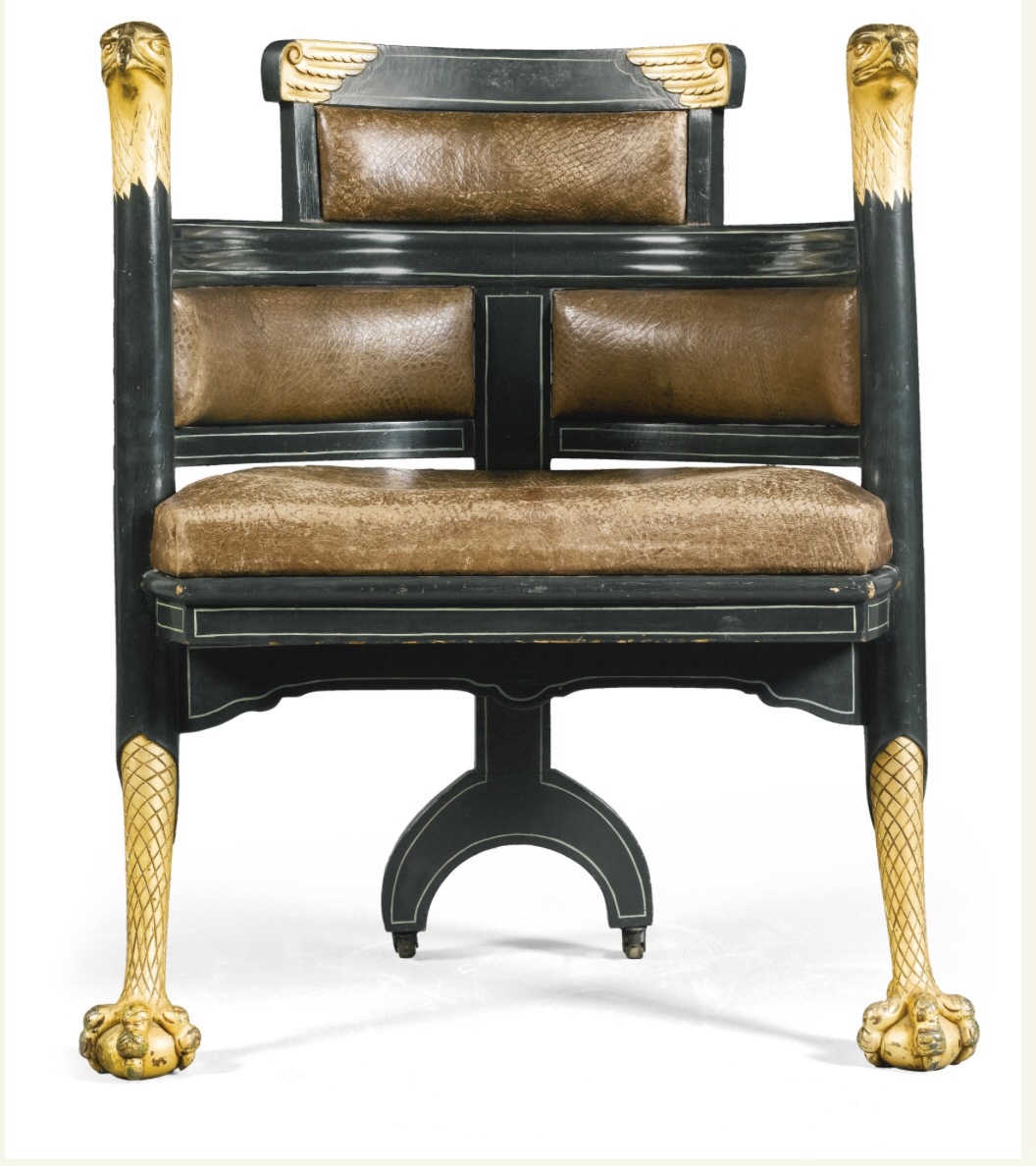
After yesterday’s post about Dromore Castle, County Limerick it transpires that tomorrow in London Sotheby’s will be selling a chair the original of which was designed by Godwin for the library of the house. The ‘Eagle’ Chair is more Egyptian than Gothic in inspiration and indicates how eclectic were Dromore’s interiors. Like all the other furnishings, it was manufactured by William Watt’s Art Furniture Company and some pieces including this one featured in the company’s 1877 catalogue.
It is unknown how many ‘Eagle’ chairs were subsequently produced: a version in oak with variant stretcher and reupholstered in brown leather was sold at Christie’s, London in May 1995 for £18,400. This one carries a pre-sale estimate of £8,000-£12,000.
For more information on the lot, see: http://www.sothebys.com/en/auctions/ecatalogue/2014/1000-ways-seeing-l14313/lot.248.html
More and More Dromore
The history of Dromore Castle, County Limerick and the work of its architect Edward William Godwin were discussed here some weeks ago (see Une Folie de Grandeur, 30th December 2013). Today the focus is on what remains of the building’s remarkable interiors since every aspect of their original decoration – furniture, wall paintings, chimney pieces, stained glass, tiles, brass- and ironwork – was likewise overseen by Godwin.
It was in the mid-1860s that William Pery, third Earl of Limerick decided to rectify his lack of a country seat in Ireland where the family had long owned thousands of acres of land in Counties Limerick and Cork. Hitherto when not in England he and his forebears had occupied an 18th century house in Limerick city but this was no longer deemed satisfactory. His decision to create a new rural residence coincided with Lord Limerick’s friendship with Godwin, the two men then respectively serving as President and Vice-President of the Architectural Society in England.
An article on Dromore Castle written by Marian Locke and published in the Winter 2011 issue of the Old Limerick Journal states that Godwin thoroughly explored his prospective client’s estates in search of a site without finding anywhere he deemed suitable before coming across a small shooting lodge owned by the Earl on a piece of land of some forty acres overlooking Dromore Lake. This the architect decided was the perfect spot, ‘a dream-like situation on the edge of a wood…overlooking the water, which would reflect the castle one hundred feet below.’ As indeed it still does, Lord Limerick buying up a further 200 acres, seventy of which were covered by aforementioned water.
So the rocky outcrop on which Dromore stands, and the views offered from this position, made certain other decisions inevitable, not least that the greater part of the accommodation would face north, hardly the best way to ensure the building’s interior would retain heat, or receive much sunlight.
Access to Dromore Castle is through a gateway on the western side and immediately to the south, only accessible by first stepping outside, was the large double-height banqueting hall seen here. This still has its hooded stone chimneypiece, but the minstrels’ gallery has gone along with the pitched timber roof. A door at the far end of the hall gave access to a slender three-storey Chaplain’s Tower which on the first floor in turn opened onto south-facing battlements, concluding in the easterly corner with a small block that originally served as a bakery.
The main portion of the castle runs west to east, with a chapel located on the first floor over the main gateway; above this looms the round tower that is one of Dromore’s more unusual features. Most of the northwest corner is taken up by a stone staircase leading to the first floor where it terminates in an arched gothic window. The shape of this window is echoed by stepped barrow vaulting above the steps, one of Godwin’s most striking effects to survive.
On reaching the top of the main staircase, one turned west along a corridor off which opened a succession of reception rooms inside what, from the exterior, looks like an enormous fortified keep. Thus the entire ground floor was given over to servants’ quarters, with a typically massive kitchen occupying the central portion. A consequence of this arrangement is that the central courtyard was primarily a service area, although a door leading from the southern end of the drawing room opened onto another run of battlements, this time looking eastwards down to the lake (or west into the courtyard). Still, it must have been a drawback that the castle’s owners could not directly enter the surrounding gardens. Perhaps they might not have wished to do so, given the splendour of their surroundings. The drawing room, for example, featured an elaborately carved pink marble chimney piece (which survives, suspended in space), and arched recesses with marble columns (some of which remain in situ) beneath more carved capitals.
Meanwhile up another flight of stairs one reached a further north-facing corridor, its windows set inside deep arched recesses, off which ran the main bedrooms. At the very end of the passage, the north-east corner was given over to the countess’s bedroom which had a stone balcony providing views of the lake far below but this was an advantage enjoyed by nobody else. The third floor was given over to servants’ bedrooms and then, once more in the north-east corner one ascended to the fourth floor billiard room, something of a break with the spirit of medievalism pervading elsewhere.
Although the exterior walls of Dromore Castle are up to six feet thick, from the start it suffered from problems of damp. In an attempt to overcome this problem, Godwin designed a brick lining with a cavity of about two inches from the stonework, but to no avail. In an article on the building carried by Country Life in November 1964, Mark Bence-Jones quotes from a lecture the architect gave in 1878, that is less than a decade after completing his commission, in which he commented ‘Whenever it was going to rain…the walls showed it like a weather glass.’ Thus the elaborate murals he designed for the main rooms never had a chance of survival. At least some of these were executed by Academician Henry Stacy Marks, an artist who specialised in painting birds. At Dromore, however, the plan was for him to cover the walls of the first-floor corridor were to depict the four seasons, twelve months and day and night (complemented by stained glass windows showing the six days of earth’s creation). The dining room murals featured the eight virtues, those of the drawing room the four winds and the four elements. Alas, none could withstand the harsh Irish elements and before long all had perished. Nevertheless, according to Bence-Jones Lord Limerick was ‘extremely delighted’ with his new property, even if this delight did not encourage him to spend much time at Dromore.
According to Marian Locke, Dromore cost in the region of £80,00-£100,000 to build, and yet it was only intermittently occupied by the Limericks for fifty years. After the First World War the family effectively abandoned the property and finally in 1939 the castle and many of its contents along with the surrounding land were sold, reputedly for just £8,000, to a local timber merchant Morgan McMahon. Although he bought the estate primarily for the value of its woodland, Dromore’s new owner was so engaged by the place that he and his family carried out necessary repairs and moved in. They remained in residence until the mid-1950s when it was again sold, but this time there was no reprieve. Faced with costly maintenance and rates, the new owners removed the roof and stripped out the interior. Since then the castle has stood empty, the dividing floors long gone so that now there is no difference between those areas once occupied by master and by servant: today all are equally open to sun and rain, and all share the same patina of neglect. Yet somehow enough of Godwin’s decorative scheme lingers on. It offers a tantalising sense of what Dromore must have looked like during its all too brief, but wondrous, heyday.