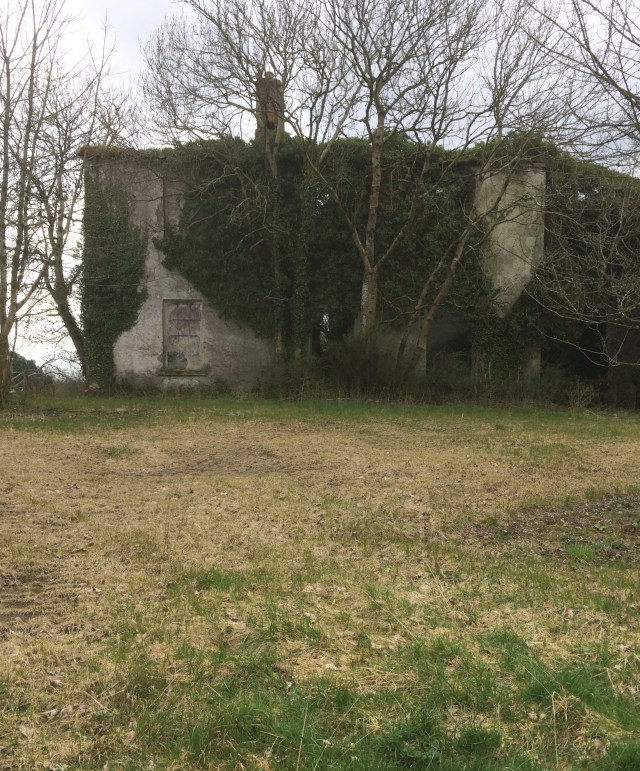
Following Monday’s account of Belview, County Offaly, here are some views of the building which provided the funds to build a fine house. Ballycahan Mill (located in County Westmeath, although only a few hundred yards distant) is believed to date from the late 18th century, the main structure being a three-storey block used for the bleaching and scutching of linen. On a map of 1838 the field to the southwest of the mill is described as the ‘old bleach green’ indicating that the surrounding land was also used as part of the industrial process. Like Belview, this building is now just a shell.
Tag Archives: Ruins
Not Such a BelView

Writing of agriculture and manufacturing in County Offaly in 1801, Sir Charles Coote noted that the linen industry then thrived, with several local landowners ‘who keep looms employed, but do not bleach. Mr Holmes of Prospect and Mr Armstrong of Belview are the most extensive manufacturers, and both have large greens, but they only bleach their own linen, their [sic] being bleach yards for public accommodation.’ Almost twenty years later Peter Besnard, Inspector-General for Trade and Manufacture of Linen and Hemp in Ireland, produced a report in which he commented on Offaly: ‘The Manufacturing and Bleaching branches of the Linen Business are carried on in this county as usual, particularly in the neighbourhood of Clara and Charlestown; in the latter place, a new Linen Hall has been built by Andrew Armstong Esq. of Belview, whose family have long been supporters and encouragers of the Linen Trade. Mr Armstrong has built this Hall at his own expense, and likewise gives a premium for the best Web sold in it; and I cannot avoid remarking, that wherever premiums have been established, and judiciously applied, they have been productive of much benefit.’


The Armstrong family appears to have settled in this part of the country in the 18th century, one John Armstrong (born 1748) marrying Jane Holmes, whose family lived nearby in a house called Prospect (still standing). He married a second time and had a son Andrew Armstrong, the man mentioned by both Sir Charles Coote and Peter Besnard as being active in the linen industry. A large range of now-derelict buildings on ground below Belview testify to the one-time importance of this business, in the 18th and early 19th centuries by far the most commercially viable in Ireland. From the early 1700s onwards Irish linen was imported duty free to England and to the American colonies, so that eventually this one product accounted for around fifty per cent of Ireland’s total exports. It is understandable that so many entrepreneurial spirits became involved in the business and, if they managed their concern sufficiently well, grew rich, as did the Armstrongs. As was so often the case, they gradually climbed the social scale, moving away from the commercial class to become landed gentry. John Herbert Armstrong, for example, who inherited Belview in the mid-19th century , joined the army and served as a major in the Royal Tyrone Fusiliers. He further cemented his gentry status by marrying Eliza Catherine Lowry whose family, related to the Earls of Belmore, lived at Pomeroy House, County Tyrone. Their son in turn married Emily Theodosia Blacker-Douglas whose family were large landowners (with over 8,000 acres in County Kerry) and lived in Elm Park, outside Armagh. However, after selling their estate in 1912 under the Irish Land Act, the Armstrongs left Belview, which was subsequently leased to a variety of tenants.


Located on the border of Counties Offaly and Westmeath, Belview is a substantial house, the front portion of which dates from the second half of the 18th century. To the rear is an older L-shaped building which looks to have been adapted into a service wing when the newer section was added. The latter featured the usual layout of the period, with a drawing room, dining room and morning room/office opening off a central entrance hall on the ground floor: traces of neo-classical plasterwork survive in some of these spaces. Outside the east-facing façade is of five bays, with a Venetian window on the first floor. Below a short flight of stone steps led to a tripartite limestone doorcase with engaged Doric columns and an open pediment. The house testifies to the Armstrongs’ wish to identify themselves with the local gentry, as well as to the wealth that could be accumulated through the linen trade. A folly built in the form of a monastic round tower by Andrew Armstrong in 1817 and now buried in the nearby woodland, likewise provides evidence of the family’s social ambitions. The house was abandoned some decades ago and is now a roofless ruin.
Monasterboice


Rising some twenty-one feet, the tallest high cross in Ireland can be found, along with a couple of others, at Monasterboice, County Louth. The place name derives from Mainistir Bhuithe meaning ‘Monastery of Buithe’: the latter was an early Christian saint said to have founded a religious settlement here in the late 5th century. Three high crosses survive here, this one which dates from the 9th century, standing closest to the round tower. Panels on one side feature, among others scenes of the Sacrifice of Isaac, Daniel in the Lion’s Denand David with the head of Goliath. The opposite side is devoted to scenes from the Life of Christ, such as his baptism, the Kiss of Judas, his arrest and crucifixion.
What’s Left

The remains of Rattin Castle, County Westmeath, a substantial four-storey tower house that was built in the 15th or 16th centuries. During this period the land on which it stands, formerly under the control of Hugh de Lacy, was in the possession of the d’Arcy family. The last member, Nicholas d’Arcy, forfeited the castle in the 1640s during the Confederate Wars and it seems to have fallen into ruin after that: a source from that period claimed the building originally had several towers and no less than 500 rooms.
Important Remains
In Classic Irish Houses of the Middle Size (1976) Kiltullagh, County Galway was described by the late Maurice Craig as having formerly been very handsome, thanks to its ‘gigantic paneled chimney-stacks and (as can still be traced) a very steep roof…To judge by the provision of pistol-loops it must have been built early in the 18th century or even earlier…Even in its present state it can be seen to be a building of quality. The pistol-loops commanding the entrance are conspicuous.’ Likewise, the reference to Kiltullagh in Vanishing Country Houses of Ireland (1988) noted that it was an ‘important, late seventeenth-century or early eighteenth-century, two-storey house. The very high chimney-stacks have sunk panels, and there are pistol-loops in the basement which is most unusual for a house of this period. The house which is now a ruin is a most impressive example of an early virtually undefended house and should be preserved from further depredation.’


Kiltullagh belonged to a branch of the d’Arcy family, one of the Tribes of Galway, the mercantile clans that ran the city during the Middle Ages. Like other members of the same milieu, from the early 16th century onwards they gradually acquired parcels of land in the countryside and gradually metamorphosed into gentry, although this process was not without setbacks. The lawyer Patrick d’Arcy was a key figure on the Roman Catholic side during the Confederate Wars of 1641-52, in the former year writing his Argument which insisted that ‘no parliament but an Irish one can properly legislate for Ireland’ and later helping to draw up a Constitution for the Confederacy. In the aftermath of that side’s defeat, he lost his lands but the greater part of these were restored to his heir James d’Arcy: the family owned over 18,750 acres – divided between Kiltullagh and an estate to the west around Clifden – but all this was lost in the aftermath of the Great Famine when the property was sold by the Encumbered Estates Court. (The last of the family to own the property, Hyacinth d’Arcy, subsequently became a Church of Ireland clergyman). In the meantime, one of the more interesting members was another Patrick d’Arcy, born in 1725 and at the age of fourteen sent to Paris to be raised by an uncle who was a banker there. An eminent soldier and scientist, he was created a French count and a member of the Académie Royale des Sciences, dying of cholera in 1779, two years after marrying his niece Jane d’Arcy.


As so often, we know almost nothing about Kiltullagh’s history. It was clearly a substantial house and stood at the centre of a large estate, but the architect responsible for the building’s design is a mystery. Kiltullagh appears to have been occupied by the d’Arcys until the second decade of the 19th century when the then-head of the family, John d’Arcy, following the death of his first wife, moved west where he founded the town of Clifden and outside it built a new residence, Clifden Castle (now also a ruin). Thereafter the house was rented to tenants and at some date gutted by fire. As with Clifden, the entire property was sold through the Encumbered Estates Court in 1850, being bought for £6,000 by Pierce Joyce. Kiltullagh was never rebuilt and stood a ruin. The former stable yard has been converted into a residence and some years ago work was undertaken on the main building to secure what remained. However, this enterprise appears to have halted and since then the interior has remained filled with scaffolding.
One Site: Two Ruins (II)

Second the remains of St Columcille’s church at Skryne, County Meath. Intended for Anglican worship, this was built in the early 19th century: in 1809 the Board of First Fruits provided £500 towards its construction costs. At the time there were some 67 souls who worshipped here but, as was the case across the country, numbers declined during the last century and the church closed in the 1960s. Today only the squat tower with its diagonal buttresses remains on the site.
One Site: Two Ruins (I)
First the remains of St Columba’s church at Skryne, County Meath. The place name derives from Scrín Choluim Chille (Colmcille’s Shrine): in the ninth century the relics of St Columba, otherwise Columcille, were brought here from England for safe keeping and a monastery established. The ruins likely date from a 15th century church built on the site of the earlier foundation, and consist of sections of the former nave and a massive tower at the west end.
On the Nail

Now incorporated into the wall of the graveyard surrounding St Mary’s Cathedral, Limerick (see the recent post, A Significant Anniversary, July 2nd 2018): a row of Tuscan columns that once formed the ground floor arcade of the city’s Exchange building. Originally built in 1673, the original building was demolished in 1702 and rebuilt, with further building taking place in 1777-78. James Pain was paid £432.17s 5d for repairs and alterations to the structure in 1815 and his younger brother George Richard £182.1s 2½ d for more of the same four years later. By 1872 the Exchange was in use as a national school before being eventually demolished. Nearby in the city museum is preserved a limestone pillar with copper plate on top, known as the nail. Given to the Exchange in 1685 by Robert Smith, Mayor of Limerick, this was used by merchants to confirm transactions between themselves. It is often proposed that the phrase ‘payment on the nail’ derives from the Limerick monument, but it is found in texts from the previous century and there were similar nails in other mercantile cities such as Bristol.
Sorrow in Sunlight

The graveyard of Grey Abbey, County Down. A Cistercian monastery was founded here in 1193 by Affreca, wife of John de Courcy and daughter of Godred Olafsson, King of the Isles after she had vowed to create such a house if given a safe passage across the Irish Sea. The abbey was closed down in 1541 and then the buildings burnt some thirty years later by the O’Neills to stop English colonists using them. On land directly behind the east end of the church the graveyard, where once monks had been buried, continued in use and is accordingly packed with tombstones tumbling one over the other. Particularly poignant is this stone erected to commemorate Isabella Green who died in December 1816 aged ten months.
On the Fringes of Europe

The name Ballinskelligs derives from Baile an Sceilg meaning ‘Place of the craggy rock’ and refers to a coastal village on the Iveragh peninsula in County Kerry. On the western fringe of Europe, this has always been a remote and none-too affluent part of the country, which is likely why early Christian monks, in search of solitude settled on Skellig Michael, one of two islands some miles off the coast, where they lived in bleak isolation: some of their beehive huts and oratories can still be seen by visitors prepared to make the boat journey. Eventually in the late 12th or early 13th century, the monks moved to the mainland and took up residence in Ballinskelligs, where evidence of their buildings remains, along with another historic property.


Ballinskelligs Castle is one of the many tower houses that can be found throughout Ireland. As so often, it is impossible to date the building precisely but the consensus seems to be that it was constructed in the 16th century by the dominant MacCarthy family, ancient Kings of Desmond. The tower stands on an isthmus at the western end of the bay but much of the surrounding land has been eroded over time and it is most easily accessible at low tide. Presumably it was built as an observation post for all vessels coming into this part of the coast and to keep an eye on the arrival of potential pirates. Originally of three storeys, the tower has lost its upper section but corbels to support a floor survive. Following the dissolution of the Kingdom of Desmond at the end of the 16th century, and the loss of the MacCarthys’ authority, the building passed to the Sigerson family but later in the 17th century was reduced to being used as a pilchard-curing station as part of Sir William Petty’s fisheries enterprise.


Ballinskelligs Priory, at the other end of the long beach, was an Augustinian house likely established after the abandonment of Skellig Michael as a religious settlement: certainly the priory retained control of the island until it was in turn shut down during the 16th century Dissolution of the Monasteries. The present collection of remains dates from the 15th century and has been extensively – and perhaps rather too rigorously – conserved in recent years: a certain sterility now pervades the site. But, as with Ballinskelligs Castle, the views are outstanding. In the case of the priory, it is better to be inside looking out rather than outside looking in.


