An Architectural Conundrum

IMG_1345
In Three Homes, a memoir published in 1938, playwright and author Lennox Robinson, together with his siblings Tom and Nora, recalled their childhood in late 19th century County Cork. Robinson was born in Douglas, now a dormitory suburb of Cork city but then still a separate village lying a few miles to the south-east. The youngest child of a stockbroker-turned-clergyman, he was born in a since-demolished property called Westgrove but often visited his aunt Eleanor, who had married a wealthy brewer, John Frazer Crichton, in Donnybrook House which still stands. This the Robinsons in their recollections describe as being ‘lowbuilt, old and charmingly planned, rooms open one into the other on the ground floor a bedroom opened off the dining room, the drawing room on the opposite side of the hall had its back drawing room and the same plan was repeated in the bedrooms upstairs.’ More than a century later, although the condition of the building has somewhat deteriorated, the layout remains unchanged.

IMG_3005
IMG_3012 IMG_3003
IMG_3009
The origins of Donnybrook House are unclear. We know that by the mid-18th century the land on which it stands had come into the ownership of the Davies family as the Rev Boyle Davies, Dean of Cloyne died there in 1763. He was the son of another of those ambitious Anglican clerics so common to the era, in this case the Rev Rowland Davies whose father of the same name had come to Ireland from Herefordshire probably in the 1640s: Rowland Davies was born in Cork in 1649. He entered Trinity College Dublin in 1665 and initially seemed destined for a career in medicine before switching to the church. After taking orders in 1671 he held several minor offices and then became Dean of Cloyne in 1679. An ardent supporter of the Anglican faith (in 1716 he published a treatise called A truly Catholick and Old Religion, shewing that the Established Church in Ireland is more truly a member of the Catholick Church than the Church of Rome), he participated in the Battle of the Boyne, and the Sieges of both Limerick and Cork before returning to his pastoral duties. In 1707 he became Precentor of Cork and three years later Dean of the same diocese. He died in 1721. Rowland Davies may have been responsible for the purchase of Donnybrook’s land. On the other hand, he is known to have been a tenant of the Blarney estate, where two of his sons were born, until it was sold in 1702 to Lord Chief Justice Sir Richard Pyne for £3,000. It is said that the winged cherub heads seen above the arched ground floor windows of Donnybrook’s wings came from Blarney. Furthermore Rowland Davies built himself a house called Dawstown on part of what had formerly been McCarthy land north of Blarney. Here he died and here one branch of his descendants continued in occupation until the early 19th century. One wonders therefore whether the Donnybrook estate might have been bought by the Dean for his son, or whether Boyle Davies himself bought it. Curiously a year after the latter’s death his widow Mary, whose maiden name was Travers, leased the place to one Boyle Travers, who was a cousin of both her and her late husband (the reason for their shared first name is that they were both descendants of Elizabeth Boyle whose father Richard Boyle had become Archbishop of Tuam in 1638).

IMG_2906
IMG_2926
IMG_2923
IMG_2912
The Davies/Travers/Boyle family synopsis above helps to explain why it is not easy to work out the origins of Donnybrook House. Douglas emerged as an urban settlement from the early 18th century onwards thanks to the development here of mills associated with the textile and weaving industries which produced linen sailcloth. Tellingly the first such to open was Donnybrook Mills in 1726 (it was also one of the very last to close in the 20th century). A large pond which stood in front of the house (it can be seen in the watercolour above which dates from the first half of the 19th century) is now dried out. However formerly it served as catchment for a millrace that twenty feet below drove the millwheel. The site on which Donnybrook House stands is therefore at the top of a slope, the ground dropping sharply to the immediate north of the building. A substantial basement beneath the main rooms could be the earliest part of the fabric, dating back to before the arrival of the Davieses; in other words, as was so often the case, a newer residence was created incorporating parts of an older one. It has been proposed that a McCarthy castle stood here, thereby establishing another link with Blarney.
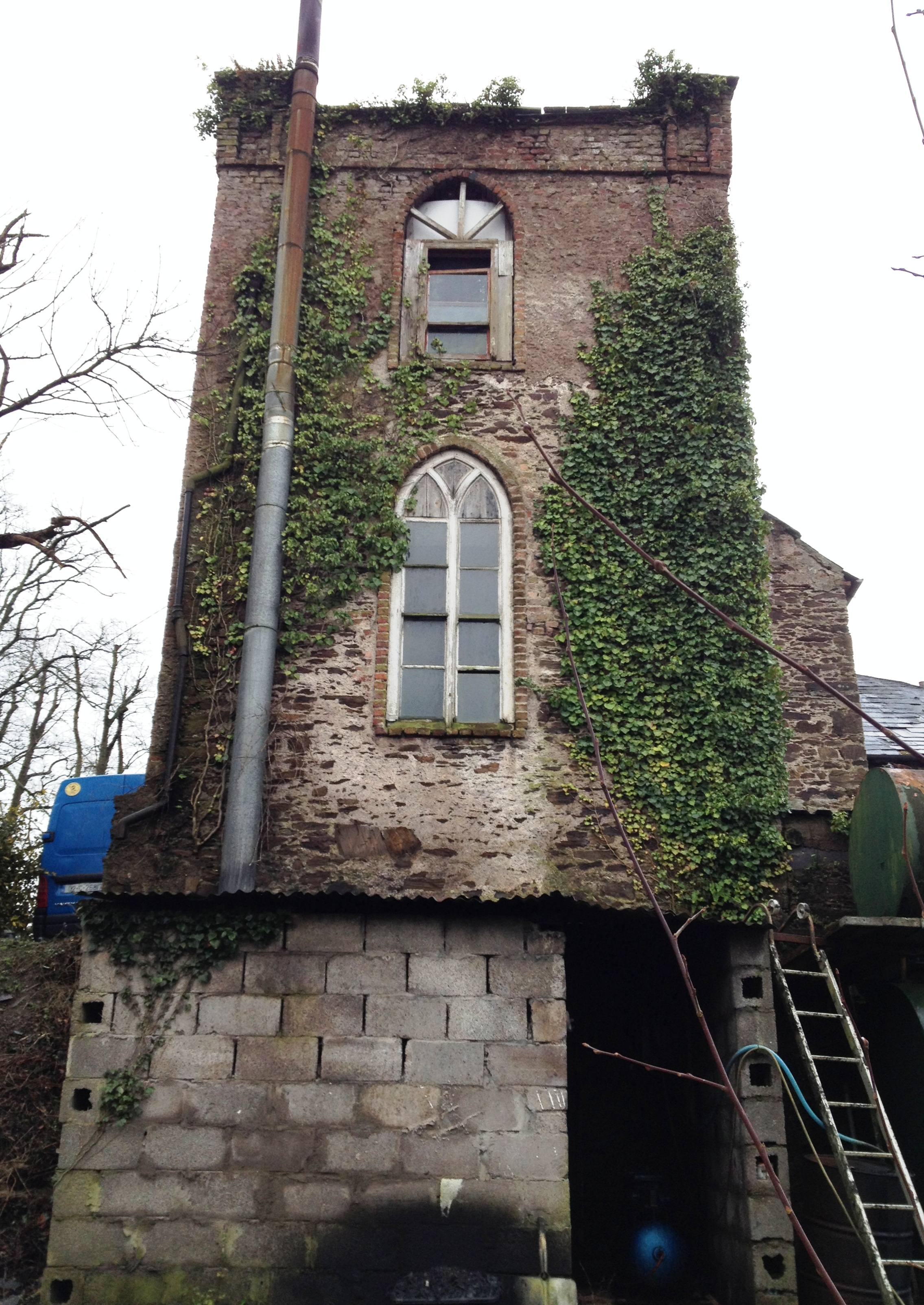
As one sees it today, the central block of the house, facing east, is of five bays and features a fine carved limestone doorcase with pretty fanlight above. The building initially looks single storey but this is not the case: a mid-18th century staircase directly beyond the front door leads to a first floor, the only evidence of which on the outside of the building is a solitary dormer window likely dating from the late 19th century and lighting the upper landing. The two slightly projecting tower ‘wings’ are believed to have been added in the early 1800s. They served both to increase accommodation and to give the house a more ancient, picturesque appearance (hence the gothic arched windows). As can be seen in that early watercolour, like the rest of the exterior the towers were originally rendered but subsequently covered in weather slates. Various additions were also made to the rear of the building over the course of two centuries, including a rather fine Edwardian bathroom that opens off the staircase return.

IMG_2948
IMG_2971
IMG_2955
IMG_2950
Donnybrook House’s original setting has long since gone: the surrounding gardens no longer exist, nor do any mills that once operated in the vicinity. Likewise most of the other historic houses and villas once dotting the landscape in this part of the country are gone: today almost the entire area is given over to housing estates. As is apparent, the building at present needs some attention. The roof of the south tower (that to the left of the entrance) has collapsed, bringing down the floors inside and making this part of the building unsafe. Meanwhile the north tower is suffering from water ingress and risks becoming similarly hazardous. This damage is not visible from the exterior because blind gothic windows on the upper level were designed to conceal the pitched roofs. On the other hand, the central section of the property appears to be in relatively good condition although rather damp, and has continued to be used and occupied. Internally some of the original 18th and early 19th century wooden joinery, including wainscot panelling, has survived, as have a number of the old sash windows. The spirit of the house invoked by Lennox Robinson and his siblings can still be felt.
Here is a building waiting to be rescued from what too often has been the fate of such properties in Ireland: ruin and disappearance. Wonderfully the present owner is keen to restore Donnybrook House and bring it back to residential use. Rescue and refurbishment is still feasible and must be encouraged. Donnybrook House is an important and rare testament to Cork’s architectural and industrial history. Its preservation merits everyone’s support.

IMG_3068

With special thanks to Ciara O’Flynn, Built Heritage Conservation Consultant/Buildings Archaeologist, for generously sharing her research into Donnybrook House.


Opportunity Knocks

FullSizeRender 6
Opportunism and those who practise it are not, as a rule, judged very favorably. Yet there are times when our verdict on opportunists can be inaccurate or imperceptive. Much of Georgian Dublin is a manifestation of opportunism at work: the result of a handful of perspicacious developers – another now-detested term – recognising an opportunity and responding to it. This was certainly the case with the first Luke Gardiner who piecemeal built up landholdings on the northside of the city and there created new streets and terraces to meet growing demand for residential property. Gardiner’s first venture in this arena, and the basis of his future success, was the development from the late 1720s onward of Henrietta Street.

IMG_2420
IMG_2480
IMG_2425
IMG_2460
Luke Gardiner was a man of modest origins, far removed at the start of his professional life from the wealth he would come to enjoy. Much the same could be said of his protégé Nathaniel Clements who, although enjoying somewhat less humble beginnings, was the youngest of five sons and very much expected to make his own way. This he did, like Gardiner, by building houses and then selling them on: the parallels between the past and the present can sometimes be discomfiting. Henrietta Street was also Clements’ first venture into property development, as he took on several sites from Gardiner. One of these was number 4 (originally 5) Henrietta Street which he completed around 1740-41 and sold to George Stone, then Bishop of Ferns. Stone occupied the building but did not finish paying for it, until 1747 when he was appointed Archbishop of Armagh and, in turn, opportunistically moved into a still-grander residence on the street before selling No.4. Its second owner was John Maxwell, MP for County Cavan who nine years later would be created first Lord Farnham. Of Scottish ancestry, Maxwell was the descendant of three generations of clerical opportunists: the Farnham estate in County Cavan had originally been purchased by his grandfather, the Anglican Bishop of Kilmore and Ardagh. When John Maxwell acquired No.4 Henrietta Street, it came with a plot of land to the immediate east, perhaps serving as a garden. In 1754 Maxwell’s only daughter married another MP, Owen Wynne of Sligo, likewise the descendant of opportunists, although in this instance they had been army men. Around the time of his marriage the plot next to No.4 passed into Wynne’s hands and a house was built here. Today it is No.3 Henrietta Street.

IMG_2400
IMG_2413
IMG_2407
FullSizeRender 1
There are unanswered questions remaining about the history of 3 Henrietta Street, not least who was responsible for its design. The house is sometimes attributed to Nathaniel Clements because like its neighbour – which he almost certainly did build – there is a semi-circular bow at the back of the building. On the other hand, by the time of No.3’s construction, Clements had moved on to other projects and, more critically, he and Maxwell were political opponents, so it seems unlikely his assistance would have been sought here. Perhaps when Wynne embarked on the enterprise he decided to copy some features of his father-in-law’s adjacent residence. The interior shows alterations believed to date from 1830. Originally the entrance hall – like other houses on this side of the street – would have been of two storeys with the stairs visibly rising to the first floor. In the 19th century this staircase was taken out and a smaller one inserted, divided by a wall from the front of the house with the new entrance hall made just one storey high. But the first floor reception rooms retain much of their original decoration, the pair to the front of the room having a deep frieze with strapwork and festoons, while below the walls are sectioned by plaster panelling. To the rear at this level is a wonderful room with rococo stuccowork in the coved ceiling which extends into the bow, and gives the space a more intimate character than any of the others possess.

FullSizeRender 4
IMG_2357
IMG_2362
IMG_2380
As already mentioned, in the 19th century 3 Henrietta Street, like almost all other houses in the vicinity, underwent changes both of design and usage. The advent of the King’s Inns at the top of the street, and the gradual departure of private owners in the aftermath of the 1800 Act of Union meant many of the buildings came to be used as solicitors’ offices: in the decades leading up to his death in 1885 some three-quarters of the street were bought by the lawyer Tristram Kennedy and let to other members of his profession. However, his property portfolio was subsequently acquired by another – altogether less attractive – opportunist, former Dublin Lord Mayor Joseph Meade. Seeing a chance to get a good return on his investment, notoriously he converted most of the houses into tenements. The original interior spaces were divided to fit in more rooms for entire families to occupy and valuable items such as chimney pieces were stripped out and sold off. This was the fate of 3 Henrietta Street for a large portion of the last century, and evidence of its decline, as much as of its glory, can still be seen in the building. But the house is now on the market, and awaits a new owner who can offer it a viable future. What will happen next? As has been the case here over the past two and a half centuries, opportunity knocks – and 3 Henrietta Street once more awaits the advent of an opportunist.

FullSizeRender 5

Lost and Found

IMG_3239
Like many words in the English language, ‘lost’ is open to diverse use. It can, for example, mean missing or misplaced but just as often is employed to denote something that has vanished, perished or been destroyed. Such is the case with an engrossing – albeit chastening – book recently published, Lost Ireland: 1860-1960. Author William Derham has trawled through thousands of photographs to select 500 images of buildings throughout the island, the majority of which have entirely disappeared or else been so altered/mutilated that they no longer bear any semblance to their original state.

IMG_3240
In a thoughtful introductory essay, Derham provides an historical context for why so many older buildings in Ireland should come to have been lost and laments the disappearance of certain building types such as the early unfortified house represented by Eyrecourt, County Galway: dating from the second half of the 17th century and still intact less than 100 years ago, it is now a roofless shell. Likewise Ireland has no examples of the ‘cagework’ urban house in which the frame would be of wood and the spaces between filled with wattle and daub. The last of these to survive, in Dublin on the corner of Castle and Werburgh Streets, was demolished as long ago as 1812. Likewise the once-widespread brick gabled townhouses known as Dutch Billies are now almost extinct, or else subsumed into later buildings.

IMG_3242
Some losses – notably among the ranks of the Irish country house – are already well-known, but even here Derham finds examples likely to be unfamiliar to most readers, and explains the shameful role played in the erosion of their number by that state body the Land Commission. However he covers many other areas of depletion and, frankly, dissipation, such as the damage inflicted on Roman Catholic churches and cathedrals in the aftermath of the second Vatican Council. Using the excuse of a new liturgy, members of the Irish clergy stripped interiors of the buildings for which they were responsible: one of the most egregious examples being the gutting of Pugin’s Killarney Cathedral at the instigation of then-bishop Eamon Casey. Tellingly their clerical equivalents in other countries did not feel impelled to engage in similar acts of vandalism. But valuable secular buildings were also squandered for no good reason, such as the demolition in 1964 of a fine mid-18th century market house in Mountrath, County Laois – supposedly because a public lavatory was needed (although this was never built). As much as an exhortation to protect what remains as a requiem to what has gone, this is a beautifully produced book and allows us to find again, if only in photographic form, what has been lost. Do acquire a copy while you can as it is certain to sell out.

IMG_3234
Lost Ireland: 1860-1960 by William Derham is published by Hyde Park Editions, price £39.95/€49.95. The photographs above were taken at a recent exhibition in Dublin Castle to coincide with the launch of the book. They show (from top), Roxborough Castle, County Tyrone (burnt 1922), Longford Castle, Longford (demolished 1972), Woodstock, County Kilkenny (burnt 1922) and Ballynastragh, County Wexford (burnt 1923). The exhibition has now ended but deserves to travel to other venues around the country in coming months; why not encourage your local arts centre/library to borrow it?

Not so Cosy

IMG_2729

There has been much talk in recent years of the decline of the Irish village: here is an example of the deterioration found across the country. On a key corner site in Crossakiel, County Meath stands a now-vacated former pub and grocery which, with slates gone from the roof and windows broken, only looks set to fall into further ruin. When that happens, as seems to be inevitable, the possibility of Crossakiel having a viable commercial future will grow even more remote than is the case at present. And so the decline continues.

IMG_2740

A Call to Action

FullSizeRender 1

Last November the Department of Arts, Heritage and the Gaeltacht launched a document called An Action Plan for the Sustainable Future of the Irish Historic House in Private Ownership. In her Introduction Minister Heather Humphreys observed that these properties ‘are an important part of our social, cultural and architectural heritage,’ as well as being ‘an essential thread of our national story and a great source of local community pride.’ Furthermore historic houses are ‘a vital attraction for both local and foreign visitors and they play an important role in stimulating economic development, particularly at community level.’
Last Thursday members of the Browne family announced that Westport House, County Mayo where they and their forebears have lived for almost 350 years, is to be placed on the open market. The financial difficulties faced by the Brownes, arising from a bank loan (and its attendant guarantees) taken out in 2006 by the late Jeremy Sligo, have been well known for some time. (Incidentally, they demonstrate yet again how in this country while a borrower can be penalised for making an ill-advised decision, the relevant lender suffers no such retribution). Westport’s predicament demonstrates how fragile is Ireland’s remaining stock of historic properties, how vulnerable to the vagaries of shifting circumstance, precisely because so few safeguards or supports exist to ensure they can weather past and future storms.
Westport House perfectly conforms to Minister Humphreys’ designation of the Irish historic property being a source of local pride, an attraction for domestic and overseas visitors and a key player in stimulating regional economic development. A report commissioned last year by Mayo County Council found the house and grounds attracted 162,000 visitors annually and contributed €1.7 million to the fiscal purse and local economy, with 60 per cent of respondents citing the Browne family home as their main reason for visiting Mayo. It is vital to the well being of the area, and the Brownes deserve applause for making this so.
Over the past year there have been plenty of reports, meetings, analyses and consultations over Westport’s plight. The time for talk has now come to a close. Decisive action needs to take place, the estate and house ought to be preserved, and the values espoused in its recent document by the Department of Arts, Heritage and the Gaeltacht made manifest. Otherwise, yet again, we will witness the diminution of Ireland’s heritage, and the loss of another ‘essential thread of our national story.’

FullSizeRender

Scouting Around for a Saviour

IMG_2972

A week ago the national tourist board, Fáilte Ireland, announced that €60,175 in funding is to be made available to Castle Saunderson, County Cavan. Seemingly this money is part of the organisation’s ‘New ideas in Ancient Spaces’ Capital Grants Scheme for attractions within the Ireland’s Ancient East initiative. The latter scheme was launched by Fáilte Ireland’s last April and ‘seeks to build on the wealth of historical and cultural assets in the east and south of Ireland.’ Leaving aside the fact that Castle Saunderson could never be described as being located in either the east or south of the country (north-midlands might be the simplest summary) one wonders what will be the result of this expenditure. According to Fáilte Ireland, the money ‘will be used to enhance the “on the ground” visitor experience and present the story of Castle Saunderson through the ages. This will be achieved through the development of a new “easy to explore” heritage trail – The Castle Trail. Through interpretative displays, visual art and written interpretation, the story will imaginatively portray the dramatic history and transition of this place as part of Ireland’s Ancient East from free land, through conflict, plantation and the divisive advent of Unionism and the Orange Order to the peaceful coexistence of the present day.’ In other words, the money doesn’t appear to be going towards the restoration of a building on the site which has only fallen into dereliction in the past twenty years and which, with a hint more creativity and resourcefulness, could be restored to serve as a splendid base for the aforementioned ‘on the ground’ visitor experience.

IMG_9192
IMG_9281
IMG_9228
IMG_9211
Around the middle of the 17th century the land on which Castle Saunderson stands passed into the hands of one Robert Sanderson whose father, Alexander Sanderson, had come to Ireland as a soldier and settled in County Tyrone. Robert Sanderson had been a Colonel in the army of Gustavus Adolphus of Sweden, and in 1657 served as High Sheriff of County Cavan. On his death in 1675, the estate passed to his eldest son, another Colonel Robert who sat in the Irish House of Commons and married Jane Leslie, a daughter of the Right Rev John Leslie, Bishop of Clogher. The couple had no children and so Castle Saunderson passed to a nephew, Alexander Sanderson. It was the latter’s grandson, another Alexander, who changed the spelling of the family name to Saunderson as part of an ultimately fruitless effort to claim the Castleton peerage of the Saundersons of Saxby, Lincolnshire (the first and last Earl Castleton having died unmarried in 1723). It is his son Francis who is credited with having built the core of the present house. Staunchly anti-Catholic, he is said to have disinherited his eldest son for marrying a member of that faith (or it could have been because she was the daughter of a lodge keeper at Castle Saunderson). So the estate of over 12,000 acres went to a younger son, Alexander. He likewise disinherited his first-born son because he was crippled, and another son who proved rebellious, instead leaving Castle Saunderson to the fourth son, Colonel Edward James Saunderson who, like his forbears, was a Whig politician, and in Ireland leader of the Liberal Unionist opposition to Gladstone’s efforts to introduce some measure of home rule. It appears to have been after the death of his eldest son Somerset Saunderson in 1927 that the family moved out of the house, although they did not sell the property until half a century later.

IMG_9202
IMG_9234
IMG_9277
IMG_9247
As has been mentioned, at the core of Castle Saunderson is a classical house built by Francis Saunderson probably around the time of his marriage to Anne White in 1779. In the mid-1830s the building was extensively remodeled in a version of Elizabethan gothic for his son Alexander Saunderson. In December 1835 Nathaniel Clements wrote to Lady Leitrim that he had called by Castle Saunderson where the owner was ‘altering and castellating his house, so I was quite in my element’ The architect responsible for this work is now considered to be George Sudden, who was employed elsewhere in the area, at Lough Fea, County Monaghan and Crom Castle, County Fermanagh, Castle Saunderson displaying certain similarities with the latter (where the original design had been by Edward Blore). This intervention resulted in a bit of a mongrel, the east-facing, two-storey former entrance front retaining long sash windows to either side of a central three-storey castellated tower, its octagonal turrets echoed by lower, square ones at either end of the facade. The north and south fronts are asymmetric, the former having an octagonal entrance tower placed off-centre, the latter featuring a four-bay loggia between two further towers, as well as a substantial service wing at right angles that once incorporated a single-storey orangery. Although unoccupied by the Saundersons, the property was not sold by the family until 1977 when it was bought by a businessman who undertook restoration work. For a period it then became an hotel before being sold again in the 1990s after which fire gutted the house. In 1997 Castle Saunderson and its grounds were acquired by what is now called Scouting Ireland which initially appeared to show interest in restoring the building but eventually chose to construct a new centre elsewhere in the grounds at a cost of some €3.7 million. Meanwhile the old castle has continued to deteriorate: it looks unlikely Fáilte Ireland’s recently-trumpeted initiative will change this situation.

IMG_9208

Fragmentary Evidence

Satblog2
An 18th century door sidelight currently to be seen on the premises of Bonhams at 31 Molesworth Street, Dublin. It is one of a number of items of architectural salvage collected by conservationist and painter Peter Pearson who for decades has been assiduously saving such fragmentary evidence from historic properties which would otherwise have been demolished or allowed to fall down without any record being kept of their decoration. For his work in this field, Mr Pearson is himself something of a national treasure, albeit one far too insufficiently appreciated. The show in Bonhams (which continues until next Wednesday, October 21st) features a number of his own fine architectural pictures alongside many more rescued artefacts, not least the diversity of 18th century dado rails shown below.

Satblog1

When Nobody Cried Stop

IMG_2970
How curious that nobody in recent decades has thought to write a monograph on one of Ireland’s most prolific and talented architects: Francis Johnston. Born in Armagh in 1760, Johnston was effectively ‘discovered’ by the city’s primate Richard Robinson who sent him to Dublin to study with the Archbishop’s architect Thomas Cooley. Following the latter’s death in 1784 Johnston took over many of his commissions, not least Rokeby, County Louth which was Robinson’s country seat (see Building on a Prelate’s Ambition, February 4th 2013). Thereafter his career never faltered and demand for his services was unceasing. Among the most famous examples of his work are the General Post Office in Dublin and, on the other side of the city and in completely different mode, the Chapel Royal in Dublin Castle (of which more in due course). Success allowed him to be singularly generous: appointed second president of the Royal Hibernian Academy in 1824 he designed and built the organisation’s premises on Abbey Street (it was one of the casualties of the 1916 Easter Rising, ironically headquartered in another of Johnston’s buildings, the GPO). After he died in 1829 his fabled collection of paintings, sculpture, books, objets d’art and curiosities was unfortunately dispersed. But throughout the country there survive examples of his work and these consistently demonstrate the refinement and assurance of Johnston’s taste. Until recently one of the best examples was Ballynegall, County Westmeath.

IMG_2953
IMG_9025
IMG_9027
IMG_2197
Ballynegall dates from 1808 when it was designed for James Gibbons whose family appears to have been involved in banking and other business in Dublin, from whence derived their fortune. Five years earlier he or his father (also called James Gibbons) had bought the estate on which it stands from William Reynell (his forebear Colonel Arthur Reynell had acquired the estate in 172). Seemingly some of the stone from an older property called Castle Reynell was used in the construction of Ballynegall. Evidence of the Gibbons’ affluence is evidenced by the fact the house was renowned for having cost £30,000 to build: an astonishingly substantial figure at the time. James Fraser’s Handbook for Travellers in Ireland (first published 1838) describes Ballynegall as a ‘handsome Grecian mansion’ which ‘accords with the rich and beautiful park around.’ James Gibbons senior died in Cheltenham in 1834, after which the property passed to his son, James junior. He died in 1846 while hunting and since he had no children Ballynegall next passed to a nephew of his wife James William Middleton Berry. On his own death in 1855 the estate was inherited by a cousin Thomas Smyth. Ballynegall remained in the possession of the Smyth family until 1963.

IMG_2960
IMG_9043
IMG_9036
IMG_2242
In 1993 Ballnegall was judged by Christine Casey and Alistair Rowan to be ‘a most delightful villa by one of Ireland’s most refined designers – a man of European stature.’ Of six bays and two storeys, its west-facing facade was perfectly plain except for a four-column Greek Ionic portico which defined the entrance. The garden front had deep Wyatt windows flanking a broad central bow. A sunken service wing to the north was matched on the other end of the house by a large mid-19th century cast-iron conservatory attributed to Richard Turner (Casey and Rowan propose this replaced an earlier one designed by Johnston), its roof supported by pilaster shafts with lotus capitals. Internally the house was a model of neo-classical restraint, the groundfloor holding an entrance hall divided into two sections by a screen of Ionic columns. This in turn gave access to the drawing room (which benefitted from the east-facing bow), library, dining room and morning room. A staircase at right angles to the entrance hall and screened from it by a further pair of Ionic columns led via a bow-shaped return to the generous first floor bedroom corridor: the basement featured an equally fine, broad corridor running the length of the building. Throughout the house the plasterwork by George Stapleton was simple but exquisite, in particular the guilotte and palmette friezes running below dentil and foliage cornices. Much of the furniture appears to have been made for the house by Mack, Williams & Gibton (the library’s bookcases look to have been especially fine) but other captivating details included the 19th century wallpapers, that in the drawing room being pink and gilt, and stenciled to represent decorative panels and pilasters.

IMG_2957
IMG_9006
IMG_9047
IMG_9051
We are fortunate that Ballynegall and its beautiful interiors were recorded in a series of photographs taken in 1961 just a year before the contents were dispersed on the instructions of Captain Michael Smyth during the course of a three-day auction in July 1962. The sale catalogue lists many fine pieces, all scattered: where are they now, and do the present owners know their provenance? The following year the house and estate were likewise sold, after which Ballynegall went through a couple of owners. In 1981 the house itself was ruthlessly stripped of everything that could be taken out: doors, chimney pieces, columns, even the floorboards pulled up for the value of the timber, and then the building unroofed. The portico now adorns the front of the K Club, County Kildare and the Turner conservatory serves as a restaurant at Lyons Village in the same county. The fate of the rest of the fittings is unknown although some of the chimney pieces apparently ended up in England.
As the photographs taken earlier this year and shown here reveal, Ballynegall has been gradually drifting into oblivion ever since that despoliationh. Back in 1993 Casey and Rowan wrote that the fate of Ballynegall was ‘one of the most tragic consequences of the laissez-faire attitude of successive governments towards the architectural inheritance of the State…There can be little satisfaction in contemplating the lacerated fragment of a Fragonard and still less pleasure in a visit to Ballynegall as it is now.’ Visiting the place is indeed a melancholy experience, not just because the building is in such lamentable condition but also because that condition is a reflection of national indifference towards our own collective heritage. Within many people’s lifetime a fine house, a masterpiece of neo-classical refinement designed by one of Ireland’s greatest architects, has willfully and shamefully been permitted to fall into dereliction. It happened because nobody cried stop. It continues to happen for the same reason…

IMG_9053

A Mere Shell

IMG_2889
Above is a photograph taken some time ago of Cloverhill, County Cavan. The original house was built by a branch of the Saunderson family in 1758 but then extended from 1799 onwards to a design by Francis Johnston. It is his work which can be seen here: a two-storey, three bay house with east-facing breakfront entrance bay focussed on a pedimented Ionic portico: on the south side was a bow with Wyatt windows. In 1958 the property was sold by a descendant of the original owners and has since been allowed to fall into ruin. As can be seen below, it is now a roofless shell, the portico seemingly removed more than two decades ago and moved to a house in County Wexford.

IMG_9343

The Age of Austerity

IMG_8503
The Irish countryside: so littered with the remnants of once-fine houses. Now their walls, if these still stand, are smothered in ivy, their interiors providing a shelter for species of trees and shrubs formerly permitted only in the garden, and a habitat for wildlife which would never have been allowed indoors. Here runs a tumbling line of estate wall, there the suggestion of a former gate lodge, across the fields can be seen the remains of a stableyard, closer to hand lifestock grazes in what was clearly once a landscaped demesne. Until recently, and aided by fictional accounts such as Elizabeth Bowen’s The Last September, a widespread belief persisted that the majority of these properties were burnt during the upheavals of the 1920s. We now know this was not the case, that while a number of significant country houses were destroyed in the course of the War of Independence and subsequent Civil War, many more survived. Their ruin came later, when the Land Commission had taken away the surrounding acreage necessary to sustain their upkeep, when rates grew too high, and the cost of employing sufficient workers too great. Unable to afford maintenance, owners departed their houses, sold up the contents, watched a new owner to remove chimneypieces and other fittings, saw the roof taken off and accepted the inevitable: yet another ruin to add to Ireland’s already substantial number. Such was the fate of Dromdihy, County Cork.

IMG_8617
IMG_8566
IMG_8567
IMG_8581
Dromdihy, sometimes called Dromdiah, stands on raised ground with superlative views for many miles north-eastwards as far as the Irish Sea close to Youghal. The original owner was one Roger Green Davis who acted as land agent for Sir Arthur de Capell-Brooke, an absentee landlord. Despite his surname, de Capell-Brooke’s family was actually of Irish origin. The first of their number had probably come to the country with the Normans when they were called de la Chappelle, Des Chapelles or De Capella. This was later hibernicised to Sheapallh and then converted in English to Supple. There were many Supples in East Cork but the majority of them lost their lands during the 17th century. One branch however, through familial association with the Boyles, Earls of Cork and by converting to the Anglican church, retained an estate based around the town of Killeagh. In the mid-18th century Richard Supple married Mary Brooke,of daughter of Arthur Brooke, of Great Oakley, Northamptonshire. In 1797 their son, Richard Brooke Supple inherited the English estate from his great-uncle Wheeler Brooke in obedience to whose wishes he assumed the surname Brooke, at the same time adding the orignal surname of his own family: six years later he was created a baronet. His heir Sir Arthur de Capell-Brooke was an explorer who travelled through Scandinavia and published several books about what he had seen. When not engaged in these activities, he lived in Northamptonshire, hence the need for an agent to look after his Irish estate.

IMG_8528
IMG_8532
IMG_8543
IMG_8550
One wonders how much attention Sir Arthur paid to his property in Ireland since Roger Green Davis, who had inherited the position of agent from his own father William, was able to build up a landholding of more than 2,250 acres in County Cork, albeit some of it rented from the de Capell-Brooke estate. Thus the need to build a residence befitting his status, which Dromdihy was intended to proclaim. Completed in 1833 according to Samuel Lewis, the architect responsible for the house’s design is unknown: in some accounts it is attributed to Roger Green Davis. If so, he must have been a man of austere taste since Dromdihy demonstrates a predilection for the most distilled form of neo-classicism. The central block, of five bays and two storeys over basement, is rendered with cut limestone employed for parapets and cornices, quoins and window surrounds, varying treatment of the window’s architraves relieving what might otherwise be a monotonous facade. On either side of this are single-storey wings, that to the left (now entirely submerged in overgrowth) having Doric columns flanking a window and concluding in a bow. At the other end of the building, the wing served as entrance to the house, approached via a flight of steps and accessed through a pedimented portico with four fluted Doric columns, all in crisp limestone. The design is so pared back, so devoid of extraneous ornament, so uncompromisingly faithful to the ideology of Greek Revivalism it might have come from the hand of a Schinkel or von Klenze.

IMG_8631
IMG_8511
IMG_8505
IMG_8558
A description of Dromdihy in the 1860s noted that it ‘consists of a centre and two wings, ornamented with Doric columns and with a portico at the eastern end, by the hall is entered, and off which are hot, cold, vapour and shower baths. The first floor comprises five sitting-rooms; on the second floor are four best bedrooms, with dressing-rooms and water-closet…’ Evidently Green Davis spared no expense on the property: it is said that the stone was cut by craftsmen brought from Italy for the purpose. But if the design was admirable, its execution left something to be desired since seemingly from the start Dromdihy suffered from damp, the roof leaking and the interior manifesting both dry and wet rot. Roger Green Davis’ son John, a barrister, sold the place to William Stopford Hunt, an Assistant Land Commissioner and well-known cricketer. At the start of the last century, he had let the place to Lieutenant-General Sir Lawrence Parsons (a cousin of the Earls of Rosse) whose daughter Nora Robertson would later write the memoir Crowned Harp. However Stopford Hunt retained ownership of the estate until he sold up in 1923 at which time the house and surrounding ninety acres were purchased by the O’Mahony family. They ran a manufacturing and timber business on the estate but by 1944 the house was deemed uninhabitable and its roof removed. Dromdihy has been in steady decline ever since, an empty shell high on the rise visible to anyone travelling south from Youghal.

IMG_8627