

Although only portions remain, enough of St Thomas’ Priory in Ballybeg, County Cork survives to give an idea of how important this religious house once was. Founded by Philip de Barry for the Canons Regular of St Augustine in 1229, the buildings included a church measuring 166 feet in length and 26 feet in width: today only the towering western end with its pair of lancet windows still stands. This fortified section dates from the late 14th/15th centuries, together with a similar tower further west (used for accommodation) and testifies to the uncertain state of the country during this period, when even ecclesiastical property was not safe from attack. In Monasticon Hibernicum, published in 1786, Mervyn Archdall wrote of Ballybeg Priory, ‘the traces of the foundation, with a high tower a considerable way to the south-west, prove it to have been a truly magnificent structure.’
Shedding Light on a Subject

The houses of Dublin’s Henrietta Street have featured here more than once, and deservedly so since even if many have suffered long periods of neglect those that remain are among the most important such buildings in the capital. Henrietta Street was the first major scheme undertaken by the 18th century’s enlightened and far-seeing property developer Luke Gardiner (would that his present successors displayed such taste and perspicacity). From 1721 onwards he began to construct large domestic residences on what had hitherto been open ground to the north of the existing city. Nothing better demonstrates confidence in such an enterprise than the developer himself living on site, and around 1731 Luke Gardiner built his own house, the architect responsible being the most fashionable of the era, Sir Edward Lovett Pearce. This is 10 Henrietta Street which remained in ownership, even if increasingly intermittent occupation, through successive generations of the original family until 1829 when Charles Gardiner, Earl of Blessington died without a male heir. His fascinating second wife, born Marguerite Power, is believed to have visited the house only once and it eventually became used by members of the legal profession (not surprisingly since the Gardiner estate thereafter became immersed in long and costly litigation). In 1899 the building was acquired by the Daughters of Charity of St Vincent de Paul, members of which order continue to live there still.


Unlike many other properties on Henrietta Street, the interiors of No.10 remain relatively unaltered, the most notable changes occurring during the 18th century when the house was still owned and lived in by the Gardiners. On the ground floor, a rear room originally known as the Breakfast Parlour, appears least changed from the original decorative scheme, with a splendid doorcase flanked by Corinthian columns and topped by a pedimented entablature: the ceiling here, unlike most of the others, exemplifies sober early 18th century classicism, compartmentalised in low-relief geometric plasterwork patterns.
Structurally the most significant intervention was a reconfiguring of the entrance hall and staircase. When the house was first built, it featured a double-height entrance containing stairs leading to the first-floor. However, some years after the death of Luke Gardiner in 1755 his son Charles reordered this space to create a single-storey entrance hall, behind which a new staircase hall was instated. Probably around the same time a number of rooms were given new ceilings in the rococo manner. These decorations are important because in the majority of cases they are made not of plaster but papier-mâché. The use of this medium is unusual but not unique – a number of other examples survive elsewhere in the city and in Carton, County Kildare – but it seems strange to find it here. One of the attractions of papier-mâché was its relative cheapness (relative to stuccowork, that is) but the Gardiners were certainly affluent to afford anything they wished. On the other hand, its great merit is easier (and cleaner) installation than plaster, so perhaps this is why papier-mâché was preferred for the redecoration of existing rooms.
It was not used, on the other hand, for the saloon, or ballroom (now used as a chapel), which in its present form looks to have been either added or extended at the time when Charles Gardiner was re-fashioning other spaces in the house. The saloon ceiling (central photograph above) while stylistically not unlike the others on this level is of plasterwork, and the other striking decorative feature is a substantial Venetian window in the centre of the west wall.


An inventory survives for 10 Henrietta Street, taken in November 1772 and itemising the contents of each room in the house. It adds immensely to our understanding not just of this property but also of how rooms in an 18th century urban residence were furnished. The answer is: relatively sparsely. The two interlinked first-floor drawing rooms, for example, each contained a large pier glass (valued at £12 & 10 shillings, and £9 respectively), and a marble-topped table (£4 and £3) but only a handful of other items, at least those considered worth recording. The Ante Chamber – formerly the upper portion of the entrance hall – featured ‘2 Large Landscapes in Gilt frames’ (£22 & 15 shillings), a large Dutch market scene (£7) and a mahogany dressing table (just 15 shillings). The most notable items were in the saloon which held two marble-topped tables with brass borders (£9), two ‘large Pictures of the Cartoons Gilt Frames’ (a pair of cartoons attributed to Raphael and valued at £50), two full-length portraits in gilt frames of George I and the Duke of Bolton (£17), a similar portrait of the Earl of Stafford and his secretary (£7), a pair of mahogany card tables (£1 & 16 shillings) and ‘2 Plates of Glass in late Mr Gardiner’s frames’ (£17). And so it goes on through the house, giving us an insight into living conditions at the time. Coupled with the preservation of the house itself (which benefitted some years ago from a major restoration programme that saw many of the rooms brought back to their initial state), 10 Henrietta Street sheds clearer light than perhaps any other such property in Dublin on how a grand urban residence looked in the Georgian period.
Into the Woods

Buried in the midst of trees, the remains of a neo-classical gate lodge in County Fermanagh. Likely dating from the early 19th century, its entrance at the top of a short flight of steps features a fine Tuscan portico flanked by windows each set within a shallow arched niche. Although almost beyond redemption (the rear wall has bulged out and looks on the verge of collapse), the building’s quality of stonework for key features, together with an evident consideration of the overall design, is testament to the care once paid even to such modest dwellings.
Unclear Past, Unclear Future

The remains of the Augustinian Priory in Ballinrobe, County Mayo. This was the first religious house established by the order in Connaught but there remains some uncertainty over who was responsible for its foundation: it has been suggested that the priory owed its origins to Elizabeth de Clare (a granddaughter of Edward I) who in 1308 married John de Burgh and four years later had a son William, in celebration of which Ballinrobe Priory was established. On the other hand, another proposal is that the priory was set up in 1337 by Roger Taaffe, perhaps on behalf of the de Burghs. Whatever the facts, the house thrived, despite a bad fire early in the 15th century and even survived suppression in the 1540s, with members of the order still in residence 100 years later. Thereafter it fell into ruin. Restoration work was carried out on the site some twenty-five years ago but, despite being surrounded by a graveyard (and by an increasing number of new houses) the priory looks to be falling into serious neglect again: a future as unclear as its past?
Pourquoi me reveiller

Ah! Bien souvent mon rêve s’envole
Sur l’aile de ces vers,
Et c’est toi, cher poète
Qui, bien plutôt, était mon interprète.
Toute mon âme est là!
Pourquoi me réveiller, ô souffle du printemps?
Pourquoi me réveiller?
Sur mon front, je sens tes caresses
Et pourtant bien proche est le temps
Des orages et des tristesses.
Pourquoi me réveiller, ô souffle du printemps?


Demain dans le vallon viendra le voyageur,
Se souvenant de ma gloire première.
Et ses yeux vainement chercheront ma splendor,
Ils ne trouveront plus que deuil et que misère.
Hélas!
Pourquoi me réveiller, ô souffle du printemps?

Piltown, County Meath: Built by Thomas Brodigan 1838, burnt by arsonists 2006.
Stable or Unstable?

To the immediate north-west of the castle at Charleville Forest, County Offaly stands an equally substantial block that once served as stables for the property. Like the main house, this was designed by Francis Johnston in 1798 for Charles Bury, Lord Tullamore (later created Earl of Charleville) and is in the same solid Gothic style. Unfortunately whereas the greater part of the castle is still in use, the same is not true of the stable block which as a consequence is now in a poor state of repair.
Finding a Niche

One of the architectural wonders of Ireland is also one of its greatest mysteries: the forecourt of Curraghmore, County Waterford. This stupendous space, in which matching blocks of stables and offices face each other across an arena, leads up to the main house which has its own, more modestly proportioned wings. Linking the two sections are quadrants accommodating pedimented niches and entablatured doorcases, all executed in crisp limestone. Who was the architect responsible for the mise-en-scène? Both Francis Bindon and John Roberts have been proposed, but to date no one has been able to say for certain: it remains a mystery.
Selective Memory

The phrase ‘history is written by the victors’ has often been attributed to Sir Winston Churchill, but the words’ innate fallacy is demonstrated by the fact that no one can say for certain who actually first used them. History is written as often by losers, and by those who played no role in any supposed conflict. And in the present age of alternative truths, history is even more vulnerable to prejudice and selective memory. Irish history is as replete as any other with forgotten or overlooked narratives, usually laid aside because they do not fit into the preferred version. It is easier to propose a clear linear story than one in which there are sundry twists and diversions diverting attention away from the central tale. So it is that visitors to the Castlecomer Discovery Park in County Kilkenny, while they are given the opportunity to learn about the history of coal mining in this region, will hear no mention of a remarkable woman who a century ago lived here as the mine manager’s wife. Despite her subsequent achievements and global fame, she does not fit comfortably into the story being told and has therefore been omitted (to the extent that staff in the Discovery Park are even unfamiliar with her name). That woman was Constance Spry.



In 2004 vacuum-cleaner inventor James Dyson resigned as chairman of London’s Design Museum when the institution’s then-director Alice Rawsthorne proposed organising an exhibition dedicated to Constance Spry, whose career was dismissed by one of the museum’s founders, Terence Conran, as nothing more than “high-society mimsiness”. These glib verdicts say more about the male prejudices of Dyson and Conran than they do about Spry and her considerable achievements, which were twofold. In the first place she revolutionised flower arranging which, while undoubtedly a minor art, is nevertheless one that impinges on all our lives, often for the better. Spry spurned the stiff and excessively formal style of floral decoration that predominated in her youth and replaced it with a looser approach, recognising every plant, whether cultivated or wild, had potential; typically for a London wedding in 1938 she filled the church with vases holding nothing but cow parsley. (Incidentally, in the wake of Conran’s criticism it was pointed out by the Guardian’s James Fenton that the decorative tricks found in every Conran store – a bundle of twigs in a glass vase, say, or an amusing confection of ornamental cabbages – were all first found in Spry’s work.) Furthermore, as an ardent gardener she helped to save many rare plants, especially varieties of old roses, from potential extinction: tellingly when rose specialist David Austin created his first variety in 1961 he named it ‘Constance Spry.’
Spry’s innovations within her field deserve to be acknowledged, but so too, and more importantly, does her position as a role model for women seeking to take control of their lives and run their own businesses. In this respect she already had the example of her father, a remarkable man called George Fletcher, who left school at the age of 14 with minimal qualifications and no social advantages but, thanks to his appreciation of the benefits of education, finished by being head of technical instruction in early 20th-century Ireland (but like his offspring has now been almost entirely forgotten). His only daughter Constance likewise became involved in education, employed by the government in the early 1900s to travel throughout this country lecturing on the advantages of sound healthcare. It was in this capacity that she came to Castlecomer, staying for two weeks to improve the condition of the local miners. And while in the town, she also first met and soon after married the mine manager James Heppell Marr.


Constance Spry lived in the Castlecomer region for six years and gave birth here to her only child before the marriage to Marr broke down and she moved away. A woman who 100 years ago had the courage to leave her husband and search for employment to support an infant son: there was nothing mimsy in Spry’s background or character. She started to arrange flowers professionally in response to demand for her services, and her achievement in this field was entirely unplanned, a coincidence of circumstances to which she responded with avidity. Here is where her significance lies: as one of a number of pioneering women who in the early part of the last century demonstrated it was feasible for members of their sex to develop and run successful businesses. During the same period, for example, Syrie Maugham established an interior-design company of international renown, while soon afterwards Rosemary Hume founded the original Cordon Bleu school of cookery; both women became friends and associates of Spry. The characteristic she shared with them was an ability to spot the potential in a supposedly mundane skill and transform it into a viable commercial concern. Spry, Maugham, Hume et al had no professional predecessors from whom to learn, the expectation being that, like their mothers before them, they would marry and raise children. But perforce breaking free from the constraints of their upbringing, they had the ability to recognise how a natural aptitude could be deployed to generate income and provide employment. Thanks to flower arranging, Spry gained global fame, publishing books and giving lecture tours around the world while running a school where other women could learn the skills that had proven so profitable for her.
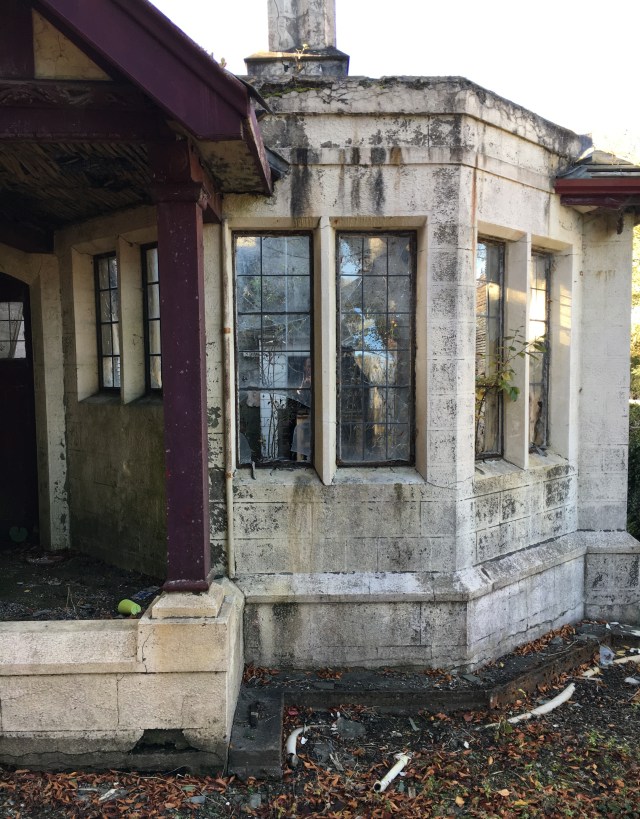
Today’s photographs show what remains of a lodge beside gates opposite Castlecomer Discovery Park. These gates mark the entrance to the now-lost Castlecomer Park, permitted to fall into ruin before being demolished in 1975. It was here that Constance Spry first stayed when she came to the town, the house’s residents being also owners of the local coal mine for some three centuries. The lodge and gates were designed by Dublin architect George Francis Beckett in 1912-13, during the period when Constance Spry was here. More recently the building has been gutted by fire and there is every likelihood it will soon be as little remembered as the exceptional woman who came to the area in 1910 in order to improve the health of the local coal miners.
Just a Shell

On Bishop Street in Ballyshannon, County Donegal stands the now-ruinous ‘Shell House.’ Dating from c.1880, the building’s name derives from the decoration of its façade, probably applied in the middle of the last century. The greater part of the surface has been covered with a mixture of shells and small pieces of broken china arranged in geometrical patterns. This appears to have been inspired by the grander shell houses and follies created in the 18th century and found on estates like Carton, County Kildare and Curraghmore, County Waterford. Sadly this example of vernacular embellishment is now in poor repair and sections of the ornamentation have already been lost: the rest is sure to follow soon.
Small but Perfectly Formed

The terrifically severe neo-classical former national school in Bagenalstown, County Carlow dates from c.1825. Of one storey, despite its modest proportions the building achieves a certain monumentality thanks to the use of large blocks of local granite and the insertion of this grandiose entrance flanked by Doric columns. The window openings are equally severe but have been ruined by the insertion of unsympathetic uPVC glazing.


