Levels of History

IMG_4150
The staircase in Ashbrook, County Derry, one of the oldest continuously occupied houses in this part of the country. The land on which it sits was granted to General Thomas Ash by Elizabeth I in the 1590s as a reward for his aid in quashing the O’Neill Rebellion during the Nine Years War and the family (later Beresford-Ash) has remained there ever since. The rear section of Ashbrook is a 17th century house but in the 1760s a new section was added to the front providing ground floor rooms with higher ceilings than had hitherto been the case. As a result, upper floor levels had to be altered resulting in the present arrangement, seen below, whereby a single flight of stairs leads from a top-lit gallery to bedrooms at the front of the house.

IMG_4140

The Rockford Files

IMG_4911

The handsome coachhouse entrance in the stableblock at Rockford, County Tipperary. This is part of a late 18th century complex originally built by the Kingsley family which subsequently passed by marriage to a branch of the Wolfes of County Kildare. In the second half of the 19th century, the latter built a new residence for themselves nearby and perhaps at that time these buildings were given their present appearance, including a series of pointed niches with brick surrounds that flank all the doors.

IMG_4922

Lip Service 

IMG_4656
As is still remembered, legislation collectively known as the Penal Laws meant that for much of the 18th century Roman Catholics under the authority of the British government found it hard to practice or express their faith publicly. It is worth pointing out that these laws were as much an affliction in England, Wales and Scotland as they were in Ireland, but the numbers of Catholics here were proportionately far greater than in those other countries. only in the late 1700s/early 1800s was the legislation gradually relaxed, ultimately leading up to the Roman Catholic Relief Act of 1829 which created full emancipation for members of this faith. But even prior to that date, Catholics had begun to embark on the construction of what at the time were always called chapels, buildings in which they could gather to hold their services. The great age of Catholic church building came in the post-emancipation era, which makes these early buildings all the more precious since relatively few of them still survive. They tended to be simple in form and design, not least because the costs involved in putting them up were borne by the local population, few of whom would have been wealthy. Weekly collections among the faithful led to the creation of a fund which was then used to pay for construction costs: Thackeray’s account of visiting various chapels during his tour of Ireland in 1842 make plain that the majority of those in attendance were the poorest of the poor.

IMG_4607
IMG_4619
IMG_4615
IMG_4628
St Brigid’s in Portumna, County Galway dates from 1825, and was therefore constructed a few years before full Catholic Emancipation had been achieved. A basic T-plan in form, it has a three-bay nave leading up to a pair of wide single-bay transepts, this simple design being a reflection of the limited resources then available. In 1858 a three-bay wide and one-bay deep porch was added to the west end, rising two storeys before being topped by a square-plan tower drum. It may be around this time that the exterior of St Brigid’s received its neo-gothic ornamentation such as the crenellated parapets and towers, and corner buttresses, thereby dressing up the original structure. In this form it remained in use for the next century. However in the late 1950s a new St Brigid’s was built on the adjacent former market square, using stone from the Portumna Castle which had been built in the 1860s and gutted by fire in 1922: evidently the local community felt their old church was no longer good enough for services. The now redundant church was converted into a sports hall, and served as such for some time before being deemed unfit for that purpose also. Since then it would appear the building (transferred into private ownership) and an adjacent abandoned convent, has sat empty, a prey to the elements and to vandalism.

IMG_4652
IMG_4648
IMG_4637
IMG_4636
How, one wonders, might the generation which contributed often very tiny sums of money judge what has become of St Brigid’s church in our own age? Would they consider the shillings and pence they could scarcely have afforded to hand over well-spent on a building which their descendants seem willing to leave fall into dereliction? Would they be satisfied that this is how their legacy, the hard-earned – and hard-paid for – right to free and open expression of faith, should be treated in such a fashion? Asking these questions is not intended to offend or to criticise the burghers of Portumna. The present circumstances of St Brigid’s are by no means unique: they are replicated in towns right across the country and are symptomatic of a greater problem.  Like so many other historic properties in Ireland, this one is listed by the local county council as being a ‘protected structure’ but one wonders what protection it is being offered. According to information provided by the Citizens Information Board, ‘A protected structure is a structure that a planning authority considers to be of special interest from an architectural, historical, archaeological, artistic, cultural, scientific, social or technical point of view. If you are the owner or occupier of a protected structure, you are legally obliged to prevent it becoming endangered, whether through damage or neglect.’ That legal obligation is meant to be enforced by the relevant local authority: there is no evidence of enforcement here but again that is hardly unusual. Last week, after two months’ negotiation between political parties, this country finally got a new government. When the various ministerial portfolios were announced, there was no reference to anyone being responsible for the department of heritage: apparently it comes under the remit of the Minister for Regional Development, Rural Affairs, Arts & the Gaeltacht but is of so little consequence that the name wasn’t even judged worthy of inclusion in this long-winded title. Too often the excuse offered for neglect of the country’s architectural heritage is that it represents the interests or legacy of alien others: this is the explanation customarily proffered to explain the wasteful abandonment of our country houses, for example. Nothing could more truly be representative of the national narrative than St Brigid’s, raised by and for the local population to serve their needs and to express their beliefs. Its neglect, like the title of new government ministries and the manner in which legislation regarding protected structures fails to be enforced, accurately express Ireland’s attitude towards our heritage: we may pay lip service to the visible evidence of our past but really we don’t care what becomes of it.

IMG_4661


Adorned with All Graces and Perfections

IMG_4076
In the parish church of Tamlaght Finlagan, Ballykelly, County Derry is this monument to Mrs Jane Hamilton (nee Beresford) who died in 1716. By an unknown sculptor, the work is not so much based on as directly copied from Grinling Gibbons’ monument to Mary Beaufoy in Westminster Abbey who died eleven years earlier. The latter’s tomb was originally surmounted by an urn and garlands of flowers but these were removed in the late 18th century: they remain in place in the Tamlaght Finlagan monument. The most notable difference between the two pieces lies in the poses taken by mourning putti on either side of the main figure. One of those attending Mrs Hamilton is shown below (note also the elegant heels on the deceased’s shoes). In the accompanying tablet, she is described as not only ‘adorned with all Graces and Perfections of mind & Body,’ but then ‘crown’d them all with exemplary Piety & Virtue.’ Who could ask for more?

IMG_4085

Studying the Classics

IMG_4561
Often overlooked by visitors to Cork’s Crawford Art Gallery is the institution’s remarkable collection of classical sculpture casts. Derived from those in the Vatican, the casts were made on the instructions of Pope Pius VII and under the supervision of Antonio Canova. They were originally presented to Britain’s Prince Regent (the future George IV) but he having no desire for them, the casts languished until William Hare, Lord Ennismore (later first Earl of Listowel), then President of the Cork Society of Arts persuaded the Prince to have the collection shipped to Ireland where they duly arrived in 1818. Initially displayed inside a converted theatre on Patrick Street, the casts subsequently passed into the care of the Cork School of Art and thus came to reside in what is now the Crawford Gallery. Above, the Belvedere Torso can be seen through the form of the Lancellotti Discobolus. The latter also figures below, sighted beyond the Borghese Gladiator and the Apollo Belvedere.

IMG_4549

In Limbo

IMG_4427

Tyrrell is a common Irish surname but as with so many others, its origin is Anglo-Norman. At a date around the 1170s Hugh Tyrel (or Tirrell) came to this country and acquired the Barony of Fertullagh, County Westmeath running to some 39,000 acres, as well as land in Castleknock closer to Dublin. The Tyrrells thereafter flourished, in part because like so many others of their ilk they gradually became integrated with the indigenous population. The best-remembered member of the family is Captain Richard Tyrrell who in July 1597 defeated a superior force of English soldiers at a place in Westmeath thereafter known as Tyrrellspass. The Berminghams likewise were a Norman family, the first of whom Richard de Bermingham came to Ireland in the 1170s. Initially they settled in County Galway but also became established further east. Thomas Bermingham, the last Baron of Athenry and Earl of Louth died without a male heir in 1799 and with his death the main branch came to an end. More than half a century earlier, the Tyrrells and the Berminghams had coincided when in 1735 Walter Bermingham sold Grange Castle, County Kildare to Thomas Tyrrell.

IMG_4502
IMG_4520
IMG_4526
IMG_4498
Today set in the midst of a series of stone enclosures Grange Castle is most likely a 15th century tower house, one of a number of defensive properties built by the Berminghams in this part of the country, not least nearby Carrick Castle, which is earlier in date but now in poorer condition. Grange has survived better no doubt because it remained in use as a domestic residence. In addition, at some date in the late 16th/early 17th century it was modernised, as can be seen by the larger window openings, the tall chimney stacks (indicating an increased number of hearths) and the ornamental crenellations around the roofline. Further improvements appear to have occurred not long after the castle was acquired by the Tyrrells when a single storey house was added to the immediate west. Linked to the castle at the rear, this evidently contained the main reception rooms, with the older section presumably being utilised as sleeping quarters. The main point of access was through the house, via a fine carved limestone doorcase, its pediment containing the Tyrrell coat of arms and their motto Veritas Via Vitae (a variant of Christ’s words in St John’s Gospel, ‘I am the way, the truth and the life.’).

IMG_4494
IMG_4482
IMG_4480
IMG_4490
Grange Castle remained in the ownership of the Tyrrells until 1988 when responsibility for the mediaeval structure was handed over to the state. However the later house, and surrounding outbuildings remain in the ownership of the family. In the mid-1990s a charitable trust was established to restore the property with the intention that it be opened to the public. Over the course of several years a considerable amount of work was undertaken to improve both house and grounds. However in 2003 this enterprise came to a close and it appears that ever since the place has sat empty, and a prey to vandals. The castle itself is secure, the only access being via a locked door to the rear of the house. The latter however is easily accessed and accordingly has suffered some despoliation. At the same time the damage is not so grave to render the project beyond re-activation, and perhaps this will occur. For the moment Grange Castle appears to be in limbo.

IMG_4442

Out of Place

IMG_5276
On the west wall of St Michael’s church in Castlepollard, County Westmeath hangs this memorial to Catherine Gunning who, as can be read, died in 1751 aged just nineteen (‘Here underlies too sad a truth/Discretion, innocence and youth/Death veil thy face, thy cruel Dart/Has Virtue pierc’d thro’ beauty’s heart’). Catherine was a cousin of those famous 18th century beauties, the Gunning sisters, Maria who married the sixth Earl of Coventry (but then died aged 27, most likely from lead poisoning due to efforts to maintain her pale skin) and Elizabeth who married first the sixth Duke of Hamilton and then the fifth Duke of Argyll (as well as being made a baroness in her own right). The Gunnings had settled in County Roscommon in the 17th century and through the marriage of Catherine’s surviving sister Bridget, this branch of the family’s property at Hollywell would pass to the Blakeneys. The plaque was likely moved from the older church of Killafree when the present St Michael’s was built c.1827 but a puzzle is why Catherine Gunning was laid to rest in this part of the country and not closer to her home?

Down with Mrs Delany

IMG_3852
In June 1743 Mary Pendarves (née Granville) married as her second husband the Anglican clergyman Dr Patrick Delany who a year later was made Dean of Down. As a result, although the couple’s main residence was at Delville on the outskirts of Dublin, they often spent time in the Dean’s diocese there occupying a house not far from Downpatrick with the distinctive name of Mount Panther. Much embellished after its acquisition by the future first Earl Annesley in 1770, for two centuries Mount Panther was judged one of the finest properties in County Down with especially fine plasterwork in the ballroom and drawing rooms. It survived until the 1960s but is now a ruin. However, a few souvenirs of Mount Panther have been incorporated into a house in neighbouring County Antrim including these curved doorcases and doors which were a feature of the staircase hall. Also rescued from Mount Panther were the neo-classical plasterwork wall decorations which incorporate a variety of motifs including the head of a big cat, although it looks more like that of a lion than a panther.

IMG_3857

An Architectural Conundrum

IMG_1345
In Three Homes, a memoir published in 1938, playwright and author Lennox Robinson, together with his siblings Tom and Nora, recalled their childhood in late 19th century County Cork. Robinson was born in Douglas, now a dormitory suburb of Cork city but then still a separate village lying a few miles to the south-east. The youngest child of a stockbroker-turned-clergyman, he was born in a since-demolished property called Westgrove but often visited his aunt Eleanor, who had married a wealthy brewer, John Frazer Crichton, in Donnybrook House which still stands. This the Robinsons in their recollections describe as being ‘lowbuilt, old and charmingly planned, rooms open one into the other on the ground floor a bedroom opened off the dining room, the drawing room on the opposite side of the hall had its back drawing room and the same plan was repeated in the bedrooms upstairs.’ More than a century later, although the condition of the building has somewhat deteriorated, the layout remains unchanged.

IMG_3005
IMG_3012 IMG_3003
IMG_3009
The origins of Donnybrook House are unclear. We know that by the mid-18th century the land on which it stands had come into the ownership of the Davies family as the Rev Boyle Davies, Dean of Cloyne died there in 1763. He was the son of another of those ambitious Anglican clerics so common to the era, in this case the Rev Rowland Davies whose father of the same name had come to Ireland from Herefordshire probably in the 1640s: Rowland Davies was born in Cork in 1649. He entered Trinity College Dublin in 1665 and initially seemed destined for a career in medicine before switching to the church. After taking orders in 1671 he held several minor offices and then became Dean of Cloyne in 1679. An ardent supporter of the Anglican faith (in 1716 he published a treatise called A truly Catholick and Old Religion, shewing that the Established Church in Ireland is more truly a member of the Catholick Church than the Church of Rome), he participated in the Battle of the Boyne, and the Sieges of both Limerick and Cork before returning to his pastoral duties. In 1707 he became Precentor of Cork and three years later Dean of the same diocese. He died in 1721. Rowland Davies may have been responsible for the purchase of Donnybrook’s land. On the other hand, he is known to have been a tenant of the Blarney estate, where two of his sons were born, until it was sold in 1702 to Lord Chief Justice Sir Richard Pyne for £3,000. It is said that the winged cherub heads seen above the arched ground floor windows of Donnybrook’s wings came from Blarney. Furthermore Rowland Davies built himself a house called Dawstown on part of what had formerly been McCarthy land north of Blarney. Here he died and here one branch of his descendants continued in occupation until the early 19th century. One wonders therefore whether the Donnybrook estate might have been bought by the Dean for his son, or whether Boyle Davies himself bought it. Curiously a year after the latter’s death his widow Mary, whose maiden name was Travers, leased the place to one Boyle Travers, who was a cousin of both her and her late husband (the reason for their shared first name is that they were both descendants of Elizabeth Boyle whose father Richard Boyle had become Archbishop of Tuam in 1638).

IMG_2906
IMG_2926
IMG_2923
IMG_2912
The Davies/Travers/Boyle family synopsis above helps to explain why it is not easy to work out the origins of Donnybrook House. Douglas emerged as an urban settlement from the early 18th century onwards thanks to the development here of mills associated with the textile and weaving industries which produced linen sailcloth. Tellingly the first such to open was Donnybrook Mills in 1726 (it was also one of the very last to close in the 20th century). A large pond which stood in front of the house (it can be seen in the watercolour above which dates from the first half of the 19th century) is now dried out. However formerly it served as catchment for a millrace that twenty feet below drove the millwheel. The site on which Donnybrook House stands is therefore at the top of a slope, the ground dropping sharply to the immediate north of the building. A substantial basement beneath the main rooms could be the earliest part of the fabric, dating back to before the arrival of the Davieses; in other words, as was so often the case, a newer residence was created incorporating parts of an older one. It has been proposed that a McCarthy castle stood here, thereby establishing another link with Blarney.
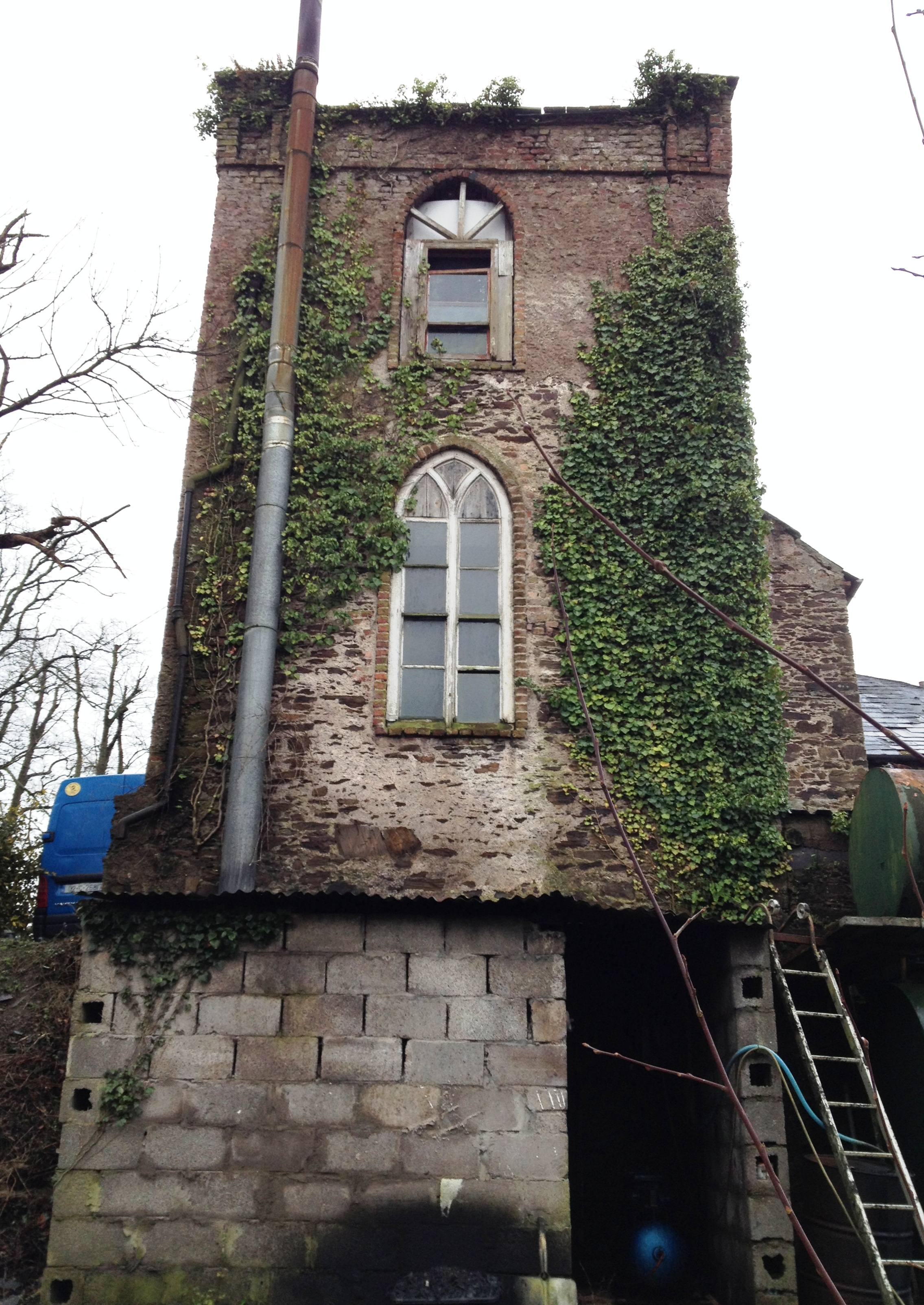
As one sees it today, the central block of the house, facing east, is of five bays and features a fine carved limestone doorcase with pretty fanlight above. The building initially looks single storey but this is not the case: a mid-18th century staircase directly beyond the front door leads to a first floor, the only evidence of which on the outside of the building is a solitary dormer window likely dating from the late 19th century and lighting the upper landing. The two slightly projecting tower ‘wings’ are believed to have been added in the early 1800s. They served both to increase accommodation and to give the house a more ancient, picturesque appearance (hence the gothic arched windows). As can be seen in that early watercolour, like the rest of the exterior the towers were originally rendered but subsequently covered in weather slates. Various additions were also made to the rear of the building over the course of two centuries, including a rather fine Edwardian bathroom that opens off the staircase return.

IMG_2948
IMG_2971
IMG_2955
IMG_2950
Donnybrook House’s original setting has long since gone: the surrounding gardens no longer exist, nor do any mills that once operated in the vicinity. Likewise most of the other historic houses and villas once dotting the landscape in this part of the country are gone: today almost the entire area is given over to housing estates. As is apparent, the building at present needs some attention. The roof of the south tower (that to the left of the entrance) has collapsed, bringing down the floors inside and making this part of the building unsafe. Meanwhile the north tower is suffering from water ingress and risks becoming similarly hazardous. This damage is not visible from the exterior because blind gothic windows on the upper level were designed to conceal the pitched roofs. On the other hand, the central section of the property appears to be in relatively good condition although rather damp, and has continued to be used and occupied. Internally some of the original 18th and early 19th century wooden joinery, including wainscot panelling, has survived, as have a number of the old sash windows. The spirit of the house invoked by Lennox Robinson and his siblings can still be felt.
Here is a building waiting to be rescued from what too often has been the fate of such properties in Ireland: ruin and disappearance. Wonderfully the present owner is keen to restore Donnybrook House and bring it back to residential use. Rescue and refurbishment is still feasible and must be encouraged. Donnybrook House is an important and rare testament to Cork’s architectural and industrial history. Its preservation merits everyone’s support.

IMG_3068

With special thanks to Ciara O’Flynn, Built Heritage Conservation Consultant/Buildings Archaeologist, for generously sharing her research into Donnybrook House.


Respected and Lamented by All Who Knew Him

IMG_3275
In the rarely opened south transept of Cloyne Cathedral, County Cork the end wall is dominated by this splendid early 18th century monument to members of the Longfield family, the first listed John Longfield having acquired a nearby estate and named it Castle Mary, perhaps in honour of his heiress wife, Mary Hawnby of Mallow. Successive generations are listed, the first (and last) Viscount Longueville being the grandson of John and Mary Longfield: note how the word ‘respected’ had to be tucked into the available space. On Lord Longueville’s his death without an heir, Castle Mary was inherited by a cousin, Colonel Mountifort Longfield. The house was burnt by the IRA in 1920, so this is now the best-preserved memorial to the family.

IMG_3280