

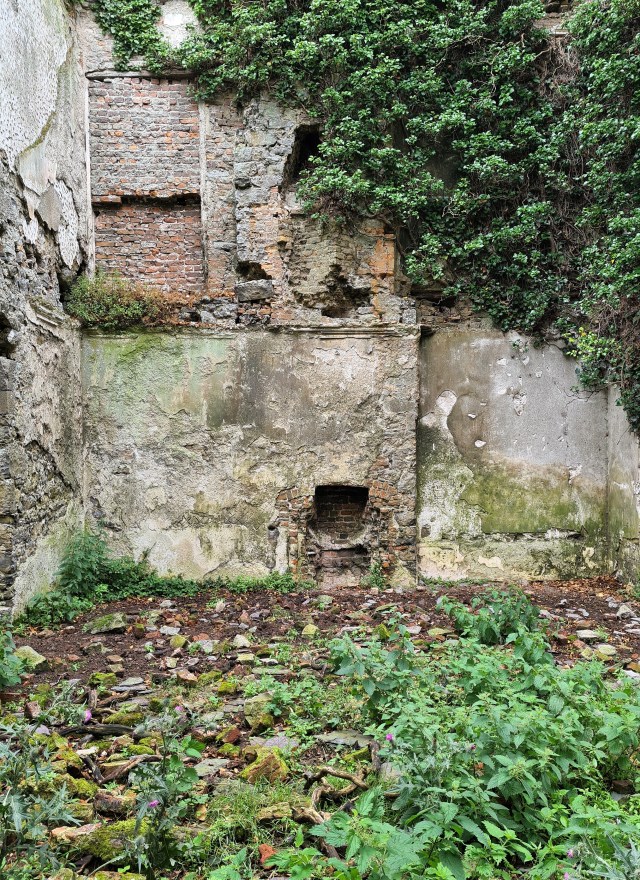
Long in ruins, this is Christ Church, otherwise Magourney parish church in Coachford, County Cork. In 1750 Charles Smith called it ‘new’ suggesting the building had likely been constructed in the first half of the 18th century. Thanks to funds provided by the ever-helpful Board of First Fruits, in 1818/19 it was extensively refurbished and the tower raised to its present level with blind lunettes and oculi; the little flanking pavilions, one of which held the vestry, the other a staircase, date from the same period. Just a few decades later, however, the parish embarked on building another new church, and this one was deconsecrated in the late 1850s.
Captured by Cunning

In the last quarter of the 16th century a number of members of the Cuffe family, all from Somerset, arrived in Ireland seeking opportunities to enrich themselves. Henry Cuffe, for example, came to this country as secretary to Robert Devereux, Earl of Essex when the latter was appointed Lord Lieutenant here in 1599. But when Essex fell from favour two years later and was executed, Cuffe suffered the same fate. Meanwhile, one of his relatives, perhaps a brother (it seems unclear) called Hugh Cuffe had also settled in Ireland where he was granted some of the Earl of Desmond’s lands in Munster, following the earl’s own death in 1583. Initially Hugh Cuffe seems to have been based in County Clare, but within a few years he was recorded as receiving land in County Cork, close to property which had been given to Edmund Spenser. However, before much longer had passed Cuffee had to surrender at least some of what he had been granted, after his right to it was challenged by members of an Old English family related to the FitzGeralds . Nevertheless, he must have held onto something because a marriage settlement drawn up in 1604 between his daughter Dorothea, and Charles Coote, describes Hugh Cuffe as being ‘of Cuffe’s Wood (or Kilmore), County Cork.’


Like Hugh Cuffe, Charles Coote was an English settler, arriving here in 1600 as captain of a foot regiment in the army of Charles Blount, Lord Mountjoy who had succeeded the Earl of Essex as Lord Deputy of Ireland: Coote was therefore a member of the force that a year later defeated the Irish and Spanish forces at the Battle of Kinsale. He soon began to reap the benefits of being on the winning side. In 1605 he was appointed Provost Marshal of Connaught and then in 1613 was given the office of General Collector and Receiver of the King’s Composition Money for Connaught, also for life, before being further promoted to Vice-President of Connaught. As a result of holding these positions, his main base was in Roscommon where he built a residence, Castle Coote. He also founded the towns of Jamestown and Carrick-on-Shannon, both in County Leitrim, as well as Mountrath, County Laois. Knighted in 1616, five years later Coote was appointed a Privy Councilor by James I, who also made him the first Baronet of Ireland, ‘in consideration of his good and faithful services in the province of Ulster.’ All seemed to be going well for him until the outbreak of the Confederate Wars in 1641. Although by then aged 60, he was instructed by the English government to raise a regiment and suppress insurrection, which he did with considerable force in County Wicklow before moving north. In May 1642 he was shot dead while leading a cavalry charge against a Confederate army in Trim, County Meath.


As already mentioned, in 1604 Hugh Cuffe’s daughter Dorothea married Charles Coote. Although the couple spent much of their time in Connaught, Coote owned land in what is now Laois but was then called Queen’s County. Here at some unknown date, perhaps around 1621 when he became a baronet, perhaps later, he embarked on building a substantial new house, which in honour of his wife he named Castle Cuffe. Was the place ever finished and occupied? We shall probably never know because soon after the onset of the Confederate Wars it was threatened with attack by the O’Dunnes who had formerly owned the land on which the castle stood. A cunning strategy was adopted to capture the place: Captain Daniel Dunne placed a tree trunk, coloured to look like a large cannon, on a hill some distance from the building and threatened to fire on it unless the occupants surrendered, which they duly did – fleeing to the town of Birr some miles away. Meanwhile, Dunne’s troops, having taken everything they wanted from Castle Cuffe, set fire to the place. It appears to have remained a ruin ever since and only scant remains survive, although their height gives an idea of how impressive a house must once have stood here, constructed on a H-plan, rising three storeys high and with a facade 100 feet long. What mostly survive are a number of gable ends topped with high, squared chimneys, their striking appearance – as is so often the case in Ireland – a matter of indifference to the cattle which now call Castle Cuffe home.
Gone but not Forgotten

‘Few cities can boast more extensive conveniences, more eminent beauties, than Dublin… To convey to the curious inquirer adequate ideas of those objects; to diffuse information of a Capital so long undesertly unnoticed, and to give it that place in estimation with regard to others it merits, this work was undertaken.’
From the Preface to A Picturesque and Descriptive view of the City of Dublin.
Published in 1799 as a bound volume with accompanying text, James Malton’s images of Ireland’s capital in the years immediately preceding the Act of Union are justly renowned, not least because so many of the buildings he chose to illustrate still remain, little changed. However, two of the plates are important for offering us views of since-lost properties.
Seen above, the Hibernian Marine Society’s School for the Children of Decayed Seamen) was built between 1770-73 on Sir John Rogerson’s Quay and is thought to have been designed by Thomas Ivory. Run by a charity, the building served as a place of education for boys whose fathers had either lost their lives at sea, or had become impoverished during their service in the Royal Navy or Merchant Navy. Accommodating some 160 students and the relevant staff, the school comprised a large three-storey central block flanked by wings, one holding a chapel, the other a dining hall. After being badly damaged by fire in 1872, the building became a warehouse but was demolished in 1979.
The Tholsel, which originated in the Middle Ages, served a diverse range of purposes in the city: meeting place for elected officials, guildhall, court and gaol. In its final incarnation, situated on Skinner’s Row (now a small park opposite Christ Church Cathedral), the building dated from the early 1680s. However, during the course of the 18th century, many of its functions were assumed by other, more modern places like the Four Courts and the Royal Exchange (now City Hall). By the time it was illustrated by Malton, the Tholsel’s days were numbered and it was demolished in 1809.
Both these prints are among those included in an exhibition, Malton’s Dublin, which runs until November 12th at the Irish Architectural Archive, 45 Merrion Square.
Copycats


After Monday’s post explaining the history of Thomastown Castle, County Tipperary, these pictures might be of interest since they show the gate tower that formerly gave access to the main house. It dates from around 1812 and was likewise designed by Richard Morrison: note the Mathew family coat of arms prominently displayed over the gateway. Aside from this detail, the building is almost identical to a similar gate tower at the entrance to the demesne of Borris House, County Carlow. This was also designed by Morrison and at the same date: one wonders if the estates’ respective owners ever noticed or remarked on the duplication?
Recalling a Lavish Host

Many people in Ireland will be familiar with the name of Theobald Mathew, a 19th century Roman Catholic priest who became known as the Apostle of Temperance. A member of the Capuchin order, in 1838 Fr Mathew, witnessing the problems arising from excessive consumption of alcohol, founded the Total Abstinence Society in Cork city, where he was then living. Within nine months some 150,000 persons had enrolled in this organisation and at its height during the late 1840s it is estimated that half the population of Ireland were members. What may be less well known is that Theobald Mathew was related to a wealthy, and Protestand, landed family and grew up at Thomastown Castle, County Tipperary where his father acted as agent to a cousin, the first Earl of Landaff. Now a striking ruin, Thomastown was for several centuries the seat of the Mathew family. Of Welsh origin (hence the choice of name for their title), they were connected through marriage to the Butlers, and thus acquired land in this part of the country. As was so often the case, a series of judicious marital alliances made them exceedingly rich, allowing the construction of a large residence in the late 17th/early 18th centuries. In Town and Country in Ireland under the Georges (1940) Constantia Maxwell provides an excellent account of life there in the years after the house had been built by Thomas Mathew. The building was ‘surrounded by gardens adorned with terraces, statuary, and fish ponds, and by a park of some two thousand acres stocked with deer. Mr Mathew, besides being very rich, was held to be one of the finest gentlemen of the age, and, having travelled much on the Continent and lived in London and Dublin, had a large circle of friends. Nothing gave him so much pleasure as to invite these to Thomastown, where he had no less than forty guest-rooms, besides handsome accommodation for servants. The guests in his house were invited to order anything they might wish for, as at an inn; they might seat themselves at the dining-room table without paying irksome respect to rank, or, if they preferred it, dine with chosen companions in their own rooms. A large room was fitted up as a city coffee-house with newspapers and chessboards, where servants had been ordered to bring refreshments at any time of the day. For those who liked sport fishing tackle was provided, as well as guns and ammunition, while hounds and hunters were available in the stables. But, although everything at Thomastown was on such a lavish scale, there was no disorder or waste, for Mr Mathew rose early every morning to look over the accounts, and his servants were well paid, and forbidden to take tips.’ A description of life at Thomastown was provided by Thomas Sheridan in his biography of Jonathan Swift described how the later was so delighted with Thomas Mathew’s hospitality that instead of staying for a fortnight, as originally intended, he remained there for four months.


As mentioned, the house at Thomastown was once surrounded by splendid gardens. Writing in 1778, Thomas Campbell noted that not only was the setting perfect, with the Galtee Mountains ‘set at such a due distance that they are the finest termination for a prospect a painter could desire’ but ‘behind the house is a square parterre, with flowers, with terraces thickly studded with busts and statues; before it, a long and blind avenue, planted with treble rows of well-grown trees, extends its awkward length. In the centre of this, and on the acclivity of the hill, are little fish ponds, pond above pond. The whole park is thrown into squares and parallelograms, with numerous avenues fenced and planted.’ By the time Campbell visited, this style of garden had fallen out of fashion, so he tut-tutted that ‘if a hillock dared to interpose its little head, it was cut off as an excrescence, or at least cut through; that the roads might be everywhere as level as they are straight. Thus was this delightful spot treated by some Procrustes of the last age.’ A few years later, Joseph Cooper Walker was just as critical of Thomastown’s gardens. ‘They lie principally on the gentle declivity of an hill,’ he explained, ‘resting on terraces, and filled with “statues thick as trees”. A long fish pond, sleeping under “a green mantle” between two rectilineous banks, appears in the midst. And in one corner stands a verdant theatre (once the scene of several dramatic exhibitions) displaying all the absurdity of the architecture of gardening. Thus did our ancestors, governed by the false taste which they imbibed from the English, disfigure, with unsuitable ornaments, the simple garb of nature.’ Not much later, perhaps when the second Earl of Landaff, who inherited title and estate on his father’s death in 1806, transformed the house, these by-now old-fashioned gardens were largely swept away in favour of open parkland.



Thomastown, as previously mentioned, was originally a late 17th/early 18th century house of two storeys, the centre just one room deep with projecting wings forming a short entrance courtyard. However, it appears that the generous Thomas Mathew enlarged the house by filling in the space between the wings to create a dining room, some 50 feet long and 20 feet deep, no doubt to feed all the guests he entertained. Several generations later, the second Earl of Landaff decided to alter the building’s appearance by giving it a Gothick makeover. In 1812 the architect Richard Morrison was commissioned to come up with a design for the place. The original entrance arcade was now glazed to create a Great Hall, while the first-floor gallery became a gothic-style library. However, the drawing room retained its classical decoration, with screens of scagliola columns at either end, a typical Morrison flourish which can still be seen in the library at Ballyfin, County Laois. Meanwhile, the exterior was ornamented with a crenellated parapet and a series of octagonal turrets topped with dart-like finials. As Mark Bence-Jones noted, from a distance these look like rabbits’ ears. A kitchen and service wing at right-angles to the house was also thoroughly dressed in Tudor-Gothic decoration, although a stone tower at the corner of the range is in Norman style. The entire building was covered in stucco, which was then rather oddly painted pale blue. An engraving of the completed work made by John PrestonNeale in 1819 although this included an unexecuted family wing and a more simple service range than that actually constructed. The second earl had no children and following his death, Thomastown passed to a sister Lady Elizabeth Mathew who in turn left the estate to a cousin of her mother, the Vicomte de Chabot. Before the end of the 19th century, it had come into the possession of the Dalys of Dunsandle, County Galway but seemingly by then the house was already falling into ruin. And so it has remained, with much of the central block, where those hospitable dinners were once given, long since collapsed. Today the only diners seen here are cattle.
Barmeath

Home to the Bellew family for several, this is Barmeath Castle, County Louth. The core of the building is a late medieval tower house built by the Moores who previously owned the land on which it stands. A two-storey wing was added to this around 1700 and then towards the middle of the 18th century a large plain block constructed, of three storeys and seven bays. However, changing tastes meant that in the 1830s the first Lord Bellew commissioned Hertfordshire architect, Thomas Smith, to transform the building into a neo-Norman castle with ample crenellations and fat round corner turrets, as well as the addition of a great square tower at one end, this now becoming the main entrance. Despite this elaborate make-over, it is still possible to detect the more straightforward Georgian house on what then became the garden front.
In Circles

In the gardens at Castlewellan, County Down: a large stone circular pool with fountain at its centre. The grounds here were laid out during the second half of the 19th century by the fourth Earl Annesley and then by his brother, the fifth earl who succeeded to title and estate in 1974. Both were keen plantsmen, responsible for establishing many of the rare species which can still be found on the site today, although some of its other features have since been lost, such as a series of 19 greenhouses, five of which were set aside for the cultivation of orchids. Below is a photograph of another pool, this one at the centre of the walled garden which has undergone extensive restoration in recent years.
Without Any Debt

Like so many others, the Burges (originally Burches) family appear to have arrived in this country in the mid-17th century, having for several previous generations been clergymen in England. And again, as was frequently the case, judicious connections through marriage aided their rise to wealth. Two brothers, David and Joseph, the elder of which was Rector of St Mark’s church in Dublin, moved to Armagh and in 1716 the younger married Elizabeth Lloyd whose father Ynyr was Deputy Secretary of the East India Company and owned land in East Ham, now a suburb of London. One of their sons, another Ynyr, also held an important post in the East India Company as Secretary & Paymaster of Seamen’s Wages, further improving their fortune. The family history in the 18th and early 19th century is complex as various lines failed to produce a male heir and therefore property was inherited by nephews or cousins who sometimes had to change their surnames as a condition of succeeding to estates. However, by the mid-19th century John Ynyr Burges, married to Lady Caroline Clements, a daughter of the second Earl of Leitrim, is listed in gentry directories as being of East Ham and Thorpe Hall, both in Essex, and of Parkanaur, County Tyrone. The land on which the last of these stands was originally held by the O’Donnelly family until they were displaced in the early 1600s and the property granted by James I to Sir Toby Caulfeild. His family remained in possession, until the Parkanaur estate was sold in 1771 by James Caulfeild, first Earl of Charlemont by Ynyr Burges. He appears to have rarely visited the place but some time after his death in 1793 a two-storey gabled cottage called Edenfield was built on the land for use as an occasional residence for the family.


The architect Thomas Duff has been discussed here before with regard to Narrow Water Castle, County Down (Narrow Water Castle « The Irish Aesthete). Born in Newry in 1792, we know little of his background and education but 21 years later he is mentioned as executant architect of St Mary’s church in his hometown. In 1822 he advertised in the Belfast press to advise ‘such gentlemen as intend building, that he purposes to furnish plans of every description, in the Grecian, Roman and Gothic styles of architecture, with estimates and such written instructions as are requisite for the execution of each design.’ He also reassured readers that he would superintend the work. Soon enough commissions followed, beginning with Belfast’s Fisherwick Presbyterian church, a large classical building dominated by its Ionic portico. Duff was soon in demand among other denominations, and in 1825 he designed the Roman Catholic cathedral in Newry, described in 1841 by Thackeray (otherwise highly dismissive of the ‘Papist’ faith) as a fine building which did the architect credit: the cathedral, incidentally, is in the Perpendicular Gothic manner, reflecting Duff’s versatility and his ability to adapt to the wishes of clients. This was demonstrated in 1830 when, together with his then-partner Thomas Jackson, he designed the first museum built in Ireland by voluntary subscription for the Belfast Natural History and Philosophical Society in the Greek Revival style, with a portico exactly copied from the octagon tower of Adronicus in Athens. A few years later, he was responsible for designing the Tudoresque Narrow Water Castle. And so it went on with a huge amount of work for religious, domestic and commercial properties right up to the time of his death in 1848 at the relatively young age of 56. However, during the previous decade he had been employed by John Ynyr Burges to transform Edenfield, the cottage at Parkanaur, into a substantial mansion.


Around 1820 Edenfield cottage was enlarged thanks to the addition of a new wing. However, it was only in the following decade that the house assumed its present appearance and proportions, following the employment of Thomas Duff: the original three-bay, two-storey building can still be detected behind the entrance porch. But the entire structure was refronted by Duff, also responsible for designing a very substantial west wing which holds many of the main reception rooms, as well as two neighbouring yards behind the main block. The architect was given a strict budget of £5,000 and a plaque located above the archway leading to the stableyard declared ‘This house and offices were built by John Ynyr and Lady Caroline Burges without placing any debt upon the property A.D. 1870.’ Renamed Parkanaur, the building’s make-over made it look to be an Elizabethan manor house, one that would not be out of place in the Cotswolds. There are further gabled bays, their corners delineated by slender polygonal towers, an abundance of stone finials, tall chimneys, hood mouldings over the windows, as well as the obligatory Oriel window. Inside the decorative flourishes continue, not least in the Great Hall which is lit by three large Perpendicular windows and has a minstrel’s gallery above an arched screen. Elsewhere, other than in the ceiling decoration, the Tudor borrowings are less explicit, and both the gallery and inner hall contain exceedingly fine Jacobean carved chimneypieces, presumably brought here from some house in England; that in the gallery is dated 1641. Parkanaur remained in the possession of the same family until 1955 when sold by Major Ynyr Alfred Burges, after which the house stood empty for three years until bought by Thomas Doran. Originally from this part of Ireland, as a young man he had emigrated to the United States and there worked as a truck driver until unable to do so owing to ill-health. He subsequently started a business, the Cheerful Greetings Card Company, which involved people throughout America selling its products door to door: this was so successful that it made Doran a multi-millionaire (he eventually sold the company in 1966 for in the region of UD$10 million). Doran was a friend of a Presbyterian minister, the Rev Gerry Eakins who wished to establish a residential centre for disabled young adults, and so he bought Parkanaur and presented it to be used for this purpose. Opened in 1960 as the Thomas Doran Training Centre and now called Parkanaur College, the buildings continue to be used for this purpose.
Pitching About

The Irish countryside is replete with old graveyards, some of them better maintained than others. But oftentimes those left to fend for themselves are more appealing than well-ordered sites. That’s the case here, an old graveyard at a spot called Stone Cross in County Meath. Surrounded by fields and contained with the remains of a dry stone wall, the place holds a modest number of tombs, almost none of them upright, but instead looking as though they have been pitched about by high winds.
Of Extraordinary Antiquarian Interest.

‘The Island of Devenish is undoubtedly one of the foremost and most interesting of the Lough Erne Archipelago. As the visitor sails down the lake from Enniskillen, after turning the point of Derrylinch, the Round Tower tops, with the rounded windows and the square Bell Tower of a more modern priory, appear over the Island’s highest ridge towards the south. On proceeding, wooded promontories throw their broad shadows across the still bays; the fair slopes and lawny knolls stand greenly out from the dark sylvan scenery; while the islands seem to be floating, as on a crystal sea, until the tourist reaches Devenish Island. The soil is exceedingly fertile and covered with the rankest and greenest grass. Over this the pilgrim, landing from his well-appointed pleasure-boat will be sure to turn his steps in the direction of various old buildings, lying in proximate position, and yet somewhat separated in some instances. The ruins, which yet remain in their insular situation, are of extraordinary antiquarian interest.’
From Lives of the Irish Saints by the Rev. John Canon O’Hanlon, Volume IX (1873)


‘One of the most interesting spots in the neighbourhood of Enniskillen, is Devenish Island, with its round tower and other ancient relics. It stands just where the lower lake expands; and is about two miles from Enniskillen. One may visit it either by boat from Enniskillen, or follow the road from the town, and make use of the ferry-boat. The island slopes gently from the water’s edge, in a fine green swell; but is entirely destitute of wood; and is said to contain upwards of seventy acres. The round tower of Devenish is said to be the most perfect in Ireland and, altogether, the finest specimen of these singular structures. The height of the tower is eighty-two feet; the thickness of its walls three feet, five inches; the circumference forty-nine feet; and the diameter, inside, nine feet, two inches. Twelve feet above the doorway there is a window, angularly pointed; and, higher up, another window nearly square. Still higher are the four windows, common in all these towers; and the key-stone above each is ornamented with a human head.’
From Ireland in 1834: A Journey throughout Ireland by Henry D Inglis (1835)


‘The lower church is dedicated to St. Molush, “who read the planets” we were told; and near it are the remains of an ancient building, called St Molush’s kitchen. In the vicinity is a coffin of hewn stone in which, if the saint found a resting place, he has long since been dispossessed of it, and superstition now ascribes to this stone-bed the power of removing pains in the back. Near the summit of the hill are the remains of the abbey. The centre of the building is an arch resting on four pillars, and supporting a belfry tower, with a winding staircase of good workmanship leading to the summit. An inscription records the date of the erection, and the name of the architect, etc. That which was apparently the northern aisle of the church, is now changed into a stall for cattle, a desecration much resented by the herdsman, a very superstitious and apparently a very devout Catholic who repeated with much zest an observation which had been made to him, that the author of this piece of barbarism would be found to be adorned with hoofs and horns in the next world!’
From The Island of Saints, or Ireland in 1855 by John Eliot Howard (1855)


