
The round tower at Kilree, County Kilkenny. A religious settlement is supposed to have been established here by St Brigid but no buildings from the early Christian period survive. Situated in the south-west corner of the former enclosure, the tower is believed to date from the 11th century and features a door and seven windows. It rises some twenty-nine metres to a battlemented top now missing its cap, thereby allowing views of the sky from the interior.
Tag Archives: Architectural History
A Special Friendship

The story of Castle Ward, County Down is well-known. Wonderfully sited on a rise above Strangford Lough the house dates from the mid-1760s when an older residence was replaced by something more à la mode. The problem was that Bernard Ward and his wife Lady Anne (née Bligh) had very different ideas about what they wanted. Mr Ward (created Baron Bangor in 1770, and then Viscount Bangor in 1781) preferred the classical style, whereas his wife fancied Gothick. As Mrs Delany wrote around this time, ‘Mr Ward is building a fine house, but the scene about is so uncommonly fine it is a pity it should not be judiciously laid out. He wants taste, and Lady Anne is so whimsical that I doubt her judgment. If they do not do too much they can’t spoil the place, for it hath every advantage from nature that can be desired.’ Ultimately a compromise was reached whereby Mr Ward had his way on the entrance front, and Lady Anne hers on the side overlooking Strangford Lough. Internally the same division was agreed so that the ground floor rooms are quaintly split between the two decorative styles. The architect responsible for organising this curious arrangement is unknown, although it has been proposed that, like the stone used for the exterior, he came from Bath or else Bristol (the names of both James Bridges and Thomas Paty have been mentioned). Nevertheless the arrangement was not enough to hold the Ward marriage together and soon after Castle Ward was finished Lady Anne, who complained of being bullied, decamped first to Dublin and later to Bath where she died in 1789, eight years after her husband.
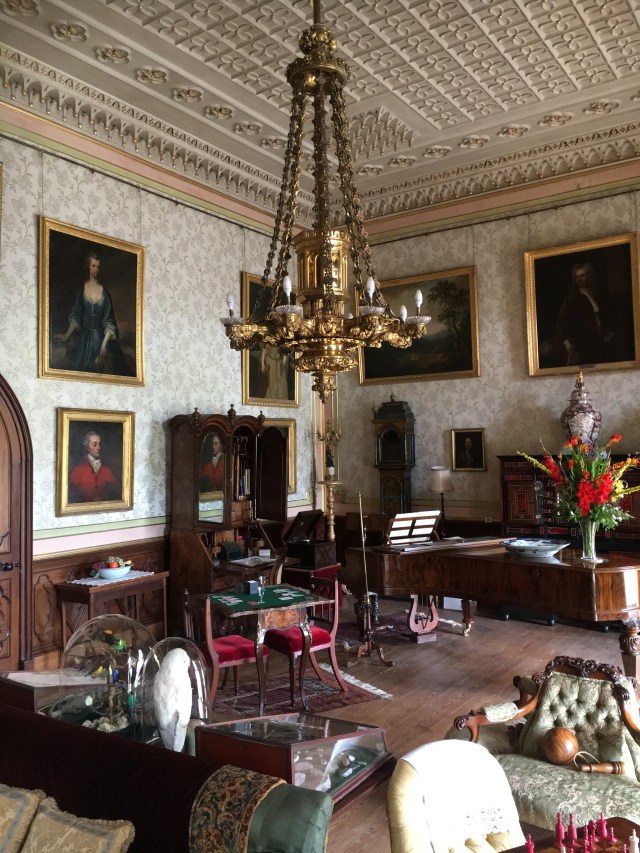


It may be that the Wards’ differences extended beyond just architecture. In an article published in 2000, Professor Sean Connolly discussed the relationship that existed between Lady Anne and an older woman, Letitia Bushe. Born in County Kilkenny in the first decade of the 18th century, Letty Bushe was a gentlewoman of modest means whose life was spent either in rented rooms in Dublin or staying with friends in the country. A talented amateur watercolourist, she was also known for the brilliance of her conversation (as well as her good looks before these were marred by smallpox). Among her closest friends was the aforementioned Mrs Delany who, when still Mrs Pendarves and visiting Dublin in November 1731 wrote to her sister, ‘I eloped for an hour or two to make a visit to a young lady who is just recovered of the small-pox. I think I never saw a prettier creature than she was before that malicious distemper seized her – a gay, good-humoured, innocent girl, without the least conceit of her beauty; her father has been dead about six months, a worthless man that has left a very uncertain fortune; she paints delightfully.’ The two women remained friends and regular correspondents until Letty Bushe’s death in 1757. But for a period she had a closer and much more intense relationship with Lady Anne. It appears they met in 1739, when the latter was just twenty-one and Miss Bushe in her mid-thirties. On July 31st 1740 she wrote to her younger friend, ‘This Day twelvemonth was the Day I first stay’d with you, the night of which you may remember pass’d very oddly. I cannot forget how I pity’d you, & how by that soft road you led me on to love you. I feared many things for you, & my compasion by degrees rose into esteem.’ Later again she would write of ‘two whole years of thoughts, tenderness, stuff and nonsense’. All of which indicates this was more than just a standard friendship.


Professor Connolly chronicles the relationship’s ups and downs, in part caused by Lady Anne’s regular visits to England where her father, John Bligh, first Earl of Darnley, had extensive estates. Letty Bushe suffered agonies in her absence. In the spring of 1740 Lady Anne crossed the Irish Sea, and by August of that year Miss Bushe was confessing, ‘About the time you left Ireland, I hardly slept at nights, and such a wizened pale old hag I grew.’ This appears not to have been an exaggeration because Mrs Ann Preston, with whom Letty Bushe was then staying in County Meath, in turn wrote to Lady Anne, ‘What has your Ladyship said to poor Miss Bushe? For since your last letter she has neither eat, drank, slept or spoke one chearfull sentence. In short she is so very unlike herself that I scarce know her. I beg you will say something to her to raise her spirits.’ The following month Miss Bushe wrote to her inamorata, ‘You make some of the sweetest moments of my life in reflection, & were it not for bitter absence I think you wou’d do so in reality. Tho I live & eat & sleep & laugh, yet I am often surprized at my self, well knowing I seldom am without your Idea, & the cruel sence of being separated from you.’ So it went on for several years, even after the marriage of Lady Anne in September 1742 to Robert Hawkins Magill of Gill Hall, County Down (he died less than three years later). We can only guess at the tone and content of Lady Anne’s letters because it appears that at some date she made off with her side of the correspondence and destroyed it. But she preserved the letters received from Letty Bushe and they provide both an insight into their relationship and a possible explanation for the failure of her marriage to Mr Ward. Despite the couple having three sons and four daughters prior to her departure for Dublin, it was perhaps more than just his architectural judgement she found disagreeable.

A Woman’s Life in Mid-Eighteenth-Century Ireland: The Case of Letitia Bushe by S.J. Connolly was published in The Historical Journal, Vol.43 (2000)
Encouraging Conservation and Preservation

Today sees the start of this year’s National Heritage Week, the aim of which according to the Heritage Council (which coordinates the event) ‘is to build awareness and education about our heritage thereby encouraging its conservation and preservation.’ This is a laudable aspiration and merits everyone’s support. Heritage Week has encouraged some valuable initiatives. As of today, for example, St Lawrence’s Gate, a thirteenth century barbican originally built as part of the defences of Drogheda, County Louth (seen above) is to be permanently closed to vehicular traffic – something which should have happened many years ago – thereby ensuring its better protection. All counties in Ireland participate with enthusiasm in Heritage Week but once the seven days are over, many of our historic buildings revert to a condition of vulnerability. Below is a photograph of the former Church of Ireland church at Castlehyde, County Cork. Originally constructed in 1809 it further benefitted from the attention of George Pain in 1830. Having been closed for services, it has sat empty for some time and is now in imminent danger of collapse. This building is as much part of our heritage as St Lawrence’s Gate, and although likewise listed for protection has been allowed to slip into its present state. It would be beneficial if the goodwill engendered by Heritage Week were put to advantage to ensure more historic properties were given the support required to ensure their long-term future. Obvious ways to do so would be to use this high-profile annual event to highlight specific buildings at risk, and to campaign that local authorities enforce the law regarding protection of listed structures, something that with rare exceptions they currently fail to do so. As the state of the church in Castlehyde shows, until our legislation is matched by implementation every week needs to be Heritage Week.
Making a Splash

A summer morning at Ballyfin, County Laois. When the house and demesne were restored some years ago, this cascade and pool were added by gardener Jim Reynolds on rising ground immediately behind the main building. In the foreground a river god reclines on a plinth while the vista is closed by a Doric temple designed for the site by architect John O’Connell.
Pallas Life

There are over twenty place names in Ireland incorporating the word ‘Pallas.’ Seemingly this derives from a Norman term, paleis, meaning boundary fence (hence the word palisade which clearly comes from the same source). One such spot is Pallas, County Galway found at the end of a boreen (from the Irish word bóithrín, meaning ‘a little road’). Here can be found, if not quite a palace, certainly the remains of a very substantial tower house and ancillary buildings. Pallas Castle as it is known, is believed to date from c.1500 when it was built by a branch of the Burke family, descendants of the Norman de Burghs, the first of whom William de Burgh had seized territory in this part of the country and in 1203 called himself Lord of Connacht. Rising five storeys, the tower stands within a bawn wall access to which is through an east-facing two-storey gatehouse flanked by similarly propotioned turrets. Immediately adjacent to the tower house on the west side are portions of a 17th century house, its gable end built into the bawn wall, through which separate entrance was created. The walls on either side retain their internal parapets, reached via flights of stone steps.


The Burkes remained in possession of Pallas until the mid-17th century when, like many other families who had risen against the Cromwellian forces, they were dispossessed of their lands and moved further west. The same fate befell another ancient family of Norman origins, the Nugents, formerly Barons Delvin but since 1621 Earls of Westmeath. They too were required to depart their original property and move west, being given part of the former Burke land including Pallas. Following the restoration of Charles II in 1660, the second Earl of Westmeath was allowed to return to his ancestral lands and those in County Galway bestowed on his second son, the Hon Thomas Nugent, created Baron Nugent of Riverston by James II in 1689. As a Roman Catholic and Jacobite he went into exile, dying in 1715 but his sons conformed to the established church and so were able to retain both the family title and estates. Their descendants remained at Pallas until the 1930s, having some thirty years earlier become Earls of Westmeath when the main line of the family died out. Ultimately the Land Commission took over the Pallas estate and divided it up, thereby ending the Nugent link. What remains of Pallas Castle is today a National Monument.


So this is what is left at Pallas, but another very substantial building in the immediate vicinity has since disappeared. In 1797 the amateur architect William Leeson, now best known for laying out the town of Westport, County Mayo, was commissioned by the fourth Lord Nugent of Riverston to design offices and, it seems, a new residence. This building was considerably enlarged by the tenth Earl of Westmeath after he inherited the title and estate on the death of his father in 1879. Surviving photographs show a house typical of the period, with an abundance of plate glass, parapets and balustrades, cement-rendered pilasters and quoins, together with a three-bay extension to one side. Further improvements were carried out on the property in the years immediately before the outbreak of the First World War with the addition of a new library and smoking room, but in the aftermath of the war circumstances were very different. The Nugents left the area for good soon after the death of the 11th Earl in 1933 when the title passed to his younger brother. A sale of the contents took place and then in 1945 the house itself was demolished, followed by an auction of its fixtures and fittings, including no less than 150 interior and exterior doors and a similar number of windows, marble chimney pieces, library shelving and so forth. Despite the building’s scale, today there is no obvious trace of it on the landscape and only the older structures survive at Pallas.
Falling Apart

The main entrance gates to Carrigglas Manor, County Longford. These were designed c.1795 for the estate’s then-owner Sir William Newcomen whose family owned one of Ireland’s most successful private banks. The gateway was part of a large scheme for Carriglas commissioned from James Gandon, of which only this and the interlinked stable and farmyards were actually built. Sir William’s son, Sir Thomas Gleadowe-Newcomen lacked his father’s acumen and when the bank collapsed in 1825 he shot himself. Carrigglas then passed into the ownership of a clever lawyer, Thomas Lefroy, today best-remembered as the possible object of Jane Austen’s amorous intentions. His descendants remained at Carrigglas until 2005 when the estate was sold to a property company called Thomas Kearns Developments which proceded to wreak havoc on the place, cutting down large swathes of ancient woodland and throwing up cheap housing before – like Sir Thomas Gleadowe-Newcomen – going bust. Three years ago Carrigglas was bought by a local company, Glennon Brothers, but since then little seems to have happened other than that the existing buildings around the estate have deteriorated further. Such is the case with the entrance, a triumphal arch flanked by low walls that conclude in a pair of lodges: stylistically it has many similarities with the entrances to the Four Courts in Dublin, also designed by Gandon. Unfortunately neglect in recent years means the ashlar blocks are beginning to shift, thereby putting the entire ensemble at risk. The structure is, of course, listed for protection.
From Venice to County Down

Evening light down the length of the Temple Water at Castle Ward, County Down. Although the main house overlooks Strangford Lough, in the 18th century it was judged necessary to have a man-made lake, its vista closed with a view of the 15th century tower house known as Audley’s Castle. The lake’s name comes from a pedimented Doric Temple built on a rise to the immediate north of the water: the building’s design is believed to have been an adaptation of a patternbook plate by Robert Morris showing Palladio’s Il Redentore in Venice. It appears in a watercolour painted by Mrs Delany in 1762 so both the temple and the lake had been completed by that date.
Portrait of the Artist’s Homestead

In Ireland few painters are better known or more admired than Sir William Orpen (1878-1931), examples of whose work today fetch some of the highest prices for a picture at auction. Yet Orpen’s background is relatively little studied, and his links with County Kerry are accordingly overlooked. Like many families, the Orpens were inclined to give themselves a more distinguished pedigree that was actually the case. So in Burke’s Landed Gentry of 1847 it is claimed that ‘The family of Orpen is of remote antiquity, and is stated to trace its descent from Erpen, second son of Varnacker (maire of the palace to Clothaire I), who was the son of Meroveus, and grandson of Theodorick, son of Clovis, King of France.’ This places their origins back in the sixth century, so that by the time William, Duke of Normandy won the Battle of Hastings in 1066, he was of course accompanied by a knight called Robert d’Erpen who thereafter settled at Erpingham in Norfolk. According to this version of events, the family turns up in Ireland in the second half of the 17th century already long established as members of the landed gentry on the other side of the Irish Sea. Such would have been the story of his forebears likely known by William Orpen. However the year before his death a cousin, the historian Goddard Henry Orpen produced an alternative, and somewhat less distinguished narrative. From this it would appear that the first Orpen to come to Ireland, a descendant of humble English yeomen, did so some time in the 1650s/60s when he acquired land around the area of Killorglin, County Kerry and that by the mid-1670s his son, Richard Orpen was employed as a land agent by the region’s greatest landowner, Sir William Petty. All of which is not quite so splendid as the lineage proposed by Burke but, as Goddard Henry Orpen wrote, ‘it is the truth I seek and not a (faked) illustrious ancestry and, after all, is it not better to rise than to fall?’


So, the earliest Orpens to settle in Kerry did so in the second half of the 17th century and prospered thanks to their association with the Pettys, later Petty-Fitzmaurices and ultimately Marquesses of Lansdowne. As a result they were able to acquire their own substantial landholdings, including the area around Ardtully in South Kerry. Until the 17th century this property was under the control of the MacFineens, a branch of the powerful MacCarthy clan but according to the Books of Survey and Distribution (compiled c.1650-80) during the course of the Confederate Wars, Colonel Donough MacFineen forfeited Ardtully, on which then stood ‘two good slate houses, a corn-mill, a castle, malthouse, barn, and tuck mill, likewise there are iron-mines and a silver mine in the quarter of Ardtully.’ The lands here were granted by the crown to one John Dillon but subsequently acquired on a long lease by the descendants of the original Richard Orpen: following a marriage between the latter’s grandson and Anna Townsend of Bridgemount, County Cork in 1766 the family’s name became Orpen Townsend. Ultimately in the first half of the 19th century the Ardtully estate was first leased and then purchased through the Encumbered Estates Court by a cousin of Richard Orpen Townsend: this was the successful solicitor Richard John Theodore Orpen. Founder of a legal practice still in existence today (as Orpen Franks) he would act as President of the Law Society from 1860 until his death sixteen years later. Knighted in 1866, he was the grandfather of the artist William Orpen and builder of a house still just extant at Ardtully.


Sir Richard John Theodore Orpen was clearly very proud of his family, if somewhat deluded about its pedigree, and assembled whatever information he could about his ancestors. He also built up a considerable land holding in County Kerry, amounting to over 12,000 acres by the time of his death. A fine residence in the centre of this property was required, and duly built at Ardtully in 1847. Its architect unknown, the house is customarily summarised as being in the Scottish Baronial style but this seems more a flag of convenience than an accurate description. In truth Ardtully looks to have been a typically Victorian grab-bag of architectural elements, its most prominent feature being a castellated round tower and turret on the south-east corner. Looking towards the river Roughty, the entrance front features a porch topped by the Orpen coat of arms (now damaged), another attempt by Sir Richard to demonstrate his lineage. Inside the house looks to have contained the usual collection of reception and bedrooms ranged over two storeys, the roofline marked by a succession of stepped gables and dormers. A substantial range of service outbuildings lay to the north. A handsome coloured illustration of Ardtully appeared in County Seats of The Noblemen and Gentlemen of Great Britain and Ireland (published 1870): conveniently the author of this six-volume work was Sir Richard’s nephew, the Rev. Francis Orpen Morris. The estate was eventually inherited by another Anglican clergyman, Sir Richard’s second son, the Rev. Raymond Orpen, Bishop of Limerick, Ardfert and Aghadoe. Uncle of the painter Sir William Orpen, he retired from office in 1921 and the same year Ardtully was burnt by the IRA. It has remained a ruin ever since, the link with one of this country’s greatest artists forgotten.
The Holy Well

Hooded moulding above the west gable doorway giving access to what remains of a late mediaeval chapel adjacent to St Patrick’s Well a few miles outside Clonmel, County Tipperary. The building and well were once part of the estates attached to the nearby Cistercian abbey of Inishlounaght founded in the 12th century. A notable feature of the building’s interior is the altar tomb of Nicholas White who died in 1622. Originally this was erected in a chantry chapel attached to St Mary’s, Clonmel. However when the latter was demolished in 1805 the tomb was moved to its present location.


Close to the chapel is a small pool fed by an underground spring. The abundant water this produces in turn fills a substantial nearby basin at the centre of which rises a small stone cross, much weathered and said to date from the early Christian period. The site assumed much of its present appearance in the mid-1960s when a group of American supporters restored the chapel and landscaped the surrounding grounds.
Jacobean Sophistication


The façade of Portumna Castle, County Galway seen from the outer court. The house dates from 1618 when it was commissioned by Richard Burke, fourth Earl of Clanricarde and his wife Frances Walsingham, who had previously been married to both Sir Philip Sidney and the second Earl of Essex. The building’s design bears similarities to the Clanricardes’ mansion at Somerhill, Kent completed just a few years earlier. At the time it was probably the most sophisticated semi-fortified house in Ireland, with Italianate influences apparent throughout beginning with the Tuscan gateway providing access to the inner court. Few changes were made thereafter to the property, other than the addition of a bow at the centre of the rear elevation. However Portumna Castle was accidentally gutted by fire in 1826 and the family later built a new residence on an adjacent site. The latter was destroyed in 1922 and its stones used to build a Roman Catholic church in the nearby town. The old castle was subsequently acquired by the state and re-roofed although, having stood exposed to the elements for over 150 years, its interior retains few original features.


