A Triumphal Entrance

IMG_9327
Cloverhill House, County Cavan was shown here some months ago (see A Mere Shell, 9th September 2015), a ruin well on the way to vanishing altogether. Happily its entrance is in better condition, a slim, unadorned ashlar triumphal arch flanked by pedestrian gates. The residnce to which it originally gave access was extended by Francis Johnston in 1799, so one imagines the arch dates from the same period. The side gates need to be cleared of overgrowth if they are not to go the way of the old house.

FullSizeRender

Occupational Therapy

FullSizeRender
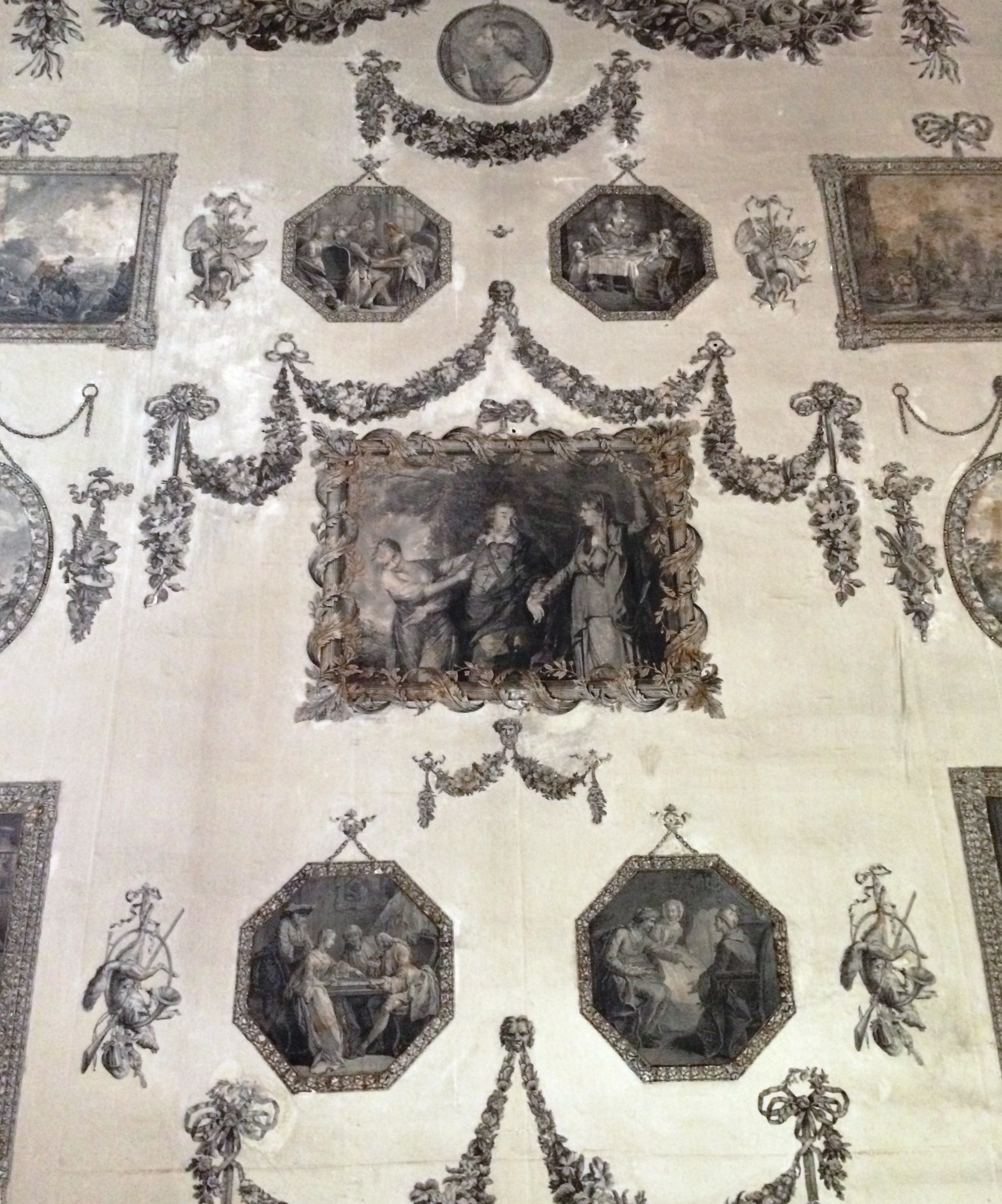
During this post-festive season, when evenings can seem especially long and monotonous, readers might like to consider occupying their time with the creation of a print room. This once-fashionable pursuit, which had its heyday in the second half of the 18th century, subsequently fell out of favour and only one intact example survives in Ireland: that at Castletown, County Kildare. The design and execution of print rooms was customarily left to women, although it evolved from the mostly-male habit of collecting valuable prints and storing these either in a cabinet or within albums. Later on prints might be hung in a chamber designated for the purpose, often kept shrouded in order the work avoided suffering light damage: while cheaper than paintings prints, especially those of larger dimensions could be expensive to produce. However, larger runs of prints in the 18th century, often reproductions of popular works of art, helped to bring down costs and make these pictures accessible to a broader market than had hitherto been the case. Cheaper prices led to greater disposability and the emergence of the print room, a phenomenon effectively unique to Britain and Ireland (although there were some instances of the vogue found in America).

IMG_3175
IMG_3173
IMG_3176
IMG_3179
Located behind the house’s main staircase and part of an enfilade on the ground floor overlooking the garden, Castletown’s Print Room was created in 1768 by Lady Louisa Conolly. She had been collecting pictures for at least the previous six years, and in addition had gained experience through assisting in similar ventures with her sister Emily, Countess of Kildare at nearby Carton and with Lady Clanbrassil at Cypress Grove House, Templeogue, County Dublin. Both these rooms have since been lost. The project was a long time in gestation: in 1762 she wrote to her sister Lady Sarah Bunbury, ‘I always forget to thank you my Dear for the Prints you sent me, I hope you got them of Mrs Regnier, for I have a bill there, the two little ones that you admired so, are the very things I wanted, that of Helen is charming. I have not had time to do my Print room yet.’ It is likely the reason the Print Room took so many years coming into existence is both because the Conollys were preoccupied with other work at Castletown and because Lady Louisa did not want to rush preparing the layout of what is a larger space than that customarily used for such a purpose: the ceiling here, for example, is twenty-five feet high. As a result, an awful lot of prints were needed. As late as February 1768 she was still writing to her sister Lady Sarah, ‘…any time that you choose to go into a print Shop, I should be obliged to you, if you would buy me five or Six large Prints, there are some of Teniers engraved by LeBas, which I am told are larger than the common size, if you meet with any, pray send me a few.’ Working out the design for this room was a complex business, particularly since border frames for each of the frames also had to be prepared, as well as garlands, trophies and other elements of the overall decoration.

IMG_3180
IMG_3178
IMG_3181
IMG_3196
When Lady Louisa finally came to embark on the scheme, the prints were duly cut out and then glued onto lengths of warm off-white painted paper. These in turn were attached to the room’s walls on battens overlaid with cloth. As Ruth Johnstone has noted, in many cases Lady Louisa ‘made editorial decisions based on the outside shapes of images.’ Accordingly she altered the original rectangular format of forty-six images to either an octagonal, oval or circular shape, or to a rectangle with a convex top. Most likely because of the need to create a visual balance based on size and shape there is no overriding theme to the pictures but rather they reflect mid-18th century taste. A handful of images were included for a specific reason. In central position between the two windows, for example, is a print of Van Dyck’s portrait of the children of Charles I, a group including Lady Louisa’s great-grandfather Charles II. In the same position on the opposite wall is a print taken from Sir Joshua Reynolds’ portrait of Lady Louisa’s sister, the aforementioned Lady Sarah Bunbury (the original painting, incidentally, is now in the collection of Chicago’s Art Institute). Providing a centrepiece on the east and west walls are prints of the era’s most famous actor, David Garrick, and the room also includes a portrait of William Pitt, Earl of Chatham, rather surprising since he was a political opponent of Lady Louisa’s brother-in-law Henry Fox, first Baron Holland. Otherwise the sources were diverse, with a fondness for both pastoral and classical subjects taken from the works of diverse artists including Teniers, Greuze, Jan Steen and Claude Lorrain. Despite such dissimilitude, Castletown’s Print Room conveys an impression of homogeneity thanks to its designer’s careful preparation. Anyone intending to embark on a similar enterprise will find these long winter evenings perfect for similarly thorough planning.

Last Pic
Much more information on Castletown’s Print Room can be found in Ruth Johnstone’s essay on the subject including in the Office of Public Work’s 2011 publication Castletown: Decorative Arts.


Getting Thoroughly Plastered

IMG_9646
One of the past year’s most fascinating personal discoveries was the dining room at Altidore Castle, County Wicklow. Often described as a Georgian ‘toy fort’ the house was built c.1730 for General Thomas Pearce, uncle of the architect Sir Edward Lovett Pearce, who may well have been responsible for its design. Much of the interior decoration dates from that period, including the dining room’s panelling. In the last quarter of the 18th century, however, additional ornamentation was added with the introduction of oval and circular plaster medallions featuring female classical deities and graces: this would have been around the period that Altidore was owned by Rev William Blachford, Librarian of Marsh’s Library and father of early Romantic poet Mary Tighe (author of the once-much read Psyche, or the Legend of Love),  and subsequently by her brother. During the same period the interiors of nearby Mount Kennedy – designed by James Wyatt in 1772 but only built under the supervision of Thomas Cooley the following decade – was being decorated by the celebrated stuccadore Michael Stapleton. The medallions are not unlike those seen in Lucan House, County Dublin where Stapleton also worked: might he have had a hand in the plasterwork at Altidore?

IMG_9659

A Very Conspicuous Object

FullSizeRender
In early February 1779 the church at Coolbanagher, County Laois, an old building of rough stone with straw-thatched roof, was maliciously set on fire and reduced to ruin. That same year the Hon John Dawson succeeded his father as second Viscount Carlow (he would be created first Earl of Portarlington in 1785). A man of considerable cultural interests, Lord Carlow played a key role in encouraging James Gandon to come to Ireland. When the English architect did so in 1781 he was duly invited to his patron’s country residence, Dawson Court which lay close by Coolbanagher: Lady Carlow’s correspondence records Gandon being with the family over Christmas 1781, together with the local rector, her brother-in-law the Rev. William Dawson. The following spring work began on a new church at Coolbanagher, designed by Gandon. Work progressed relatively slowly. In November 1783 Lord Carlow wrote to his wife, then in London, ‘The church has been neglected but now gets on apace, and I believe I shall have the whole body of it fit for roofing before the winter sets in. I shall not, however, put on the roof till spring.’ A month later, he advised her, ‘I have concluded my work at the church for this season. It will make a very conspicuous object to the new house and to the whole province of Leinster.’ Further time passed before Lady Carlow wrote in March 1785 to her sister, a regular correspondent, ‘We are going to have great doings here next week. The new church is to be consecrated on Tuesday; the Bishop and all the clergy in the neighbourhood are to attend, besides all the country, I suppose, and Lord Carlow will ask them all to dinner both on that day and on the next, as there are races within three miles of us. I own I am sorry to begin with this sort of work so soon, but there is no help for it.’ Shortly afterwards Gandon also designed a mausoleum for his patron and this lies to the immediate south of the building (see Preparing for the End last Wednesday, December 23rd).

IMG_7794
IMG_7777
IMG_7798
During a visit to Ireland in 1792 the English judge George Hardinge visited this part of the country and observed that Lord Carlow ‘has just built a most beautiful Church for his Parish upon his own Architecture and Wyatt himself might own it with pride as a work of his.’ Despite this mis-attribution, the church of St John the Evangelist in Coolbanagher has long been judged Gandon’s work, not least because a number of preparatory sketches from his hand survive which appear to show the evolution of ideas for the building. The initial concept suggests the entire church was intended as a kind of mausoleum, with a sarcophagus altar at the east end. This scheme was abandoned (and the more modest Portarlington Mausoleum erected immediately outside the building) and instead one adopted not unlike the courthouse concourse Gandon had designed for Nottingham a decade earlier. Everything from vestibule to vestry is contained within a single compact space, with the nave measuring a neat thirty feet wide by sixty feet long. This chamber is divided into three compartments articulated by alternate piers and niches, the former being carried up and across the barrel vaulted ceiling. Light is provided by Diocletian windows on the upper walls, these flanked by draped medallions. An arched and bow-fronted gallery at the west end was supported on slender Doric columns while presumably the altar table stood below a similar arch to the east. As Edward McParland has commented, stripped of all superfluous ornament, ‘when Coolbanagher was consecrated in 1785, there was no more nobly simple nor any more calmly grand church in the country.’ A view of the interior attributed to James Malton shows the building as Gandon intended (see above, the three figures in the foreground are supposed to represent the architect, Lord Carlow and the Rev. William Dawson).

FullSizeRender 3
FullSizeRender 4
FullSizeRender 2
Visitors to Coolbanagher church can still gain a sense of Gandon’s design, although this has since been the subject of some alteration. During the 19th century evangelical revival, the building must have seemed rather too pagan in character: more Roman bath (those Diocletian windows) than place of Christian worship. There also appear to have been problems with the roof, since it had to be repaired in 1822 and again in 1827. Radical alteration occurred in 1865 when, working on plans commissioned from Thomas Drew, a decision was taken by the rector and vestry to create an enlarged semi-circular chancel accessed by railings and containing a pulpit, reading desk and altar; the arch was given some gothic-spirited carvings presumably at the same date. Out too went the theatre-box gallery, and the old box pews, supposedly ‘to afford increased accommodation in the Church, so as to leave the aisle clear – which is at present inconveniently crowded.’ Finally the barrel ceiling went for good, replaced by the present pitched roof with exposed wood beams. More recently and reverting to the site’s original spirit, the late Major Cholmeley-Harrison commissioned urns (which were designed by Gandon but may never have been made) to be placed in the nave niches. Today the building represents a clash of cultures (not helped by the present colour scheme) in which Enlightenment idealism does battle with religious dogma, neither emerging victorious. Even so, Coolbanagher church remains, as Lord Carlow intended, a ‘very conspicuous object’ to the whole province of Leinster, if not to the entire country.

IMG_7818

Pure Folly

IMG_4289
This seeming folly closes a vista inside the walled garden of Strokestown Park, County Roscommon. In fact the main feature here, the limestone Venetian window, was originally sited on the first floor of the main house and formed part of Richard Castle’s design dating from the 1730s. When Strokestown underwent modifications around 1819 –  the architect on that occasion being John Lynn – the window was removed (presumably because a large Ionic portico was added directly beneath) and put into storage. It only found a new home in the walled garden when this was restored in the 1990s.

A Generous Welcome to the World

IMG_0184
The generous proportions of the front door in the entrance hall at Ballymacmoy, County Cork. Since the early 18th century the house has been home to successive generations of Hennessys, one of whom Richard emigrated to France where he became an officer in the famous Dillon’s Regiment before settling in the Cognac region and founding the eponymous family firm. The present building dates from the second decade of the 19th century, replacing an older property when its excessively heavy slates caused the roof to collapse, killing a pig and a goose, and injuring a beggar who unfortunately happened just then to call to the door.

Mixing the Orders

IMG_1947
One of the series of doors found at the base of the stairs in the south hall at Ballyhaise, County Cavan. While the core of the house dates from c.1730, this part of the building was extensively remodelled and extended early in the following century. The doorcases, with their ribbed pilasters and feathered capitals beneath expansive arched fans, date from that period.

IMG_1949
For more about Ballyhaise, see Made to Last For Ever, March 9th 2015.

The Consequences of Being in Service

IMG_0744
‘Therefore his servants said to him, “Let a young woman be sought for my lord the king, and let her wait on the king and be in his service. Let her lie in your arms, that my lord the king may be warm”.’ (1 Kings 1:2).
William Ponsonby-Barker of Kilcooley, County Tipperary was an ardent evangelical Christian and in the years prior to his death in 1877 he would habitually emulate the example of King David in the Old Testament, and take a young woman to bed with him – strictly for the purposes of keeping his elderly body warm. The human hot water bottle would, it is said, be chosen from among the housemaids lined up after evening prayers. In his book Twilight of the Ascendency (1987) Mark Bence-Jones tells that on one occasion, the maid selected by Ponsonby-Barker ‘offended his olfactory sensibilities, so he sprinkled her liberally from a bottle which he took in the dark to contain eau de cologne but which in fact contained ink!’ Of course it may be that the owner of Kilcooley was following the strictures of his late mother. According to the American Quaker Asenath Nicholson who recorded a visit to the estate in her 1847 book Ireland’s Welcome to the Stranger, ‘the pleasure of walking over these delightful fields is enhanced by the knowledge that his tenants are made so happy by his kindness. To every widow he gives a pension of £12 a year; and to every person injuring himself in his employment, the same sum yearly, as long as the injury lasts. His mother was all kindness, and her dying injunction to him was, “To be good to the poor”…His mother, whom he ardently loved, was buried in a vault on the premises; and his grief at her death was such that he left the domain for twelve months. He supports a dispensary for the poor, who resort to it twice a week, and receive medicine from a physician who is paid some sixty pounds a year for his attendance.’

IMG_0845
IMG_0898
IMG_0842
IMG_0836
From the 12th century onwards Kilcooley belonged to the Cistercian order which built a fine abbey there. Following the dissolution of the monasteries in the 1540s, the land passed into the possession of the Butlers, Earls of Ormonde. In 1636 the twelfth earl (and future first Duke of Ormonde) in turn sold Kilcooley to the Norfolk-born judge Sir Jerome Alexander for £4,200. Following his death in 1670, the estate was bequeathed to a daughter Elizabeth Alexander, on the condition that she did not marry an Irishman. In the event her husband was another lawyer, William Barker who had been born in Essex: he had already been granted 3,300 acres in Limerick in 1667 and received a further 1,300 acres in Tipperary in 1678; three months prior to his marriage in June 1676 he was made a baronet, the first of four all confusingly bearing the same first name. Successive Sir William Barkers lived in the mediaeval Kilcooley Abbey, adapted as a private residence. However, each of them also seems to have considered the notion of building a new residence, only the last of the line doing so. On succeeding his father at some date on or before 1719, the second baronet thought to construct both an alternative house and an adjacent market town but in the event did neither.  Following the marriage of his heir in July 1736 to Mary Quin of Adare Sir William wrote of plans to build ‘as fine and elegant a private gentleman’s seat as any in Europe and inland market as ye country could afford, instead of botching it now about old Abbey walls not proper adapted to be anything called polite’. But nothing happened either then or until around the time the last Sir William inherited Kilcooley on the death of his father in 1770. Ten years earlier he had married Catherine Lane and around this time was handed responsibility for the estate. A stone in the stable yard bearing the date 1762 certainly suggests work was done on the property then, so perhaps the core of the present house dates from the same period.

IMG_0771
IMG_0849
IMG_0829
IMG_0885
As built by the fourth Barker baronet, Kilcooley conformed to the Palladian style then beginning to go out of fashion; this certainly suggests an earlier date than c.1790 which was traditionally given. Owing to alterations made in the 19th century after a fire, it is difficult to see the original form of the house. Looking towards a lake created in 1789 at the cost of just over £442 the entrance front is of seven bays and two storeys over elevated basement. Arched links on either side lead to pedimented pavilions and these in turn link to quadrants giving access to service yards: rubble-filled niches and oculi visible beneath later render hint at the building’s earlier form. The garden front looks across parkland towards the romantic ruins of the old abbey. On this side, the house has a central breakfront of three bays broken up by four giant Ionic limestone pilasters and ending in a parapet supporting eagles and urns. Access on this side, as on the entrance front, is via a double flight of balustraded stone steps. Single bays on either side lead, again as on the other side of the house, to pedimented pavilions and thence to a further run of buildings, including a pretty hexagonal model dairy. The aforementioned fire – of which more below – gutted the central block of the house (Asenath Nicholson specifically mentions the loss of a fine library) but appears to have spared the wings. Thus it is possible to gain a sense of the interior of Kilcooley in these sections of the building. On one side, for example, there is a fine cantilevered stone staircase which looks to be 18th century (and although intended for use by servants is actually handsomer than that used by the owners). At the other end of the house are a couple of rooms with tall lugged doorcases and coved ceilings. One of these still retains its arabesque rococo stuccowork, as well as a tall, slender marble chimneypiece.

IMG_0783
IMG_0794
IMG_0792
IMG_0833
The strict Christian beliefs of William Ponsonby-Baker may have led to the fire that destroyed the central block of Kilcooley. One day in 1839 a woman arrived at the house with a small child who, she said, had been fathered by the butler, a Mr Ashby. So shocked was Ponsonby-Barker by his employee’s behaviour that he immediately fired Ashby: as the house maids had already discovered, there were consequence to being in service at Kilcooley. In revenge, Ashby packed the chimney in the library with paper and set it alight. As a result, the building was gutted and as Asenath Nicholson commented ‘An elegant library was lost’ along with many of the other contents. Kilcooley’s owner set about rebuilding the house, where work was completed in 1843. Certain alterations were made at this time to both exterior and interior. Regarding the latter, canted bay windows were inserted on the ground floor of both the entrance and garden fronts (originally those on the main facade were bows), and a second storey with balustrade loggias added to the links between main block and wings, as a result of which the building gained space but lost some of its lightness. Internally, a new main cantilevered stone staircase was created to one side, lit by an arched window on the return. An enfilade of reception rooms overlooks the mediaeval abbey on the garden side; these appear to be following the original house’s ground plan, although a portion of the central room was shaved off to create an antechamber. Meanwhile to the front one finds the dining room and library: both of these are half-paneled in oak, as is the entrance hall between them. This last is unquestionably Kilcooley’s most striking feature, an enormous double-height space with first floor gallery, the whole lit by a glazed dome: interestingly hot water pipes run around the base of the dome, evidently in an effort to ensure the gallery wasn’t too cold. Below runs a vast basement, with a central passage providing access to a wealth of storage and staff rooms, including in one of the wings a lofty kitchen, again probably part of the original building as it still has a central octagon through which smoke would once have escaped.

IMG_0734

More on Kilcooley next Monday…


A Spirit of Theatre

IMG_0359
The origins of Dublin castle go back to the first decade of the 13th century, but this site – the highest spot in the immediate locality – was previously occupied by a fortress constructed around the first half of the tenth century after the Vikings settled here. More than two hundred years later the Normans arrived and took possession of Dublin, making it their centre of government in Ireland. Hence in 1204 King John commanded the erection of a large stone castle where the Viking fortification had previously stood. The result was a building of strong walls and good ditches designed to defend the city but also to serve as an administrative centre and to provide protection for the King’s treasury. The castle was largely completed by 1230 under the direction of Henry of London, then Archbishop of Dublin. It is only during the reign of King John’s son, Henry III that the first references are made to a chapel within the castle’s walls. Deeply religious (he maintained at least fifty chapels for his own and his household’s exclusive use), Henry was particularly devoted to the cult of St Edward the Confessor, to whom he was related (Edward’s mother had been a Norman princess) and whose remains he installed in a costly shrine in Westminster Abbey. Thus around 1242 when the king ordered that new windows be made for the chapel in Dublin Castle he had the building dedicated to Edward the Confessor. Situated to the immediate east of the circular Record Tower – today the most intact portion of the mediaeval castle – over the following centuries the chapel underwent the same vicissitudes as the rest of the site. Between 1358-61 its interior was extensively redecorated, with 600lbs of glass purchased for the windows, together with a new crucifix and rood and two devotional statues, one of the Virgin, the other of St Thomas the Martyr who now succeeded Edward the Confessor as the chapel’s patron. It would appear that in the 16th century further repairs and refurbishments were carried out by Sir Henry Sidney, then acting as Ireland’s Lord Deputy, and perhaps again in 1638 after a fire had damaged the upper floor of the building. Worse followed in 1684 after another fire broke out to the immediate west. In order to contain the conflagration, Lord Arran, son of the first Duke of Ormonde (then serving as Lord Deputy) ordered the chapel and a number of other adjacent structures be blown up.

IMG_0459
IMG_0393
IMG_0381
IMG_0437
It would appear that towards the end of the 17th century Sir William Robinson, then Surveyor General, rebuilt the chapel along with other portions of the castle in order to make the whole place more comfortable as a residence for the English crown’s representative in Ireland. But while such work continued over successive decades, the chapel remained a relatively modest property: a late 18th century painting shows it to have been of red brick and looking more domestic than religious in character. However, as 1800 and the Act of Union approached, the building underwent reappraisal and it was considered to be ‘little consistent with its attachment to a royal palace.’ In 1801 James Gandon was invited to submit plans for a new chapel. He produced seven designs, none of which survive so one can only speculate what this great advocate of neo-classicism might have created. After a further delay finally in 1807 Francis Johnston who two years earlier had been appointed architect to the Board of Works, embarked on the building one sees today. As Judith Hill has written, the result was intended to emphasize the role of the Church of Ireland in the governance of the country, symbolized by its location within the walls of the administration’s headquarters. It therefore had to provide public access, greater space ‘and an enhanced architectural presence within the castle precincts.’ As a result, the eventual chapel was double the size of its predecessor, with an organ and space for a choir to offer cathedral-standard services: like the viceroy, the chapel was expected to represent the royal presence in Ireland. Underlining its ancient links to the regime, access to the chapel for the castle’s residents was via the old Record Tower. This Johnston reworked in order to improve its appearance, increasing the tower’s height by the addition of another storey with tripartite windows and then topping the whole with machicolated battlements resting on tiered corbels.

IMG_0388
IMG_0368
IMG_0369
IMG_0424
Francis Johnston, who would soon move on to design the classical General Post Office on Sackville (now O’Connell) Street, was equally at home working in the gothic mode, as he had already demonstrated with Charleville Castle, County Offaly (begun 1798). He adopted the same style for the new chapel in Dublin Castle, even if here it acts as decoration laid over classical symmetry. The exterior of cut limestone building is, as intended by Johnston, rather austere, north and south elevations being of six bays, their two-tiered windows flanked by stepped buttresses that finish in pinnacles. The west end is absorbed into the drum of the mediaeval Record Tower but that at the east, Judith Hill proposes, draws inspiration from the façade of Westminster Hall in London which had recently been cleared of later accretions. Buttressed towers stand guard on either side of a low door above which can be seen the window which lights the chancel within. Decorative flourishes come from the profusion of heads – 103 in total – found at the base of each pinnacle and ornamenting all doors and windows. These were carved by Edward Smyth, best-known today for his keystone heads personifying the rivers of Ireland that adorn Dublin’s Custom House. Here he was likely assisted by his son John. According to Johnston, some of the heads were intended to be historical ‘and some fanciful.’ Dean Swift, for example, can be found on the north elevation, where St Peter, clutching the keys of heaven, hovers over the main public entrance to the building. St Patrick and Brian Boru face each other on either side of the east end door, the window above featuring Faith, Hope and Charity. The same three virtues can be seen inside where John Smyth is believed to have been responsible for the greater part of the work (his father Edward died in 1812). It has been noted that Smyth the younger’s contribution is often flamboyantly baroque in character, a counterpoint to Johnston’s interpretation of Perpendicular Gothic. The stucco heads form part of a larger decorative programme in which a number of other craftsmen played a role, not least stuccodore George Stapleton who created the plasterwork tracery with which the body of the chapel is smothered.

IMG_0473
IMG_0458
IMG_0456
IMG_0491
The spirit, if not the form, of baroque found in Smyth’s figurative work pervades what was henceforth known as the Chapel Royal. The interior fizzes with frothy energy thanks not only to the elaborate plasterwork but also the oak galleries carved by Richard Stewart, their fronts divided into panels, each containing the coat of arms of a different Lord Lieutenant surrounded by virtuosic foliate ornamentation. Some of the stained glass in the east window is 15th century French and was presented by Lord Whitworth (Lord Lieutenant at the time of the chapel’s inaugural service in December 1814) while that below was specially made by Joshua Bradley. Other windows contain later glass that bathes the interior in a kaleidoscope of colour. The theatricality of the building must have been even more apparent in its original incarnation when the altar table was concealed behind a large carved pulpit (now in nearby St Werburgh’s church, see: Simply Divine, May 27th 2013). The centre section of the first-floor galleries, that on the south side intended to be occupied by the Viceroy, that on the north by the Archbishop of Dublin, projects forward in the manner of an opera box. This impression was amplified when the Lord Lieutenant’s seat was surmounted by an elaborately carved baldacchino smothered in plush red drapes. The same rich fabric was used for seat coverings such as the benches made by the Dublin firm of Mack, Williams and Gibton. The total bill for their contribution came to over £1,593. Indeed eventual expenditure on the Chapel Royal reached £42,000 which was more than four times the original estimate of £9,532: this compares with the £50,000 spent on building Johnston’s near contemporaneous GPO which is a much larger building. Some of the chapel’s high cost can be ascribed to necessary structural work owing to the nature of a sloping site below which ran the river Poddle (as well as an old quarry). But much of it was due to Johnston’s determination to create a virtuosic building. The chapel retained its original interior until the two tenures of the seventh Earl of Carlisle as Lord Lieutenant between 1855 and 1864. One suspects that Lord Carlisle, a fervent Christian (his mother, to whom he was devoted, had been a keen evangelical) found the character of the Chapel Royal too frivolous for his taste. To improve the calibre of services, he had a new Telford organ installed at the west end, while at the east the old pulpit was removed to allow a clear view of the altar table (a new and smaller Caen stone pulpit was placed to the immediate north). The baldacchino over the Lord Lieutenant’s box came out too while the entire ceiling was painted azure with gold stars. Thankfully much of this Victorian redecoration was removed when the Chapel Royal was refurbished some thirty years ago and in so far as is possible it has now reverted to its appearance when first opened.

IMG_0426

A visit to the Chapel Royal is now included in tours of Dublin Castle and is much recommended. In addition, an exhibition on the building called ‘Pinnacles, Pomp & Piety’ – featuring many of the original contents from the Chapel, such as furniture, silverware and historic drawings – can be seen in the State Apartments until March 6th 2016. This is accompanied by a terrifically informative book, ‘The Chapel Royal, Dublin Castle, An Architectural History’ (Myles Campbell and William Derham, editors), to which today’s text is indebted and which will likewise enhance other readers’ knowledge both of the Chapel Royal, and the context in which it was built and decorated.