A Mere Shell of Itself

IMG_0161

A corner of the Shell House in the gardens of Kinoith, County Cork, otherwise known as the Ballymaloe Cookery School. This charming octagonal structure was created by artist Blott Kerr-Wilson in 1995 to mark the silver wedding anniversary of Kinoith’s owners, Tim and Darina Allen. As you can see, the whole interior is covered in an enormous variety of shells, at least some of which – those formerly holding a mussel or scallop – passed across the tables of Ballymaloe House.

The Good Shepherd

CH26-%20Drawqing%20room%20DSC_9397

One last image for the moment from Cappoquin House, County Waterford (see Risen from the Ashes, 4th March). Here the central panel from an 18th century chimneypiece removed from the building before the fateful fire of 1923 and reinstated in the drawing roomm (now billiard room) following restoration. The carved marble is a complete delight, filled with enchanting details, whether the dog at his master’s feet, the obelisk in the field behind or even the smoke rising from a cottage further back. A little late for Easter but never mind: it’s a wonderful tribute to Irish craftsmanship.

Casino Royale

Marino Casino by William Ashford 1776

In 1760 James Caulfeild, Viscount Charlemont (he would be created first Earl of Charlemont three years later) wrote in his memoirs, ‘I quickly perceived and being thoroughly sensible it was my indispensable duty to live in Ireland, determined by some means or other to attach myself to my native country: and principally with this view I began those improvements at Marino which have proved so expensive to me.’ Wonderfully situated on rising ground looking south across Dublin Bay and towards the Wicklow Mountains, Marino was Lord Charlemont’s pocket estate just a couple of miles east of Ireland’s capital. At its heart were some 50 acres acquired by his stepfather Thomas Adderley on which the latter built a residence originally called Donnycarney House. This he presented in 1755 to Charlemont on the young man’s return from a Grand Tour lasting no less than nine years during which period, together with time spent in the customary European destinations, he had taken an extended voyage to Greece, Turkey and Egypt.
However, unquestionably the most important country visited by Charlemont was Italy and the painting above, painted in 1773 by Thomas Roberts, Ireland’s finest landscape artist of the 18th century, portrays the kind of arcadian Italianate view first proposed over 100 years before by Claude Lorrain and Poussin, complete with shepherd and flock of sheep. The picture furthermore gives expression to Charlemont’s ambition to improve not only the Marino estate but also the country of which it was part. This is embodied by the building at the heart, if not the actual centre, of the painting: a small temple or casino.

James Malton

Milton

While in Rome during the course of his Grand Tour, Lord Charlemont came to know a number of artists such as Pompeo Batoni, whose wonderful portrait of him can now be found in the Yale Center for British Art. He also associated with Giovanni Piransi, the first four-volume edition of whose Antichitá Romane (1756) was dedicated to his Irish friend, ‘Regni Hiberniae Patricio’ although the two men subsequently quarrelled. But the link to Piranesi demonstrates Charlemont’s interest in architecture from an early age, also evidenced by his commissioning a design for a garden temple from Luigi Vanvitelli, today best-known for the enormous Bourbon palace of Caserta. Vanvitelli’s proposal for an Irish building was rejected on the grounds of expense, but another architect with whom Charlemont first became acquainted while in Rome produced a more satisfactory, if ultimately no less costly, scheme. This was Sir William Chambers, responsible not just for the casino in the grounds of Marino but also Charlemont’s superb townhouse in central Dublin (today the Hugh Lane Gallery of Modern Art). Despite designing both these buildings and Trinity College’s Chapel and Examination Hall it should be noted that Chambers never came to Ireland.
Work on the casino at Marino was not completed until the mid-1770s perhaps in part because its owner placed many other demands on his income and was therefore constantly short of funds. But even before completion the building’s exceptional merits were recognised, as can be testified by the number of artists who produced paintings in which it features. Aside from Thomas Roberts, there was James Malton whose watercolour dated 1795 is shown above, together with an engraving by Thomas Milton after Francis Wheatley which was produced twelve years before. Jonathan Fisher, James Coy and George Mullins were among those who also exhibited work depicting the casino during the same period. It is difficult to think of any other building, certainly one of the casino’s relatively modest proportions, that attracted as much notice in 18th century Ireland.

IMG_1900

IMG_1904

The sublime perfection of the casino at Marino – contained within a elaborately carved Portland stone exterior the Greek Cross plan measures just 40 by 40 feet yet contains 16 rooms spread over three floors, many of them with splendid plasterwork and inlaid floors – has been often described and analysed, and I do not intend to do either here. Less appreciated is the fact that this was just one of a number of ornamental buildings once found on Charlemont’s estate which he gradually extended to three times its original acreage. size. The main residence was Marino House seen above; the early 20th century photograph shows the principal facade behind which were two long wings creating a kind of rear courtyard; the rooms here included an important library and a gallery to accommodate some of the owner’s extensive book, picture and sculpture collection.
We know that Charlemont employed Matthew Peters to help with the design of the parkland at Marino. Born in Belfast, before settling in Dublin in the early 1740s he had worked as a gardener for his uncle who was employed by Lord Cobham at Stowe, Buckinghamshire. Given the influence exerted by Stowe’s park for many years hence, Peters’ presence there as a young man strikes me as highly important in the layout of Marino. In the evolution of garden design during the 18th century from French-style formality to the supposedly natural but carefully planned ‘English garden’ championed by Capability Brown (who also worked at Stowe), a slightly earlier alternative to the former was proposed. Best described as picturesque it is represented today by the likes of Stourhead in Wiltshire and Painshill, Surrey; can it be mere coincidence that the man responsible for the latter’s creation, the Hon Charles Hamilton, was born in Dublin the son of an Irish peer? At Stourhead and Painshill – both of which evolved around the same time as Marino – the park is treated as a series of rooms, each with its own character and focal point. Visiting them is like moving around a gallery holding different but complementary paintings and, I would propose, the same was once also true of Marino with the casino as the finest but by no means the only item meriting visitors’ attention.

IMG_1817

IMG_1891

So at Marino, Charlemont’s park once held an extensive series of buildings of widely divergent character. We have become so accustomed to the casino as the embodiment of neo-classicism it can come as a shock to discover that not far away on the same estate was a tall Gothic tower known as ‘Rosamund’s Bower.’ Dating from 1762, it stood at the end of a serpentine lake populated by ducks and swans. The tower’s front imitated a ‘highly ornamental screen, adorned with tracery and niches…a crocketed pinnacle conveying the idea of a spire’ while the interior, lit by stained glass windows ‘has been fitted up to imitate a nave, and side aisles of a cathedral.’ Two views of Rosamund’s Bower are shown above. It has been suggested that this structure was designed by Johann Heinrich Muntz, a Swiss-born painter and architect who was encouraged by Horace Walpole to move to England where he worked with Sir William Chambers. Marino House itself contained an ‘Egyptian Room’, so called because of its decoration, while elsewhere in the grounds could be found rustic hermitages, a root house and a moss house, together with such resting points as a covered gothic seat which, in a surviving drawing looks like a much-pinnacled bus shelter. A handful of drawings of the other structures at Marino were made by Thomas Roberts’ younger brother, confusingly called Thomas Sautelle Roberts. Two of them can be seen below and offer us a suggestion of how the grounds of Marino must have looked in the late 18th century.

IMG_1824

IMG_1826

The greater part of Marino as originally laid out no longer exists, and with it has gone the context in which the casino was intended to be seen and understood. Like so many Irishmen before and since Lord Charlemont spent beyond his means and left his heir heavily in debt. The family never recovered and even by 1835 the Dublin Penny Journal could remark that the estate’s grounds, to which Charlemont had always admitted the public – and in which he was mugged on a number of occasions – had ‘now lost its attraction – it has long been neglected’ while Rosamund’s Bower was ‘in ruins and a stranger seldom visits it.’ Furthermore the estate’s proximity to an expanding city made it vulnerable to encroachment. In the early 1880s the Caulfeilds sold the land to the Christian Brothers who initially occupied Marino House but eventually moved to other buildings put up in the grounds. In the 1920s Dublin Corporation acquired some 90 acres of the former estate and build almost 1,300 houses for local families; it was at this time that Marino House was demolished with almost nothing other than a couple of chimneypieces salvaged. The casino might likewise have been lost but thankfully its importance was recognised: in 1930 the building was taken into state care, the first post-1700 structure to be designated a National Monument. Now standing on just a few acres and surrounded on all sides by buildings of later date and lesser merit, today the casino is looked after by the Office of Public Works and open to the public.

???????????????????????????????????????????????????????????????

The Casino at Marino is currently hosting an exhibition, The Absent Architect, until the end of April. For more information, see http://www.heritageireland.ie/en/dublin/casinomarino/

The Bells, the Bells…

IMG_1427

No longer in use but still in place: the old servants’ bell box at Fort William, County Waterford. Note that when this was put up the house enjoyed the luxury of no less than three bathrooms between eight bedrooms. Trust me, that’s more than some large Irish houses possess even today.
I shall be writing more about Fort William in a few weeks’ time.

The Bellamont Busts

IMG_1205

Since first writing of Bellamont Forest (La Belle au Bois Dormant, January 21st), I have heard from a number of readers concerned about a set of 18th century marble busts formerly in the house. Although none can be verified with absolute certainty, various tales exist concerning the origin of these busts. It is said, for example, that they represent different members of the Coote family responsible for building Bellamont. It has also been proposed that they were brought back from mainland Europe after a Grand Tour and installed in niches in the entrance hall and first-floor landing specifically created to accommodate them.
What can be confirmed is that the busts were already in the house more than two centuries ago. Sir Charles Coote, an illegitimate son of the last Earl of Bellamont, produced a Statistical Survey of Cavan in 1802 in which he wrote of the house, ‘The entrance from the portico is a lofty hall, thirty feet by thirty, which is ornamented with statuary in regular niches…’ Likewise in 1835 Lieutenant P. Taylor’s statistical report on the parish of Drumgoon includes a description of Bellamont with the observation, ‘The portico enters into a lofty hall 30 feet square, tastefully ornamented with statuary…’ I am grateful to Kevin Mulligan for bringing these two references to my attention.

IMG_1564

The earliest known visual evidence of the busts’ presence in the house comes from a photograph album presented by Richard Coote to his neighbour Lady Dartrey in September 1870. Now in the possession of the National Library of Ireland, it includes a view of the entrance hall (then serving as a billiard room), which with that institution’s permission I reproduce above; one can assume the picture was taken at some date prior to 1870 (and incidentally, how fascinating to see the hall decorated in such high-Victorian style). A photograph in Volume V of the Irish Georgian Society’s Records (see top of this piece) which was published in 1913 and shows the busts in their niches appears to be a section of the earlier picture. Thereafter it would seem the busts remained within the house through changes of ownership – until last year.
Following the death of John Coote in January 2012, the busts were removed from Bellamont. After representations from the Irish Georgian Society, in September Cavan County Council issued notice to a number of parties requiring the busts’ return. To date this has not happened. I do not intend to become immersed in legal niceties, not least because the matter could yet go to litigation. On the other hand, the busts’ removal does raise a number of significant questions about what constitutes a permanent fixture within a historic building and what should be deemed a transitory decorative feature. In the case of the busts no violence was done to the house during their removal, for which nothing other than a step ladder was required. In other words, unlike say when a chimneypiece is taken out, the structure suffered no damage.
The Government’s 2011 Architectural Heritage Protection Guidelines for Planning Authories proposes: ‘free-standing objects may be regarded as fixtures where they were placed in positions as part of an overall architectural design.’ It also states that ‘Works of art, such as paintings or pieces of sculpture, placed as objects in their own right within a building, are unlikely to be considered as fixtures unless it can be proved that they were placed in particular positions as part of an overall architectural design.’
It is worth noting first that these are only guidelines; the document’s opening page counsels that what follows ‘does not purport to be a legal interpretation of any of the Conventions, Acts, Regulations or procedures mentioned. The aim is to assist planners and others in understanding the guiding principles of conservation and restoration.’ In addition, the advice offered is that works of art can only be deemed fixtures provided there is proof ‘they were placed in particular positions as part of an overall architectural design.’ In the case of the Bellamont busts the lack of such conclusive documentary evidence is an obvious problem for anyone championing their return. We do not know the artist responsible, or the date of their creation. Were they commissioned or bought ‘off the shelf’? Can it be conclusively demonstrated the niches were designed to accommodate them?
The next photograph shows the entrance hall in the mid-1980s not long before Bellamont Forest was bought by John Coote; over the intervening century every aspect of the room’s decoration has changed except for the busts.

zz

I am unaware of any similar case to the Bellamont busts in this country at the moment or indeed in the past but it has to be said that recent precedents in Britain are not encouraging. In 1990, for example, Canova’s marble statue of The Three Graces, which had been commissioned by sixth Duke of Bedford in 1814 and installed in a purpose-built temple at Woburn, was removed after it had been judged not to constitute a part or fixture of the building. Only following four years of intense negotiation was the statue jointly bought by the Victoria & Albert Museum and the National Galleries of Scotland. More recently in 2007 Dumfries House and contents were offered for sale by the Marquess of Bute. Those contents included the only fully documented suites of furniture made by Thomas Chippendale. If anything could be deemed a fitting, albeit free-standing, it was surely these Chippendale pieces. Yet they would have been dispersed at auction (for which catalogues were printed by Christie’s) but for the intervention of the Prince of Wales who subsequently helped to establish a charitable trust preserving Dumfries and its furnishings.
Alas in Ireland we have no such well-connected champions of the country’s architectural heritage, nor have we shown much concern for preserving the historic contents of our houses. For this reason, the issue of the Bellamont busts is important and could set a precedent. But it is essential that sentiment does not cloud any discussion relating to their removal. Over centuries an inordinate number of works of art have been taken from their original or long-term settings and placed elsewhere, as a visit to any state gallery or museum will demonstrate. To insist that proprietors of historic buildings may not dispose of certain items which have remained in the same location beyond a certain period of time is to trespass dangerously on the rights of private ownership. It could also hinder rather than help the cause of heritage preservation by inspiring antagonism among the very people we are trying to encourage and support. Having seen the busts in place over many years, my ardent wish is that they will be restored to the niches they occupied for so long. But I am also sufficiently aware of the complexities of the case to appreciate this might not happen.

Bella1

Bella3

The Irish Aesthete welcomes comment on this or any other topic covered here, provided it is expressed in temperate language.

The Cosby Show

Stradbally_Hall

It was only after the Norman Invasion of the late 12th century that Ireland started to be divided into counties of which there eventually were – and still are – thirty-two. Much of this work was undertaken during the 16th century when successive Tudor monarchs encouraged English settlers to take over large tracts of land hitherto owned by the unruly Irish. In 1556, for example, Mary I created two new shires in the midlands, named Queen’s and King’s County after herself and her consort Philip II of Spain. Exceptionally Laois, as Queen’s County has been known since Independence, neither has any sea coast nor borders onto any county which does so. It is therefore the most landlocked region of Ireland and for centuries was controlled by the O’Mores (sometimes spelled O’Moore), the leading family of the region’s Seven Septs. Rory O’More who died in 1557 and his son, Rory Óg O’More were both notable leaders in Ireland’s wars against the Tudors while another member of the same family, also called Rory O’More, would become head of the 1641 Rising against the English.
The O’Mores’ opponents included successive generations of Cosbys beginning with the arrival in Ireland of Sir Francis Cosby, a soldier from Nottinghamshire who was granted land in Queen’s County after being appointed General of the Kern (an armed Irish foot soldier) by Mary in 1558. Since this land traditionally belonged to the O’Mores it is not surprising Sir Francis remained in perpetual conflict with Rory Óg until the latter was slain in a battle against English forces in 1577; Sir Francis would himself be killed three years later in the Battle of Glenmalure where the Irish were led by the celebrated warrior Fiach MacHugh O’Byrne (The Irish Aesthete sometimes likes to imagine Fiach as one of his more bellicose ancestors).

IMG_1376

Stradbally Hall - drawing room

Sir Francis Cosby was succeeded by his oldest son Alexander who created a residence in the former Franciscan Friary of Stradbally, Queen’s County. The name Stradbally derives from the Irish term An Sráidbhaile meaning a village or town of one street. And so it remains to this day; Stradbally is effectively a long linear street with two openings on the western side forming Market Square and Courthouse Square. Remnants of the old friary survive but in the closing years of the 17th century the Cosbys built themselves an alternative residence which was then added to and embellished by successive generations before it in turn was deemed no longer suitable (the house’s appearance is known from a rare topographical painting of Stradbally dating from circa 1740).
In 1766 the estate was inherited by Dudley Cosby, who the previous year had been appointed Minister Plenipotentiary to the Court of Denmark at a time when negotiations were underway for the marriage of Christian VII and Princess Caroline, a sister of George III; that wedding took place around the time Cosby inherited Stradbally and its unhappy consequences are familiar to anyone who has read Stella Tillyard’s 2006 book A Royal Affair. Cosby’s own marriage proved as fatal. Having been ennobled in 1772 as Lord Sydney of Leix and Baron of Stradbally, he embarked not just on the construction of a new house but the courtship of a bride to occupy it. In December 1773 he married Lady Isabella St Lawrence, daughter of the first Earl of Howth. A month later he was dead: whether the two events were related is unknown. Since he had no direct heirs, the peerage lapsed and the estate, with its still-incomplete house, passed to a cousin, Admiral Philips Cosby. He had been born in America where his father was Lt Governor of Annapolis and his uncle General William Cosby Governor of New York. Though Admiral Cosby retired from the Royal Navy in 1782, he was repeatedly recalled to serve during later wars against the French.

IMG_1383

IMG_1392

The house begun by Lord Sydney and completed by his heir forms the core of the present Stradbally Hall; of two storeys over a raised basement and nine bays long, its chaste late 18th century classical decoration survives in the three linked reception rooms on the garden front. But the building’s external appearance was radically altered during the 1860s when Colonel Robert Cosby employed the architect Sir Charles Lanyon to enlarge and remodel Stradbally Hall. A new entrance front was added to the property featuring two-bay projections on either side of a single-storey Doric portico. Meanwhile on the garden front the house’s existing recessed centre section was filled with a stupendous three-arch loggia and a two-storey bachelors’ wing added to the immediate west.
Lanyon also made many changes to the building’s interior, not least the creation of a vast, top-lit central hall. This features a Victorian oak staircase climbing up to a picture gallery some sixty feet long and twenty feet wide above which is suspended a coffered and barrel-vaulted ceiling with glass occupying a considerable part of the space; at either end of the gallery small lobbies were created by the insertion of a pair of pink marble Corinthian columns and each side of the gallery is flanked by a line of bedrooms.

IMG_1387

IMG_1389

Nothing else can match the scale and grandeur of the hall, but some of the groundfloor rooms come close, not least the ballroom which also serves as a library. The most notable feature here is the ceiling, decorated with a series of 24 early 19th century French paper panels telling the story of Cupid and Psyche. And while the basic form of the three interconnecting reception rooms on the garden side remains much as they were when first built in the late 18th century, their decoration is now distinctly Victorian, not least thanks to the gilt wallpaper in the drawingroom. This is what gives the house is unique character: an awareness that no major alteration has been made to its appearance for around 150 years.
Stradbally Hall’s size makes it plain that this was a house designed for entertaining on a massive scale. The early 19th century Irish memoirist Sir Jonah Barrington, who was born not far away at Abbeyleix, writes of a dinner at Stradbally Hall during which a half-blind guest sitting next to Admiral Philips Cosby mistook the latter’s knobby fist for a bread roll and thrust his fork into it with easily imagined consequences. Still home to the Cosby family, Stradbally Hall is undergoing a vigorous renewal thanks to the attentions of the present generation, Tom and Gesa, who encourage a variety of imaginative activities on the estate. The best-known of these is an annual music festival, the Electric Picnic, which takes place at the end of summer. It’s probably not what Lord Sydney envisaged when he embarked on building the house, but anything that keeps slates on Stradbally’s roof is to be encouraged.

untitled

For further information about Stradbally Hall and fourteen other houses, see the new soft-cover edition of my book Romantic Irish Homes published by CICO Books. Incidentally, if you are journalist/blogger who is interested in featuring the book, do contact Mark McGinlay at CICO (publicity@cicobooks.co.uk) for further information and/or to be put on the review copy list.

The Stockpiling of Centuries

080609_ 0135

An accumulation of Victoriana on top of a cabinet on the first-floor gallery of Stradbally Hall, County Laois. More next week about this fascinating house, in which restrained 18th century classicism was subsequently encased within full-blown 19th century baronial extravagance.

Risen from the Ashes

IMG_0750

In 1913, Sir John Keane, who had succeeded his father as fifth baronet twenty-one years earlier, decided to carry out some embellishments of the family seat, Belmont, more commonly known as Cappoquin House, County Waterford. Sir John was a descendant of the O’Cahans of Ulster who had lost their lands during the province’s plantation in the early 1600s and, like so many others, been forced to resettle west of the Shannon. Towards the end of the 17th century, one of them changed his name to Keane, converted to Anglicanism and entered government service as a lawyer. In 1738 his son John Keane acquired three 999-year leases on the town of Cappoquin and surrounding estate from Richard Boyle, fourth Earl of Cork and Burlington. John Keane’s grandson, also called John (1757-1829) and created a baronet in 1801, was responsible for building Cappoquin House on the site of an old Fitzgerald castle around 1779.

IMG_0733

We will probably never know the architect responsible, although the name of John Roberts (1712-96), responsible for many other notable buildings in Waterford City and County, has often been proposed. Located on a prominent site above the point where the river Blackwater turns 90 degrees en route to the Irish Sea, the house’s south-facing seven-bay ashlar facade with three-bay breakfront rises two storeys over basement, its parapet finished with a line of urns. There are scarcely any images of the house before 1930 other than an 1843 watercolour signed R Armstrong. This shows the old conservatory to the immediate east side of the house and also a servants’ wing unattached to the main house, which explains the former’s survival after the latter went up in flames in 1923.
Seemingly much of the interior of Cappoquin had charming Adamesque plasterwork but this did not extend to the drawing room. So in 1913 Sir John Keane engaged the services of Page L Dickinson to embellish that part of the house. Dickinson is a curious character, the author of a memoir The Dublin of Yesterday published in 1929 after he had moved to England in voluntary exile from post-independence Ireland and filled with laments for a since-lost ancien regime. But he also wrote, in conjunction with Thomas Sadleir, the excellent Georgian Mansions in Ireland (1915) which contains detailed accounts of, among many other houses, Dowth Hall (see Netterville! Netterville! Where Have You Been?* of December 24th).

235

238

Fifth son of the Dean of the Chapel Royal in Dublin, Page L Dickinson was first apprenticed to the architect Richard Caulfield Orpen (brother of artist William Orpen), and then became his partner in the practice. In 1913 he was asked to improve the appearance of Cappoquin House’s drawing room primarily through the addition of plasterwork decoration. Lack of photographs, which the building’s owner would lament after it had been gutted by fire, means we do not know how the finished room looked. But an idea of its appearance can be gleaned from surviving correspondence between the two men because in some of his letters Dickinson not only described what he proposed to do but included sketches of same. The latter show oval wall panels and swags in the Adam-revival style then fashionable. The work was carried out by a Dublin craftsman, Michael Creedon of Clare Lane and again extant documentation shows that he expected to complete the job at a cost of £130 ‘as the ornament would be rather close to the eye & would consequently have to be modelled with special care.’
In addition to the drawing room decoration, Dickinson also designed a new loggia immediately outside on the west front of the house. This was to replace a flimsier 19th century timber and slate structure, and was sufficiently robust to survive the 1923 fire. Once more, Dickinson’s letters show the evolution of the design to its final form, an excellent example of architect and client working together to produce a satisfactory result. All the work was completed in late spring 1914, just months before the outbreak of the First World War.

IMG_0732

IMG_0759

So how was it that Cappoquin House came to be gutted by fire in February 1923? The explanation lies in Ireland’s complicated history during this period. In December 1921 representatives of the British government and those of the fledgling Irish state had signed a treaty concluding hostilities and providing for Ireland’s independence – except for six counties in Ulster which remained part of the United Kingdom. Not everyone in this country welcomed the treaty’s outcome and an extremely violent civil war ensued. Among those targeted by anti-Treaty supporters were members of the new state’s upper parliamentary house, the Senate: no less than 37 houses belonging to Senators were deliberately burnt out. In December 1922 Sir John Keane had accepted an invitation from the Free State government to become a Senator. The consequences were inevitable.
In fact, he had already realised that Cappoquin House, like many other similar properties in Ireland, was vulnerable to attack. His wife and children had moved to England and he had arranged to have the best furniture, pictures and silver taken away and put into storage. Much was lost when the house was set on fire, not least an historic library, but a great many of the contents were spared destruction. Immediately Sir John set about applying to the Irish government for compensation for his losses and investigating how best to go about restoring the hollow structure. Although he received less financial support than had been requested, he still went ahead with the project, initially intending to work with the same architect as ten years before. But by this time Dickinson had already moved to England, so he recommended his former partner Richard Orpen who did take on the job.

IMG_0753

Cappoquin House is a very rare example of an historic Irish property rebuilt following its deliberate destruction, and it stands as a tribute to the tenacity of the redoubtable Sir John Keane who, incidentally, also remained as an active Senator until 1944, by which time he was aged over seventy. A lot of trouble was taken to ensure the house’s interiors were as splendid as they had been before the fire, and the extensive papers dealing with its gradual reconstruction make for fascinating reading. This time the exquisite plasterwork decoration in most of the main reception rooms had to come from the London firm of G Jackson & Sons – one can only assume Mr Creedon was no longer in business in Dublin – and all their invoices remain. For example plasterwork of the octagon above the main stairs (seen at the start of this piece) cost £166. Ironically due to insufficient funds the only area not redecorated was the old drawing room which had been given its splendid new appearance just a decade before the fire. Today Cappoquin House and its equally delightful gardens remain in the ownership of the same family, admirably cared for by Sir John’s grandson, Sir Charles Keane and his wife Corinne. They welcome visitors so here is an opportunity to see for yourself an Irish house that rose like a phoenix from the ashes of destruction (see http://www.cappoquinhouseandgardens.com/).

L1010913

For more about the restoration of Cappoquin House after the 1923 fire, see my article on the subject in the current spring issue of the Irish Arts Review.

Sola, Perduta, Abbandonata*

IMG_0099

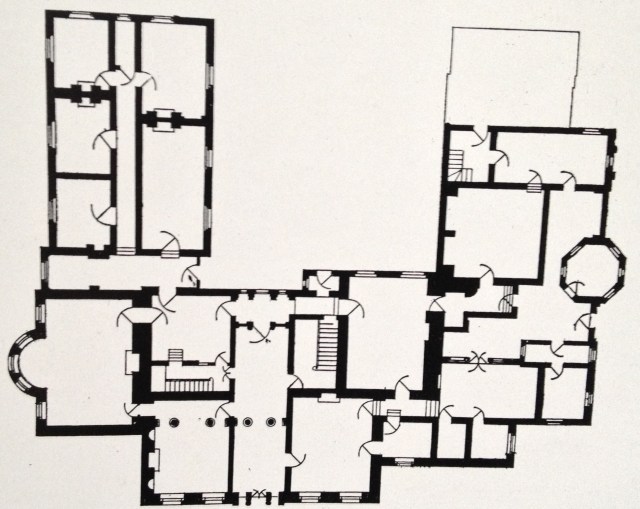
It was Mariga Guinness who first told me many years ago of a wondrous Palladian house in the north-west of Ireland, directly behind which had been built an immense factory. The tale sounded quite improbable – and Mariga was on occasion inclined to exaggeration for effect – but indeed such was, and remains, the case: step outside Hazelwood, County Sligo and you are confronted by the sprawling spectacle of a now-abandoned industrial complex.
Situated on a peninsula barely two miles beyond Sligo town, Hazelwood occupies, or at least ought to occupy, an enchanting location. The entrance front looks north across a long plain of pasture towards the mass of that geological curiosity Ben Bulben, while to the rear the ground descended through a series of terraces and thereafter an opening in the ancient woodland to close on the shores of Lough Gill. It is easy to see why the Williamite soldier Lieutenant-General Owen Wynne, whose family’s Welsh origins are indicated by his first name, should have chosen this spot on which to build a new residence following the purchase of some 14,500 acres in the area in 1722. Nine years later he employed the architect Richard Castle, then much in demand, to design the house which, despite dreadful mistreatment, has somehow survived to this day.

IMG_0097

IMG_0098

Even in its present degraded condition, the house has a magisterial authority. Hazelwood is typical of the Palladian style fashionable in Ireland at the time of its construction. The ashlar-fronted central block, of three storeys over basement, is joined by arcaded quadrants to two storey wings. Above the north front’s pedimented entrance (inset with a carving of the family’s coat of arms) there is a splendid glazed aedicule with Ionic columns and pilasters and flanked by round-headed niches, while the south front boldly proposes a Venetian door below a Venetian window. The building’s sense of significance is increased by both entrances being accessed by sweeping flights of steps.
The interiors must have been similarly superlative, since even after many years of neglect enough of their decoration remains to indicate the original appearance. The main entrance hall has recessed arches on its walls above which hang plasterwork swags, and a deep dentilled cornice. A central doorway leads into the south-facing library which contains similar ornamentation and from here one passes into a succession of other reception rooms. Upstairs is equally splendid: a massive staircase hall leads, via a deep coved archway, into the first floor landing the ceiling of which is open to the galleried second storey, the whole series of spaces once lit by a glazed octagon. Most of the rooms have lost their original chimneypieces, replaced by others of a later fashion since the Wynnes were not averse to making alterations, some less happy than others; a two-storey, three-bay bedroom extension on the south-west corner of the building dating from c.1870 for example fundamentally disrupts Castle’s meticulously planned symmetry. Still, whatever about the Wynne family’s modifications to their property, they were nothing to what would follow once Hazelwood passed into the hands of later owners.

IMG_0075

IMG_0095

IMG_0089

His son having predeceased him, in 1737 Lt Gen. Wynne left Hazelwood to a nephew also called Owen; indeed with one exception successive heads of the family bore the same first name. Owning not just the surrounding farmland but also much of Sligo town, the Wynnes were a dominant presence in the region. Still, if they were sometimes motivated by self-interest, successive generations were wise enough to know that keeping town and countryside economically vibrant would be to their advantage. In his 1802 statistical survey of Sligo, Dr James McParlan wrote of Hazelwood, ‘the more the soil of this demesne is unfriendly to agriculture and ungrateful, the more it reflects honour on the masterly exertions of Mr Wynne, who as a farmer stands unrivalled in this and perhaps in most counties of Ireland.’ The Wynnes were never absentee landlords, nor did they seek titles or honours and during the Great Famine in the 1840s they lowered their tenants’ rents. The last male Wynne to live at Hazelwood, Owen VI, died in 1910 leaving four daughters, the eldest of which had married a Perceval of nearby Temple House. She and her husband lived in Hazelwood until 1923 when they left the house, thus ending a family link going back two centuries.
Having stood empty for seven years, Hazelwood was acquired by a retired tea planter who carried out essential repairs before selling house and estate to two government bodies, the Forestry Department and the Land Commission. For those unfamiliar with its work, the latter organisation was charged with responsibility for breaking up estates throughout the country and dividing land into small (and as it subsequently proved economically unviable) plots for farmers. The Irish people have in the past shown themselves to be at best indifferent to and at worst disdainful of the country’s architectural heritage. But this is as nothing to how it was treated by the Land Commission which displayed an almost visceral hatred of fine buildings. So it was with Hazelwood. In 1946, after serving for some time as a military barracks, the house and immediate surrounds were offered for sale by the commission with the specific condition that the buyer must demolish the buildings, remove all materials and level the site. Somehow, days before the auction was due to be held, this stipulation was withdrawn and Hazelwood sold for use as a psychiatric hospital; it was shortly afterwards that the original staircase was taken out of the house.

IMG_0090

IMG_0101

Worse was to come. In 1969 an Italian company called Snia which produced nylon yarn bought Hazelwood and built a factory for 500 employees. It would have been perfectly feasible for the business to have erected these premises on a site out of view of the old house and screened by trees, thus preserving the Arcadian parkland created by the Wynnes. Indeed one might have thought the relevant planning authorities in Sligo County Council would have insisted this be the case. But instead the factory, surrounded by an expanse of tarmac, went up just a couple of hundred yards to the rear of Hazelwood, thereby destroying the gardens and blocking the view of Lough Gill. In 1983 the business closed down and four years later the factory was sold to a South Korean company which produced video tapes; not surprisingly, given changes in digital technology, in 2005 it too went out of business.
The following year Hazelwood was sold to Foresthaze Developments, a consortium of predominantly local businessmen. In 2007 they applied for permission to build, amongst other structures, 158 detached houses and 54 apartments in four blocks (in their defence, they also intended to sweep away the factory). This application was refused by the local authority, belatedly waking up to an awareness of its responsibilities with regard to Sligo’s heritage. On the other hand the County Council, while since insisting the owners act to ensure Hazelwood’s roof be kept watertight, has not come up with any feasible proposal or practical help for the building’s future. In the meantime the members of Foresthaze Developments have become mired in litigation with each other; funds which might be spent on restoring the house are going instead on legal fees. A local group of hard-working enthusiasts (http://hazelwoodheritagesociety.ie) continues to campaign for the building’s preservation.
This really is a shabby tale in which state hostility and local authority apathy have conspired to ensure the worst possible outcome. Hazelwood is one of Ireland’s most important early 18th century houses and occupies an important place in the nation’s architectural pantheon. Given what has been allowed to happen over the past half-century, it is truly astonishing the main structure still stands. As a report in the Buildings of Ireland survey for Sligo observes, ‘In spite of abject neglect and inappropriate alteration, it is testimony to the quality of the building that it has survived relatively intact.’ But we should not take that survival for granted. Hazelwood’s condition has steadily deteriorated over recent harsh winters and unless serious remedial work takes place soon it will be lost forever, a further blot on Ireland’s already shameful record in this area.

IMG_0102

*For non-opera aficionados, the opening words of the eponymous heroine’s last act aria in Puccini’s Manon Lescaut.

Back to Bellamont

Bellamont 4

Having been once to Bellamont (see La Belle au Bois Dormant, January 21st), it is impossible not to return. Here is the upper floor of the house’s main cantilevered staircase. The relative want of ornamentation – only plasterwork curlicues embellishing each sprung arch – forms a striking yet sublime contrast to the elaborate workmanship found on the floor below.