Fit for a King

8

Boyle, County Roscommon is a provincial market town, seemingly indistinguishable from many others throughout the country. Once of importance as a centre of trade for the locality, it now appears to have slipped into irreversible decline. Somewhere, in other words, to by-pass except that rising in the middle of the town and towering over all other buildings is an immense early 18th century townhouse.
Known as King House, the name taken from the family responsible for its construction, this marvellous edifice is reminiscent of the seigneurial chateaux one finds in regional French urban centres, evidence of a powerful dynasty determined to wield and enforce authority. The family association with Boyle was due to John King (d.1637), an English adventurer who had come to Ireland with Sir Richard Bingham, the royal-appointed Governor of Connacht. In 1603 the Boyle estate running to over 4,000 acres and originally developed by the Cistercian monks whose abbey had since been dissolved, was leased to King and another soldier but in 1617 the former was granted the entire property as a reward for ‘reducing the Irish to obedience.’ One of his children Edward King, a fellow of Christ’s College, Cambridge drowned while on a boat sailing to Ireland in August 1637 and was soon eulogised by his friend John Milton in the poem Lycidas. However, Sir John had six sons and thereafter successive generations of the family increased its holdings until the Kings became the area’s most prominent land owner.
5

6

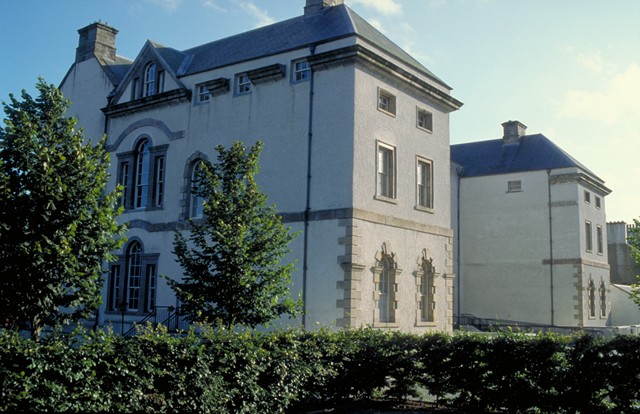
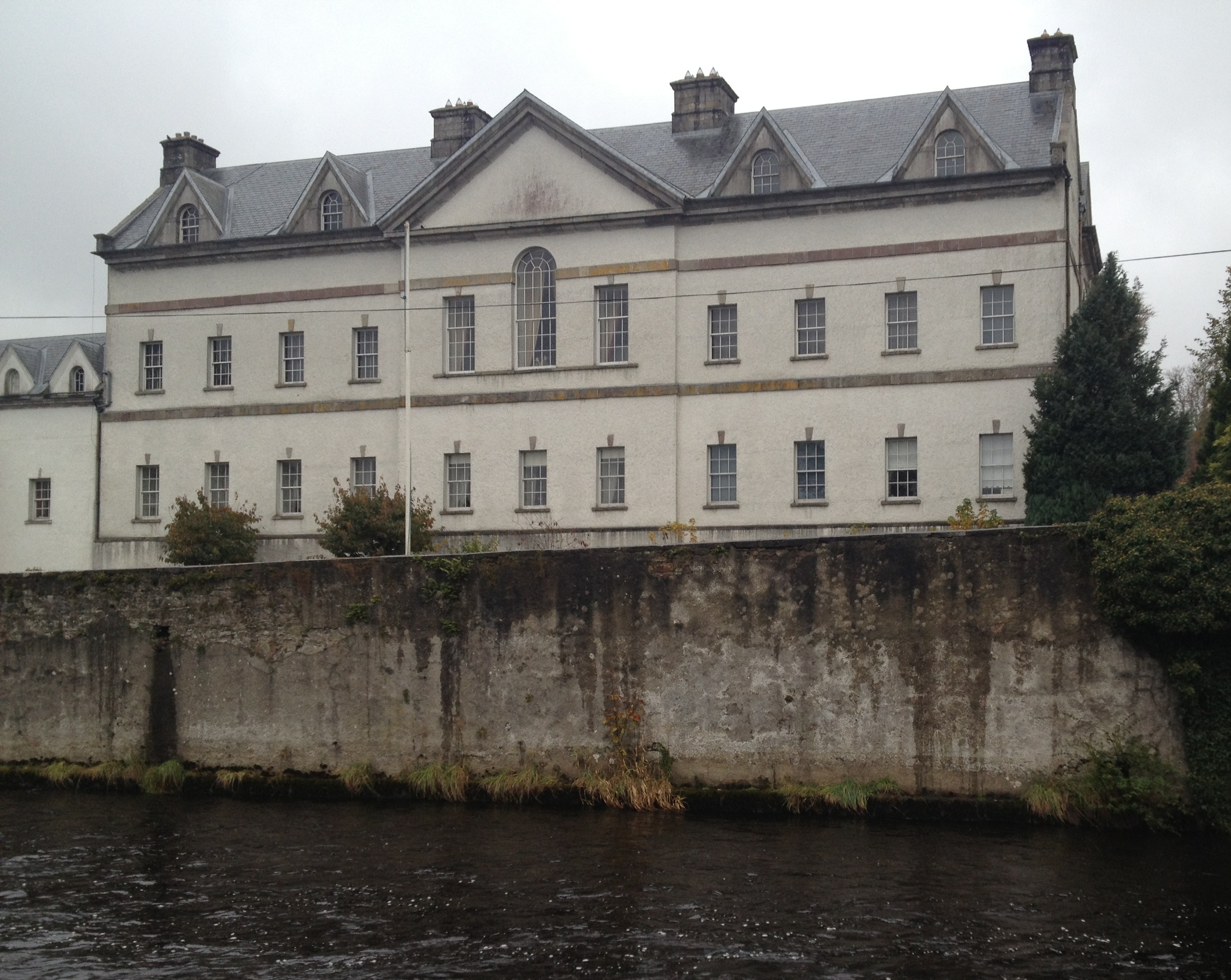
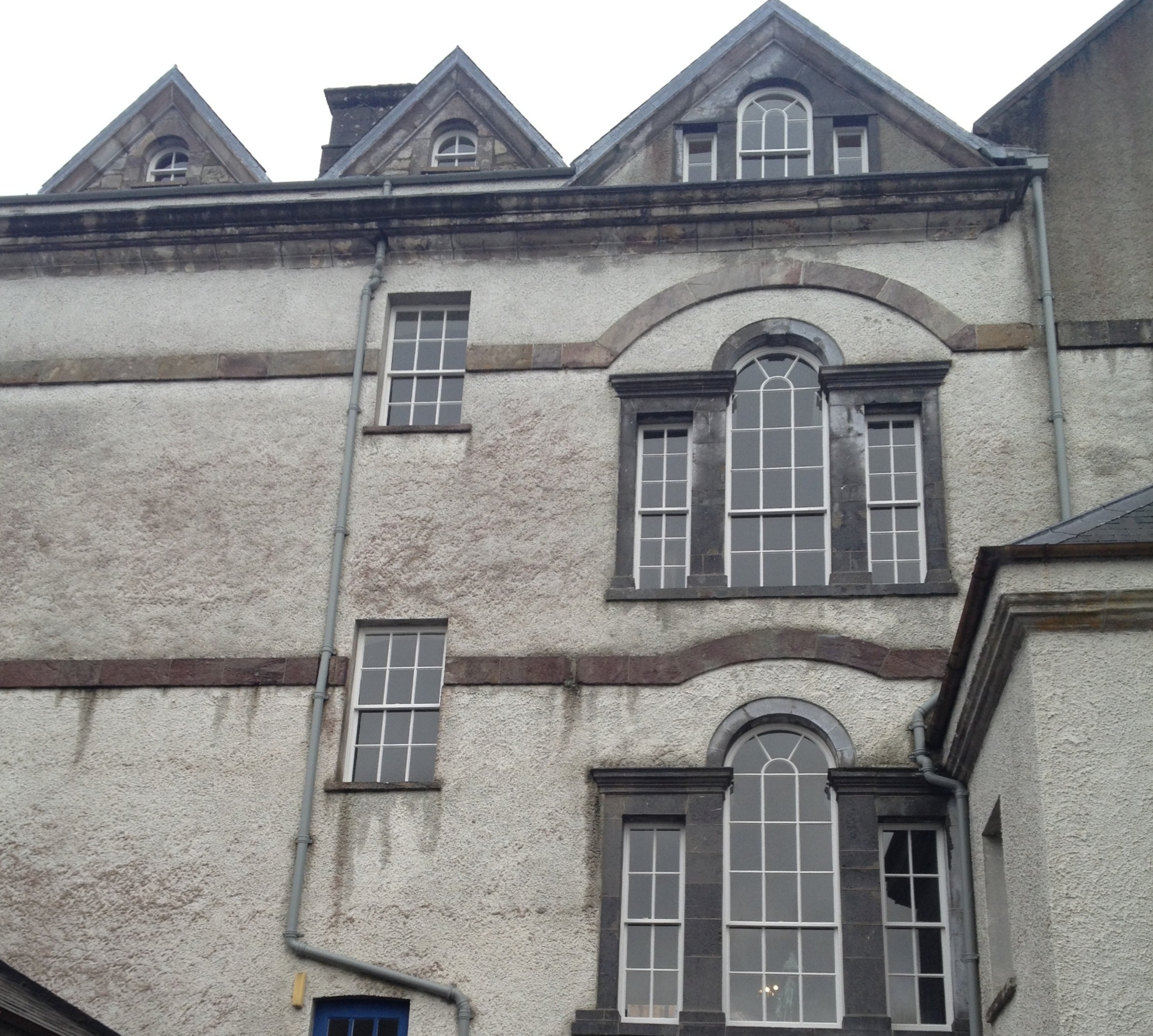
Of three storeys over basement, King House was built for Sir Henry King, dates from 1720-30 and is believed to occupy the site of an earlier structure. As ever, we do not know the architect responsible. Both Pearce and Castle have been mentioned, but so too has William Halfpenny (d.1755), an Englishman who worked in Ireland during the 1730s in Dublin, Hillsborough, County Down and Waterford City. There is also some speculation that the building as seen today is incomplete; the pedimented north front is strikingly plain, so it has been posited that the two-bay projecting wings were meant to be joined by another block so as to form an enclosed courtyard. If this was the intention, then it helps to explain the want of external decoration. The rear of the house, which looks south to the river Boyle and would once have had a pleasure garden running down to water’s edge, is more satisfactory if rather too rigorously symmetrical. In fact the best views are those of the two sides, where a pair of Venetian windows sits one above the other. Roughcast render suggests a variety of material was used for the building, although all the window and door surrounds are of fine cut limestone.
Not a lot of the original interior remains, but there is an explanation why this should be the case. The Kings used their house for little more than half a century before it was damaged by fire in 1788. By this date tastes had changed and it was considered more desirable to reside in the countryside, so the family moved to the nearby estate of Rockingham (of which more in the months ahead). King House was first leased and then in 1795 sold for £3,000 to the government. Subsequently it was converted into an army barracks and during the 19th century was occupied by the Connaught Rangers; presumably during this period was added the large extension to the south-west of the main block. As evidence of its size the house was able to accommodate 12 officers and 260 non-commissioned officers and private foot soldiers, as well as a 30-bed hospital and stabling for horses. Following Independence, the building continued to serve the same purpose for members of the Free State Army until the 1960s when King House passed into private hands and was used as a store and fuel depot. Its condition quickly deteriorated and by the 1970s tenders were invited for the building’s demolition to make way for a car park. I remember first seeing the place at that time, when the chances of its survival looked slim. Thankfully in 1987 King House was acquired by Roscommon County Council with a full programme of restoration work beginning two years later.
2

3

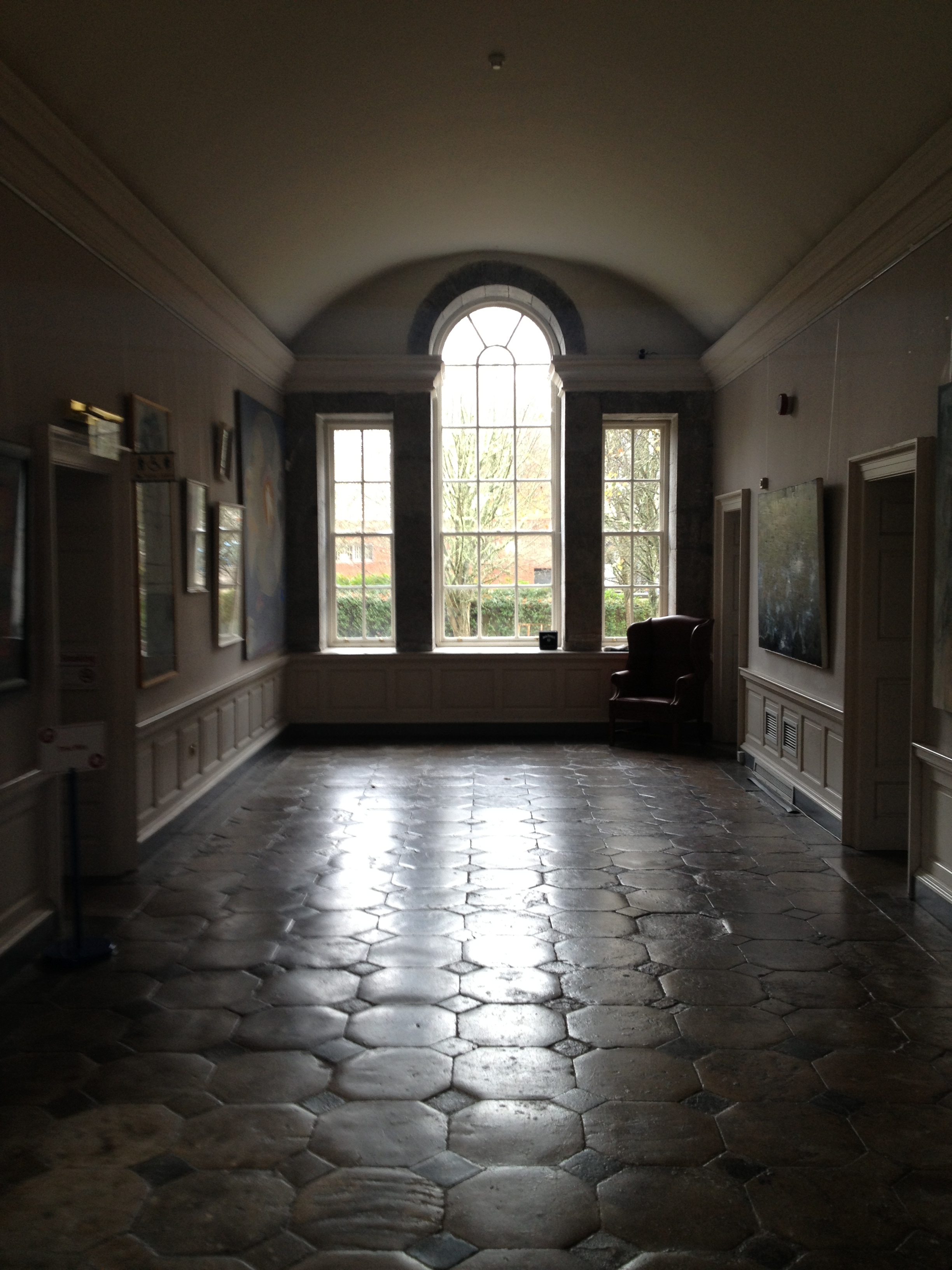
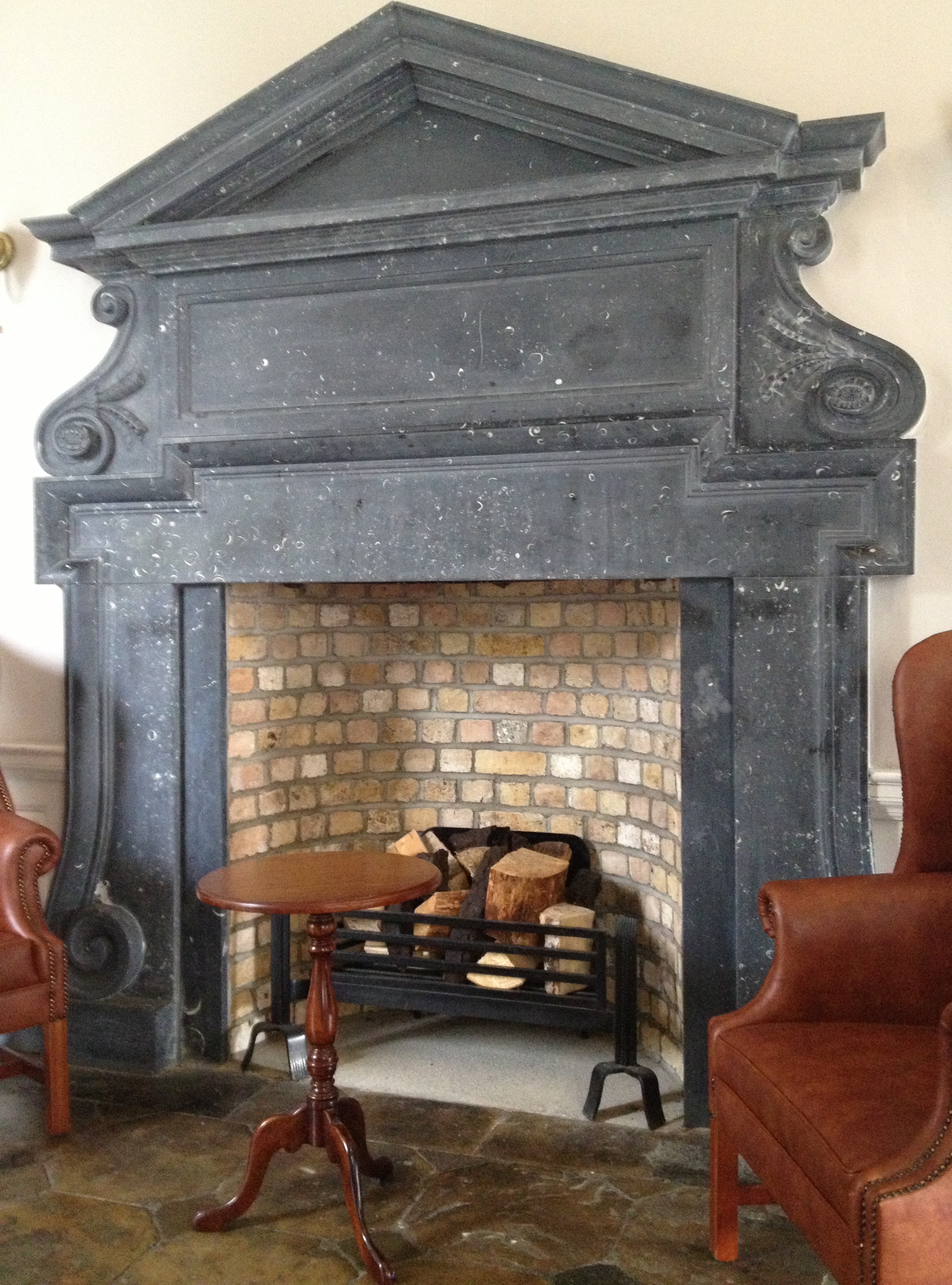
Today King House is a public amenity, a museum and a facility used for various purposes, from wedding receptions to library services. Given its chequered history, the building’s want of interior ornamentation does not come as a surprise. The 1788 fire, followed by conversion for use as a barracks helps to explain the lack of an elaborate staircase, for example, and also the absence of much plasterwork embellishment. The most striking extant feature is the gallery found running the length of the house on each floor and lit at either end by the aforementioned Venetian windows. That on the groundfloor retains a splendid stone flagging and two immense baroque chimneypieces of Kilkenny marble. The vaulted ceilings of red brick are unusual since this is customarily only found in basements. Seemingly the notion was that vaulting would prevent the spread of fire, a theory soundly disproved by the conflagration of 1788. Elsewhere some rooms have decorative cornicing but overall the impression is of refined purity.
Or at least that would be the case if those responsible for King House would allow the building to speak for itself. Loath as one is to speak ill of any organisation prepared to ensure a future for the country’s architectural heritage, what a shame that in this case the relevant authorities have shown scant confidence in the house’s inherent qualities. The restoration work has been exemplary but rather than allow the interior’s handsome proportions to make an impression, everywhere is filled with furniture, display units, information panels, mannequins and assorted bric-a-brac relating to a disparate variety of topics. The place is so busy one is constantly denied an opportunity to assess architectural merit (or, incidentally, to take a decent picture). A dissapointment as the building is of such rare merit it deserves to be cherished as and for itself, and not treated as the setting in which much less interesting material is shown. The current style of presentation is unquestionably to the building’s detriment. King House dominates not just Boyle but much of the surrounding region since nothing else can begin to approach its resplendence. Accordingly nothing else ought to be required. Here is an instance where less would achieve more.
10

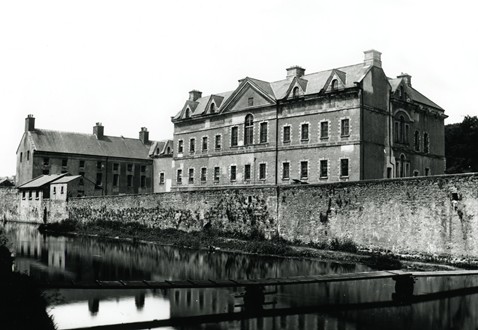
This last is an old photograph of King House when still a military barracks (and, by the looks of it, already in poor shape).

Building on a Prelate’s Ambition

IMG_0407

In 1751 an impoverished but well-connected Anglican clergyman came to Ireland and within a year had been consecrated as Bishop of Killala. Over the next decade he advanced through two further sees before being appointed Archbishop of Armagh in 1765. Richard Robinson (1709-94) was the sixth son of a Yorkshire landowner and as such it was inevitable that after graduating from Christ Church, Oxford he should have considered the Church as a lucrative career. Few of his clerical contemporaries, however, acquired so much or spent so lavishly.
He arrived in Dublin as chaplain to the then-Lord Lieutenant, Lionel Sackville, Duke of Dorset, whose support helped secure that first episcopacy. But it is clear that Robinson was always destined to make a mark. After his death it was said that during his time there Armagh had been converted ‘from an unsightly crowd of mud cabins into a handsome city of stone dwellings.’ Among the buildings for which he was responsible are the public library, the Royal School, the barracks, a county gaol, the public infirmary and, most famously, in 1793 the Armagh Observatory for which he created an endowment. Long before that date, finding the Archbishop’s residence unsatisfactory, he had a new one built for him on a 300 acre demesne, together with stables, farmyard and a chapel. No wonder Methodism’s founder John Wesley accused him of being more interested in building that in the care of souls.

IMG_0408

Robinson behaved like a continental prince-bishop. In his memoirs the playwright Richard Cumberland, whose father was Bishop of Clonfert, recalled accompanying the Archbishop to Armagh Cathedral one Sunday: ‘He went in his chariot with six horses, attended by three footmen behind… On our approach the great western door was thrown open, and my friend (in person one of the finest men that could be seen) entered, like another Archbishop Laud, in high prelatical state, preceded by his officers and ministers of the church conducting him in files to the robing-chamber and back again to the throne.’
Robinson’s lofty aspirations – the reliably-waspish Horace Walpole judged him ‘a proud but superficial man’ – led him to seek secular as well as religious preferment and in 1777 he was created Baron Rokeby in the Irish peerage. Some years later he acquired an estate in Marlay, County Louth and here built a house which was given the name Rokeby Hall (http://www.rokeby.ie). By so doing he evoked the Robinson family’s Yorkshire seat which his older brother Sir Thomas, an amateur architect but professional spendthrift, had been obliged to sell in 1769. So the new Rokeby in Ireland was intended not just to serve as a country retreat but also to replace a lost estate and provide an alternative dynastic base: although the Archbishop never married, there were several potential heirs among his siblings’ offspring.

IMG_0391

IMG_0394

IMG_0400

As his architect for the house, Robinson chose Thomas Cooley who had already been responsible for many of the new buildings in Armagh, including the Archbishop’s Palace. Unfortunately Cooley died in 1784 and so his plans were handed over to the youthful Francis Johnston. Born in Armagh, Johnston’s abilities had been noticed by Robinson who sent him as an apprentice to Cooley in 1778. Nevertheless, although the younger architect oversaw Rokeby’s construction surviving plans show just how much its layout is as originally devised by Cooley.
Rokeby’s limestone exterior looks somewhat severe, the facade relieved only by the slightly advanced three centre bays with first-floor Ionic pilasters beneath a pediment. To the immediate right and reticently recessed is a long extension which might appear to be a later addition but is in fact contemporaneous with the main house and originally contained many of the necessary services such as a large kitchen. The main house is often described as being two-storey over basement. However there is a splendid attic storey tucked behind the parapet and centred on a striking circular room lit by glazed dome; as a result of an acoustic trick when you stand directly beneath this your sense of hearing is affected.

IMG_0431

IMG_0428

While obviously not a small house, Rokeby is by no means palatial and the appeal of its interiors lies in their neo-classical refinement devoid of superfluous ornamentation. This is evident in the entrance hall where the space is simply but effectively divided by the intervention of two Doric columns. There is relatively little plasterwork decoration, except on the main staircase and the upper landing. The latter is one of the finest features of the house: a circular lobby off which open various bedrooms and dressing rooms, every second door topped by an oculus providing light for this space.
These rooms look to have retained their original chimneypieces, sadly not the case on the groundfloor. On his death Archbishop Robinson left Rokeby to a nephew, John Robinson, Archdeacon of Armagh (created a baronet in 1819) but he fled Ireland after his father-in-law, Captain James Spencer of Rathangan House, County Kildare, was killed by rebels during the 1798 Rising. Rokeby was then rented to a sequence of tenants; James Brewer’s The Beauties of Ireland published in 1826 noted that the house ‘is now, we believe, in the hands of a farmer, and the chief apartments are let furnished to casual inmates.’ Only some time after Archdeacon Robinson’s death in England in 1832 did his son Sir Richard return to Rokeby and presumably embark on a programme of refurbishment necessary after almost half a century of neglect. Hence the chimneypieces in the main rooms are of a later date as are some doors, evident in the different disposition of their panelling.

Rokeby 1

IMG_0384

Descendants of the Robinsons remained in possession, although not necessarily in occupation of Rokeby until the middle of the last century, after which the house passed through a variety of hands often with unfortunate consequences. When the present owners bought the place in 1995, for example, the library had been stripped of its bookcases and divided in two with one half used as a kitchen.
Over the past eighteen years, a process of gradual restoration has taken place at Rokeby, driven by just the right balance of enthusiasm, commitment and ongoing research into the house’s history. At the moment, the owners are undertaking the restoration of Rokeby’s most notable 19th century addition: a substantial conservatory designed c.1870 by Richard Turner. This is due to be reinstated later in the spring. One feels confident that even if members of his family are no longer in residence, Archbishop Robinson would be delighted to see the country house he commissioned so well maintained and loved.

Robinson-Reynolds

A mezzotint produced in 1764 by Richard Houston and based on a portrait of Richard Robinson painted by Joshua Reynolds the previous year and now in Christ Church, Oxford. Reynolds painted Robinson three times and a version of the last of these hung in Rokeby until the last century. Today it is in the collection of the Barber Institute of Fine Arts, Birmingham.

The Beauty of Birr

IMG_0896

Anne, Countess of Rosse (1902-1992) was one of the best looking and most stylish women of her generation. Birr Castle, County Offaly is full of mementoes of her tenure as chatelelaine including this chalk portrait which hangs above a mahogany chest on the return of the main staircase. Proposing her as an 18th century beauty, the artist was Anne Rosse’s brother, Oliver Messel (1904-1978). Originally renowned as a stage designer, in later years he achieved fame for the houses he created in the Caribbean.

Dowth Update

Dowth pic

For those of you who have been concerned about the future of Dowth Hall (see my piece Netterville! Netterville! Where Have You Been? on December 24th last), the estate was sold at auction yesterday. Seemingly there were three interested bidders, the buyer is Irish and paid €5 million for Dowth and surrounding 420 acres (a considerably higher figure than the €3.75m guide price). A lot more will need to be spent if the house, with its ravishing rococo plasterwork, is to be brought back to good condition. Let us hope the new owner is prepared to undertake this task…
*On Thursday February 7th The Irish Times reported that Dowth’s new owner is a County Meath resident, Owen Brennan, who owns a successful agri-technology business.

Taking to the Air

IMG_0462

Woodbrook, County Wexford is believed to date from the 1770s but was badly damaged during the 1798 Rising. As a result, the building appears to have undergone considerable reconstruction in the first decade of the 19th century which is presumably when the tripartite Wyatt windows were inserted. One of them provides ample light to the rear hall which contains the house’s principal feature: a wooden flying spiral staircase, the only one of its kind in Ireland. As you ascend or descend, the steps lightly quiver with every tread.

La Belle au Bois Dormant

2 T UMAX     PowerLook 3000   V2.1 [4]

Here is Bellamont Forest, County Cavan which can lay claim to being the most beautiful house in Ireland. Certainly its situation is unparalleled, since the building sits on a rise at the end of a mile-long drive, the ground to either side dropping to lakes, the world beyond screened by dense woodland. Bellamont is an unexpected delight, hidden from view until one rounds the last turn of the drive and sees the house ahead.
In purest Palladian style and looking like a villa in the Veneto, Bellamont is believed to have been designed c.1725-30 by the pre-eminent architect then working in Ireland, Sir Edward Lovett Pearce who was also responsible for the Houses of Parliament in Dublin (now the Bank of Ireland), and a number of since-lost country houses such as Desart Court, County Kilkenny and Summerhill, County Meath. Pearce was a cousin of Bellamont’s builder Thomas Coote, a Lord Justice of the King’s Bench. The Cootes had come to Ireland at the start of the 17th century and prospered so well that within 100 years their various descendants owned estates throughout the country. Ballyfin, County Laois which has recently undergone a superlative restoration was another Coote property.

BFI-054012_V1 kopie

BFI-006889 kopie

The appeal of Bellamont lies in its exquisite simplicity, beginning with an exterior which is of mellow red brick with stone window dressings. Of two storeys over a raised rusticated basement, the front is dominated by a full-height limestone portico reached by a broad flight of steps. The imposing effect is achieved by the most effortless means and using the plainest materials, but there can be no doubt that Bellamont was always intended to impress. The Portland stone-flagged entrance hall, with its coved ceiling and pairs of flanking doors, sets the tone for what is follow.
While there are small rooms immediately to right and left, the latter traditionally used as a cosy winter library, the main reception areas lie to the rear of the building, a sequence of drawing room, saloon and dining room which retain their 18th century decoration including the chimneypieces. The first of these is believed to have once been a series of rooms, but following a fire in 1760 acquired its present form including the elaborate recessed ceiling which was probably intended to complement that in the dining room on the other side of the saloon. The walls of this central room contain contain stucco panels once filled with family portraits, the best-known of which – painted by Sir Joshua Reynolds in 1773 and showing the Charles Coote, Earl of Bellamont resplendent in his robes as a Knight of Bath – now hangs in the National Gallery of Ireland.

BFI-053965 kopie

BFI-006860 kopie

The aforementioned Earldom of Bellamont was a second creation of the title for a member of the family. Evidently an ostentatious and pompous man – seemingly he insisted on making his maiden speech in the House of Lords in French, to the bemusement of his fellow peers – Lord Bellamont can at least be credited with having the good taste to enhance the house built by his grandfather. He married a daughter of the first Duke of Leinster and by her had four daughters and just one son who died in Toulouse at the age of 12, his body being brought back to Bellamont to lie for three days on the upper landing before burial in the family vault.
As a result of there being no legitimate heir, the earldom again lapsed on Lord Bellamont’s death in 1800. However, despite being seriously wounded in the groin during a duel with Lord Townshend, he managed to have at least 16 offsring out of wedlock by four different women, and one of these sons, also called Charles Coote, inherited Bellamont Forest. Ultimately it was sold out of the family in the middle of the 19th century and bought by the Smiths (later Dorman-Smiths), one of whom Major-General Eric Dorman-Smith served in the British army during both the First and Second World Wars after which, having changed his surname to O’Gowan, he became involved with the IRA.

BF_II-000766 kopie

BFI-006881 kopie

In 1987 Bellamont Forest was bought by John Coote, an Australian interior designer whose family had emigrated from Ireland at the start of the last century. John dearly loved the house and undertook to restore it to a pristine condition, keeping the decoration spare so that the beauty of the rooms’ architecture would be more apparent. There was never a great deal of furniture, just a few large pieces he had specifically made and which were inspired by Georgian workmanship. In revealing the building’s purity he not only demonstrated the splendid taste of Pearce but his own also, since it would have been tempting to intervene in the interiors.
Those interiors served wonderfully for entertaining, which John did frequently. I have been to a great many terrific parties at Bellamont, and even hosted a few there, one of which – a birthday dinner for 30 – is thankfully uncommemorated by any photographs. But there are ample souvenirs and joyous memories of John’s own sundry social gatherings, such as the thé dansants he loved to throw, when a 16-piece orchestra would play in the saloon and Jack Leslie would demonstrate how to dance the Black Bottom. The last great party at Bellamont took place during the summer of 2009 to mark John’s 60th birthday and was spectacular even by his standards, with drinks in the lower gardens followed by dinner and dancing outdoors in the balmy air.
The following year John was obliged to put Bellamont Forest up for sale, and thereafter he rarely visited the place. Tomorrow marks the first anniversary of his death, which happened unexpectedly while he was working in Indonesia. He is still sorely mourned by all of us who knew him in Ireland. Meanwhile Bellamont slumbers, awaiting a new owner who will kiss the place back to life; there is talk now of an auction in March. One prays that whoever next assumes responsibility for Bellamont will bring to the house the same flair and fun as did John Coote for so many years.

BF_I-000005 kopie

All photographs by René Kramers (http://www.reneez.com/)

All That Glitters

IMG_0310

A door on the top floor of Tullynally, County Westmeath, formerly Pakenham Hall and home to generations of the Pakenham family. Note the traces of gilt on the brass handle, and also the manner in which its quatrefoil design is echoed by that of a panel to the left.

Mounting Concern

Vernon Mount 8

In April 1801 Sir Henry Browne Hayes, a widower approaching fifty, was brought to trial in Cork for abducting a Quaker heiress Mary Pike four years earlier and forcing her to participate in a spurious marriage. Given that the facts of the case were common knowledge and that Hayes had voluntarily surrendered to the authorities, it did not take long for a guilty verdict to be reached and for the felon to be sentenced to death. On the recommendation of Ireland’s then-Lord Lieutenant, the Earl of Hardwicke, this was commuted to transportation for life to Botany Bay. Hayes’ passage was less grim than that of the average Irish convict, since he was provided with his own cabin and allowed to bring a manservant. A year after arriving in Australia, he purchased a property immediately north-east of Sydney and there built himself a house called Vaucluse which still stands and is today managed by the Historic Houses Trust of New South Wales.
After sundry adventures (he seems to have been incapable of leading a quiet life), including founding Australia’s first Freemason lodge and being sent to work in a coal mine for backing Governor William Bligh during a period of dispute in the colony, Hayes eventually secured a pardon and was allowed to return to Ireland. Even this journey was fraught, since the vessel on which he travelled, the Isabella, was shipwrecked off the Falkland Islands. Among the other passengers on board was Joseph Holt, a County Wicklow man who had been one of the leaders of the 1798 Rebellion and who, like Sir Henry, had been given transportation, and subsequent pardon, rather than the customary execution. On their arrival in Ireland it was ironically noted the crimes of both men involved pikes: Hayes had abducted one and Holt had distributed many.

Vernon Mount 7

Back in Cork, Sir Henry settled into his family residence where he died at the age of 70 twenty years later in 1832.* That house, Vernon Mount, featured last week in the Irish Times where it was reported that the relevant local authority, Cork County Council, had taken steps to secure the building’s future. There are few houses in the region more deserving of preservation, and yet, despite repeated calls for intervention, Vernon Mount has suffered shameful neglect in recent decades.
Located to the south of Cork city on a raised site with panoramic views over the Lee valley, Vernon Mount is highly unusual in design, a two-storey over basement villa, the curved entrance front having symmetrical convex bows on either side. For a long time it was thought the house dated from c.1784 and had been built by Hayes’ father, Atwell Hayes a prosperous merchant involved in brewing, milling and glass manufacture. However, an advertisement in the Cork Courier of December 10th, 1794 announced ‘a new house Vernon Mount to be let, with from 160 acres of meadows, lawns, shruberries etc’ with the house described as being ’finished in a superb style, with painted ceilings, elegant chimney pieces, grates.’
If the place was only then deemed new, the supposition is that it had been designed by Abraham Hargrave (1755-1808), a locally-based architect who worked during this period on a number of projects in Cork City and County. Evidently the house was not let by Hayes, since he brought Mary Pike there after her abduction. Incidentally, Vernon Mount’s name is a salute to George Washington and his own residence Mount Vernon in Virginia; a number of Irish house owners paid similar tributes to the American War of Independence as a means of showing their political sympathies.

Vernon Mount 3

Vernon Mount 5

There is a further connection between Vernon Mount and the United States: the artist responsible for the house’s remarkable painted interiors, Nathaniel Grogan the elder (1740-1807) spent a number of years on the other side of the Atlantic before returning to his native city. Here he was commissioned to work on the decoration of Vernon Mount, including a ceiling painting on canvas in the drawing room. Within an octagonal frame, this depicts Minerva Throwing Away the Spears of War, a reference perhaps to the cessation of hostilities at the end of the American War of Independence. Around the central work are a series of lozenge-shaped panels and roundels featuring floral motifs, angels and centaurs.
Additional examples of Grogan’s handiwork exist on the first floor, reached by a splendid cantilevered stone staircase with neo-classical wrought-iron balustrade, the whole lit by a large arched window. On the oval upper landing are eight marblised Corinthian columns interspersed with seven doors painted with tromp l’oeil niches ‘containing’ classical statues and urns; these doors lead to the house’s bedrooms and a concealed service staircase.

Vernon Mount 9Vernon Mount 10

It should be evident from this description that Vernon Mount is a house of enormous architectural importance, to be treasured and protected. But, as already mentioned, of late this has not been the case. Occupied as a family residence until the middle of the last century Vernon Mount and its surrounding parkland were bought in the 1950s by the Cork and Munster Motorcycle Club, which developed a motor race track around the house. However, the latter was well-maintained until the whole place was acquired in the 1990s by a consortium of developers led by San Diego-based IT entrepreneur Jonathon Moss and his colleague in Cork Olaf Maxwell. This consortium applied to redevelop the house and surrounding grounds as an hotel, but when the proposal was refused by Cork County Council (which described the proposal as ‘a gross over development of the site’ that would ‘be seriously detrimental to the setting, scale and character of a listed building’), the owners settled down to do precisely nothing.
Shamefully Cork County Council chose to mimic this inactivity and as a result Vernon Mount’s condition was permitted to deteriorate. The Irish Georgian Society repeatedly called for intervention but to no avail, and in 2008 the organisation arranged for the building to be placed on the World Monuments Fund List of 100 Most Endangered Sites. Still the local authority failed to act, even though two years earlier at a council meeting it had been agreed that if something were not done soon the building would be lost forever.
It appears that local residents groups, keen to have the entire area designated a public park and amenity, have taken to lobbying the county council; finally last month it used powers available under the country’s existing planning acts to carry out essential repairs to the roof of Vernon Mount. Of course this is excellent news, but the fact remains that the local authority could have availed of the same powers to take action sooner; that it failed to do so is a disgrace. One of the unanswered questions remains the condition of the interior with its unique Grogan paintings; for a long time it has long been impossible to persuade the owners to allow regular access. Australia cherishes Vaucluse and the United States Mount Vernon. In Ireland, on the other hand, there will be more scenarios like that at Vernon Mount unless and until the statutory bodies charged with responsibility for ensuring the welfare of the state’s architectural heritage actually do their job. This is a shabby tale, from which neither the consortium nor the county council emerges with credit.

Vernon Mount 1

*Poor Miss Pike, carried off in the night by Hayes, never recovered from her ordeal and around the same time as her abductor died, so did she – in a lunatic asylum.

Take a Seat

IMG_0393

An Irish mahogany chair in the entrance hall of Rokeby, County Louth. The house was built for Richard Robinson, Archbishop of Armagh, initially to the designs of Thomas Cooley (1740-1784) and then, following the architect’s early death, the job was taken over by Francis Johnston (1760-1829). This handsome chair is one of a set believed to date from the end of the 18th century and attributed to Mack Williams and Gibton. However, since that business was only established around 1812, the chairs could be earlier, made perhaps when John Mack was still working by himself (until 1801). They all bear a peer’s coronet so certainly belong to some date after Archbishop Robinson was created first Baron Rokeby in 1777. Perhaps the commission for them came from his third-cousin Matthew Robinson-Morris who succeeded to the title in 1794?
More on Rokeby soon.