Sir Hugh Lane, the original Irish Aesthete and the subject of my first book (published by Lilliput Press in 2000) drowned ninety eight years ago today after the RMS Lusitania on which he was returning from New York, was torpedoed by a German U-Boat off the coast of Cork. This portrait, now in the collection of the municipal art gallery in Dublin founded by Lane in 1908 was commissioned by his friends from John Singer Sargent two years earlier. One always wonders what Lane, still not yet forty at the time of his death, might have achieved had he lived longer.
Category Archives: Book
A Bibliophile’s Bliss
In 1971 when Anthony Powell published the tenth volume of his roman fleuve A Dance to the Music of Time he gave it the title Books Do Furnish a Room. Perhaps he was thinking of the library at Tullynally, County Westmeath? After all, Powell was married to Lady Violet Pakenham whose family has been based at Tullynally since the mid-17th century. This has to be one of the most enticing rooms in Ireland, not least because books provide the greater part of its furnishing. Discovering the weighted shelves at Tullynally is akin to attending a party and encountering lots of old friends while being introduced to just as many new ones. (It has to be said the success of this metaphor is assisted by the presence of a drinks table in one corner of the room).
Previously known as Pakenham Hall, Tullynally was deservedly deemed, ‘an early 19th century Gothic Palace,’ by John Betjeman when Britain’s future Poet Laureate stayed there in September 1939. As the late Mark Bence-Jones observed, ‘with its long, picturesque skyline of towers, turrets, battlements and gateways stretching among the trees of its rolling park, Tullynally covers a greater area than any other country house in Ireland’ and looks ‘not so much like a castle as a small fortified town; a Camelot of the Gothic Revival.’ But buried far beneath its romantic carapace of castellations and battlements lies a plain two-storied Georgian house that once served as home to the Pakenham family.
Thomas Pakenham believes the first alterations to the old building were made soon after the marriage of his forebear and namesake Thomas Pakenham to heiress Elizabeth Cuffe; most likely with her money a third storey was added to the house. That earlier Thomas was created Baron Longford in 1756 and almost twenty years later his widow became Countess of Longford in her own right. The second Baron Longford’s accounts record improvements carried out to the building around 1780, mostly raising ceiling heights and altering windows but perhaps more was done since the person responsible for this work was a ‘Mr Myers.’ He could be the Christopher Myers responsible for gothicising Moore Abbey, County Kildare some years earlier.
In any case it was the second Earl of Longford who initiated the real transformation of Tullynally from house to castle. Two of his brothers were professional soldiers and a portrait of one, Major General Sir Edward Pakenham hangs over the polished limestone chimneypiece in the library. He was killed at the Battle of New Orleans in 1815 and for purposes of preservation his body was returned to Ireland in a cask of rum; since he had been known to have a surly temper, one of his relatives laconically remarked, ‘The General has returned home in better spirits than he left.’
Despite his soldier brothers, and his brother-in-law being the first Duke of Wellington, the Earl of Longford seems to have preferred less militant pursuits and carried out extensive improvements on his Irish residence. Between 1801 and 1806 the pre-eminent Irish architect of the period, Francis Johnston worked at Tullynally, adding what one observer has since called ‘little more than a Gothic face-lift for the earlier house,’ notably two round towers projecting from the corners of the main block and battlements around the parapet. In 1817 Lord Longford married and no doubt it was the incentive of a new bride and soon-expanding family that encouraged him a few years later to embark on a second round of work at Tullynally, this time using Johnston’s former clerk, James Shiel. From 1839 to 1842 the third Earl, a bachelor, employed architect Sir Richard Morrison to embellish Tullynally further and to design two castellated wings linking the house with its stable courtyard; a final flourish was added by the fourth Earl in 1860 with the construction of a pinnacled tower at the northern end of the site.
Records show a ‘bookroom’ existed within the house from 1740 onwards, and the first inventory of books there was compiled in 1790, with a second made in the mid-19th century. Thomas once told me he could reconstruct the whole library as it was on either of those dates and compare them with its present holdings. The current contents of 6,000 volumes representing 2,000 titles have been meticulously catalogued across 14 different fields including author, name, subject, language and date of publication.
It comes as no surprise that Tullynally is such a bookish house since the Pakenhams are a dauntingly literary family. Earlier generations might have been renowned for their military prowess but the pen has now decisively vanquished the sword. Thomas’ uncle Edward, sixth Earl of Longford wrote many plays as well as several volumes of poetry. He and his wife Christine (also a playwright) were generous supporters of Dublin’s Gate Theatre from 1930 onwards and later founded the Longford Players. Following his death, he was succeeded by his brother Frank, well-known politician and human rights campaigner as well as author and his wife Elizabeth was an historian. Their children include authors Antonia Fraser and Rachel Billington as well as Thomas who is another distinguished historian but probably now more widely known for his books on trees. Thomas’ wife Valerie has written a number of excellent books and a few years ago their daughter Eliza wrote a history of the Pakenhams in the late 18th/early 19th century.
Examples of all their works can be found in Tullynally’s library, the form if not the finish of which dates from the time of Francis Johnston’s intervention. He enlarged the room by stealing a bay from its immediate neighbour so the library now has three south-east facing windows and one facing south-west. It is worth considering what are the elements that make this room aesthetically so satisfying. Obviously its ample proportions help, as does the want of superfluous decoration: the gothic ornamentation found elsewhere is employed very sparingly here. The mellow oak bookshelves covering all four walls and rising from floor to cornice make the greatest impact, especially since most of them carry an amplitude of complementarily-toned leather bindings. Note how the sequence of ten shelves is graduated in height, with smaller volumes occupying the upper levels. The only other feature of note is a set of handsome busts running along the top shelf in one corner of the room. Predating the present library by more than half a century, they represent what were then deemed ancient and modern writers of note. While the library has shutters the absence of poles or even marks in the window embrasures to indicate supports suggests there have never been curtains here. Aside from some Turkey rugs, abundant and comfortable seating, a scattering of mahogany tables and enough lamps to provide light when evening falls, nothing more is required. The library at Tullynally indicates that books do not just furnish a room, they also make it beautiful.
Tullynally’s splendid gardens (and tearoom) are now open and well worth a visit especially since the weather has, at last, improved. For information, see: http://www.tullynallycastle.com
Putting on a Good Front
Broad Street, Limerick, November 1949
Thirty years ago I was involved in the production of a little book about the traditional shopfronts of Roscrea, County Tipperary. A typical midlands market town, Roscrea had many old stores the appearance of which both inside and out dated back to the late 19th century. Largely due to insufficient funds the majority of these properties had since remained unaltered. However from the late 1960s onwards retailers here as elsewhere embarked on a determined programme of modernisation for their premises. Anything old was regarded as outmoded and a bar to progress, and so the old shopfronts with their painted fascias were swept away. Up in their place went expanses of plastic and fluorescent lighting, the same as could be found in innumerable other towns around the world. It may be that on strictly economic grounds the decision to discard the old made sense, but at what cost to the town’s character?
Awareness of this rapidly vanishing element of Roscrea’s heritage led to the project to record its still-extant shopfronts. The book contained pen and ink drawings of each premises included, together with as much information as could be ascertained about the shop and its history. It was a timely exercise: last time I passed through the town very few of the old shopfronts were still to be seen. Had the book not been published, today there would most likely be no record of what had gone.
Cigar Divan, Carlow, October 1958
Shopfronts, Askeaton, County Limerick, February 1978
I remembered the little book of Roscrea shopfronts when looking through a recently published collection of photographs taken by the late Maurice Craig. For the best part of a half century wherever he travelled about Ireland Maurice brought his camera, and the result was a wondrous record of a country which within living memory has all but disappeared. ‘I do not think of myself as a photographer,’ he writes in his Introduction, ‘merely somebody who has taken a great many photographs, usually with a purpose in mind…Unconsciously I was collecting the materials for a history of buildings, which I came to realise were at risk of destruction or mutilation.’
A brief biography of Maurice will be helpful for those to whom his name is unfamiliar. Born of Presbyterian stock in Belfast in 1919 he was educated at Shrewsbury before winning a scholarship to Magdalene College, Cambridge where he occupied the same rooms as had the nationalist leader Charles Stewart Parnell some eighty years earlier. Maurice then went on to write a doctorate on the poet Walter Savage Landor at Trinity College, Dublin. His first book, a biography of the Earl of Charlemont (see Casino Royale, March 25th) appeared in 1948 but four years later he wrote the work with which he has ever after been associated: Dublin 1660-1860. It took 13 years for the 2,000 copies of the book’s first edition to sell but since being republished in 1969 Dublin 166-1860 has rightly been regarded as a peerless piece of architectural history. Impeccably written, packed with information and anecdote, more than sixty years after first appearing this remains the best work to read about the city’s evolution during the Georgian period. If I were to choose only one of his other books to recommend it would have to be Classic Irish Houses of the Middle Size (1976), a volume as distinctive – and memorable – as its title indicates.

Shopfront, Rathcormick, County Cork, March 1979

Hacketts Shop, Killkenny, June 1948
At the close of his preface to Dublin 1660-1860, Maurice comments, ‘I have done my best to get out of the way of the buildings and let them be seen for themselves, relying on a possibly fallacious belief that architecture cannot lie.’ He adopted the same approach to his photography, allowing buildings to make their own eloquent case. Amateur though he was Maurice proved an instinctively gifted photographer. Other people, of course, were taking pictures of Irish architecture before he started doing so in the 1940s, but usually the focus was on friends or family standing in front of or inside a building, or the place was being photographed for commercial purposes, most often to be reproduced as a postcard. Maurice was interested in a structure’s inherent qualities and in capturing these for posterity (somehow he knew of the wave of demolition that lay ahead). But he brought a romantic’s eye to his self-imposed task. Look at the way he frames the house in Limerick in the first picture by enclosing it with the sides of a lane on the other side of the street. And one must be either brave or perhaps foolhardy to devote so much of an image to empty roadway as in the photograph immediately above. Yet that expanse enhances appreciation of the building, not least because the outlines of this are lightly echoed on the surface of wet tarmac.
At the age of 91 Maurice died some eighteen months before the publication of the book from which these pictures are taken, having spent his last years in a little house in Monkstown, County Dublin. Anyone who visited him there will recall walls densely packed with books, Maurice contented in the midst of them with his pipe and a cat called Minna, seemingly surrounded by chaos but actually anchored by a wealth of index cards on which all necessary information on countless subjects was inscribed in impeccable script. Like the old shopfronts of Roscrea he has now gone, but there remains ample testimony to his presence on this earth in words and pictures alike. The photographs shown here are just a handful of those featured in his last book, which includes buildings great and small, many of them long since lost, all of them worthy of being immortalised by Maurice’s camera.

O’Carroll Street, Tullamore, County Offaly, July 1957
Maurice Craig: Photographs is published by Lilliput Press (www.lilliputpress.ie)
Queen Maeve
“From the time I was almost five until I was almost eighteen, we lived in a small house in a part of Dublin called Ranelagh. On our street, all of the houses were of red brick and had small back gardens, part cement and part grass, separated from one another by low stone walls over which, when we first moved in, I was unable to peer, although in later years I seem to remember looking over them quite easily, so I suppose they were about five feet high. All of the gardens had a common end wall, which was, of course, very long, since it stretched the whole length of our street. Our street was called an avenue, because it was blind at one end, the farthest end from us.” (The Morning after the Big Fire, 1953)
Last Thursday’s property pages in the Irish Times carried a rather overwrought piece about a house for sale in Ranelagh, a suburb of Dublin to the immediate south of the Grand Canal. The origins of the name Ranelagh are rather curious. It derives from the Irish “Gabhal Raghnaill”, an area of what became County Wicklow centered around Ballinacor. Until the early 17th century, this region was under the control of an especially truculent branch of the O’Byrne family; Fiach MacHugh O’Byrne who was mentioned here a few weeks ago (The Cosby Show, March 11th) and who the altogether more unassertive Irish Aesthete likes to claim as an ancestor, was known in the 16th century as Lord of Ranelagh.
However, following the defeat of the O’Byrnes and the seizure of their lands, that title went to an interloper. In 1628 Sir Roger Jones, whose English-born father had been both Archbishop of Dublin and Lord Chancellor of Ireland, was ennobled as Viscount Ranelagh. In turn his son Richard was created Earl of Ranelagh in 1677. The latter’s London residence, immediately adjacent to Chelsea Hospital, was called Ranelagh House and some time after his death without a male heir the property was bought by a syndicate who converted the site into a fashionable spot called Ranelagh Gardens (the same ground now hosts the annual Chelsea Flower Show).
So when in 1766 a Dublin entrepreneur called William Hollister decided to open a similar open-air place of entertainment on the outskirts of his native city, he chose to emulate London by naming it Ranelagh Gardens. Thus a name which had crossed the Irish Sea returned to its own country. Well-travelled readers will know there is also an area in Paris close to the Bois de Boulogne called Ranelagh. It too is named after the Earl of Ranelagh (the French were then more anglophile than later became the case) and was the site of the Château de la Muette where Louis XVI and Marie-Antoinette spent their first years of married life. It was from here that the Montgolfier brothers made their debut ascent in a hot air balloon in November 1783. Coincidentally the first Irishman to take off in a balloon, Richard Crosbie, did so from Dublin’s Ranelagh Gardens just fourteen months later in January 1785.
“Beyond the wall Mrs Bagot and Mrs Finn shared, a row of identical walls stretched off into the distance. All the gardens were attached, like all the houses. A grove of trees, forty diminishing walls away, completed the view to the sky. It was a narrow side street, a dead end, in the suburbs of Dublin. There were shops around the corner, on the main road, but none on the street itself. Schoolteachers, shopkeepers and minor civil servants lived on the street, and a policeman had recently moved into one of the houses with his family.” (The Twelfth Wedding Anniversary, 1966)
Dublin’s Ranelagh Gardens, like their London equivalent, eventually fell from public favour and the site came to be occupied by a convent of Carmelite nuns. They turned part of the grounds into a large kitchen garden that allowed them to be almost self-sufficient since they also kept poultry and even cattle. After the nuns departed in 1975 some of the site was retained as a public park and named Ranelagh Gardens, so retaining the link with the 18th century. Meanwhile the surrounding area had been gradually developed for housing as the city expanded and the prosperous classes moved out to what they judged the more salubrious suburbs. Ranelagh had the advantage of being outside and yet close to the commercial centre, allowing easy access especially after the advent of trams from 1872 onwards: many of Ranelagh’s red-brick terraces date from the decades immediately following the arrival of public transport.
In the 18th century there were a few fine houses in the area surrounded by large gardens but inevitably these were lost as demand for development land rose. Despite the best efforts of the Irish Times writer, the resultant streets cannot claim much aesthetic merit. The houses are formulaic in style, all with the same narrow entrance halls opening onto two reception rooms before a short flight of steps descends to the kitchen with a door to the garden. A flight of stairs leads up to a couple of bedrooms, passing a bathroom en route. Built for the petite bourgeoisie, the Mr Pooters of Dublin, their design consciously avoided originality lest it frighten prospective buyers. Conformity was critical to their success.
“Thinking about all that walking had given him a sense of energy and well-being. He felt in good health and good humor, and contented to be coming home after his day’s work, and he was smiling as he stepped into the hall. There were red glass panels in the side frames of the front door, and he was always aware of the glass and always closed the door carefully. At the same instant that he was hanging his raincoat on the rack, he looked down the hall and saw the kitchen door close quicly and quietly, but not quickly enough to prevent him from seeing that Rose was down there.” (Family Walls, 1973)
Maeve Brennan was born in Dublin in 1917 and at the age of five she and her family moved to Cherryfield Avenue, Ranelagh, a street immediately identifiable in the many short stories she would later write. Her parents were both republicans and at the time of her birth Robert Brennan had been in jail for leading the 1916 Rising in Wexford. In post-independence Ireland he became part of the new establishment and in 1934 was sent to the Washington as the Irish Free State’s first minister to the United States. Ten years later he returned to Dublin but his daughter Maeve remained, moving to New York where initially she worked for Harper’s Bazaar; it’s worth pointing out that at the time this was unquestionably the most influential women’s magazine in the world and had another Irishwoman as editor, the Dublin-born Carmel Snow.
In 1949 Maeve Brennan was offered a staff job at The New Yorker where she remained for the rest of her writing career. Although she mostly produced social pieces under the title of The Long-Winded Lady, from 1950 onwards The New Yorker also carried her short stories, the best of which are set in Ranelagh. These tales, mostly featuring the same handful of characters although written decades apart, are as redolent of the world she had known in her youth as are James Joyce’s stories in Dubliners. In particular she possesses a remarkable ability to evoke sense of place; read her Irish stories (many of them collected together and published as The Springs of Affection in 1999) and you are immediately transported to Ranelagh.
Maeve Brennan’s Ranelagh is not today’s self-consciously chichi “village” but an altogether more modest suburb of Dublin whose residents, as she makes plain, possess few ambitions other than to ensure their immediate neighbours remain unaware of the tempests brewing behind those glass-paned frontdoors. This is, of course, scarcely new territory but what sets her work apart is its ability to turn the mundane into the exceptional. Thanks to her adroit yet simple use of language, the regular red-brick terraces are filled with drama even while nothing remarkable takes place. Nobody is killed, or engages in adultery, or behaves violently or even shouts, but still those streets pulsate with passion.
“They were Mr and Mrs Derdon, and they had been married to each other for twenty-seven years. He was the senior by five years. They slept in the back bedroom upstairs, and their window looked over their little walled garden, not much different from the other gardens in the terrace, and beyond that over a strip, grey and corrugated, of garage roofs.” (The Poor Men and Women, 1952)
Maeve Brennan’s later years were not happy. The pall of melancholy that hangs over her stories spilled over into her life. In 1954 she married The New Yorker‘s managing editor St. Clair McKelway, an alcoholic womaniser with three divorces behind him. A few years later she became his fourth ex-wife. By the 1970s she had developed her own drink problem and by then also suffered from declining mental health which required hospitalisation on a number of occasions. Having lived in a series of rented apartments and hotel rooms over the previous decades, she now became homeless and took to sleeping in the women’s lavatory at The New Yorker‘s office. Destitute and unwell, eventually she was admitted to a nursing home and died in Brooklyn in November 1993 at the age of seventy-six.
A few years after her death, Maeve Brennan’s stories were republished, leading to her discovery by a new readership; she has since been the subject of a biography and a play. While neither of these especially caught my fancy, I can recommend her Dublin short stories without reserve. No writer better conveys the spirit of the city in the aftermath of independence and in particular the character of Dublin’s then-burgeoning suburbs. Thanks to Maeve Brennan attributes hitherto hidden become apparent and the seemingly ordinary streets of Ranelagh appear beautiful. This is the transformative power of great prose.
“Still, he could not believe that even a human being as ineffectual as she had been could vanish from life without leaving any trace of herself at all. Any trace would be a sign that might guide him to the grief he wanted to suffer for her. But there was no sign.” (The Drowned Man, 1963)
“A Luscious Account…”
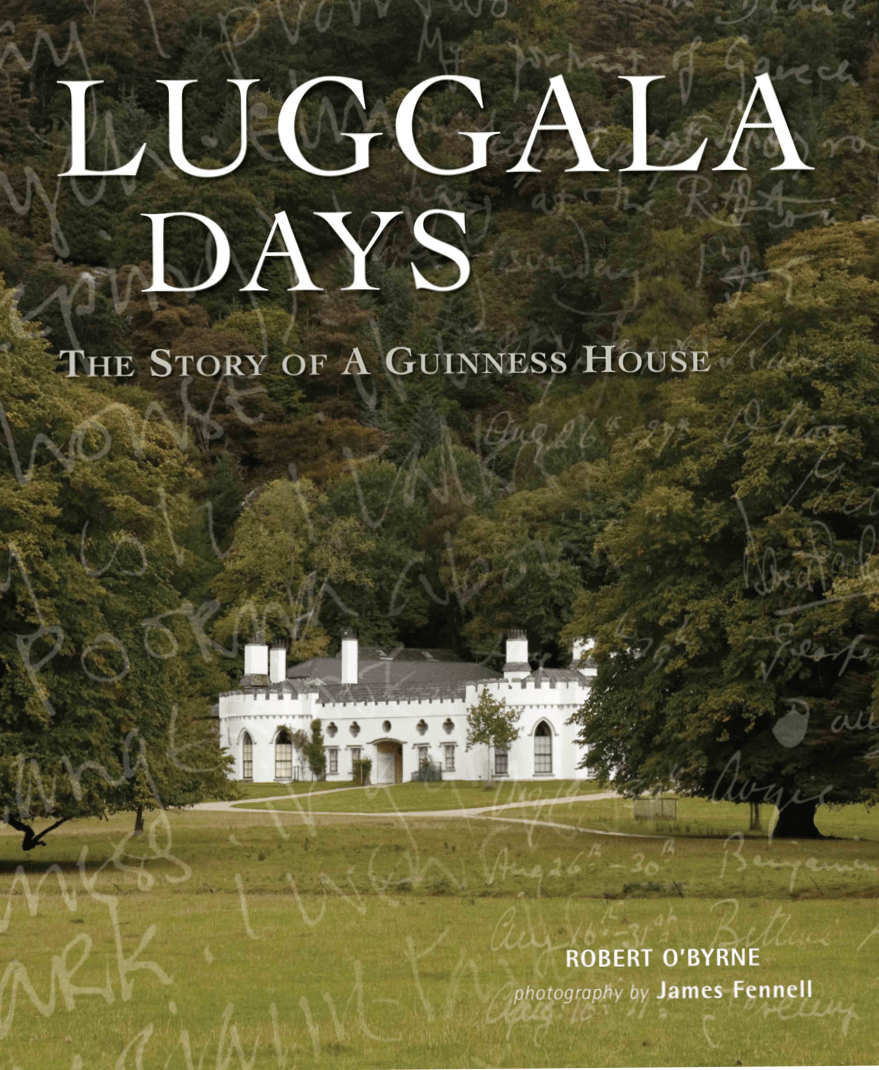
My New York pal James Andrew has written some kind words about Luggala Days in http://www.whatisjameswearing.com. Read it for yourself and simultaneously discover the delights of James’ own blog.
Worth a Squint
Delvin, County Westmeath is one of those small Irish towns through which it is easy to pass without paying attention to the place. In other words, except for residents it is never a point of destination. This is regrettable, because Delvin does have interest, although – again like so many small Irish towns – first impressions would not indicate that to be the case. Essentially a single straggling, untidy street Delvin lacks coherence and order, lacks the kind of communality of vision and presentation that make its equivalents in other countries so satisfying. The town has some fine buildings – there are a number of pretty early 19th century houses – but just as many, if not more, that destroy whatever chance Delvin might have of detaining visitors.
Those prospective visitors would be interested to know that among the reasons they should linger is the town’s appearance in a novel which caused a sensation almost a century ago. Published in 1918, The Valley of the Squinting Windows was written by Brinsley MacNamara (1890-1963), the pseudonym of a local man, John Weldon whose father James was principal of a national school elsewhere in the county. The book is a rather overwrought tale of a young teacher seduced by a wealthy, dissipated man and how a trainee priest who has fallen in love with her avenges this outrage. It owes more to 19th century melodrama than 20th century realism, and is closer in spirit to Peyton Place than to Madame Bovary, the latter presumably being what MacNamara had hoped to emulate.
The Valley of the Squinting Windows would likely be forgotten now but for the stir it caused on publication in Delvin. MacNamara always claimed that Garradrimna, the village in his novel, was representative of any small community in Ireland: ‘I used certain descriptions of characters and events because they were typical, were easily identified with local people and happenings. But people in Clare and Limerick have been able to do exactly the same in the case of their own villages. So could people in any county in Ireland.’ However, Garradrimna’s topographical details fix it so precisely as Delvin that locals understandably took umbrage, especially as there are really no attractive characters in the book, everyone being small-minded and greedy, obsessed with discovering and relishing the misfortunes of their neighbours. Seemingly when the novel was published there was great excitement in the region but this quickly changed to indignation once its contents were known: obviously no one thought to notice the title provided a fair warning of what lay inside. Instead of sensibly allowing the work slip into oblivion, the people of Delvin publicly burnt a copy in the centre of the village. Worse, they organised a boycott of children attending James Weldon’s school, as though he were responsible for his son’s novel. In response, Weldon brought a law suit for £4,000 against Delvin’s parish priest and seven parishioners for arranging the prohibition. He lost the case and was forced to emigrate. The Valley of the Squinting Windows has ever since been synonymous with small town pettiness.
Among the features of Garradrimna that made it easily identifiable as Delvin are several references to a de Lacy castle at one end of the village. Just such a structure remains in place to this day, popularly believed to have been built by the Norman soldier Hugh de Lacy who came to Ireland with Henry II in 1171 and over the next 15 years erected many such structures in this part of the country. Delvin Castle is supposed to date from a decade later, after which it was given to de Lacy’s son-in-law, Gilbert de Nugent whose descendants, later Earls of Westmeath, remained in the area until 1922. Originally a massive keep with four circular corner turrets, the castle is now only half its former size, the north wall having long since gone. The owner of the abutting corner house told me his grandmother who used to live there, on being informed she was responsible for the castle and its upkeep, handed the property over to the Office of Public Works, which seems to have done little since.
Nearby, and even more dejected in appearance, is St Mary’s, the former Church of Ireland church which incorporates a mid-16th century belfry into an otherwise predominantly early 19th century building. Deconsecrated and unroofed in 1963, the building and graveyard have recently undergone refurbishment at the hands of industrious residents, which was necessary for its well-being but has had the unintentional effect of removing much of the site’s romantic charm.
Goodness knows, otherwise romantic charm is hard to discover in Delvin; opposite the stretch occupied by castle and church, for example, a large site is occupied by a private house presumably dating from the 1970s, never attractive and now an derelict eyesore.
At the other end of the town stands the Roman Catholic Church of the Assumption, unlike its Anglican counterpart still very much in use, designed by George Ashlin in 1873 and described by Christine Casey and Alistair Rowan as ‘an accomplished small-scale essay in French Gothic’, although one imagines the French original would not be surrounded by quite so much tarmac. In fictional guise it also appears in The Valley of the Squinting Windows.
MacNamara had little good to say about Garradrimna/Delvin, damning not just the local populace but also the physical appearance of the village itself, describing it as mean and fly-blown, with ugly houses. No doubt the resident population today is quite different to that he castigated: there is even an annual Delvin Garradrimna Book Fair. But it remains the case that the novel was as much a condemnation of place as people. MacNamara’s observations on how Delvin looked – and still looks – have yet to be addressed. If that happened, even visitors unfamiliar with The Valley of the Squinting Windows would be encouraged to linger for longer than is now the case.
Brought to Book
Back in 1980 photographer Simon Marsden published a book on Irish country houses with the self-explanatory title In Ruins. It quickly sold out and has since become a bibliophiles’ favourite. Many more such works by other photographers subsequently followed, so many that one began to gain the impression of vultures gathering to feast on a corpse even before the death certificate had been issued. Sometimes it seems as though the fewer historic properties of worth that Ireland possesses, the more they will be appreciated: like the Dodo, their value will only be fully understood when the last one has fallen into irreversible ruin.
The crumbling Irish house is a staple of our national literature (think the wondrous Molly Keane, together with many others before and since) and so too are books which apparently thrive on depicting yet another building in terminal decay. It is easy to understand the appeal of these publications, essentially romantic and inspired by a concept of the past that helps to make illusory television series like Downton Abbey so popular. It is a vision of history that regards old buildings, and in particular Ireland’s great houses, as having the same kind of use-by date as found on supermarket food, after which they can serve no further purpose. According to this erroneous attitude they should be allowed, if not actively encouraged, to fall down, thereby permitting a myth to be constructed in their absence.
These somewhat melancholic thoughts were inadvertently inspired by an admirable new publication, Irish Country Houses: A Chronicle of Change. Author David Hicks discusses 24 properties spread across the four provinces and has had the original idea of featuring old photographs of the houses in their heyday alongside images of how they look now. The comparisons are rarely kind, although not always as Hicks intended. He is, for example, more generous than really ought to be the case about Adare Manor, County Limerick and Farnham in County Cavan, both converted into hotels with a singular want of sympathetic taste. And he includes Powerscourt, County Wicklow which is a travesty of restoration and deserves nothing other than condemnation. This really is an instance where the ruin was preferable to what has since been done.
That is the criticism out of the way, because otherwise Hicks’ book merits congratulation, not least thanks to texts which are both well-informed and well-written, a rare phenomenon in this genre where writers can display scant interest in researching the history of buildings they present. As a rule he is sympathetic but not sentimental, clearly passionate about his subject but not (perhaps with the exception of Powerscourt) to the exclusion of objectivity.
And the photographs are just fascinating, albeit occasionally in a ghoulish way. The first picture at the top of this piece, and the two that follow, are of Downhill, County Londonderry, the immense palace built on a cliff top overlooking the Atlantic by that notable eccentric Frederick Hervey, Earl-Bishop of Derry (1730-1803). Admirers of Amanda Foreman’s biography of Georgiana, Duchess of Devonshire may be interested to know that the Duke’s long-time mistress (and eventual second wife) was the Earl-Bishop’s daughter, Lady Elizabeth Foster. Downhill was aptly named: within fifty years of Hervey’s death it started to go irreversibly down hill, not least thanks to a disastrous fire in 1851 which gutted much of the interior and destroyed some of the finest contents. Although rebuilt twenty years later, by the early 1950s the building had been dismantled; it is now in the care of the National Trust, as is the ravishing Mussenden Temple, the adjacent domed rotunda also built by the Earl-Bishop.
The next two photographs show a house at the other end of the country, Castle Bernard in County Cork. Originally called Castle Mahon and part of the territory controlled by the O’Mahonys, in the 17th century it was acquired by an English settler, Francis Bernard whose descendants became Earls of Bandon; they greatly extended the property, with major rebuilding taking place in the early 19th century. Despite a jumble of styles, the eventual result looks charming in old photographs. In June 1921 the fourth Earl and his wife were forced out of the castle by a branch of the IRA before the building was set on fire. Lord Bandon, a septuagenarian, was then kidnapped and held hostage for three weeks before being released. Seeing the gutted shell of Castle Bernard, his niece wrote ‘The ruin is absolute and all one can do is wander across the mass of debris in those precious rooms.’
Finally, above is Clonbrock, County Galway, a house needlessly lost within living memory. The estate belonged to the long-established Dillon family who built Clonbrock in the 1780s to replace a previous residence which had been burnt, seemingly by a firework let off to celebrate the birth of the then-owner’s heir. Various additions, such as the Doric portico and the two low wings, were made during the first half of the 19th century but the central block remained unaltered, notable for the refined neo-classical plasterwork of its main rooms. The Dillons were ardent photographers and their archive today provides one of the best sources of information for life in the Irish country house.
Successive generations of the family lived at Clonbrock until 1976 when economic circumstances forced the sale of house and contents. The building was then placed on the market but despite various statements of interest it failed to find a buyer and in 1984 was destroyed by fire; I remember at the time meeting a German family who had hoped to take over Clonbrock and were dismayed by what occurred. Now it stands as yet another testament to our want of aesthetic appreciation – or maybe to our perverse preference for romantic ruins…
Irish Country Houses: A Chronicle of Change is published by Collins Press