Cloverhill House, County Cavan was shown here some months ago (see A Mere Shell, 9th September 2015), a ruin well on the way to vanishing altogether. Happily its entrance is in better condition, a slim, unadorned ashlar triumphal arch flanked by pedestrian gates. The residnce to which it originally gave access was extended by Francis Johnston in 1799, so one imagines the arch dates from the same period. The side gates need to be cleared of overgrowth if they are not to go the way of the old house.
Man Proposes, But…

Reference was made here some weeks ago to the Board of First Fruits (see Made Better by Their Presents II, December 12th 2015). Although it had a considerable impact on the Irish landscape in the 18th and early 19th century, this organization is today little known. To reiterate briefly, the board was established in 1711 to provide financial assistance for the building and improvement of the Church of Ireland’s places of worship and glebe houses. First funded by a tax on clerical incomes from 1778 onwards it received grants given by the Irish Parliament, after 1785 this being a yearly sum of £5,000. Following the Act of Union, this country’s Anglican clergy became absorbed into the newly-formed United Church of England and Ireland and thereafter the amount of money made available to the Board of First Fruits rose: its annual grant doubled to £10,000 in 1808, soared to £60,000 between 1810-16 before dropping first to £30,000 and then £10,000 after 1822. As a result of this money, the Church of Ireland was able to embark on a building spree: in the first quarter of the 19th century almost 700 churches were either newly constructed or renovated, along with 550 glebes and 172 schoolhouses. While the entire country benefitted from this programme, there were regional variations depending on the level of engagement by whoever was then in charge of a diocese. Among the most committed to the scheme was Thomas Lewis O’Beirne, Bishop of Meath for a quarter-century (1798-1823). O’Beirne is a fascinating character. Born into a Roman Catholic family in County Longford, initially he studied for the Catholic priesthood at the Jesuit seminary in St Omer, France: his younger brother Denis was there at the same time and completed his studies (the siblings would later serve in the same parish of Templemichael, Longford, Thomas as rector and Denis as parish priest). A breakdown in health led Thomas to England where he converted to Anglicanism and attended Trinity College, Cambridge. Highly intelligent, industrious and devotedly loyal to the Church of Ireland, he was appointed first to the Diocese of Ossory in 1795 before being transferred to Meath three years later. During his long episcopate, he embarked on an improvement of both clergy and buildings in the diocese, a schedule of work which has been thoroughly investigated by Mary Caroline Gallagher in her 2009 doctoral thesis on the subject.


Exhibiting the customary fervour of the convert, O’Beirne believed incumbents ought to be resident in their parishes (not something which had hitherto been universally the case) and services should be held in churches that were structurally sound and, appropriately designed and maintained. Hence his keen interest in improving both clergymen’s homes and places of worship. He was fortunate in his timing, his period as Bishop of Meath coinciding with the Board of First Fruits having most money to distribute, commonly through a mixture of grants and loans to parishes (which on occasion had the effect of saddling parishioners with long-term debt). Today we look at two Meath churches that underwent redevelopment in O’Beirne’s time. The first of these (top and above) is St Patrick’s at Castletown-Kilpatrick. There was a mediaeval church on this site and parts of it were incorporated into the newer building, in particular over the east window a portion of what is believed to be a 15th century tomb stone showing a woman in prayer. There are also two old arched windows on the second floor of the belltower and a stone head that projects from the wall of the church. These were presumably rescued by the man responsible for the building’s refurbishment, whose name features in a stone plaque over the doorcase (which also looks to be older than the main body of the church). The plaque reads ‘This Church was Rebuilt by Order of The Rigt. Honb. & Rt. Revd. Th. Lewis Lord Bishop of Meath. The Revd. Robt. Longfield Rector. Henry Owens Esqr. & Henry Liscoe, ChurchWardens. Robt. Wiggins Builder. A.D; 1820.’ The cost of the project was £467 and four years later a glebe house was also constructed to the immediate south at a cost of £1,107, this work financed by a Board of First Fruits loan. Declining numbers of worshippers meant that by the third quarter of the last century it had become difficult to sustain the church, which closed for services in the mid-1960s. The glebe house had already been sold and demolished around 1945.


Just a few miles south of Castletown-Kilpatrick stands St Sinch’s, Kilshine (above and below). According to legend St Abbán, whose father was a king of Leinster, founded a convent here and placed at its head a holy virgin called Sinche or Sineach, the church being called Cill-Sinche (thus the Anglicised name Kilshine). By the 18th century this building had fallen into poor repair and so a new church was built in 1815 at a cost of £1,600 with funds provided by the Board of First Fruits. As at St Patrick’s the occasion was commemorated with a plaque: ‘The rebuilding and restoring of this Parish Church, after it had laid in ruin for upwards of a century, were the effects of the pious exertions of that excellent Prelate, the Right Honourable and Most Reverend Father in God, Doctor Thomas Lewis O’Beirne, Lord Bishop of Meath, who in the conscientious discharge of the functions of his high and important office not only caused many other churches in this Diocese to be rebuilt and restored, but procured for that most respectable Body, the Reverend the Parochial Clergy, residences and glebes within their respective Livings, suitable as far as it was possible to their situations, thereby enabling them duly to discharge the duties of Resident Protestant Clergymen, and to dispense to their parishioners of that persuasion the invaluable comforts of Our Blessed Religion. Aided by a pecuniary grant of 1,600 from the Board of First Fruits obtained through the intercession of His Lordship the Bishop of Meath.’ Let it not be thought the work of Bishop O’Beirne went unrecorded. But once more declining attendance numbers meant St Sinch’s had closed for services by 1958 after which its monuments were removed: today both here and St Patrick’s, Castletown-Kilpatrick are united with the church at Donoughpatrick where services continue to be held. Meanwhile tangible evidence of the efforts of Thomas Lewis O’Beirne and the Board of First Fruits to ensure the Church of Ireland had a long-term future looks to be irreparably vanishing. It seems only a matter of time before both these churches, and many more beside, vanish from the countryside altogether. Truly as Thomas à Kempis advised ‘Homo proponit, sed Deus disponit.’
Attention to Detail

Viewing an old building, one is often so engaged absorbing the totality that details of design can be overlooked. How many visitors to Ballyvolane, County Cork, for example, pay much attention to the stairs? This house, originally built in 1728 by Sir Richard Pyne, was extensively modified in the second half of the 1840s by a descendant, Jasper Pyne. Evidently a new staircase was one of his additions but note how on the side of every tread is affixed a cast-iron putto in each of whose fists can be found a nail holding one of the balusters in place.
The Peripatetic Cleric

The above oil, painted in Constantinople in 1740 by Jean-Étienne Liotard, features in a marvellous exhibition devoted to the Franco-Swiss artist running until the end of the present month at the Royal Academy, London. The sitter was the Anglican clergyman Richard Pococke, then on an extended Grand Tour lasting more than eight years. Pococke’s travels took him not only around Europe but also to Egypt, Palestine, Lebanon & Syria, Asia Minor, and Greece: fortunately his full correspondence (predominantly letters sent to his mother, always addressed as ‘Honoured Madam’) from this period has been edited and published in three volumes in recent years by Dr Rachel Finnegan and is much recommended. From these we learn of Pococke’s meetings in 1740 with Liotard who was then resident in Constantinople, hence in this picture Pococke is represented in oriental costume (a fashion which the artist did much to promote when he returned to Europe). From 1747 onwards Pococke spent increasing periods of time in Ireland where his restless spirit directed him on several journeys around the country: his published tour of 1752 is also compelling reading. He was appointed Bishop of Ossory in 1756 and then of Meath in 1765 but died only a matter of months after assuming the latter office. His memorial in the graveyard of Ardbraccan, County Meath can be seen below. As mentioned, the Liotard exhibition is unquestionably worth seeing, not least for its strong Irish interest since he had many patrons in this country including Simon Luttrell, first Earl of Carhampton, the Earl of Clanbrassil and above all William Ponsonby, second Earl of Bessborough who had first invited Liotard to accompany him to Constantinople.
The Leaning Tower
Do not attempt to adjust your screens: the tilt is real. This is the 10th century round tower in Kilmacduagh, County Galway, at some 111 feet the tallest such structure in the world. The conical cap, which unusually overhangs the drum, collapsed in 1858 and was rebuilt almost twenty years later. The tower has a circumference of fifty-six feet and walls six and a half feet thick. In addition, Kilmacduagh’s round tower has the greatest number of windows – eleven, all angle-headed – and a doorway almost twenty-three feet above the ground, leading to questions about how anyone ever gained access: the height is too great for a solid ladder and the alternative would be a rope ladder of exceptional length. But most extraordinary of all, the tower leans over a foot and a half to the south-west.


At the start of the 7th century Colman MacDuagh who had hitherto been living as a hermit on the Burren, was persuaded by his cousin Guaire Aidne mac Colmáin, King of Connacht to establish a monastery in this part of the country. Legend has it that while Colman was walking through woods in the area seeking a spot for the new foundation, his girdle fell to the ground. Taking this as a divine omen he chose the place for his monastery. The girdle is said to have been studded with gems and kept for centuries by the O’Shaughnessys, descendants of King Guaire, and then by another branch of the family the O’Heynes. It has long since disappeared but an additional item associated with Colman, his supposed crozier (although likely of later manufacture) which was credited with the power to make a thief restore stolen items, is now in the National Museum of Ireland.


The fame of Saint Colman (as he became after his death in 632) attracted many followers and the monastery at Kilmacduagh thrived for several centuries. Indeed such was its importance that in the 12th century Kilmacduagh became the centre of a new diocese (subsequently merged with Galway). However like so many such establishments in Ireland it was subject to frequent attacks. The buildings were plundered several times before finally being devastated at the start of the 13th century by the Norman knight William de Burgh during his conquest of Connacht. At some date before his death in 1253 Owen O’Heyne founded the nearby house of St Mary de Petra for Augustinian canons. They remained here until the Dissolution of the monasteries in the 16th century after which the lands of Kilmacduagh were granted to the Richard Burke, second Earl of Clanricarde, a descendant of William de Burgh. Today the remains of sundry buildings from different dates can be found on the site including the cathedral, the friary of St Mary de Petra, churches dedicated to John the Baptist and the Virgin and the former glebe house as well as the world’s tallest, and only leaning, round tower.
May These Characters Remain, When All is Ruin Once Again*

Thoor Ballylee, County Galway is a 15th/16th century tower house originally built by the de Burgo family but now best known as the former property of poet William Butler Yeats who acquired it a century ago and subsequently undertook a restoration of the old building. Opened to the public in 1965, the tower closed seven years ago after being flooded by adjacent Streamstown river. It might have remained shut thereafter but for the endeavours of a local group, the Yeats Thoor Ballylee Society, which tirelessly worked for the building’s refurbishment in time for last year’s 150th anniversary of the poet’s birth. These pictures were taken two months ago, since when the tower – like so much of the surrounding country – has once more been subjected to severe flooding. However, according to the society’s website (http://yeatsthoorballylee.org) determined efforts are being made to ensure it will reopen later in the spring: an example of local, private initiative that deserves to be applauded and emulated elsewhere.

*A plaque on the castle’s wall contains the following text: ‘I the poet William Yeats/With old millboards and sea-green slates/And smithy work from the Gort forge/Restored this tower for my wife George./And may these characters remain/When all is ruin once again.’
An Active Afterlife

The west entrance to the 12th century church at Ullard, County Kilkenny, its much-weathered Romanesque doorway featuring the outline of human and animal heads. It was directly facing this entrance that Jeremy Williams was interred last Saturday following a service at nearby Duiske Abbey. Everyone interested in Ireland’s built heritage will have known Jeremy, architect, author and superlative draughtsman, a constant presence at meetings, outings and social gatherings. Always full of enthusiasm, always embarking on a fresh project, always determinedly encouraging others to share his current passion, there were no houses in Ireland where he was not assured of a welcome: and little of the country’s architectural patrimony that he hadn’t nimbly recorded with his pen. His sudden death on Christmas Eve has left a void impossible to fill. Impossible also to imagine Jeremy resting in peace: one imagines that already he is persuading the Almighty to cast an eye over freshly-drafted plans for the refurbishment of Heaven’s Gates.
Occupational Therapy

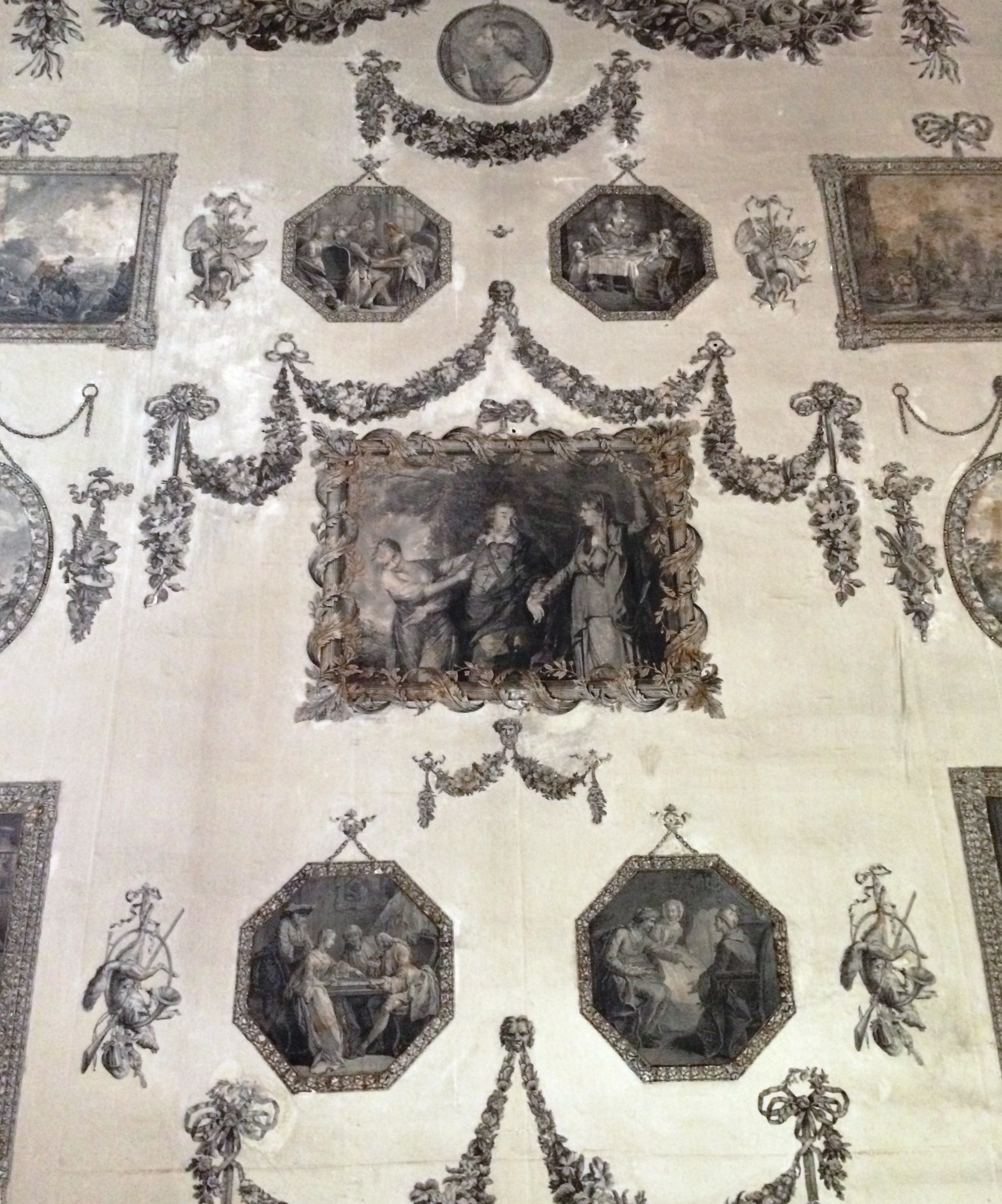
During this post-festive season, when evenings can seem especially long and monotonous, readers might like to consider occupying their time with the creation of a print room. This once-fashionable pursuit, which had its heyday in the second half of the 18th century, subsequently fell out of favour and only one intact example survives in Ireland: that at Castletown, County Kildare. The design and execution of print rooms was customarily left to women, although it evolved from the mostly-male habit of collecting valuable prints and storing these either in a cabinet or within albums. Later on prints might be hung in a chamber designated for the purpose, often kept shrouded in order the work avoided suffering light damage: while cheaper than paintings prints, especially those of larger dimensions could be expensive to produce. However, larger runs of prints in the 18th century, often reproductions of popular works of art, helped to bring down costs and make these pictures accessible to a broader market than had hitherto been the case. Cheaper prices led to greater disposability and the emergence of the print room, a phenomenon effectively unique to Britain and Ireland (although there were some instances of the vogue found in America).


Located behind the house’s main staircase and part of an enfilade on the ground floor overlooking the garden, Castletown’s Print Room was created in 1768 by Lady Louisa Conolly. She had been collecting pictures for at least the previous six years, and in addition had gained experience through assisting in similar ventures with her sister Emily, Countess of Kildare at nearby Carton and with Lady Clanbrassil at Cypress Grove House, Templeogue, County Dublin. Both these rooms have since been lost. The project was a long time in gestation: in 1762 she wrote to her sister Lady Sarah Bunbury, ‘I always forget to thank you my Dear for the Prints you sent me, I hope you got them of Mrs Regnier, for I have a bill there, the two little ones that you admired so, are the very things I wanted, that of Helen is charming. I have not had time to do my Print room yet.’ It is likely the reason the Print Room took so many years coming into existence is both because the Conollys were preoccupied with other work at Castletown and because Lady Louisa did not want to rush preparing the layout of what is a larger space than that customarily used for such a purpose: the ceiling here, for example, is twenty-five feet high. As a result, an awful lot of prints were needed. As late as February 1768 she was still writing to her sister Lady Sarah, ‘…any time that you choose to go into a print Shop, I should be obliged to you, if you would buy me five or Six large Prints, there are some of Teniers engraved by LeBas, which I am told are larger than the common size, if you meet with any, pray send me a few.’ Working out the design for this room was a complex business, particularly since border frames for each of the frames also had to be prepared, as well as garlands, trophies and other elements of the overall decoration.


When Lady Louisa finally came to embark on the scheme, the prints were duly cut out and then glued onto lengths of warm off-white painted paper. These in turn were attached to the room’s walls on battens overlaid with cloth. As Ruth Johnstone has noted, in many cases Lady Louisa ‘made editorial decisions based on the outside shapes of images.’ Accordingly she altered the original rectangular format of forty-six images to either an octagonal, oval or circular shape, or to a rectangle with a convex top. Most likely because of the need to create a visual balance based on size and shape there is no overriding theme to the pictures but rather they reflect mid-18th century taste. A handful of images were included for a specific reason. In central position between the two windows, for example, is a print of Van Dyck’s portrait of the children of Charles I, a group including Lady Louisa’s great-grandfather Charles II. In the same position on the opposite wall is a print taken from Sir Joshua Reynolds’ portrait of Lady Louisa’s sister, the aforementioned Lady Sarah Bunbury (the original painting, incidentally, is now in the collection of Chicago’s Art Institute). Providing a centrepiece on the east and west walls are prints of the era’s most famous actor, David Garrick, and the room also includes a portrait of William Pitt, Earl of Chatham, rather surprising since he was a political opponent of Lady Louisa’s brother-in-law Henry Fox, first Baron Holland. Otherwise the sources were diverse, with a fondness for both pastoral and classical subjects taken from the works of diverse artists including Teniers, Greuze, Jan Steen and Claude Lorrain. Despite such dissimilitude, Castletown’s Print Room conveys an impression of homogeneity thanks to its designer’s careful preparation. Anyone intending to embark on a similar enterprise will find these long winter evenings perfect for similarly thorough planning.

Much more information on Castletown’s Print Room can be found in Ruth Johnstone’s essay on the subject including in the Office of Public Work’s 2011 publication Castletown: Decorative Arts.
Getting Thoroughly Plastered

One of the past year’s most fascinating personal discoveries was the dining room at Altidore Castle, County Wicklow. Often described as a Georgian ‘toy fort’ the house was built c.1730 for General Thomas Pearce, uncle of the architect Sir Edward Lovett Pearce, who may well have been responsible for its design. Much of the interior decoration dates from that period, including the dining room’s panelling. In the last quarter of the 18th century, however, additional ornamentation was added with the introduction of oval and circular plaster medallions featuring female classical deities and graces: this would have been around the period that Altidore was owned by Rev William Blachford, Librarian of Marsh’s Library and father of early Romantic poet Mary Tighe (author of the once-much read Psyche, or the Legend of Love), and subsequently by her brother. During the same period the interiors of nearby Mount Kennedy – designed by James Wyatt in 1772 but only built under the supervision of Thomas Cooley the following decade – was being decorated by the celebrated stuccadore Michael Stapleton. The medallions are not unlike those seen in Lucan House, County Dublin where Stapleton also worked: might he have had a hand in the plasterwork at Altidore?