Still Standing Proud

IMG_3650

The free-standing tower at Donadea Castle, County Kildare. Presumably this is the oldest part of the building, erected by the Aylmer family on the site of an earlier mediaeval residence and completed in 1624. Later a larger house was constructed immediately adjacent to the tower, and the whole property Gothicised in the early 19th century (this work is often attributed to Sir Richard Morrison). Now at the centre of a national park, Donadea was unroofed in the 1950s but somehow traces of its former state survive, not least the wooden window frames and shutters. A shame these have never been rescued, rather than being allowed to fall into decay.

IMG_3664

An Abandoned Project

IMG_0137
The history of Ireland in the later Middle Ages becomes immensely complicated due to the fractious character of Irish families and their habit of forming, and then breaking, alliances with each other. The south-west of the country (now Counties Kerry and Cork) was for a long time dominated by the MacCarthy Mórs, Kings of Desmond under which were three cadet branches ruling over their own territories whenever not feuding among themselves. Following the death of the last of King of Desmond, Donal IX in 1596 leaving only an illegitimate son, a dispute broke out between various members of these septs over who was entitled to claim his position. One of those who sought to become the new MacCarthy Mór was Dermot MacOwen MacCarthy, a descendant of Dermod, the third son of Cormac Fionn MacCarthy Mór (1170-1242), King of Desmond (although for the purposes of his claim MacOwen MacCarthy contended he was descended from Cormac’s eldest son). But at the same time Dermot MacOwen was in dispute with a cousin, Donogh MacCormac MacCarthy for the title of Lord of Duhallow, one of the three subordinate septs of Desmond. Yet in 1598 the two men joined forces to attack Castle Hyde, home of the settler Arthur Hyde, which after a three-day siege was captured and burnt. They then reverted to their earlier quarrel over the Lordship of Duhallow. Under these circumstances, it is no wonder the Irish were so often unable to defeat their common foe, the invading English.

IMG_9854
IMG_9819
IMG_9928
IMG_9933
Following the death of Donogh MacCormac MacCarthy during a skirmish in the Clare-Galway region in 1601, Dermot MacOwen MacCarthy became the undisputed Lord o Duhallow and it is likely that around this time (or following his release by the English government in the aftermath of the Battle of Kinsale during which he had been imprisoned) work began on the construction of a his new residence immediately south of Kanturk, County Cork: on a map of Ireland made by John Norden between 1609 and 1611, there is a castle shown at “Cantork” (Kanturk). It is sometimes proposed that Donogh MacCormac was responsible for initiating work on this castle, but given that he died in 1601 that seems unlikely. Seemingly in order to pay for the building’s construction, MacCormac MacCarthy mortgaged large tracts of his territory even though under Gaelic law all such land was deemed communal property. The mortgagee was Sir Philip Percival who had arrived in Ireland in 1579 and by such means was able to amass a large estate for himself. No documentation survives about Kanturk Castle’s construction, but one legend claims it was built by seven stone-masons all called named John: for a time the building was known as ‘Carrig-na-Shane-Saor’ (the Rock of John the Mason). Work on the site seems to have stopped in 1618 after English settlers in the area objected to the castle being too large and too fortified. Accordingly the English Privy Council ordered work be discontinued. It is said that MacCormac MacCarthy was so angry at this instruction that he ordered the blue ceramic tiles on the castle’s roof be smashed and thrown into a nearby stream, which thereafter has been known as Bluepool.

IMG_9821
IMG_9895
IMG_9848
IMG_9835
Kanturk Castle, otherwise called Old Court, rises beside the Dalua river, a tributary of the Blackwater. It is constructed of local limestone rubble, with cut stone used for the mullioned and transomed windows as well as the hoods, cornices, quoins and corbels. The same cut limestone can also be seen around entrance doors, and what remain of the chimney pieces on each floor inside the building. The castle is rectangular in form, measuring twenty-eight by eleven metres and rising four storeys with a five storey, twenty-nine metre high tower at each corner. The main entrance is on the western side, a work of Italian Renaissance inspiration with an elaborate entablature above the Ionic columns on either side of the round headed door frame. Since it is located on what would have been the first floor, presumably the original approach was via a flight of steps (on the other hand, given the gun holes on other parts of the building, perhaps the raised entrance served as a defensive device?) To the rear of the castle is another more familiar arched entrance on the ground floor. Inside the floors are all gone. One of the stories about Kanturk Castle is that, after his fit of pique over the Privy Council order, MacCormac MacCarthy never occupied the place. However, given the quality of the remaining chimney pieces (some were later removed to Lohort Castle), this seems unlikely. Whether the building was ever fully completed or thereafter much used remains open to conjecture.

IMG_9845
IMG_9847
IMG_9901
IMG_9889
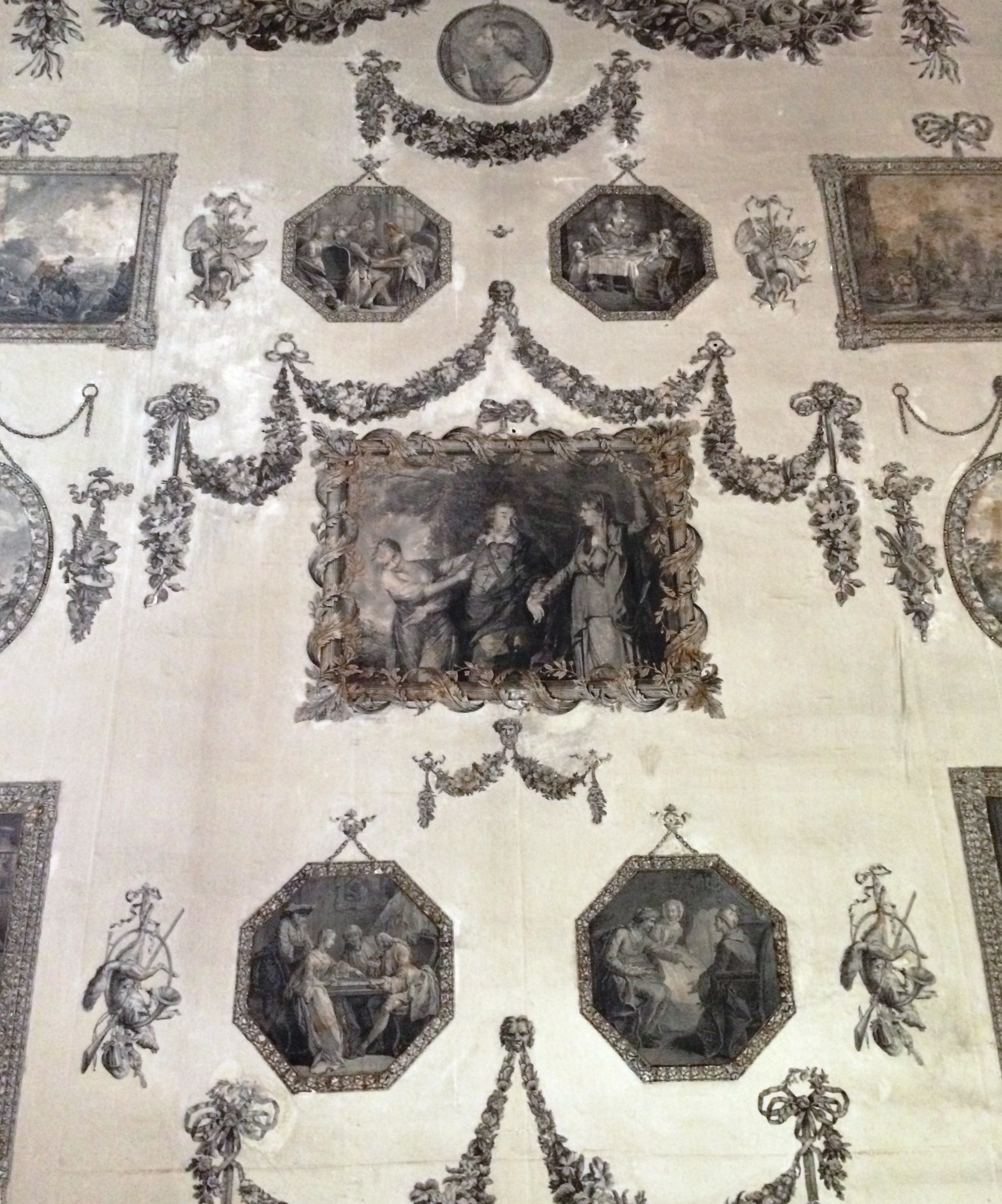
Dermot MacCormac MacCarthy was succeeded by his son, Dermot Oge, who married Julia, daughter of Donal, last O’Sullivan Beare and widow of Sir Nicholas Browne whose father had bought the vast MacCarthy estates in Kerry. Having participated in the Confederate Wars of the 1640s, both Dermot Oge and his son were killed in 1652 at Knocknaclashy, west of Mallow, in the course of battle against a Cromwellian force led by Lord Broghill. Twenty years earlier financial exigency had led him to enter into the aforementioned mortgage agreement with Sir Philip Percival, so the family’s ongoing possession of their land was already vulnerable. In the aftermath of the restoration of the English monarchy in 1660 the Court of Claims denied the MacCarthys Equity of Redemption on the old mortgage.  Instead ownership of the Lordship of Duhallow and the manor of Kanturk was awarded to ‘Sir Philip Percival, baronet, minor, grandson and heir of the said Sir Philip the Elder.’ Ultimately Sir Philip’s great-grandson Sir John Perceval became Baron of Burton, county Cork, in 1715, Viscount Perceval, of Kanturk, in 1722 and finally Earl of Egmont in 1733. Although Kanturk Castle appears in the background of a portrait of the second earl and his wife painted c.1759 by Sir Joshua Reynolds (now in Bradford Museum), the family made their residence at Lohort Castle, another former MacCarthy stronghold. In 1900 the seventh earl’s widow presented Kanturk Castle to England’s National Trust, which had only been founded five years earlier, on condition the building be maintained in the condition in which it was received. For much of the last century the castle was the National Trust’s only property in the Republic. In September 1951, it granted the building to An Taisce (a long-established charitable organisation engaged in the preservation and protection of  Ireland’s natural and built heritage) on a 1,000 year lease and at a rent of one shilling per annum if so demanded. In 2000 the National Trust officially transferred the title deeds of Kanturk Castle to An Taisce, which is now responsible for the building, a national monument, on behalf of the Irish people.

IMG_0129

Made Better by their Presents I

Cathedral doorway
The Romanesque west doorway of St Mary’s Cathedral, Limerick, founded by Donal Mór O’Brian, King of munster in 1168 but said to incorporate elements of an older palace on the same site. This is one of a number of such buildings considered in Niamh NicGhabhann’s recently published Medieval Ecclesiastical Buildings in Ireland, 1178-1915. The fascinating text explores changing attitudes to gothic architecture during the period, and increased academic interest in the subject as antiquarians like George Wilkinson and George Petrie carried out detailed surveys of old monuments. Equally interesting is how over the course of the 19th century Ireland’s built heritage became politicised, with debate focussed on what elements might be judged ‘authentically’ Irish and what foreign imports. As NicGhabhann writes, ‘In Ireland, debates on the meaning of architectural style were complicated by issues of religious identity, as well as by ideas of political symbolism and national representation.’ If not necessarily in the field of gothic architecture, these debates continue to resonate in some quarters to the present day. They became immediately applicable in Limerick when work on a new Roman Catholic cathedral, designed by Philip Charles Hardwicke, began in 1856: this stands in the area known since the Middle Ages as ‘Irishtown’ whereas St Mary’s is on King’s Island, otherwise known as ‘Englishtown.’ ‘The public and religious celebrations surrounding the consecration of St John’s Cathedral,’ writes NicGhabhann of this event in 1894, ‘can be read as a performance of both Catholic identity within the city, and the negotiation between the religious and political significance of the two cathedrals.’ That negotiation could be fractious, not least in Dublin where the Church of Ireland had possession of the capital’s two ancient gothic cathedrals, and the Catholic church had to settle for a neo-Catholic Pro-Cathedral. The choir of one of the former, St Patrick’s Cathedral , can be seen below. The building underwent a controversial ‘restoration’ in the 1860s, since Sir Benjamin Guinness, who funded the entire enterprise, chose to dispense with the services of an architect.

IMG_8788
Medieval Ecclesiastical Buildings in Ireland, 1789-1915: Building on the Past by Niamh NicGhabhann is published by Four Courts Press, 55.

A Landlord Discharging His Duty

Blessington Lion
A granite lion head, from the mouth of which water can be discharged into a basin immediately below. This is part of a monument in the centre of Blessington, County Wicklow erected to mark the coming of age in 1865 of Arthur Hill, later fifth Marquis of Downshire, whose family owned a large estate in the immediate area. On another side of the same memorial it is recorded that the water here was ‘supplied at the cost of a kind and generous landlord for the benefit of his attached and loyal tenants.’

IMG_3691

On the Town XI

IMG_7166

The skyline of Mullingar, County Westmeath is dominated by the twin campaniles of the town’s Roman Catholic cathedral: a testament to religious triumphalism’s predilection for blandness, it officially opened in the same week the Second World War began. The building was designed by Ralph Byrne, a Dublin-based architect who ran one of the busiest practices in the first half of the last century, specializing in churches, convents and diverse clerical premises. Byrne’s hallmark was eclectic classicism, as can likewise be seen in his near-contemporaneous Catholic cathedral in Cavan town and the church of SS. Peter and Paul in Athlone. Like Mullingar cathedral, they do not welcome close attention since a muddle of elements and orders soon becomes apparent. This is a case of never mind the quality, just relish the quantity because Mullingar cathedral is enormous, seemingly capable of holding 5,000 persons. That figure represents approximately a quarter of the town’s present population, testifying to Mullingar’s growth in recent years. Located in the Irish midlands and therefore benefitting from travelers passing from one side of the island to the other, Mullingar was founded around 1186 when the Norman knight William Petit received a grant of land between Lough Owel and Lough Ennell by then Lord of Meath, Hugh de Lacy. Petit built a stone castle on the site where now stand the town’s County Buildings and his brother Ralph Petit erected a church nearby. The Augustinian and Dominican orders later established houses in the area. The earliest grant of a market was given in 1207 and Mullingar subsequently acquired the right to hold four fairs a week as well as a weekly market. When Westmeath was separated from Meath in 1543 Mullingar was designated the county town. It was almost entirely burned by the forces of Hugh O’Neill in 1597 and then a fire, this time accidental, again destroyed the greater part of the town in 1747. Thus Mullingar’s present form and appearance essentially date from the late 18th and 19th centuries.
IMG_7179
IMG_7185
IMG_7217
IMG_7233
The Royal Canal reached Mullingar in 1806 and the town therefore became a base for both passenger and freight traffic (some of the original bridges connected with this enterprise survive). The canal grew steadily less important with the arrival of rail, the first train coming to Mullingar in 1848 and soon this became one of the country’s major junctions. In addition the main road from Dublin to both Galway and Sligo passed through the town, further boosting business. Mullingar’s expansion in the 19th century is evident in the number of prominent public buildings erected during this period, not least a neo-Gothic predecessor to the present Roman Catholic cathedral. Then there are the barracks, originally built between 1814 and 1819 to accommodate 1,000 troops. Other vast complexes include the former workhouse – now part of St Mary’s Hospital – designed by Poor Law Commission architect George Wilkinson and built in the Tudor Gothic style in the early 1840s, and the not dissimilar St Loman’s, a psychiatric hospital from the following decade with a three-storey façade that runs to an astonishing forty-one bays arranged in a series of symmetrical gable- and canted-fronted projections. In 1858 the town, which had been owned by the Forbes family, Earls of Granard since the 1660s, was sold to Fulke Greville-Nugent, later first Lord Greville. He instigated the rebuilding of the town’s main hotel, today still called the Greville Arms, and also the old market house, the architect for both these projects being William Caldbeck. Not far away is a fine early 19th century classical courthouse, once part of a larger complex that included a gaol: its site is now in part occupied by the Italianate-style County Hall dating from 1913.

IMG_7188
IMG_7222
IMG_7214
IMG_7254
Mullingar’s long-time role as a market and county town is evident in its centre neatly contained within the boundaries of the Royal Canal which encircles it on three sides with only the south unencompassed, although a second canal on this side runs towards Lough Ennell. Widening and narrowing in different sections a main street runs through the town from east to west, the old route from Dublin to the other side of the country: the broader sections were intended to accommodate trade on market and fair days. Much of the main thoroughfare is still occupied by retail premises, although there are vacant properties found intermittently along its length (and, as elsewhere around the country, occupation of the upper storeys appears almost non-existent with inevitable consequences for the building’s well-being). It is on the side streets and laneways that greater dereliction can be found. Here are many boarded-up structures or empty sites where demolition has taken place. And naturally the local authority has not assisted matters by granting permission for a number of shopping centres to be developed outside the old town, thereby taking consumers away from Mullingar’s original commercial district. As so often is the case, the state has likewise shown little concern for the town’s long-term welfare: in 2012 the old barracks, after being in use for almost two centuries, were closed. This meant a loss of trade in the immediate locality, but it has also left a reserve of historic buildings vacant close to the town centre: last September it was reported the barracks might be used to house some of the Syrian refugees expected to come to Ireland but nothing further has been heard on the subject. A large commercial, residential and retail development, Mullingar Central, was announced just before the economic downturn but never took place and this has left a considerable parcel of land in poor condition. Elsewhere while a certain amount of attention is paid to the canal and its facilities, one feels more could be done especially to ensure that buildings close to its banks are better maintained: a block of old warehouses immediately behind Dominick Street, for example, have slid into total disrepair. Mullingar’s story is little different from that seen elsewhere: an inability to think ahead, a reliance on short-term fixes, the lack of an overall masterplan and, above all, a failure to understand properly what successful urban living requires. Like its cathedral, on at superficial glance this town might look well enough, but closer examination indicates otherwise.

IMG_7229

Pure Folly

IMG_4289
This seeming folly closes a vista inside the walled garden of Strokestown Park, County Roscommon. In fact the main feature here, the limestone Venetian window, was originally sited on the first floor of the main house and formed part of Richard Castle’s design dating from the 1730s. When Strokestown underwent modifications around 1819 –  the architect on that occasion being John Lynn – the window was removed (presumably because a large Ionic portico was added directly beneath) and put into storage. It only found a new home in the walled garden when this was restored in the 1990s.

People in Glasshouses

IMG_9081
The roofline of a greenhouse in the walled garden at Tullynally, County Westmeath. Dating from around 1820, it has been built against a brick wall and facing south. Originally used for growing fruit such as peaches and grapes, the building retains its timber frame and fish-scale glass sheets, now something of a rarity in Ireland.

Being in the Service of the Lord

IMG_0715
As was mentioned last week Kilcooley, County Tipperary stands on land formerly settled by Cistercian monks. The order established a house here c.1182 at the request of Donal Mór O’Brien, King of Thomond and a thrice-great grandson of Brian Boru. It was one of no less than four Cistercian monasteries initiated by O’Brien and soon became a daughter house of Jerpoint Abbey, County Kilkenny, established a couple of years earlier. Like so many other such properties, Kilcooley was subject to attack, especially during the fifteenth century when many religious establishments became caught up in feuds between rival families. Having already suffered from an assault in 1418, in 1445 it was reported the abbey had been burnt and almost completely destroyed by ‘armed men.’ This led to the construction of the present church, albeit largely on the footprint of its predecessor. The work was carried out under the direction of then-abbot Philip O’Mulwanayn whose burial slab was formerly sited in front of the main altar but is now suspended on the north wall of the chancel.

IMG_0571
IMG_0531
IMG_0598
IMG_0564
Access to Kilcooley Abbey is via a well-preserved entrance chamber, in effect the church’s north transept, composed of two bays the outer having a handsome traceried window on the east wall. The inner bay has retained its stone vaulting and to the south stands a carved stone baptismal font. One then enters the church, notable for flamboyant tracery windows at the east and west ends. The main body of the building has lost its roof but this remains over the oblong crossing which supports a hefty tower, and over the chancel. To the south a narrower two-bay, rib-vaulted transept – serving as a pair of small chapels – in turn leads to a succession of other rooms, as well as offering access to the night stairs, and to the cloister garth beyond: almost nothing of the last of these now remains other than outer walls. Several other buildings in the vicinity, such as chapter house and refectory, survive in various states of ruin.

IMG_0540
IMG_0584
IMG_0599
IMG_0559
The interior of Kilcooley is memorable for two features: the chancel tombs and the doorway leading from south transept to sacristy. With regard to the former, the finest tomb here is that against the chancel’s north wall erected in memory of Piers Fitzjames Oge Butler who died in 1526. This work is attributed to Rory O’Tunney, member of a County Kilkenny family responsible for carving a number of such tombs during the first half of the 16th century. Butler’s monument features the deceased lying on top of the tomb clad in a mixture of chain and plate armour and with a loyal dog at his feet. Below him runs an elaborate panel featuring ten apostles, each in his own niche. Passing through the south transept, one is confronted by a remarkable carved screen carrying a number of images seemingly scattered at random and on sundry dates. Yet as Roger Stalley has noted (in The Cistercian Monasteries of Ireland, 1987) ‘this cannot be so as the stones have all been carefully cut to suit their present positions.’ However the impression of an ad hoc design remains: two tracery panels beneath the arch, for example, are smaller than their neighbours. Further down, panels are placed with no evident concern for their location. One shows a mermaid with comb and mirror being observed by two fish, another has an abbot inside an ogee arch, but not to the centre of it. A crucifixion scene above the door is likewise off-centre, sharing the space with St Christopher carrying the Christ child. The whole design appears simultaneously wilful and whimsical. 

IMG_0552
IMG_0558
IMG_0604
IMG_0589
Likely because of its links with the Butler family, following the Dissolution of the Monasteries Kilcooley became the property of the Earls of Ormonde. In 1636 the twelfth earl (and future first Duke of Ormonde) sold the estate to Norfolk-born judge Sir Jerome Alexander for £4,200. On his death in 1670, Kilcooley was inherited by his daughter Elizabeth who married another English-born lawyer, William Barker. In 1676 he became the first of four successive baronets bearing the same name, the last of whom built a new house on the estate around 1770. Prior to that date the Barkers may not have spent much time at Kilcooley and when they were present they lived in the old abbey which had been modified to serve as a private residence: this helps to explain why it is better preserved than many other mediaeval monasteries in Ireland. Following the death without direct heir of the last Sir William Barker in 1818 the estate was inherited by his nephew, Chambre Brabazon Ponsonby on condition he adopted the surname Barker. When he in turn died in 1834 Kilcooley passed to his eldest son, William Ponsonby-Barker some of whose idiosyncrasies were discussed last week. Again he died without leaving a son, so the next owner was his brother, Captain Thomas Ponsonby, known as ‘Damnation Tom’ owing to his habit of using the expletive in every sentence. But he only lived a further three years before dying in 1880. His son Chambre Brabazon Ponsonby, married to Mary Plunkett, sister of Sir Horace Plunkett, went to the United States with the intention of buying land there and selling Kilcooley, but died during his return journey across the Atlantic in 1884. The estate passed to six-year old Thomas Brabazon Ponsonby, whose guardian was the aforementioned Horace Plunkett, pioneer of agricultural cooperatives in Ireland. Imbued with his uncle’s idealism, Thomas Ponsonby was a progressive farmer, establishing many new enterprises on the estate including a cheese factory, a large pig enterprise and saw mills. Narrow gauge railway lines served the pigs, and this line extended to a hill where timber was felled and loaded onto bogies which would roll downhill to the saw mill. Likewise he and his wife Frances Paynter modernized the main house, with central heating installed throughout the building including the basement, the whole fired by a large coal boiler below ground in the north yard, and the water circulated by thermo-syphon. The boiler house had a glass roof, so that if there was an explosion, the force of the blast would go straight up.
Kilcooley remained in the ownership of the Ponsonbys until some ten years ago, since when it has experienced what could best be described as mixed fortunes in various  hand. It recently came on the market at the centre of an estate running to more than 1,200 acres. Given its fascinating history and exceptional collection of buildings – of which not all have been described here – one can only hope that it soon finds a new custodian, one who proves as sympathetic to the place as were the Ponsonbys.

IMG_0698

A Generous Welcome to the World

IMG_0184
The generous proportions of the front door in the entrance hall at Ballymacmoy, County Cork. Since the early 18th century the house has been home to successive generations of Hennessys, one of whom Richard emigrated to France where he became an officer in the famous Dillon’s Regiment before settling in the Cognac region and founding the eponymous family firm. The present building dates from the second decade of the 19th century, replacing an older property when its excessively heavy slates caused the roof to collapse, killing a pig and a goose, and injuring a beggar who unfortunately happened just then to call to the door.

Mixing the Orders

IMG_1947
One of the series of doors found at the base of the stairs in the south hall at Ballyhaise, County Cavan. While the core of the house dates from c.1730, this part of the building was extensively remodelled and extended early in the following century. The doorcases, with their ribbed pilasters and feathered capitals beneath expansive arched fans, date from that period.

IMG_1949
For more about Ballyhaise, see Made to Last For Ever, March 9th 2015.