A European Record


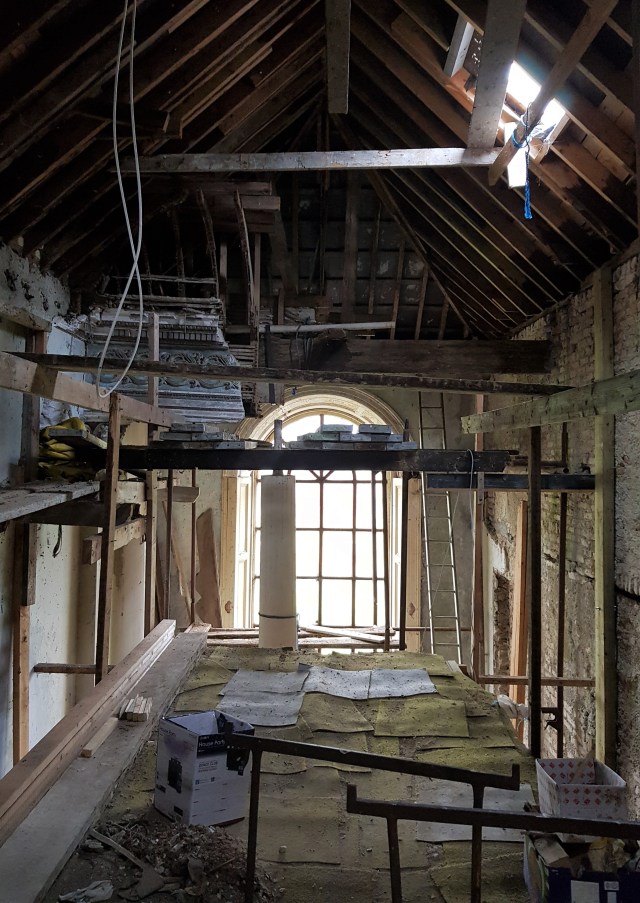
‘There are probably more derelict buildings in Ireland than in any other country of Western Europe,’ opens a television report on the rescue of Damer House in Roscrea, County Tipperary (see: https://www.rte.ie/archives/2017/1122/922043-damer-house-gets-new-life). That statement was made in 1977 and is probably just as applicable today, as can be seen by the condition of this house, in the townland or Irby on the outskirts of Roscrea.


The building looks to be early-to-mid 19th century and constructed as a residence for an affluent tenant farmer. It was designed like a miniature gentleman’s house, with a number of reception rooms on the ground floor and bedrooms upstairs, all inside sturdy walls. These still survive but the interior has been almost entirely lost and the roof is on the verge of going. Although capable of restoration and reuse, the place will likely only decline further: after all, Ireland has a reputation to maintain as the country with more derelict buildings than anywhere else in Europe…

Solid, Square and Many Windowed


‘The drive from Athenry is along an excellent rural roadway. The neatly coped walls which enclose the Lambert property soon come into sight, guarding well the vast acreage within them, and beyond on either side are the fairest pastures in the west. The impressive entrance is on the right of the roadway, great gates flanked by semi-circular curves of massive railings: long lines of laurels border the drive to the house, on which may be seen a solitary, leafless tree, gnarled and bent and throwing out a lichen-grey arm halfway across the drive. This, said Mrs O’Donoghue, is the fairies’ tree, where the little people sit at night and plan their pranks. The country folk will tell you that they have seen them, and they will also tell you that if the tree were to be cut down or injured in any way, a very disagreeable visitation would befall those who dared to do it.
The house itself is a great white mansion: solid, square and many windowed, fitted throughout with fine plate glass, and showing pretty blinds and silken curtains at every casement. It is entered by two flights of granite steps leading up to a handsome porch, whilst the interior reveals a large hall with cheerful fire and luxurious armchairs. The drawing room, which has recently been modernized, lies to the left behind immense mahogany doors, and on the right the large dining room is carpeted in crimson which complements the pale lettuce-green walls and shows off the quaintly twisted carving and the light oak paneling. There is a massive buffet in the room which bears the family plate.
Also on the ground floor are the morning room and the schoolroom, besides other apartments; whilst from the centre of the hall rises an elegantly bannistered staircase. As you mount this staircase you are confronted by a truly magnificent stained glass window bearing the crest and coat of arms of the Lambert family. From the half-landing stairways rise to the upper chambers.’
Nannie Power O’Donoghue on Castle Ellen, County Galway in 1900.


Nannie Power O’Donogue (née Ann Stewart Lyster Lambert) was born in Dublin in 1843, her father Charles Lambert having grown up on his family estate, Castle Ellen, County Galway. Believed to be of Yorkshire origin, the Lambert family were settled at Greg Clare not far away by the middle of the 17th century. By the end of the following century Walter Peter Lambert was living at Castle Ellen, initially in a castle but at some indeterminate date (between 1810 and 1840) he built a new residence for himself and his family. In 1846 his grandson, also called Walter Peter, married a Cork heiress, Elizabeth McO’Boy (likely necessary to replenish the family fortune, since his father had had no less than 19 children with two wives). Her money enabled further work to be undertaken on the property. In 1863 for example, extensive alterations and additions to the stables and yards were made to the design of Dublin architect Edward Henry Carson who twelve years earlier had married the owner’s eldest sister Isabella Lambert: their son was Edward Carson who as a child and young man often stayed at Castle Ellen. Castle Ellen remained in the Lambert family until 1921 when Captain Walter Peter Lambert offered house and remaining 600 acres for sale, the original contents being auctioned around the same time.


Like her cousin Edward Carson, Nannie Power O’Donoghue knew Castle Ellen well, having spent childhood holidays there. In 1869 at the age of 26 she married William Power O’Donoghue, composer and professor at the Royal Irish Academy of Music in Dublin: he came from a affluent Cork mercantile family. The couple’s financial circumstances suffered a setback in 1885 when the Munster Bank, in which their money was invested, failed. However, even before then Power O’Donoghue had begun earning money through her writing: she published her first novel the year before her marriage. She soon became a prolific author, beginning in 1881 with a series of articles in Illustrated Sporting and Dramatic News on riding techniques for women. These were so successful that they were published in book form as Ladies on Horseback, followed by a second similar work called Riding for Ladies (1887) which became an international best-seller. In the following decade she started to write for Irish Society (‘guaranteed Largest Circulation in Ireland of any Society paper published in the United Kingdom, and three times that of any Irish weekly journal or periodical’). Here she contributed a weekly column, ‘De Die In Diem. Or, Casual Jottings. By Candid Jane (Mrs Power O’Donoghue)’ covering whatever topic took her fancy. Although Irish Society did not survive Independence – the demand for reportage on Dublin Castle levées and charity bazaars having declined – and her views on the world often remained distinctly Victorian, she continued to write up to the time of her death, aged 96, in 1940. That same year, Castle Ellen was again offered for sale, this time by the Land Commission, which sought to dispose of the property with 66 acres. The new owners put it on the market eleven years later and in 1961 the house was temporarily used as a school. But by then it was already in a poor state of repair and the decline continued remorselessly until 1974 when local man Michael Keaney bought Castle Ellen. Since then he has been single-handedly working to keep the roof intact and ensure the house remains standing. He welcomes visitors (and even offers overnight accommodation in one bedroom) and is a wonderful fount of knowledge about the house and its history. There is, unquestionably, more work to be done but without his gallant intervention Castle Ellen would long ago have joined the list of Ireland’s lost country houses. His pluck merits appreciation and applause.
The Handsomest Thing I have Seen


Writing of Creagh Castle, County Cork in 1841 local antiquarian John Windele declared ‘The Gateway is the handsomest thing I have seen in the country, formed of panelled piers, surmounted by ogee crocheted pinnacles with finials, etc., the arches depressed, the workmanship is excellent.’ Although no architect is known to be responsible, the entrance gateway is thought to have been designed by brothers George and James Pain and to date from c.1827.


Revival


The façade of Ballykealey, County Carlow, a country house dating from c.1830 when built for John James Lecky, replacing a smaller property on the site. The architect responsible was English-born Thomas Cobden who at this time was living in the area and received many such commissions, although he also designed the Roman Catholic cathedral in Carlow town. A few years earlier, his client had married a Yorkshire heiress, which obviously acted as an incentive to overhaul Ballykealey, transformed into a Tudor-Revival mansion with steep gables, battlemented pinnacles and tall chimneys. The Leckys remained here until 1953 when house and residue of the estate were sold. The building subsequently served as a novitiate for the Patrician Brothers, but more recently has undergone another revival to  become an hotel.

Three in One


The name of Moone, County Kildare is said to derive from the Irish Maen Colmcille, meaning ‘Colmcille’s property’. This is because although the place was converted to Christianity in the fifth century by Palladius (who preceded St Patrick in Ireland), a monastery was founded here 100 years later by St Colmcille. No trace of that establishment remains, the ruins on site being those of a Franciscan friary of c.1300 (although parts of the structure may be earlier). A late 18th century image shows that considerably more then survived, including a Lady Chapel on the north side and a tall, square tower but these were then demolished. The remains of the church are remarkable for holding one of the finest High Crosses in Ireland, of local granite and rising some seven metres. It was only discovered in 1837, buried in ground near the south-east wall of the building; a further missing portion of the base was found in 1875 and restored in 1893. Dating from the ninth century, it is extremely well-preserved, all four sides carved with human and animal figures, many of them representing stories from both the Old and New Testament. The cross sits beneath what was apparently meant to be a temporary cover, but the plastic roof has been there for so long it has probably acquired protected structure status.


Not far away from the remains of the Franciscan friary rises another ancient structure: a 15th century tower house. The original owners are unknown, perhaps the Eustace family who came into possession of this part of the country through inheritance in 1447. They remained in occupation until at least the mid-17th century, but then lost the property during that era’s upheavals. As so often, there is only one point of access, a door on the east side to the south of which are stone steps leading all the way to the top. While the ground floor features the customary high, vaulted space, much of the interior was converted, probably in the 18th century, into a brick-lined dovecote. However the upper storey still holds an old stone chamber with a chimney and windows.


Between monastic ruins and tower house stands the third significant building on this site: a mid-18th century Palladian building known as Moone Abbey House. In the aftermath of the Williamite Wars, the land around here was bought by Thomas Ashe, a Dublin alderman. He died in 1741 and seven years later, Moone was acquired on a 999-year lease by Samuel Yates of Colganstown, County Dublin: he is believed to have commissioned the new house. Colganstown has been attributed to Nathaniel Clements, and his name has also been mentioned in association with Moone Abbey House along with that of Dublin-based architect John Ensor. The building was intended to make a good impression but is less substantial than initially appears to be the case, since the central block is only one-room deep. Among its quirkier features are the convex quadrant walls that in turn lead to rather unusual two-storey, two-bay wings with Dutch gables. An engraving of 1792 by Daniel Grose (see bottom of page) shows that originally the main house was of two storeys and with a Diocletian window at the top. The third storey – and porch – are 19th century additions. Like its immediate neighbours, Moone Abbey House has undergone various vicissitudes over the course of several centuries but thankfully survives. The course of Ireland’s history can be discovered in these three adjacent buildings, all still standing and, in the case of the house, still happily serving as a family home.


And finally, Daniel Grose’s view of the site in 1792.


Neighbours II


Coote Terrace is a row of three late Georgian three-bay, two-storey over basement villas in Mountrath, County Laois, the name derived from the Coote family who lived nearby in Ballyfin. They are in diverse condition, this one being well-maintained and with a handsome front garden. Its neighbour, on the other hand, looks in need of serious attention if the house is to survive.


Neighbours I


Moore Hall can be found on O’Moore Street, Tullamore, County Offaly. The house dates from the mid-1750s when built by Richard Moore, who may have been related to Charles Moore, Earl of Charleville (of the first creation). It was probably quite simple but just over a century later a doctor called John Ridley added the central limestone bay with its extraordinary first floor window in Jacobean Mannerist style that sits atop a more regular doorcase flanked by Doric columns and finished with a wide fanlight.  Aside from the unfortunate uPVC windows, the building survives in good condition, unlike its immediate neighbour, a pretty early 19th century cottage with Wyatt windows on either side of a tall and wide gothic doorcase: sadly this house is fast falling into dereliction.


Seven Years On


This week marks the seventh birthday of the Irish Aesthete, a somewhat surprising event. Nobody who begins such an enterprise imagines what its future might be like, or indeed how long it will continue. Somehow, this one has continued without interruption and thrice weekly since being started, almost on a whim, in September 2012. Since then it has ventured throughout the country and – thankfully – there remains an abundance of material (albeit in varying states of repair) for consideration.


Nevertheless, no such site can survive without support: there is little purpose in being a voice crying in the wilderness. So, as on previous occasions, sincerest thanks to everyone who has taken the trouble to be interested in what appears here. Your engagement and commitment makes the enterprise worthwhile. Here are seven views of the gardens at Glin Castle, County Limerick, home of the late Knight of Glin who died eight years ago this month but who during his lifetime did so much to ensure the survival of Ireland’s architectural heritage.


The Final Witness


The former Market House in Eyrecourt, County Galway. The building dates from c.1750 and is one of a number erected in the 18th century by local landlords the Eyre family to improve the circumstances of the locality. The linen industry, one of the few businesses free from import duties on goods sent to England, thrived during this period and both Eyrecourt and nearby Lawrencetown became active centres for the fabric’s manufacture, hence the need for a market house.


Designed on a T-plan and of five-bays and two-storeys, the building subsequently appears to have served a number of other purposes, including court house, school, town hall and theatre. However, at some date in the last century it was damaged by fire and has stood a roofless ruin ever since, last witness to what was once a thriving industry in the area.


More on Eyrecourt in due course…

Awaiting Developments


Wilton House on College Square North, Belfast. Dating from the early 1830s, the neo-classical building was originally constructed as two houses and is believed to have been designed by Thomas Jackson, a young Waterford-born architect who had recently gone into partnership with the older Thomas Duff of Newry. Towards the end of the 19th century, the pair of houses were combined into one so as to operate as the Hotel Metropole. In 1907 it began to be used as a mission hall for the Adult Deaf and Dumb Organisation which through various incarnations remained on the site until 2011. Since then it has sat empty and falling into dereliction, although at least the property still stands, unlike many others in the immediate vicinity which were lost to bombing and subsequent demolition during the 1970s. Wilton House was finally sold last year to developers who have lodged a planning application to convert the house into eight apartments, with a seven-storey extension to the rear containing a further 19 apartments.