The Lion in Winter


The Lion Gate at Mote Park, County Roscommon. This was once one of the entrances to an estate owned by the Crofton family who settled here in the second half of the 16th century; in 1798 they became Barons Crofton of Mot . In the 1620s their forebear George Crofton built Mote Castle, but it was replaced by a new house at some date between 1777-87. This property was in turn rebuilt after being gutted by fire in 1865 but only survived another century: the last of the Croftons left Mote in the 1940s after which the contents were auctioned: the house itself was demolished in the 1960s. In February 2015 its former portico, rescued at the time of the demolition, was sold at auction for €12,000.


According to a history of Mote Park compiled in 1897 by Captain the Hon Francis Crofton, the Lion Gate was erected in 1787 and its design has sometimes been attributed to James Gandon, although this is disputed. Whatever the case, it takes the form of a Doric triumphal arch with screen walls linking it to what were once a pair of identical lodges (but are now used for housing livestock). A plinth on top of the arch features a Coade Stone lion, one foot resting on a ball. Over time this had become much weathered (not helped by bees nesting inside the animal) and when taken down a few years ago three of its feet fell off. Following restoration work at the Coade workshop in Wiltshire, the lion was reinstated in September 2016 and now once more surveys what is left of the Mote parkland: this restoration was funded by a number of sources, predominantly American supporters of the Irish Georgian Society.

Fallen Out of Use


Baron Trimlestown is one of the oldest titles in Ireland, created in 1461 for Sir Robert Barnewall. The family were of Norman origin, their name originally de Berneval (from the small seaside town of Berneval-le-Grand, where Oscar Wilde stayed following his release from Reading Gaol in June 1897). Having first moved to England, following the Battle of Hastings in 1066, they followed Richard de Clare to Ireland, the first to do so, Sir Michael de Berneval, landing in Cork in 1172. Rising to power in the Pale, they were responsible for building Drimnagh Castle, now in a suburb of Dublin, and then gradually acquired substantial land holdings in County Meath. Here in Trimblestown, a few miles west of the town of Trim, they erected a mighty castle, probably in the 15th century and perhaps around the time that the title of baron was granted to Sir Robert Barnewall.


The core of Trimblestown Castle is late mediaeval, rising three storeys and with a massive square tower in the south-west corner. The main block is some 114 feet long and 40 feet wide, internally dominated by a two-storey vaulted great hall that faces towards the river Trimlestown: the exterior of this side is marked by massive corner buttresses. On the south-east side of the tower there is (or perhaps was) a shield bearing the arms of the Barnewall and Nugent families – the two had intermarried – but whether it remains in place is impossible to tell due to vegetation covering much of the walls. Considerable alterations to the building were undertaken in the 18th and 19th centuries, when a large addition was made on the northern section of the site. It is likely that at this time towers similar to those on the river front were demolished and a modern house built, the most notable feature of this being a large bow-front with views to the east. Similarities with the work undertaken during the same period at Louth Castle (see Saintly Connections, August 28th 2017) have led to suggestions that Richard Johnston might have been the architect responsible in both instances. This may have happened around 1797 when the 14th Lord Trimlestown, then aged 70, married a woman less than a third of his age: the suggestion is that she got a new house in return for an old husband. Soon afterwards, her husband also inherited Turvey, County Dublin from a distant cousin and in due course the family moved there, leaving Trimblestown Castle to slip into decay.


For much of the 18th century, although the Barnewalls held onto the greater part of their lands, they were unable to use the title Baron Trimlestown. Their problems had begun in the 1640s when Matthias, eighth Lord Trimlestown, had supported the royalist cause, deprived of his estates by Cromwell and banished to County Galway. Following the restoration of the monarchy in 1660, he regained the greater part of his original property, but remained true to the Roman Catholic faith, as did his son Robert who sat in James II’s parliament in 1689. The next couple of heirs, because of their support for the Jacobite cause and their loyalty to Catholicism, were not allowed to use the old title. They lived in France and it was only in 1746 that Robert Barnewall (who claimed the title of twelfth Lord Trimlestown) returned to Ireland and took up residence in the old castle. It is likely to have been during his lifetime (he died in 1779) that the building was first modernised. As an ardent supporter of the Catholic cause, it must have been a blow to him when his heir Thomas conformed to the Established Church (thereby reversing the government attainder and allowing him to be acknowledged after his father’s death as the 13th Lord Trimlestown). Thereafter one generation succeeded another, although more than once the title had to go to a cousin as there was no direct heir. However while there is still a Lord Trimlestown – the 21st – he has no known heirs. It seems likely that after more than 550 years one of Ireland’s oldest peerages will go the same way as the castle from which its name was derived, and fall out of use.

Class Dismissed


The former Brockagh National School in County Leitrim. Located outside the village of Glenfarne, this opened to pupils in 1885 and is typical of the buildings then being constructed for this purpose and would originally consisted of a single room (later divided into two). Seemingly closed in the 1970s when a new school was built and several smaller establishments amalgamated, like so many others across the country it has since fallen into ruin.


Still Standing


The western gable of old St Cronan’s church in Roscrea, County Tipperary. Cronan was a seventh century monk who founded a religious house, originally a short distance from Roscrea but in too remote a spot for pilgrims to find. So the monastery was re-established here and flourished for many years: the eighth century Book of Dimma, an illuminated set of the gospels now in the collection of Trinity College Dublin, was written here. Post-reformation the monastic site was used by the Church of Ireland until the early 19th century when the old church was demolished and replaced by the present building incorporating much stone from its predecessor. But the 12th century Romanesque gable was retained and for the past 200 years has served as an entrance to the churchyard.

A Transformation


After last Monday’s rather dispiriting tale about Syngefield, County Offaly, here is a much more positive story. Almost exactly six years ago I visited Hazelwood, County Sligo and a few months later wrote about the house and its sad condition (see Sola, Perduta, Abbandonata, February 25th 2013). To recap: Located immediately south of Sligo town on a peninsula that juts out into Lough Gill, Hazelwood once had a garden front that looked down through a series of terraces to the water’s edge: the entrance front faces north across a long plain of pasture towards Ben Bulben. As I wrote at the time, ‘It is easy to see why General Owen Wynne should have chosen this spot on which to build a new residence following the purchase of some 14,500 acres in the area in 1722. Nine years later he employed the architect Richard Castle, then much in demand, to design the house. Hazelwood is typical of the Palladian style fashionable in Ireland at the time of its construction. The ashlar-fronted central block, of three storeys over basement, is joined by arcaded quadrants to two storey wings. Above the north front’s pedimented entrance (inset with a carving of the family’s coat of arms) there is a splendid glazed aedicule with Ionic columns and pilasters and flanked by round-headed niches, while the south front boldly proposes a Venetian door below a Venetian window. The building’s sense of significance is increased by both entrances being accessed by sweeping flights of steps. The interiors must have been similarly superlative, since even after many years of neglect enough of their decoration remains to indicate the original appearance. The main entrance hall has recessed arches on its walls above which hang plasterwork swags, and a deep dentilled cornice. A central doorway leads into the south-facing library which contains similar ornamentation and from here one passes into a succession of other reception rooms. Upstairs is equally splendid: a massive staircase hall leads, via a deep coved archway, into the first floor landing the ceiling of which is open to the galleried second storey, the whole series of spaces once lit by a glazed octagon. Most of the rooms have lost their original chimneypieces, replaced by others of a later fashion since the Wynnes were not averse to making alterations, some less happy than others; a two-storey, three-bay bedroom extension on the south-west corner of the building dating from c.1870 for example fundamentally disrupts Castle’s meticulously planned symmetry. Still, whatever about the Wynne family’s modifications to their property, they were nothing to what would follow once Hazelwood passed into the hands of later owners.’


The last Wynne to live at Hazelwood left in 1923, after which the house stood empty for seven years. It was then bought by a retired tea planter who carried out essential repairs before selling house and estate to two government bodies, the Forestry Department and the Land Commission, the latter assuming responsibility for the building. In 1946, after serving for some time as a military barracks, Hazelwood and the immediate surrounds were offered for sale by the commission with the condition that a buyer must demolish the buildings, remove all materials and level the site. Somehow, days before the auction was due to be held, this stipulation was withdrawn and Hazelwood sold for use as a psychiatric hospital; it was shortly afterwards that the original staircase was taken out of the house. As if this wasn’t bad enough, in 1969 an Italian company called Snia which produced nylon yarn bought Hazelwood and built a factory for some 600 employees. It would have been perfectly feasible for the business to have erected these premises on a site out of view of the old house and screened by trees, thus preserving the Arcadian parkland created by the Wynnes. Indeed one might have thought the relevant planning authorities in Sligo County Council would have insisted this be the case. But instead the factory, surrounded by an expanse of tarmac, went up just a couple of hundred yards to the rear of Hazelwood, covering a space of no less than six acres and thereby destroying the house’s setting. In 1983 the business closed down and four years later the factory was sold to a South Korean company which produced video tapes; this too went out of business. The following year Hazelwood was sold to Foresthaze, a consortium of predominantly local businessmen and in 2007 they applied for permission to build 158 detached houses and 54 apartments in four blocks (in their defence, they also intended to sweep away the factory). This application was refused by the local authority, litigation among members of the consortium ensued, the recession arrived, Foresthaze went into receivership and – when I visited six years ago – the future of Hazelwood looked extremely bleak.
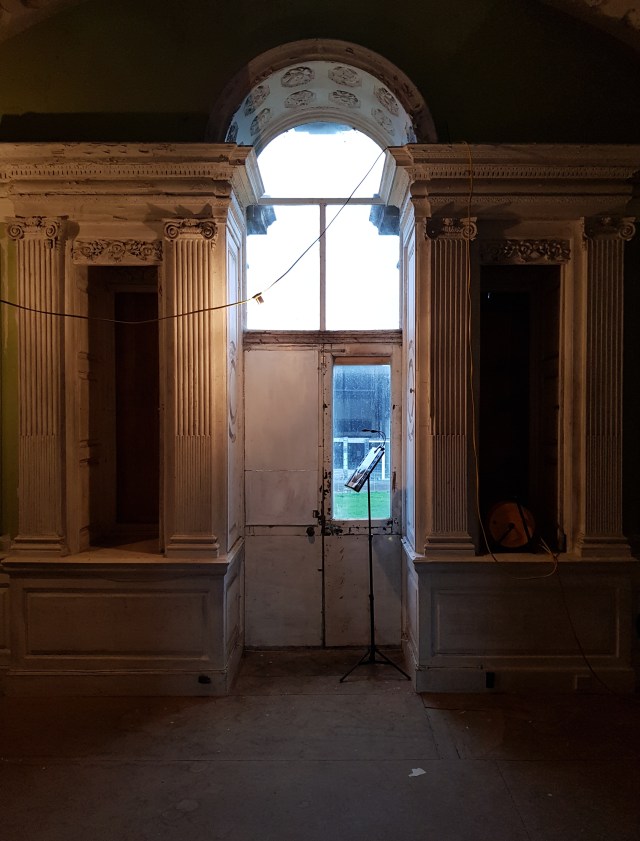


In late 2014 Hazelwood and some 80 acres was acquired by new owners who possess both vision and financial backing to ensure the place will have a viable future. The proposed scheme sees a whiskey distillery (for a new brand called Athrú) installed in part of the former factory, much of the rest of this enormous site to be deployed as a visitors’ centre and storage facility: the building’s location, surrounded by water on three sides of the peninsula, makes it perfect for a distillery. As for the house, this is to be restored to serve a variety of purposes, all intended to engage with people who come to see Hazelwood and enjoy its new facilities. Already essential conservation work has been undertaken: the west wing, inaccessible six years ago, has been re-roofed and its interior cleared. From attic to basement, dry rot in sections of the main house has been tackled and water ingress stopped. The building is now stable and, while it may still not look too lovely, a further programme of restoration work is planned for the coming years. This looks like being a long-term project, and the better for that: jobs undertaken too fast often prove to be faulty. The owners’ aspiration is that when everything is complete (and that includes tackling many outlying buildings around the former estate) Hazelwood will attract some 200,000 visitors annually. Athrú is an Irish word meaning change or transform. Thanks to this ambitious scheme the future of Hazelwood looks changed and its transformation has begun.


To the Mill

The former flour mill located on the north bank of the river Boyne at Slane, County Meath. A joint enterprise between three parties, Blayney Townley Balfour I of Townley Hall, William Burton Conyngham who lived at Slane Castle, and David Jebb, a local miller and engineer, it was constructed 1763-66 at a cost of £19,187 (including the erection of a fine miller’s house). When the English agronomist Arthur Young visited the site in 1776 he described it as ‘138ft long, the breath 54ft and the height to the cornice 42ft, being a large and handsome edifice, such as no mill I have seen in England can compare with it.’ He recorded the mill’s output as being upwards of 17,000 barrels of flour (20 stone each) per annum and the granaries capable of holding 5,000 barrels, making it one of the largest such operations in Europe at the time. The mill was operated by only 10-12 people despite then being the largest of its kind in Europe.

A Survivor


Set into a wall to the immediate west of the main entrance into Mearescourt, County Westmeath is this pedestrian gateway. It appears to be a survivor from the main house at the end of the drive: this was developed over the 17th and 18th century around an earlier tower house and the building’s present front dates from c.1760. Probably when this work was completed and a classic Paladian doorcase installed, the earlier version was removed. However, rather than simply dispose of it, the owners recycled the stone here. So this is a late-Baroque ashlar limestone doorcase with moulded architraves, the cornice supported by carved brackets, a rare survivor from the period although in need of some attention to ensure its future.

Complying with Strict Conditions of Conservation?


In February 2001 the Irish Times reported that Syngefield, County Offaly was being offered for sale. The mid-18th century house had stood vacant for more than two decades, and inevitably was in poor repair as a result. Once surrounded by a substantial amount of land, it now stood on five acres, with factories on either side of the drive, and the outbuildings already sold off. Meanwhile much of the house’s original interior had been either vandalized or stolen – all the chimneypieces were gone, for example – but enough remained, as photographs taken at the time can demonstrate. Most of the main staircase was intact, along with windowcases, lugged architraves, floorboards and some plasterwork. Of particular interest in the Irish Times feature was the information that whoever purchased the property ‘will have to comply with the strict conditions of conservation. Birr Urban District Council sought the advice of the Heritage Council and the property has been assessed by an independent conservation service.’ Hence while the guide price was low – in the region of £150,000 – the costs of bringing Syngefield back to life would be considerably higher.


As is so often the case in Ireland, the origins of Syngefield are unclear. It belonged to a branch of the Synges, cousins of the playwright John Millington Synge, and the house appears to have been built in the middle of the 18th century, perhaps around 1752 when Edward Synge married Sophia Hutchinson. There were many Edward Synges during the Georgian period, almost all of them Anglican clergymen: this one was the grandson of Edward Synge, Archbishop of Tuam and nephew of Edward Synge, Bishop of Elphin and son of Nicholas Synge, Bishop of Killaloe. It was therefore almost inevitable that he too would join the church, becoming archdeacon of Killala, as well as rector of Birr, County Offaly, hence the construction of Syngefield. His eldest son, another Edward, followed the family example and became an Anglican clergyman but a younger son, Robert, became a baronet and it was his family that continued to live in the property. At the time the Synges owned land not just in Offaly but also Counties Meath and Cork. Descendants appear to have remained in residence at Syngefield until c.1870 after which the house was sporadically let, and then sold in the last century.


Syngefield was a curious house, owing to its lop-sided appearance. Of two storeys over a semi-raised basement, it had six bays, that to the furthest left featuring Venetian windows on both ground and first floors, aping one on the upper floor above the entrance doorcase (Another oddity were the Diocletian windows in the basement.) A number of writers have proposed that a matching bay at the other end of the house had been built, thereby completing the symmetry of the façade, but that this was lost in a fire at some unspecified date. However, just as possible is that the original mid-18th century house comprised the five centre bays. The left-hand bay is a later addition, with a match at the other end of the building intended but never built owing to shortage of funds, a not-unusual situation in Ireland. In any case, when a new owner acquired the property in 2002, he decided to finish the house as was once perhaps conceived by tacking a new bay to the right of the existing property. He also doubled the size of Syngefield thanks to a vast extension at the rear that was to include a basement swimming pool, home cinema, ballroom and more bedrooms: readers can judge for themselves whether this work complied, as the Irish Times had reported would be the case, ‘with the strict conditions of conservation.’ This job, said to have cost in the region of €1 million, was never completed, presumably owing to the onset of economic recession, and in October 2009 Syngefield was offered for sale again. There appear to have been no takers, because today the unfinished structure stands with exterior and interior alike bereft of every original feature. How is it that what was intended to be a model of correct conservation came to look like this?

Recalling a Young Man ‘of Good Character’


Down a narrow lane in North County Tipperary can be found Dorrha Church of Ireland church, which dates from the early 1830s and was built with help from the Board of First Fruits. Next to it are the remains of a much older building, now fallen into ruin. On the north wall is set  a large carved tablet commemorating Lord Bernard (died February 1705) together with his wife Eleanor and ‘my beloved son James Kennedy, a young man of good character, died 9 Jan. 1704…’

There are a number of fine tombstones in the surrounding graveyard, such as that above dating from 1778, and also on the east wall of the old church the remains of a blocked-up arched window (it looks as though a tablet immediately below has been removed), above which is a badly weathered carved head.

Just Perfection


The entrance front of Castle Coole, County Fermanagh. The house was designed by James Wyatt, who took over from Richard Johnston (brother of the better-known Francis Johnston), and built between 1789 and 1798 at a cost of £57,000 for Armar Lowry-Corry, first Earl of Belmore. Wyatt never visited the site, but sent over a number of craftsmen from London to supervise the building work, not least the neo-classical exteriors clad in Portland stone (the garden façade is below). Ownership of the property was transferred to the National Trust in 1951.