Dowth Update

Dowth pic

For those of you who have been concerned about the future of Dowth Hall (see my piece Netterville! Netterville! Where Have You Been? on December 24th last), the estate was sold at auction yesterday. Seemingly there were three interested bidders, the buyer is Irish and paid €5 million for Dowth and surrounding 420 acres (a considerably higher figure than the €3.75m guide price). A lot more will need to be spent if the house, with its ravishing rococo plasterwork, is to be brought back to good condition. Let us hope the new owner is prepared to undertake this task…
*On Thursday February 7th The Irish Times reported that Dowth’s new owner is a County Meath resident, Owen Brennan, who owns a successful agri-technology business.

A Royal Progress

royal-canal-harbour-1825

This is an engraving of Broadstone on the north side of Dublin dating from 1821 and based on a picture by George Petrie. The most prominent building is the King’s Inns, designed by James Gandon in 1800 and by that date nearing completion. It looks little different today but the surprise is to find a harbour immediately in front since this has long gone. As the picture’s caption reveals, the harbour was constructed to serve the Royal Canal, its site chosen because of proximity to many key resources such as the city markets as well as the Linen Hall and various penitentiaries and workhouses.
Although Broadstone Harbour is no more the Royal Canal survives, despite sundry attempts over the past 150-plus years to damage it irreparably. Linking Dublin to the river Shannon and intended to encourage greater trade between the west and east of the country, the enterprise was plagued with problems from the very start. Not the least of these was the presence of the rival Grand Canal which follows a similar route further south and on which work had started in 1757. Construction of the Royal Canal on the other hand only began in 1790 by which time the senior waterway was almost finished and already taking large quantities of commercial and passenger traffic. So when a group of investors established the Royal Canal Company, they had to petition the Irish Parliament for financial support, receiving £66,000 to add to the £134,000 already raised from subscribers.

Royal Canal 1

Among the key shareholders of the Royal Canal scheme was the second Duke of Leinster, who insisted that the waterway pass by Maynooth, the County Kildare town beside his estate at Carton. This necessitated cutting through extensive rock at Clonsilla and creating an aqueduct to cross the river Ryewater at Leixlip, both of which added greatly to costs. By 1796 the canal had reached Kilcock and the first passengers were able to travel between this town and Dublin at a cost of one shilling and one penny, cheaper than a seat on the traditional stagecoach. However progress on moving the route further west was slow and more expensive than had been anticipated.
By 1811, despite being given almost £144,000 in government grants, the Royal Canal Company’s debts stood at £862,000. A parliamentary investigation into the business was undertaken and two years later the company was dissolved with responsibility for the project handed over to the Directors General of Inland Navigation who were instructed to complete work on the canal at public expense and with all due speed. In 1817 the Royal Canal finally joined the Shannon at a total cost of £1,421,954, seven times more than the original estimate. The following year a new Royal Canal Company assumed responsibility for the concern and built a branch line to Longford town which opened in 1830.
Now as then the Royal Canal runs for 90 miles (146 kilometres) through Counties Dublin, Kildare, Meath, Westmeath and Longford. The main water supply comes from Lough Owel near Mullingar which feeds the canal’s highest level. Its creation involved the building of 46 locks, four aqueducts and 86 bridges.

Royal Canal 4

By the mid-1830s, goods traffic on the canal had grown to 134,000 tons annually, and passenger numbers stood at 46,000 in 1837 by which time the journey between Dublin and Mullingar took an average eight hours. But even at its peak, the Royal Canal was never as successful as the Grand Canal. And the arrival of railways the following decade had an immediate and devastating effect. In 1845 the Midland Great Western Railway Company bought the canal in its entirety for £289,059 with the intention of laying railway tracks on top of the route. The government did not allow this plan to proceed, but it explains why trains heading west from Dublin do so directly alongside the canal for many miles. In 1877 the old Broadstone canal harbour was filled in and the site used as a forecourt for the railway company’s new termimus; a branch line of the canal had already connected it to the Liffey at what is now known as Spencer Dock.
Meanwhile, the Royal Canal went into steady decline, with the annual quantity of goods being carried on its route falling to 30,000 tons and passenger traffic gone. In 1938 ownership was transferred to the Great Southern Railway and six years later to the national rail company Coras Iompair Eireann. In 1955 the last boat officially to pass the length of the canal made its journey and the waterway was closed to navigation in 1961 after which it fell into serious disrepair. In the mid-1970s a group of enthusiasts started a Save the Royal Canal campaign and thanks to their sterling efforts, the route, which passed into the care of the Office of Public Works in 1978, was gradually restored. It took longer to refurbish than it had to construct: work on the last part of the Royal Canal was only completed in 2010.

Royal Canal 5

There are many reasons to celebrate the Royal Canal the most frequently cited being that it is an amenity beneficial to the tourist industry. That is certainly true and boats navigating its length bring visitors and income to towns and villages along the route. But let us leave matters economic to one side, not least because for over two centuries the Royal Canal has failed as a viable commercial proposition, inevitably costing more money than it generates. Though it might seem perverse to do so, this aspect of the waterway should be judged a cause for celebration, especially in the present era when the merit of everything and everyone seems to be based solely on the grounds of cost-effectiveness. Applying that criterion to the Royal Canal makes no sense, but instead demonstrates the fatuity of assessing value on economic grounds alone.
What’s more important in this instance is that the Royal Canal provides an example of successful intervention in the natural landscape. We are inclined to believe all man-made intrusions damage the environment, but the Royal Canal offers conclusive evidence this need not be the case: far from impairing its surroundings, the waterway often enhances them. And that is what matters most: the Royal Canal as an object of beauty. The original scheme may have been ill-conceived and sometimes ill-executed, over-time and over-budget in its completion, but we are all now the grateful beneficiaries. That gives it a value beyond price.

royal canal 1830

La Belle au Bois Dormant

2 T UMAX     PowerLook 3000   V2.1 [4]

Here is Bellamont Forest, County Cavan which can lay claim to being the most beautiful house in Ireland. Certainly its situation is unparalleled, since the building sits on a rise at the end of a mile-long drive, the ground to either side dropping to lakes, the world beyond screened by dense woodland. Bellamont is an unexpected delight, hidden from view until one rounds the last turn of the drive and sees the house ahead.
In purest Palladian style and looking like a villa in the Veneto, Bellamont is believed to have been designed c.1725-30 by the pre-eminent architect then working in Ireland, Sir Edward Lovett Pearce who was also responsible for the Houses of Parliament in Dublin (now the Bank of Ireland), and a number of since-lost country houses such as Desart Court, County Kilkenny and Summerhill, County Meath. Pearce was a cousin of Bellamont’s builder Thomas Coote, a Lord Justice of the King’s Bench. The Cootes had come to Ireland at the start of the 17th century and prospered so well that within 100 years their various descendants owned estates throughout the country. Ballyfin, County Laois which has recently undergone a superlative restoration was another Coote property.

BFI-054012_V1 kopie

BFI-006889 kopie

The appeal of Bellamont lies in its exquisite simplicity, beginning with an exterior which is of mellow red brick with stone window dressings. Of two storeys over a raised rusticated basement, the front is dominated by a full-height limestone portico reached by a broad flight of steps. The imposing effect is achieved by the most effortless means and using the plainest materials, but there can be no doubt that Bellamont was always intended to impress. The Portland stone-flagged entrance hall, with its coved ceiling and pairs of flanking doors, sets the tone for what is follow.
While there are small rooms immediately to right and left, the latter traditionally used as a cosy winter library, the main reception areas lie to the rear of the building, a sequence of drawing room, saloon and dining room which retain their 18th century decoration including the chimneypieces. The first of these is believed to have once been a series of rooms, but following a fire in 1760 acquired its present form including the elaborate recessed ceiling which was probably intended to complement that in the dining room on the other side of the saloon. The walls of this central room contain contain stucco panels once filled with family portraits, the best-known of which – painted by Sir Joshua Reynolds in 1773 and showing the Charles Coote, Earl of Bellamont resplendent in his robes as a Knight of Bath – now hangs in the National Gallery of Ireland.

BFI-053965 kopie

BFI-006860 kopie

The aforementioned Earldom of Bellamont was a second creation of the title for a member of the family. Evidently an ostentatious and pompous man – seemingly he insisted on making his maiden speech in the House of Lords in French, to the bemusement of his fellow peers – Lord Bellamont can at least be credited with having the good taste to enhance the house built by his grandfather. He married a daughter of the first Duke of Leinster and by her had four daughters and just one son who died in Toulouse at the age of 12, his body being brought back to Bellamont to lie for three days on the upper landing before burial in the family vault.
As a result of there being no legitimate heir, the earldom again lapsed on Lord Bellamont’s death in 1800. However, despite being seriously wounded in the groin during a duel with Lord Townshend, he managed to have at least 16 offsring out of wedlock by four different women, and one of these sons, also called Charles Coote, inherited Bellamont Forest. Ultimately it was sold out of the family in the middle of the 19th century and bought by the Smiths (later Dorman-Smiths), one of whom Major-General Eric Dorman-Smith served in the British army during both the First and Second World Wars after which, having changed his surname to O’Gowan, he became involved with the IRA.

BF_II-000766 kopie

BFI-006881 kopie

In 1987 Bellamont Forest was bought by John Coote, an Australian interior designer whose family had emigrated from Ireland at the start of the last century. John dearly loved the house and undertook to restore it to a pristine condition, keeping the decoration spare so that the beauty of the rooms’ architecture would be more apparent. There was never a great deal of furniture, just a few large pieces he had specifically made and which were inspired by Georgian workmanship. In revealing the building’s purity he not only demonstrated the splendid taste of Pearce but his own also, since it would have been tempting to intervene in the interiors.
Those interiors served wonderfully for entertaining, which John did frequently. I have been to a great many terrific parties at Bellamont, and even hosted a few there, one of which – a birthday dinner for 30 – is thankfully uncommemorated by any photographs. But there are ample souvenirs and joyous memories of John’s own sundry social gatherings, such as the thé dansants he loved to throw, when a 16-piece orchestra would play in the saloon and Jack Leslie would demonstrate how to dance the Black Bottom. The last great party at Bellamont took place during the summer of 2009 to mark John’s 60th birthday and was spectacular even by his standards, with drinks in the lower gardens followed by dinner and dancing outdoors in the balmy air.
The following year John was obliged to put Bellamont Forest up for sale, and thereafter he rarely visited the place. Tomorrow marks the first anniversary of his death, which happened unexpectedly while he was working in Indonesia. He is still sorely mourned by all of us who knew him in Ireland. Meanwhile Bellamont slumbers, awaiting a new owner who will kiss the place back to life; there is talk now of an auction in March. One prays that whoever next assumes responsibility for Bellamont will bring to the house the same flair and fun as did John Coote for so many years.

BF_I-000005 kopie

All photographs by René Kramers (http://www.reneez.com/)

And in 2013…

sws28

…The Irish Georgian Society is due to move into its new headquarters on Dublin’s South William Street. This building, the City Assembly House, is of great historical significance: it includes the oldest purpose-built exhibition gallery in Ireland and Britain. Dulwich Art Gallery was only constructed in 1817 whereas work began on the City Assembly House in 1766. Yet until recently its importance was almost unknown and certainly uncelebrated. Even today, hundreds of pedestrians pass by without knowing anything of the structure, or its elegant interiors. This will change once the IGS is installed.
The origins of the City Assembly House lie with a short-lived organisation called the Society of Artists in Ireland. An idealistic venture, its purpose was to increase awareness of and appreciation for the visual arts and for its indigenous practitioners, many of whom believed they had to move to London to receive sufficient notice. So in February 1765, the Society organised an exhibition of paintings, drawings and sculpture, held in Napper’s Great Room on George’s Lane, on the north side of the Liffey. There were 88 exhibits, including work by the likes of John Butts (who would die that same year) and Robert Hunter (fl.1748-1780).

sws3

sws25

The debut exhibition was such a success that a month later the decision was reached to build a permanent home for the Society. The site chosen for the new premises was taken on a long lease from Maurice Coppinger, whose name is commemorated by Coppinger Row which runs down the 110 feet side elevation of the City Assembly House; its three-bay frontage of 44 feet on South William Street rises three storeys over basement with a weathered rusticated ground floor below mellow brick. On the other side of Coppinger Row stands the well-known Powerscourt House, built a decade after the City Assembly House as a town residence for the third Viscount Powerscourt and now a shopping mall.
The driving forces behind the Society of Artists’ endeavour were carver Richard Cranfield and sculptor Simon Vierpyl, both of whom combined creativity with entrepreneurship, since they also worked as speculative property developers. But within a short time Vierpyl had ceded his interest in the scheme to Cranfield who was thereafter the building’s sole owner. As so often is the case, we do not know who was responsible for the design of the City Assembly House, although one possibility is that Oliver Grace (dates likewise unknown) was involved in some way, since in the Society’s 1768 show he submitted a drawing of ‘An elevation, proposed as a front to the Exhibition Room.’ It is also speculated that Grace worked on both the designs for St John’s Cathedral in Cashel, County Tipperary and Lyons, County Kildare, the house built at the very end of the 18th century for Nicholas Lawless, first Lord Cloncurry.

sws16

sws6

sws8

Naturally the principal space in the City Assembly House is its exhibition gallery, a top-lit octagon 40 feet wide and 33 feet high. This shape of room had been popular for spaces used to display works of art ever since Bernardo Buontalenti designed the Tribuna in Florence’s Uffizi Palace in the late 1580s. It was also used on several occasions in buildings by the 18th century Scottish architect Robert Adam, not least the original London premises of auctioneer James Christie on Pall Mall, begun the same year as the City Assembly House. An octagon not only permits more hanging space but also makes viewing of diverse works easier since they are divided between a greater number of walls than would be the case in a cube.
Initially the Society of Artists enjoyed considerable success: having shown just 88 works of art in its first exhibition, by 1780 that number had risen to 214, with every painter and sculptor of note during this period featured. But then the organisation dissolved into rancour and internal feuding, which is so often the case in Ireland. So the building’s owner, Richard Cranfield, had to find alternative uses for the property and following his death in 1809, the leasehold was sold on to Dublin Corporation which used the City Assembly House’s gallery as its meeting chamber until moving into City Hall (formerly the Royal Exchange) on Dame Street in the 1850s. Thereafter the building on South William Street served a variety of purposes, most recently as Dublin’s Civic Museum until that was closed a decade ago.

sws9

sws14

Now the Irish Georgian Society, which has a long tradition of working to ensure the future of Ireland’s architectural heritage, has assumed responsibility for the City Assembly House and for ensuring the building as a vibrant future fully reflecting the dynamism of its original developers. At the moment the building is encased in scaffolding and undergoing extensive restoration, during which all kinds of discoveries about its original form are being made; some especially charming decorative features lost for decades are coming to light and will be given due attention. Both the exhibition gallery and the rooms in front, the two linked by a staircase winding towards a glazed oval dome, will once more become known by and accessible to the public. This will ensure that the City Assembly House’s importance in the history of 18th century Dublin will be duly celebrated and the building become a destination for all tourists interested in learning more about the city’s most enterprising era. The IGS’s aspiration is that the City Assembly House’s doors open during spring 2013. The Irish Aesthete hopes everyone will enjoy similarly momentous events in the year ahead.

sws21

If you would like to know more about the City Assembly House or the Irish Georgian Society and its work, please visit the organisation’s website: http://www.igs.ie

The Folks Who Live at Rush Hill

20121110-133549.jpg

The Irish term ‘strong farmer’ refers not to the title holder’s physical strength but to the size of his land holding. Until sequential legislation in the late 19th/early 20th centuries collectively known as the Land Acts, the greater part of this country lay in the possession of a relatively small number of wealthy families, their tenants obliged to survive on tiny holdings of just a couple of acres. Tenantry leasing larger, more economically viable plots of land came to be known as strong farmers and their fiscal strength allowed them to build bigger houses than the usual one- or two-roomed thatched cottage.
Rush Hill in County Roscommon is just such a house. This has never been a particularly fashionable, or indeed affluent, part of the country but it used to sustain many more such properties; of the four ‘gentlemen’s seats’ identified in the immediate parish by Samuel Lewis in his 1837 Topographical Dictionary of Ireland, Rush Hill is the only one still standing. The core of the house dates from c.1700. By that date, and for the next 200-odd years, much of the region was owned by the King family, beneficiaries of extensive land acquisitions made in the first decades of the 17th century by an ancestor, Edward King, Anglican Bishop of Elphin.

20121112-093441.jpg

Rush Hill’s clerical connections are frequent. Within a century of Bishop King taking possession of the land on which the house stands, it was leased together with some 400 acres to a relation of his descendants, the Rev. George Blackburne who became rector of the local parish and built a new church at the end of what was effectively Rush Hill’s drive. Described by Lewis as ‘a neat, plain building with a small spire,’ this survived an ever-dwindling congregation until demolished in 1971. The graveyard survives.
Unmarried, Blackburne left control of the property to his nephew William Devenish; generations of the same family remained there as major tenant farmers and minor Protestant gentry for the next 150 years. In 1884 the last of the line to live at Rush Hill, Robert Devenish gave up the tenancy and two years later it was let to George Acheson whose heirs continued to live there until 1943, during which time they acquired the freehold of the house and 109 acres from the King estate. Next it passed into the hands of a local farmer but after fifty years the house was abandoned and began to slide into decay, a condition only partially arrested when a Dutch family bought the place in 1997. Ten years ago Rush Hill was acquired by its present owners who ever since have been engaged in diligently restoring house and grounds.

20121111-181339.jpg

20121111-182206.jpg

By the time they assumed responsibility for the place, Rush Hill was in poor shape; it had not been rewired since the mid-1950s when electricity was first introduced to the premises, the only sink was in the kitchen, supplied with water via a rubber hose through a window, and the only lavatory was broken. Almost all the windows needed to be replaced, as did many floorboards and parts of the roof, while the majority of original fittings like chimney pieces had long since been sold or stolen. Likewise outdoors the gardens were overgrown and the yard buildings in a state of total dereliction.
Given the scale of work required, inevitably it has taken time to achieve the present results. Looking at Rush Hill today, it is hard to imagine the property’s shambolic state a mere ten years ago. While most of the finance for this enterprise has come from the owners’ own resources, they did receive assistance on a couple of occasions from the Heritage Council; one worries the organisation may not be able to provide such support for much longer, given the present government’s apparent determination to emasculate it.

20121111-191127.jpg

20121111-191436.jpg

Rush Hill is precisely the kind of property that deserves help from state agencies, especially when relatively small sums can make a substantial difference. Too often, because the national mindset is fixed on the extremes of Big House and peasant cottage, the idea that our architectural heritage might include other kinds of domestic building tends to be overlooked. Not being one of the region’s more significant properties, Rush Hill could easily have slipped out of existence, like the other three ‘gentlemen’s seats’ in the parish, had it not been rescued just in time. The evolution of Rush Hill took place over three centuries; the core five-bay house probably began as just one-room deep and without the lop-sided extensions to either side of the central block or indeed the latter’s projecting groundfloor bows. Gradually the house grew to reflect successive owners’ affluence and aspirations until achieving its present form. In the process, it came to represent one lesser-known but still important strand of our nation’s history. Without Rush Hill’s patient preservation we should all be the poorer.

20121111-184159.jpg

Nature Full of Poetry

‘In this sequester’d, wild, romantic dell
Where nature loves in solitude to dwell,
Who would expect ‘midst such a lonely park
The charms of fancy and the plans of art,
Whilst the neat mansion, formed with simple taste,
Amidst a wilderness for comfort plac’d,|
Adorns the scene and hospitably shews
The seat of pleasure and serene repose.’
So in 1807 wrote, Joseph Atkinson, an army officer-turned-playwright, of Luggala, County Wicklow. For more than 200 years, this secluded valley tucked deeo into the Wicklow Mountains has been the subject of many such encomia, generations of visitors captivated by what they have found there.
Yet until the onset of the Romantic era at the end of the 18th century Luggala, along with much of the surrounding region, lay unoccupied, untended and largely unknown. Only following its discovery around 1787 by Peter La Touche, a rich banker in search of seclusion, did Luggala come to public notice. Having remained free from the intervention of man for millennia the site, La Touche wisely realised, demanded nothing other than a dwelling with a character to match the setting. Designed by a now-unknown architect, this is Luggala Lodge, facing Lough Tay at the other end of the valley and terminating a vista that stretches from lake shore to steep ground immediately behind. As James Brewer remarked in 1825 the building ‘is well adapted to the recluse parts of Ireland, where nature reigns in wild and mysterious majesty.’

Three years before Brewer the Rev. George Newenham Wright, a cleric with literary aspirations, published A Guide to the County of Wicklow. Several pages of the book are devoted to Luggala, the author awe-struck that the first view of the site ‘is of a bold, awful and sublime character’ and the sheer mass of mountainside closing the prospect ‘exhibiting a continued mass of naked granite to the very summit, forming the most complete representation of all that is wild, dreary and desolate in nature, and defying all attempts at innovation that the aspiring genius of man has ever dared to undertake.’ Not long afterwards, Prince Herman von Pückler-Muskau, an impoverished German aristocrat travelling through Britain and Ireland in search of a wife wealthy enough to fund his inclination towards extravagance, visited County Wicklow and afterwards reported:, ‘I reached the summit of the mountain above the magnificent valley and lake of Luggelaw, the sun gilded all the country beneath me, though the tops of the hills were yet shrouded in mist. This valley belongs to a wealthy proprietor, who has converted it into a delightful park…It is indeed a lovely spot of earth, lonely and secluded; the wood full of game, the lake full of fish and nature full of poetry.’ When American film director John Huston wrote his memoir An Open Book in 1980 he recalled the first time he had visited Luggala twenty-nine years earlier. Arriving late at night and in the dark, he had seen little. ‘The next morning at dawn I went to the window and looked out upon a scene I have never forgotten. Through pines and yews in the garden I saw, across a running stream, a field of marigolds and beyond the field – surprisingly – a white sandy beach bordering a black lake…Above the lake was a mountain of black rock rising precipitously, and on its crest – like a shawl over a piano – a profusion of purple heather. I was to go back to Luggala many times, but I’ll never forget that first impression. I was Ireland’s own from that moment.’

Luggala Lodge, wrote the Knight of Glin in 1965, is an example of ‘that special brand of eighteenth-century gothick that rejoices in little battlements, crochets, trefoil and quatrefoil windows and ogee mantelpieces: in fact, the gothick of pastrycooks and Rockingham china.’ The building observed Michael Luke some twenty years ago, shines ‘like the discarded crown of a prima ballerina.’ Bulgarian-born author Stephane Groueff who stayed in the house during the 1950s remembered it ‘looking like an illustration from a nursery book of “The Queen of Hearts”.’ And actress Anjelica Huston recalls Luggala from her childhood: ‘It was like going into a fairy tale. Descending into the dell with the ferns and the overhanging trees, the flocks of deer and the pheasants, and then coming on the magical lake with its sand made up of chips of mica.’
Diarist Frances Partridge came to stay in the early 1950s and afterwards recorded, ‘What a magical atmosphere that house had, charmingly furnished and decorated to match its style, dim lights, soft music playing and Irish voices ministering seductively to our needs.’ Sixty years later, author and critic Francis Wyndham remembers Luggala as being ‘the most romantic place I’ve ever known,’ and recalls ‘that sparkling little jewel of a house with the black lake before it.’
And here is the present custodian of Luggala, the Hon. Garech Browne, wonderfully photographed by Neil Gavin in the house’s drawing room. Like each of his predecessors, Garech has ensured the special character of this spot be preserved. Luggala today remains as it was in the time of Joseph Atkinson, ‘the seat of pleasure and serene repose.’

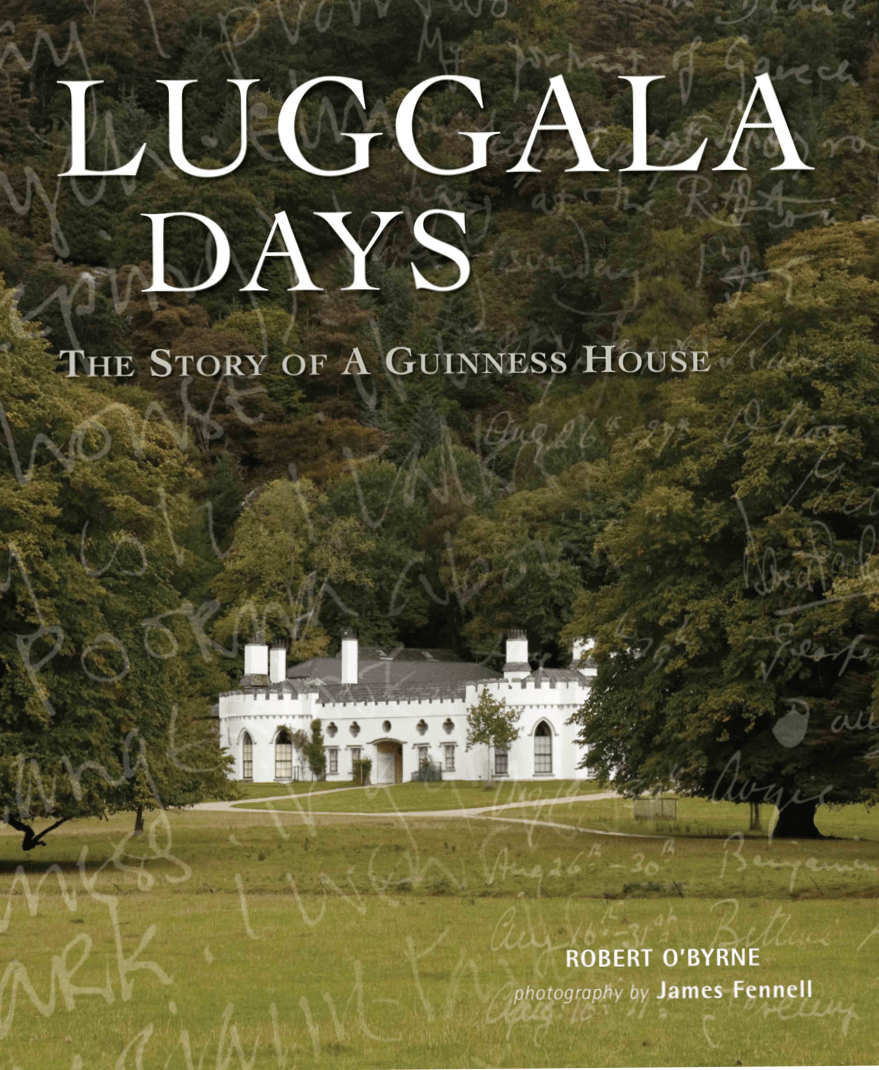
My new book, Luggala Days: The Story of a Guinness House, has now been published.

Sapientia in Libris Exsistit*

Both Marsh’s Library, attached to St Patrick’s Cathedral, Dublin and the Bolton Library in Cashel are rightly well-known foundations. Much less familiar to the public is the Cotton Library belonging to St Carthage’s Cathedral in Lismore, County Waterford. St Carthage (otherwise known in Irish as Mochuta) first established a monastery in his native Kerry but finally settled in Lismore in 635, dying there some two years later.
The small cathedral bearing his name, originally the abbey church of St Cathage’s foundation, has gone through a series of vicissitudes, being burnt by the White Knight at the start of the 17th century, re-roofed by Richard Boyle, the great Earl of Cork soon after, then damaged again during the 1640s before being rebuilt three decades later by the Irish Surveyor General William Robinson whose other extant works include Marsh’s Library. The greater part of the cathedral structure as seen today dates from the beginning of the 19th century when it was extensively reconstructed first by Sir Richard Morrison and then by the brothers James and George Richard Pain.
Only after they had all finished their work did Henry Cotton establish the library which now bears his name. Born in Oxford in 1789 Cotton was appointed sub-librarian of the university’s Bodleian Library in 1814, retaining that position for eight years by which time he had been admitted to holy orders. In 1823 he moved to Ireland where he became domestic chaplain to his father-in-law Richard Lawrence who had recently been elevated to the Archbishopric of Cashel. In 1834 Cotton was elected Dean of Lismore, retaining this position until the end of the following decade when failing eyesight obliged him to retire. A considerable scholar, he wrote many books, most notably Fasti Ecclesiæ Hibernicæ, a five-volume history of the Irish church including the succession of prelates and members of the country’s cathedral bodies. He died in 1879 and is buried within the cathedral grounds.

Believed to date from 1851, the library he founded can be reached by a door off the north transept of the cathedral followed by a short flight of wooden steps. It is unclear whether the room housing the library was built for this purpose or converted when Cotton made his donation. It’s not a large space and much of the north wall is taken up by a wide vaguely Tudor-esque window which provides ample light to the interior but limits opportunities for the bookcases with their charming castellations and spires. The centre of the east wall has a quartrefoil window bearing the arms of the Dukes of Devonshire (who have owned adjacent Lismore Castle since it passed into their hands in the 18th century courtesy of a Boyle heiress) and their motto ‘Cavendo Tutus’ or Safety through Caution. As if testifying to these words, the fireplace immediately beneath the window is now blocked by a display case.

The core of the collection is made up of Cotton’s own library, enhanced by a variety of gifts made over the past 150 years. Among the holdings are a 16th century English translation of John Calvin’s writings and an English translation of the Koran dating from 1734, as well as some works by the great 17th century polymath Robert Boyle. Second-youngest of the first Earl of Cork’s fourteen children, Boyle was born in Lismore and spent part of his adult life in Ireland but eventually left the country since he found it impossible to continue his chemistry research here. There are also quirky items of the sort that give any library its particular interest, not least a Victorian box with the words ‘Exceeding Great and Precious Promises’ on its cover. Inside the box are over 100 tiny scrolls, each bearing a religious injunction; the idea is that you remove one scroll every morning and then implement its directive over the rest of the day.

St Carthage’s current dynamic Dean, Paul Draper, would like the Cotton Library to be more accessible, and appreciated. At the moment there are problems concerning security and safety that would need to be resolved. In addition, some funding for the project is required since the room itself needs attention, especially the western corner of the north wall. Conditional on those issues being addressed, there’s no reason why the Cotton Library shouldn’t provide another reason to visit Lismore and its handsome cathedral.

*Wisdom resides in books