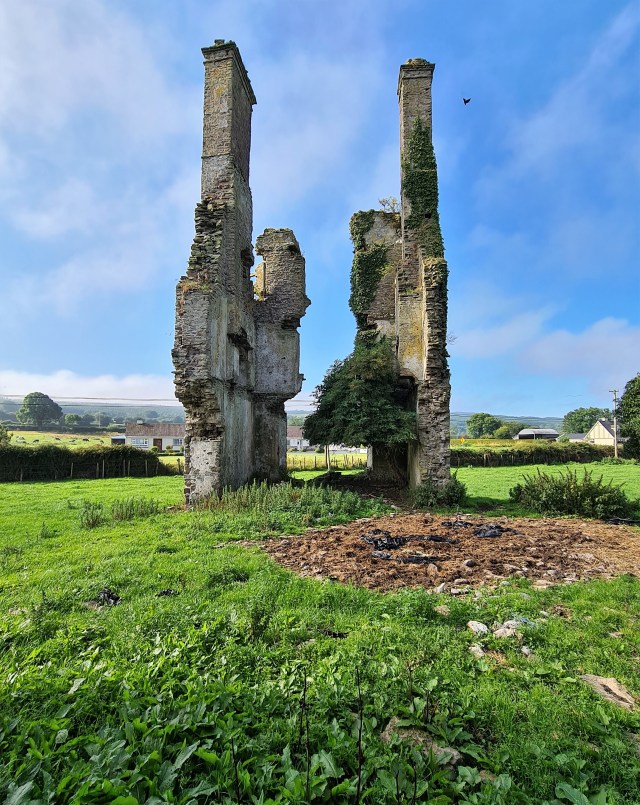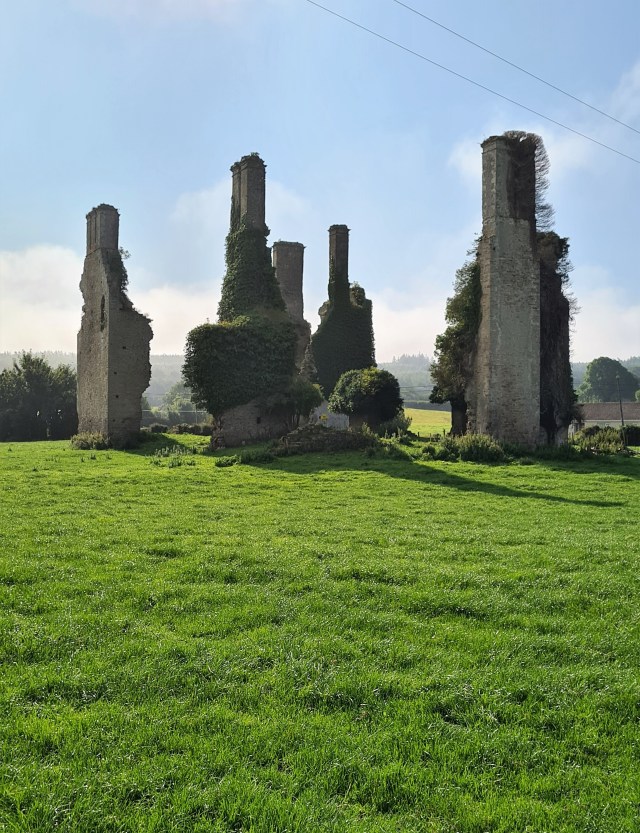
Disheveled


Daingean, County Offaly was formerly called Philipstown, the name given to it in the mid-16th century in honour of her husband (Philip II of Spain) after whom this part of the world was also given the nomenclature King’s County. Philipstown was intended to be the county town (like Maryborough – now Portlaoise – in neighbouring Queen’s County – today County Laois). However, even before the end of the 18th century, the place was being eclipsed by Tullamore and never recovered its status. A couple of buildings survive to show Philipstown’s municipal ambitions, not least the courthouse which dates from the first decade of the 19th century and replaced an earlier building. This one, with a large market square in front, is of five bays and two storeys, the two outer ones pedimented with relieving niches beneath and limestone urns above. The slightly recessed three centre bays are rusticated on the ground floor, and divided by limestone pilasters on the first (seemingly there were once windows between these). The building has had a chequered history, intermittently allowed to fall into poor condition, and it does not appear to be in great shape at present, despite some work being undertaken there a few years ago. In his excellent Pevsner Guide to Central Leinster, Andrew Tierney politely describes the courthouse as being ‘disheveled at the time of writing.’ Others might opt for stronger language.


Help Urgently Needed II


In a wonderful location looking east across Lough Arrow, Ballindoon, County Sligo was originally called Kingsborough, thereby indicating it was built for a branch of the King family who some lived some 25 miles away at Rockingham, County Roscommon. The latter house was designed by John Nash and Ballindoon has sometimes also been attributed to him, but since it is believed to date from c.1820 perhaps it can only regarded as being in his style: by that date the architect was far too busy with royal commissions in London to have time for an Irish client. Essentially a lake-side villa, Ballindoon is a building of exceptional character, beginning with the immense pedimented Doric portico on the north-facing entrance front, its scale overwhelming the single bays on either side. Similarly the garden front is dominated by an enormous dome-topped bow, with a further series of engaged Doric columns around the ground floor. Unfortunately, like Hollybrook a few miles to the west (see previous entry), Ballindoon has stood empty for some years and is now suffering as a consequence, with what appears to be dry rot appearing on the upper floor: the insertion of uPVC windows throughout the house probably doesn’t help. Ballindoon was offered for sale with 80 acres three years ago, but remains unsold, and accordingly remains at risk.


Help Urgently Needed I


In a wonderful location looking east across Lough Arrow, Hollybrook, County Sligo dates from the mid-18th century when believed to have been built to replace an earlier castle on the site: the estate then belonged to the ffolliott family around 1659, subsequently passing in and out of their possession on at least one occasion. In the last century it was run for several decades as an hotel (see a fascinating piece of film from 1938 showing it in use for this purpose: (1) Holiday at Hollybrook House, Co Sligo 1938 – YouTube) but in recent decades the house has stood empty and falling into the present state of decline; despite being on the market for several years along with 275 acres, it remains unloved. In urgent need of help if it is to survive, Hollybrook is of three storeys over basement and superficially appears to be a typically symmetrical building of the period. However, an examination of the facade shows that the handsome Doric portico is slightly off-centre: note how it is closer to the window on the left than to that on the right. The rear of the building shows similar idiosyncracies in the fenestration placement. One wonders therefore whether the old castle, probably a tower house, wasn’t demolished but, as happened in other instances, incorporated into a new house. Alas, an examination of the interior would be required to take this investigation further.


The Age of Improvement


Another abandoned Church of Ireland church, this one in Affane, County Waterford. Set in the midst of a substantial graveyard, the building dates from 1819 when erected at a cost of £500 with the usual support from the Board of First Fruits. This was a period when considerable numbers of such churches were being either built or restored across the country as part of an effort by the Church of Ireland to provide better facilities for worshippers and, it was hoped, increase the number of persons attending services: Affane church could accommodate 200 people although it is unlikely it did so very often. Already by 1874 the parish had been united with that of Cappoquin and by the condition of the building – today a relic from the Anglican Church’s age of improvement – it looks to have been long out of use.

…To the Other End of Town


Located at the northern end of Rathdrum, County Wicklow, this is what remains of Ardavon, once home to the Comerfords, a family responsible for building a mill in the lower part of the town in the mid-19th century. The mill eventually closed in 1935 but the buildings still stand on one side of the bridge crossing the river Avonmore. Meanwhile the Comerfords remained at Ardavon until 1958 when the house was acquired by the Wicklow County Vocational Education Committee. It was then used as a school but in 1991 Avondale Community College opened and Ardavon became redundant, a property owned, but not used, by the local authority. Soon enough the inevitable happened: in 1997 the house was badly damaged by fire and despite undertakings by Wicklow Council to undertake restoration work, it has remained a roofless ruin ever since.


From One End of Town…


Located at one end of Rathdrum, County Wicklow, this is the former Royal Fitzwilliam Hotel, opened in October 1863 beside the station by the Dublin & South Eastern Railway. Although trains still stop here, the hotel closed in 1931 and appears to have been left empty for many years, although for a brief period earlier this century it was used to house asylum seekers. At the height of the economic boom, it was offered for sale at €1.9 million, but failed to find a buyer: by 2013 the price had plunged to €150,000, but still there were no takers. In the interim it was subject to vandalism before finally, in December 2009, being badly damaged by fire. Since then its condition has further deteriorated and is now in a pitiful state, with the handful of distinguishing features such as the cast-iron drinking fountain, being allowed to rot.


On a Clear Day


As far back as the late 13th century Herbertstown, sometimes called Harbourstown, County Meath was associated with the Caddells, a family of Anglo-Norman origin who, despite the Penal Laws, remained true to the Roman Catholic faith and at the same time managed to hold onto their lands in this part of the country. Their residence here, of two storeys and six bays with the facade distinguished by an Ionic portico, was originally constructed in the mid-18th century but presumably later enlarged or altered, as it was described by Samuel Lewis in 1837 as ‘a handsome modern mansion, with a demesne comprising more than 400 acres tastefully laid out and well-planted, and commanding an extensive view from the summit of a tower within the grounds, which forms a conspicuous landmark to mariners.’ Herbertstown House was demolished at some date in the 1930s/40s but the ‘tower’ survives. Dating from c.1760, it is actually a polygonal limestown gazebo, with large round-headed openings on each side, one of which drops to the ground to provide access to the interior. Although now roofless and open to the elements, a balustraded platform around the top of the building (once section missing) indicates this once held a viewing platform, which makes sense as the gazebo stands at the summit of an artificial mound and offers superlative prospects of the surrounding countryside. Local legend has it that the Caddell responsible for constructing the building used it to watch racing at Bellewstown, some four miles away, after he had fallen out with the event’s organisers.


Differing Fates I


The two-storey gatehouse which formerly provided the main entrance to the Rockingham estate in County Roscommon; this building, like most of the others here, was commissioned by Robert King, first Viscount Lorton from architect John Nash. The gatehouse, however, is not in the classical idiom employed elsewhere at Rockingham but instead is an exercise in Tudorbethan Gothic with a crenellated parapet and pointed-arch windows, sandstone used for the main body of the building and limestone for the dressings. For the past half century this part of the former estate has been in public ownership, jointly managed by the local authority and Coillte. It might therefore have been thought that the historic buildings under their care would be decently maintained, but instead the gatelodge, under which many visitors pass as they arrive at the site, has been allowed to fall into neglect; hardly an impressive introduction to the place. Instead of being left in its present condition, the building ought to be restored, and could repay investment by being offered for holiday lets.


Vast and Magnificently Furnished


According to Burke’s guide to Irish Landed Gentry published in 1899, the Gerrards of Gibbstown, County Meath were ‘a branch of the family to which belonged Sir Gilbert Gerrard, 1st bart., of Fiskerton, co. Lincoln (a descendant of the Gerrards of Ince). During the English Civil War, Sir Gilbert had been an ardent royalist, which may explain why the Gerrards wished to claim association with him. In fact, they were an old Anglo-Norman family who for centuries had been based not far from Gibbstown at the now-ruined Clongill Castle. Gibbtown, meanwhile, belonged to a branch of the Plunket family, who built a tower house here. At some date in the second half of the 17th century, after the lands had been confiscated from the Plunkets, they were acquired by Thomas Gerrard, who died at Gibbstown in 1719, leaving it to his eldest son John. His two other sons were Thomas, who was left Liscarton (see Liscarton « The Irish Aesthete) and Samuel who lived at Clongill from where he corresponded with the likes of Jonathan Swift and Alexander Pope. Meanwhile, the main branch remained at Gibbstown, while also spending time at another County Meath property, Boyne Hill. When travelling through Ireland in 1776, Arthur Young visited Gibbstown and met its owner, another Thomas Gerrard with whose farming methods he was much impressed (‘he has made many covered drains with stones, the effect of which is great; and he has his fields fenced in the most perfect manner by deep ditches, high banks and well planted hedges’). At the time the estate ran to 1,200 acres bringing in annual rent of £1,300. Following the second Thomas’ death in 1784, Gibbstown was inherited by his only son John Gerrard, who married a County Galway heiress but the couple had no children, so in 1865 the estate passed to a nephew, once more called Thomas. He likewise had no children, and so following his death in 1913 the place was inherited by a nephew, Major Thomas Gerrard Collins, who two years later assumed the additional surname of Gerrard. He would be the last of the family to live here as by 1927 the Land Commission had moved in and the Gibbstown estate was broken up. The following decade it became a Gaeltacht area (now called Baile Ghib) in which Irish speakers from Donegal, Mayo and Kerry were settled on small holdings of 22 acres each. 


Until 1865 the Gerrard family at Gibbstown had occupied what appears to have been a long, two-storey 18th century dwelling attached to the late-medieval tower house. However, when Thomas Gerrard inherited the estate from his uncle, despite being a bachelor he decided to embark on constructing a new residence for himself elsewhere on the estate. This was no modest building but a vast Italianate palazzo designed in the early 1770s by William Henry Lynn. Of three storeys and seven bays, faced with cut limestone and entered beneath a Doric portico, the house also featured a long colonnade which led to a free-standing campanile; it was commonly believed that the cost of building and fitting out the new Gibbstown had run to £250,000. A description of the property in the Irish Times in 1912 noted that the centre of the house was dominated by a hall rising some 80 feet and topped by a stained glass dome, with galleries running around the upper floors off which opened the main bedrooms, each of which were ‘vast and magnificently furnished, the adjacent dressing rooms also being large beyond custom, and each set of rooms was furnished with a different suite of furniture, which formed an interesting study in itself…A circular marble corridor formed an imposing feature of the building, and on the first floor were two great sitting rooms, a long and magnificent drawing room, and a dining room; where the roof and tapestried walls harmonised well with the richness of the furniture.’ Alas, Mr Gerrard and his nephew did not enjoy these surroundings for very long before much of them were destroyed: in April 1912 fire broke out in Gibbstown, largely gutting the two upper floors and destroying the aforementioned stained glass dome in the central hall. Fortunately many of the contents were rescued, including a large collection of Chinese porcelain including some pieces, according to the Irish Times, which had come from Paris’s Tuileries Palace, destroyed in 1871. In May 1913 Thomas Gerrard died at the age of 78, by which time Major Thomas Collins Gerrard had already embarked on a restoration of the house, the architect this time being the ubiquitous James Franklin Fuller. But as already noted above, change was in the air and Gibbstown would not be occupied for much longer. In June 1930, Battersby & Co began auctioning the house’s contents, so substantial that it took a fortnight to dispose of them all. Among the best-sellers was a Chinese Chippendale table that made 110 guineas, a satinwood reading table that went for 30 guineas, a carved Italian marble chimneypiece (33 guineas) and an ormolu and bronze clock surmounted by a figure representing Alexander the Great (22 guineas). So it went on, day after day until everything was gone. Five years later Major Gerrard presented the Royal Dublin Society with a bronze vase four feet, eight inches high on a two-foot high pedestal by Major Gerrard. The vase features the figures of Day and Night after Thorvaldsen from plaques exhibited at the Great Industrial Exhibition held in Dublin in 1853: now painted blue and white and beside a plaque announcing that it had been given on permanent loan by ‘the last Gerrard of Gibbstown’ it can still be seen outside the RDS’s premises. 


Major Gerrard died in 1945, but even before then the great Italianate house, built barely 70 years earlier, and rebuilt after the fire just over 30 years before, stood an empty anachronism. In this instance however, unlike many other such buildings, it was not demolished but instead taken down, with the stones carefully numbered before being brought to the Cistercian monks at Mellifont, outside Collon, County Louth; the intention was that they would be used in the erection of a new church. However, that never happened and instead, over a period of time, the stonework was sold off piecemeal and used in various other properties around the area. Meanwhile, a wrought-iron aviary from Gibbstown ended up being used in an arcade in Drogheda, County Louth. So, the late 19th century house has gone, but its predecessor remains – just about. It will be remembered that before Thomas Gerrard embarked on his grandiose scheme, the family had lived in an older building, an extension to the late-medieval Plunket tower house. This structure was incorporated into an immense series of 18th and 19th century yards, including stables, coach houses, animal sheds, staff accommodation and much more. These are in turn linked to very substantial walled gardens, the whole offering testimony to the high standards of farming here noted by Arthur Young back in the 1770s. Internally the house consists of a series of rooms often opening one into the next or connected by long, narrow corridors, suggesting the building is relatively early in date and may even have originated in the 17th century. And a couple of the rooms retain at least some of their charming rococo plasterwork. How much they continue to do so is open to question, since in recent years the site has been used as an urban assault airsoft venue (in which participants attempt to eliminate each other using replica weapons). Good clean fun, no doubt, but not necessarily beneficial for the buildings. It will probably be only a matter of time before the surviving remnants of the Gibbstown estate disappear for good.

Quite Batty


The former Roman Catholic church at Derrycunnihy, County Kerry dates from the last quarter of the 19th century and is thought to have been built on the instructions of local landowner Valentine Browne, fourth Earl of Kenmare whose family, despite their large estates, had always remained Catholic. Located close to Ladies View and offering panoramic prospects over the surrounding countryside, the church is almost set into the rocky surroundings, its relatively plain design distinguished only by the polygonal apse. Seemingly it was damaged by fire in the 1950s and then abandoned for services the following decade after which it fell into disrepair. However, the state has now begun restoration work on the property, which is home to a number of protected species including Lesser Horseshoe Bats and Barn Owls.