A Matter of Concern


The old market house in Ballybay, County Monaghan. It was built in 1848 to replace an earlier building serving the same purpose which stood on another site but found to be in poor condition and demolished. Markets were held on the ground floor under the arches, while the space upstairs was used for a variety of purposes: a schoolhouse, a courthouse, a library and an assembly room for dances and concerts. Designed by William Walker, last year the building was offered for sale: now the old market house stands sadly neglected with the threat that it could yet go the same way as its predecessor.

The Last of his Line


From the Journal of the Royal Society of Antiquaries of Ireland, Volume XXVIII, Part IV (1898) by Francis Joseph Bigger: ‘The ancient church of Kilmakilloge stands on a rocky eminence a little north of Bunaw. Burials have been very numerous in the interior of the church ruins, and many bones and portions of coffins are strewn about. The gravestones clearly denote the overwhelming proportion of O’Sullivan to any other name; and one curious monument to the east of the church bears an inscription worth recording. This monument is a high, square altar-tomb raised on steps and supported on four carved pillars, the intervening spaces being filled with stone panels. On the east end is the following inscription “I H S This Monument contains the Last Remains of the Late McFININ DUFFE He DEPD THIS LIFE THE 1 DAY of SEPT 1809 aged 58 years Pater Patrie.” This McFinin Duffe was an O’Sullivan, and the last of his line.’

Nature Stakes Her Claim


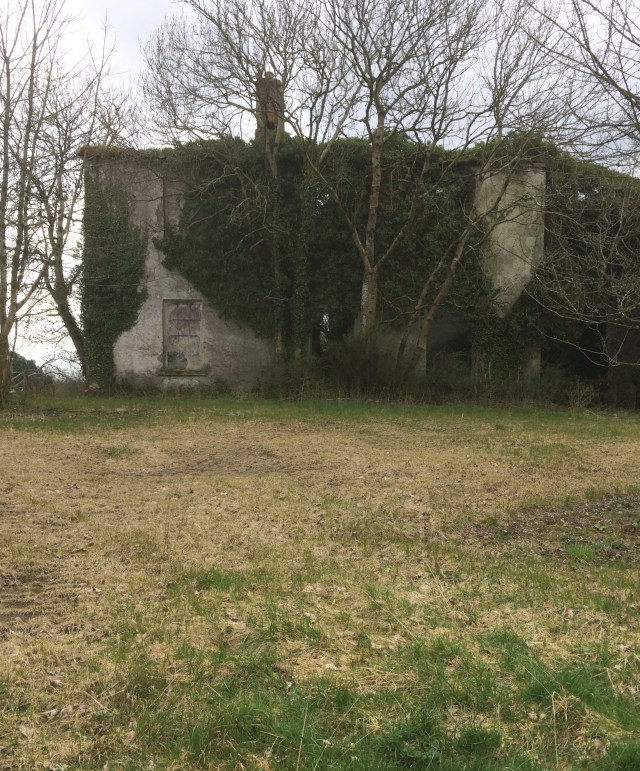
An abandoned farmhouse in County Westmeath. Normally it is the smaller, less-well constructed buildings which are forsaken, but this one was sturdily built and so its neglected condition is somewhat surprising. The interior still contains much of its furnishings, although now in some disarray. Soon the roof will give way and then the walls tumble, allowing Nature to stake her claim to the site.

Truncated

The truncated remains of Causetown Castle, County Meath. Otherwise known as Lisclogher, this late-mediaeval tower house is believed to have been built for the Dowdall family, settled in the area since the arrival of the Anglo-Normans.


The building has curved angles on two sides and a pair of circular towers on the other pair, that to the south-east, which contained garderobe closets, being in better condition and rising three storeys, as no doubt once did the whole castle. However, at some date the upper portion was lost so that now the interior contains little other than a ground floor barrel-vaulted chamber.

Six of the Best

Milltown Park, County Offaly

Lambay, County Dublin

Castletown, County Kildare

Dublin Castle

Moore Hall, County Mayo

Mount Shannon, County Limerick

Six years ago on September 24th 2012, the Irish Aesthete made its debut. What was the intent behind this initiative? Impossible to recall, although then as now a primary motivation was encouraging greater and more widespread engagement with Ireland’s architectural heritage, much of which remains at risk from either neglect or misuse. Over the past six years, some aspects of the site have changed, others remained the same. Very soon, the format of a thrice-weekly posting was established, with longer features each Monday and shorter ones every Wednesday and Saturday. The quality of photographs has certainly improved and, one hopes, will continue to do so (not least thanks to improvements in the calibre of mobile phone cameras). There has been a consistent effort to represent the entire island of Ireland, and to show the good, the bad and – with regrettable frequency – the ugly. What hasn’t altered throughout this period has been the attention of friends and followers, which is enormously appreciated: without regular support and feedback, it is unlikely the Irish Aesthete would have continued for so long. Therefore thank you to everyone who has shown interest in this site: you make it worthwhile. Happily today the Irish Aesthete is read across the world and has led to other opportunities for writing and speaking engagements, thereby helping to spread the gospel of our architectural history. A further outcome is that early next year the first book of Irish Aesthete photographs will be published, about which more in due course. Meanwhile, to mark today’s anniversary, here are six personal favourites taken over the years. You may have made other choices from the site: please feel free to share your own suggestions. Of the six shown above, two are properties in private hands, two are in public ownership, and two are ruins. All however are important elements in our common cultural heritage.

At a Crossroads


On the cusp of dereliction: a two-storey, three bay house of coursed rubble limestone at Glencara Crossroads, County Westmeath. Likely dating from the early to mid-19th century, the building is close to Glencara House and may have been associated with that estate, perhaps built for an agent or worker there. Glencara House was constructed c.1824 for the Kelly family to the designs of an unknown architect but alterations were made around 1840 (attributed to J.B. Keane). These included the addition of canted bays, not unlike the clearly added to this little two-storey property, although this is somewhat less sophisticated: note how the entrance and window above are slightly off-centre. Unfortunately the househas stood empty and neglected for a number of years and, like the location, its future is now at a crossroads.


How to Kill a Street


The former entrance to a house on Lower O’Connell Street, Kinsale, County Cork. One of a terrace testifying to the long-standing prosperity of the town, these handsome residences date from c.1800 and have fine cut-limestone door cases and slate covering their upper storeys. All of them have been incorporated into an hotel which faces the harbour. This means the entrances have all been closed, and insensitive uPVC windows inserted at every level. As a consequence an entire section of Lower O’Connell Street has lost both character and, just as important, public engagement. Shabby and neglected, what ought to be a thoroughfare just as bustling as others in Kinsale has instead become a dead space.

Whence Came the Wealth


Following Monday’s account of Belview, County Offaly, here are some views of the building which provided the funds to build a fine house. Ballycahan Mill (located in County Westmeath, although only a few hundred yards distant) is believed to date from the late 18th century, the main structure being a three-storey block used for the bleaching and scutching of linen. On a map of 1838 the field to the southwest of the mill is described as the ‘old bleach green’ indicating that the surrounding land was also used as part of the industrial process. Like Belview, this building is now just a shell.


Not Such a BelView


Writing of agriculture and manufacturing in County Offaly in 1801, Sir Charles Coote noted that the linen industry then thrived, with several local landowners ‘who keep looms employed, but do not bleach. Mr Holmes of Prospect and Mr Armstrong of Belview are the most extensive manufacturers, and both have large greens, but they only bleach their own linen, their [sic] being bleach yards for public accommodation.’ Almost twenty years later Peter Besnard, Inspector-General for Trade and Manufacture of Linen and Hemp in Ireland, produced a report in which he commented on Offaly: ‘The Manufacturing and Bleaching branches of the Linen Business are carried on in this county as usual, particularly in the neighbourhood of Clara and Charlestown; in the latter place, a new Linen Hall has been built by Andrew Armstong Esq. of Belview, whose family have long been supporters and encouragers of the Linen Trade. Mr Armstrong has built this Hall at his own expense, and likewise gives a premium for the best Web sold in it; and I cannot avoid remarking, that wherever premiums have been established, and judiciously applied, they have been productive of much benefit.’


The Armstrong family appears to have settled in this part of the country in the 18th century, one John Armstrong (born 1748) marrying Jane Holmes, whose family lived nearby in a house called Prospect (still standing). He married a second time and had a son Andrew Armstrong, the man mentioned by both Sir Charles Coote and Peter Besnard as being active in the linen industry. A large range of now-derelict buildings on ground below Belview testify to the one-time importance of this business, in the 18th and early 19th centuries by far the most commercially viable in Ireland. From the early 1700s onwards Irish linen was imported duty free to England and to the American colonies, so that eventually this one product accounted for around fifty per cent of Ireland’s total exports. It is understandable that so many entrepreneurial spirits became involved in the business and, if they managed their concern sufficiently well, grew rich, as did the Armstrongs. As was so often the case, they gradually climbed the social scale, moving away from the commercial class to become landed gentry. John Herbert Armstrong, for example, who inherited Belview in the mid-19th century , joined the army and served as a major in the Royal Tyrone Fusiliers. He further cemented his gentry status by marrying Eliza Catherine Lowry whose family, related to the Earls of Belmore, lived at Pomeroy House, County Tyrone. Their son in turn married Emily Theodosia Blacker-Douglas whose family were large landowners (with over 8,000 acres in County Kerry) and lived in Elm Park, outside Armagh. However, after selling their estate in 1912 under the Irish Land Act, the Armstrongs left Belview, which was subsequently leased to a variety of tenants.


Located on the border of Counties Offaly and Westmeath, Belview is a substantial house, the front portion of which dates from the second half of the 18th century. To the rear is an older L-shaped building which looks to have been adapted into a service wing when the newer section was added. The latter featured the usual layout of the period, with a drawing room, dining room and morning room/office opening off a central entrance hall on the ground floor: traces of neo-classical plasterwork survive in some of these spaces. Outside the east-facing façade is of five bays, with a Venetian window on the first floor. Below a short flight of stone steps led to a tripartite limestone doorcase with engaged Doric columns and an open pediment. The house testifies to the Armstrongs’ wish to identify themselves with the local gentry, as well as to the wealth that could be accumulated through the linen trade. A folly built in the form of a monastic round tower by Andrew Armstrong in 1817 and now buried in the nearby woodland, likewise provides evidence of the family’s social ambitions. The house was abandoned some decades ago and is now a roofless ruin.

Out of Work

An unrestored section of the former union workhouse at Donaghmore, County Laois. As with the majority of such buildings erected across the country from 1839 onwards, this one was designed by George Wilkinson, although the earlier neo-Tudor style he employed had long since been abandoned by the time work started here. Completed in September 1853, the project cost £4,750 with a further £775 spent on fittings. By the time it opened, the Great Famine had ended and thereafter workhouses gradually fell out of use: this one closed in 1886. For much of the last century the premises were used by local farmers for the Donaghmore Co-Operative Society. More recently a front portion of the site has been converted into a museum.