How long past were the Glories


‘Inver House embodied one of those large gestures of the minds of the earlier Irish architects, some of which still stand to justify Ireland’s claim to be a civilised country. It was a big, solemn, square house of three stories, built of cut stone, grandly planned, facing west in two immense sweeping curves, with a high-pillared portico between them and stone balustrades around the roof.’


‘The high windows of the great room were bare of blinds and curtains, and the hot afternoon sun beat in unchecked. It was a corner room, looking south towards the demesne, and its longer western side was built out in a wide, shallow curve, with two massive pillars of green Galway marble marking at either end the spring of the curve, and supporting a heavy gilt cornice above the broad window.’


‘Everything that had survived of the original conception of the room, the heavy, tall teak doors, with their carved architraves and brass furniture, the huge, brass-mounted fireplace, the high mantelpiece of many coloured marbles, chipped and defaced, but still beautiful, the gorgeous deep-moulded ceiling that Lady Isabella’s Italian workmen had made for her, from the centre of which the wreck of a cut-glass chandelier still hung, all told of the happy conjunction of art and wealth, and of a generous taste that would make the best of both. But a cursory glance would show how long past were the glories of a great room.’


The above passages are taken from Somerville & Ross’s The Big House of Inver, published in 1925, and while their descriptions of Inver are not an exact match, nonetheless in spirit they seem to capture what one can see, and feel, at Scregg, County Roscommon. Dating from the mid-18th century, the house and surrounding land has for hundreds of years belonged to a branch of the ancient Irish Kelly family and was occupied until the 1980s but has since stood empty. How little in some ways has Ireland changed since the time of Somerville & Ross.


Stooped but not yet Conquered


Originally from County Durham in England, by 1651 Cuthbert Fetherstonhaugh was living in Philipstown (now Daingean), County Offaly, the first of this family to settle in Ireland. His grandson Thomas married Mary Sherlock from Kildare and the couple moved to Ardagh, County Longford where around 1703 he bought some 235 acres of land from the Farrell family. At some point between this acquisition and his death in 1749 he commissioned a new residence in Ardagh; this building is said to have provided part of the inspiration for Oliver Goldsmith’s 1773 comedy She Stoops to Conquer since the playwright mistook the Fetherstonhaugh’s house for an inn. The couple’s eldest son Ralph sat in the House of Commons of the Irish Parliament for 12 years from 1768 onwards and in 1776 was created a baronet. He also simplified the family surname to Fetherston (other branches retained the name in full). His eldest son Thomas, the second baronet, likewise sat as an M.P., in the Irish Parliament until 1800 and thereafter at Westminster until his death in 1819. The third and fifth baronets, Sir George and Sir Thomas Fetherston respectively were responsible for giving the local village of Ardagh its present appearance, by commissioning new housing for the local population. In the early 1860s Sir Thomas employed Dublin-based architect James Rawson Carroll to design one- and two-storey cottages around a green featuring a clock tower erected to the memory of his uncle, Sir George (see Commemorating a Life-long Devotion « The Irish Aesthete)


Sir Thomas Fetherston had only one son, another George, who was only 13 when he inherited the estate. He later became an Anglican clergyman and travelled widely, meaning he did not spend as much time in Ardagh as had his father. Under the terms of the Wyndham Act, in 1903 Sir George sold most of the estate – by then running to some 11,000 acres – to his tenants, retaining only the house and demesne. When he died unmarried at the age of 70 in 1923 the baronetcy died out also. Within a few years, the former family home had been sold to an order of nuns, the Sisters of Mercy who moved into the building and then gradually added extensions to the east side, from which they ran a home economics college. As in the case of so many other such properties, at the start of the present century the nuns gradually wound down operations here and in 2007 the house and surrounding 227 acres was sold at auction for  €5.25 million. However, that sale fell through and it was back on the market for €5; by June 2009, as the effects of recession began to be felt, that price had dropped to €3.25 million. It was finally sold at auction in June 2012 for €1.36 million. Since then, the house has sat empty.


As mentioned, the main house at Ardagh is thought to date from the first half of the 18th century when constructed for Thomas Fetherstonhaugh. But much of its present appearance is 19th century, when it was refurbished first by Sir George Fetherston (who laid out the surrounding grounds) and then by his nephew Sir Thomas. The latter was responsible for the present stable block which, like a considerable portion of the adjacent village, was designed by architect James Rawson Carroll and features a series of cut-stone blocks with half-hipped roofs around a central courtyard. Sir Thomas is thought to have been responsible for adding a two-storey, three-bay ballroom wing to the immediate east of the eight-bay house, as well as the latter’s porch and arcaded conservatory. During the Civil War, an attempt was made to burn down the building, but this seems to have caused little damage. A more serious fire in 1948 led to the nuns then in residence removing the top floor, thereby making the house look longer and lower than would previously been the case. Anyone passing through Ardagh village cannot fail to see the building standing forlorn and unkempt across open ground. It seems unfortunate that a property linked to the family who did so much for the area, and which can claim associations with one of the finest comedies ever written in the English language, should today be left in this sad condition.  

Taking the Initiative


As 2020 draws to what for many people will be a most welcome close, the Irish Aesthete is delighted to announce some good news: an initiative designed to acknowledge the importance of our privately-owned heritage properties. Devised by this writer, the O’Flynn Group Heritage Prize is the first of its kind: a new national award recognising the really significant role played by owners of historic homes. For this reason, the prize is being presented in association with Historic Houses of Ireland, a charity established in 2008 to promote the immediate and long-term future of the country’s privately owned historic properties. All HHI members are owners of such buildings and they understand better than anyone the sector’s particular problems, especially over the past year.


Worth €5,000 and adjudicated by a small group of assessors, the O’Flynn Group Heritage Prize is intended to be presented annually to one property, the owners of which have demonstrated outstanding dedication and commitment to the preservation of the building in their care. Sponsor the O’Flynn Group has already shown itself keenly aware of the importance of providing a viable future for historic buildings, as can be seen in the company’s own redevelopment of the early 19th century former barracks site in Ballincollig, County Cork. The Irish Aesthete would like to thank the O’Flynn Group for the company’s most generous support of this project. 


A 300-year old country house in County Kilkenny has been chosen as the inaugural winner of the new prize. After buying Ballysallagh in 1987, local pharmacist Kieran White and his wife Geralyn moved into the dilapidated building with their three children (then aged between two and five) and embarked on a gradual programme of rescue and refurbishment undertaken over several decades as their financial circumstances allowed. Today Ballysallagh stands as a model of first-rate restoration, internally furnished with flair and taste. Around the house the Whites have laid out herbaceous borders, a herb garden, maple walk and folly. The aspiration is that the Whites will be just the first of many such equally-deserving recipients of the prize over the years ahead.


For more information about Ballysallagh and its restoration, please see today’s Irish Times: Restoring country home glory takes blood, sweat and tears (irishtimes.com)
and for more on the house’s history:
Of the Middle Size « The Irish Aesthete

Lighting up the Night


The sad end of the main house at Loughcrew, County Meath is well-known. The building was said to be the subject of a curse: ‘Three times will Loughcrew be consumed by fire. Crows will fly in and out of the windows. Grass will grow on its doorstep.’ And so it came to pass. The house, designed in severe neo-classical style by architect Charles Robert Cockerell in the early 1820s, did indeed suffer three fires, the last occurring in 1964 and leading to the demolition of its remains a few years later, so that now the Naper family, resident on the estate since the 1650s, live in the former yard buildings. Today just parts of the facade’s great Greek Ionic portico show where it once stood, but elsewhere on the surrounding land, more active restoration has taken place. 


A short distance to the west of the remains of the old house at Loughcrew stands a late-medieval church associated with St Oliver Plunkett who was born here in 1629. The church has a large, three-storey residential tower at the west end, as was often the case with such buildings erected during the late 14th and 15th centuries when much of the country was disturbed by feuding between different families and not even religious buildings were safe from attack. Entrance to the church was via a door at the west end and the interior appears always to have been relatively simple, with a single chapel opening on the south side, the upper portion of the window here being divided in two by a central spandrel featuring the Naper coat of arms. Unlike many such sites, the church continued to be used for services throughout the 17th and 18th centuries. Despite being renovated and re-roofed in 1818, it was abandoned 25 years later when a new place of worship was built elsewhere. 


Immediately adjacent to the old church lies the Loughcrew estate’s walled garden, parts of which are believed to date back to the arrival of the Naper family here in the mid-17th century; there is, for example, a classical arched gateway dated 1673. Over the past couple of decades, much of the garden, which had fallen into neglect has been restored and a number of the earlier features – such as a canal and a formal parterre, been re-instated. Some features of an earlier settlement on the site have also been uncovered. Meanwhile, later aspects of a fashionable country house garden, like the 19th century taste for deep herbaceous borders, can once more be found. Loughcrew and its gardens are a work in progress, but already much has been achieved and the future promises even more. 


Over the coming weeks, every evening Loughcrew gardens are hosting a musical Lightscape open to the public. Further details, and information on ticket purchase, can be found at https://loughcrew.com/loughcrew-lightscape 

The Irish Country House in the 21st Century


So, as 2020 draws to a close, how stands the Irish country house? Indeed, in some instances, does it still stand at all? Certainly, the past couple of decades have produced a great deal of information on the subject, and today much more is known about our historic properties, thanks to considerable scrupulous research and many recent publications (the Irish Aesthete has a shelf-long list of new books on his Christmas wish list). But does our being better informed lead to these buildings being better appreciated, and better cherished?


Certainly, there are instances where Irish country houses have been scrupulously restored, both by the state and private individuals. And many of those who have inherited such properties valiantly continue to devote themselves to making sure this legacy will pass to the next generation. What supports exist to assist them in the undertaking? What are the obstacles, what the challenges?


But other country houses have been lost – and a considerable number remain at risk of loss. To what extent does Ireland pay lip service to its architectural heritage? When it comes to our country houses, how well – if at all – is existing legislation enforced? What protection do they enjoy from decay or ill-conceived alterations? Are owners who fail to look after their historic properties taken to task? And are those who do make an effort duly rewarded?


So many and such complex questions. I shall be attempting to tease out a few of the answers in an online lecture available on the Irish Georgian Society website for a week (only) from tomorrow, December 1st called ‘The Irish Country House in the 21st century: Ruins and Restoration’. You can find more information on www.igs.ie/events (Please note, there is a fee for viewing, and you must book before 3pm tomorrow).

Blowing in the Wind I


Last January, the Irish Times reported that a land parcel of 800 acres in County Tipperary was being offered for sale as a single lot with an asking price of €11 million. According to the article, ‘a wide range of investors and land speculators are expected to express their interest in the sale.’ The reason for that interest, and the figure this parcel was expected to make, arises from the fact that the site contains two substantial clusters of wind turbines (18 and 12 respectively), with a third now underway and expected to active in two years’ time. The turbines were originally developed by a mining company which, between 1999 and 2015 extracted zinc and lead from the ground. Long before the mine closed, in 2009 the company embarked on developing the first group of wind turbines, the second commissioned in 2013. The operation of this business is managed by another body, a Canadian-based global fund called Brookfield Renewable Partners, which in 2016 struck a ten-year deal with Facebook to provide its energy needs: the latest cluster of wind turbines here will generate power for Facebook’s  data centre campus in Clonee, Co Meath, and its new European headquarters in Ballsbridge, Dublin.


Killoran House stands less than a mile from the Lisheen wind farms. For many hundreds of years the land here belonged to members of the Campy or Campie family, the first of whom was a soldier Solomon Camby, originally from Norfolk it seems, whose name is mentioned in reports of the Battle of Marston Moor (July 1644) when Parliamentary forces defeated the Royalist army. He was then a member of the cavalry regiment that came to be known as the Ironsides; Camby was part of what was called the ‘Maiden Troop’ headed by Captain Robert Swallow and drawn from Norwich. Subsequently in 1649 he came to Ireland as part of the New Model Army and was involved in crushing opposition here; he appears to have been in County Mayo in 1653 when English troops attempted to burn down Ballintubber Abbey. Like many other soldiers, he was rewarded for his services in land, and this was confirmed by the post-Restoration English government in 1667 when Major Solomon Camby was granted over 1,700 acres in the barony of Lower Ormond, County Tipperary and some 90 acres in the barony of Forth, County Wexford. One may assume that the original Solomon Camby was a staunch Protestant, but in the 18th century one of his descendants married a member of the Lalor family, who had always remained Roman Catholic. By the time Solomon Lalor Cambie inherited the former Lalor estate at Killoran in the following century he must also have been a Catholic (since he was educated by the Jesuits at Clongowes Wood College). His land holding ran to almost 1,600 acres and it was probably for this reason that he decided to build a new residence for himself.


Killoran House dates from around 1850, and is a typical solid gentleman’s residence of the period, with an extensive yard to one side of the building. The three-bay, two storey entrance front is curious because the centre bay entrance projection has its door around one side. The front, on the other hand, is taken up by a large and elaborate fanlight window; inside, the space directly above acts as an additional room off the landing, accessed via a pair of shuttered doors. Otherwise the interior is, again, typical of the time although the cantilevered staircase is lighter than usually the case for the mid-19th century. Currently on the market, the house is in a very poor state of repair, and looks to have been left empty for quite some time. Many of the windows are broken and slates missing from the roof. As a consequence, large quantities of rain water have entered the building and some upper floors have collapsed. Almost all the interior fittings like chimney pieces have been removed. Surrounded as it is by wind turbines, and with more due to be added to their number shortly, Killoran House’s prospects do not look cheering. The property is, naturally, included on the local authority’s list of protected structures.


Apologies to anyone who looked at this earlier when the text was missing…

Another World


Powerscourt, 1925

Frank Browne, better known as Fr Browne, was without doubt the finest photographer working in Ireland during the middle decades of the last century. Taking some 42,000 pictures, all of which he carefully catalogued before his death in 1960, he left behind an astonishingly rich record of daily life throughout the country over that period. Even more remarkably, photography began, and remained, an extra-curricular hobby because Frank Browne was first and foremost a Jesuit priest. His activities as a photographer had to be fitted in – and sometimes set aside – as and when was required by his superiors in the order. This makes his achievement in the medium all the more impressive. It is clear that he could have made a comfortable living from his work, but chose not to do so. All financial compensation he received for his work, and during certain busy periods the amounts were substantial, he was not permitted to retain: the money was immediately forwarded to the Provincial Treasurer of the Jesuit order. Among the payments he received were those for a series of images of Ireland’s country houses, commissioned by the Irish Tatler & Sketch. Published monthly, the photographs were accompanied by Browne’s own texts, in which he discussed the building in question and its history. It says a great deal about the man’s character that he managed to gain the trust of so many owners, who allowed him access to their properties, which were then still private and not open to the public. The pictures he took on these occasions are a fantastic but hitherto insufficiently explored resource, since they show interiors of many houses either since lost or radically altered. What’s particularly interesting is to look at how such buildings, still occupied by their original families, were then furnished as it is indicative of decorative taste at the time, often little altered from the 19th century. The pictures also provide viewers with a wistful awareness of what has been lost, usually sold at auction and frequently taken out of the country. Some of these images are included in a newly-published book, Wandering Wicklow with Father Browne, and they are shown here.


Killruddery, 1947

Killruddery, County Wicklow is today one of Ireland’s most popular and visited country houses, enjoying the benefits of being located on the edge of Dublin. It has been home to successive generations of the Brabazon family, Earls of Meath, since the early 17th century. The core of the building dates from that period, but heavily encased in a number of later additions, the most substantial being made by father and son architects Richard and William Vitruvius Morrison during the 1820s when they greatly enlarged the house and transformed its exterior to resemble an immense Tudor mansion, further alterations being made some forty years later when William Slater added a Dutch gable and Oriel window to the south front. A decade earlier, the present conservatory was constructed, replacing an earlier one that was part of the Morrisons’ contribution. Browne’s photographs were taken in 1947 when all of this was still in place. But just a few years later, extensive dry rot was discovered in parts of the building and the fourteenth Earl of Meath took the decision that demolition was the only option. Accordingly, in the early 1950s the entire entrance front on the north side was pulled down and the remainder remodelled by Claud Phillimore. At least a third of the house was lost including the double-height entrance hall seen here, along with an equally monumental dining room and other spaces. Browne’s pictures provide an invaluable record of how Killruddery appeared before these revolutionary changes were instigated.


Shelton Abbey, 1947

The Howard family came from the village of Shelton in Nottinghamshire, and remembered this when they chose to name their Irish house Shelton Abbey. The original building here is thought to have been constructed for Ralph Howard, first Viscount Wicklow, in the mid-1750s, its design attributed to English architect Matthew Brettingham. In 1819 Howard’s grandson, William-Forward Howard, 4th Earl of Wicklow invited the Morrisons père et fils to remodel the building so that it might resemble ‘an Abbey erected in the fourteenth century, and…formed into a baronial residence shortly after the Reformation’ although the architects complained the result was less perfect than they might have wished since the owner wished to retain as much as possible of the original fabric. Some of the interiors, such as the library and dining room, retained their classical decoration but others, not least the main drawing room, were made over in Tudor Gothic style with wonderful fan vaulted ceilings. During the 1740s the first Ralph Howard had undertaken a Grand Tour during which he was painted by Pompeo Batoni and acquired a number of old master works and antiquities. Subsequent further generations of the family married well and added to Shelton Abbey’s contents so that by the time the eighth, and last, Earl of Wicklow inherited the place it was filled with treasures. Unfortunately, his bank balance was less well stocked and in 1947 he decided to open his home as an hotel. Just before this happened, Browne was invited to photograph the building, the first such job he undertook for Irish Tatler & Sketch. His pictures therefore show Shelton Abbey when still a private property. Sadly, the earl’s scheme was not a success  – it was perhaps too early for the allure of a country house hotel to be appreciated – and in 1950 he made the decision to sell the estate. A sale of the contents duly followed and took an astonishing 13 days, an indication of how impressive they were, with dealers coming from England and the United States to snatch up many bargains. Today Shelton Abbey is an open prison and its interiors, bereft of their former contents, have suffered from indifferent maintenance. This gives Browne’s pictures a particular poignancy, not least one showing Mr Virtue, the house’s long-serving butler, looking apprehensively out the front door as he awaits the arrival of paying guests.


Humewood, 1947

Wandering Wicklow with Father Browne is published by Messenger Publications (www.messenger.ie) and now available in all good bookshops.


Disregarded


A week ago, this site explored the old house at Clonalis, County Roscommon and explained why in the last quarter of the 19th century it was abandoned for another residence elsewhere on the property. The branch of the ancient O’Conor family who still live here moved to Clonalis exactly 200 years ago, in 1820; prior to that they had been living elsewhere in the county. As mentioned, by the early 1700s the great O’Conors had been brought low, a consequence of their support over previous decades for the Roman Catholic and Jacobite causes, and the harsh penalties duly imposed on them. The head of this branch, Denis O’Conor, was known as ‘The Heir to Nothing’ as all his ancestral lands had been taken from him; supposedly he advised his own children never to be impudent to the poor because, ‘I was the son of a gentleman but you are the sons of a ploughman.’ In 1720, aided by his uncle, Counsellor Terence McDonagh he won a case in the Dublin courts that restored him a portion – 500 acres – of his patrimony. According to family tradition, he was so poor that he had to walk to the capital barefoot. On this parcel of land at Ballinagare, he built a new house for himself; until then, he had been living in a mud hut in County Sligo. This house became a home for Denis O’Conor’s extended family, including his mother-in-law, Countess Isabella O’Rorke who had been a Maid of Honour at the court of the exiled James II in Saint-Germain-en-Laye, and his maternal uncle, Thadeus O’Rorke, former Chaplain to Prince Eugene of Savoy but by then the fugitive Catholic Bishop of Killala. The house also became a centre for anyone who espoused the old Gaelic culture, not least the period’s most famous bard and harpist Turlough Carolan who composed airs in honour of Denis O’Conor, his wife Maire, and their son Charles. A harp used by Carolan is still kept at Clonalis, along with the chalice of Bishop Thadeus O’Rorke his pectoral cross, liturgical vestments and an Episcopal ring presented to him by Prince Eugene.



Charles O’Conor was born in 1710, ten years before his father Denis won the court case and was able to move the family to Ballinagare. Having already been educated by a Franciscan friar through the medium of Irish and Latin, in adolescence he was taught by his uncle, Thadeus O’Rorke, before spending time in Dublin where he was taught mathematics, science and French by another Catholic clergyman. In 1731, he married Catherine O’Fagan who brought sufficient fortune with her to allow the couple establish their own household and here he devoted his time to the study of Ireland’s ancient history and culture, paying particular attention to all available original sources, aided by his fluency in both Irish and Latin. He also read all the leading contemporary writers in English and French. Throughout his life he collected, and annotated, Irish manuscripts and in 1753 published the work for which he remains best-remembered, Dissertations on the Antient History of Ireland which, thanks to its rigorous scholarship brought him widespread acclaim, not least from Samuel Johnson who after reading the book wrote to its author, ‘I have long wished that the Irish literature were cultivated. Ireland is known by tradition to have been once the seat of piety and learning; and surely it would be very acceptable to all those who are curious either in the original of nations, or the affinities of languages, to be further informed of the revolution of a people so ancient, and once so illustrious.’
Like his forebears, he remained a devout Roman Catholic, which at the time had its drawbacks. Conscious of the disadvantages suffered at the time by fellow-members of the same faith, along with historian John Curry, in 1757 he was one of the founders of the Catholic Committee, an organization campaigning for the repeal of the Penal Laws. He experienced the hazards of this legislation in 1777 when one of his younger brothers, Hugh O’Conor, conformed to the Established Church and filed a bill in chancery ‘for obtaining possession of the lands of Belanagare as its first protestant discoverer.’ Long litigation followed, ending only after the threat was seen off by the payment of a large financial settlement.


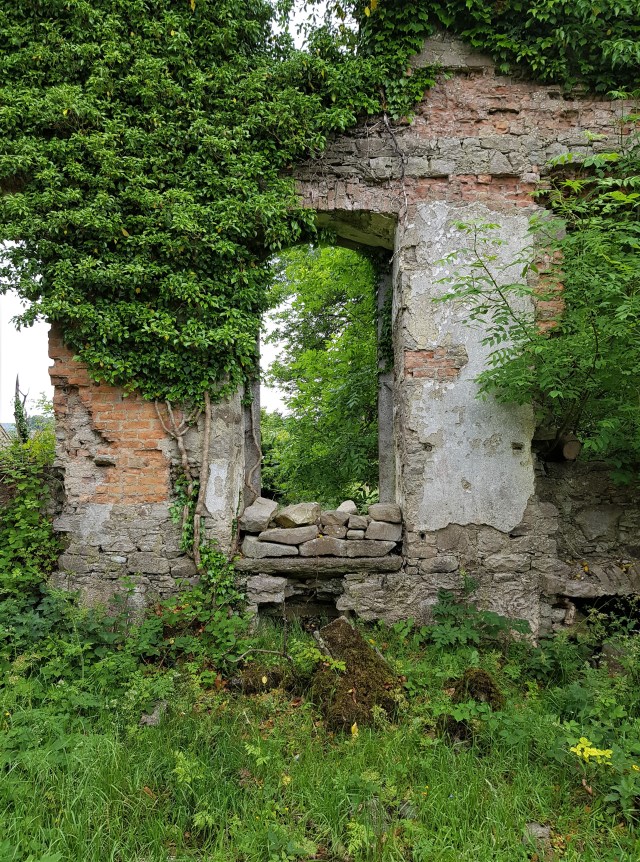
Following the death of his father Denis in 1749, Charles O’Conor moved to the house at Ballinagare and lived there until 1760 when he handed over the property to his eldest son (another Denis). Then he, moved to a smaller residence which he built and called the Hermitage. The latter still stands, albeit in somewhat precarious condition, but the former has fallen into ruin; this likely occurred after 1820 when Charles O’Conor’s grandson, Owen, moved to Clonalis. What remains are the façade and portions of the walls behind; these are believed to incorporate masonry taken from a late-medieval tower house constructed by an earlier generation of O’Conors. Faced in cut limestone, the entrance front is relatively modest, of three bays and one storey over raised basement, with a single storey extension to one side; a pediment incorporating a single arched window rises above the entablature. Dating from the 1720s, the house was intentionally given this diminutive appearance so as not to draw too much attention to its owners but it must have extended in both depth and possibly width to the rear since the number of occupants – members of the O’Conor family and their servants – is known to have been substantial. The entire interior has gone, as has the back wall, making it impossible to judge how the building looked when still occupied. The same is not true of Charles O’Conor’s second residence, the Hermitage which, as mentioned, still stands This modest house, just one room deep, is of two storeys and three bays, with an extension to the rear accommodating the staircase return. An adjacent yard would have held stables and coach house as well as rooms for the servants. Inside, it is still possible to see some of the decoration in both dining and drawing rooms, and entrance hall but the stairs are now too precarious to risk ascent to the first floor. The house was occupied until at least the middle of the last century, but a bungalow was subsequently constructed immediately in front, since when the older building has been used as a storage space, the ground floor windows enlarged to allow vehicular access. Its future must be considered precarious. Charles O’Conor was one of Ireland’s foremost scholars in the 18th century, and through his writings did much to preserve and disseminate evidence of this country’s ancient, and then-imperiled, culture. Almost thirty years ago, Seamus Deane described O’Conor as ‘one of the disregarded but very important figures of Irish history.’ The neglect of the buildings associated with him demonstrates little has changed in the interim.

Another Souvenir


Monday’s post about the former house at Clonalis, County Roscommon included a photograph of the building when still intact. That image showed much of the facade covered in ivy, but another, and clearer, picture has now been found which shows the same view with much less vegetation. What’s especially interesting is that above each of the windows and niches on ground and first floors there was a carved stone mask. Thankfully, some of these were salvaged and are now kept in the new Clonalis but they are a curious feature. The only other example of this kind of external decoration that comes to mind are the masks above the windows on the central section of the entrance front at Gloster, County Offaly, which also dates from the early 18th century. Does anyone know of other instances?


A Souvenir of the Past


Clonalis, County Roscommon must be one of the best-known country houses in Ireland, thanks to its long links with the O’Conors, and specifically with the head of that family, known as the O’Conor Don. In the posthumously published The O’Conors of Connaught: An Historical Memoir (1891), the antiquarian John O’Donovan declared ‘No family in Ireland claims greater antiquity, and no family in Europe, royal or noble, can trace its descent through so many generations of legitimate ancestors.’ The line of their forebears can be followed back to pre-Christian Ireland, and from the 5th century onwards they frequently acted as King of Connacht. Such was the case with Conchobar mac Tadg who ruled during the third quarter of the 10th century and from whom the name O’Conor derives. His descendant Toirdhealbhach Mór Ua Conchobhair (anglicized as Turlough Mór O’Conor) became High King of Ireland around 1120, as did his son Ruaidrí mac Tairrdelbach Ua Conchobair (Rory O’Conor) who was the last man to hold this title before the Anglo-Norman invasion. Following his abdication, he retired to Cong Abbey, County Mayo and remained there until his death. Incidentally, his father Tairrdelbach was responsible for commissioning what is today known as the Cross of Cong, which was originally held in Tuam Cathedral. Members of the O’Conor family continued to act as Kings of Connacht until the late 15th century. Following the 16th century Reformation, the they remained Roman Catholic and, in due course, were loyal to the Stuart cause, with the result that by 1700 they had been stripped of almost all their former land holdings and left near-penniless. In the mid-17th century Daniel O’Conor Don and his wife Anne succeeded in retaining some 440 acres at Clonalis on the western side of the river Suck and their direct descendants remained there until 1820 when the last of them, Alexander O’Conor Don, died unmarried; it appears he spent much of his time at Clonalis living in a modest cottage since his brother, from whom he inherited the place, had left life-use of the house to his widow. Highly – and expensively – litigious, Alexander O’Conor’s various forays into the courts seem to have depleted what funds and lands were then held. Finally in 1820 a distant kinsman, Owen O’Conor was able to secure the estate and the title of O’Conor Don. It is from him that the present owners of Clonalis are descended.


We know little of what the original house at Clonalis looked like: a photograph (see below) shows the appearance of its façade. From this it is apparent the building’s central block was of two storeys over raised basement, and seven bays. There were three-bay wings on either side, each of one storey over basement. Thereafter much becomes a matter of conjecture, but looking inside what remains, the impression is that the first part of the house to be constructed was probably the front portion which stood just one room deep. Such gable-ended ‘long houses’ appear to have been common among old families who wanted to live in reasonable comfort but had limited financial means: the oldest part of Glin Castle, County Limerick is very similar. At some date, perhaps in the second half of the 18th century, an additional series of rooms was added behind the original block and this now backed onto the adjacent yard (which still stands). A central corridor runs like a spine down the centre of the building, separating old and new sections. The wings were added either then or later and presumably in part or whole acted as servants’ quarters. All this work may have been undertaken around the time that Dominick O’Conor Don (elder brother of the litigious Alexander) married Catherine Kelly, co-heiress with her sister to their father’s estate. The money she brought to the union could have paid for the additions to the house, and help to explain why, following her husband’s death, she was left use of it for the rest of her life (she died 19 years after him in 1814).


There were, it appears, always problems with the old building, not least its proximity to the river Suck, which meant that it suffered from damp, especially in winter months when this part of the land was prone to flooding. In 1847, following the death of his father Charles Owen O’Conor inherited the estate at the age of nine; he had been barely two when his mother died. His own health seems to have been delicate, and he spent a number of periods abroad until his marriage in 1868. Four years later, after having four sons, his wife Georgiana Perry died. This series of deaths appear to have been associated with the location of the old house, unhealthily close to the river, and this encouraged Charles Owen O’Conor to think of building an alternative residence on his land. In 1878, a year before his second marriage, he commissioned a design from English architect Frederick Pepys Cockerell and work soon began on a second house, located on a site on higher ground and some further distance away from the Suck. This high-Victorian Italianate building is notable for being one of the first concrete houses constructed in Ireland. Upon its completion, the O’Conors moved from their old home to the new, with the inevitable consequence that the former gradually slid into disuse and disrepair. Fortunately the present O’Conor house, with its many important archives and items telling the story not just of one family but of Ireland, is today wonderfully well-maintained and well-worth a visit.