Look to the Stars


Internationally acclaimed for his work, the astronomer William Edward Wilson was born in 1851 in Belfast, where his grandfather, also called William, had made a fortune in the shipping business. As a result, William senior bought each of his four sons an estate, that given to William junior’s father, John Wilson, being Daramona, County Westmeath. The younger William, not enjoying good health as a child, was educated at home but when he was 19 the opportunity arose to join an expedition travelling to Algeria to witness a total solar eclipse. This inspired his interest in astronomy and in due course he acquired his first telescope. When aged thirty, he constructed his own observatory at Daramona, on a site immediately adjacent to the house. Here he worked for the rest of his life, until his early death in 1908. Among the scientific breakthroughs with which he is credited are the production of the first photo-electric measurements of the brightness of stars and the first accurate determination of the temperature of the solar photosphere. He was also responsible for making a series of outstanding celestial photographs. As a result of his work, he was elected a Fellow of the Royal Society in 1896 and awarded an honorary Doctor of Science degree by Trinity College Dublin in 1901.


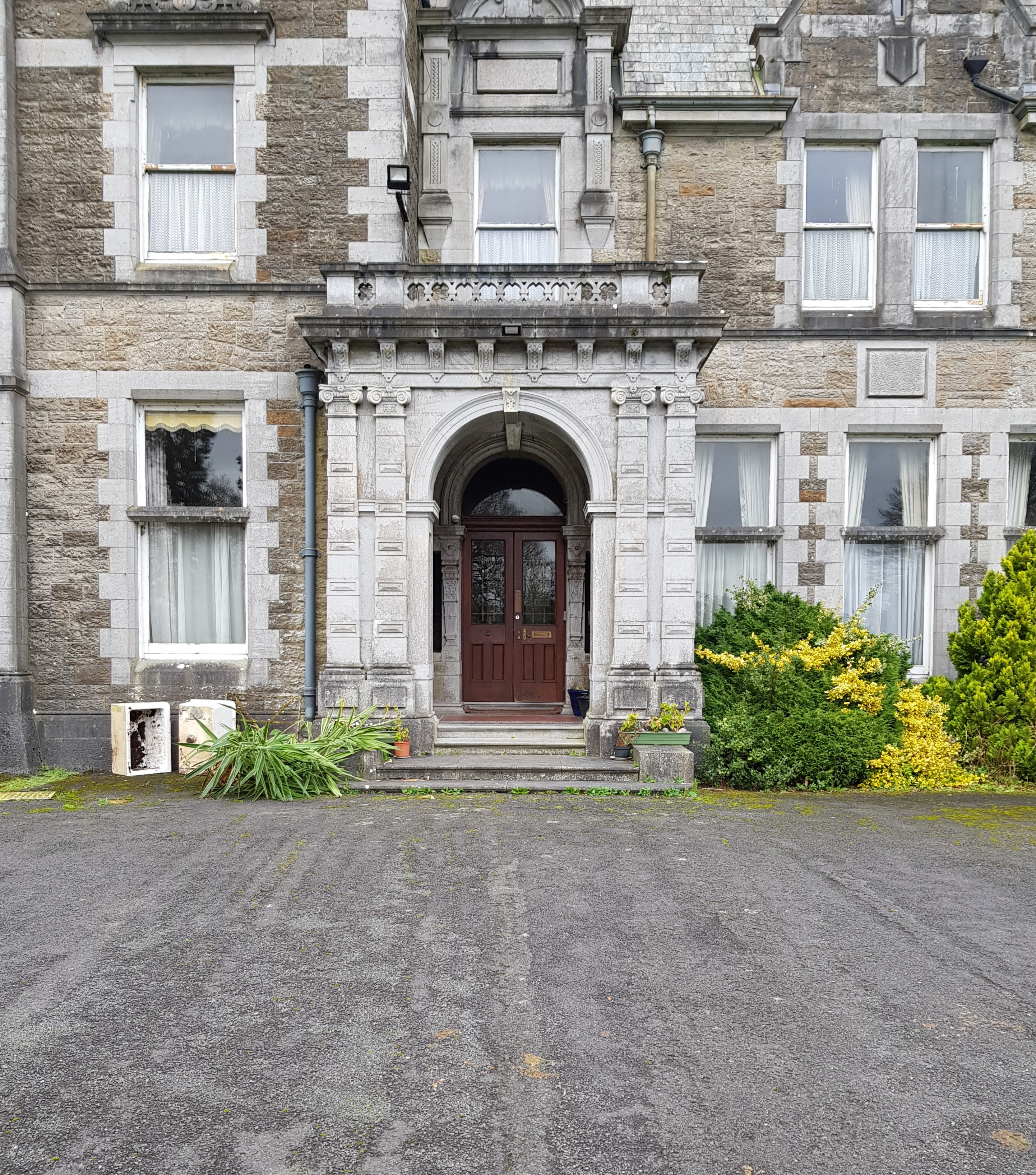
Daramona is a mid-19th century, three-bay, two-storey Italianate villa probably built by John Wilson soon after the birth of his son, the future astronomer. There was an older house immediately behind the present one, but it has long since been demolished; it is suggested that the somewhat over-scaled limestone Doric entrance porch was recycled from the previous building. The doorcase behind has a particularly wide fanlight and sidelights. The interior is typical of the period, the most interesting space being the very substantial library, the largest room on the ground floor, which has timber panelled walls and, above the chimneypiece, a panel bearing the family coat of arms. Immediately behind the house, on the site of the earlier house, are two long service wings. Wilson’s two-storey observatory, completed around 1892 and originally domed, stands left of the rear of the house. Beyond it is a curtain wall topped with a balustrade and incorporating a pedimented doorcase leading providing access to the rear avenue.


Not long after Edward Wilson’s death in 1908, his widow and children moved first to County Cavan and then, following the outbreak of troubles in the 1920s, to England. His telescope was offered to the University of London where it remained until 1974; it is now in Liverpool’s Merseyside County Museum. Much of his original instrumentation when to Trinity College Dublin. Meanwhile, Daramona was sold to another family who lived in and maintained the property until it was put on the market in 2000. House and land were then bought by a local building firm which applied to construct 38 houses on the site. Thanks to a campaign by scientists in Ireland and around the world, this application was refused by the county council which in due course conferred protected structure status on the main building, ancillary outhouses, demesne wall and gates. Since then it would appear nothing has been done, so that today Daramona is fast falling into decay and – once more – taking with it part of the national history. Looking for a solution to this problem? One might as well follow William Wilson’s example, and look to the stars.


Whim in All His Improvements


On August 25th 1732, the future Mrs Delany (then the merrily widowed Mrs Pendarves) embarked on a journey from Navan, County Meath to Cootehill, County Cavan. She wrote in her journal, ‘travelled through bad roads and a dull, uninhabited country, till we came to Cabaragh, Mr Prat’s house, an old castle modernized, and made very pretty: the master of it is a virtuoso, and discovers whim in all his improvements. The house stands on the side of a high hill; has some tall old trees about it; the gardens are small but neat; there are two little terrace walks, and down in a hollow is a little commodious lodge where Mr Prat lived whilst his house was repairing. But the thing that most pleased me, was a rivulet that tumbles down from rocks in a little glen, full of shrub-wood and trees; here a fine spring joisns the river, of the sweetest water in the world.’


The ‘Mr Prat’ to whom Mrs Pendarves refers was Mervyn Pratt, a sometime Member of the Irish Parliament representing County Cavan. His father, Joseph Pratt, had been one of two brothers who moved from Leicestershire to Ireland in the mid-17th century, both of them settling in County Meath. However, Joseph made an advantageous marriage to Elizabeth, only daughter and heiress of Col. Thomas Cooch (or Couch) who owned estates in Counties Donegal and Cavan. When he died in 1699, he left his property in the latter county to his grandson Mervyn Pratt, then aged 12. The heir duly settled on his inheritance and married Elizabeth, daughter of a neighbour, the Hon. Thomas Coote of Bellamont, County Cavan. At Cabra (spelled ‘Cabaragh’ by Mrs Pendarves), the couple’s home was an old castle, built at the start of the 17th century by Gerald Fleming (who had in turn been granted territory previously held by a branch of the O’Reilly family). This was the building which was ‘modernized and made very pretty.’


Today the castle at Cabra is just one of a number of buildings constructed or improved by Mervyn Pratt. A walk through the site today leads first to his former stable block (see first set of pictures), popularly known as the Barracks. A long, two-storey gabled block the east side features a series of lunettes resting on a string-course; most of these have been blocked up but two are open as part of doorcases into the building. Nothing remains of the interior. To the west and on higher ground are the remains of the extended old castle, primarily consisting of two four-storey towers, that to the south likely the original Fleming residence. Again, almost nothing survives of the interior, but somehow in the newer block there remains intact one plastered niche, as well as evidence of an adjacent cantilevered staircase. From this high spot, the land begins to drop and, past a typical domed and recessed icehouse, the path leads down to a lake beside which stands what’s left of the ‘little commodious lodge’ where Mervyn Pratt lived while the castle was being restored and enlarged. It has been proposed by Kevin Mulligan that this building (as well as the stables) were designed by Sir Edward Lovett Pearce and originally featured a broad pedimented façade inspired, via the work of Lord Burlington, by Palladio’s Villa Valmarana at Vigardolo. As elsewhere, not a lot remains and indeed at least half of the building no longer stands; the central portion has lost its pediment and, given a flat, utilitarian roof, is now used as a store shed. But at least here, enough does survive for the original concept to be apparent.


The Pratts remained in possession, but perhaps not in residence at Cabra for the rest of the 18th century; in his Statistical Survey of the County of Cavan (1802) Sir Charles Coote while enthusiastic about the improvements undertaken by Mervyn Pratt and his successors in the local town of Kingscourt, was much less engaged with the demesne and buildings at Cabra. ‘The ruins of the old castle,’ he wrote, ‘which was the family mansion, are contiguous to the house, but quite too near to have any pleasing effect, which such pieces of antiquity afford in the landscape.’ Sir Charles was far more enthusiastic about the landscape and house at nearby Cormy (‘very beautiful, and formed with great judgement and true economy’) owned by Henry Foster who was then undertaking to transform a standard Georgian house into a romantic Gothic castle. However, before this work was finished, Cormy was sold to Colonel Joseph Pratt who abandoned the old family old home and renamed the new one Cabra Castle. This remained in the ownership of his descendants until 1964 and has since been used as an hotel. Meanwhile the older Cabra estate fell into neglect until acquired by the national Forest and Wildlife Service in 1959. Today it is run by Coillte (the state forestry body) and open to the public as Dún a Rí forest park.

A Very Sumptuous Establishment


A PhD thesis presented by Michael Ahern in 2003 (and subsequently published) explores the history of the Society of Friends, otherwise known as Quakers, in County Tipperary from the mid-17th to early 20th centuries. In the text, Dr Ahern notes how, ‘One of the most remarkable achievements of this persecuted minority, consisting of farmers, tradesmen and small business people, was the manner in which they triumphed over adversity and, in the course of time, became successful and prosperous members of the middle class. Participation in the affairs of their own Society provided a sound training which enabled members to cope with the business procedures of the secular world. Although the administrative meetings of the Society generally related to religious concerns, a large proportion of their activities was strictly practical in content and created an environment which cultivated business and administrative expertise.’ During the second half of the 18th century, one of the businesses in which they came to have a powerful presence was milling. Certain urban centres likewise became centres for this activity, among them Clonmel, County Tipperary.’ Legislation passed by the Irish parliament in 1757 offered financial incentives for the land carriage of corn to Dublin; for every five hundred-weight of flour brought to market, a premium of three pence per mile (excluding the first 10 miles) was paid. The result was an explosion in both the production of wheat and corn, and the establishment of mills, especially in areas like Clonmel, which benefitted from fast-moving water (in this case, the river Suir). Anner Mill, the first such Quaker operation, was opened here in 1771 by John Grubb, whose family would become synonymous with the industry. Many more followed, so that in 1797 when legislation was proposed to abolish financial incentives, the business was sufficiently well-established as to be in no need of subsidy: ‘The principal millers in the neighbourhood of Clonmell,’ declared John FitzGibbon, Lord Clare, ‘a part of the kingdom from which there is a considerable influx of corn to the city, do not complain of the bill; on the contrary many have declared that they will not suffer any loss from it.’


Of English origin, the Sparrow family had settled in Ireland in the mid-17th century and soon converted to the Quaker faith. They were based in the Wexford region where one of them, Samuel Sparrow, participated in the 1798 Rebellion and then fled to the United States, were he remained for the rest of his life. Long before then, at some date during the first decades of the 18th century, Richard Sparrow moved from Wexford to Clonmel where he established himself as a baker. His son, Simmons Sparrow, was more ambitious and, like many other members of his church, became involved in the area’s burgeoning milling industry. In 1778 he opened a large mill on the north side of Suir Island, which looked across to Clonmel’s quays and which could take advantage of the river’s fast-moving water. This building continued in operation until 1801 when it was destroyed by fire; eight years later the site was sold by the Sparrows to another Quaker, Thomas Hughes. In the meantime, Simmons Sparrow opened another mill to the immediate west of the town at Toberaheena while for a period in the mid-1790s his son Richard leased another two mills still further west along the Suir. Following Simmons Sparrow’s death the business was continued by Richard but he seems to have lived beyond his means and eventually lost everything, dying in Clapham, outside London in 1814 after which his estate in Tipperary was auctioned to pay the deceased’s debts.


In 1798, the American Quaker preacher and abolitionist William Savery visited this country and noted with dismay that ‘Friends in Ireland seemed to live like princes of the earth, more than in any country I have seen – their gardens, horses, carriages, and various conveniences, with the abundance of their tables, appeared to me to call for much more gratitude and humility, than in some instances, it is feared is the case’. While in Clonmel, where he stayed with the successful miller (and Quaker) Sarah Grubb, Savery visited the home of Richard Sparrow, judging it to be ‘a very sumptuous establishment indeed, which I did not omit to tell him was quite too much so’, his stables being fit for a nobleman. The house in question was Oaklands, seen in today’s photographs. Little information exists about the building, the fine entrance to which was shown here last Saturday. Of three storeys over basement, it has four bays, with a central breakfront accommodating two and a plain limestone portico supported by paired Doric columns, behind which was a doorcase with fan- and substantial sidelights. The garden front featured a substantial canted bow and a flight of cast-iron steps giving access to one of the reception rooms. This was one of four such spaces on the ground floor of the ‘sumptuous’ interior, of which little now remains. Following Richard Sparrow’s financial collapse, Oaklands passed to the Rialls, another Quaker family involved in banking. However, within a few years their own fortunes suffered a setback when the bank, like many other such private establishments in the aftermath of the Napoleonic Wars, failed and was forced to close in 1820 (its premises, for a long time part of the Clonmel Arms Hotel, have stood vacant and awaiting redevelopment for some time). In due course they were followed by Colonel Pownoll Phipps, a fascinating character who – for reasons too complicated to explain here – had as a teenage boy found himself stranded with is siblings, but without their parents, in Revolutionary France, and had then gone on to serve in the British army in India under the future Duke of Wellington; he died at Oaklands in 1858 and the estate was, at least for a while, owned by his eldest son. It then passed through a succession of different hands, and was still occupied, but in poor condition, fifteen years ago, later standing empty. The inevitable consequence of this was that the house attracted the attention of vandals and finally was gutted by fire in October 2017, leaving it in the state seen today.

Leading to Ruin


The main entrance to Oaklands, County Tipperary, a house built in the late 18th century. Centred on fine rusticated limestone gateposts, the walls curve outward to a pair of lodges. That on the right retains what is likely to have been the original form of both, single storey with a pedimented façade featuring windows on either side of a doorcase slightly recessed inside an arch. At some date the lodge on the left was enlarged, and given a hodge-podge of decorative details including Doric pilasters and Tudoresque mouldings above the windows. All now derelict, like the house to which these gates once gave access.


More on Oaklands next Monday.

On the Ball II


Today surrounded by architecturally inconsequential housing estates, this is Ballsgrove, built on raised ground overlooking Drogheda, County Louth. It was built as a country villa by George Ball, member of a family which had been prominent merchants and citizens of the town since the 14th century, although they also owned an estate called Ballygall near Glasnevin, Dublin. This was sold by George Ball in 1725, the proceeds seemingly being used to pay for the construction of Ballsgrove. Facing west, the house is of five bays and two storeys over raised basement. At some date in the 19th century the rear was given single-storey canted bays. These have castellations, as does the the little octagonal pavilion built on the south-east corner seen below.

Saviour Sought


Fruit Hill, Co Wexford recently featured here (see https://theirishaesthete.com/2020/03/07/a-labour-of-love), a sensitively restored house believed to date from the second quarter of the 18th century and notable for being U-shaped with two wings projecting behind the one-room-deep residence with only a narrow passage between them. A similar house stands, just about, in neighbouring County Carlow and is called Mount Pleasant. Mark Bence-Jones’ Guide to Irish Country Houses includes four properties of the same name, but this is none of them. Indeed, little documentation exists about the Carlow house and some of it is erroneous.


Mount Pleasant was built and occupied by the Garrett family. The first of them, James Garrett was the son of a Captain John Garrett, one of five brothers who came to Ireland in the 17th century around the time of the Cromwellian Wars and, like many others, was rewarded for his efforts with a grant of land in County Laois. James Garrett on the other hand settled in Carlow around 1700 when in his mid-20s. He may have been responsible for building a house called Janeville, or it could have been his son whose tomb in the local church refers to ‘the charitable Thomas Garrett of Janeville deceased, Aug.31st, 1759, aged 48 years.’ The same church also contains a monument to another Garrett, the inscription of which runs as follows: ‘Here lie deposited in humble hope of a joyful resurrection the mortal remains of James Garrett, late of Mountpleasant, Esq. – Vain would prove an attempt at panegyric; since no eulogy could do justice to his merits. Reader, wouldst thou be had in everlasting remembrance? Endeavour to emulate his virtues. He departed this life July the 17th, 1818. Aged 72 years.’ Because James Garrett might have been the son of Thomas Garrett, it has often been assumed that the latter’s house, Janeville, was renamed Mount Pleasant by the former, and that they lived in the same property. In fact, this is not the case as Janeville and Mount Pleasant – which is seen in today’s pictures – are different houses, albeit in the same part of the county.


Some four miles apart, Janeville and Mount Pleasant were both once Garrett houses and dated from the early years of the 18th century, but while the first of these is still intact, the second, as can be seen, has fallen into ruin. Stylistically they share similarities, both having five bay facades centred on a granite doorcase with sidelights. Both are also of three storeys, although only two are visible from the front of Janeville which as a delightful Venetian window on the first floor above the entrance. The attic windows can be seen on the double-gabled side elevations. Mount Pleasant, on the other hand, features attic windows on its façade, with a tiny Diocletian window in the centre. And the rear of the building is like that of Fruit Hill, County Wexford, with wings creating a U-shaped house. At Mount Pleasant, the centre of the back evidently had a Gothic arched window, now blocked and the entire west wing was, at some unknown date, allowed to fall into dereliction, the owners only occupying the eastern side of the building. It was sold a couple of years ago, but no work has been done on the property and so the decline continues. However, as Fruit Hill shows, no house is ever beyond redemption; perhaps this one may yet find a saviour.


A Labour of Love


When the present owners bought Fruit Hill, County Wexford some 25 years ago, the house was a roofless shell, having been allowed to fall into dereliction for much of the last century. Long associated with the Glascott family and believed to date from the second quarter of the 18th century, the building is wonderfully idiosyncratic in appearance, from the façade’s pediment containing a Venetian window and flanked by dormer windows, to the ground floor where the fenestration was lowered on one side (the drawing room) but not the other (dining room). The gable-ended main block, its upper portion still carrying evidence of having been weather-slated, is only one room deep but extended at the rear by two wings to form a U-shaped house. The owners have not so much restored Fruit Hill as brought it back from near-death, a task few others would have been sufficiently brave to take on, since little more than the walls – and not even all of those – remained on the site. Their work here is an admirable labour of love and testimony to the fact that no building should be deemed beyond rescue.


Dancing on the Ceiling


As David Skinner explains in his 2014 monograph on Wallpaper in Ireland, in the early 19th century some French manufacturers began to produce narrative papers, each one different and intended to be hung in sequence so as to tell a story. These ‘papiers-peints paysages’ as they were called, became popular throughour Europe and North America, and a number of them were hung in Irish houses. One particular monochrome set, telling the ancient myth of Cupid and Psyche was first created in 1816 by Joseph Dufour of Paris, based on a series of pictures specially produced by two neo-classical artists of the time, Louis Lafitte and Merry-Joseph Blondel. At least three Cupid and Psyche sets could once be found here but two of the houses where they were installed, Kinlough, County Leitrim and Piltown, County Louth, are now ruins (for the latter, see https://theirishaesthete.com/2017/03/13/pourquoi-me-reveiller). The third set remains in situ in the library/ballroom of Stradbally Hall, County Laois where in the 1860s it was placed not on the walls but rather unusually in sequence around the outer perimeter of the ceiling.

Suffering Neglect


As has been discussed here before, Townley Hall, County Louth is one of Ireland’s most perfect neo-classical buildings (see: https://theirishaesthete.com/2013/06/10/la-tout-nest-quordre-et-beaute). The house was designed in the mid-1790s by Francis Johnston, who until then had been employed primarily by Richard Robinson, Archbishop of Armagh, often to complete commissions left unfinished following the early death of Thomas Cooley in 1784. Townley Hall is his first independent piece of work although here again the client’s involvement was critical since it is known that Blayney Townley Balfour, who owned the property, and his sister Anna Maria were intimately involved in every stage of the design.


Johnston was invited to design not just Townley Hall itself but also a number of ancillary buildings, including a new stableyard. His plans for this survive and are dated between 1799 (work being initiated on the site in May of that year) and 1804. The intention was to build around a rectangular courtyard with coach house and grainstore topped by a cupola on the north side, and stables coming forward to its immediate east and west. The south side was to be taken up by screen wall with arched entrance. Sadly this scheme was never realized, possibly for financial reasons (like many other house builders before and since, Blayney Townley Balfour discovered the initial budget was insufficient). Instead, while the northern range was constructed, it lacked the proposed cupola, and only the western range of stables were finished; a terrace of single-storey cottages runs along the eastern side of the site. Likewise the south wall with entrance arch was left unbuilt, and even a modified plan for railings with piers went unrealized. A drawing of the plan survives a penciled note reading ‘not built yet – 1837 FTB’, those initials standing for Lady Florence Townley Balfour (daughter of the first Earl of Enniskillen) who had married Blayney Townley Balfour in 1797.


As is well known, Townley Hall was sold by the heirs of the Townley Balfour family in the 1950s and, having been owned for a short period of time by Trinity College Dublin, was sold again with the Land Commission taking the greater part of the surrounding estate. Many of the ancillary buildings are no longer part of Townley Hall, including the former stableyard. Almost every other part of the former estate has been restored and brought into use, but sadly this element, which is, it seems, independently owned, has languished in neglect for a number of years, and is now in poor repair. Even if not as originally intended by Johnston, the yard remains associated with what is widely judged to be his masterpiece, and accordingly deserves a better fate.

Something for Everyone


The Taylour family has appeared here before, in connection with Headfort, County Meath (see https://theirishaesthete.com/2016/02/22/a-unique-legacy). Dating from the 1760s, that house was built for Thomas Taylor, first Earl of Bective (incidentally, it was his son, the first Marquess of Headfort who assumed the new surname of Taylour). One of Lord Bective’s younger sons was the Hon Robert Taylor (b.1760) who in 1783 entered the British army as a cornet in the 5th Dragoons. Thereafter his rise through the ranks was steady and by 1796, having spent time in Flanders and Germany during the French Revolutionary Wars, he was a Colonel. He was here during the Irish Rebellion of 1798 when promoted to the rank of Brigadier-General and serving as second-in-command to General Lake at the Battle of Ballinamuck in September of that year when the French General and his forces were defeated, thus marking the end of the rising. Taylor continued his career in the army for two more decades, finally being brevetted a full general in 1819. Around this time, or soon after, he acquired a small estate in his native Meath called Dowdstown.


Situated not far from the Hill of Tara, the name Dowdstown presumably derives from the Dowdall family which came to own this property in the 16th century; previously it had been a grange for the Cistercian St Mary’s Abbey in Dublin. At the end of the 17th century it came to be owned by the Rochforts. When General Taylor bought the place, there may have been some kind of dwelling there already, but surviving drawings in the Irish Architectural Archive by James Shiel dated 1820 and 1834 show that improvements were carried out on the site during this period for its new owner (the archive also holds unexecuted drawings for Dowdstown by Birmingham architect Joseph Bateman from 1831). Parts of this building probably survive in the two-storey block to the north of the present main house at Dowdstown, but the residence was likely to have been quite modest. In his Topographical Dictionary of Ireland (1837) Samuel Lewis notes that ‘the Hon. Gen. Taylor has a seat in the cottage style in a demesne of about 590 acres, of which about 240 are plantations.’ These extensive plantations of trees, long since cut down, gave rise to a notion that General Taylor had been a participant at the Battle of Waterloo and then laid out his grounds to imitate how different regiments were placed on that occasion, with taller trees represented officers. In fact, the roll call of participants at Waterloo does not include Taylor’s name, and as a general he would have been a prominent figure on that occasion. Nor is it mentioned in any of his obituary notices, an extraordinary omission had he been present.


A bachelor, General Taylor died in April 1839, leaving Dowdstown to a nephew, Thomas Edward Taylour whose branch of the family lived at Ardgillan Castle (originally called Prospect House) in County Dublin. It appears that when his mother died twenty years later, Thomas and his younger brother Richard Chambre Hayes Taylor who had inherited Ardgillan swapped properties. Accordingly the Dowdstown estate now passed into the possession of Richard Taylor who, like his uncle before him, was a professional soldier, having entered the British army in 1835 at the age of 16. He subsequently saw service in India on a couple of occasions (being there during the Indian Mutiny of 1857 and involved in the Capture of Lucknow), and took part in the Crimean War. Like his uncle he eventually rose to the rank of General and was knighted two years before his death in 1904.
In 1863 he married Lady Jane Hay, a daughter of the eighth Marquess of Tweeddale, and it was no doubt as a result of this union that the ‘cottage style’ property he had inherited at Dowdstown was deemed insufficient. One of the period’s most popular architectural practices, Lanyon, Lynn & Lanyon, was requested to enlarge the place, possibly with the assistance of another Ulster architect Samuel Patrick Close who worked with the firm on many occasions. As today’s pictures show, Dowdstown might be described as offering something for everyone, since it displays a fantastical array of styles both inside and out. The south-facing façade, for example, is somewhat French in flavour, thanks to a turreted corner with conical slate roof and a large central bow projection. The west-facing entrance front on the other hand, looks more Jacobethan in inspiration, with a four-storey belvedere-topped tower to the immediate left of the main door which has a heavily ornamented porch. The interiors are equally eclectic but the most heavily decorated areas are the drawing room and adjacent staircase hall, each visible to the other thanks to a screen of coloured glass between them, the whole divided into sections by heavy banded pilasters with richly carved capitals; they imitate those in stone on the porch.
It’s open to question how much time the Taylors ever spent living at Dowdstown. For a number of years in the 1880s the General was Governor of the Royal Military College at Sandhurst and seems to have settled in England following his retirement, dying in Surrey in 1904. Dowdstown seems to have been rented out for long periods before finally being sold in 1926 to a religious order, the Columban Fathers who initially used it as their own residence before finding other purposes for the building. Since such is no longer the case, the order is now offering Dowdstown for sale.